Exodus 8:1
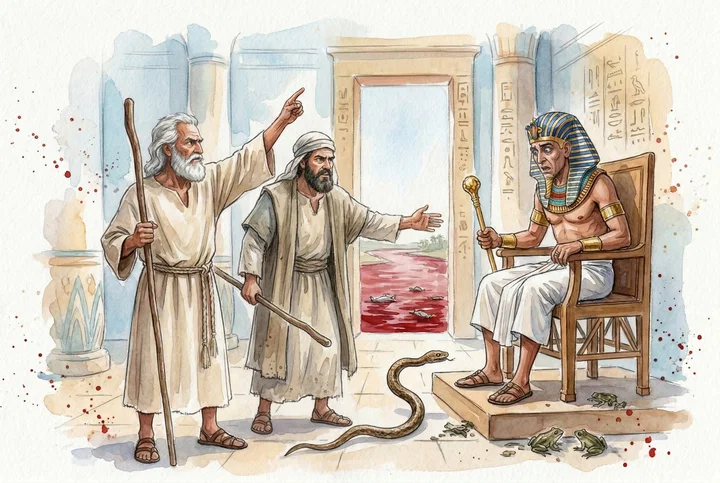
And the LORD spake unto Moses, Go unto Pharaoh, and say unto him, Thus saith the LORD, Let my people go, that they may serve me.
Translations
And the LORD spoke to Moses, Go to Pharaoh, and say to him, Thus says the LORD, Let my people go, that they may serve me.
And the LORD spake unto Moses, Go unto Pharaoh, and say unto him, Thus saith the LORD, Let my people go, that they may serve me.
And the Lord spake unto Moses, Go unto Pharaoh, and say unto him, Thus saith the Lord, Let my people go, that they may serve me.
And the LORD spoke to Moses, Go to Pharaoh, and say to him, Thus saith the LORD, Let my people go that they may serve me.
And the LORD spake unto Moses, Go in unto Pharaoh, and say unto him, Thus saith the LORD, Let my people go, that they may serve me.
And Jehovah spake unto Moses, Go in unto Pharaoh, and say unto him, Thus saith Jehovah, Let my people go, that they may serve me.
And Jehovah saith unto Moses, 'Go in unto Pharaoh: and thou hast said unto him, Thus said Jehovah, Send My people away, and they serve Me;
And Jehovah said to Moses, Go unto Pharaoh, and say unto him, Thus saith Jehovah: Let my people go, that they may serve me.
Then said Yahweh unto Moses, Go in unto Pharaoh,—then shalt thou say unto him—Thus, saith Yahweh,—Let my people go, that they may serve me.
Berean Standard Bible, Majority Standard Bible
Then the LORD said to Moses, “ Go to Pharaoh and tell him that this is what the LORD says: ‘ Let My people go, so that they may worship Me.
The LORD spoke to Moses, “ Go in to Pharaoh, and tell him, ‘ This is what the LORD says, “ Let my people go, that they may serve me.
And this is what the Lord said to Moses: Go to Pharaoh and say to him, The Lord says, Let my people go so that they may give me worship.
Afterward the Lord sayde vnto Moses, Goe vnto Pharaoh, and tell him, Thus saith the Lord, Let my people goe, that they may serue me:
Douay-Rheims (Challoner revision)
And the Lord said to Moses: Go in to Pharao, and thou shalt say to him: Thus saith the Lord: Let my people go to sacrifice to me.
Pictures
Cross-references 20 of 30
- Exodus 5:1
And afterward Moses and Aaron went in, and told Pharaoh, Thus saith the LORD God of Israel, Let my people go, that they may hold a feast unto me in the wilderness.
same demand to release Israel for wilderness service
- Exodus 4:23
And I say unto thee, Let my son go, that he may serve me: and if thou refuse to let him go, behold, I will slay thy son, even thy firstborn.
Repeats the command to Pharaoh to release Israel to serve God.
- Exodus 8:8
Then Pharaoh called for Moses and Aaron, and said, Intreat the LORD, that he may take away the frogs from me, and from my people; and I will let the people go, that they may do sacrifice unto the LORD.
Pharaoh promises to let Israel go for sacrifice if the frogs are taken away.
- Psalms 105:43-45
And he brought forth his people with joy, and his chosen with gladness:
Israel was freed so they could keep God’s statutes and laws.
- Exodus 3:10
Come now therefore, and I will send thee unto Pharaoh, that thou mayest bring forth my people the children of Israel out of Egypt.
God commissions Moses to bring Israel out of Egypt to worship him.
- Exodus 5:2
And Pharaoh said, Who is the LORD, that I should obey his voice to let Israel go? I know not the LORD, neither will I let Israel go.
Pharaoh refuses the demand to let Israel go.
- Exodus 10:3
And Moses and Aaron came in unto Pharaoh, and said unto him, Thus saith the LORD God of the Hebrews, How long wilt thou refuse to humble thyself before me? let my people go, that they may serve me.
The LORD again commands Pharaoh to release Israel so they may serve him.
- Exodus 7:20-22
And Moses and Aaron did so, as the LORD commanded; and he lifted up the rod, and smote the waters that were in the river, in the sight of Pharaoh, and in the sight of his servants; and all the waters that were in the river were turned to blood.
The blood sign demonstrates divine power as God demands Pharaoh let his people go.
- Exodus 8:20-23
And the LORD said unto Moses, Rise up early in the morning, and stand before Pharaoh; lo, he cometh forth to the water; and say unto him, Thus saith the LORD, Let my people go, that they may serve me.
The warning of flies and the distinction between Egypt and Goshen are fulfilled.
- Exodus 20:2
I am the LORD thy God, which have brought thee out of the land of Egypt, out of the house of bondage.
God identifies himself as Israel’s deliverer from bondage, calling them to serve him.
- Deuteronomy 5:15
And remember that thou wast a servant in the land of Egypt, and that the LORD thy God brought thee out thence through a mighty hand and by a stretched out arm: therefore the LORD thy God commanded thee to keep the sabbath day.
Israel’s deliverance from Egypt is given as a reason to keep the Sabbath.
- Exodus 14:21-31
And Moses stretched out his hand over the sea; and the LORD caused the sea to go back by a strong east wind all that night, and made the sea dry land, and the waters were divided.
The Red Sea crossing delivers Israel from Egypt and destroys Pharaoh’s pursuing forces.
- Exodus 9:3-7
Behold, the hand of the LORD is upon thy cattle which is in the field, upon the horses, upon the asses, upon the camels, upon the oxen, and upon the sheep: there shall be a very grievous murrain.
The cattle plague struck Egypt’s system of animal worship.
- Exodus 6:6
Wherefore say unto the children of Israel, I am the LORD, and I will bring you out from under the burdens of the Egyptians, and I will rid you out of their bondage, and I will redeem you with a stretched out arm, and with great judgments:
God promises to free Israel from Egyptian bondage.
- Exodus 10:27
But the LORD hardened Pharaoh’s heart, and he would not let them go.
Pharaoh’s hardened heart explains why he would not let Israel go.
- Leviticus 25:55
For unto me the children of Israel are servants; they are my servants whom I brought forth out of the land of Egypt: I am the LORD your God.
Israel belongs to the Lord as his servants because he brought them out of Egypt.
- Exodus 4:21
And the LORD said unto Moses, When thou goest to return into Egypt, see that thou do all those wonders before Pharaoh, which I have put in thine hand: but I will harden his heart, that he shall not let the people go.
foretells hardening fulfilled only later
- Joshua 24:14-15
Now therefore fear the LORD, and serve him in sincerity and in truth: and put away the gods which your fathers served on the other side of the flood, and in Egypt; and serve ye the LORD.
Both call Israel to serve the Lord.
- Exodus 1:13-14
And the Egyptians made the children of Israel to serve with rigour:
God calls Israel from cruel Egyptian service to serve him.
- Revelation 18:4
And I heard another voice from heaven, saying, Come out of her, my people, that ye be not partakers of her sins, and that ye receive not of her plagues.
latter-rain Come out repeats Exodus call
Commentary
Each commentary is drawn from primary sources: the writings of Ellen G. White and Adventist pioneers and periodicals. Each commentary is separate. Its own words are not a quotation; follow the references to read the source passages.
Ellen G. White
10 sources
The command was repeated again and again, with Moses and Aaron meeting Pharaoh in the morning as he stood on the bank of the river, speaking in the name of the great I AM and demanding that he release Israel from Egyptian bondage to serve and sacrifice to God.1SP 186.1–3SG3 207.2–208.2ST Mar 11, 1880PP 265.2–266.1SG4 237.3–239.1 The release was to separate Israel from the world and prepare them to receive God's word.Ms 160, 1899, par. 1–2 It was to bring them out of Egypt to free them from idolatry and put them in the service of God.Ms 160, 1899, par. 1–21SP 180.3–181.1
Israel had been long in servitude and had grown from a few families to a large multitude while surrounded by influences calculated to make them forget the living God who made heaven and earth.1SP 180.3–181.1 Many had lost the knowledge of the true God and forgotten His law, joining with the Egyptians in worship of the sun, moon, and stars and of beasts and images of wood and stone.1SP 180.3–181.1 Children daily witnessed those abominations and engaged in them, offering sacrifice to senseless objects.1SP 180.3–181.1 A faithful remnant preserved the knowledge of God, grieved over the corruption, and cried to the Lord for deliverance from the yoke to be rid of idolatry and its corrupting influences.1SP 180.3–181.1 Many others were corrupted and content to remain in bondage rather than face the difficulties of going to a new country, so God did not deliver them by the first display of signs and wonders but overruled events to develop Pharaoh's tyrannical spirit more fully and to manifest His great power before Egyptians and Israel, to make His people anxious to leave Egypt and choose the service of God.1SP 180.3–181.1
Refusal of the demand was warned to bring frogs over all the borders of Egypt, enforced by stretching the rod over the waters.1SP 186.1–3SG3 207.2–208.2PP 265.2–266.1 This followed the earlier signs of the rod becoming a serpent and the waters turned to blood, so that the fish died and the water stank and the Egyptians had to dig wells for water through seven days.ST Mar 11, 1880SG3 242.3 The frogs came up from the river and spread over the land into houses and bedchambers and ovens and kneading-troughs, even swarming in the palaces.ST Mar 11, 1880PP 265.2–266.1 Though the frog was sacred and the Egyptians would not destroy it, the pests became intolerable.PP 265.2–266.1
The demand and the plagues came by the power of the living God, not by magic or any human power of Moses and Aaron and not by human influence.1SP 186.1–3SG3 207.2–208.2SG4 237.3–239.1 Signs and wonders were wrought to convince Pharaoh that God had sent them, to begin teaching Pharaoh who had professed to be wholly ignorant of God to know Him and that there is none like the Lord God.1SP 186.1–3SG3 207.2–208.2SG4 237.3–239.1 They asserted Jehovah's supremacy and exposed the powerlessness of Egypt's idols.1SP 186.1–3SG3 207.2–208.2PP 758.3–760.1 Satan, unwilling for Israel to be released to serve God, worked through Pharaoh's magicians to counterfeit God's true work by enchantments.SG4 237.3–239.1 They changed well water to blood and appeared to bring up frogs, to destroy the influence of God's work, to harden Pharaoh against God's manifestations, to increase his hatred of Israel, and to stagger the faith of Moses and Aaron.ST Mar 11, 1880SG3 242.3SG4 237.3–239.1 This led Pharaoh to think the miracles were magic and to harden his heart.ST Mar 11, 1880SG3 242.3 But God's work proved superior and set limits Satan could not pass, since the magicians could bring up frogs but could not stay or remove the plague, exposing the emptiness of Pharaoh's boasting over them.1SP 186.1–3SG3 207.2–208.2ST Mar 11, 1880PP 265.2–266.1SG4 237.3–239.1
Pharaoh was humbled to ask Moses and Aaron to entreat the Lord to take the frogs away, promising to let the people go to sacrifice.1SP 186.1–3SG3 207.2–208.2PP 265.2–266.1 When asked to appoint the time he set tomorrow, the next day, secretly hoping the frogs would disappear of themselves and save him the humiliation of submitting to the God of Israel.SG3 207.2–208.2ST Mar 11, 1880PP 265.2–266.1 But the plague continued until the appointed time so he might know there is none like the Lord God.1SP 186.1–3SG3 207.2–208.2PP 265.2–266.1 At the appointed hour the living frogs were taken away while the dead remained where they died and were gathered into heaps that polluted the atmosphere with sight and smell.ST Mar 11, 1880PP 265.2–266.11SP 216.1SG3 242.3 God could have caused them to return to dust in a moment but deliberately left them dead in heaps so the king and people could not call the removal sorcery or enchantment like the magicians' work and vain philosophy could not explain it away, giving undeniable evidence that the work was not magic but a judgment from the God of heaven.ST Mar 11, 1880PP 265.2–266.11SP 216.1SG3 242.3 Moses breaking the yoke of bondage to free Israel prefigured the first advent of Christ to break Satan's power over the human family and deliver those made captives by him.SG4 237.3–239.1
Sources
Pioneers and periodicals
71 sources
The Lord commanded Pharaoh through Moses to release Israel from Egypt so the people might go into the wilderness to serve and worship Him with sacrifice and feast.ST Jan 25, 1910ST Dec 28, 1888ST Feb 4, 1913 That service was obedience to His holy law, with the Sabbath as its central test, because bondage had hindered them from keeping it and freedom was given that they might keep it.RH Mar 25, 1909RH Sep 24, 1872ST Jun 16, 1887ST Mar 31, 1898 The plagues that enforced the demand arrayed the true God against Egypt's false gods, turning what Egypt worshiped into torment and proving its gods powerless to protect or deliver.ST Jan 24, 1911RH Mar 11, 1915ST Jul 6, 1915ST Mar 10, 1881RH Oct 31, 1912 As the ten plagues fell just before that deliverance, seven last plagues will fall just before the final deliverance, while God shields His people through judgment rather than removing them beforehand.RH Dec 23, 1851ST May 31, 1910ST Jul 18, 1878ST Oct 28, 1930 The demand stands for all time that no ruler or church may fetter conscience, for God frees His people from bondage of men and of sin not to serve themselves but to serve Him in liberty.ST Jun 4, 1902ST Nov 14, 1906RH Mar 4, 1902RH Mar 7, 1907
Words and Historical Setting
The Lord spoke to Moses, with Aaron alongside him, to go to Pharaoh and demand the release of Israel so that the people might serve Him, worship Him, offer sacrifice to Him, and hold a feast to Him in the wilderness.ST Jan 25, 1910ST Dec 28, 1888ST Feb 4, 1913ST Jan 20, 1909ST Mar 10, 1881 The demand warned that refusal to release the people would bring a plague of frogs across all the borders of Egypt, and the first request itself was an opportunity for Pharaoh to open his heart to God and receive further truth.ST Dec 28, 1888ST Feb 4, 1913 The request was reasonable, since God would have allowed Israel to remain in Egypt if free there to worship and serve Him, and it followed Pharaoh's claim not to know the Lord and his demand for a miracle, exposing his unfairness in rejecting evidence of divine power.ST Jan 20, 1909ST Mar 10, 1881
The command belongs to the warnings and interviews with Pharaoh and to the plagues of blood, frogs, lice, and flies in Exodus 5 to 8, part of the Exodus 7 to 12 series leading to the departure that gives the book its name meaning going out.ST Jan 25, 1910RH Jan 20, 1916RH Jan 20, 1916 It stands in the history of the great deliverance in chapters 1 to 18, in which Israel, grown more and mightier than the Egyptians under bitter bondage and oppression, was delivered through Moses as chosen leader and became a nation with thorough organization, efficient leadership, a complete code of laws, and an established form of worship.ST Jan 24, 1911RH Jan 20, 1916 Those plagues confronted Egypt's idolatry and showed the Lord above its gods, while God warned Pharaoh while there was still hope of salvation.ST Jan 24, 1911
It was addressed three and one-half millenniums ago to Egypt when Egypt ruled the world as the greatest of all kingdoms for might and power and skill and wisdom in statecraft.ST Nov 14, 1906 The Pharaoh commanded to let the people go stood as representative of the sun-god upon the throne of men, in a land that deified its river for fertilizing the land by annual overflow and bringing abundant substance, and that worshiped the sun for joining with the river in producing food.ST Nov 14, 1906 The my people to be let go were the few descendants of the nomadic patriarch Abraham who had sought supplies from Egypt's granaries, one of whom, the captive slave Joseph turned prime minister, had taught Pharaoh to store grain in plenteous years to become rich in famine and had instituted one of the best land-laws the world has known with easy rental and taxes combined, under which as long as his memory lived and was honored and his laws governed, Egypt prospered and flourished and the people in Egypt knew no oppression.ST Nov 14, 1906
The demand stands among the events of Exodus 1 to 14 that obtain no direct mention in the historical records of Egypt because public monuments registered only successes and triumphs.RH Apr 23, 1908 It stands among terrible plagues from which Egypt suffered during a whole year, which court historiographers refrained from mentioning and which no monarch would inscribe upon his edifices, as with the disaster of the Red Sea.RH Apr 23, 1908 The Egyptian plagues probably lasted several months, with the first plague of blood possibly during the Nile's annual inundation around mid-June or August and the second plague of frogs around September.ST May 6, 1913
The command was delivered by meeting the king in the morning standing on the bank of the river, backed first by stretching the rod over the waters to turn them to blood so that fish died and water stank and the Egyptians had to dig wells for seven days.ST Mar 11, 1880 It was then backed by bringing a swarming multitude of frogs over the land into waters, houses, bedchambers, beds, ovens, and kneading-troughs.ST Mar 11, 1880STST Apr 3, 1901 Egypt's magicians by enchantments counterfeited both signs by changing well water to blood and appearing to bring frogs, which led Pharaoh to think the miracles were magic and harden his heart, but they could not remove the frogs, so Pharaoh had to ask Moses and Aaron to entreat the Lord and appoint a time for prayer.ST Mar 11, 1880ST At the appointed hour the living frogs were taken away while the dead bodies remained heaped and polluting the air, because God left the effect to prove the work was judgment from the God of Heaven and not magic, and the frogs' sacred status to the Egyptians made the plague an affront to their religious beliefs.ST Mar 11, 1880ST The demand was also accompanied by warning that refusal would bring swarms of flies afflicting Egypt, while Goshen where Israel lived would be spared as a sign that the Lord ruled in the midst of the earth.ST Nov 23, 1904
Release to Serve God
Israel was to be let go so that the people might worship and serve the Lord, and that purpose governed the whole demand to Pharaoh.RH Mar 25, 1909ST Jun 25, 1902ST Jun 16, 1914ST Sep 10, 1896 They were led out of Egypt in B.C. 1491 that they might serve God, not to live in idleness but to go on serving under a different Master and in a different kind of service.ST Sep 10, 1896RH Mar 4, 1902 Service under Egypt had been with rigor and had made life bitter with hard bondage, while service to the Lord is under a good, gracious, and compassionate Master and is rendered with gladness and singing by His own people whom He made.RH Mar 4, 1902 Their deliverance, completed at the Red Sea, demonstrated God's wisdom, love, and power, His ability and right to rule, and Israel's obligation to obey.ST Mar 7, 1906 It began their restoration to holiness and the reestablishment of God's kingdom among them.ST Jun 16, 1914
Serving God was the one central word that came from Moses to Pharaoh as the messenger of the Lord.RH May 25, 1905 It was repeated again and again, standing as the dominant manifest side of his message in the same way the coming flood stood in the deluge message, the kingdom of heaven at hand in John the Baptist's message, Christ's mission as the Christ in Jesus' message, justification by faith in the Reformation message, and Christ's coming and the hour of judgment in the threefold message.RH May 25, 1905 It was a simple, single, reasonable message from Jehovah, a challenge to all the powers of evil and a crisis in God's work, when the shepherd from Midian stood before earth's mightiest monarch to ask release for His people so they might serve Him.ST Feb 7, 1911 The demand carried in itself the power that turned the rivers of Egypt into blood and smote the land with plague.ST Apr 4, 1911 The might lay not in Moses himself but in the Word of God simply spoken through him.ST Apr 4, 1911
The request was reasonable, for after all the years in which Egypt had been enriched by Israel, while Egypt worshiped its multitude of gods with multiplied ceremonies, Israel desired only to go apart into the wilderness to worship the one God and hold a simple feast unto Him with sacrifice.ST Nov 14, 1906 If Pharaoh had yielded, great blessing would have come to him, with partial emancipation from the fearful system of idolatry that held him in thrall.ST Nov 14, 1906 God would have allowed Israel to remain in Egypt if they had been free there to worship and serve Him, but Pharaoh refused and pressed the burdens heavier.ST Nov 14, 1906ST Jan 20, 1909 In kindness to save both the king and His people, Jehovah wrought miracles before Pharaoh, yet the king's servants seemed to duplicate them, the river was turned to blood and Pharaoh's god was shown to be nothing while he dug wells for water, and still he made stubborn his heart.ST Nov 14, 1906 The request to let Israel go was then given once more, with warning repeated again and again that if Pharaoh refused all the gods of Egypt and all their worshipers would be humbled.ST Nov 14, 1906
That service is obedience to His holy law given afterward, which is the only true service and the proof and essence of love to Him. Their deliverance prepared them, newly rescued from pagan influence, to receive a renewed revelation of the everlasting Gospel, later pictured in the water from the rock and most fully in the sanctuary.ST Aug 8, 1900 The saving work stood in Israel's oppression and bondage with the whole power of Egypt set against them, on the way to the song of triumph on the farther side of the Red Sea with the host of Egypt overthrown.ST Jan 30, 1912 It was creative power manifested again, such work as was never done in the saving of any nation.ST Jan 30, 1912 The demand to let His people go was enforced by the ten plagues, which humbled that proud nation to the dust and utterly destroyed the supposed power of its almost countless gods.ST Nov 27, 1901
Those plagues gave every Israelite abundant opportunity, such as few have had before or since, to gain personal knowledge of and acquaintance with the King of kings and Lord of lords, so that the God of Abraham, Isaac, and Jacob became to believers not merely the God heard of but the God known by thrilling personal experience in deliverance.ST Nov 27, 1901 Hundreds of years of slavery had unfitted Israel to comprehend God's great salvation and the character He required, so to fit them for the service He called them to He gave them a great multiple object-lesson in various forms and rites comprehending the great plan of salvation. That object-lesson was the sanctuary that He might dwell among them, built after the divine pattern given to Moses in the mount by workmen He specially endowed. God thus redeemed Israel from bondage so they could serve Him, delivering them and renewing His law to them, by which He became King over the true Israel, even though Israel was to dwell alone and not be reckoned among the nations.ST Jun 16, 1914ST Dec 8, 1914
Plagues Against False Gods
The demand to release Israel set God's true religious system directly against Egypt's false religious system, miracle against miracle, to confront idolatry and show that the Lord is above all its gods.ST Jan 24, 1911RH Mar 11, 1915ST Jul 6, 1915ST Nov 1, 1899 Through these judgments He made Himself known as the true God and exposed the false deities as powerless usurpers.ST Jan 24, 1911ST Jul 6, 1915ST Nov 1, 1899 The plagues challenged the gods associated with the affected waters and creatures, demonstrating to Pharaoh and his people that their gods were powerless and that Israel's God alone is true.ST Mar 10, 1881ST Jan 14, 1889
The command introduces the miracle in which the sacred waters were made to send forth multitudes of frogs to infest the whole land, turning what was adored as sacred and life-giving into an annoyance and causing the people to detest their gods.RH Mar 11, 1915RH Oct 31, 1912ST Jan 22, 1885 Frogs were both revered and abhorred, objects of worship that the Egyptians did not dare to kill, so to punish them by what they worshiped as well as what they detested struck at their worship itself.RH Oct 31, 1912ST Dec 4, 1901ST Jul 22, 1886 The river revered as an object of worship was shown powerless to protect its worshipers when Jehovah polluted what they honored and turned it into misery.ST Jan 22, 1885ST Dec 4, 1901 That Egypt with learned arts beyond later reproduction yet worshiped frogs proves that great human learning without true religion ends in idolatry and moral corruption.RH Oct 31, 1912ST Jul 22, 1886
The frog plague was worse than the blood upon the river, afflicting all the land and houses, and neither the Egyptians nor their gods had any power to remove it.ST Mar 11, 1880STST Dec 4, 1901 The magicians by enchantments counterfeited both signs, changing well water to blood and appearing to bring frogs, which led Pharaoh to regard the miracles as magic and hardened his heart.ST Mar 11, 1880STST May 4, 1882 They could not remove the frogs, so Pharaoh had to ask Moses and Aaron to entreat the Lord and himself appointed the time for prayer.ST Mar 11, 1880ST At the appointed hour the living frogs were taken away while the dead bodies remained heaped and polluting the air, because God left the effect to prove the work was judgment from the God of Heaven and not magic.ST Mar 11, 1880ST Dec 4, 1901 God's miracles were meant to convince Pharaoh and his people to obey, while the magicians' miracles were meant to deceive him and harden him against the message.ST Mar 11, 1880ST May 4, 1882 The failure of Egypt's gods left no excuse for treating the wonders as mere magic of Moses and Aaron and no excuse for doubting God's power to carry out the announced judgment.ST Mar 10, 1881ST Dec 4, 1901
God warned Pharaoh while there was still hope of salvation, earnestly desiring to convert him and to display divine power and glory through him.ST Jan 24, 1911ST Feb 4, 1903 If Pharaoh had yielded, God would have used Egypt mightily as He used Babylon and Persia, and He did not at once do the worst.ST Feb 4, 1903ST Dec 4, 1901 Pharaoh presumed upon mercy as weakness, hoped the threatened judgment would fail, hardened his heart and resisted further.ST Feb 4, 1903ST Dec 4, 1901 God hardened him only by withdrawing His Spirit after Pharaoh kept rejecting Him and all hope was gone, while Pharaoh kept power to obey as proved when he finally freed Israel.ST Feb 4, 1903ST Dec 4, 1901 In producing frogs together with lice, flies, locusts and the other plague creatures, God exercised creative power, the same creative power later exercised in feeding the multitudes in the wilderness with quails and manna.ST Aug 22, 1911
Sabbath Law and Deliverance
The demand to release Israel so the people might serve God belonged to a conflict of authority over the right to obey God and keep His commandments, particularly the Sabbath.RH Mar 25, 1909ST Jun 16, 1887 Moses and Aaron by God's authority taught the people to rest, while Pharaoh refused that authority, charged that they made the people rest from burdens and were idle, and made their burdens heavier.RH Mar 25, 1909ST Jun 16, 1887 The insistence that Pharaoh let them go to serve Him was God's answer to that refusal, and deliverance came through the plagues and God's direct intervention.RH Mar 25, 1909ST Jun 16, 1887
The real hardship of Egyptian bondage in the house of bondage where God's law was rejected was being hindered from serving God.RH Sep 24, 1872ST Jun 4, 1902ST Mar 31, 1898 The rigor of servitude kept Israel from serving Him and hindered keeping the Sabbath more than any other precept, after it had been nearly obliterated by cruel bondage under idolatrous masters.RH Sep 24, 1872ST Nov 22, 1883ST Mar 31, 1898 Slavery had deprived them of the privilege of serving God and keeping the Sabbath.RH Sep 24, 1872ST Nov 22, 1883ST Mar 30, 1915
The liberty asked for was liberty to keep God's commandments, meaning not only knowledge of His law but opportunity and power to keep it, since obligation to obey carries power to obey where there is honest desire and humble trust.ST Mar 31, 1898ST Mar 30, 1915 Pharaoh's refusal to let them rest kept them from serving God in Egypt, while in the wilderness they could serve Him, and observance of His Sabbath tested that service.ST Oct 21, 1897ST Mar 31, 1898RH Nov 27, 1913 Although as long as they labored the Egyptians fed them well with bread to the full and a good living, bodily food is not and cannot be the end and aim of existence.ST Oct 21, 1897RH Nov 27, 1913 God would not leave His people well fed amid affliction, sin and degradation, but brought them out to observe statutes and keep laws, even permitting hunger to teach love and care.ST Mar 31, 1898RH Nov 27, 1913
The very first service required after they left Egypt was to keep the Sabbath and rest on the seventh day.ST Jun 16, 1887ST Feb 25, 1889 After more than two hundred years in bondage when many had become idolaters they needed reform before covenant, and God tested them by the Sabbath.ST Jun 16, 1887ST Feb 25, 1889ST Aug 22, 1911 The Sabbath had been the point of controversy before leaving Egypt, was made the test of obedience before Sinai, and was then given prominence in the law spoken by God's voice amid Sinai's thunders and written with His finger.ST Jun 16, 1887ST Aug 22, 1911 The miracles connected with their release honored the seventh-day Sabbath and taught them to revere it.ST May 1, 1884ST Aug 22, 1911 Their freedom was intended to enable obedience to God's statutes and laws and gave reason to urge Sabbath-keeping and righteous living.ST May 1, 1884ST Mar 30, 1915
Deliverance did not create the Sabbath institution or Sabbath obligation, any more than it created every other moral obligation enforced with the same reason.RH Sep 24, 1872ST Nov 22, 1883ST Mar 23, 1915 The duty to keep the seventh day rests on God making heaven and earth in six days, resting the seventh, and sanctifying it.RH Sep 24, 1872ST Nov 22, 1883 Redemption is only a local and temporary added reason giving added force to the appeal to keep the Sabbath because they were redeemed from bondage, and it cannot make observance binding only on those who came out of Egypt, while the fundamental reason remains the reason given in establishing the law.RH Sep 24, 1872ST Nov 22, 1883ST Mar 23, 1915ST Mar 30, 1915 Serving God is not bondage but salvation and liberty, and it was Christ who brought Israel out of the house of bondage to place them where they could obey.ST Jun 4, 1902ST Mar 31, 1898
Foreshadowing Final Deliverance
The ten plagues that fell on Egypt just before God delivered His ancient people foreshadow seven terrible plagues that will sweep the world just before the final deliverance at the close of probation.RH Dec 23, 1851ST Oct 28, 1930 Those seven are the wrath of God without mercy, and after they begin forgiveness of sin will never again be granted.ST Oct 28, 1930 The Egyptian judgments were literal and tangible, and the frogs stood second in the series that included water turned to blood, swarms of flies, murrain on man and beast, lightning thunder and hail, three days of thick darkness, and death of the firstborn.ST May 31, 1910RH Mar 23, 1852 As God then manifested power to deliver Israel from bondage in Egypt, so He will visit plagues of similar nature and largely identical form to rescue His people from spiritual Egypt and save them in the kingdom of God, and the account is the comparison for the literal judgments in Revelation 16.ST May 31, 1910RH Mar 23, 1852
The record of the Lord commanding Pharaoh to release Israel to serve Him proves the two witnesses have power to smite the earth with all plagues as often as they will, a power to be exercised again under the seven last plagues.RH Jan 14, 1862 Israel remaining in Egypt during the plagues instead of being taken away beforehand means God keeps His people on earth through His judgments on the wicked while shielding them from destruction.ST Jul 18, 1878 This is repeated at the end when the saints are not removed from the earth till after six of the seven last plagues have been poured out, must witness the fearful scenes of the time of trouble, and are protected by the seal of the living God so that though a thousand fall at their side and ten thousand at their right hand it does not come near them.ST Jul 18, 1878
Moses presenting God's truth and command to let His people go that they may serve Him when about to lead Israel out was withstood by Jannes and Jambres, chiefs among the Egyptian magicians, who successfully counterfeited some of the miracles in Exodus 7 and 8 in an effort to overthrow his work.ST Oct 20, 1887ST Mar 18, 1886ST Nov 13, 1884 That withstanding by miracles and resistance of truth provides the pattern for persons in the perilous times of the last days who profess godliness and have a form of godliness while denying its power.ST Oct 20, 1887ST Mar 18, 1886 They resist the truth presented by its advocates by working miracles, showing signs, and doing wonders, thereby causing peril for the advocates of truth.ST Oct 20, 1887ST Mar 18, 1886ST Nov 13, 1884 The command belongs to Israel's deliverance from bondage and the beginning of their separation as God's people, with the following plague of frogs showing God's displeasure with their oppressors.RH Mar 17, 1859 It applies symbolically to modern Egypt and Babylon, where frog-like spirits are portrayed as a sign of judgment while God gathers His remnant, and deceptive wonders are also associated with the struggle preceding those final plagues.RH Dec 23, 1851RH Mar 17, 1859
That going out was accompanied by awful displays in nature in darkness, plague, and storm, showing that deliverance comes with divine judgments expressed through the natural world.ST Sep 28, 1904 This gives the pattern where the opening of a new age and a great act of redemption is preceded and accompanied by grand, striking, and awful phenomena.ST Sep 28, 1904 It is therefore precedent for expecting no less grand displays before the last advent to judge the world and change all things.ST Sep 28, 1904
Freedom Conscience and Life
The demand is the reasonable request of Jehovah the Creator to Pharaoh the creature, and to all kings for all time, for free service and not compelled service.ST Nov 14, 1906 No ruler, no religion pagan or Christian papal or Protestant, and no council, consistory, presbytery, or conference has right to bind one soul in bondage or to fetter worship or non-worship, for the soul created and redeemed by God belongs to God yet is made free to choose within a sacred circle of choice that even Deity will not enter to compel.ST Nov 14, 1906 Choose is the message to souls and leave them free to choose is the message to rulers, who must learn that the Most High rules in the kingdom of men, while God permits evil's seed-sowing to work out and shows false gods powerless to make men better or to fetter conscience.ST Nov 14, 1906 If men still refuse, the plagues of wrath of which Egypt was the type will devour them as Egypt's king was destroyed in the Red Sea.ST Nov 14, 1906
Israel's enslavement denied rights of conscience, and the plagues that followed were protest against a nation interfering with religious freedom.ST May 19, 1914 Refusal to allow freedom of worship was followed by judgments challenging Egypt's gods and exposing their inability to protect Egypt until Israel was released to leave God's people and work under God's care.ST May 19, 1914 The same call is to come out of the fallen churches and the world and unite in one body in church capacity to serve Him, seen in the Advent movement, continuing through the third angel's message calling honest souls out, and going in mighty power in the latter rain to Babylon.RH Nov 3, 1868 Obeying costs persecution and great mental struggle even as holding Israel troubled them, and as those refusing to unite with Israel in Egypt would have been destroyed by plagues and those seeing truth in 1843 to 1844 but not uniting made shipwreck and were snared, so the seven last plagues will come upon all but the 144,000 who are one perfect body, requiring moral courage to unite and share blessings and union of organization.RH Nov 3, 1868
Even the modified serf slavery in which Israel lived was not sanctioned, but after they were allowed in divine purpose to remain servile for a time instant release was demanded, on refusal terrible judgments fell on oppressors, Israel was led out as an army of fugitive slaves, and pursuers were drowned in the Red Sea.RH Oct 1, 1861 It is the present demand to free the enslaved African people in America for His service, for God loves the poor despised African as parents love sons mourned in sickness, wounds, imprisonment, and death, with slave-mothers' sons torn away to die in Carolina rice-swamps as precious as sons dying in trenches before Richmond.RH Aug 19, 1862 His wrath is pure love and sensitive tenderness of a father-mother heart seeing children crushed, scattered, wronged, cheated, scourged, hungering, and pained through slow ages, and the time has come when the nation has right to demand and the President has right to decree freedom with petitions from all the land, for hardness and impenitence cannot leave this arrear of crime unrighted without bringing plagues upon the country.RH Aug 19, 1862
Deliverance from Egypt pictures deliverance from bondage of sin, with Christ now speaking the same command to the devil holding people in sin and setting people free through faith in His atoning blood and power of His Holy Spirit.RH Mar 7, 1907RH Dec 28, 1916ST Jun 4, 1902 That freedom is not to live out of harmony with God's law which brings bondage but to walk at liberty keeping His law with circumcised hearts freed from dead works, and only one in whom God's life is revealed knows liberty.RH Mar 7, 1907RH Dec 28, 1916ST Jun 4, 1902 In Christian life the Spirit's power likewise frees from sin so God's power is revealed through faithful service.RH Mar 7, 1907RH Dec 28, 1916ST Jun 4, 1902 The demand repeated again and again shows deliverance from bondage is not that the delivered may bless or serve themselves but that they may serve Him, exchanging rigorous bitter hard service under Egypt for service under a good, gracious, compassionate Master rendered with gladness and singing by His own people whom He made, and the same word stands against anyone who holds in bondage or would do so.RH Mar 4, 1902RH Aug 31, 1911
Sources