Genesis 14:15
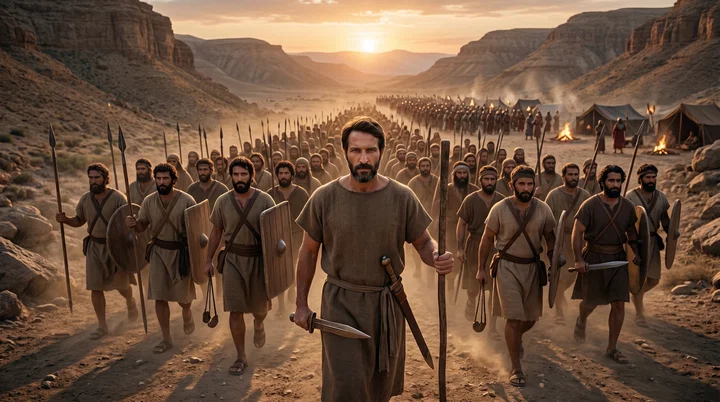
And he divided himself against them, he and his servants, by night, and smote them, and pursued them unto Hobah, which is on the left hand of Damascus.
Translations
And he divided himself against them, he and his servants, by night, and smote them, and pursued them to Hobah, which is on the left hand of Damascus.
King James Version, KJV Cambridge Paragraph Bible
And he divided himself against them, he and his servants, by night, and smote them, and pursued them unto Hobah, which is on the left hand of Damascus.
And he divided himself against them, he and his servants by night, and smote them, and pursued them to Hobah, which is on the left hand of Damascus.
Revised Version, American Standard Version
And he divided himself against them by night, he and his servants, and smote them, and pursued them unto Hobah, which is on the left hand of Damascus.
And he divideth himself against them by night, he and his servants, and smiteth them, and pursueth them unto Hobah, which [is] at the left of Damascus;
And he divided himself against them by night, he and his servants, and smote them, and pursued them as far as Hobah, which is to the left of Damascus.
And he divided himself against them by night, he, and his servants, and smote them,—and pursued them as far as Hobah, which was on the left of Damascus.
Berean Standard Bible, Majority Standard Bible
During the night, Abram divided his forces and routed Chedorlaomer’s army, pursuing them as far as Hobah, north of Damascus.
He divided himself against them by night, he and his servants, and struck them, and pursued them to Hobah, which is on the left hand of Damascus.
And separating his forces by night, he overcame them, putting them to flight and going after them as far as Hobah, which is on the north side of Damascus.
Then he, and his seruants deuided them selues against them by night, and smote them and pursued them vnto Hobah, which is on the left side of Damascus,
Douay-Rheims (Challoner revision)
And dividing his company, he rushed upon them in the night: and defeated them, and pursued them as far as Hoba, which is on the left hand of Damascus.
Pictures
Cross-references
- Hebrews 7:1-2
For this Melchisedec, king of Salem, priest of the most high God, who met Abraham returning from the slaughter of the kings, and blessed him;
Identifies Melchizedek, whom Abraham met after the battle, and recounts Abraham’s tithe.
- Genesis 14:1-4
And it came to pass in the days of Amraphel king of Shinar, Arioch king of Ellasar, Chedorlaomer king of Elam, and Tidal king of nations;
Identifies Chedorlaomer and records the years of subjection before the rebellion.
- Genesis 14:20
And blessed be the most high God, which hath delivered thine enemies into thy hand. And he gave him tithes of all.
Melchizedek credits God with delivering Abraham’s enemies after his victory.
- Genesis 14:21
And the king of Sodom said unto Abram, Give me the persons, and take the goods to thyself.
The king offers Abram the spoil.
- 2 Peter 2:7-8
And delivered just Lot, vexed with the filthy conversation of the wicked:
Describes Lot’s righteous life among the wicked.
- Genesis 14:23
That I will not take from a thread even to a shoelatchet, and that I will not take any thing that is thine, lest thou shouldest say, I have made Abram rich:
Abram refused to take any spoil after victory.
Commentary
Each commentary is drawn from primary sources: the writings of Ellen G. White and Adventist pioneers and periodicals. Each commentary is separate. Its own words are not a quotation; follow the references to read the source passages.
Ellen G. White
4 sources
Awakened affection moved Abraham to rescue Lot, and he first sought divine counsel before setting out in pursuit with three hundred and eighteen trained servants from his own camp, joined by his confederates Mamre, Eshcol, and Aner with their bands.PP 134.3–135.1 He divided his force to approach from different directions and attacked the invaders' encampment at Dan by night with a vigorous and unexpected assault.PP 134.3–135.1ST Feb 7, 1884Lt 69, 1890, par. 1–2 The enemy were greatly superior forces, yet being flushed with victory and given up to reveling with no fear of assault, they were utterly routed and the king of Elam was slain.PP 134.3–135.1PP 157.2–3
He then pursued the defeated forces that had taken captives from Sodom as far as Hobah near Damascus.PP 134.3–135.1PP 157.2–3Lt 69, 1890, par. 1–2 The speedy victory came under God with the Lord's aid and showed the people that divine power had made him conqueror.PP 134.3–135.1ST Feb 7, 1884PP 157.2–3 The triumph recovered Lot and his family together with all the other prisoners and their goods taken from Sodom.PP 134.3–135.1ST Feb 7, 1884PP 157.2–3
His generous treatment of the prisoners and the spoil, including refusal to take what belonged to others, drew wonder and admiration.ST Feb 7, 1884PP 157.2–3 The verse proves that righteousness is not cowardice and that true religion makes a person courageous in maintaining the right and defending the oppressed.PP 134.3–135.1 Abraham's conduct in the rescue is an example of taking particular care for family obligations toward relatives.Lt 69, 1890, par. 1–2
Sources
Pioneers and periodicals
42 sources
Abram divided himself and his servants against the captors, fell upon them by night, smote them and pursued them to Hobah, which lies to the north of and near Damascus.ST Dec 14, 1915ST Oct 21, 1889ST Nov 24, 1909 The pursuing force was 318 trained servants born in his own household, a reliable army for a distant expedition, though those who held the number differently put it at 319 carrying out a well-planned surprise by night.RH Nov 4, 1873RH Mar 10, 1863RH Mar 26, 1872 With that small company he overtook the four victorious kings who had plundered Sodom, defeated them and brought back Lot with his family, the women and inhabitants of Sodom, and all the goods and spoil.RH Nov 4, 1873RH Oct 1, 1908ST Apr 28, 1914 Though a man of peace, he risked his life for his kinsman in a defensive rescue, and the victory was wrought with the Lord's aid to show that God wins battles through few rather than many and success does not depend on earthly might.ST Feb 7, 1884AUST Jun 14, 1920ST Jul 21, 1909RH Apr 2, 1861 On his return God blessed him in the victory, and his first act was to give Melchizedek, priest of the most high God, a tenth of all he had gained, proving the devoting of one-tenth for God's ministers an established rule from the beginning, while he refused the king of Sodom's offer of spoil lest any man should say he had made Abram rich.ST Feb 7, 1884ST Jan 22, 1880RH Nov 4, 1873
Night Attack and Geography
Abram divided himself and his servants against the captors and struck by night, smiting them and pursuing them to Hobah, which lies on the left hand, that is to the north of and near Damascus.ST Dec 14, 1915ST Oct 21, 1889ST Nov 24, 1909RH Dec 12, 1871RH Mar 10, 1863 The night attack was made on the kings who had taken Lot, and the pursuit extended as far as Hobah near Damascus.ST Oct 21, 1889ST Nov 24, 1909RH Oct 1, 1908RH Mar 10, 1863 The servants born in Abraham's house were led as an armed, trained household force by night against those kings.RH Oct 1, 1908RH Mar 10, 1863
The attacking force was three hundred and eighteen trained servants born in Abraham's household, forming a reliable army even for a distant expedition.RH Nov 4, 1873RH Mar 10, 1863 His ability to arm that number from his own household shows his standing as an independent prince exercising sovereign power in Canaan. Those who number the force at three hundred and nineteen trained servants teach that by a well-planned surprise by night they recaptured Lot, his family, and their goods.RH Mar 26, 1872 The force is also described as a small body of about three hundred servants, used although Abraham was inexperienced in war.RH Apr 2, 1861
A trusted warrior who was Abraham's dependent and adopted heir may have led in that battle and pursuit as far as Hobah.RH Oct 1, 1861 What is done in the night is called night, not day, for the verse uses the Hebrew lah-yil for night and keeps the marked distinction between day, yohm, the light part of the twenty-four hours, and night.RH Dec 12, 1871 Damascus already existed in Abraham's time, and Hobah's stated relation to Damascus shows Damascus was then known.ST Jul 20, 1915RH Aug 31, 1905 The verse does not establish who founded the city.ST Jul 20, 1915
Historicity and Ancient Setting
Genesis 14:15 belongs to a true historical account of an invasion of Palestine in Abraham's time, namely Chedorlaomer's campaign and the real war and battle of four kings against five.RH Jul 9, 1914ST May 20, 1913ST Dec 14, 1915 The chapter records actual kings and a war in Abraham's time, including the victory of the four kings over the five, and the kings named in the account were real historical figures.RH Jul 9, 1914ST May 20, 1913ST Dec 14, 1915ST Nov 23, 1904 The account also mentions the father of the Israelites as part of that history.ST Dec 14, 1915
Its history is confirmed and illustrated in minute detail by archaeological evidence, including monuments and ancient eastern records.RH Jul 9, 1914ST Dec 14, 1915ST Dec 14, 1915 Tablets found in the Chamber of Records by the banks of the Euphrates within the last thirty years tell the story of Genesis in the same way, corroborating it in minute detail and vindicating Genesis as a historical record to be trusted beyond question. Ancient inscriptions attest to Babylon's divided kingdoms, Elamite suzerainty, and rulers' claims to power in the West, with numerous names found on monuments, some letter for letter.RH Jul 9, 1914ST Dec 14, 1915 The list of kings is confirmed by ancient records, so the chapter is to be taken as accurate history rather than fable, parable, myth, or later fiction.RH Jul 9, 1914ST May 20, 1913ST Dec 14, 1915ST May 3, 1910 A chronological difficulty once raised against that history, that Abraham was thought to have lived about three hundred years before Hammurabi, is removed by evidence that dynasties once considered consecutive actually existed at the same time.ST Dec 14, 1915
Chedorlaomer was king of Elam, whose imperial authority extended across Mesopotamia westward to the Mediterranean and nearly to Egypt and kept the territory in subjection for twelve years.ST Jan 20, 1904 The Chedorlaomer of Genesis 14 is Kudur-la-ukhgamur, whose name occurs on a tablet from the reign of Khammurabi of Babylon.ST Jul 8, 1897 He was an imitator of Nimrod in imperialism, seeking the title and power of king of kings and establishing universal dominion over the peoples and nations of the East by conquest and holding them in subjection, the same pattern later followed by Thothmes III as far eastward as the borders of India.ST Jan 27, 1904 The account involving Abraham and Chedorlaomer is part of the unfolding of God's providence and word through history.ST Dec 14, 1915ST Nov 12, 1885
Capture and Rescue Outcome
Lot was taken prisoner with the people of Sodom when Sodom was overcome in war, carried away with them and with their goods and possessions.ST Jan 29, 1894ST Oct 24, 1895RH Aug 4, 1910RH Mar 26, 1872 Without rescue he would likely have become a slave and dragged out a miserable life in bondage.ST Jan 29, 1894RH Mar 26, 1872
Abraham pursued the four victorious kings who had plundered Sodom and taken Lot captive, overtook and defeated them, and brought back all that had been taken away.RH Nov 4, 1873RH Oct 1, 1908ST Apr 28, 1914RH Aug 4, 1910 He recovered Lot with his family, many women, all the other captives and inhabitants of Sodom, and all the goods, booty, and spoil.RH Nov 4, 1873ST Apr 28, 1914RH May 26, 1863RH Aug 4, 1910 He rescued Lot without cost while himself remaining in the less fertile heights of the promised land, because he sought to save Lot as the righteous man living among them.ST Oct 24, 1895ST Nov 8, 1899
Lot's capture was the result of his worldly, selfish choice in settling near Sodom for pasture and gain and pursuing wealth.RH Mar 26, 1872ST Jul 31, 1901 Scarcely seven years after he dwelt there Sodom became involved in war.RH Mar 26, 1872 The deliverance was a warning that Lot did not heed, for he returned and located himself in the city of Sodom itself, and the recording of the capture and rescue was designed as a warning to those who should come after.RH Mar 26, 1872
The verse belongs to the account of Abraham's great victory over the kings, which precedes the vision given to him in Genesis 15.ST Aug 7, 1901 The pursuit and rescue belong to the early history connected with Jerusalem: after rescuing Lot and returning toward Hebron, Abraham was met by Melchizedek, king of Salem, who brought bread and wine and blessed him in the name of God Most High.ST Oct 21, 1889RH Jul 21, 1868 The battle is recorded to identify Melchizedek as the king and priest who met Abram after the slaughter of the kings.ST Oct 21, 1889
Abraham's War and Victory
Though a man of peace, Abraham went to war to rescue his nephew Lot, acting as an independent prince against neighboring rulers with sovereign power in Canaan.AUST Jun 14, 1920 His ability to arm 318 servants born in his own household sustained that standing and showed his power in the land. That armed household also reflected the success of his work in bringing people to serve the true God.AUST Jun 14, 1920
With his trained servants he boldly pursued the armies of four victorious kings who had plundered Sodom and taken Lot captive, risking his own life for his ungrateful nephew.RH May 26, 1863 He displayed great bravery and skill to gain a complete victory and rescue Lot with all the inhabitants of Sodom.RH May 26, 1863 Though inexperienced in war, he used a small force of about three hundred servants to defeat the monarchs on the plains of Sodom, which others number as five kings and five monarchs.ST Jul 21, 1909RH Apr 2, 1861 The victory came with the Lord's aid and was a victory God wrought and offered, illustrating that God can win battles through a few rather than many and that success does not depend on earthly might.ST Feb 7, 1884ST Jul 21, 1909RH Apr 1, 1902
The servants born in his house served as a reliable army on that distant expedition because they followed him willingly rather than being held as chattel slaves.RH Mar 10, 1863 His action was a defensive fight to rescue his captured allies, who had been his confederates and had protected him.RH Oct 14, 1862 The blessing he received from Melchizedek confirms that he acted as a servant of God, so that killing in a defensive war did not make him a murderer or violate God's law.RH Oct 14, 1862
The act appeared wholly noble, worthy of praise and the usual rewards of valor.RH May 26, 1863 Yet Abraham afterward feared he had sinned by shedding blood, lest among the multitude he had slain there was one good and worthy man compelled by force to join the invaders.RH May 26, 1863 He judged his deed as only following nature in rescuing his own kin rather than true nobility.RH May 26, 1863
Tithing After the Battle
God blessed Abraham when he defeated the kings in recovering Lot and taking great spoil and booty, and his very first act afterward on returning after the slaughter of the kings was to give Melchizedek, priest of the most high God, a tithe or tenth of everything he had gained.ST Jan 22, 1880 This devoting of one-tenth for the support of God's ministers and servants was taught by the Lord from the beginning and was an established rule and practice in the patriarchal age when men were devoted wholly to the service of God.ST Jan 22, 1880 The question is raised whether the tithe was given before or after the young men had eaten.ST Sep 2, 1889
The victory gave Abram a splendid chance to enrich himself when the king of Sodom met him and offered him all the spoil if he would return only the persons.RH Nov 4, 1873 But Abram lifted up his hand to the Lord, the most high God, possessor of heaven and earth, and refused to take even a thread or a shoe-latchet lest the king should say he had made Abram rich, refusing to take the spoils that belonged to others.ST Feb 7, 1884RH Nov 4, 1873 That rescue by the night attack to recover Lot and his family came with the Lord's aid and led to this refusal.ST Feb 7, 1884
God was Abram's portion, so Abram could not be bought and was content with what he had, giving tithes of the spoils to Melchizedek and waiting for the city that has foundations, whose builder and maker is God.RH Nov 4, 1873 Melchizedek dwelled near Sodom, was greater than Abraham, and was the express representative of Christ.ST Oct 4, 1883 God punished theft in Abraham's day, proving the law against stealing was already in force long before Moses gave the law at Sinai.
Moral and Spiritual Lessons
Abraham moved to rescue Lot when Lot was in danger, not because any statute required it, but because he sought to do what was right and felt bound by kinship and love, and believers are likewise bound to help a brother in need.ST Oct 1, 1902 The attack and pursuit that overthrew Lot's captors belonged to that rescue of Lot and the people carried captive by the invading kings.RH Jul 19, 1870ST Oct 1, 1902
That rescue gave the people of Sodom an opportunity to know Abraham as the friend of God, and therefore gave them access to the light of truth.RH Jul 19, 1870 In that experience Abraham and God's power became known to the cities, including Sodom, giving the people and Lot a lesson they ought to have learned.RH Jul 19, 1870ST Sep 1, 1898 Their deliverance came through Abraham's intervention because he sought to save Lot as the righteous man living among them, and it was an expression of God's long-suffering mercy toward the cities.ST Oct 24, 1895 Melchizedek dwelled near Sodom and was greater than Abraham as the express representative of Christ, and his nearness, with Abraham dwelling a short distance away and Lot dwelling among them, gave the men of Sodom means of great light concerning the second advent of Christ and the day of judgment.ST Oct 4, 1883
Abram armed three hundred and eighteen of his servants to pursue by night the king who had conquered Sodom and taken his relative Lot captive, smote the enemy, and brought back all the goods and the people that were taken away.RH Nov 4, 1873 The victory gave him a splendid chance to enrich himself when the king of Sodom met him and offered him all the spoil if he would return only the persons, but he lifted up his hand to the Lord, the most high God, possessor of heaven and earth, and refused to take even a thread or a shoe-latchet lest the king should say he had made Abram rich.RH Nov 4, 1873 God was Abram's portion, so he could not be bought and was content with what he had, giving tithes of the spoils to Melchizedek and waiting for the city that has foundations, whose builder and maker is God, making him an example of freedom from covetousness.RH Nov 4, 1873 That victory over the kings was a victory God wrought and offered, and it stands as an encouragement to be strong and courageous in going forward in the Lord's work.RH Nov 4, 1873RH Apr 1, 1902
Sources