Genesis 16:10
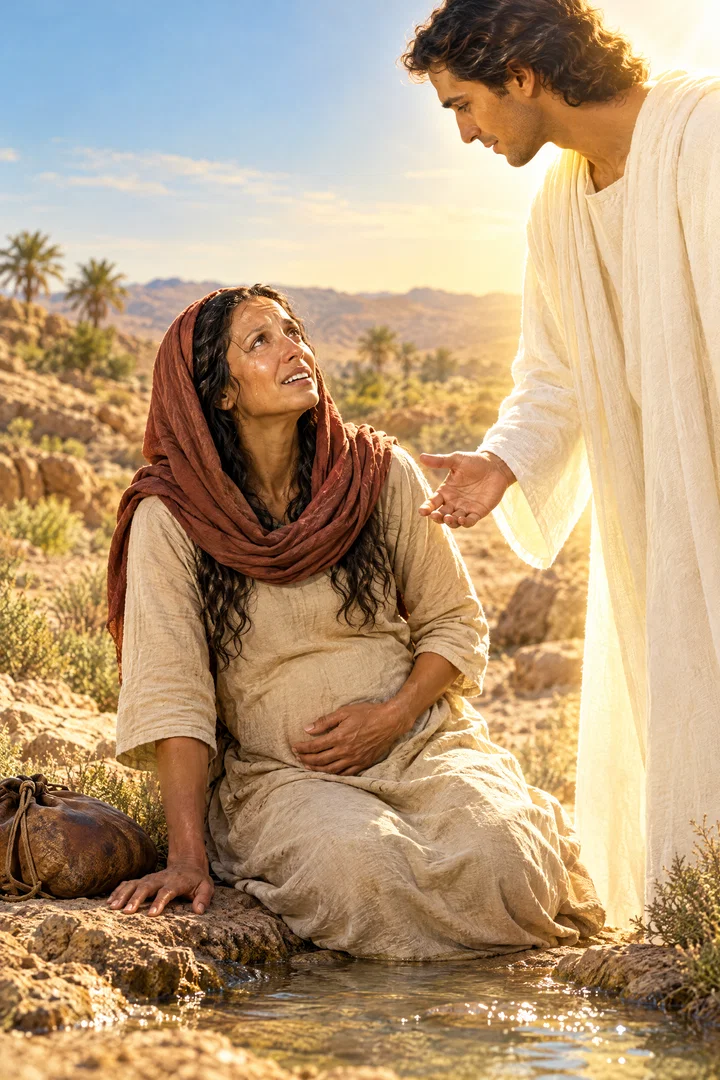
And the angel of the LORD said unto her, I will multiply thy seed exceedingly, that it shall not be numbered for multitude.
Translations
And the angel of the LORD said to her, I will multiply your seed exceedingly, that it shall not be numbered for multitude.
And the angel of the LORD said unto her, I will multiply thy seed exceedingly, that it shall not be numbered for multitude.
And the angel of the Lord said unto her, I will multiply thy seed exceedingly, that it shall not be numbered for multitude.
And the angel of the LORD said to her, I will multiply thy seed exceedingly, that it shall not be numbered for multitude.
And the angel of the LORD said unto her, I will greatly multiply thy seed, that it shall not be numbered for multitude.
And the angel of Jehovah said unto her, I will greatly multiply thy seed, that it shall not be numbered for multitude.
and the messenger of Jehovah saith to her, 'Multiplying I multiply thy seed, and it is not numbered from multitude;'
And the Angel of Jehovah said to her, I will multiply thy seed exceedingly, that it shall not be numbered for multitude.
And the messenger of Yahweh said to her, I will, greatly multiply, thy seed—so that it shall not be numbered for multitude.
Berean Standard Bible, Majority Standard Bible
Then the angel added, “ I will greatly multiply your offspring so that they will be too numerous to count.”
The LORD’s angel said to her, “ I will greatly multiply your offspring, that they will not be counted for multitude.”
And the angel of the Lord said, Your seed will be greatly increased so that it may not be numbered.
Againe the Angel of the Lord saide vnto her, I will so greatly increase thy seede, that it shall not be numbred for multitude.
Douay-Rheims (Challoner revision)
And again he said: I will multiply thy seed exceedingly, and it shall not be numbered for multitude.
Pictures
Cross-references
- Galatians 4:22-31
For it is written, that Abraham had two sons, the one by a bondmaid, the other by a freewoman.
Hagar and Sarah’s histories illustrate the two covenants.
- Genesis 21:12
And God said unto Abraham, Let it not be grievous in thy sight because of the lad, and because of thy bondwoman; in all that Sarah hath said unto thee, hearken unto her voice; for in Isaac shall thy seed be called.
God confirms that Abraham’s seed will be called through Isaac, not Ishmael.
- Genesis 17:15-22
And God said unto Abraham, As for Sarai thy wife, thou shalt not call her name Sarai, but Sarah shall her name be.
God specifies that Sarah will bear the covenant heir, Isaac.
- Genesis 15:4-6
And, behold, the word of the LORD came unto him, saying, This shall not be thine heir; but he that shall come forth out of thine own bowels shall be thine heir.
God promises Abram descendants from his own body, and Abram believes.
- Genesis 12:2
And I will make of thee a great nation, and I will bless thee, and make thy name great; and thou shalt be a blessing:
God promises to make Abram a great nation, anticipating the multiplication of his descendants.
- Genesis 13:16
And I will make thy seed as the dust of the earth: so that if a man can number the dust of the earth, then shall thy seed also be numbered.
God promises Abram a numerous seed, compared to the dust of the earth.
- Genesis 22:17
That in blessing I will bless thee, and in multiplying I will multiply thy seed as the stars of the heaven, and as the sand which is upon the sea shore; and thy seed shall possess the gate of his enemies;
God renews his promise to multiply Abraham’s seed, the promised line excluding Ishmael.
- Genesis 15:5
And he brought him forth abroad, and said, Look now toward heaven, and tell the stars, if thou be able to number them: and he said unto him, So shall thy seed be.
God promises Abraham offspring as numerous as the stars.
- Genesis 17:2
And I will make my covenant between me and thee, and will multiply thee exceedingly.
God renews the promise to multiply Abraham’s descendants.
- Genesis 18:10
And he said, I will certainly return unto thee according to the time of life; and, lo, Sarah thy wife shall have a son. And Sarah heard it in the tent door, which was behind him.
God promises Sarah a son, fulfilling the earlier promise of abundant offspring.
- Hebrews 11:11
Through faith also Sara herself received strength to conceive seed, and was delivered of a child when she was past age, because she judged him faithful who had promised.
Sarah trusted God’s promise of offspring despite being past age.
- Romans 9:8
That is, They which are the children of the flesh, these are not the children of God: but the children of the promise are counted for the seed.
Distinguishes children of the flesh from the promised seed, excluding Ishmael from the promised line.
- Genesis 25:12-18
Now these are the generations of Ishmael, Abraham’s son, whom Hagar the Egyptian, Sarah’s handmaid, bare unto Abraham:
Lists Ishmael’s descendants and describes their spread and settlements.
- Genesis 26:4
And I will make thy seed to multiply as the stars of heaven, and will give unto thy seed all these countries; and in thy seed shall all the nations of the earth be blessed;
Renews the promise of numerous descendants to Isaac.
- Genesis 28:14
And thy seed shall be as the dust of the earth, and thou shalt spread abroad to the west, and to the east, and to the north, and to the south: and in thee and in thy seed shall all the families of the earth be blessed.
Both promise an exceedingly numerous offspring.
- Genesis 16:4
And he went in unto Hagar, and she conceived: and when she saw that she had conceived, her mistress was despised in her eyes.
Hagar’s conception stirred the friction that drove her to the desert.
- Galatians 4:28
Now we, brethren, as Isaac was, are the children of promise.
Believers, like Isaac, are identified as children of promise.
- Genesis 18:1
And the LORD appeared unto him in the plains of Mamre: and he sat in the tent door in the heat of the day;
The Son of God appears to Abraham as the Angel of Jehovah.
Commentary
Each commentary is drawn from primary sources: the writings of Ellen G. White and Adventist pioneers and periodicals. Each commentary is separate. Its own words are not a quotation; follow the references to read the source passages.
Ellen G. White
1 source
The angel's promise to Hagar came after she was directed to go back to Sarah and submit herself to her.PP 145.2–3 It came after she was assured that the Lord had heard and regarded her affliction.PP 145.2–3 In that context she was told that her seed would be multiplied exceedingly, until it could not be numbered for multitude.PP 145.2–3 That assurance of innumerable descendants was given to comfort her in her distress.PP 145.2–3
Sources
Pioneers and periodicals
21 sources
The angel's word was spoken to Hagar in the wilderness after she fled from Sarah's harshness, promising that her son Ishmael would father descendants too many to count, the Ishmaelites and Arabs.ST Sep 8, 1898RH Dec 25, 1856RH Jan 16, 1872 The One who made that promise was the Son of God, and His power to give and fulfill such increase shows He is divine.ST Jun 3, 1908 Abraham's taking of Hagar was an act of distrust that tried to gain the promised heir by human scheming instead of trusting God to fulfill His word through Sarah, and it brought bondage and painful separation without changing God's purpose that the covenant line would come through Isaac.ST Apr 1, 1875ST Apr 11, 1900ST Sep 23, 1913 Hagar the bondwoman stands for the covenant from Mount Sinai, and her son born after the flesh stands for its children in bondage, while Sarah and Isaac born by promise stand for the covenant of freedom, teaching that salvation comes by God's promise through faith and not by fleshly effort to earn it, and that mere descent from Abraham does not make one Israel.RH May 29, 1900ST Mar 1, 1905ST Sep 28, 1915RH Jan 16, 1872 The promise was given to comfort a despairing outcast, showing that God sees the discouraged not to condemn but to save, so that His watchful presence brings safety and hope even in trouble.ST Nov 8, 1899ST Mar 23, 1915
Words and Historical Setting
Genesis 16 is to be read with Genesis 15 and Genesis 17 within Genesis 11-21 and Psalms 4-6, covering B.C. 2247 to B.C. 1872.ST Jan 2, 1912 That reading shows God's call to Abram and his sojourn and trials of faith, in which he did not come at once to fullness of faith but learned over and over through constant and remarkable evidences of God's overruling providence.ST Jan 2, 1912
The promise to multiply seed exceedingly so that it could not be numbered for multitude was spoken in the wilderness to Hagar after Sarah's oppression drove her from Abraham's household.ST Sep 8, 1898 She wandered in the desert deprived of home and counsel through no fault of her own and thought she was driven out to die.ST Sep 8, 1898 A messenger direct from the throne of God comforted her and advised her to return to her mistress and suffer whatever fell to her lot.ST Sep 8, 1898 The promise about her seed pointed to the child born soon after who became a wild man with his hand against everyone and everyone's hand against him.ST Sep 8, 1898
Abraham's taking Hagar showed distrust in God's promises and a temporary lack of faith from human weakness.ST Apr 1, 1875ST Sep 23, 1913 It was an attempt in unbelief to bring about the promised heir by human arrangement and scheming rather than trusting God to fulfill His promise in the right way through Sarah, and after Abraham accepted this human arrangement Hagar conceived.ST Apr 1, 1875ST Apr 11, 1900 This choice led to the birth of Ishmael and the painful separation from him, but it did not change God's stated purpose that the covenant line would come through Isaac.ST Apr 1, 1875
Genesis 16 records a patriarchal violation of the marriage institution.RH Feb 3, 1852RH Nov 8, 1853 That violation does not destroy the sacred character of marriage.RH Feb 3, 1852RH Nov 8, 1853 Marriage was made for man before the fall.RH Nov 8, 1853
The Angel of the LORD who speaks the promise of descendants too numerous to count is the Son of God.ST Jun 3, 1908 He comforted the discouraged Hagar with that promise.ST Jun 3, 1908 Only God could make and fulfill such a promise, and His ability to do so demonstrates His divinity.ST Jun 3, 1908
The appearance to Hagar in the desert shows true spirit communication as the ministration of angels, not communication from the dead. An angel came to her and saved her and her child Ishmael. Angels, whether good or evil, are not dead people but a distinct order of beings who existed before man and the earth were created.
Covenant Doctrinal Meaning
To understand the two covenants one must begin with Genesis 16 together with Genesis 15, Genesis 17, and Genesis 21:1-21, which provide the background for Paul's comparison in Galatians 4:21-30, especially verse 24, of the sons born to the handmaid and the freewoman.RH May 29, 1900ST Nov 21, 1900RH Jun 26, 1900 Hagar the bondwoman to whom the multiplied seed is promised is the covenant from Mount Sinai, and her son Ishmael, the natural child of a human plan born after the flesh, represents the children of that covenant in bondage, while Sarah the freewoman and her son Isaac, born by God's promise, represent the other covenant in freedom.RH May 29, 1900ST Sep 28, 1915ST Apr 29, 1908 Ishmael's birth through Hagar was the result of human scheming rather than God's plan to bring the promised child through Sarah, relying on human effort rather than God's power.ST Sep 28, 1915ST Apr 29, 1908 Abraham and Sarah's arrangement to secure the promised heir through Hagar when they doubted God would fulfill His promise in the right way brought conflict and bondage and stands as a figure of trying to help God's promise through fleshly schemes rather than relying on God's power.ST Mar 1, 1905 The promised heir could not be secured by human planning, for the promise and its fulfillment depended on God, teaching that justification and salvation come through God's promise by faith, not through human effort to earn them.ST Mar 1, 1905
The promise that Hagar's descendants would become exceedingly numerous did not make Ishmael the promised free-born heir, for as the son of an enslaved woman he belonged to the line of bondage, while the promised inheritance was to come through a free-born son.ST Mar 22, 1899 The increase of Abraham's natural descendants to a multitude was one blessing in the promissory covenant, and his natural seed served as a type of the heirs of salvation.RH Feb 7, 1854 The account supplies the two sons, Ishmael born through Hagar the maidservant in contrast to Isaac born through Sarah the free woman, whom Paul in Galatians 4 makes an allegory of the two covenants, testaments, or dispensations.ST Jan 24, 1900 They are the typical and antitypical systems, and the two peoples, literal Israel and true Israel, or Jews and Gentiles, as representatives of the Lord and His work in two special periods of its development in the earth.ST Jan 24, 1900
Fulfillment and Pastoral Comfort
The promise is that the descendants through Hagar's son Ishmael would become exceedingly numerous, beyond numbering for multitude.RH Dec 25, 1856RH Jan 16, 1872 They are the Ishmaelites, identified with the inhabitants of Syria and with the Arabs as that seed multiplied exceedingly.RH Dec 25, 1856RH Jan 16, 1872 Those multiplied descendants, together with the descendants of Keturah and of Esau, are not reckoned as Israel entitled to the promises.RH Jan 16, 1872 If being Israel and inheriting the promises came by fleshly descent from Abraham, all of them would have to be counted in, and the fact that they are not proves that lineal descent does not decide who is Israel, but some other principle does.RH Jan 16, 1872
God gave the promise to comfort Hagar when she was despairing in the wilderness over her condition and thought she was driven out to die.ST Nov 8, 1899ST Mar 23, 1915 The assurance of many descendants showed that He saw her, had not forgotten her, and would supply her need.ST Nov 8, 1899ST Mar 23, 1915 The angel brought her a message of hope that she would become the mother of a nation, and in response she named Him as the One who sees her.ST Mar 23, 1915 The verse means that God sees the discouraged soul not to condemn but to save.ST Nov 8, 1899 His watchful presence is a source of hope and joy, not terror, so that when people yield to Him His seeing them means they are safe even in trouble.ST Mar 23, 1915
Sources