Genesis 16:9
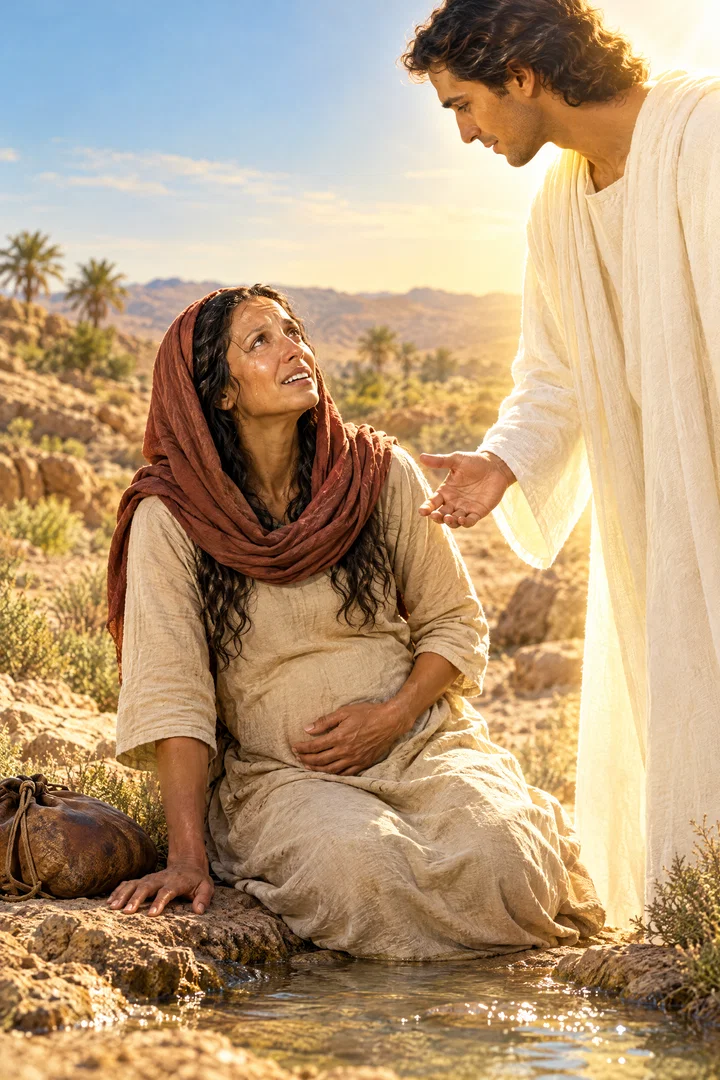
And the angel of the LORD said unto her, Return to thy mistress, and submit thyself under her hands.
Translations
And the angel of the LORD said to her, Return to your mistress, and submit yourself under her hands.
King James Version, Revised Version
And the angel of the LORD said unto her, Return to thy mistress, and submit thyself under her hands.
And the angel of the Lord said unto her, Return to thy mistress, and submit thyself under her hands.
And the angel of the LORD said to her, Return to thy mistress, and submit thyself under her hands.
And the angel of Jehovah said unto her, Return to thy mistress, and submit thyself under her hands.
And the messenger of Jehovah saith to her, 'Turn back unto thy mistress, and humble thyself under her hands;'
And the Angel of Jehovah said to her, Return to thy mistress, and submit thyself under her hands.
And the messenger of Yahweh said to her, Return unto thy lady,—and humble thyself under her hands.
Berean Standard Bible, Majority Standard Bible
So the angel of the LORD told her, “ Return to your mistress and submit to her authority.”
The LORD’s angel said to her, “ Return to your mistress, and submit yourself under her hands.”
And the angel said to her, Go back, and put yourself under her authority.
Then the Angel of the Lord saide to her, Returne to thy dame, and humble thy selfe vnder her hands.
Douay-Rheims (Challoner revision)
And the angel of the Lord said to her: Return to thy mistress, and humble thyself under her hand.
Pictures
Cross-references
- Galatians 4:21-31
Tell me, ye that desire to be under the law, do ye not hear the law?
Hagar’s story is used as an allegory of the two covenants and bondage.
- Genesis 21:9-14
And Sarah saw the son of Hagar the Egyptian, which she had born unto Abraham, mocking.
Hagar and Ishmael are sent away, while Isaac is named as the covenant seed.
- Genesis 16:4
And he went in unto Hagar, and she conceived: and when she saw that she had conceived, her mistress was despised in her eyes.
Hagar’s contempt leads to oppression and flight.
- Genesis 16:13
And she called the name of the LORD that spake unto her, Thou God seest me: for she said, Have I also here looked after him that seeth me?
Hagar names the Lord as the God who sees her, comforting her.
- Genesis 16:1
Now Sarai Abram’s wife bare him no children: and she had an handmaid, an Egyptian, whose name was Hagar.
Introduces Hagar as Sarah’s Egyptian handmaid.
- Genesis 21:14-21
And Abraham rose up early in the morning, and took bread, and a bottle of water, and gave it unto Hagar, putting it on her shoulder, and the child, and sent her away: and she departed, and wandered in the wilderness of Beer-sheba.
Hagar and Ishmael are sent away and then succored by God.
- Genesis 16:2
And Sarai said unto Abram, Behold now, the LORD hath restrained me from bearing: I pray thee, go in unto my maid; it may be that I may obtain children by her. And Abram hearkened to the voice of Sarai.
Abraham sought and followed Sarah's counsel
- Galatians 4:24
Which things are an allegory: for these are the two covenants; the one from the mount Sinai, which gendereth to bondage, which is Agar.
identifies Hagar as Sinai covenant
- 1 Peter 3:6
Even as Sara obeyed Abraham, calling him lord: whose daughters ye are, as long as ye do well, and are not afraid with any amazement.
gives Sarah obeying Abraham as example
- Genesis 17:15-21
And God said unto Abraham, As for Sarai thy wife, thou shalt not call her name Sarai, but Sarah shall her name be.
Further account of Hagar’s sons and God’s promise to Abraham.
- 1 Peter 5:5
Likewise, ye younger, submit yourselves unto the elder. Yea, all of you be subject one to another, and be clothed with humility: for God resisteth the proud, and giveth grace to the humble.
Both instruct a person to submit.
- Genesis 21:12
And God said unto Abraham, Let it not be grievous in thy sight because of the lad, and because of thy bondwoman; in all that Sarah hath said unto thee, hearken unto her voice; for in Isaac shall thy seed be called.
God told Abraham to follow Sarah's counsel
- Genesis 15:4-5
And, behold, the word of the LORD came unto him, saying, This shall not be thine heir; but he that shall come forth out of thine own bowels shall be thine heir.
The promise of an heir sets in motion the events leading to Hagar’s flight.
Commentary
Each commentary is drawn from primary sources: the writings of Ellen G. White and Adventist pioneers and periodicals. Each commentary is separate. Its own words are not a quotation; follow the references to read the source passages.
Ellen G. White
4 sources
The angel met Hagar after she had fled from Sarah.1SP 95.2–3SG3 101.1–2 Her flight and the command to return arose from the unhappiness caused when Abraham and Sarah failed to wait in trusting, confiding faith for the promised son, when Sarah entreated and urged Abraham to take Hagar and Abraham failed to endure the test of faith in God's unlimited power.1SP 95.2–3 Before fleeing, Hagar had become proud and boastful and had carried herself haughtily in her bearing toward Sarah.1SP 95.2–3ST Mar 27, 1879SG3 101.1–2 She flattered herself that she was to be the mother of the great nation promised to Abraham.1SP 95.2–3
The angel directed her to go back to Sarah, her mistress, and to yield and submit herself under her hands and to her authority, reminding her of her position and duty.PP 145.2–31SP 95.2–3ST Mar 27, 1879SG3 101.1–2 That direction both reproved Hagar for her proud and haughty conduct and comforted her.PP 145.2–31SP 95.2–3ST Mar 27, 1879SG3 101.1–2 The comfort was that God had heard her affliction and would multiply her descendants.PP 145.2–3
Sources
Pioneers and periodicals
33 sources
The angel who met Hagar in the desert after she fled from harsh treatment for despising her mistress was the Son of God, who both reproved her haughty conduct and told her to return to Sarah and submit herself under her authority.ST Mar 27, 1879ST Apr 11, 1900ST Jun 3, 1908RH Dec 30, 1902ST Nov 21, 1900 With the command He gave her comfort and hope for the future as mother of a nation, with a prediction about her soon-born son as a wild man in conflict with all.ST Sep 8, 1898ST Mar 23, 1915 Her flight came from unbelief and human scheming to fulfill God's promise of an heir by human effort, which brings conflict rather than blessing, for Ishmael born after the flesh into bondage figures those who seek justification by law and cannot secure salvation by their own works.ST Apr 1, 1875ST Apr 11, 1900ST Mar 1, 1905ST Sep 23, 1913ST Sep 28, 1915 Hagar the bondwoman and Sarah the freewoman with their two sons set forth the two covenants, Hagar representing the covenant from Mount Sinai which genders to bondage and Sarah the other covenant.RH May 29, 1900ST Nov 21, 1900ST Jan 24, 1900 The command teaches not to seek happiness by fleeing difficult surroundings but to face trials, overcome contempt and faults within, and yield meekly, for God sees the discouraged to comfort and save them and not to condemn them, and trials met rightly become a blessing.ST Mar 20, 1907ST Nov 8, 1899RH Dec 30, 1902RH Aug 3, 1905ST Nov 4, 1930
Hagar's Flight and Return
Genesis 16:9 stands in Genesis 15-17 within the history running from Babel and the scattering of humanity through the genealogy of Abraham and God's call to Abram, dated from B.C. 2247 to B.C. 1872.ST Jan 2, 1912 It belongs to Abram's sojourn and trials of faith and displays God's overruling providences, showing that Abraham did not come at once to fullness of faith but had to learn the lesson over and over, pressing whether readers are children of Abraham.ST Jan 2, 1912 It falls within God's providential dealings with Abraham's family as the chosen family through whom the Seed would come.ST It comes after the Lord renewed His promise to Abram of his own literal seed, made covenant that his seed should possess the land, and counted Abram's belief to him for righteousness, in connection with the birth of Ishmael, Sarai's jealousy, and Hagar leaving with her son.ST Jan 29, 1894
Hagar was Sarah's Egyptian slave handmaid who conceived by Abraham and then despised her mistress after the arrangement made in unbelief, an example of human effort to fulfill God's promise which produced conflict rather than the promised blessing.ST Apr 11, 1900ST Mar 22, 1899 Her son Ishmael was born after the flesh into bondage, because children of a slave woman are slaves even when the father is a freeman, so she could bring forth children only to bondage, unlike the free-born promised son of a freewoman and not a bond-servant born in the house.ST Mar 22, 1899 After Sarah dealt harshly with her she fled, wandering as a wronged woman driven into the wilderness in despair.ST Mar 23, 1915RH Jul 3, 1900 Her return to Sarah to submit did not make all peaceful and pleasant afterward, proving that the invented scheme to gain a son through the bondwoman was unsatisfactory to the whole company from the first step.RH Jul 3, 1900
The Angel of Jehovah who met discouraged Hagar with comforting counsel is the Son of God, who meets people in the details of their lives as Friend and Helper.ST Jun 3, 1908 His divine promise to her reveals who He is, and she recognized Him as the God who sees her.ST Jun 3, 1908 He comforted her but also reproved her haughty conduct, directing her to return to Sarah and submit herself under her mistress's authority even though she had been harshly treated.ST Mar 27, 1879RH May 2, 1865 The command records the angel telling her to return to her mistress and submit to her authority, as part of the account of Abraham's household that Paul draws on in explaining the contrast between Hagar the handmaid and the freewoman.ST Nov 21, 1900 It is a call to submission and an example of the gospel's work of reconciliation, and of meekly accepting correction and yielding rather than leaving one's place.RH Dec 30, 1902RH May 2, 1865 Abraham's taking Hagar instead of patiently waiting for God's promise showed distrust and helped bring him to the severe later test involving Isaac.ST Apr 1, 1875
With the command came hope for her future that she would be the mother of a nation, for God saw her in loneliness and distress so that the divine gaze brings hope and safety rather than terror to those who yield to Him.ST Mar 23, 1915 She had been driven from the household at a critical time and wandered heart-wounded in the desert, finding comfort only in the visit and comforting words of a messenger direct from God's throne.ST Sep 8, 1898 In obedience to the angel's counsel she smothered her grief and returned to Sarah to suffer whatever fell to her lot.ST Sep 8, 1898 The treatment she then received left its impress upon her child, born soon after, who according to the angel's prediction became a wild man with his hand against everyone and everyone's hand against him.ST Sep 8, 1898
Covenant Allegory and Doctrine
Abraham and Sarah's resort to Hagar to obtain the promised heir came from unbelief, human weakness, temporary lack of faith and doubting, an attempt by human scheming to fulfill for themselves what God had promised instead of patiently waiting for Him.ST Apr 1, 1875ST Mar 1, 1905ST Sep 23, 1913ST Aug 9, 1905 The scheme was unsatisfactory to the whole company from the first step, and did not make all peaceful and pleasant afterward even when Hagar was sent back to submit after fleeing Sarah's harsh dealing.ST Apr 1, 1875RH Jul 3, 1900 That distrust helped bring Abraham on to the later severe test involving Isaac.ST Apr 1, 1875
Hagar the bondwoman and Sarah the freewoman, with their two sons, are the beginning of the subject of the two covenants, and any true study must begin where the subject begins, with Genesis 16 together with Genesis 15, Genesis 17, and Genesis 21:1-21.RH May 29, 1900ST Nov 21, 1900 Hagar represents the covenant from Mount Sinai which genders to bondage while Sarah represents the other covenant, and their two sons represent the children of the two covenants.RH May 29, 1900ST Jan 24, 1900 The allegory in Galatians 4 sets forth by them the typical and antitypical systems, the two testaments or dispensations, and the two peoples, literal Israel and true Israel, Jews and Gentiles, as representatives of the Lord and His work in two special periods of its development in the earth, whose particulars are worth close examination.ST Jan 24, 1900
Ishmael was born after the flesh as the natural child of the flesh into bondage through human planning rather than God's promise, unlike Isaac the free-born promised son and child of God's promise.ST Mar 1, 1905ST Sep 28, 1915ST Apr 29, 1908ST Mar 22, 1899 Children of a slave woman are slaves even when the father is a freeman, so Hagar, an Egyptian slave woman under Sarah her mistress, could bring forth children only to bondage, unlike the free-born son of a freewoman that God had promised Abraham and not a bond-servant born in his house.ST Mar 22, 1899 He figures those who seek justification by law and try to earn it themselves, showing that human beings cannot fulfill God's righteousness or help secure salvation by their own strength, and that human effort to fulfill God's promise produces conflict rather than the promised blessing.ST Apr 11, 1900ST Mar 1, 1905
The episode is a plain violation of the marriage institution as established before the fall, showing the evil, unhappiness and consequences that came when polygamy entered Abraham's household.RH Feb 3, 1852RH Mar 1, 1870RH Jan 21, 1875 Such patriarchal violation does not destroy or lessen the sacred character of marriage, just as any patriarchal violation of the Sabbath would not destroy the sacred character of the Sabbath institution.RH Feb 3, 1852ST Jun 10, 1875RH Jan 21, 1875 By commanding Hagar to return to her mistress Sarah and submit herself under her hands, the verse upholds Sarah's rightful place as Abraham's wife.ST Jun 3, 1913 It means husband and wife live in the normal relationship ordered by God, where the husband leads with whole-hearted, kind, tender, uplifting love and regards his wife as his equal helpmeet from the Lord, the wife helps him with all her power, preeminent in her sphere as he is in his, and both settle differences without quarrels or tyrannical demands for lordship or ladyship.ST Jun 3, 1913
The angel's telling Hagar to return to her mistress and submit is not proof that the angel acted as a slave-catcher or that slavery was divinely endorsed.RH Oct 13, 1859 Her return to Abraham's household is part of the evidence that her status as handmaid did not make her chattel.RH Oct 1, 1861 Ishmael was another of Abraham's sons, from whom the Arabs came, yet though literally descended from Abraham his descendants are not reckoned as entitled to the promises made to Israel.RH Jan 16, 1872 Their exclusion proves that fleshly descent from Abraham does not by itself make anyone an Israelite, and that some other principle besides lineal descent decides who are Israelites.RH Jan 16, 1872
The angel's meeting with Hagar in the desert, saving Hagar and Ishmael her child and telling her to return to her mistress and submit herself, shows the ministration of angels to people on earth. It is spirit communication in the true sense, but not communication with the dead, because the angel was not the spirit of a dead person. Angels, whether good or evil, are not dead people but a distinct order of beings who existed before man and the earth were created, before man sinned or any soul died.
Submission Trials and Hope
The angel told Hagar to go back to her mistress and place herself under her authority instead of trying to find happiness by running away from hard surroundings.ST Mar 20, 1907RH Aug 3, 1905 Running away did not cure her unhappiness, because what she needed was an inward change, including putting away contempt for the one over her.ST Mar 20, 1907RH Aug 3, 1905 Going back gave her an experience she could never have gained by escaping what looked like unfavorable surroundings.ST Mar 20, 1907RH Aug 3, 1905 The command is therefore a call to meet trial where one is and to look for the inward faults that need correcting, rather than to expect happiness merely from a change of place.ST Mar 20, 1907 Sarah's harsh dealing was permitted for Hagar's good, showing that trials lay open defects of character and may become a blessing or otherwise according to how they are met.ST Mar 20, 1907
Obedience here meant meekly accepting correction and yielding instead of leaving one's place, even when the mistress had dealt harshly.RH Dec 30, 1902RH May 2, 1865 It stands as an example of the reconciling work of the gospel, which sends the wronged back to submit.RH Dec 30, 1902RH May 2, 1865 Though driven from the household at a critical time and wandering heart-wounded in the desert, she found comfort only in the visit and comforting words of a messenger direct from God's throne, then smothered her grief and returned to bear whatever fell to her lot.ST Sep 8, 1898 The treatment she then received left its impress upon her soon-born child, who became according to the prediction a wild man with his hand against everyone and everyone's hand against him.ST Sep 8, 1898
God met this wronged woman fleeing in despair to comfort and save her, not to threaten or condemn her.ST Nov 8, 1899ST Mar 23, 1915 Though she supposed she had been driven out to die in the wilderness, His seeing her meant He had not forgotten her, and He met her need by sending her back to return and submit.ST Nov 8, 1899ST Nov 4, 1930 That sending back belongs to His saving watchcare and gives hope to every discouraged soul that He sees in order to save.ST Nov 8, 1899 He finds and sees people in loneliness and distress even when they are not seeking Him, so that His gaze brings hope and safety rather than terror to those who yield, and with the command came the promise of a future as mother of a nation.ST Nov 8, 1899ST Mar 23, 1915ST Nov 4, 1930
Sources