Genesis 18:5
And I will fetch a morsel of bread, and comfort ye your hearts; after that ye shall pass on: for therefore are ye come to your servant. And they said, So do, as thou hast said.
Translations
And I will fetch a morsel of bread, and comfort you your hearts; after that you shall pass on: for therefore are you come to your servant. And they said, So do, as you have said.
And I will fetch a morsel of bread, and comfort ye your hearts; after that ye shall pass on: for therefore are ye come to your servant. And they said, So do, as thou hast said.
and I will fetch a morsel of bread, and comfort ye your hearts; after that you shall pass on: for therefore are you come to your servant. And they said, So do, as thou hast said.
And I will bring a morsel of bread, and comfort ye your hearts; after that you shall pass on: for therefore are ye come to your servant. And they said, So do, as thou hast said.
and I will fetch a morsel of bread, and comfort ye your heart; after that ye shall pass on: forasmuch as ye are come to your servant. And they said, So do, as thou hast said.
and I will fetch a morsel of bread, and strengthen ye your heart; after that ye shall pass on: forasmuch as ye are come to your servant. And they said, So do, as thou hast said.
and I bring a piece of bread, and support ye your heart; afterwards pass on, for therefore have ye passed over unto your servant;' and they say, 'So mayest thou do as thou has spoken.'
And I will fetch a morsel of bread; and refresh yourselves; after that ye shall pass on; for therefore have ye passed on towards your servant. And they said, So do as thou hast said.
And let me fetch a morsel of bread, and stay ye your heart, Afterwards, ye may pass on, For on this account, have ye passed by, over against your servant. And they said, Thus, shalt thou do as thou hast spoken.
Berean Standard Bible, Majority Standard Bible
And I will bring a bit of bread so that you may refresh yourselves. This is why you have passed your servant’s way. After that, you may continue on your way.”“ Yes,” they replied, “ you may do as you have said.”
I will get a piece of bread so you can refresh your heart. After that you may go your way, now that you have come to your servant.”They said, “ Very well, do as you have said.”
And let me get a bit of bread to keep up your strength, and after that you may go on your way: for this is why you have come to your servant. And they said, Let it be so.
And I will bring a morsell of bread, that you may comfort your hearts, afterward ye shall go your wayes: for therefore are ye come to your seruant. And they said, Do euen as thou hast said.
Douay-Rheims (Challoner revision)
And I will set a morsel of bread, and strengthen ye your heart, afterwards you shall pass on: for therefore are you come aside to your servant. And they said: Do as thou hast spoken.
Pictures
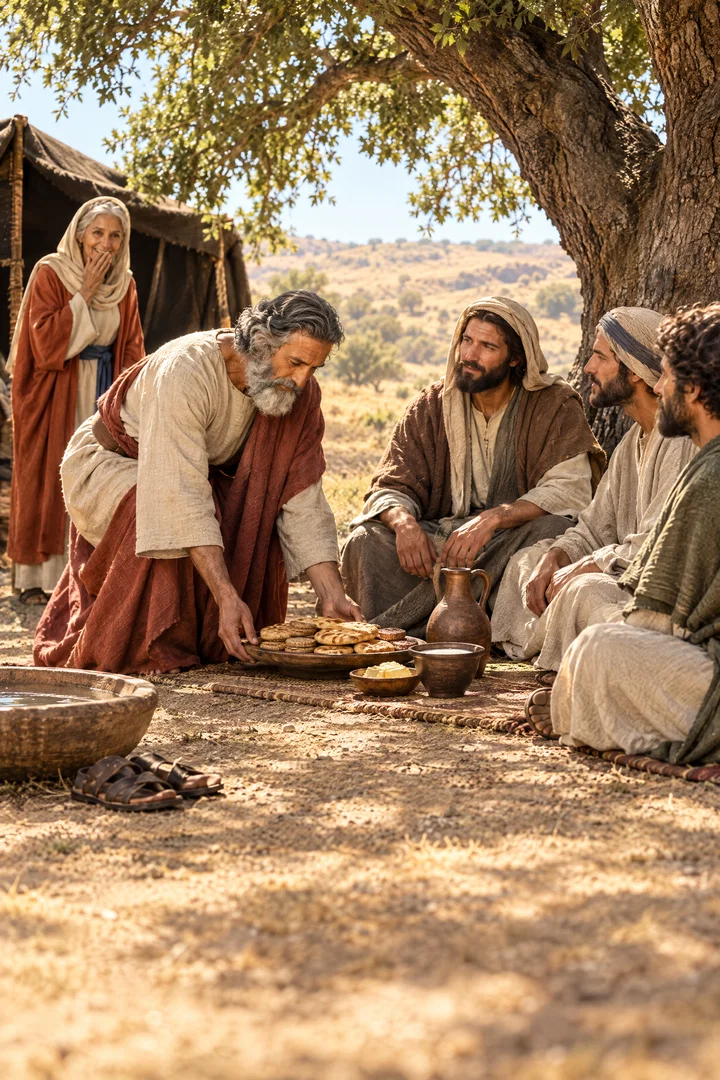
Cross-references
- Genesis 19:1-3
And there came two angels to Sodom at even; and Lot sat in the gate of Sodom: and Lot seeing them rose up to meet them; and he bowed himself with his face toward the ground;
Angels appear to Lot in human form, and he offers them hospitality.
- Hebrews 13:2
Be not forgetful to entertain strangers: for there by some have entertained angels unawares.
Abraham welcomes strangers, illustrating hospitality that unknowingly entertains angels.
- 1 Peter 4:9
Use hospitality one to another without grudging.
hospitality is to one another without grudging
- Judges 6:18-21
Depart not hence, I pray thee, until I come unto thee, and bring forth my present, and set it before thee. And he said, I will tarry until thou come again.
Gideon hosts the angel as Abraham hosted his guests.
- Judges 19:21
So he brought him into his house, and gave provender unto the asses: and they washed their feet, and did eat and drink.
The guests wash their feet after being welcomed into the house.
- Acts 12:7-9
And, behold, the angel of the Lord came upon him, and a light shined in the prison: and he smote Peter on the side, and raised him up, saying, Arise up quickly. And his chains fell off from his hands.
An angel appears in human form and leads Peter from prison.
- Matthew 25:35
For I was an hungred, and ye gave me meat: I was thirsty, and ye gave me drink: I was a stranger, and ye took me in:
Receiving strangers is treated as serving Christ.
- Job 31:32
The stranger did not lodge in the street: but I opened my doors to the traveller.
Job says he did not leave a traveler without shelter.
- Hebrews 7:6-7
But he whose descent is not counted from them received tithes of Abraham, and blessed him that had the promises.
Melchizedek blesses Abraham, showing he is greater than Abraham.
- Genesis 19:2-3
And he said, Behold now, my lords, turn in, I pray you, into your servant’s house, and tarry all night, and wash your feet, and ye shall rise up early, and go on your ways. And they said, Nay; but we will abide in the street all night.
Lot welcomes and presses visiting angels to stay.
- Genesis 24:32
And the man came into the house: and he ungirded his camels, and gave straw and provender for the camels, and water to wash his feet, and the men’s feet that were with him.
Water is provided for the travelers to wash their feet.
- Hosea 12:4
Yea, he had power over the angel, and prevailed: he wept, and made supplication unto him: he found him in Beth-el, and there he spake with us;
Both describe angels appearing in human form.
- Matthew 25:43
I was a stranger, and ye took me not in: naked, and ye clothed me not: sick, and in prison, and ye visited me not.
Refusing hospitality to a stranger is condemned in the judgment.
- Genesis 18:22
And the men turned their faces from thence, and went toward Sodom: but Abraham stood yet before the LORD.
distinguishes the Lord from the two men
- Genesis 18:17
And the LORD said, Shall I hide from Abraham that thing which I do;
God reveals the plan concerning Sodom after Abraham’s hospitality.
- Judges 13:6
Then the woman came and told her husband, saying, A man of God came unto me, and his countenance was like the countenance of an angel of God, very terrible: but I asked him not whence he was, neither told he me his name:
Both describe a divine messenger appearing in human form.
- Romans 12:13
Distributing to the necessity of saints; given to hospitality.
Commands believers to practice hospitality as Abraham did.
- Genesis 19:27-28
And Abraham gat up early in the morning to the place where he stood before the LORD:
Abraham views the aftermath of Sodom’s destruction.
Commentary
Each commentary is drawn from primary sources: the writings of Ellen G. White and Adventist pioneers and periodicals. Each commentary is separate. Its own words are not a quotation; follow the references to read the source passages.
Ellen G. White
21 sources
Abraham offers a little food and rest to comfort the hearts of his guests before they go on their way, and they agree to stay for it.ST Dec 1, 1909ST Dec 13, 1905PP 158.1–2 In the heat of a summer noon he is resting in his tent door under the oaks of Mamre when he sees three passing travelers who ask nothing of him, yet though old and honored and rich he runs to meet them, bows low, begs them to remain, washes their feet with his own hands, has food prepared and stands by them as they rest in cool shade.ST Nov 6, 18796T 341.1–2 He thinks he is only being kind to weary strangers, but his guests are heavenly angels entertained without knowing it, two bound for Sodom and one the Son of God Himself, their Commander and Creator and King.Ms 201, 1903, par. 10–11ST Oct 9, 18936T 341.1–2 In this God is working through holy angels for the help and deliverance of His people, sending them as ministers who come in human form as wayfarers, rest as if weary, and accept the hospitality of human homes.4SP 447.3GC88 512.1GC 631.1–632.1 His welcome stands as the finest pattern of true courtesy and unselfish kindness, and the same privilege is still open now, for by entertaining strangers homes may still receive angels and leave a blessing behind them.Ms 201, 1903, par. 10–11ST Nov 6, 1879Lt 49, 1875, par. 21–236T 342.1–3
The Offer and Visitors
The verse is Abraham offering bread and food with refreshment and rest to comfort and refresh his guests before they continue on their journey, and they accept his offer.ST Dec 1, 1909ST Dec 13, 1905PP 158.1–2Ms 7, 1897, par. 6–7Lt 108, 1901, par. 9–10
It is hot summer noontide in the heat of the day.ST Nov 6, 18796T 341.1–2 Abraham is resting in his tent door under the shadow of the oaks of Mamre when he sees three travelers passing near.ST Nov 6, 18796T 341.1–2 They make no appeal and solicit no favor, yet he will not let them go on their way unrefreshed.6T 341.1–2
Though a man full of years, of dignity and wealth, highly honored and accustomed to command, he runs to meet them, bows to the ground, and begs them to remain.6T 341.1–2 He brings water with his own hands to wash the dust of travel from their feet, and they rest under cooling shade while he himself selects their food and Sarah makes ready.6T 341.1–2 He stands respectfully beside them while they eat.6T 341.1–2 He serves them simply as wayfarers and passing strangers who might never come his way again.6T 341.1–2
The visitors are heavenly angels entertained unawares.Ms 201, 1903, par. 10–116T 341.1–26T 342.1–3 Two of them are on the way to destroy Sodom for its great wickedness.Ms 201, 1903, par. 10–11ST Oct 9, 1893 One of them is the Son of God, their glorious Commander, his Creator, Redeemer, and King.6T 341.1–2Ms 7, 1897, par. 6–7 Abraham thinks he is only showing courtesy to weary human travelers and unknown strangers.Ms 201, 1903, par. 10–11Ms 7, 1897, par. 6–7
Angelic Ministry and Blessing
Genesis 18:5 shows God working through holy angels for the succor and deliverance of His people, sending them on a mission of mercy as ministers to His children.4SP 447.3GC88 512.1GC 631.1–632.1GC88 631.2–632.1 Celestial beings take an active part in the affairs of men by coming as men in the garb of wayfarers, appearing in human form to men of God, resting as if weary under the oaks at noon, and accepting the hospitalities of human homes.4SP 447.3GC 631.1–632.1GC88 631.2–632.1 Heavenly ministering angels frequently disguise themselves in the form of human beings and bear an active part in human life.5MR 353.1–354.1 They visit the world, eat at the humble board of families, and often appear as weary travelers in need of shelter for the night, as they did when they came to Abraham.5MR 353.1–354.1
What is owed to such angelic care and interposition will not be fully understood until the providences of God are seen in the light of eternity.ED 304.3–4 Then the veil between the visible and the invisible world will be drawn aside and wonderful things will be revealed.ED 304.3–4 The visitors in Genesis 18:5 accept human hospitality while bringing promises of blessing.ST Dec 1, 1909GC88 512.1 Abraham welcomes them as guests and offers them food and refreshment before they continue on their journey.ST Dec 1, 1909
At hot summer noontide he sees three travelers passing near who make no appeal and solicit no favor, yet he will not let them go on their way unrefreshed.6T 341.1–2 Though a man full of years, of dignity and wealth, highly honored and accustomed to command, he runs to meet them, bows to the ground, begs them to remain, brings water with his own hands to wash the dust of travel from their feet, himself selects their food while Sarah makes ready and they rest under cooling shade, and stands respectfully beside them while they eat, serving them simply as wayfarers and passing strangers who might never come his way again.6T 341.1–2 In doing so he ministers unknowingly not only to heavenly angels but to their glorious Commander, his Creator, Redeemer, and King.6T 341.1–2 When the entertainment is over the counsels of heaven are opened to him and he is called the friend of God, showing that welcoming strangers with such practical kindness in offering travelers food and refreshment before they continue their journey is a small act that can bring blessing.6T 341.1–2PP 158.1–2 The angels of God who communed with Abraham once tarried to share his hospitality, and Gideon acted on that precedent when he entreated the divine Messenger to remain as his guest and hastened to prepare a kid and unleavened cakes from his scanty store and set them before Him.PP 546.1–547.2
Hospitality Duty Today
Abraham's welcome is the finest example of the power of true courtesy and of what is due from one person to another, the conduct of a true gentleman and a Christian gentleman.Lt 49, 1875, par. 21–2319MR 12.2–13.2 It is representative of courteous, kind and loving conduct toward others, showing politeness, courtesy, benevolence, kindness and attentiveness wrought by the moulding and fashioning of mind and heart even without printed instruction.Ms 201, 1903, par. 10–11Lt 80, 1894, par. 1 His hastening to provide for the needs of three travelers in the heat of the day is an example of that courtesy and of freedom from selfishness.ST Nov 6, 1879
Practicing hospitality is a duty that brings blessing, and his welcome is an example of Bible courtesy that can open hearts to receive the truth and glorify God.6T 341.1–2Lt 108, 1901, par. 9–10 At hot summer noontide, while resting in his tent door under the shadow of the oaks of Mamre, he saw three travelers passing near who made no appeal and solicited no favor, yet he would not let them go on their way unrefreshed.6T 341.1–2 Though a man full of years, of dignity and wealth, highly honored and accustomed to command, he ran to meet them, bowed to the ground, begged them to remain, brought water with his own hands to wash the dust of travel from their feet, himself selected their food while Sarah made ready and they rested under cooling shade, and stood respectfully beside them while they ate.6T 341.1–2 He served them simply as wayfarers and passing strangers who might never come his way again, yet in doing so he ministered unknowingly not only to heavenly angels but to their glorious Commander, his Creator, Redeemer and King, and when the entertainment was over the counsels of heaven were opened to him and he was called the friend of God.6T 341.1–2
His offering of bread and refreshment to passing strangers as an act of courtesy and hospitality to unknown travelers was important enough for God to record in His word.6T 342.1–3 Those strangers were angels entertained unawares, and the privilege granted to Abraham in ministering to them is not denied now.6T 342.1–3 By showing hospitality to God's children, homes may still receive angels into their dwellings, for even in our day angels in human form enter homes and are entertained.6T 342.1–3 Christians who live in the light of God's countenance are always accompanied by unseen angels, and these holy beings leave behind a blessing in the home.6T 342.1–3
In Genesis 18-19 this offer stands as a call to seek the Lord most earnestly and to take a more decided stand for Him.Ms 29, 1887, par. 57 It calls for being not only professed believers in the truth but obedient to all of God's requirements.Ms 29, 1887, par. 57 It calls for heartfelt confession of sin and earnest prayer, with hearts softened and subdued by the Spirit of God.Ms 29, 1887, par. 57
Sources
Pioneers and periodicals
80 sources
At his tent door on the plain of Mamre at hot noonday Abraham as a servant offered unfamiliar travelers a morsel of bread to refresh their hearts and rest before passing on, and they accepted his offer.ST Oct 6, 1887ST Mar 9, 1888ST Oct 17, 1895ST Oct 1, 1902ST Nov 29, 1910 The three men were the Lord Jehovah the Son of God come to converse with Abraham with two angels on their way to investigate and destroy Sodom, yet at first taken for ordinary tired wayfarers.RH Feb 9, 1869ST Mar 9, 1888ST Jun 3, 1908RH Mar 30, 1916 The visit renewed the promise that aged Abraham and Sarah would have the child of promise in the miraculous birth of Isaac, and it brought the announcement of Sodom's doom with Abraham's great intercessory pleading for the city.ST Aug 28, 1901ST Sep 8, 1898ST Nov 24, 1914RH Feb 18, 1915RH Mar 30, 1916 The angels were real corporeal persons with bodily form who spoke, walked, sat in his tent and ate the material food he offered.ST Jul 23, 1874ST Jan 17, 1878RH Jul 12, 1864RH Apr 9, 1872RH Apr 10, 1913 The verse therefore teaches generous unselfish hospitality to unfamiliar strangers and travelers, given freely for their good, for in entertaining strangers some have entertained angels unawares.RH Feb 9, 1869STST Mar 9, 1888ST Dec 7, 1904CO 75.2–76.3
Words and Setting
Abraham sat at his tent door on the plain of Mamre at Hebron, beneath a tree, at hot noonday in the heat of the day when the visitors came to him.ST Nov 6, 1879ST Oct 1, 1902ST Nov 29, 1910ST Dec 23, 1889 The scene belongs to the visit paid to him by God or Christ with two angels, appearing as three men and travelers, whom he welcomed and entertained there.ST Nov 6, 1879ST Oct 1, 1902ST Nov 29, 1910 His hospitality there is set beside Job and his friends sitting beneath a tree.ST Dec 23, 1889
As servant to his guests he offered to fetch a morsel of bread to comfort and refresh their hearts and to give them food and rest before they should pass on, recognizing that they had come to him and inviting them to stay.ST Oct 6, 1887ST Mar 9, 1888ST Oct 17, 1895ST Oct 31, 1895 They answered, So do as thou hast said, accepting his offer to share his hospitality and continue their journey afterward.ST Oct 6, 1887ST Oct 17, 1895ST Oct 31, 1895 The welcome was given freely to passing strangers and unfamiliar wayfarers, after the custom of calling even a passing stranger one who had been invited.ST Mar 9, 1888RH Oct 22, 1901 The Hebrew word for servant which he used of himself does not by itself mean a person held in involuntary or abject bondage.RH May 30, 1865
The meal then quickly prepared was plain and temperate in quantity and variety, unleavened bread with veal, milk and butter, with no long delay to set a table full of varied delicacies. After he had received the promise of a son, he in thanksgiving prepared unleavened bread and meat as a peace-offering, which the visitors ate, and the promise of a son was then confirmed to him again.RH Jun 13, 1912
The visit occurred in the same year as the formal establishment and gracious renewal of the covenant promises to Abraham, just before Isaac's birth.ST Oct 4, 1883RH Jun 23, 1903RH Oct 25, 1853 It brought both the announcement that Isaac would be born and the announcement of Sodom's destruction.ST Oct 4, 1883RH Jun 23, 1903
Heavenly Visitors Identified
Three men came to Abraham at Mamre, one of whom was the Lord Himself, Jehovah, the Son of God, Christ, while the other two were angels accompanying Him.ST Mar 9, 1888ST Jun 3, 1908RH Nov 27, 1913RH Apr 9, 1857 He came in the form of a man among men to converse with Abraham, to bring him into Heaven's confidence, to tell him of Sodom's doom, and to patiently hear his pleas for the city.ST Jun 3, 1908ST Nov 29, 1910 The visit was paid one hot noonday as Abraham sat at his tent door in Hebron on the plain of Mamre, showing how for 2,000 years after the fall God appeared to men in human form to converse with, instruct and reprove them.ST Nov 29, 1910RH Nov 27, 1913RH Apr 9, 1857 In that interview two persons communed and deliberated together upon Sodom's fate with magnanimous concessions to Abraham's requests, and settled the purpose touching the birth of Isaac in that same year, after which God left off talking with Abraham.ST Nov 29, 1910 Abraham as servant entertained his guests by offering a morsel of bread to comfort their hearts before they passed on, and this hospitality to heavenly guests becomes the basis for the exhortation not to forget to entertain strangers, since some have entertained angels unawares.ST Mar 9, 1888RH Nov 27, 1913 The private visit and interview resulted in the salvation of Lot and his two daughters.RH Nov 27, 1913
The visitors were on their way to Sodom to investigate it, to warn of its overthrow, and to destroy it.ST Oct 9, 1893RH Mar 30, 1916RH Jan 27, 1910 Abraham courteously entertained the two angels at his tent before they went on to Sodom, while the Lord remained with Abraham.ST Oct 9, 1893 Their stop at his tent formed the setting for the announcement of Sodom's doom and for Abraham's plea for its people.
They appeared as unfamiliar travelers and men, so that Abraham at first took them for ordinary tired wayfarers and welcomed them without knowing their heavenly identity.RH Jan 9, 1908RH Feb 9, 1869ST Jan 11, 1905ST Aug 14, 1901 He offered them food to refresh them and bread to comfort their hearts, that they might rest and regain strength before continuing their journey.RH Jan 9, 1908RH Feb 9, 1869ST Jan 11, 1905 His offer expressed simple, sincere and generous care for strangers, given freely for their good rather than for payment or reward, and his treatment of them showed his faithfulness.RH Jan 9, 1908RH Feb 9, 1869ST Aug 14, 1901 His act stands as the pattern of true hospitality commanded toward strangers, meaning needy travelers and saints and fellow believers, not idle tramps who will not work.ST Jan 11, 1905
Promise and Coming Judgment
The visit renewed the promise that Abraham's seed would be perpetuated and favored above all other people, and that his aged wife Sarah, though she and Abraham were old and stricken in age, would be the mother of the child of promise.ST Aug 28, 1901ST Sep 8, 1898 The promise seemed unbelievable to Abraham and Sarah, and Sarah laughed within herself at it, then denied laughing from fear when asked why she laughed.ST Aug 28, 1901ST Sep 8, 1898 The Lord declared that nothing is too hard for Him and that He would return at the appointed time of life and Sarah would have a son, and His word proved true in the miraculously begotten birth of Isaac to their old age, born out of due time.ST Aug 28, 1901ST Sep 8, 1898 Isaac's name means laughter, turning Sarah's laughter into rejoicing so that all who hear laugh with her, and all who believe are Isaacs, redeemed and recreated and born from above by the same word of God, laughing and rejoicing in the salvation of God.ST Aug 28, 1901 The birth promised there was as miraculous as a new creation, a miracle of the Spirit of God wrought at the very beginning of Abraham's seed.ST Nov 15, 1899 The covenant and the promises and the Seed came through Isaac and not through Ishmael, who was born according to the flesh, which proves the true seed of Abraham is spiritual.ST Nov 15, 1899 Those who like Isaac are born through promise are the children of promise counted for the seed, while the children of the flesh are not the children of God.ST Nov 15, 1899
Before destroying the cities of the plain God revealed His purpose to Abraham His righteous servant, so that warning could be given before judgment and those who feared His word could escape.ST May 9, 1878ST Mar 8, 1883ST Oct 31, 1895 That warning to Abraham was followed by a warning to Lot so he could be prepared.ST Mar 8, 1883 The private visit and interview with Abraham, in which Abraham welcomed Christ and two angels and provided for them before they continued on their way, resulted in the salvation of Lot and his two daughters.RH Nov 27, 1913 The chapter is the setting for the announcement of Sodom's doom and contains Abraham's great intercessory prayer and pleading with Christ for Sodom and its people.ST Nov 24, 1914RH Feb 18, 1915 That pleading manifests prayer as the Christian's life and as evidence of new life, and shows Abraham as the friend of God whose life manifested prayer.RH Feb 18, 1915 The Visitor pleaded with was the divine Son of God, the same One throughout, who existed in the form of God, took the form of an angel as Michael the Archangel chief in service, and in the fulness of time was born of a woman under the law to redeem them under the law, died and rose again, proving He was both divine and human while on earth and did not lose His divine identity by becoming man.ST Nov 24, 1914
The account belongs to God's providential dealings with Abraham's family, chosen as progenitor of the Seed, highlighting God's providential care and interest among people.ST Dec 20, 1910ST Abraham recognized the arrival of his visitors as an opportunity to serve them, offering them food and rest before they continued their journey.
Nature of Angels and God
The three who came to Abraham's tent were real, corporeal persons with bodily form and shape, not essence without a particular place, who spoke with him, walked, sat in his tent, and ate the material food he fetched to comfort their hearts before they passed on.ST Jul 23, 1874ST Jan 17, 1878RH Apr 9, 1872ST Aug 23, 1877ST Feb 13, 1879 Their acceptance of bread to refresh them and rest before continuing their journey proves that even angels can eat physical food when it is served.ST Jul 23, 1874RH Apr 9, 1872RH Mar 26, 1914 Angels are spirit beings who can appear in human shape as literal beings and travelers, and being spirits does not mean lacking bodies.RH Jul 12, 1864RH Sep 18, 1855RH Jun 18, 1861 They lay down, ate and drank, conversed, took hold of Lot's hand, and met ordinary people in everyday settings as welcomed guests.RH Jul 12, 1864RH Sep 18, 1855ST Aug 10, 1915RH Oct 8, 1903ST Nov 25, 1880 They are real heavenly beings commissioned by God rather than mere influences or impulses, and not disembodied human spirits.RH Jul 12, 1864RH Apr 10, 1913
These communications and ministrations came from a distinct order of beings who existed before humanity, who were not dead and had never been dead, and who are not the spirits of the dead.ST Jan 9, 1893 They are sent to minister for those who shall be heirs of salvation, coming in person to labor for human salvation with interest, solicitude and watchful care.RH Nov 5, 1872 Their willingness to share Abraham's hospitality displays their friendly, sociable nature.RH Oct 29, 1901 The divine Visitor among them was the Son of God, the same One throughout, who existed in the form of God, took the form of an angel as Michael the Archangel, chief in service, and in the fulness of time was born of a woman under the law to redeem those under the law, died and rose again.ST Nov 24, 1914 His so appearing and pleading heard by Abraham proves He was both divine and human while on earth and did not lose His divine identity by becoming man.ST Nov 24, 1914
Because angels appearing to men in bodily form always in human shape lay down, ate food and took hold of Lot's hand, a spirit or spiritual being has bodily form and being a spirit does not mean being without shape or body.RH Apr 16, 1872RH Jun 18, 1861 Since God is a Spirit and angels are spirits, God in the highest sense must possess bodily form with personal form as the instrumentality for the manifestation of His powers, so that man can be physically in the image of God in his whole upright, godlike frame.RH Apr 16, 1872RH Jun 18, 1861 Abraham's entertaining them and feeding them when he fetched bread to comfort their hearts shows that angels in heaven are literal persons possessing body and parts, as seen likewise by many, and the saints in the resurrection are as those angels in heaven.RH Jun 8, 1869 An angel acting as the Lord's servant or agent is frequently called Lord.RH Nov 10, 1859 Abraham addressed the visitors in the plural about their personal comfort, while their mission and communications were treated as coming directly from God, so he received communication from God through them as messengers.RH Nov 10, 1859RH Feb 28, 1856
For two thousand years after the fall God appeared to men, conversed with men, and instructed and reproved them in the form of man, as in the visit God or Christ with two angels paid to Abraham one hot noonday as he sat at his tent door in Hebron on the plain of Mamre.ST Nov 29, 1910 The chapter shows two persons communing together, with magnanimous concessions made to Abraham's requests when they two deliberated upon Sodom's fate, and in that same year an intensely interesting talk with His friend Abraham settling the purpose touching the birth of Isaac, after which God left off talking with Abraham.ST Nov 29, 1910 Such appearing is an example of God coming to His people when He especially favors them or carries out judgment, rather than necessarily coming in person.RH Jan 24, 1856
Hospitality Taught
The verse shows generous hospitality to unfamiliar strangers and travelers, offering food to refresh and strengthen them and rest before they continue their journey.RH Feb 9, 1869STST Aug 25, 1898 Abraham welcomes them freely for their good rather than for payment or reward, and urges the offer upon them until they accept it, making the welcome a genuine act of hospitality.ST Dec 1, 1909RH Feb 9, 1869ST He recognizes their arrival as an opportunity to serve them, and his courtesy in providing food to comfort them is hospitality to heavenly visitors received as guests.ST Dec 1, 1909ST Aug 25, 1898 While they share his hospitality they bring him promises of blessing.ST Dec 1, 1909
Because the three men at Mamre included the Lord with two angels in human appearance, this hospitality becomes the basis for the exhortation not to forget to entertain strangers, since some have entertained angels unawares.ST Mar 9, 1888ST Dec 7, 1904CO 75.2–76.3RH Jan 23, 1855RH Oct 22, 1901 Abraham offers a morsel of bread to comfort their hearts before they pass on, as a servant entertaining his guests, and caring for a stranger in this way can mean serving a divine messenger without knowing it.ST Mar 9, 1888ST Dec 7, 1904RH Feb 9, 1869 Welcoming strangers in this way can mean welcoming angels into one's home, as Lot likewise entertained angels without knowing who they were.CO 75.2–76.3RH Jan 23, 1855RH Oct 22, 1901 The account of Genesis 18:2-5 is therefore given as a reason to welcome unfamiliar travelers with food and refreshment before they continue their journey.RH Oct 22, 1901RH Feb 9, 1869
Abraham's welcome exemplifies genuine courtesy, freedom from selfishness, and faithfulness, welcoming travelers in need of kindness even when the guest receiving it is the Lord.ST Nov 6, 1879ST Jan 4, 1905RH Feb 21, 1907RH Dec 22, 1910ST Aug 14, 1901 He hastens to provide for the needs of three visitors in the heat of the day, taking them at first to be ordinary travelers.ST Nov 6, 1879ST Aug 14, 1901 This example illustrates the lesson of hospitality taught by Jesus and repeatedly urged in Scripture, and the commanded duty not to neglect hospitality toward strangers.ST Jan 4, 1905RH Feb 21, 1907
Hospitality here is timely kindness that invites heavenly visitors to stay and share fellowship rather than letting them pass by.ST Apr 17, 1879CO 75.1STST Dec 1, 1909ST Mar 11, 1903 Abraham sitting at his tent entrance and offering bread to refresh their hearts presents a call to make room for holy fellowship in ordinary life rather than postponing it until life's work is finished or until a later season.ST Apr 17, 1879STST Dec 1, 1909 It is an image of opening the heart to angel guests through kindness, while a heart left cold by selfishness and with deeds of kindness delayed until "all too late" is not ready to welcome them.RH Jun 29, 1911 His hospitality was service to guests who had come to him, and Abraham's home was blessed by such service, presenting comfort to guests before they continue on their journey.CO 75.1ST Mar 11, 1903
Their willingness to share Abraham's hospitality is compared with their receiving Lot's hospitality in Sodom, both offering bread to refresh them before they continued on their way and both having the offer accepted.ST Oct 6, 1887 Abraham cordially entertaining three strangers with bread to comfort their hearts, at first supposing they were only tired wayfarers when they were angels, is the pattern of true hospitality commanded toward strangers.ST Jan 11, 1905 That true hospitality means cordial care for needy travelers and saints and fellow believers, not for idle tramps who will not work.ST Jan 11, 1905
Following the Example
Offering food and refreshment to visiting guests was ordinary hospitality, in which guests were given water to wash their own feet, and this providing of water is distinct from Jesus' washing of His disciples' feet as a spiritual lesson of humility.ST Aug 5, 1886ST Oct 24, 1900 Abraham's offer of a morsel to comfort his visitors belongs to that common custom of refreshment, not to a host himself performing the washing.ST Aug 5, 1886ST Oct 24, 1900
Sarah's part in quickly preparing food fit for angels to eat exemplifies women's proper work in keeping the household.RH Nov 13, 1900 That same preparation for the angels and for her family is serving others and the family as missionary work for God.RH Oct 3, 1907 Abraham's own hastening to prepare food and attend to unexpected guests shows he remained nimble and vigorous at a hundred years of age.RH Mar 31, 1903
The fact that the angels ate flesh meat during the visit proves that eating flesh is not sin.RH Sep 24, 1901 It further shows that circumstances can make eating flesh better than abstaining.RH Sep 24, 1901 The welcome given to visitors in Basartschai is compared to Abraham's generous reception with food and refreshment before continuing the journey, holding the account up as a present model. The account of Abraham and the angels can also be represented in a home as a picture that inspires holiness and gives children a worthy ideal.RH Feb 18, 1909
Abraham welcomed his angelic visitors as guests by offering them food and refreshment before they continued their journey, and they accepted his offer.ST Dec 1, 1909ST Dec 13, 1905 Their acceptance of human hospitality while bringing Abraham promises of blessing displays their friendly, sociable nature.ST Dec 1, 1909RH Oct 29, 1901 Heavenly visitors could thus meet ordinary people in everyday settings and be welcomed with practical hospitality.ST Dec 13, 1905RH Oct 29, 1901
Sources