Genesis 18:4
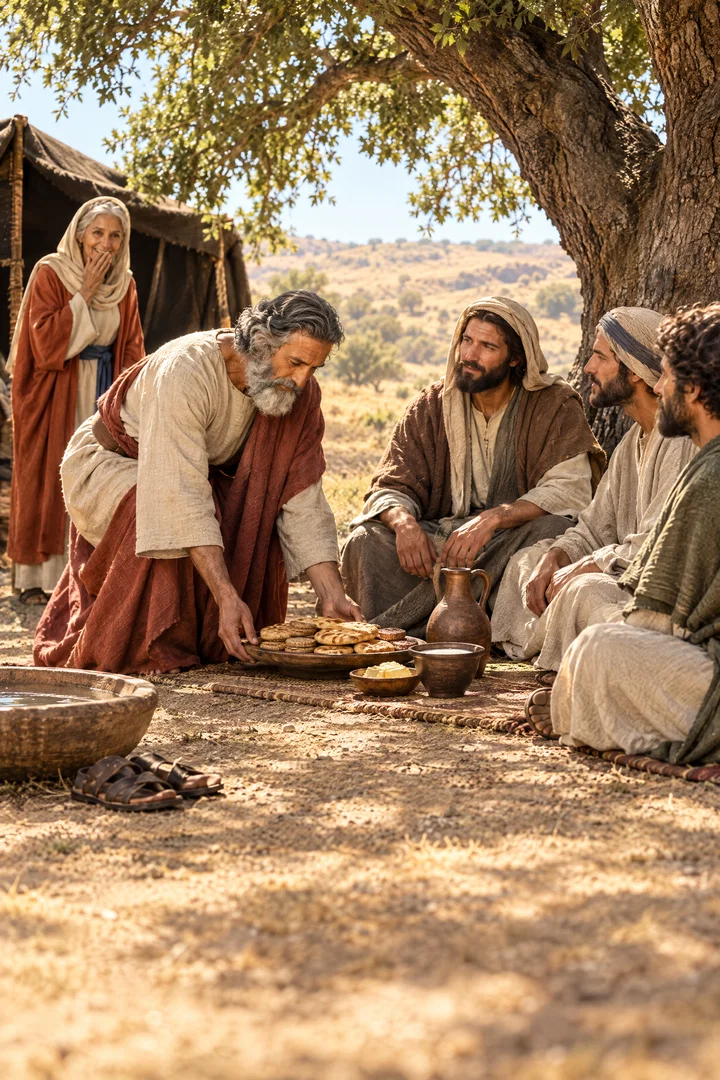
Let a little water, I pray you, be fetched, and wash your feet, and rest yourselves under the tree:
Translations
American King James Version, King James Version
Let a little water, I pray you, be fetched, and wash your feet, and rest yourselves under the tree:
let a little water, I pray you, be fetched, and wash your feet, and rest yourselves under the tree:
Let a little water, I pray you, be brought, and wash your feet, and rest yourselves under the tree:
Revised Version, American Standard Version
let now a little water be fetched, and wash your feet, and rest yourselves under the tree:
let, I pray thee, a little water be accepted, and wash your feet, and recline under the tree;
Let now a little water be fetched, that ye may wash your feet, and rest yourselves under the tree.
Let there be fetched, I pray thee a little water, and bathe ye your feet,—and rest yourselves under the tree.
Berean Standard Bible, Majority Standard Bible
Let a little water be brought, that you may wash your feet and rest yourselves under the tree.
Now let a little water be fetched, wash your feet, and rest yourselves under the tree.
Let me get water for washing your feet, and take your rest under the tree:
Let a litle water, I pray you, be brought, and wash your feete, and rest your selues vnder the tree.
Douay-Rheims (Challoner revision)
But I will fetch a little water, and wash ye your feet, and rest ye under the tree.
Pictures
Cross-references 20 of 22
- Genesis 19:2
And he said, Behold now, my lords, turn in, I pray you, into your servant’s house, and tarry all night, and wash your feet, and ye shall rise up early, and go on your ways. And they said, Nay; but we will abide in the street all night.
Lot likewise invites his guests to rest and wash their feet.
- Hebrews 13:2
Be not forgetful to entertain strangers: for there by some have entertained angels unawares.
Abraham welcomes strangers who are angels, without knowing their identity.
- Genesis 43:24
And the man brought the men into Joseph’s house, and gave them water, and they washed their feet; and he gave their asses provender.
Guests are given water to wash their feet.
- Luke 7:44
And he turned to the woman, and said unto Simon, Seest thou this woman? I entered into thine house, thou gavest me no water for my feet: but she hath washed my feet with tears, and wiped them with the hairs of her head.
Both describe water for washing a guest’s feet as a customary courtesy.
- Judges 19:21
So he brought him into his house, and gave provender unto the asses: and they washed their feet, and did eat and drink.
Both hosts provide for their guests to wash their feet.
- Genesis 24:32
And the man came into the house: and he ungirded his camels, and gave straw and provender for the camels, and water to wash his feet, and the men’s feet that were with him.
Water is provided for guests to wash their feet.
- Genesis 18:16-17
And the men rose up from thence, and looked toward Sodom: and Abraham went with them to bring them on the way.
The visitors continue toward Sodom, and God makes Abraham a confidant.
- John 13:1-17
Now before the feast of the passover, when Jesus knew that his hour was come that he should depart out of this world unto the Father, having loved his own which were in the world, he loved them unto the end.
Christ’s washing of the disciples’ feet is contrasted with the ordinary practice described in Genesis 18:4.
- Genesis 19:1
And there came two angels to Sodom at even; and Lot sat in the gate of Sodom: and Lot seeing them rose up to meet them; and he bowed himself with his face toward the ground;
Angels appear as men and are received as guests.
- 1 Peter 4:9
Use hospitality one to another without grudging.
Instructs believers to show hospitality without complaint.
- Romans 12:13
Distributing to the necessity of saints; given to hospitality.
Both texts urge believers to provide for others through hospitality.
- John 13:14-15
If I then, your Lord and Master, have washed your feet; ye also ought to wash one another’s feet.
contrasts Christ's washing with hospitality custom
- 1 Samuel 25:41
And she arose, and bowed herself on her face to the earth, and said, Behold, let thine handmaid be a servant to wash the feet of the servants of my lord.
Foot washing expresses humility, contrasting subjection with hospitality.
- Genesis 18:8
And he took butter, and milk, and the calf which he had dressed, and set it before them; and he stood by them under the tree, and they did eat.
The visitors eat the meal Abraham serves.
- Genesis 24:21
And the man wondering at her held his peace, to wit whether the LORD had made his journey prosperous or not.
Cited as another instance of water being provided for a guest to wash his feet.
- Song of Solomon 5:3
I have put off my coat; how shall I put it on? I have washed my feet; how shall I defile them?
shows person washing own feet
- Matthew 25:43
I was a stranger, and ye took me not in: naked, and ye clothed me not: sick, and in prison, and ye visited me not.
Refusing hospitality to a stranger is included among the grounds for judgment.
- Matthew 25:35
For I was an hungred, and ye gave me meat: I was thirsty, and ye gave me drink: I was a stranger, and ye took me in:
Welcoming strangers is treated as service to Christ.
- Genesis 19:27-28
And Abraham gat up early in the morning to the place where he stood before the LORD:
Abraham observes the aftermath of Sodom’s destruction.
- Judges 6:18-19
Depart not hence, I pray thee, until I come unto thee, and bring forth my present, and set it before thee. And he said, I will tarry until thou come again.
Gideon follows Abraham’s example of hospitality.
Commentary
Each commentary is drawn from primary sources: the writings of Ellen G. White and Adventist pioneers and periodicals. Each commentary is separate. Its own words are not a quotation; follow the references to read the source passages.
Ellen G. White
20 sources
At the hot noontide under the oaks of Mamre Abraham offered three passing travelers who asked for nothing a little water to wash the dust of travel from their feet and rest in the cooling shade while refreshments and food were made ready.Ms 201, 1903, par. 10–11ST Oct 9, 18936T 341.1–2 He served promptly and personally with his own hands and stood respectfully beside them while they rested and ate, not knowing he was entertaining angels, including the Son of God, his glorious Commander, Creator, Redeemer, and King.Ms 201, 1903, par. 10–116T 341.1–2ST Nov 6, 18796T 342.1–3 The verse shows holy angels appearing in human form as weary wayfaring men who accept a human home and even eat at its board, through whom God works for the succor and deliverance of His people in missions of mercy.ST Dec 1, 19094SP 447.3ED 304.3–4GC 631.1–632.1 Abraham's welcome is the finest example of true courtesy and Bible politeness toward unknown strangers, counted important enough for God to record in His word, and the same privilege is not denied now, for by showing hospitality to God's children believers may still receive God's angels into their dwellings and open their hearts to blessing and truth.Ms 201, 1903, par. 10–116T 341.1–219MR 12.2–13.2Lt 49, 1875, par. 21–236T 342.1–3
Hospitality at Mamre
The verse belongs to the coming of three travelers passing by the tent door under the oaks of Mamre at hot summer noontide, who asked for nothing.6T 341.1–2 Abraham met them with the offer of a little water to wash the dust of travel from their feet and rest under the cooling shade of the tree, with refreshments and food made ready while they rested.Ms 201, 1903, par. 10–11ST Oct 9, 18936T 341.1–2ST Nov 6, 1879Lt 49, 1875, par. 21–23 His welcome was courteous care for their human needs as strangers, offering water and rest beneath the tree.ST Oct 9, 1893ST Nov 6, 1879Lt 49, 1875, par. 21–23Ms 7, 1897, par. 6–7
He served promptly and personally, bringing the water with his own hands, having food he himself had selected made ready by Sarah, and then standing respectfully beside them while they ate.6T 341.1–2 His prompt provision for their needs was done simply for passing wayfarers who might never come again.6T 341.1–2ST Nov 6, 1879 He thought he was only helping weary travelers and did not know he was entertaining angels.Ms 201, 1903, par. 10–116T 341.1–26T 342.1–3
Among them was one who was the Son of God, his glorious Commander, his Creator, Redeemer, and King, ministered to together with the heavenly angels with him.6T 341.1–2Ms 7, 1897, par. 6–7 The messengers were sent before the destruction of Sodom for its great wickedness, coming to Abraham with promises of blessing on a mission of mercy to a child of God.Ms 201, 1903, par. 10–11ST Dec 1, 1909GC88 512.1
Angels Ministering to People
Holy angels appear in human form to men of God as wayfaring men in the garb of travelers.4SP 447.3ED 304.3–4GC 631.1–632.1GC88 631.2–632.1 They rest as if weary under the oaks at noon and accept the hospitality of a human home, with a little water for the feet and rest under the tree.4SP 447.3GC 631.1–632.1GC88 631.2–632.15MR 353.1–354.1 Ministering angels thus visit this world disguised as weary travelers in need of shelter for the night, even eating at the humble board of families.5MR 353.1–354.1
Through them God works for the succor and deliverance of His people, with celestial beings taking an active part in the affairs of men.4SP 447.3GC 631.1–632.1GC88 631.2–632.1 This is part of His providential care and interposition through His angels.ED 304.3–4 Angels in all ages have ministered to God's people, and the visit to Abraham with promises of blessing is one example of their being sent on missions of mercy, with holy angels sent on a mission of mercy to a child of God.ST Dec 1, 1909GC88 512.1
The meeting in such an ordinary earthly setting shows that heaven can be near in the common walks of life.ST Dec 13, 1905 Mighty ones take an active part in the work men call their own while so disguised.5MR 353.1–354.1 The visitors included the Covenant Angel who wrought for Israel in time past, and Gideon's asking the divine Messenger to remain as his guest follows Abraham's example of offering hospitality and tarrying to share it, seeking proof that his visitor is that same Covenant Angel.PP 546.1–547.2 What is owed to such angelic care will not be fully understood until seen in the light of eternity.ED 304.3–4
Example of Courtesy Today
Abraham's offer of water for tired feet, rest under the tree, and refreshment stands as the finest example of true courtesy and Bible politeness.Ms 201, 1903, par. 10–1119MR 12.2–13.2Lt 49, 1875, par. 21–23Lt 80, 1894, par. 1Lt 108, 1901, par. 9–10 It expresses kindness, love, benevolence, and thoughtful attentiveness, showing what is due from man to fellow man and to unknown passing strangers.Ms 201, 1903, par. 10–1119MR 12.2–13.2Lt 49, 1875, par. 21–236T 342.1–3Lt 80, 1894, par. 1 His welcoming of the travelers to his tent as a Christian gentleman is the model of courtesy toward fellow human beings.19MR 12.2–13.2Lt 49, 1875, par. 21–23Lt 80, 1894, par. 1
God counted the act important enough to record in His word.6T 342.1–3 Done simply for passing wayfarers who might never come again, this service ministered not only to heavenly angels but to their glorious Commander, his Creator, Redeemer, and King, and it opened the counsels of heaven to Abraham and led to his being called the friend of God.6T 341.1–2 Lot learned this hospitality and courtesy from Abraham and made it part of his religious life, showing that welcoming strangers can mean welcoming God's messengers and the blessing, hope, and peace they bring.PP 158.1–2
The privilege granted to Abraham is not denied now, for by showing hospitality to God's children believers may still receive God's angels into their dwellings, even angels in human form.6T 342.1–3 The presence of unseen angels who accompany Christians leaves a blessing in the home.6T 342.1–3 Such politeness, courtesy, benevolence, kindness, and attentiveness are to be shown under the Lord's molding and fashioning of the heart, and this Bible courtesy can make hearts open to receive the truth and bring glory to God.Ms 201, 1903, par. 10–11Lt 108, 1901, par. 9–10
Sources
Pioneers and periodicals
77 sources
Abraham welcomed his three visitors at his tent door by having a little water fetched for them to wash their own feet and inviting them to rest under the tree.ST Oct 6, 1887STST Mar 9, 1888RH Jan 27, 1910 He treated them as weary ordinary travelers, serving them promptly and personally with generous, courteous, practical care given freely without expectation of payment or favor.RH Jan 9, 1908RH Feb 9, 1869STRH Dec 22, 1910ST Jan 11, 1905 The host supplied the water while the guests did the washing themselves, which was the ancient Eastern pattern of hospitality with no instance of a host washing his guests' feet himself.RH Feb 24, 1859RH Apr 22, 1862ST Aug 5, 1886RH Jun 16, 1868 Their feet that could be washed and bodies that could rest and eat show they were real embodied personal beings in human form, not bodiless phantoms, and that being called spirits does not mean being without bodily form or unable to eat material food.ST Jul 23, 1874ST Jan 17, 1878RH Jul 12, 1864ST Aug 23, 1877RH Apr 10, 1913 One of the three was Jehovah Himself in human form, come to renew the covenant promise that aged Sarah would bear Isaac the child of promise and to reveal the coming judgment on Sodom before the two angels went on to carry it out.ST Jun 3, 1908ST Nov 15, 1899RH Nov 10, 1859ST Sep 8, 1898
Words and Setting
Genesis 18:4 is Abraham's offer to have a little water fetched for his three visitors so they could wash their feet and rest themselves under the tree.ST Oct 6, 1887ST Mar 9, 1888RH Feb 21, 1907ST Aug 25, 1898 The offer is a customary act of practical hospitality for welcoming and entertaining visitors.ST Mar 9, 1888RH Sep 3, 1903
The offer was made as he sat at his tent door, welcoming the angels who visited him and watching for them rather than letting daily demands keep him from receiving them.STST Apr 17, 1879 It took place on the plain of Mamre at Hebron, among the oaks where he had pitched his tent and built an altar after leaving Bethel.RH Jan 27, 1910ST Nov 29, 1910 That was his permanent dwelling-place and place of worship for nearly twenty years, where he entertained the angels on their way to destroy Sodom.RH Jan 27, 1910RH Jan 27, 1910 It was about fervid midday, when travelers would naturally be tired, hungry and thirsty, and the invitation was made urgently and without advance preparation.STST Nov 29, 1910 The scene can be pictured with a tent, nearby trees, distant mountains and sheep, Abraham, a shepherd, and the three travelers approaching.RH Dec 6, 1906
The offer reflects the Syrian and Eastern custom of hospitality, in which a guest removes his shoes, has his feet washed, and is welcomed to rest and feel at home.RH Jan 8, 1857 The washing of the feet was an ordinary act of cleansing them. Abraham addresses the three visitors in the plural when providing for their personal comfort, because three men or angels had appeared to him, but in the singular when speaking of their mission, showing he understood the message as coming directly from God through angels.RH Feb 28, 1856 In welcoming the visitors he addresses himself as God's servant, where servant is a general term and does not mean a person held in involuntary, abject bondage.RH May 30, 1865
Hospitality in Abraham's Offer
Abraham welcomed weary strangers with practical, generous and courteous care to make them comfortable, offering water for their feet and a place to rest beneath the tree.RH Jan 9, 1908RH Feb 9, 1869STRH Dec 22, 1910 His kindness was given gladly and freely, without expectation of payment, reward or favor, to travelers who had asked for nothing.RH Jan 9, 1908RH Feb 9, 1869RH Dec 22, 1910 He acted urgently and personally without advance preparation, promptly providing for their needs at about fervid midday when travelers would naturally be tired, hungry and thirsty.RH Jan 9, 1908ST Nov 6, 1879ST He ran to serve his unexpected guests, nimble and active even at a hundred years of age, showing that old age need not mean physical weakness.RH Jan 9, 1908ST Nov 6, 1879RH Mar 31, 1903
He treated them as tired wayfarers and ordinary travelers in need of kindness, not knowing at first that they were angels and that one was the Lord himself.RH Feb 9, 1869RH Dec 22, 1910ST Jan 11, 1905ST Aug 14, 1901 His hospitality was simple and quickly prepared, offering only a morsel of bread to comfort their hearts before they passed on. The meal actually served was unleavened bread, veal, milk and butter, with no long delay to set a table full of delicacies. True hospitality so refreshes guests with plain, temperate fare, teaching temperance in quantity and variety at a single meal rather than eating many good things together.
Sarah shared in entertaining the visitors under the tree by preparing food fit for angels to eat, making preparing food part of the proper employment of women as well as men.RH Nov 13, 1900RH Oct 3, 1907 Her preparation of food for the angels and her family was service to God and others, an example of missionary work.RH Oct 3, 1907 In the visit Abraham also prepared unleavened bread and meat as a peace-offering of thanksgiving after receiving the promise of a son, the visitors ate, and the promise was confirmed.RH Jun 13, 1912 The holy visitors accepted Abraham's hospitality just as the same holy beings later accepted Lot's hospitality, challenging a sharp distinction between the two men.ST Oct 6, 1887
Footwashing Custom Clarified
Abraham asked that a little water be fetched so that his visitors could wash their own feet and rest themselves under the tree, the host supplying the water while the guests did the washing themselves, for he did not wash their feet himself.RH Feb 24, 1859RH Apr 22, 1862ST Aug 5, 1886RH Jul 21, 1868RH Jun 16, 1868 The offer was an example of hospitality in which water was furnished for heavenly guests and tired wayfarers to wash and refresh themselves, not an instance of the master of the house washing or offering to wash his guests' feet himself.RH Apr 22, 1862RH Jul 21, 1868RH Jun 16, 1868ST Mar 29, 1899ST Mar 9, 1888 It was customary to offer strangers water so they could wash their own feet, and the verse does not describe a host washing the feet of guests or servants.RH Feb 24, 1859ST Aug 5, 1886RH Jul 21, 1868RH Jun 16, 1868ST Mar 29, 1899
This was the Bible pattern and Eastern custom of hospitality in ancient times, in which the host provided water and the guests washed themselves.RH Apr 22, 1862ST Aug 5, 1886RH Jul 21, 1868RH Jun 16, 1868ST Mar 29, 1899 No instance exists where a host washed his guests' feet himself as an act of hospitality, and even Abraham, renowned for hospitality, did not wash his guests' feet himself, showing that washing a guest's feet was not a host's customary duty.RH Apr 22, 1862ST Aug 5, 1886RH Jun 16, 1868ST Mar 9, 1888
The verse therefore gives no support for calling Christ's washing of His disciples' feet in John 13 an act of hospitality and proves the opposite.RH Apr 22, 1862ST Aug 5, 1886RH Jun 16, 1868ST Mar 9, 1888 His act of girding Himself and washing them Himself in the upper room was entirely out of the usual order and unlike Abraham furnishing water for guests to wash themselves, showing His act was not based on the hospitality customs of that time.RH Apr 22, 1862ST Aug 5, 1886RH Jun 16, 1868ST Mar 9, 1888 It was not an ordinary Jewish custom but a humble act with spiritual meaning, not merely ordinary hospitality but teaching Christian fellowship and service to one another and humility, distinct from the later ordinance of humility.RH Apr 22, 1862RH Jun 16, 1868RH Jan 8, 1867ST Oct 24, 1900ST Mar 9, 1888
Angels as Bodily Beings
The offer of water to wash feet and rest under the tree shows the three visitors had feet that could be washed and bodies that could rest, proving angels appear in human form as real, embodied, personal beings and not phantoms.ST Jul 23, 1874ST Jan 17, 1878RH Jul 12, 1864RH Apr 9, 1872RH Apr 16, 1901 They performed fully physical actions in that form, appearing and conversing and walking and talking, lying down and taking hold of Lot's hand and sharing food.ST Jan 17, 1878RH Jul 12, 1864RH Apr 9, 1872RH Jun 18, 1861 The surrounding account says they ate the food Abraham prepared, and the later account identifies such visitors as angels, establishing that angels have material bodies.ST Jul 23, 1874ST Jan 17, 1878ST Aug 23, 1877
Their eating proves angels can eat material food, so being called spirits does not mean they are bodiless or unable to eat.ST Jul 23, 1874ST Aug 23, 1877ST Feb 13, 1879RH Mar 26, 1914RH Sep 18, 1855 Even angels ate physical food when they visited Abraham, and the same is shown in their eating with Abraham and Lot as literal beings.ST Jan 17, 1878RH Mar 26, 1914RH Sep 18, 1855 These messengers were not spirits of dead people but an entirely different and higher order of beings, for angels existed before anyone had died and had never been dead.ST Jan 9, 1893RH Apr 16, 1901
Being a spirit does not mean being formless and impersonal, for the angels who visited Abraham and Lot were spirit beings with personal bodily form always in human shape.RH Apr 16, 1872RH Jun 18, 1861RH Sep 18, 1855 A spirit or spiritual being must have a bodily form as the instrumentality for manifesting its powers, as shown by their washing feet and resting and lying down and eating and taking hold of the hand.RH Apr 16, 1872RH Jun 18, 1861 They are personal heavenly beings under God's direction who appear in human form and intervene in human affairs, not merely influences or impulses, and their courteous, sociable conduct in accepting Abraham's gracious hospitality shows they are friendly and approachable.ST Aug 23, 1877RH Apr 10, 1913RH Oct 29, 1901
This proves God, who is Spirit in the highest sense, also has bodily form in the same way as those angels, and that man is physically made in the image and likeness of God.RH Apr 16, 1872RH Jun 18, 1861 Abraham's fetching a little water for them to wash their feet and inviting them to rest and then feeding them proves angels in heaven are literal persons possessing body and parts who can be entertained and fed and seen.RH Jun 8, 1869 The saints in the resurrection will be as those angels, with literal incorruptible bodies bearing the image of the heavenly and fashioned like Christ's glorious body.RH Jun 8, 1869 The visit belongs with accounts of angels sent on missions of mercy and ministry to God's people, as ministering spirits for those who shall be heirs of salvation who encamp around those who fear God to deliver them.ST Dec 1, 1909RH Apr 9, 1857RH Nov 5, 1872 By meeting people in ordinary earthly settings with promises of blessing it shows heaven can be near in the common walks of life, and by their coming to secure salvation it proves God's wonderful effort to save man, with angels intensely interested in the plan of salvation and rejoicing when one sinner repents.ST Dec 1, 1909ST Dec 13, 1905RH Nov 5, 1872
Divine Visitor Promise Judgment
One of the three men was Jehovah Himself visiting Abraham in human form, the divine Son of God before His human birth appearing in angelic form as Michael the Archangel, the Angel of Jehovah in whom the Father's name is, the Angel of His presence and God's special messenger.ST Jun 3, 1908RH Nov 10, 1859ST Nov 24, 1914ST Nov 29, 1910 He did not lose His divine identity in taking the form of a servant or angel, but is the same One through it all who later was born of a woman under the law to redeem, died, rose from the dead, and lives forevermore with the keys of death, and an angel acting only as servant or agent of the Lord is frequently called Lord.RH Nov 10, 1859ST Nov 24, 1914 The same divine Being met Abraham before the two angels went on to Lot in Sodom, Abraham welcoming the Lord and two angels at his tent and showing them hospitality with water and rest.ST Jun 3, 1908ST Oct 17, 1895ST Nov 24, 1914 He came to speak with Abraham and commune with him as friend as two persons together, conversing, instructing and reproving in the form of man, to tell him of Sodom's doom and warn of its overthrow, and patiently listened to his pleas, deliberating upon Sodom's fate and making magnanimous concessions to his requests, and when the purpose was settled left off talking with him.ST Jun 3, 1908ST Nov 24, 1914ST Nov 29, 1910
The Lord revealed the coming judgment on Sodom to Abraham before the city was overthrown.ST Mar 8, 1883RH Jun 23, 1903 The angels visited his tent as messengers to carry out that mission of judgment toward Sodom and to warn of its destruction, showing the Lord giving revelations through angelic messengers.RH Aug 7, 1916RH Jun 23, 1903RH Mar 30, 1916RH Jan 23, 1855 The welcome with water for washing feet and rest beneath the tree takes place before the visitors proceed toward Sodom, and the private interview that followed led to the salvation of Lot and his two daughters.RH Nov 27, 1913RH Jan 23, 1855
The visit announced the birth of Isaac and graciously renewed the covenant promises to Abraham in the year the covenant was formally established.ST Nov 15, 1899RH Jun 23, 1903RH Oct 25, 1853 It revealed that his aged wife Sarah would be the mother of the child of promise through whom the covenant, the promises, and the Seed would come, not through Ishmael, with his seed perpetuated and favored above all other people just before Isaac's birth and Sodom's destruction.ST Nov 15, 1899ST Sep 8, 1898ST Oct 4, 1883 Sodom's destruction took place just before Isaac's birth.ST Oct 4, 1883
Sarah, well stricken in age, laughed within herself at the promise and denied that she laughed for fear.ST Aug 28, 1901 She was told that nothing is too hard for the Lord and that at the appointed time according to the time of life Sarah shall have a son.ST Aug 28, 1901 The son was conceived and born to Abraham in his old age at the set time of which God had spoken by the word of God, the child of promise miraculously begotten and born out of due time, and Abraham called his name Isaac, which means laughter, and Sarah said God hath made me to laugh so that all that hear will laugh with her.ST Aug 28, 1901ST Sep 8, 1898 Isaac's birth is as miraculous as a new creation, a miracle of the Spirit of God wrought at the very beginning of Abraham's seed to show the true seed of Abraham is spiritual.ST Nov 15, 1899 The seed of the bondwoman is born after the flesh, but believers, as Isaac was, are children of the freewoman through promise, since the children of the flesh are not the children of God but the children of the promise are counted for the seed, and all who believe or hear are redeemed, recreated and born from above by the same word and are Isaacs in laughing and rejoicing in God's salvation.ST Nov 15, 1899ST Aug 28, 1901
Hospitality Applied Today
Abraham's offer of water for feet and rest under the tree presents hospitality as a lesson taught by example and supports the call to show hospitality.ST Jan 4, 1905 In Hebrew usage a guest was called one who is called in, reflecting the custom of calling strangers in and offering them care.RH Oct 22, 1901 Hospitality means doing what is right and treating others as one would wish to be treated, according to one's ability, without expecting compensation.ST It does not depend on wealth, lavish meals, or fine rooms.ST
His courteous service to unfamiliar visitors exemplifies generous, respectful, practical kindness to travelers and strangers.RH Dec 22, 1910ST Dec 7, 1904 His prompt provision for their needs is an example of courtesy toward others, set as Christian courtesy against mere worldly politeness.ST Nov 6, 1879RH Dec 22, 1910 He treated them as weary travelers in need of kindness, not as people from whom he expected a favor, though one of the guests was the Lord himself, not known at first.RH Dec 22, 1910
His readiness shows watching for visitors and inviting them to stay rather than letting the demands of daily life keep him from receiving them.ST Apr 17, 1879ST That hospitality makes room for fellowship with angels through sharing food and conversing with them.ST Apr 17, 1879ST His offer of water and rest belongs to that readiness to receive the angels.ST Oct 31, 1895
Welcoming strangers can mean entertaining angels without knowing it.CO 75.1RH Oct 22, 1901 Abraham's practical care in offering water for washing feet and a place to rest under the tree brought blessing to his home.CO 75.1CO 75.2–76.3 This courtesy is part of the hospitality through which he received angels unawares, and it is an example of hospitality to strangers and to God's children that can bring blessing.CO 75.2–76.3RH Oct 22, 1901 It illustrates hospitality toward strangers who may be received without knowing their true identity.RH Feb 9, 1869
This is the true hospitality commanded toward strangers, to be distributed to the necessity of saints and practiced one to another without grudging.ST Jan 11, 1905 It was shown in cordial entertainment of three visitors at first supposed to be only tired wayfarers.ST Jan 11, 1905 It does not include feeding idle tramps who will not work and who ought to work quietly and eat their own bread.ST Jan 11, 1905
The villagers' reception recalled that humble, practical care. Their offer to remove the visitors' shoes especially recalled it.
Sources