Genesis 21:4
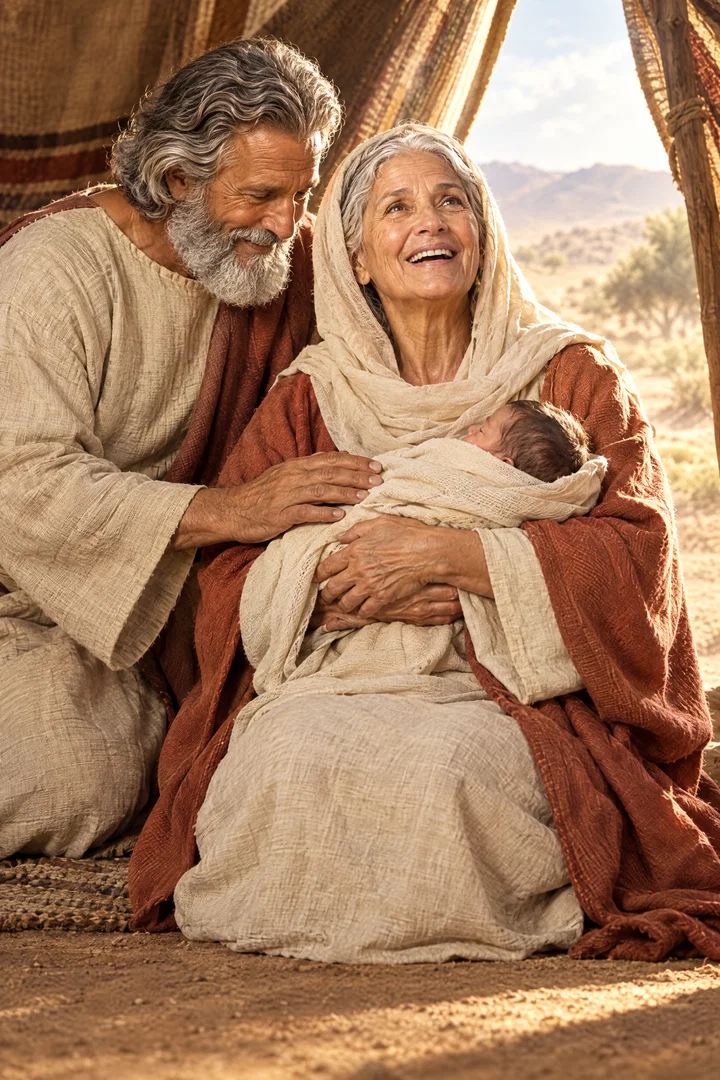
And Abraham circumcised his son Isaac being eight days old, as God had commanded him.
Translations
American King James Version, King James Version, KJV Cambridge Paragraph Bible
And Abraham circumcised his son Isaac being eight days old, as God had commanded him.
Webster Bible, Darby Translation
And Abraham circumcised his son Isaac, being eight days old, as God had commanded him.
Revised Version, American Standard Version
And Abraham circumcised his son Isaac when he was eight days old, as God had commanded him.
and Abraham circumciseth Isaac his son, [being] a son of eight days, as God hath commanded him.
And Abraham circumcised Isaac his son, when eight days old,—as God commanded him.
Berean Standard Bible, Majority Standard Bible
When his son Isaac was eight days old, Abraham circumcised him, as God had commanded him.
Abraham circumcised his son, Isaac, when he was eight days old, as God had commanded him.
And when his son Isaac was eight days old, Abraham made him undergo circumcision, as God had said to him.
Then Abraham circumcised Izhak his sonne, when he was eight dayes olde, as God had commanded him.
Douay-Rheims (Challoner revision)
And he circumcised him the eighth day, as God had commanded him,
Pictures
Cross-references
- Genesis 17:12
And he that is eight days old shall be circumcised among you, every man child in your generations, he that is born in the house, or bought with money of any stranger, which is not of thy seed.
God commands circumcision for male children at eight days old.
- Galatians 4:22-31
For it is written, that Abraham had two sons, the one by a bondmaid, the other by a freewoman.
Isaac is presented as the child of promise, contrasting the heirs of the two covenants.
- Genesis 17:19
And God said, Sarah thy wife shall bear thee a son indeed; and thou shalt call his name Isaac: and I will establish my covenant with him for an everlasting covenant, and with his seed after him.
God names Isaac as the son through whom the covenant will continue.
- Genesis 18:10-14
And he said, I will certainly return unto thee according to the time of life; and, lo, Sarah thy wife shall have a son. And Sarah heard it in the tent door, which was behind him.
God promises Sarah a son at the appointed time, fulfilled in Isaac’s birth.
- Genesis 16:1-4
Now Sarai Abram’s wife bare him no children: and she had an handmaid, an Egyptian, whose name was Hagar.
Hagar’s conception of Ishmael followed Sarah and Abraham’s human plan.
- Luke 2:21
And when eight days were accomplished for the circumcising of the child, his name was called JESUS, which was so named of the angel before he was conceived in the womb.
Both record circumcision on the eighth day.
- Genesis 15:4-5
And, behold, the word of the LORD came unto him, saying, This shall not be thine heir; but he that shall come forth out of thine own bowels shall be thine heir.
God promised Abraham an heir from his own body, fulfilled in Isaac.
- Romans 9:7-9
Neither, because they are the seed of Abraham, are they all children: but, In Isaac shall thy seed be called.
Isaac is identified as the child of promise.
- Genesis 22:1-18
And it came to pass after these things, that God did tempt Abraham, and said unto him, Abraham: and he said, Behold, here I am.
Isaac, the promised heir, is central to Abraham’s test of faith.
- Galatians 3:16
Now to Abraham and his seed were the promises made. He saith not, And to seeds, as of many; but as of one, And to thy seed, which is Christ.
Identifies the promised Seed with Christ, whose line the passage traces through Isaac.
- Matthew 1:1-2
The book of the generation of Jesus Christ, the son of David, the son of Abraham.
Jesus’ genealogy traces his descent from Abraham through Isaac.
- Genesis 21:12
And God said unto Abraham, Let it not be grievous in thy sight because of the lad, and because of thy bondwoman; in all that Sarah hath said unto thee, hearken unto her voice; for in Isaac shall thy seed be called.
confirms seed called in Isaac
- Galatians 4:28-29
Now we, brethren, as Isaac was, are the children of promise.
Isaac is a child of promise, and his persecution parallels believers’ experience.
- Hebrews 11:11
Through faith also Sara herself received strength to conceive seed, and was delivered of a child when she was past age, because she judged him faithful who had promised.
Sarah trusted God’s promise and received strength to conceive.
- Hebrews 11:17-19
By faith Abraham, when he was tried, offered up Isaac: and he that had received the promises offered up his only begotten son,
Abraham’s obedience in circumcising Isaac connects with his test concerning Isaac.
Commentary
Each commentary is drawn from primary sources: the writings of Ellen G. White and Adventist pioneers and periodicals. Each commentary is separate. Its own words are not a quotation; follow the references to read the source passages.
Pioneers and periodicals
22 sources
Abraham circumcised his son Isaac when he was eight days old in obedience to what God had commanded him.ST Apr 11, 1900ST Jan 17, 1884ST Mar 1, 1905 Isaac was the miraculous child of promise, born to Sarah his lawful free wife in their old age at the set time by God's power after long waiting.ST Apr 11, 1900ST Mar 1, 1905RH Jul 5, 1915 Heirship was established in Isaac alone and not in Ishmael, for in Isaac the seed was to be called.ST Apr 11, 1900ST Mar 1, 1905RH Jul 5, 1915 Born through faith in God's promise, Isaac represents the children of the covenant of promise who are born anew by God's power and made free in Christ under the new covenant, in contrast to Ishmael born after the flesh who represents bondage, an allegory of the two covenants.RH May 29, 1900ST Sep 28, 1915ST Apr 29, 1908ST Jan 24, 1900 The eighth day denotes the child's age and not a day of the week, so it gives no support for Sunday observance, and infant circumcision gives no parallel for Christian baptism which belongs with repentance and personal faith.ST Jan 17, 1884ST Mar 6, 1884ST Nov 8, 1883ST Mar 28, 1906
Obedience and Historical Setting
Abraham circumcised his son Isaac when Isaac was eight days old, in obedience to what God had commanded him.ST Apr 11, 1900ST Jan 17, 1884ST Mar 1, 1905ST Mar 6, 1884RH Jul 5, 1915 The eighth day denotes the child's age, not a particular day of the week.ST Jan 17, 1884ST Mar 6, 1884ST Nov 8, 1883 The verse therefore gives no support for Sunday observance and does not show that the patriarchs kept Sunday as the Sabbath.ST Jan 17, 1884ST Nov 8, 1883ST Nov 8, 1883 If circumcision day were taken to be Sunday it would imply that every male child was born on Sunday.ST Mar 6, 1884ST Nov 8, 1883
Isaac was born twenty-five years after the promise to Abraham and just after the destruction of Sodom, which occurred just before he was born.ST Jun 4, 1885ST Oct 4, 1883 He was weaned at about five years old.ST Jun 4, 1885 Isaac had opportunity to converse with Shem for fifty years, and through Shem Abraham and Isaac were instructed in divine truth associated with Noah and Enoch, including Enoch's prophecy and translation, connected with knowledge of Christ's second advent and the resurrection of the just.ST Oct 4, 1883 The patriarchal history around the verse shows Abraham and Isaac accumulating estates, supporting that the right of property and the commandment against theft had force before the law was formally given at Sinai.ST Jul 9, 1874
Promised Son and Heir
Isaac was the miraculous child of promise, born to Sarah, Abraham's lawful free wife, at the set time God had declared, in their old age after years of waiting and despite her barrenness, by God's power and not by human planning or arrangement.ST Apr 11, 1900ST Mar 1, 1905RH Mar 16, 1869ST Apr 29, 1908ST Jun 15, 1904 He was duly named Isaac and received with great rejoicing in God as the fulfillment of the promise.ST Apr 11, 1900ST Mar 1, 1905RH Mar 16, 1869 His birth through Sarah illustrates that the promised seed comes through God's creative power, and those so born anew are children of promise who receive freedom through Christ under the new covenant, in contrast to Ishmael, born through Hagar by human planning unto bondage.ST Mar 1, 1905ST Sep 28, 1915ST Apr 29, 1908
His circumcision at eight days old marked him as the covenant seed in whom salvation must come in God's way and by His power, not by fleshly schemes.ST Apr 11, 1900ST Mar 1, 1905RH Jul 5, 1915 It stands in the account of God's progressive dealings with Abraham, the father of the faithful, continuing the line of the Promised Seed through Isaac rather than Ishmael.ST Dec 20, 1910ST Mar 1, 1905RH Jul 5, 1915 It also marks the continuation of Abraham's family and the development of his faith through obedience to God's command.ST Apr 11, 1900ST Dec 20, 1910ST Jan 6, 1909
Heirship was established in Isaac alone and not in Ishmael, for in Isaac shall the seed be called.ST Apr 11, 1900ST Mar 1, 1905RH Jul 5, 1915 Although Abraham still felt the fruit of his own doing should share the heirship, Sarah perceived that the son of the bondwoman sharing it would break up the home and pervert God's blessing, and said he shall not be heir with Isaac, and God confirmed her voice.ST Apr 11, 1900 This settling of the heirship perfected Abraham's faith for the trial of offering Isaac in Genesis 22.ST Apr 11, 1900 His birth had already rehearsed the lesson that Abraham must trust God's promise rather than devise his own way to fulfill it, and the offering of Isaac was a further lesson of faith.ST Jun 15, 1904
Isaac was born twenty-five years after the promise to Abraham and was weaned at about five years old, when the weaning feast was held.ST Jun 4, 1885 At that feast Ishmael the son of the bondwoman mocked Isaac, which mocking is the persecution spoken of by Paul.ST Apr 11, 1900ST Jun 4, 1885 That mocking marks the beginning of the four hundred years of affliction.ST Jun 4, 1885
Covenant Allegory and Doctrine
To understand the two covenants the family history to which the circumcision of Isaac belongs must be studied, for Isaac, Sarah's son by the freewoman, represents the children of the covenant of promise.RH May 29, 1900 He is the child born through God's promise to Sarah, and he represents those who receive freedom through Christ under the new covenant, in contrast to Ishmael, whose birth through Hagar followed human planning and represented bondage.ST Sep 28, 1915 His birth in Genesis 21:1-7 came through God's power rather than human planning, and it illustrates the new covenant and the truth that those born anew through God's creative power are children of promise.ST Apr 29, 1908 The distinction is between Isaac, born through God's promise, and Ishmael, born after the flesh, for Isaac's birth came through Sarah's faith in God's promise, while Hagar's son represents bondage.ST Mar 22, 1899
The history of Abraham's two sons, Ishmael born of Hagar the maidservant and Isaac born of Sarah the freewoman, teaches in allegory the two covenants, testaments, or dispensations, the typical and antitypical systems, and the literal Israel and the true Israel, Jews and Gentiles, as representatives of the Lord and His work in two special periods of its development in the earth.ST Jan 24, 1900 Isaac's birth is like Christ's birth in being part of the fulfillment of God's promise to Abraham, but it is not the promise's final fulfillment. The promise of an everlasting inheritance of righteousness is fulfilled at Christ's coming and the resurrection.
The circumcision of Isaac at eight days old in obedience to God's command does not establish a parallel or type for Christian baptism.ST Mar 28, 1906 Baptism is connected with repentance and personal faith, so it is distinguished from the circumcision of infants.ST Mar 28, 1906 Circumcision was not exclusively for the Jews, for Ishmael was circumcised as well as Isaac, and the same rite was practiced beyond Israel.ST Nov 4, 1889
Sources