Genesis 24:13
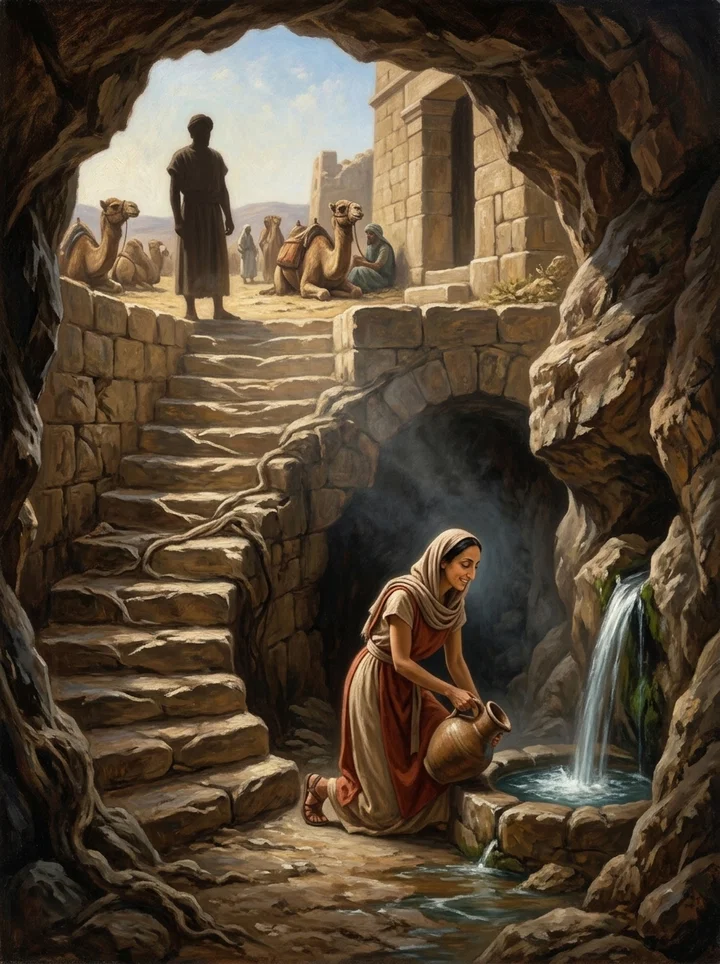
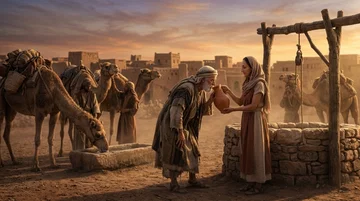
Behold, I stand here by the well of water; and the daughters of the men of the city come out to draw water:
Translations
American King James Version, King James Version, KJV Cambridge Paragraph Bible, Webster Bible
Behold, I stand here by the well of water; and the daughters of the men of the city come out to draw water:
Behold, I stand by the fountain of water; and the daughters of the men of the city come out to draw water:
Behold, I am standing by the fountain of water; and the daughters of the men of the city are coming out to draw water:
lo, I am standing by the fountain of water, and daughters of the men of the city are coming out to draw water;
Behold, I stand [ here] by the well of water, and the daughters of the men of the city come out to draw water.
Here am, I, stationed by the fountain of water,—and, the daughters of the men of the city, are coming forth to draw water:
Berean Standard Bible, Majority Standard Bible
Here I am, standing beside the spring, and the daughters of the townspeople are coming out to draw water.
Behold, I am standing by the spring of water. The daughters of the men of the city are coming out to draw water.
See, I am waiting here by the water-spring; and the daughters of the town are coming out to get water:
Lo, I stand by the well of water, whiles the mens daughters of this citie come out to drawe water.
Douay-Rheims (Challoner revision)
Behold I stand nigh the spring of water, and the daughters of the inhabitants of this city will come out to draw water.
Pictures
Cross-references
- Genesis 24:50-51
Then Laban and Bethuel answered and said, The thing proceedeth from the LORD: we cannot speak unto thee bad or good.
Rebekah’s family recognizes the Lord’s direction and agrees to the marriage.
- Genesis 29:1-10
Then Jacob went on his journey, and came into the land of the people of the east.
Both scenes bring a traveler to a well where women arrive to draw water.
- Exodus 2:15-17
Now when Pharaoh heard this thing, he sought to slay Moses. But Moses fled from the face of Pharaoh, and dwelt in the land of Midian: and he sat down by a well.
Moses meets Reuel’s daughters at a well as they draw water.
- Genesis 24:27
And he said, Blessed be the LORD God of my master Abraham, who hath not left destitute my master of his mercy and his truth: I being in the way, the LORD led me to the house of my master’s brethren.
Eliezer praises God for guiding him after his prayer is answered.
- Genesis 24:58
And they called Rebekah, and said unto her, Wilt thou go with this man? And she said, I will go.
Rebekah agrees to go and become Isaac’s wife.
- Genesis 24:7
The LORD God of heaven, which took me from my father’s house, and from the land of my kindred, and which spake unto me, and that sware unto me, saying, Unto thy seed will I give this land; he shall send his angel before thee, and thou shalt take a wife unto my son from thence.
Abraham says God’s angel will guide the servant.
- Genesis 24:67
And Isaac brought her into his mother Sarah’s tent, and took Rebekah, and she became his wife; and he loved her: and Isaac was comforted after his mother’s death.
Isaac takes Rebekah as his wife and loves her.
- Genesis 27:46
And Rebekah said to Isaac, I am weary of my life because of the daughters of Heth: if Jacob take a wife of the daughters of Heth, such as these which are of the daughters of the land, what good shall my life do me?
Rebekah’s concern about Jacob’s marriage echoes Abraham’s concern in Genesis 24.
- Genesis 25:20
And Isaac was forty years old when he took Rebekah to wife, the daughter of Bethuel the Syrian of Padan-aram, the sister to Laban the Syrian.
Gives Isaac’s age when he married Rebekah.
- Genesis 24:52
And it came to pass, that, when Abraham’s servant heard their words, he worshipped the LORD, bowing himself to the earth.
The servant worships after hearing their response.
Commentary
Each commentary is drawn from primary sources: the writings of Ellen G. White and Adventist pioneers and periodicals. Each commentary is separate. Its own words are not a quotation; follow the references to read the source passages.
Ellen G. White
9 sources
Abraham's servant stands by the well of water where people gathered and where the daughters of the men of the city come out to draw water.1SP 102.1PP 171.3SG3 109.1SG3 112.3 That well was in the city of Nahor, in Haran, where the city's women came in the evening to draw water, and that setting gave the servant opportunity to meet the women.PP 171.3PP 172.1 He stood there seeking God's guidance about finding a wife for Isaac, having asked God for a specific sign as evidence to direct the choice.1SP 102.1PP 171.3SG3 109.1PP 172.1 At the well he observed Rebekah's courteous conduct, which supplied the evidence he had asked for and confirmed to him that God had selected her to become Isaac's wife.1SP 102.1SG3 109.1
His mission was carried out by Abraham's experienced, God-fearing servant as part of Abraham's care in educating Isaac to love a life of noble obedience and in obtaining a suitable wife for him.SG3 112.3CE 228.1–230.1ST Apr 10, 1879 Isaac, then forty years old, submitted to his father's judgment, letting his father's servant choose for him and trusting God to direct the choice.CE 228.1–230.1SG3 112.1–2 The resulting marriage was one of tender domestic happiness in which Isaac loved Rebekah and was comforted by her.CE 228.1–230.1
The recorded account of Isaac's marriage is given as an example of seeking a marriage choice in the fear of God, with prayer and respect for parental guidance.CE 228.1–230.1SG3 112.1–21SP 104.3 It is given for the benefit of parents to command their households after them, to instruct their children to yield to and respect parental authority.ST Apr 10, 1879 It calls parents to guide the affections of their children toward persons judged suitable as companions for sons and daughters, because Satan controls the affections of the young to a great extent and leaving affections unguided and unrestrained deserves rebuke.SG3 112.3ST Apr 10, 1879
Sources
Pioneers and periodicals
20 sources
Abraham's servant stands by the well outside the city in Mesopotamia as he seeks a wife for Isaac among Abraham's kindred, at evening when the young women come out to draw water after the custom of the place.ST Jan 14, 1886ST Sep 15, 1898ST Sep 15, 1898ST May 19, 1898 He waits there in brief, direct prayer that God will mark out Isaac's appointed wife by her kind answer to his request for drink, in giving him water and offering also to draw for his camels.ST Aug 26, 1875 Rebekah's coming and her offer fulfill the sign and answer the prayer, showing that even a practical choice of a life companion may be brought to God in faith rather than left to chance, and that God guides through the ordinary course of daily life.RH Jul 25, 1912ST Jan 14, 1886RH Jan 30, 1872ST Sep 15, 1898 The errand keeps the family through which God's purpose would continue joined to the godly line and not to the ungodly, and it rests on piety, unselfishness, faithfulness, and confidence that the Lord will lead.ST Aug 3, 1915ST Jan 9, 1912 It stands as instruction for parents to command their households and guide the affections of their children toward suitable companions, while Isaac's acceptance of his father's judgment shows noble obedience and honors father and mother under the fifth commandment already in force in patriarchal times.ST Apr 10, 1879ST Jul 9, 1874
Setting at the Well
Abraham's tried servant Eliezer stands by a well in Mesopotamia, in Padan-Aram outside the city of Nahor and outside Haran, seeking a wife for Isaac among Abraham's kindred.ST Jan 14, 1886ST Sep 15, 1898RH Jul 25, 1912 The daughters and young women of the city come there to draw water, and their coming sets the scene for his prayer for guidance and his providential meeting with Rebekah.ST Jan 14, 1886ST Sep 15, 1898ST Sep 15, 1898 He waits at the well and asks God to identify Isaac's appointed wife through her response to his request for water, namely that she will give him drink and also draw for his camels.RH Jul 25, 1912 Rebekah's arrival and her kindness in offering water fulfill the asked-for sign and confirm God's guidance.ST Jan 14, 1886RH Jul 25, 1912 It is evening when the women come out to draw water, fitting the enduring custom of women gathering at a town well or fountain to carry water home.ST May 19, 1898 That fountain also served as a place where people met and exchanged news.ST May 19, 1898 The errand belongs to the closing step in the progressive steps of God's dealing with Abraham, the father of the faithful, when Abraham had come fully to trust God and sent his servant to obtain a wife for Isaac.ST Dec 20, 1910 It is part of God's providential care and interest among the children of men and is to be read with the Promised Seed ever in mind, falling within the account of God's providential dealings with Abraham's family as the chosen progenitor of the Seed.ST Dec 20, 1910ST The mission was to find Isaac a wife from the godly line, so that the family through which God's purpose would continue would not be joined to the ungodly line.ST Aug 3, 1915 The chapter highlights the servant's piety, unselfishness, and faithfulness, and his confidence that the Lord would lead him as he carried out his task.ST Jan 9, 1912
Prayer and Providence
The servant stands waiting by the well outside Nahor and Haran as the young women of the city come to draw water, and the well becomes the setting for his mission to find a wife for Isaac.RH Jul 25, 1912ST Feb 17, 1914 There he offers a brief, direct prayer asking God to guide him to the right woman and to make known Isaac's appointed wife.ST Aug 26, 1875ST Feb 17, 1914 The sign he asks is a response of kindness to his request for water, that she will give him drink and also draw water for his camels.RH Jul 25, 1912 Standing by the well he thus seeks God's direction in choosing a life companion for Isaac, treating even that decision as important enough to bring to God.
Rebekah's arrival and her offer to give him water fulfilled the sign he had asked and answered the prayer, confirming God's guidance.RH Jul 25, 1912RH Jan 30, 1872RH Aug 31, 1869ST Sep 5, 1900 His prayer is answered when Rebekah appears, an instance of the power of prayer seen in Genesis 24:12-27.RH Aug 31, 1869ST Sep 5, 1900RH Aug 1, 1871 He had watched for God's guidance and then gratefully recognized His mercy.ST Jan 14, 1886 He uses Rebekah's kindness as the confirmation that God has led him.RH Jul 25, 1912
The account shows that a practical, temporal responsibility may be brought earnestly to God in prayer.ST Jan 14, 1886 The choice of Isaac's wife and the servant's journey were guided by God, and the lesson is that God's servants should trust His guidance in faith rather than chance.ST Jan 14, 1886ST Sep 15, 1898 The servant's faith and prayer draw attention to that trust.ST Sep 15, 1898
The fulfillment illustrates that God can direct events through the natural course of everyday life, even in small matters.RH Jan 30, 1872 The event appeared ordinary, and Rebekah herself may not have known she was being led.RH Jan 30, 1872
Family and Covenant Guidance
Genesis 24:13 belongs to the record of the course Abraham pursued both in educating Isaac to love a life of noble obedience and in obtaining a wife for him.ST Apr 10, 1879 That record is given for the benefit of parents to lead them to command their households after them.ST Apr 10, 1879 It instructs them to teach their children to yield to and respect parental authority, and to guide the affections of their children toward persons judged to be suitable companions for sons and daughters.ST Apr 10, 1879 Such guidance is necessary because Satan controls the affections of the young to a great extent, and to leave those affections unguided and unrestrained deserves rebuke.ST Apr 10, 1879
Isaac's acceptance of his father's judgment in choosing a wife was the result of that training in obedience. Abraham's exercise of parental authority in the marriage served his children's welfare and happiness, rather than selfish or arbitrary control. Isaac's deference to his father's wishes was honor to parents in action, showing that the fifth commandment already controlled God's chosen servants.ST Jul 9, 1874 That commandment was therefore not new at Sinai but already in force from earlier patriarchal times.ST Jul 9, 1874 The servant's arrival in Padan-Aram took place about one hundred years before Jacob's arrival there, and the two arrivals are to be compared.ST Oct 6, 1898
Sources