Genesis 27:3
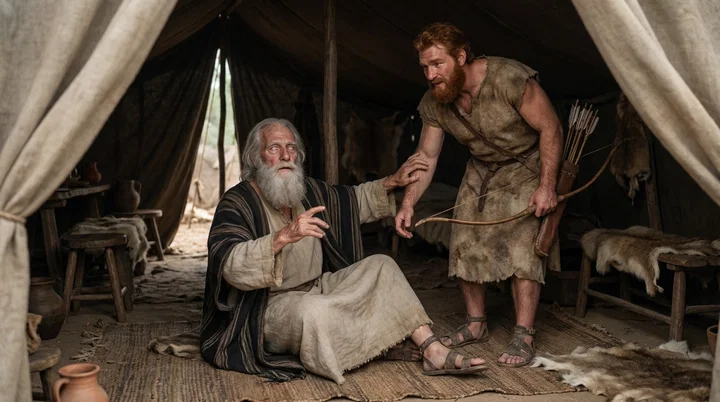
Now therefore take, I pray thee, thy weapons, thy quiver and thy bow, and go out to the field, and take me some venison;
Translations
Now therefore take, I pray you, your weapons, your quiver and your bow, and go out to the field, and take me some venison;
King James Version, Webster Bible
Now therefore take, I pray thee, thy weapons, thy quiver and thy bow, and go out to the field, and take me some venison;
now therefore take, I pray thee, thy weapons, thy quiver and thy bow, and go out to the field, and take me some venison;
Revised Version, American Standard Version
Now therefore take, I pray thee, thy weapons, thy quiver and thy bow, and go out to the field, and take me venison;
and now, take up, I pray thee, thy instruments, thy quiver, and thy bow, and go out to the field, and hunt for me provision,
And now, I pray thee, take thy weapons, thy quiver and thy bow, and go out to the field and hunt me venison,
Now, therefore, take I pray thee, thy weapons, thy quiver and thy bow, and go out to the field, and catch for me game;
Berean Standard Bible, Majority Standard Bible
Take your weapons— your quiver and bow— and go out into the field to hunt some game for me.
Now therefore, please take your weapons, your quiver and your bow, and go out to the field, and get me venison.
So take your arrows and your bow and go out to the field and get meat for me;
Wherefore nowe, I pray thee take thine instruments, thy quiuer and thy bowe, and get thee to the fielde, that thou mayest take mee some venison.
Douay-Rheims (Challoner revision)
Take thy arms, thy quiver, and bow, and go abroad: and when thou hast taken some thing by hunting,
Pictures
Cross-references
- Genesis 25:23
And the LORD said unto her, Two nations are in thy womb, and two manner of people shall be separated from thy bowels; and the one people shall be stronger than the other people; and the elder shall serve the younger.
God foretold that the elder would serve the younger, a promise Rebekah and Jacob tried to bring about.
- Genesis 25:29-34
And Jacob sod pottage: and Esau came from the field, and he was faint:
Esau had sold his birthright to Jacob before Isaac requested the meal.
- Hebrews 12:16-17
Lest there be any fornicator, or profane person, as Esau, who for one morsel of meat sold his birthright.
Esau sold his birthright for food and later sought the blessing in vain.
- Genesis 25:28
And Isaac loved Esau, because he did eat of his venison: but Rebekah loved Jacob.
Isaac favors Esau for the venison, while Rebekah favors Jacob.
- Genesis 27:18-29
And he came unto his father, and said, My father: and he said, Here am I; who art thou, my son?
Jacob receives Isaac’s blessing in place of Esau.
- Malachi 1:2-3
I have loved you, saith the LORD. Yet ye say, Wherein hast thou loved us? Was not Esau Jacob’s brother? saith the LORD: yet I loved Jacob,
Jacob and Esau’s account illustrates God’s words about them as peoples and types of character.
- Genesis 27:43
Now therefore, my son, obey my voice; and arise, flee thou to Laban my brother to Haran;
Rebekah sends Jacob to flee to Padan-aram after the deception.
- Hebrews 11:20
By faith Isaac blessed Jacob and Esau concerning things to come.
Isaac’s blessing of Jacob and Esau concerned things to come.
Commentary
Each commentary is drawn from primary sources: the writings of Ellen G. White and Adventist pioneers and periodicals. Each commentary is separate. Its own words are not a quotation; follow the references to read the source passages.
Ellen G. White
14 sources
Isaac secretly sends Esau out to the field to hunt game with quiver and bow and prepare venison for a customary ceremonial meal before blessing him before his death.PP 179.4–180.2ST Apr 17, 18791SP 106.2 He intends the firstborn blessing for his elder favored son, despite knowing God's purpose that Jacob would carry the promise, despite Esau's indifference to its obligations and his marriages to women who worship false gods, and while Esau hides that he has already sold his birthright to Jacob with an oath.PP 179.4–180.2ST Apr 17, 18791SP 106.2SG3 114.1PP 179.3 Rebekah overhears the request, remembers God's word that the elder would serve the younger, and persuades Jacob to secure the blessing by deception after he first resists, when they should have trusted God to fulfill His purpose in His own time rather than using fraud.SG3 115.1SG3 114.1ST Jan 29, 1880 Jacob's obtaining of the blessing and birthright by fraud was his own real sin and guilt before God, which God did not prompt and which is no model for gaining an advantage.SG3 115.1SG3 133.24SP 437.2GC88 616.1–2Ms 139, 1899, par. 17–21 Because Jacob had previously repented of that fraud, God heard his prayer and mercifully preserved his life from Esau, yet the sin brought crushing guilt and fear, forced him to flee into many years of exile, gave Satan ground to accuse him and move Esau against him, and pressed upon him in his long night of wrestling until he cast himself upon God's mercy and prevailed.SG3 133.24SP 437.2GC88 616.1–2ST Feb 13, 1901PP 201.3–202.2
Isaac's Request for Venison
Isaac secretly sent Esau out to the field with quiver and bow to hunt game and prepare venison for a ceremonial meal before giving him the blessing before his death.PP 179.4–180.2ST Apr 17, 18791SP 106.2PP 179.3 He arranged this solemn blessing ceremony in secret, intending to bless his elder son.PP 179.4–180.2PP 179.3 The venison was for the customary feast on such occasions.ST Apr 17, 1879 His request was made while he favored Esau and intended to bless him as firstborn with the firstborn and birthright blessing, despite knowing God's purpose that Jacob would carry the promise.PP 179.4–180.2ST Apr 17, 1879PP 179.3
He held to this intent despite Esau's indifference to the obligations of the blessing and his marriages to women who worship false gods.PP 179.3 Esau meanwhile hid from Isaac that he had already sold his birthright to Jacob and confirmed the sale with an oath.1SP 106.2SG3 114.1
Deception, Repentance, and Consequences
Rebekah overheard Isaac's request for Esau to hunt game and prepare meat before receiving the blessing, and remembering God's word that the elder would serve the younger, she persuaded Jacob to secure the blessing by deception after he first resisted.SG3 114.1 Rebekah and Jacob should have trusted God to fulfill His purpose in His own time rather than using fraud.SG3 115.1SG3 114.1 Jacob knew God had promised the blessing to him, yet his lack of faith in God's ability to fulfill the promise led him to act wrongly.ST Jan 29, 1880
God did not prompt their deception and could have provided for Jacob by His own means, so their conduct is no model for gaining an advantage.SG3 115.1Ms 139, 1899, par. 17–21 Jacob could have been blessed by God even without the privileges usually given to the firstborn if he loved and feared God, while God alone could grant Esau prosperity or bring adversity according to his conduct.SG3 115.1 Jacob's obtaining of the blessing and birthright by fraud was his own real sin and guilt before God, a wrong needing repentance.SG3 133.24SP 437.2GC88 616.1–2PP 201.3–202.2
Because Jacob had previously repented of that fraud, God heard his prayer and mercifully preserved his life from Esau, and without that prior repentance God could not have heard him.SG3 133.24SP 437.2PP 201.3–202.2 The sin added crushing self-reproach to anxiety and fear, with guilt, sadness, despondency, remorse, and a troubled sense of having lost God's protection.GC88 616.1–2ST Jan 29, 1880ST Feb 13, 1901 It forced Jacob to flee for his life alarmed by his brother's deadly threats and anger, keeping him for many years an exile.GC88 616.1–2ST Jan 29, 1880ST Feb 13, 1901 It left him terrified when Esau approached for revenge while his own company was unarmed and defenseless, with hope only in God's mercy and defense only in prayer.GC88 616.1–2
The sin gave Satan ground to accuse Jacob before the angels of God and claim the right to destroy him, and to move Esau to march against him.PP 201.3–202.2 It pressed upon Jacob's conscience during his long night of wrestling, where Satan endeavored to force guilt upon him to discourage him and break his hold upon God, and the heavenly Messenger tested his faith by reminding him of his sin.PP 201.3–202.2 Jacob cast himself upon God's mercy, having learned that God is merciful, pointed back to his repentance, pleaded for deliverance, and held fast the Angel with earnest agonizing cries until he prevailed.PP 201.3–202.2 His night of anguish over that sin represents the experience of God's people in the time of trouble.GC88 616.1–2PP 201.3–202.2
The same deception is still practiced in partiality and hypocrisy and secret working that binds men's freedom.Lt 7, 1896, par. 1–4 That secret working handles men as machinery to be harnessed and driven, and by deceptive reasoning turns man from his rights and grasps all possible irrespective of agreements and of disappointment and wrong to others.Lt 7, 1896, par. 1–4 All such secret working is open to the eye of God, who will in no case justify or excuse it, and angels veil their faces at it.Lt 7, 1896, par. 1–4 The time has come to investigate Christ's teachings to ancient Israel against it.Lt 7, 1896, par. 1–4
Sources
Pioneers and periodicals
48 sources
Old and blind and ready to give his final blessing, Isaac told Esau to take his bow and quiver into the field and bring back hunted game for the savory feast that belonged with the solemn blessing.ST Apr 17, 1879ST Sep 22, 1898ST Mar 30, 1888ST Sep 22, 1898ST Mar 31, 1881 He favored Esau because Esau was a bold hunter whose venison gratified his appetite, a preference rooted in appetite rather than merit.ST Apr 17, 1879ST Esau had already foolishly sold his birthright to satisfy hunger, yet he hoped this venison would win him the covenant blessing, while God's purpose was that the elder should serve the younger and the promise go through Jacob.ST May 17, 1910ST Feb 23, 1915STST Feb 26, 1894ST Oct 1, 1902 Rebekah overheard the request and, unwilling to trust God to fulfill His word in His own time and way, plotted with Jacob to imitate hairy Esau with kid skins and obtain by fraud the blessing meant for his brother.ST Feb 28, 1906ST Sep 22, 1898STRH Nov 16, 1916ST Oct 1, 1902 The trick gained its aim but not by God's approval, bringing guilt, Esau's hatred, lifelong separation of mother and son, and long exile and chastening for Jacob until repentance, forgiveness, and a changed character as Israel restored him to favor.RH Nov 16, 1916RH Mar 30, 1869ST Feb 26, 1894ST Oct 1, 1902ST Oct 4, 1905
Words and Setting
The verse is Isaac's direction to Esau to take his hunting weapons, his quiver and his bow, to go out to the field and to bring in venison.ST Sep 22, 1898ST Mar 30, 1888ST Sep 22, 1898RH Nov 30, 1916ST Apr 6, 1888 The command was given to prepare for the blessing Isaac intended to bestow before his death, and it set in motion the scheming by which Rebekah and Jacob secured for Jacob the blessing meant for Esau.ST Sep 22, 1898ST Mar 30, 1888ST Sep 22, 1898RH Nov 30, 1916ST Apr 6, 1888
The request was made when Isaac was old and blind, with his sight grown dim, and when he was preparing to give his blessing before he died.ST Apr 17, 1879ST Sep 22, 1898ST Mar 31, 1881ST Oct 1, 1902RH Nov 4, 1858 The hunted game was to be made into the savory dish he liked, as the customary feast and dinner for the solemn ceremony of giving the sacred covenant blessing to the firstborn.ST Apr 17, 1879ST Mar 31, 1881ST Oct 1, 1902 Isaac at that time favored Esau and intended to bless him as firstborn.ST Apr 17, 1879ST Mar 31, 1881
That favoritism was rooted in appetite rather than merit, for Isaac loved his favorite son as a cunning, bold hunter of wild animals whose venison and savory dishes appealed to him.ST Apr 17, 1879ST Feb 24, 1887ST Feb 24, 1887ST Esau supplied his father with game from the field, and is portrayed as a wild hunter who had killed many animals.ST Feb 24, 1887ST Feb 24, 1887STST Oct 4, 1905 In the connected request that Esau prepare food so that Isaac may bless him before death, the phrase my soul means Isaac himself, equivalent to myself, not a separate part of him.RH Sep 12, 1854
The verse thus places Esau out in the field hunting at the time Jacob received the blessing from Isaac through fraud, by which the firstborn was given second place.ST Jul 31, 1901ST Jan 3, 1911
Birthright and Blessing
The birthright at stake carried a double portion of property, family rulership, and the priesthood, and in this case it carried being the line through whom Christ would come and in a measure the salvation of the race.ST May 17, 1910 Its blessing embraced spiritual blessings and manifold temporal blessings, including a home in the kingdom of God, prosperity in all the hand touches, the choice of obedience to God, denial of sinful worldly pleasures, and wrestling with God until sinful scheming and supplanting are forgiven through humble confession and seeking pardon.RH Dec 30, 1915 The same sterling principles of acting from principle not impulse and abandoning worldly associations and customs at sacrifice and reproach bring the blessing of the Infinite One in Sabbath keeping today just as God blessed Jacob spiritually and temporally.RH Dec 30, 1915
Esau had foolishly sold his birthright for a meal to satisfy immediate appetite and advantage, treating lasting privileges as less valuable than temporary indulgence.ST May 17, 1910ST Oct 6, 1914 He is described as profane for despising his birthright, as treating it lightly, and as presenting an eternal inheritance that people can trade away for temporary pleasure.ST Feb 23, 1915ST Oct 4, 1905 He had taken advantage of hunger being met only in reverse, for Jacob had taken advantage of Esau's appetite to purchase the birthright, and then Jacob obtained by fraud the father's blessing designed for his brother.ST Apr 1, 1897 Although Esau had sold it without valuing it, he welcomed his father's command to hunt because he knew his father's weakness and hoped by ministering to his appetite to secure the coveted blessing and keep it from his twin brother.ST
Jacob valued what the birthright and God's promise meant, while Esau had treated the birthright lightly.ST May 17, 1910ST Oct 4, 1905 God had designed the blessing for Jacob because of his superior character, for Jacob was superior in morality, integrity, and faith in God.ST Feb 26, 1894ST Feb 26, 1894 Though selfish and sinful in deed he was better in principle than Esau, and though his faith was crude and uninstructed he had faith where Esau lacked faith, so that faith enabled God to work toward his moral reformation.ST Jul 27, 1904ST Mar 30, 1888 His desire was right but his method was wrong, and he gained the blessing not because of his deception but in spite of it.ST Feb 26, 1894ST Oct 4, 1905
God's purpose was that the elder should serve the younger and that Jacob should carry the promise, yet Isaac favored Esau and intended to bless him as firstborn, with the customary feast on such occasions.ST Apr 17, 1879 That order to go out to the field, hunt venison, and prepare the dinner he liked so Esau could receive his blessing endangered the Lord's word and Jacob's purchase of the birthright for a mess of pottage.ST Oct 1, 1902 The blessing Isaac prepared to give went with the birthright Esau had already sold and God meant for Jacob.ST Feb 26, 1894 Esau hoped the venison would help him obtain the sacred covenant blessing as firstborn in the solemn ceremony, but his claim had already been sold to Jacob, and Jacob held the rightful claim.STST Mar 31, 1881
Deception Through Distrust
Rebekah overheard the request for hunted game as the feast for the blessing intended for Esau and determined that Jacob should not fall victim to what she regarded as Esau's selfishness.ST Sep 22, 1898STST Oct 1, 1902 Out of favoritism and motherly love and ambition for her favored son, whom she had taught obedience and longing for divine favor, she plotted to take matters into her own hands rather than trust God to resolve the circumstances in His own time and way.ST Feb 24, 1887STRH Nov 16, 1916ST Feb 17, 1914 She did not trust Jehovah and wait for His time, but feared the promise that the elder should serve the younger would be frustrated and thought she must do something herself.RH Nov 16, 1916ST Feb 17, 1914ST Oct 1, 1902
While Esau was out hunting, she sent Jacob to kill kids, prepared the dinner herself, and covered Jacob's neck and hands with kid skins to imitate hairy Esau.ST Oct 1, 1902 In this way she sent him in to deceive his blind father by personating his brother.ST Oct 1, 1902
Jacob then with his mother's connivance and conspiracy obtained by fraud, guile, duplicity, dissimulation and trickery the father's blessing designed for Esau, after taking advantage of Esau's hunger and appetite to buy the birthright.ST Feb 28, 1906ST Apr 1, 1897RH Mar 30, 1869RH Aug 17, 1869RH Dec 30, 1915 His name Jacob, meaning supplanter, described his overreaching, mercenary and covetous character.ST Apr 1, 1897 By that act he sinned against his father and his brother and his own soul and against God.ST Jul 31, 1884
Rebekah and Jacob acted as though God could not fulfill His promises without their intervention, showing lack of faith.ST Jul 31, 1884STST Oct 6, 1914 Jacob felt scruples against deceiving his father, but his mother's counsel prevailed.RH Nov 16, 1916 Their attempt to supplement the Lord's promise with human works and worldly means, taking the case into their own hands instead of submissively leaving the matter in the hands of the Lord and waiting for God's own time, was a shameful error by which Jacob while still unconverted and with crude and uninstructed faith sought in a more dishonorable manner what God would have fulfilled in good time and in a more honorable manner.ST Feb 24, 1887ST Jul 31, 1884ST Oct 6, 1914RH Apr 8, 1875ST Mar 30, 1888
Jacob gained the blessing not because of his deception but in spite of it.ST Feb 26, 1894ST Feb 26, 1894 His desire for God's promise and blessing was right, since he valued what Esau had treated lightly, but his method was wrong.ST Oct 4, 1905ST Mar 30, 1888 God knew his desire yet did not approve his deceit, and trying to secure the promised outcome through designed deception and cheating was wrong.ST Feb 24, 1887ST Oct 4, 1905ST Feb 26, 1894ST Mar 30, 1888
Consequences and Restoration
Esau afterward sought the blessing of the birthright with tears, but he was rejected and could not move his father to change the decision, so the firstborn was put in second place and Jacob was forced to flee from home because of his brother's hatred.ST Jan 3, 1911ST Mar 30, 1888ST Feb 23, 1915 The fraud gained its immediate purpose, yet it brought guilt, self-reproach, condemnation, sorrow, anxiety, and fear of being killed by Esau, whose rage and hatred threatened Jacob's life.ST Jul 31, 1884ST Jan 29, 1880ST Feb 13, 1901ST Jul 27, 1904 Jacob therefore became a fugitive hurrying for his life from his father's house, sent away by his mother to his uncle's house in distant Padan-aram in a strange country, cast down and discouraged and fearing he had forever lost the blessing God designed to give him.ST Jul 31, 1884ST Jul 27, 1904ST Feb 26, 1894 He left with a heavy, despairing heart, sad and despondent and troubled by the thought that he had lost God's protection, feeling utterly forsaken of God and man as if his sins like a great gulf had separated him from Heaven.ST Jan 29, 1880ST Feb 13, 1901ST Jul 27, 1904ST Feb 26, 1894
Mother and son were separated for life by their scheming interference with God's plans concerning the promised Seed, acting as though God could not fulfill His promises without their intervention.STRH Nov 16, 1916RH Jul 4, 1865 Rebekah was deprived of the comfort of her son's companionship to her old age and never saw him again, and Jacob never saw his mother again after fleeing his loved home and his dear mother.STRH Nov 16, 1916ST Oct 1, 1902ST Feb 26, 1894 Her triumph lasted only a moment, and both she and Jacob suffered self-reproach and condemnation, showing that parental deceit even to gain a promised good brings guilt and separation.RH Nov 16, 1916RH Jul 4, 1865
Overreaching was met with retribution, for Jacob's selfish plotting and shameful error in stealing his brother's blessing by taking his case into his own hands instead of waiting for God's own time brought consequent suffering and long-continued afflictions as God's chastisement.ST Nov 20, 1879ST Jan 9, 1912RH Apr 8, 1875ST Jul 21, 1881 His long exile, remembered with guilt and sorrow, with more than twenty years before even formal reconciliation, brought perplexing trials, deep remorse, penitence, weeping, humiliation, and loss of self-confidence, with fear that the God of his fathers had cast him off.ST Nov 20, 1879ST Oct 1, 1902ST Feb 26, 1894 Thorough repentance and perfect trust and patient submission had to be developed in him for the error to be remitted, even though he repented and was forgiven, and the greatest of those trials was wrestling with the angel, which placed him among the heroes of faith.ST Jul 31, 1884RH Mar 30, 1869RH Apr 8, 1875
God did not utterly forsake His erring, distrustful servant but still extended mercy to him, permitting afflictions until he should learn patient submission and graciously revealing a Saviour and a way by which he could be restored to favor.ST Jul 31, 1884ST Oct 6, 1914 Jacob later repented, yielded himself to God, and received a changed character represented by his new name Israel, meaning prevailer with God, unto victory.ST Jan 6, 1909RH Mar 30, 1869ST Oct 6, 1914 His going down into Egypt was the turning point that closed those afflictions forever, because the chastisement had worked deep and thorough repentance in him and God's rod was withdrawn, and his sojourn there was the period assigned by Providence for ripening him for the kingdom of God, so his life ended in heavenly brightness.RH Apr 8, 1875ST Jul 21, 1881
The disaster reached the whole family and the descendants, for enmity was carried into Esau's descendants for hundreds of years, so Edom refused Israel passage from Egypt to Canaan and Israel could only subdue Edom by warfare under David and Amaziah without ever wielding moral influence over them.ST Oct 1, 1902 Jacob had coveted the birthright and blessing for temporal rather than spiritual ends, and that scheme to secure God's promise by human contrivance brought sorrow and anxiety and sent him into exile.ST Oct 4, 1905
Doctrine Influence and Application
The dim sight of Isaac, who readied himself to bless Esau while Jacob received the blessing instead, shows that human sight can mistake one person for another while the Lord knows His own regardless of outward appearance or circumstance.RH Nov 4, 1858 Jacob's coveting of Esau's birthright and blessing and his unrighteous course to secure them proves that covetousness was already sin before Moses was given, breaking as idolatry the first and second commandments. His obtaining of his father's inheritance through guile and dissimulation stands as an example of a good man's sin, not as permission for others to sin.RH Aug 17, 1869
Isaac's sending of Esau into the field to hunt game for him set the stage in which Jacob obtained the blessing by fraud and deceit.ST Nov 18, 1897ST Sep 1, 1909 Jacob's pursuit of the blessing through selfish advantage represents religious people who seek God's favor for temporal gain and sacrifice principle to get it.ST Nov 18, 1897 That deceit represents those who seek God's blessing through selfishness and expediency, while Esau's sale of his birthright represents those who lack faith and obedience.ST Sep 1, 1909 Esau's hunting and appetite belong to his selling his birthright to Jacob for food, and the birthright is an eternal inheritance that people can trade away for temporary pleasure.
Jacob's earlier fraud concerning the birthright was a sin for which he repented, and his experience teaches that in the coming time of trouble God's people must have confessed sins blotted out with no concealed wrongs left to accuse them.RH Nov 14, 1912 Rebekah had taught her favored son Jacob obedience and longing for divine favor and was ambitious for him to receive the promised blessing, yet she did not trust Jehovah and wait for His time, plotted to take matters into her own hands, and her counsel overcame Jacob's scruples against deceiving his father.RH Nov 16, 1916 Her triumph lasted only a moment, and both she and Jacob suffered self-reproach and condemnation, with Rebekah deprived of her son's companionship to her old age, showing that parental deceit even to gain a promised good brings guilt and separation while children walk in their parents' shadow.RH Nov 16, 1916 Jacob was led into error and exile through his mother's influence, showing that people are accountable for the influence they exert, cannot evade the consequences of causing others to do wrong, and that many will be lost through negligence or misconduct.ST Apr 12, 1883 His siding with his mother in deceiving Isaac was a wrong act from sympathy on the wrong side, and he that gathers not with Christ scatters abroad.RH Jan 7, 1873 That wrong influence did not end with the act but lived on destroying precious souls until the Judgment makes manifest souls eternally lost as its result, so that even if the doer is saved through pardoning love there is a loss that might have been eternal gain.RH Jan 7, 1873
For Jacob the result was being obliged to flee for his life to a stranger's land, and in after years the act nearly proved the ruin of himself, his family, and his substance.RH Jan 7, 1873 He later fled from Esau because of this deception in securing the blessing.ST Sep 6, 1883 The birthright blessing includes spiritual blessings and manifold temporal blessings, including a home in the kingdom of God, prosperity, the choice of obedience to God, denial of sinful worldly pleasures, and wrestling with God until scheming is forgiven through humble confession and seeking pardon.RH Dec 30, 1915 The same sterling principles of acting from principle not impulse and abandoning worldly associations and customs at sacrifice and reproach bring the blessing of the Infinite One in Sabbath keeping today just as God blessed Jacob spiritually and temporally.RH Dec 30, 1915
Sources