Genesis 34:26
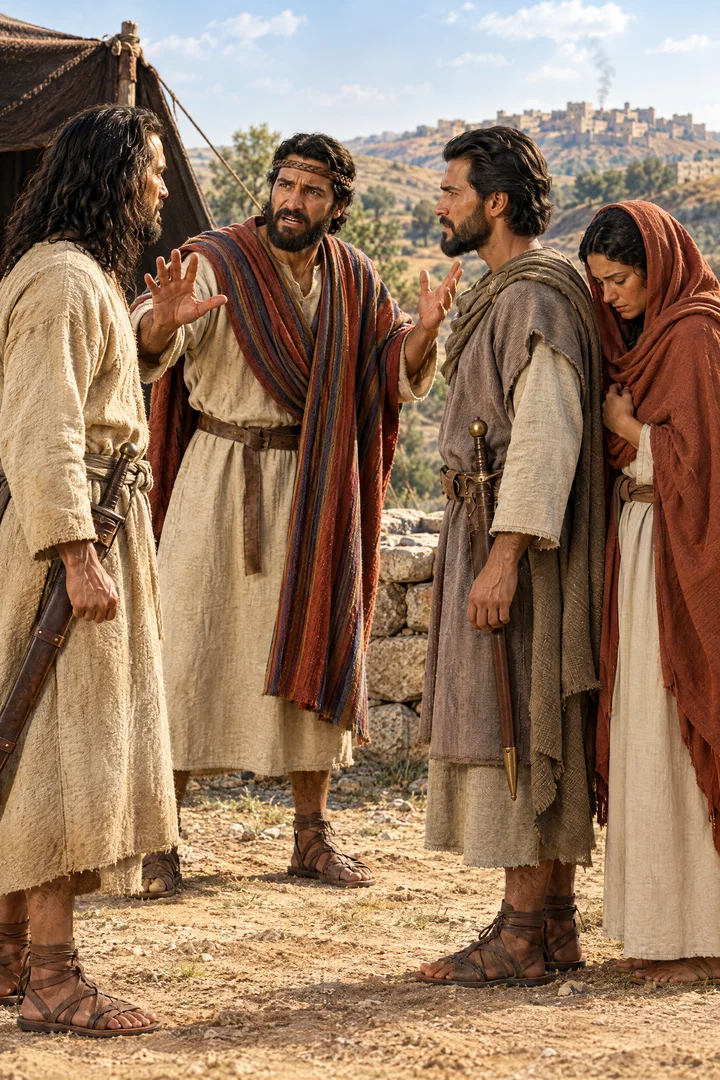
And they slew Hamor and Shechem his son with the edge of the sword, and took Dinah out of Shechem’s house, and went out.
Translations
American King James Version, King James Version, KJV Cambridge Paragraph Bible
And they slew Hamor and Shechem his son with the edge of the sword, and took Dinah out of Shechem’s house, and went out.
And they slew Hamor and Shechem his son with the edge of the sword, and took Dinah out of Shechem's house, and went out.
Revised Version, American Standard Version
And they slew Hamor and Shechem his son with the edge of the sword, and took Dinah out of Shechem’s house, and went forth.
and Hamor, and Shechem his son, they have slain by the mouth of the sword, and they take Dinah out of Shechem's house, and go out.
And Hamor and Shechem his son they slew with the edge of the sword; and took Dinah out of Shechem's house; and went out.
Hamor also, and Shechem his son, slew they with the edge of the sword,—and took Dinah out of the house of Shechem, and came forth,
Berean Standard Bible, Majority Standard Bible
They killed Hamor and his son Shechem with their swords, took Dinah out of Shechem’s house, and went away.
They killed Hamor and Shechem, his son, with the edge of the sword, and took Dinah out of Shechem’s house, and went away.
And Hamor and his son they put to death with the sword, and they took Dinah from Shechem's house and went away.
They slewe also Hamor and Shechem his sonne with the edge of the sword, and tooke Dinah out of Shechems house, and went their way.
Douay-Rheims (Challoner revision)
And they killed also Hemor and Sichem, and took away their sister Dina, out of Sichem’s house.
Pictures
Cross-references
- Genesis 49:5-7
Simeon and Levi are brethren; instruments of cruelty are in their habitations.
Jacob condemns Simeon and Levi’s cruel anger and foretells their scattering.
- Genesis 34:1
And Dinah the daughter of Leah, which she bare unto Jacob, went out to see the daughters of the land.
Dinah’s visit to the daughters of the land begins the events ending in slaughter.
- Genesis 34:30
And Jacob said to Simeon and Levi, Ye have troubled me to make me to stink among the inhabitants of the land, among the Canaanites and the Perizzites: and I being few in number, they shall gather themselves together against me, and slay me; and I shall be destroyed, I and my house.
Jacob rebukes his sons for their violence and its consequences.
- Genesis 35:2-5
Then Jacob said unto his household, and to all that were with him, Put away the strange gods that are among you, and be clean, and change your garments:
After the killing, Jacob’s household puts away foreign gods before going to Bethel, and God protects them.
- Genesis 34:7
And the sons of Jacob came out of the field when they heard it: and the men were grieved, and they were very wroth, because he had wrought folly in Israel in lying with Jacob’s daughter; which thing ought not to be done.
brothers anger that drove the killing
- Genesis 35:5
And they journeyed: and the terror of God was upon the cities that were round about them, and they did not pursue after the sons of Jacob.
terror of God prevented pursuit
- Genesis 35:4
And they gave unto Jacob all the strange gods which were in their hand, and all their earrings which were in their ears; and Jacob hid them under the oak which was by Shechem.
surrender of idols and earrings
- Genesis 34:31
And they said, Should he deal with our sister as with an harlot?
Dinah’s brothers justify the killing as a defense of their sister’s honor.
- Genesis 35:9-12
And God appeared unto Jacob again, when he came out of Padan-aram, and blessed him.
God renews Jacob’s promise after his family leaves Shechem.
Commentary
Each commentary is drawn from primary sources: the writings of Ellen G. White and Adventist pioneers and periodicals. Each commentary is separate. Its own words are not a quotation; follow the references to read the source passages.
Ellen G. White
6 sources
The verse records Simeon and Levi killing Hamor and Shechem his son with the edge of the sword and taking Dinah out of Shechem's house, completing their ruinous destruction of the city.PP 204.2–3SG3 171.1SG3 136.1–137.1 The attack was a deceitful, cruel, bloody and revengeful retaliation, though not unprovoked, and was a grievous sin, part of the cruelty Jacob knew his sons had practiced against the people of Shechem.PP 204.2–3ST Dec 18, 1879SG3 171.11SP 125.1SG3 136.1–137.1 God did not sanction their conduct.1SP 125.1SG3 136.1–137.1
The sons were not all righteous but were tainted with idolatry.1SP 125.1 Jacob did not know their purpose beforehand but learned of it only after the cruelty was done, to his horror.PP 204.2–31SP 125.1SG3 136.1–137.1 He reproved them for troubling him and making him despised among the inhabitants of the land, fearing the indignation of the surrounding nations would bring danger and destruction on him and his house, and in that distress he called upon God.1SP 125.1SG3 136.1–137.1
Jacob later condemned their fierce anger and cruel wrath, declaring they would be divided and scattered in Israel.SG3 171.1PP 235.5–6 Levi's later faithfulness to God changed that curse into a blessing through service at the sanctuary.PP 235.5–6
Sources
Pioneers and periodicals
17 sources
Simeon and Levi put Hamor and his son Shechem to death with the sword and brought Dinah out of Shechem's house in revenge for the violation and disgrace of their sister.RH May 25, 1916RH Dec 8, 1910RH Apr 16, 1901 Their vengeance fell not on the two men only but on the whole city in a slaughter of its men and defenseless people with plunder of livestock and captivity of wives and children, because in that patriarchal age an injury to one of the family was reckoned an injury to all and the offender's whole house was held chargeable.RH Dec 8, 1910RH Mar 12, 1908RH Apr 16, 1901RH May 25, 1916 Though the men of Canaan were in a low state of morals and the sons of Jacob stood for a higher standard of purity, their treacherous and cruel revenge was a grievous sin that made the innocent suffer and dishonored God and drew Jacob's horror and rebuke.ST Dec 18, 1879ST Jan 3, 1911RH Sep 21, 1911RH May 25, 1916 The deed sprang from Levi's impetuous fearlessness yielded to evil, and by the law that character perpetuates itself it fixed the future of Simeon and Levi to be scattered in Israel with no landed possession for Levi and only a small portion for Simeon.RH Sep 21, 1911RH Jul 4, 1865RH Apr 24, 1900ST Dec 17, 1912RH Sep 21, 1911 That same fearless boldness, when Levi repented and stood true to God, was turned under grace to holy service, so that the scattering remained but in blessing with God himself as his inheritance, the ministry of the sanctuary, the tithe, and cities of refuge.RH Apr 24, 1900ST Dec 17, 1912RH Sep 21, 1911
Story and Background
Genesis 34:26 records that Simeon and Levi killed Hamor and Shechem his son with the edge of the sword and took Dinah out of Shechem's house.ST Dec 4, 1879RH May 25, 1916RH Dec 8, 1910RH May 25, 1916RH Jul 4, 1865 It was revenge for the violation and disgrace of their sister after her association with the people of the land, her seduction, and the proposed marriage.RH May 25, 1916RH Apr 16, 1901RH Jul 4, 1865 The retaliation went beyond the two men to wholesale slaughter and ruin of the whole city.RH May 25, 1916RH Dec 8, 1910RH May 25, 1916 All the men and the defenseless people were killed, livestock was seized, and wives and children were carried away.RH Dec 8, 1910RH Apr 16, 1901RH May 25, 1916 Dinah was the tenderly loved only daughter among twelve brothers, and the brothers' wrath over her shame was so hot that no respectable settlement to cover it up and adjust the matter could quench it, so they secretly vowed revenge and carried it out, leaving Dinah at home forever disgraced and the whole country in uproar over the killing.RH Apr 16, 1901
The action reflects the patriarchal age when the family and not the individual was the unit of society.RH Mar 12, 1908 The kindred stood together as one man to secure redress, because an injury done to Dinah was an injury to the whole family to which she belonged, and an offense committed by Shechem was reckoned as chargeable to his entire house.RH Mar 12, 1908 The verse stands within Genesis 32 to 35, a setting marked by being met by angels, a changed heart and a changed name, reconciliation, and the death of Rachel. That setting calls for the spirit of forgiveness in the heart. It is the event after which Jacob was told to go to Bethel and build an altar to God.ST May 4, 1882
The episode is one of the sad fruits of Jacob's mistake in having more than one wife, which brought partiality, jealousy, envy, low standards of morality, and crime into his family.RH May 25, 1916ST It belongs to the harm that came to Jacob's daughter and the sins of his sons after the family lived near a city and associated with the people of the land.RH May 25, 1916RH May 18, 1905 The verse shows that circumcision was known and practiced by Jacob's family long before Moses, since Simeon and Levi imposed circumcision on Hamor and Shechem and then slew them and took Dinah out of Shechem's house.RH Dec 17, 1861 The ordinance enjoined on Abraham had been retained by his descendants for four hundred years, so Moses did not originate it but committed to the Hebrews what already existed and was already known, in the same way the Sabbath was given to Israel.RH Dec 17, 1861
Moral Meaning and Consequences
The chapter lays bare the low state of morality in Canaan, against which the sons of Jacob upheld a higher standard of purity than the inhabitants of the land.ST Jan 3, 1911
Although provoked by a lawless deed done to their sister, the retaliation of Simeon and Levi was treacherous, revengeful, cruel and unfair violence.ST Dec 4, 1879RH May 25, 1916RH Jul 4, 1865 They betrayed men who had trusted them, slew Hamor and Shechem and brought ruin and slaughter on the whole city, so that innocent people throughout the city suffered and God was dishonored.ST Dec 4, 1879RH May 25, 1916 The wrong done to one person did not justify such cruelty, and the deed was grievous sin that horrified Jacob, drew his rebuke, and stood among the cruelty he knew his sons had practiced.ST Dec 18, 1879ST Dec 4, 1879RH Sep 21, 1911RH May 25, 1916
The act revealed Levi's impetuous, fearless nature, which when controlled by Satan led him to take part in murdering the Shechemites.RH Sep 21, 1911ST Dec 17, 1912RH Sep 21, 1911
The cruel act determined the future because character perpetuates itself under God, fulfilling the prophecy that Simeon and Levi would be scattered in Israel.RH Jul 4, 1865RH Apr 24, 1900 Levi received no landed inheritance in Palestine and was to have no possession, and Simeon's inheritance was small and less valuable than the other tribes.RH Jul 4, 1865RH Apr 24, 1900
That same fearless boldness was later directed toward serving God when controlled by His grace.ST Dec 17, 1912RH Sep 21, 1911 Levi repented and alone was true to God when Israel rebelled at the giving of the law, so God gave a new decree that left the first decree of no inheritance and scattering standing but added blessing to it.RH Apr 24, 1900 Though Levi has no possession, God Himself is his inheritance and possession, with the holy ministry of the sanctuary in a place closer to God than any other in Israel, the tithe of all increase which is more than a twelfth, and certain cities containing the wealth of the country.RH Apr 24, 1900 The scattering remains but in blessing, for their cities are cities of refuge.RH Apr 24, 1900 Repentance and loyalty do not remove the effects of the first act but under God change it all to blessing, placing the Levite in nearest relation to God and favored above all tribes.RH Apr 24, 1900
Sources