Genesis 35:19
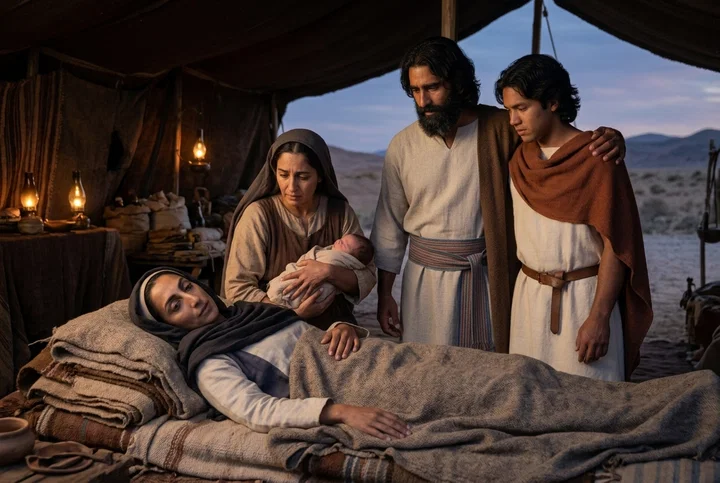
And Rachel died, and was buried in the way to Ephrath, which is Beth-lehem.
Translations
And Rachel died, and was buried in the way to Ephrath, which is Bethlehem.
King James Version, KJV Cambridge Paragraph Bible, Webster Bible
And Rachel died, and was buried in the way to Ephrath, which is Beth-lehem.
Revised Version, American Standard Version
And Rachel died, and was buried in the way to Ephrath ( the same is Beth-lehem).
and Rachel dieth, and is buried in the way to Ephratha, which [is] Bethlehem,
And Rachel died, and was buried on the way to Ephrath, which [ is] Bethlehem.
So Rachel died,—and was buried on the way to Ephrath, the same, is Bethlehem.
Berean Standard Bible, Majority Standard Bible
So Rachel died and was buried on the way to Ephrath ( that is, Bethlehem).
Rachel died, and was buried on the way to Ephrath ( also called Bethlehem).
So Rachel came to her end and was put to rest on the road to Ephrath ( which is Beth-lehem).
Thus died Rahel, and was buried in the way to Ephrath, which is Beth-lehem.
Douay-Rheims (Challoner revision)
So Rachel died, and was buried in the highway that leadeth to Ephrata, this is Bethlehem.
Pictures
Cross-references
- Jeremiah 31:15-17
Thus saith the LORD; A voice was heard in Ramah, lamentation, and bitter weeping; Rahel weeping for her children refused to be comforted for her children, because they were not.
Rachel’s burial is the background for the prophecy’s image of her weeping for her children.
- Matthew 2:17-18
Then was fulfilled that which was spoken by Jeremy the prophet, saying,
Matthew applies Jeremiah’s image of Rachel weeping to the slaughter of children.
- Genesis 48:7
And as for me, when I came from Padan, Rachel died by me in the land of Canaan in the way, when yet there was but a little way to come unto Ephrath: and I buried her there in the way of Ephrath; the same is Beth-lehem.
Jacob recalls Rachel’s death and burial near Ephrath.
- 1 Samuel 17:12
Now David was the son of that Ephrathite of Beth-lehem-judah, whose name was Jesse; and he had eight sons: and the man went among men for an old man in the days of Saul.
Both texts identify Bethlehem as David’s city and Rachel’s burial place.
- 2 Chronicles 11:6
He built even Beth-lehem, and Etam, and Tekoa,
Both texts identify Bethlehem, which Rehoboam fortified.
- Matthew 2:1
Now when Jesus was born in Bethlehem of Judaea in the days of Herod the king, behold, there came wise men from the east to Jerusalem,
Both texts identify Bethlehem as the place connected with Jesus’ birth.
- Ruth 1:19
So they two went until they came to Beth-lehem. And it came to pass, when they were come to Beth-lehem, that all the city was moved about them, and they said, Is this Naomi?
Rachel was buried near Bethlehem, where Naomi and Ruth arrived.
- 2 Samuel 23:15
And David longed, and said, Oh that one would give me drink of the water of the well of Beth-lehem, which is by the gate!
Both texts mention Bethlehem.
- Genesis 35:1-4
And God said unto Jacob, Arise, go up to Beth-el, and dwell there: and make there an altar unto God, that appeared unto thee when thou fleddest from the face of Esau thy brother.
Jacob returns to Bethel, and his household removes its foreign gods.
- Jeremiah 41:17
And they departed, and dwelt in the habitation of Chimham, which is by Beth-lehem, to go to enter into Egypt,
Both texts place a lodging near Bethlehem.
Commentary
Each commentary is drawn from primary sources: the writings of Ellen G. White and Adventist pioneers and periodicals. Each commentary is separate. Its own words are not a quotation; follow the references to read the source passages.
Ellen G. White
3 sources
Rachel died during the journey and was buried where she died, on the way to Ephrath, which is Bethlehem.ST Dec 4, 1879PP 206.3–4PP 212 Her death occurred while giving birth to Benjamin.PP 206.3–4 She was laid to rest at the place of her death on the road to Ephrath, later called Bethlehem and identified as Bethlehem.ST Dec 4, 1879PP 206.3–4PP 212 A stone monument, a pillar, was raised over her grave to preserve her memory.ST Dec 4, 1879PP 206.3–4PP 212 Her loss remained a singular grief in Jacob's long life.PP 206.3–4 Shortly before his own death, he recalled her death and burial near Ephrath.PP 206.3–4
Sources
Pioneers and periodicals
17 sources
Rachel died while the family was traveling after leaving Bethel, and she was buried where she died by the roadside leading to Ephrath, which is Bethlehem.ST Dec 4, 1879ST Jul 10, 1901ST Aug 25, 1881 Ephrath is Bethlehem, also called Ephratah and Bethlehem-Judah, and this is its first mention, with Benjamin born at that same time and place.ST Jul 10, 1901ST May 1, 1907 Jacob set a pillar of stone over her grave about a mile from Bethlehem to preserve her memory, apart from the family burial place at Machpelah.ST Dec 4, 1879ST Jul 10, 1901ST Aug 25, 1881 Her departing soul was her departing life, for soul means the person and the life and not a separate conscious part, so Rachel herself was buried and death is the death of the living person, which unlocks the unconscious state of the dead.RH Jan 5, 1864RH Sep 12, 1854RH Feb 15, 1870 By that death she entered sheol long before the slaughter of her posterity, so her weeping in Jeremiah 31:16 and Matthew 2:17-18 is figurative lamentation and not literal tears from one long dead, like the speaking dead in sheol elsewhere.RH Mar 28, 1865ST Mar 15, 1877RH May 5, 1874 Her death was the painful loss of Jacob's beloved wife, laying another beloved life in the grave and bringing bitter tears and lonely bereaved grief to the living.RH Mar 2, 1905ST Jan 9, 1912
Burial on the Road to Bethlehem
Ephrath is Bethlehem, also called Ephratah and Bethlehem-Judah, and this is the first mention of Bethlehem, then called Ephrath.ST Jul 10, 1901ST May 1, 1907 Rachel died and was buried on the road to Ephrath, which is Bethlehem, and the tomb was still associated with that area more than seventeen centuries later.RH Jan 27, 1910 The place where she died and was buried on the road to Ephrath is also called Bethlehem, with her tomb about a mile from Bethlehem.RH Jan 27, 1910
Rachel died while Jacob's family was traveling and was buried where she died on the roadside to Ephrath.ST Dec 4, 1879ST Jul 10, 1901RH Jan 27, 1910 This was when Jacob camped nearby after leaving Bethel on his return to Palestine from Padan-aram, at the time and place where Benjamin was born.ST Jul 10, 1901 Jacob set a pillar upon her grave, a stone monument placed over her grave to preserve her memory.ST Dec 4, 1879ST Jul 10, 1901 Unlike the other patriarchal family members mentioned, she was buried apart from the family burial place at Machpelah.RH Jan 27, 1910 The roadside tomb near Bethlehem is identified as Rachel's burial place, where she died about forty centuries before 1881.ST Aug 25, 1881
The verse places Rachel's death near Bethlehem and marks it as the birthplace of Benjamin about 1700 years before Christ.ST May 1, 1907 This proves Bethlehem is one of the oldest cities in Palestine and was already very ancient in the days of Christ.ST May 1, 1907 Rachel died there about forty centuries before the visit described, and her tomb was still associated with the area more than seventeen centuries later.ST Aug 25, 1881
Death as Unconscious Sleep
Rachel herself died and was buried on the way to Ephrath, and the departing of her soul means only that her life departed from her.RH Jan 5, 1864RH Sep 12, 1854RH Feb 15, 1870 Soul means person and life, not an immortal principle that separates from the body at death.RH Jan 5, 1864 Soul departing, life departing, and dying are all the same thing, for the departing of Rachel's soul was the departing of her life, and that was her death.RH Jan 5, 1864RH Sep 12, 1854 The wording refers to Rachel herself as buried, meaning her body, and does not say that her departed soul was buried, because the soul that departed was her life, not a conscious person separate from her body.RH Jan 5, 1864RH Feb 15, 1870 Death is the death of the living person, and this is the key that unlocks the whole subject of the unconscious state of the dead.RH Jan 5, 1864
By that death she entered sheol in the nether parts of the earth.RH Mar 28, 1865RH Sep 3, 1872 That entrance into sheol was long ages, nearly 2000 years, before a dreadful slaughter of her posterity took place.RH Mar 28, 1865RH Sep 3, 1872 Her death and burial on the way to Ephrath, later called Bethlehem, provide the background for Jeremiah's later picture of Rachel breaking forth into lamentation and bitter weeping and refusing to be comforted because her children are not.RH Mar 28, 1865RH May 5, 1874RH Sep 3, 1872ST Jun 23, 1881 That lament over her children is spoken of figuratively in Jeremiah 31:16 and Matthew 2:17-18, to whom the Lord says to refrain the voice from weeping and the eyes from tears for the work shall be rewarded.RH Mar 28, 1865ST Mar 15, 1877RH Sep 3, 1872 That weeping did not literally happen, for one long dead in sheol many centuries after death cannot literally shed tears and lament.RH Mar 28, 1865ST Mar 15, 1877RH May 5, 1874RH Sep 3, 1872ST Jun 23, 1881
It is figurative language to set forth a great truth, like the speaking dead in sheol elsewhere.RH Mar 28, 1865RH Sep 3, 1872 It is exactly like the rich man speaking in hades.RH Sep 3, 1872
Sorrow in Jacob's Family
The death of Rachel belongs to the January 21 reading and stands as one of the chief events of Genesis 32 to 35, alongside Jacob being met by angels, his changed heart and changed name, and his reconciliation with Esau. The chapter in which it stands shows who inherited Isaac's earthly possessions and who inherited the enduring substance, what became of the birthright for which Jacob longed and which Esau held, what each received, and that Jacob was a wanderer like his fathers.ST Oct 27, 1898
It records Rachel's death and burial on the way to Ephrath, identified as Bethlehem, and is included among the accounts showing the sad fruits of Jacob's having more than one wife, including partiality, jealousy, envy, low moral standards, and crime.ST
Rachel's death was one of Jacob's many sorrows and deep personal sorrows before Joseph disappeared.RH Mar 2, 1905ST Jan 9, 1912 It was the painful loss of his beloved and best beloved wife, whom he had to part with and lay in the grave with the rest of the dead.RH Mar 2, 1905 That closing of another beloved life in death added another tomb to the tombs that dot the world, bringing bitter tears and lonely, bereaved grief to the living who weep at the grave. His life was marked by such trials, though God continued to care for him.RH Mar 2, 1905
Sources