Genesis 42:22
And Reuben answered them, saying, Spake I not unto you, saying, Do not sin against the child; and ye would not hear? therefore, behold, also his blood is required.
Translations
And Reuben answered them, saying, Spoke I not to you, saying, Do not sin against the child; and you would not hear? therefore, behold, also his blood is required.
King James Version, KJV Cambridge Paragraph Bible
And Reuben answered them, saying, Spake I not unto you, saying, Do not sin against the child; and ye would not hear? therefore, behold, also his blood is required.
And Reuben answered them, saying, Did I not speak to you, saying, Do not sin against the young man; and ye would not hear? therefore behold also his blood is required.
Revised Version, American Standard Version
And Reuben answered them, saying, Spake I not unto you, saying, Do not sin against the child; and ye would not hear? therefore also, behold, his blood is required.
And Reuben answereth them, saying, 'Spake I not unto you, saying, Sin not against the lad? and ye hearkened not; and his blood also, lo, it is required.'
And Reuben answered them, saying, Did I not speak to you, saying, Do not sin against the lad? But ye did not hearken; and now behold, his blood also is required.
And Reuben responded to them, saying—Spake I not unto you saying, Do not sin against the child! And ye hearkened not? His very blood, therefore lo! it is required.
Berean Standard Bible, Majority Standard Bible
And Reuben responded, “Didn’t I tell you not to sin against the boy? But you would not listen. Now we must account for his blood!”
Reuben answered them, saying, “Didn’t I tell you, saying, ‘Don’t sin against the child,’ and you wouldn’t listen? Therefore also, behold, his blood is required.”
And Reuben said to them, Did I not say to you, Do the child no wrong? but you gave no attention; so now, punishment has come on us for his blood.
And Reuben answered them, saying, Warned I not you, saying, Sinne not against the childe, and ye would not heare? and lo, his blood is now required.
Douay-Rheims (Challoner revision)
And Ruben one of them, said: Did not I say to you: Do not sin against the boy: and you would not hear me? Behold his blood is required.
Pictures
Cross-references
- Genesis 37:21-22
And Reuben heard it, and he delivered him out of their hands; and said, Let us not kill him.
Reuben urged his brothers not to kill Joseph and planned to rescue him.
- Genesis 37:28
Then there passed by Midianites merchantmen; and they drew and lifted up Joseph out of the pit, and sold Joseph to the Ishmeelites for twenty pieces of silver: and they brought Joseph into Egypt.
The brothers sold Joseph despite Reuben’s warning.
- Genesis 42:36
And Jacob their father said unto them, Me have ye bereaved of my children: Joseph is not, and Simeon is not, and ye will take Benjamin away: all these things are against me.
Jacob laments the loss of Joseph and Simeon and fears losing Benjamin.
- Genesis 37:4
And when his brethren saw that their father loved him more than all his brethren, they hated him, and could not speak peaceably unto him.
Parental favoritism bred the brothers’ hatred behind the crime.
- Genesis 4:8-10
And Cain talked with Abel his brother: and it came to pass, when they were in the field, that Cain rose up against Abel his brother, and slew him.
Abel’s blood is known to God.
- Genesis 37:5-11
And Joseph dreamed a dream, and he told it his brethren: and they hated him yet the more.
Joseph’s dreams provoke his brothers’ envy, and later events fulfill them.
- Genesis 37:33
And he knew it, and said, It is my son’s coat; an evil beast hath devoured him; Joseph is without doubt rent in pieces.
Jacob believes false evidence that a beast devoured Joseph.
Commentary
Each commentary is drawn from primary sources: the writings of Ellen G. White and Adventist pioneers and periodicals. Each commentary is separate. Its own words are not a quotation; follow the references to read the source passages.
Ellen G. White
7 sources
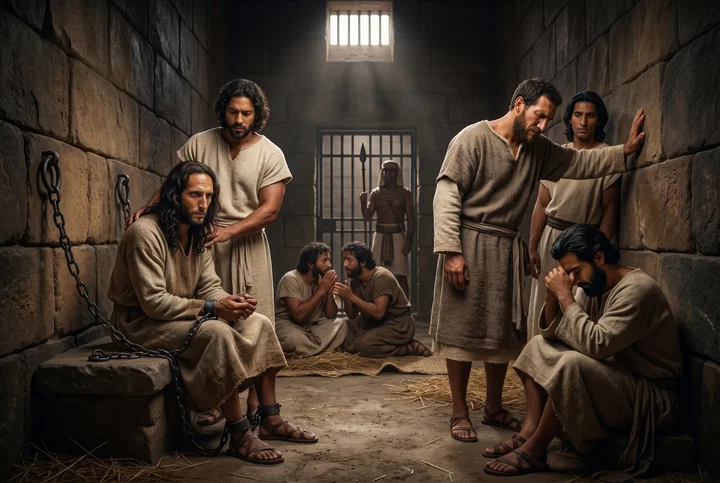
The words belong to the three days the brothers spent confined in Egypt as suspected spies, days of bitter sorrow in which they reflected upon their past wrong course, especially their cruelty to Joseph.SG3 155.2 In the verse Reuben reminds them that he had warned them not to sin against the child Joseph, but they would not hear.1SP 141.1–142.2SG3 156.1PP 224.3–225.1PP 225.4 He declares that his blood is now required of them, meaning their present distress and danger is the consequence of their guilt and responsibility for selling him, for their cruelty toward him, and for ignoring his anguish and mistreating him.1SP 141.1–142.2SG3 156.1PP 224.3–225.1PP 225.4
Facing death or slavery if condemned as spies, they feared God designed to punish them by suffering them to become slaves because they had sold Joseph as a slave.SG3 155.2 Their sorrow over their cruelty and their dread of just punishment showed repentance for how they had treated Joseph.SG3 155.2 That repentance gave assurance that they would in no case treat Benjamin as they had treated him.SG3 155.2
Since their cruelty toward Joseph they had lived with remorse and great distress of mind, believing his blood was required of them and fearing guilt for his death.1SP 151.1SG3 167.1 Learning that Joseph was alive relieved their remorse and their troubled minds, because they knew they were not guilty of his blood and death.1SP 151.1SG3 167.1 They then humbly confessed the wrongs they had committed against him and entreated his forgiveness, and rejoiced greatly that he was alive.SG3 167.1
Sources
Pioneers and periodicals
19 sources
Reuben spoke in Egypt while he and his brothers stood in prison under suspicion as spies, confessing among themselves in their own tongue that their distress had come because they had ignored Joseph's pleading, while Joseph understood them and turned aside to weep before binding Simeon before their eyes.ST Jan 3, 1911ST Nov 17, 1898ST Nov 17, 1898ST Oct 23, 1901 He reminded them that he had warned them at the time not to harm the boy, but they would not listen, and now his blood was being required of them.ST Jan 22, 1880STST Jan 28, 1913 Their cruelty had grown out of hatred and envy fed by their father's unwise favoritism toward Joseph and by the jealousies of a divided household, leading them first to seek his death and then to sell him into Egypt and deceive their father about his fate.ST Jan 3, 1911ST Dec 14, 1915ST Dec 6, 1883 Present trouble awakened their consciences and softened hearts that had been hard, making them ready to repent and seek forgiveness, as Joseph in wisdom and love sought to awaken them.ST Jan 22, 1880ST Apr 16, 1894ST Nov 17, 1898 Through the fires of such affliction God welded a jealous and divided household into bonds of love, burning out self-love and hatred until their hearts were made pliable and fit for His Spirit, while still guiding Joseph by a roundabout path from slavery to rule in Egypt.RH Jan 19, 1860ST Dec 14, 1915ST Sep 28, 1904RH Nov 24, 1874
Setting and Meaning
The verse exposes the guilt of the brothers rooted in hatred and envy toward Joseph.ST Jan 3, 1911 That hatred grew from their father's loving but unwise favoritism toward Joseph as the petted child of his old age and son of his favorite wife, and from the jealousies bred by plurality of wives between the mothers and between their families.ST Jan 3, 1911 The hatred led first to an attempt to kill Joseph and finally to selling him as a slave into Egypt.ST Jan 3, 1911 Then they deceived their father into believing wild beasts had slain him, with apparent evidence that an evil beast had devoured him, and they rejoiced in his absence instead of sharing their father's consuming unspoken grief.ST Dec 14, 1915ST Dec 6, 1883
Years later famine drove the sons to Egypt to buy food and bread.ST Oct 23, 1901ST Dec 14, 1915 There Joseph had been placed by God over all purchasable food and vested by the king with power so that all must bow to him, and through faithfulness to God had become prime minister.ST Oct 23, 1901ST Dec 14, 1915 He recognized them though they did not recognize him.ST Oct 23, 1901 To learn whether their characters had changed and whether their word could be trusted he charged them with being spies and put them in prison, where they expected death.ST Oct 23, 1901
The verse is Reuben's answer during that first visit to Egypt.ST Nov 17, 1898 It was spoken after Joseph's proposition was accepted and after the brothers confessed they were verily guilty because they saw the distress of Joseph's soul when he besought them and they would not hear.ST Nov 17, 1898ST Nov 17, 1898 While they protested innocence to Joseph through an interpreter, they spoke freely to one another in their own language without knowing Joseph understood.ST Nov 17, 1898ST Oct 23, 1901 Their words moved him to turn aside and weep before binding Simeon before their eyes.ST Nov 17, 1898ST Nov 17, 1898
In the verse Reuben reminds his brothers that at the time he had warned them, saying do not sin against the child, and they would not hear or listen.ST Jan 22, 1880ST Nov 17, 1898STST Jan 28, 1913ST Mar 27, 1893 He recognizes their present distress and imprisonment in Egypt as connected to that earlier wrongdoing and crime against Joseph.ST Nov 17, 1898STST Jan 28, 1913 So now Joseph's blood is required of them and accounted for.ST Jan 22, 1880ST Jan 28, 1913RH Nov 24, 1874ST Mar 27, 1893 Even the mention of Joseph only as a youth whom God guided and saved belongs to this reckoning.RH Nov 24, 1874
The setting fulfills Joseph's dreams despite his brothers' hatred, as they came unknowingly before him enthroned and humbly bowed, fulfilling the dreams that had aroused their envy.ST Jan 3, 1911ST After three days Joseph released all but Simeon, the most guilty in the sin toward Joseph, keeping him bound as hostage until they should bring Benjamin.ST Oct 23, 1901 He sent the rest home with corn and bread on condition they not return without their younger brother, with money placed in the mouths of their food sacks.ST Oct 23, 1901ST Dec 14, 1915 They later told their father together with the demand for Benjamin what had befallen them there, while the discovery of the money stamped them as thieves, until he cried that all these things are against him, that Joseph is not, Simeon is not, and Benjamin would be taken away.ST Dec 14, 1915ST Dec 6, 1883
Teaching and Application
Present distress brings past cruelty and guilt to mind, for the brothers in prison remembered the warning not to sin against the child and understood that his blood was now required of them.ST Jan 22, 1880ST Apr 16, 1894ST Nov 17, 1898 That earlier remorse over their treatment of him showed their hearts had been softened.ST Apr 16, 1894 In sore straits through famine they became ready to repent of cruelty to Joseph and seek forgiveness.ST Sep 28, 1904
Joseph in wisdom and meaning and love was attempting to awaken the consciences of his brethren, and the exchange reveals traits in Reuben's character.ST Nov 17, 1898 It gives lessons from adversity about what to do when in trouble of any kind.ST Nov 17, 1898
Their affliction united a household divided by jealousy in the closest bonds of love and welded their hearts firmly together.ST Sep 28, 1904 God as Creator knows just when affliction has been enough to make hearts pliable.ST Sep 28, 1904 He brings His people through the fires of affliction to burn out the dross of self-love, so their hearts become fit temples for His Holy Spirit instead of low shrines of passion and hatred and jealousy.ST Sep 28, 1904
As part of the life of Joseph, the verse teaches underlying principles designed to guide dealing with the various contingencies of life.ST Nov 29, 1905 It gives an example to help and guide anyone called to pass through similar experiences, with practical lessons to be known as familiarly as one's own name for personal good and for counseling others in similar difficulties, as part of the Bible as a trustworthy guidebook to the very end.ST Nov 29, 1905 It also gives lessons from adversity about what to do when in trouble of any kind.ST Nov 17, 1898
The verse belongs to Joseph's history, which shows that God may lead a person by a roundabout path while still guiding him to the right end.RH Jan 19, 1860 It belongs to the story of the sons going to Egypt for bread after they sold young Joseph into Egyptian slavery and deceived their father into believing wild beasts had slain him, by which time Joseph through faithfulness to God had become prime minister in Egypt.ST Dec 14, 1915 It mentions Joseph as a youth whom God guided and saved.RH Nov 24, 1874 It is part of the story of Joseph, whom time could make forgotten by his brothers; even when people forget or fail to recognize someone, the Lord knows His own and keeps His eye on them.RH Nov 4, 1858
Sources