Genesis 37:33
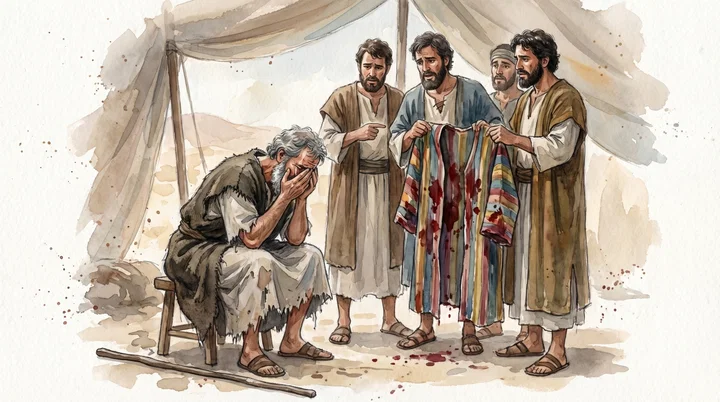
And he knew it, and said, It is my son’s coat; an evil beast hath devoured him; Joseph is without doubt rent in pieces.
Translations
And he knew it, and said, It is my son’s coat; an evil beast has devoured him; Joseph is without doubt rent in pieces.
King James Version, KJV Cambridge Paragraph Bible
And he knew it, and said, It is my son’s coat; an evil beast hath devoured him; Joseph is without doubt rent in pieces.
And he knew it, and said, It is my son's coat; an evil beast hath devoured him: Joseph is without doubt rent in pieces.
And he knew it, and said, It is my son’s coat; an evil beast hath devoured him; Joseph is without doubt torn in pieces.
And he knew it, and said, It is my son’s coat: an evil beast hath devoured him; Joseph is without doubt torn in pieces.
And he discerneth it, and saith, 'My son's coat! an evil beast hath devoured him; torn — torn is Joseph!'
And he discerned it, and said, [ It is] my son's vest! an evil beast has devoured him: Joseph is without doubt rent in pieces!
So he examined it, and said—The tunic of my son! A cruel beast hath devoured him,—torn in pieces—torn in pieces, is Joseph!
Berean Standard Bible, Majority Standard Bible
His father recognized it and said, “ It is my son’s robe! A vicious animal has devoured him. Joseph has surely been torn to pieces!”
He recognized it, and said, “ It is my son’s tunic. An evil animal has devoured him. Joseph is without doubt torn in pieces.”
And he saw that it was, and said, It is my son's coat; an evil beast has put him to death; without doubt Joseph has come to a cruel end.
Then he knewe it and said, It is my sonnes coate: a wicked beast hath deuoured him: Ioseph is surely torne in pieces.
Douay-Rheims (Challoner revision)
And the father acknowledging it, said: It is my son’s coat, an evil wild beast hath eaten him, a beast hath devoured Joseph.
Pictures
Cross-references
- Genesis 50:20
But as for you, ye thought evil against me; but God meant it unto good, to bring to pass, as it is this day, to save much people alive.
God turned the evil done to Joseph into good, saving many lives.
- Genesis 42:36
And Jacob their father said unto them, Me have ye bereaved of my children: Joseph is not, and Simeon is not, and ye will take Benjamin away: all these things are against me.
Jacob mourns Joseph as lost and fears further bereavement.
- Acts 7:9
And the patriarchs, moved with envy, sold Joseph into Egypt: but God was with him,
Joseph’s brothers sold him into Egypt, reflecting the persecution and envy behind their claim that he was dead.
- Genesis 37:5-11
And Joseph dreamed a dream, and he told it his brethren: and they hated him yet the more.
Events meant to thwart Joseph’s dreams ultimately brought about their fulfillment.
- Genesis 37:3
Now Israel loved Joseph more than all his children, because he was the son of his old age: and he made him a coat of many colours.
Jacob’s special love for Joseph led to favoritism among his sons.
- Genesis 45:26-28
And told him, saying, Joseph is yet alive, and he is governor over all the land of Egypt. And Jacob’s heart fainted, for he believed them not.
Jacob learns Joseph is alive, contrary to his belief after seeing the coat.
- Genesis 37:28
Then there passed by Midianites merchantmen; and they drew and lifted up Joseph out of the pit, and sold Joseph to the Ishmeelites for twenty pieces of silver: and they brought Joseph into Egypt.
Joseph’s brothers sell him, beginning the long period in which Jacob believes him dead.
- Genesis 42:6
And Joseph was the governor over the land, and he it was that sold to all the people of the land: and Joseph’s brethren came, and bowed down themselves before him with their faces to the earth.
Joseph’s brothers bow before him, fulfilling his dreams.
- Genesis 46:29-30
And Joseph made ready his chariot, and went up to meet Israel his father, to Goshen, and presented himself unto him; and he fell on his neck, and wept on his neck a good while.
Jacob’s long grief over Joseph ends in joyful reunion.
- Genesis 45:9-11
Haste ye, and go up to my father, and say unto him, Thus saith thy son Joseph, God hath made me lord of all Egypt: come down unto me, tarry not:
Joseph sends for Jacob to come to Egypt, promising to provide for him.
- Genesis 45:5-7
Now therefore be not grieved, nor angry with yourselves, that ye sold me hither: for God did send me before you to preserve life.
Joseph explains that God sent him ahead to preserve life.
- Genesis 41:46
And Joseph was thirty years old when he stood before Pharaoh king of Egypt. And Joseph went out from the presence of Pharaoh, and went throughout all the land of Egypt.
Joseph’s age before Pharaoh helps establish when Jacob mourns him.
- Genesis 46:1-7
And Israel took his journey with all that he had, and came to Beer-sheba, and offered sacrifices unto the God of his father Isaac.
Jacob and his family travel to Egypt to join Joseph.
Commentary
Each commentary is drawn from primary sources: the writings of Ellen G. White and Adventist pioneers and periodicals. Each commentary is separate. Its own words are not a quotation; follow the references to read the source passages.
Ellen G. White
5 sources
Jacob at once knew the blood-stained coat brought to him as his son Joseph's own garment.SG3 142.1–2PP 212.11SP 130.1–2 From that torn and bloodied evidence he concluded that an evil beast had devoured Joseph and rent him in pieces.SG3 142.1–2PP 212.11SP 130.1–2SG3 168.2
That conclusion was mistaken, for it rested on false evidence put before him by his sons.SG3 142.1–2PP 212.11SP 130.1–2SG3 168.2 They deceived him with the coat and concealed from him the truth that they had sold Joseph, leaving him to believe Joseph was dead.SG3 142.1–2PP 212.11SP 130.1–2SG3 168.2
The imagined violent death brought Jacob intense grief that lasted a long time.SG3 142.1–2PP 212.11SP 130.1–2SG3 168.2 For many days he refused comfort and mourned as one who would go down to the grave in sorrow for his son.SG3 142.1–2PP 212.1SG3 168.2 He declared that he would mourn Joseph until his own death.SG3 142.1–2PP 212.11SP 130.1–2
He continued to mourn Joseph as dead until they met again alive in Egypt.SG3 168.2 There Joseph left his chariot to run on foot to meet his father, and they embraced and wept over each other.SG3 168.2 Jacob's joy at seeing his son alive made him say he was now willing to die.SG3 168.2
The verse belongs to the account of Joseph's suffering while virtuous, when he was maligned, persecuted, and treated as a criminal.Lt 10, 1879, par. 4–9 Such suffering did not mean God had forsaken him, for God gave him signal victories despite appearances.Lt 10, 1879, par. 4–9
Sources
Pioneers and periodicals
45 sources
Jacob knew the blood-stained coat of many colors brought to him as his son's, smeared with the blood of a killed he-goat, and concluded that an evil beast had devoured Joseph and torn him in pieces with no body left to bury.ST Apr 2, 1894ST Oct 2, 1901ST Oct 27, 1898ST Apr 20, 1888RH Nov 7, 1854 That conclusion was false, yet it was the natural reading of the bloody coat, and it hid what the brothers had actually done in stripping Joseph, casting him into the pit, and selling him to the Ishmaelites for twenty pieces of silver to be taken into Egypt.ST Apr 2, 1894ST Jan 3, 1911ST Apr 2, 1894RH Aug 14, 1860 Deceived by their presenting the coat as proof to cover their crime, Jacob rent his garments, put on sackcloth, refused comfort, and mourned as for the dead for about twenty-two years while Joseph was alive.ST Mar 17, 1887ST Apr 2, 1894ST Oct 27, 1898ST Oct 27, 1898 What the brothers meant for evil to prevent Joseph's dreams, God meant for good, directing the cruel sale toward the throne of Egypt to preserve food and save the lives of his family and many thousands in famine.ST Mar 17, 1887ST Apr 2, 1894RH Jan 11, 1906RH Mar 20, 1900 In this Jacob reaped from his own sons what he had sown in deceiving his own father, showing that deception brings bitter sorrow even after repentance, yet God can be trusted to bring His purpose to pass even through seeming ruin and loss.RH Jan 19, 1860ST Jun 9, 1881RH Mar 30, 1869ST Apr 20, 1888ST Jul 10, 1893
Coat Recognized, Beast Concluded
Jacob knew at once the garment held up before him for his son's coat, the coat of many colors belonging to Joseph, stained and dipped and smeared with the blood of a slain he-goat whose throat had been cut with a knife.ST Apr 2, 1894ST Oct 2, 1901ST Oct 27, 1898ST Feb 7, 1911 His sons had killed the goat, dipped the coat in its blood, splashed the stain upon it, and brought it to him asking whether it was his son's coat.ST Apr 2, 1894ST Feb 7, 1911 Seeing it bloodied, he took it as Joseph's and no other's.ST Oct 2, 1901ST Oct 27, 1898ST Apr 29, 1903
At sight of the bloodied coat he concluded that an evil and wild beast had devoured and killed Joseph, that Joseph was without doubt rent and torn in pieces.ST Oct 2, 1901ST Apr 20, 1888ST Jun 11, 1894ST Oct 22, 1912ST Apr 29, 1903 He believed his son dead by a wild animal, with no body left to bury.RH Nov 7, 1854RH Aug 14, 1860 The coat seemed to confirm death, yet left terrible uncertainty about what had befallen his favorite son.ST Aug 24, 1915ST Dec 6, 1883
That conclusion was false and mistaken, a supposed rather than actual loss, for Joseph was alive and had only been taken away for a time.ST Jan 3, 1911ST Apr 2, 1894ST Aug 24, 1915 It was nevertheless the natural conclusion to draw when shown the bloody coat, which was made to look like proof that an evil beast had killed him.ST Apr 2, 1894ST Aug 24, 1915ST Dec 6, 1883
The false conclusion hid what the brothers had actually done in stripping Joseph, casting him into the pit, and selling him to the Ishmaelites for twenty pieces of silver, a paltry price from a merchant band for a half-nude slave driven toward Pharaoh's land.ST Apr 2, 1894 Afterward he was brought into Egypt and sold to Potiphar, an officer of Pharaoh.ST Apr 2, 1894 The brothers stared upon the stain with cruel and satisfied delight as the proof that Joseph was torn in pieces by an evil beast, unaware that he would one day furnish them with food and save their famished lives, and Jacob accepted their lie about the torn and bloodied coat to his own grief and mourning.RH Aug 14, 1860
Deception and Jacob's Mourning
The verse marks a deliberate deceit by which the brothers hid their guilt and crime from their father.ST Oct 27, 1898ST Oct 27, 1898ST Nov 10, 1881 They brought the blood-smeared coat to Jacob and asked whether it was his son's coat, holding it tauntingly before their weeping father with cruel delight while burying their secret.ST Apr 2, 1894ST Oct 27, 1898ST Sep 28, 1904 Deceived by that concealment, Jacob knew it as his son's coat and concluded that an evil or wild beast had devoured Joseph and rent him in pieces.ST Oct 27, 1898ST Oct 27, 1898ST Sep 28, 1904ST Nov 10, 1881 That conclusion was one downward step after envy and hatred and a scheme of murder, leaving the brothers in fearful expectation of wrath to be visited upon them.ST Oct 27, 1898
Deceived by the bloody coat, Jacob rent his garments, put sackcloth upon his loins, and mourned for his son many days.ST Apr 2, 1894 He pictured a violent death and entered years of sorrow brought on by his sons' hatred and persecution.ST Mar 17, 1887 He refused comfort from his sons and daughters and said he would go down to the grave mourning for his son.ST Mar 17, 1887ST Apr 2, 1894
He believed Joseph dead for about twenty-two years, from when Joseph was seventeen and sold until Jacob came into Egypt in the second year of the famine.RH Apr 26, 1870ST Mar 31, 1881 Through all those years he mourned as though the loss were real, while Joseph was alive and prospering.ST Jun 9, 1881RH Mar 30, 1869 His mourning rested on a false conclusion drawn from the recognized coat, yet the grief was unrelenting.ST Jun 9, 1881RH Mar 30, 1869RH Apr 26, 1870
The loss came while his heart was still sore from the death of Rachel his beloved wife, and it was followed by gaunt famine, so that in his personal family trouble he felt that all things were against him.ST Jan 9, 1912 His guilty sons buried their secret while he gave up Joseph as dead after he disappeared completely with no clue.ST Jan 9, 1912 His distress over Joseph's supposed death afterward grounded his sons' fear that losing Benjamin would bring him further grief.ST Jan 22, 1880
Roots and Reaping of Sin
The hatred that led to the bloodied coat grew from loving but unwise favoritism, for Joseph was the son of the favorite wife and the petted child of old age, while too little affection was shown to the other sons, and from the evils of plurality of wives in the jealousies that existed both between the wives and between their families.ST Jan 3, 1911ST Oct 27, 1898 That partiality in family or school carries a significance to be studied, for it shows the inevitable result of partiality and the misery such favoring produces.ST Oct 27, 1898
The brothers went downward step by step through envy and hatred to a scheme of murder and then to selling Joseph as a slave into Egypt.ST Dec 25, 1901ST Oct 27, 1898RH Mar 20, 1900 Their hatred and persecution brought their father years of sorrow, while leaving themselves in fearful expectation of wrath to be visited upon them.ST Oct 27, 1898 Their evil actions nevertheless moved him toward the throne of Egypt.RH Mar 20, 1900
In being deceived by his own sons with the coat, Jacob reaped lying and deception from those near and dear to him, being made to feel wrongdoing through them.ST Jul 10, 1893ST Jun 15, 1882ST Nov 10, 1881 As he had been separated from his father's house through his own deceit of his father, which had caused his parents sorrow, so he was now separated from Joseph through his children's treachery and brought to sorrow over the supposed loss of his beloved son.ST Jun 9, 1881ST Apr 20, 1888 The punishment thus resembled the sin, for he who had deceived his father was himself deceived by his children.ST Nov 10, 1881
God abhors deception and may allow its suffering to be felt in this life even after repentance and forgiveness, for sin when forgiven may still leave bitter consequences that remain and continue in motion.ST Jun 9, 1881RH Mar 30, 1869ST Apr 20, 1888 People often suffer the very harm they bring on others, and actions can set painful consequences in motion even when the person later repents.ST Apr 20, 1888 Jacob's grief over the supposed tearing in pieces also belonged to failing to see God's hand in the events surrounding Joseph, and to failing to trust God's promises and to wait patiently.ST Dec 14, 1915RH Mar 2, 1905
God's Good Purpose Prevails
What men meant for evil against Joseph, God meant for good, for the Lord directed events so that the cruel act intended to prevent his dreams helped bring about their fulfillment.ST Mar 17, 1887ST Apr 2, 1894 The brothers' evil actions, meant to make his life miserable, nevertheless moved him toward the throne of Egypt.ST Mar 17, 1887RH Mar 20, 1900
Joseph had been sent ahead to Egypt to preserve support for God's cause during the famine, a truth hidden from Jacob for years while he grieved.RH Jan 11, 1906 Unaware of this purpose, the brothers sold him for a paltry price as a half-nude slave driven toward Pharaoh's land, yet he would one day furnish them with food and save their famished lives.ST Feb 7, 1911 So the evil meant by the sale became salvation to the weeping father and his family, when the son sold into slavery became their only hope in time of trouble.ST Feb 7, 1911ST Jan 9, 1912 In fact the supposed death was not against Jacob but God's signal and wonderful providence to save the lives of many thousand people.RH Jan 11, 1906ST Jan 9, 1912
The history shows that God can be safely trusted to bring a person to whatever God has intended for him, even when the way leads round through seeming ruin and loss, for God still guides right.RH Jan 19, 1860 Joseph is not recorded as complaining about being taken to Egypt through his brothers' cruelty, and his willingness to go where God sent him reflects submission to the divine plan.RH Jan 19, 1860ST Nov 29, 1905 That submission developed a character others could trust.ST Nov 29, 1905
The supposed death was God's providence to bring about the happy reunion of the afflicted father and his lost son through the journey into Egypt.RH Jan 11, 1906ST Jan 9, 1912 When the truth was revealed years later, sorrow turned into overwhelming joy and thankfulness.RH Jan 11, 1906ST Jan 9, 1912 It is pictured as the ruler in Egypt sending grain down the Nile as a sign that there is bread in Egypt and a call drawing his father toward him.ST Feb 10, 1881
Type, Death, and History
Joseph's brothers sold him into Egypt out of envy, and this is a type of Christ, whom the Jews delivered to death through envy.ST Dec 25, 1901 The account is of Joseph, who feared God, being persecuted by his brothers, who were wayward and envious.RH Jun 8, 1916 It shows that the wicked persecute the righteous, and that he that was born after the flesh persecutes him that was born after the Spirit.RH Jun 8, 1916
Jacob concluded his son had been killed and eaten by a wild animal, leaving no body to bury.RH Nov 7, 1854 Yet he still expected to go down into sheol to be with him.RH Nov 7, 1854 This proves sheol is neither the dug grave nor hell as a place of suffering, but the shared state of death for all the dead, a condition of unconsciousness.RH Nov 7, 1854
The Pentateuch record concerning Joseph is fully corroborated by the decipherment of the inscriptions on Egyptian monuments and tombs.ST Jul 30, 1885 That outside confirmation is so complete that the Pentateuch is a most valuable aid to the full understanding of Egyptian history and is treated as of prime historical importance, proving the Old Testament trustworthy to a date far earlier than the ninth century B.C.ST Jul 30, 1885 The whole color of the Genesis story agrees admirably with Egypt at this time, an agreement viewed with wonder, while Egyptian monuments contain no record of Bible miracles because kings do not report their disasters, and Egyptian annals fail and give only clues to history.ST Nov 20, 1884 Egyptian pictures and accounts show slaves with Hebrew features working at brick-making as the Hebrews worked, and Egyptian pictures and stories and pious books illustrate habits and customs and help illustrate the accounts of the land and people of the Nile, and Pithom, one of the two store cities built by the children of Israel, was found bearing its name on an inscription, with great brick store-houses without windows or doors for preserving grain for use in war or famine.ST Nov 20, 1884
Reading and Living the Story
The career and experiences of Joseph contain principles designed to guide the various contingencies of life, disclosing underlying principles and an example to help anyone called to pass through a similar experience.ST Nov 29, 1905 The variety of human experiences recorded in Scripture have their counterpart in experiences people go through, and are to be known familiarly for the good of the soul and for giving counsel to others in similar difficulties, as part of the Bible as a guidebook to be trusted to the very end.ST Nov 29, 1905
Jacob recognized Joseph's coat and wrongly concluded that a wild beast had killed Joseph and torn him to pieces, grieving as though Joseph were dead when Joseph was alive and had only been taken away for a time, so that the loss was supposed rather than actual.ST Dec 14, 1915ST Aug 24, 1915 He did not see God's hand in the events surrounding Joseph, and his grief stands as part of the consequences of failing to trust God's promises and to wait patiently.ST Dec 14, 1915RH Mar 2, 1905 The mistaking of the bloodied coat for proof warns against grieving as though there were no divine hand and teaches patience, trust, and waiting on God's promises.ST Dec 14, 1915RH Mar 2, 1905ST Aug 24, 1915
The deceit of the brethren toward Jacob led him to conclude from his son's coat that an evil beast had devoured Joseph and he was rent in pieces, marking one downward step after envy, hatred, and a scheme of murder, and leaving the brethren in fearful expectation of wrath to be visited upon them.ST Oct 27, 1898 The coat was presented to him tauntingly and smeared with blood, and the deception brought Jacob deep grief.ST Sep 28, 1904 The coat carries a significance to be studied, and the episode illustrates the inevitable result of partiality in the family or school and the misery jealousy can cause within a home, while the divine plan concerning the children of Israel is being developed in it.ST Oct 27, 1898ST Sep 28, 1904
Jacob's belief that Joseph was rent in pieces by an evil beast belongs to a youth in which Joseph was guided and saved by God, showing that God cares for children and youth and that those who seek Him early find Him.RH Nov 24, 1874 Every child and youth should want the God of Israel for a friend so that angels may guard him in the time of trouble.RH Nov 24, 1874 The story of Joseph should be read by every fireside, for Joseph was truthful, obedient, noble, spirited, and dared to do right.RH Oct 9, 1900
Genesis 37 is to be read with Genesis 38 and Psalm 17 with the Promised Seed and the channels through which that Seed should come kept in mind.ST The simple Scripture narrative of Joseph is also told in the Koran as a more story-like account.RH Jan 11, 1912 The story of Joseph and his brethren where Jacob recognizes his son's coat and concludes Joseph was killed and torn apart by a wild animal was once forbidden to be published in Sunday school papers by Turkish censorship.ST Mar 27, 1893
The brothers holding the many-colored coat dipped in the blood of a goat before their weeping father and asking whether it is his son's coat, to make him doubt and mourn that Joseph is not, pictures professed sons of God tearing apart the Bible, covering it with their own learning, and holding its mutilated parts before longing souls to make them doubt whether it is the Word of God and mourn that the Bible is not.ST Feb 7, 1911 As the evil the brothers meant brought salvation to the weeping father and his family when the son sold into slavery became their only hope in time of trouble, so the attack leaves the Old Book still the one hope of every longing soul in days of trouble.ST Feb 7, 1911
Sources