Genesis 44:13
Then they rent their clothes, and laded every man his ass, and returned to the city.
Translations
American King James Version, King James Version, KJV Cambridge Paragraph Bible, Revised Version, American Standard Version
Then they rent their clothes, and laded every man his ass, and returned to the city.
Then they rent their clothes, and loaded every man his ass, and returned to the city.
and they rend their garments, and each ladeth his ass, and they turn back to the city.
Then they rent their clothes, and loaded every man his ass, and they returned to the city.
And they rent their mantles,—and laded each man his ass, and returned to the city.
Berean Standard Bible, Majority Standard Bible
Then they all tore their clothes, loaded their donkeys, and returned to the city.
Then they tore their clothes, and each man loaded his donkey, and returned to the city.
Then in bitter grief they put the bags on the asses again and went back to the town.
Then they rent their clothes, and laded euery man his asse, and went againe into the citie.
Douay-Rheims (Challoner revision)
Then they rent their garments, and loading their asses again, returned into the town.
Pictures
Cross-references
- Genesis 44:9
With whomsoever of thy servants it be found, both let him die, and we also will be my lord’s bondmen.
The brothers promise that the guilty man will die and they will become bondmen.
- Genesis 45:1-15
Then Joseph could not refrain himself before all them that stood by him; and he cried, Cause every man to go out from me. And there stood no man with him, while Joseph made himself known unto his brethren.
The brothers’ return leads to Joseph revealing himself and reuniting with his family.
- Genesis 44:18-34
Then Judah came near unto him, and said, Oh my lord, let thy servant, I pray thee, speak a word in my lord’s ears, and let not thine anger burn against thy servant: for thou art even as Pharaoh.
Judah pleads with Joseph to spare Benjamin and protect their father from grief.
- Genesis 44:4-5
And when they were gone out of the city, and not yet far off, Joseph said unto his steward, Up, follow after the men; and when thou dost overtake them, say unto them, Wherefore have ye rewarded evil for good?
steward's accusation starts the search
- Genesis 42:6-9
And Joseph was the governor over the land, and he it was that sold to all the people of the land: and Joseph’s brethren came, and bowed down themselves before him with their faces to the earth.
The passage recounts the brothers bowing before Joseph.
- Genesis 37:5-11
And Joseph dreamed a dream, and he told it his brethren: and they hated him yet the more.
Joseph recalls the dreams as his brothers bow.
Commentary
Each commentary is drawn from primary sources: the writings of Ellen G. White and Adventist pioneers and periodicals. Each commentary is separate. Its own words are not a quotation; follow the references to read the source passages.
Ellen G. White
5 sources
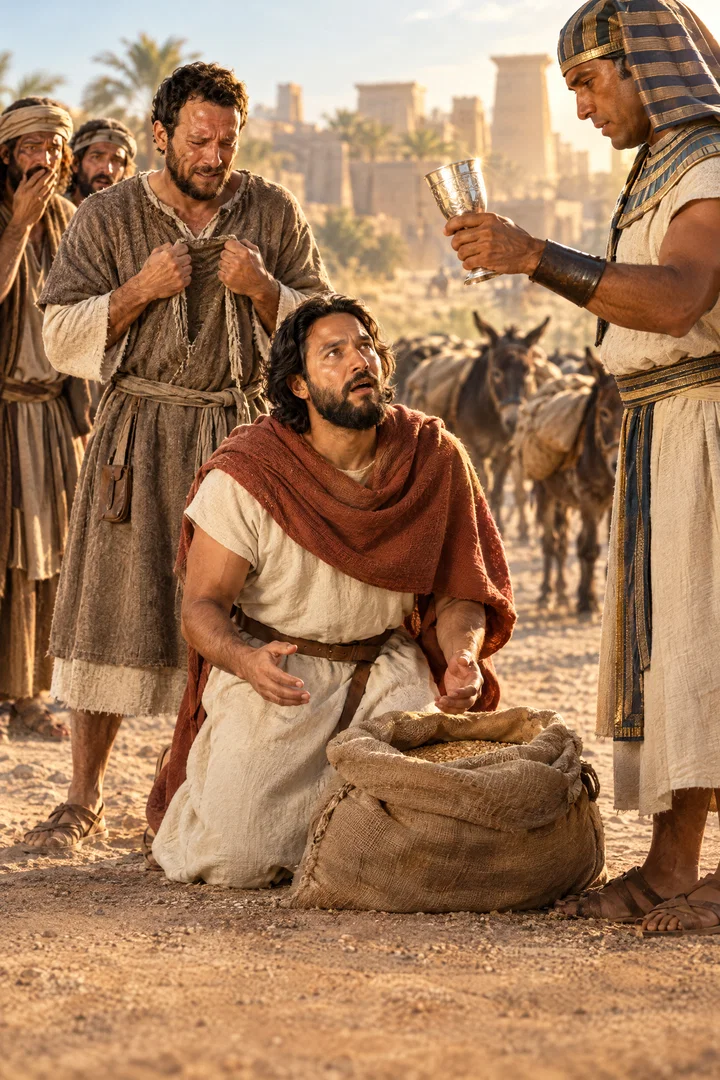
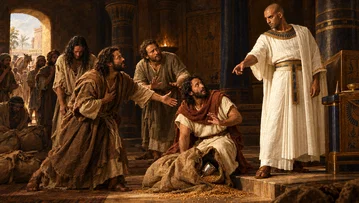
The moment comes immediately after the silver cup is discovered in Benjamin's sack.ST Jan 29, 1880PP 229.1–5SG3 163.11SP 147.1–148.1ST Mar 31, 1887 At that discovery the brothers are left speechless.ST Jan 29, 1880 They tear their clothes to express utter wretchedness and deep distress.ST Jan 29, 1880PP 229.1–5SG3 163.11SP 147.1–148.1ST Mar 31, 1887 Tearing the garments in this way is the customary sign of great affliction and deep affliction.ST Jan 29, 1880SG3 163.11SP 147.1–148.1ST Mar 31, 1887 They then load their donkeys again.1SP 147.1–148.1
They return to the city in sadness and sorrow, moving slowly and heavily.ST Jan 29, 1880PP 229.1–5SG3 163.11SP 147.1–148.1ST Mar 31, 1887 They make that return afraid.SG3 163.11SP 147.1–148.1ST Mar 31, 1887 They believe God's hand is against them because of their past wickedness and wrongdoing, bringing that wrongdoing back upon them.ST Jan 29, 1880SG3 163.11SP 147.1–148.1ST Mar 31, 1887
They expect Benjamin to become a slave and live a life of slavery, doomed to enslavement.ST Jan 29, 1880PP 229.1–5SG3 163.11SP 147.1–148.1ST Mar 31, 1887 That enslavement comes under their own promise.ST Jan 29, 1880PP 229.1–5 They believe Jacob's fears are now being realized, with his worst fears fulfilled in the loss of his beloved son.ST Jan 29, 1880SG3 163.11SP 147.1–148.1ST Mar 31, 1887
Sources
Pioneers and periodicals
9 sources
The verse records the moment after Joseph's hidden silver cup was found in Benjamin's sack, when the brothers tore their clothes, loaded every man's donkey again, and returned together to the city to face Joseph.ST Apr 16, 1894ST Nov 24, 1898ST Mar 17, 1914ST Jan 28, 1913ST Their tearing of garments was the customary expression of deep affliction and utter wretchedness, showing grief and alarm, distress and speechlessness, sorrow and fear.ST Jan 29, 1880ST Mar 31, 1887ST Nov 24, 1898ST Mar 17, 1914ST Jan 28, 1913 In that distress they tore their clothes when the cup was found and then loaded their donkeys and returned to the city.RH Aug 17, 1876
In returning sadly they felt the hand of God was against them for their past wickedness and believed God was bringing their past wrongdoing back upon them.ST Jan 29, 1880ST Mar 31, 1887 They believed Jacob's fears for Benjamin would now be realized, and that by their own confident promise that the one with the cup should be a servant forever, Benjamin was now doomed to a life of slavery.ST Jan 29, 1880ST Mar 31, 1887ST Apr 16, 1894 Joseph had hidden the cup as a deliberate policy to detain his brethren and try them to see what they would do in regard to Benjamin and whether they still held the same envy and jealousy toward him that they had held toward Joseph.ST Apr 16, 1894 Their return led to Judah's eloquent plea and offering on Benjamin's behalf, showing that the afflictions of years had softened their hearts and led them to greater humility and love for one another.ST Apr 16, 1894
Their distressed response treats stealing as a serious and heinous wrong and shows concern to avoid covetousness, proving that the law forbidding theft was already in force in Joseph's time before Moses and Sinai.RH Aug 17, 1876 As part of Joseph's history, the verse illustrates that God may lead a person by a winding path yet bring him safely to the purpose God intends.RH Jan 19, 1860
Sources