Genesis 46:29
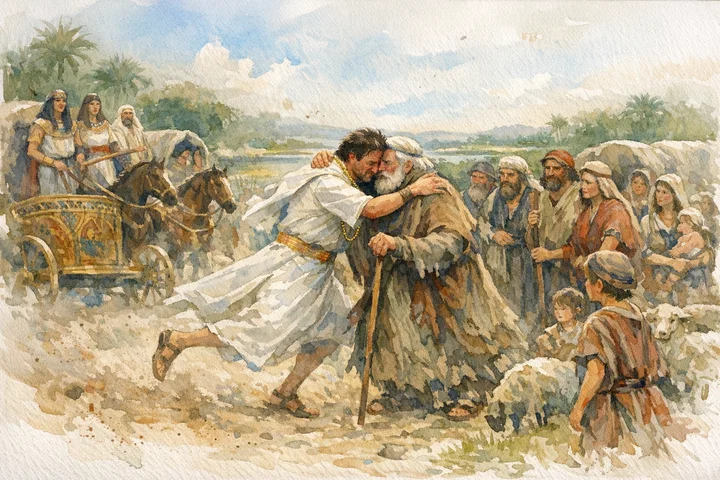
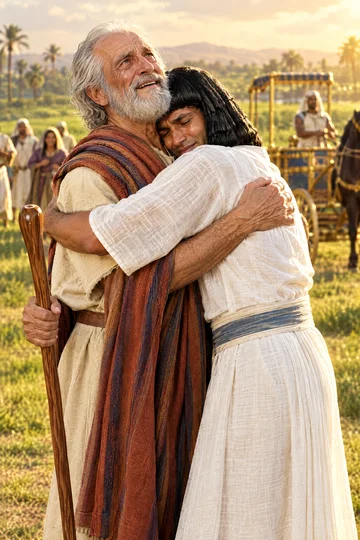
And Joseph made ready his chariot, and went up to meet Israel his father, to Goshen, and presented himself unto him; and he fell on his neck, and wept on his neck a good while.
Translations
And Joseph made ready his chariot, and went up to meet Israel his father, to Goshen, and presented himself to him; and he fell on his neck, and wept on his neck a good while.
King James Version, KJV Cambridge Paragraph Bible
And Joseph made ready his chariot, and went up to meet Israel his father, to Goshen, and presented himself unto him; and he fell on his neck, and wept on his neck a good while.
And Joseph made ready his chariot, and went to meet Israel his father to Goshen; and presented himself to him: and he fell on his neck, and wept on his neck a good while.
Revised Version, American Standard Version
And Joseph made ready his chariot, and went up to meet Israel his father, to Goshen; and he presented himself unto him, and fell on his neck, and wept on his neck a good while.
and Joseph harnesseth his chariot, and goeth up to meet Israel his father, to Goshen, and appeareth unto him, and falleth on his neck, and weepeth on his neck again;
Then Joseph yoked his chariot, and went up to meet Israel his father, to Goshen, and he presented himself to him; and he fell on his neck, and wept on his neck a good while.
Then yoked Joseph his chariot, and went up to meet Israel his father towards Goshen,—and he appeared unto him, and fell upon his neck, and wept upon his neck a good while.
Berean Standard Bible, Majority Standard Bible
Joseph prepared his chariot and went there to meet his father Israel. Joseph presented himself to him, embraced him, and wept profusely.
Joseph prepared his chariot, and went up to meet Israel, his father, in Goshen. He presented himself to him, and fell on his neck, and wept on his neck a good while.
And Joseph got his carriage ready and went to Goshen for the meeting with his father; and when he came before him, he put his arms round his neck, weeping.
Then Ioseph made ready his charet and went vp to Goshen to meete Israel his father, and presented himselfe vnto him and fel on his necke, and wept vpon his necke a good while.
Douay-Rheims (Challoner revision)
And when he was come thither, Joseph made ready his chariot, and went up to meet his father, in the same place: and seeing him, he fell upon his neck, and embracing him wept.
Pictures
Cross-references
- Genesis 45:26
And told him, saying, Joseph is yet alive, and he is governor over all the land of Egypt. And Jacob’s heart fainted, for he believed them not.
tidings that Joseph is alive and governor
- Genesis 45:28
And Israel said, It is enough; Joseph my son is yet alive: I will go and see him before I die.
Jacob resolves to see Joseph before death
- Genesis 46:34
That ye shall say, Thy servants’ trade hath been about cattle from our youth even until now, both we, and also our fathers: that ye may dwell in the land of Goshen; for every shepherd is an abomination unto the Egyptians.
Shepherding suited Joseph’s family to dwelling in Goshen.
- Luke 15:20
And he arose, and came to his father. But when he was yet a great way off, his father saw him, and had compassion, and ran, and fell on his neck, and kissed him.
The father welcomes his returning son, falling on his neck and kissing him.
- Genesis 48:11-12
And Israel said unto Joseph, I had not thought to see thy face: and, lo, God hath shewed me also thy seed.
Jacob rejoices to see Joseph and his sons, whom he welcomes as grandsons.
- Acts 7:14
Then sent Joseph, and called his father Jacob to him, and all his kindred, threescore and fifteen souls.
Gives the number as seventy-five, including Joseph and his family.
- Genesis 46:3-4
And he said, I am God, the God of thy father: fear not to go down into Egypt; for I will there make of thee a great nation:
assurance God will go with Jacob to Egypt
- Genesis 43:9
I will be surety for him; of my hand shalt thou require him: if I bring him not unto thee, and set him before thee, then let me bear the blame for ever:
Judah pledges responsibility for Benjamin, persuading Jacob to send him.
- Genesis 37:5-11
And Joseph dreamed a dream, and he told it his brethren: and they hated him yet the more.
Joseph remembers the dreams when his brothers bow before him.
Commentary
Each commentary is drawn from primary sources: the writings of Ellen G. White and Adventist pioneers and periodicals. Each commentary is separate. Its own words are not a quotation; follow the references to read the source passages.
Ellen G. White
5 sources
The meeting took place at Goshen, where Joseph went up to meet his father Israel, also called Jacob.SG3 168.2PP 233.1–3ST Feb 5, 1880 He did not remain in his chariot but left it and hastened and ran on foot to meet his father.1SP 152.2SG3 168.2PP 233.1–3ST Feb 5, 1880 He embraced him, falling on his neck, and father and son wept over each other together for a long time, a good while.1SP 152.2SG3 168.2PP 233.1–3ST Feb 5, 18805T 124.1–2
The reunion was very affectionate and moving, a very affecting outpouring of the deep love and joy that had been restrained during their many years apart.1SP 152.2SG3 168.2PP 233.1–3ST Feb 5, 1880 Jacob had long mourned Joseph as dead, and after seeing him alive again he said he was now willing and ready to die.SG3 168.2PP 233.1–3 Joseph's greeting showed deep filial reverence, respect and love, and he tenderly cared for his father's comfort in his declining years.5T 124.1–2
His example teaches young people to love and honor their parents, and love for one's mother is a trait God approves.5T 124.1–2
Sources
Pioneers and periodicals
9 sources
Genesis 46:29 belongs to the closing chapters of Genesis, the Book of Beginnings, completing the interesting and helpful story of Joseph and his brothers, full of lessons on the surface as well as deeper ones. It records part of Jacob's journey to Egypt with his descendants and their reception by Joseph and Pharaoh.ST Jan 10, 1911 It belongs to the account in which Joseph's role preserved his relatives' lives, turning what was intended for harm to their good.ST Jan 23, 1912
The verse takes place as Jacob's household arrives in Egypt, when Joseph goes up to meet Israel his father at Goshen.RH Sep 21, 1911ST Jan 10, 1911 Goshen was chosen as a grazing country where the family could keep sheep and remain separate from the Egyptians, who regarded shepherds as an abomination.RH Sep 21, 1911 Jacob feared his descendants would otherwise be absorbed by them.RH Sep 21, 1911
The meeting follows Jacob's long mourning of Joseph as dead.RH Jun 25, 1872 The first news that Joseph was alive seemed too good to be true and made Jacob faint.RH Jun 25, 1872 But fuller details revived his heart, lighted his countenance with inexpressible joy, and animated his whole being.RH Jun 25, 1872
The reunion is joyful and very affectionate after years of separation.ST Jan 10, 1911ST Dec 6, 1883 Joseph leaves his chariot and runs to meet his father on foot, embraces him, and father and son weep on each other a good while.ST Feb 5, 1880 The scene is simple yet affecting and moves all who read it to tears.RH Jun 25, 1872 It began years of happiness and rest for Jacob, who later held Joseph's sons on his knees and could see that his hardships had been steps toward good, even though he had felt that everything was against him.ST Jan 23, 1912ST Dec 6, 1883
The verse shows God's providential care and direction in preserving Israel's family, the progenitors and line through which the promised Seed would come.ST Jan 10, 1911 Though no words directly say God sent them, the going into Egypt was under His direction. It shows He can guide people to His purpose even by a roundabout way and can use what was intended for harm for good.ST Jan 23, 1912RH Jan 19, 1860 God sent His children into Egypt for a twofold purpose, to preserve His own people from famine and to try them, and to keep representatives of the truth of God constantly before Egypt.
The story of Joseph's reunion with his father after Jacob comes to Egypt is one of the Bible accounts children love to hear again.RH Oct 1, 1901 It shows the gladness of a father receiving a long-buried son as from the grave, with sweet surprise at seeing him from a distance, a touched heart, and flowing tears.RH Jul 15, 1862 He runs as with the feet of youth, falls on his neck, and embraces and kisses him amid joyful tears.RH Jul 15, 1862 This is the joy of a father over a sinner converted from the error of his way, a son that was dead and is alive again, lost and found.RH Jul 15, 1862
Sources