Luke 15:20
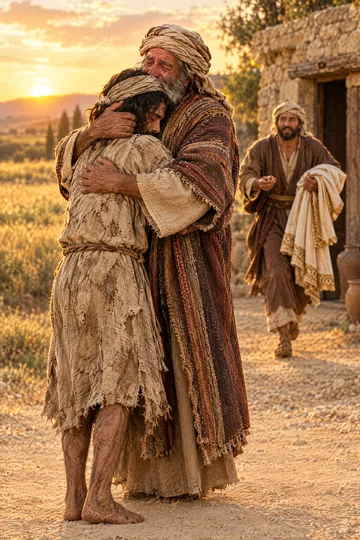
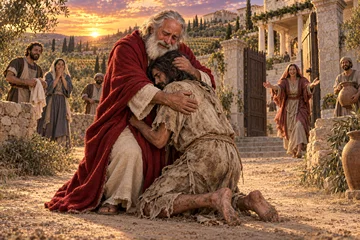
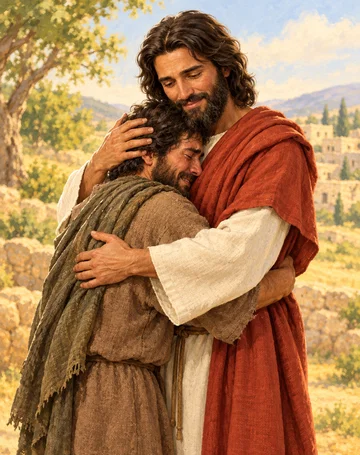
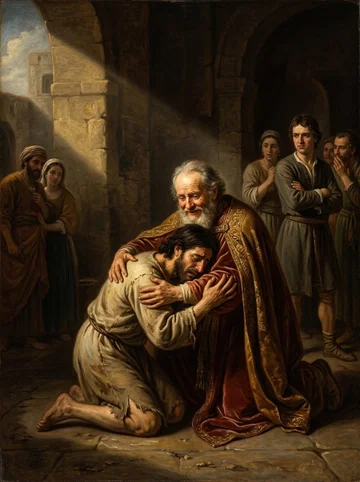
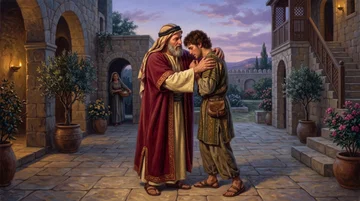
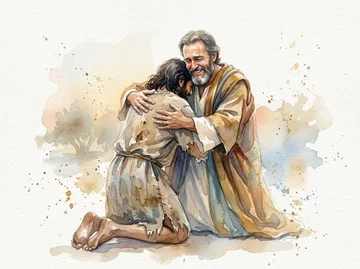
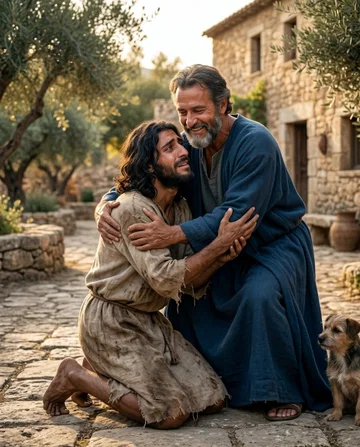
And he arose, and came to his father. But when he was yet a great way off, his father saw him, and had compassion, and ran, and fell on his neck, and kissed him.
Translations
American King James Version, King James Version, KJV Cambridge Paragraph Bible, Webster Bible
And he arose, and came to his father. But when he was yet a great way off, his father saw him, and had compassion, and ran, and fell on his neck, and kissed him.
Revised Version, American Standard Version
And he arose, and came to his father. But while he was yet afar off, his father saw him, and was moved with compassion, and ran, and fell on his neck, and kissed him.
'And having risen, he went unto his own father, and he being yet far distant, his father saw him, and was moved with compassion, and having ran he fell upon his neck and kissed him;
And he rose up and went to his own father. But while he was yet a long way off, his father saw him, and was moved with compassion, and ran, and fell upon his neck, and covered him with kisses.
Now, while yet he was holding afar off, his father saw him, and was moved with compassion, and, running, fell upon his neck, and tenderly kissed him.
Berean Standard Bible, Majority Standard Bible
So he got up and went to his father. But while he was still in the distance, his father saw him and was filled with compassion. He ran to his son, embraced him, and kissed him.
“ He arose and came to his father. But while he was still far off, his father saw him and was moved with compassion, and ran, fell on his neck, and kissed him.
And he got up and went to his father. But while he was still far away, his father saw him and was moved with pity for him and went quickly and took him in his arms and gave him a kiss.
So hee arose and came to his father, and when hee was yet a great way off, his father sawe him, and had compassion, and ranne and fell on his necke, and kissed him.
Douay-Rheims (Challoner revision)
And rising up he came to his father. And when he was yet a great way off, his father saw him, and was moved with compassion, and running to him fell upon his neck, and kissed him.
Pictures






Cross-references 20 of 40
- Luke 15:7
I say unto you, that likewise joy shall be in heaven over one sinner that repenteth, more than over ninety and nine just persons, which need no repentance.
Heaven rejoices over one sinner who repents.
- Luke 15:10
Likewise, I say unto you, there is joy in the presence of the angels of God over one sinner that repenteth.
Heaven rejoices over one sinner who repents.
- Luke 15:24
For this my son was dead, and is alive again; he was lost, and is found. And they began to be merry.
The father explains his joy as his lost son being found and alive again.
- Psalms 103:13
Like as a father pitieth his children, so the LORD pitieth them that fear him.
The Lord’s pity for those who fear him is compared to a father’s pity for his children.
- Isaiah 55:7
Let the wicked forsake his way, and the unrighteous man his thoughts: and let him return unto the LORD, and he will have mercy upon him; and to our God, for he will abundantly pardon.
The returning sinner receives mercy and abundant pardon.
- Luke 15:28-30
And he was angry, and would not go in: therefore came his father out, and intreated him.
The elder brother’s resentment contrasts with the father’s welcome.
- Matthew 18:14
Even so it is not the will of your Father which is in heaven, that one of these little ones should perish.
The father’s welcome reflects God’s will that none of the lost should perish.
- Romans 5:8
But God commendeth his love toward us, in that, while we were yet sinners, Christ died for us.
God shows his love for sinners by taking the initiative to save them.
- John 6:37
All that the Father giveth me shall come to me; and him that cometh to me I will in no wise cast out.
Both promise that the coming sinner will be welcomed and received.
- 1 John 3:1
Behold, what manner of love the Father hath bestowed upon us, that we should be called the sons of God: therefore the world knoweth us not, because it knew him not.
The Father's love welcomes the prodigal and makes him a son of God.
- Luke 15:16
And he would fain have filled his belly with the husks that the swine did eat: and no man gave unto him.
The son’s wasteful living leaves him in want, feeding on swine’s husks before returning.
- Galatians 4:7
Wherefore thou art no more a servant, but a son; and if a son, then an heir of God through Christ.
The returning servant is received as a son and heir.
- 2 Corinthians 5:20
Now then we are ambassadors for Christ, as though God did beseech you by us: we pray you in Christ’s stead, be ye reconciled to God.
God in Christ calls sinners to be reconciled and restored to favor.
- Luke 15:1-2
Then drew near unto him all the publicans and sinners for to hear him.
Jesus receives sinners, prompting the Pharisees’ complaint.
- Jeremiah 3:22
Return, ye backsliding children, and I will heal your backslidings. Behold, we come unto thee; for thou art the LORD our God.
God invites backsliders to return and be healed.
- Malachi 3:7
Even from the days of your fathers ye are gone away from mine ordinances, and have not kept them. Return unto me, and I will return unto you, saith the LORD of hosts. But ye said, Wherein shall we return?
God calls the wanderer to return and promises to return to them.
- Jeremiah 31:3
The LORD hath appeared of old unto me, saying, Yea, I have loved thee with an everlasting love: therefore with lovingkindness have I drawn thee.
God’s everlasting love draws the sinner back to him.
- 1 John 1:9
If we confess our sins, he is faithful and just to forgive us our sins, and to cleanse us from all unrighteousness.
Returning to God brings forgiveness and cleansing from sin.
- Isaiah 44:22
I have blotted out, as a thick cloud, thy transgressions, and, as a cloud, thy sins: return unto me; for I have redeemed thee.
God blots out sins and invites the sinner to return.
- Jeremiah 3:14
Turn, O backsliding children, saith the LORD; for I am married unto you: and I will take you one of a city, and two of a family, and I will bring you to Zion:
Both invite the backslider to return to God, who promises to bring them back.
Commentary part 1 of 2
Each commentary is drawn from primary sources: the writings of Ellen G. White and Adventist pioneers and periodicals. Each commentary is separate. Its own words are not a quotation; follow the references to read the source passages.
Ellen G. White
120 sources
When he was still a great way off, his father saw and recognized him despite years of sin and degradation, had compassion, ran to meet him, and fell on his neck and kissed him.ST Jan 29, 1894Ms 147, 1897, par. 31–33ST Jan 29, 1894 The welcome comes before he reaches home and before he can make himself respectable, at even the first feeble step and desire toward God, for no one can take the first step toward the Father without Him hastening to receive, pardon and bless.SC 53.2–54.1ST Jan 29, 1894ST Apr 20, 1915 This is God's pitying love for those who have strayed to their own course, revealing His mission to recover the lost rather than condemn or destroy them, and though He hates sin He gave Himself in Christ so the sinner might be saved to eternal blessedness.COL 198.1ST Jan 29, 1894Lt 20, 1889, par. 12–14Lt 80, 1898, par. 1 The returning sinner meets no reproach, taunt or reminder of unworthiness, but is forgiven and restored as a son, embraced, clothed with the best robe of Christ's righteousness, and celebrated with joy in heaven.ST Jan 29, 1894TCBMP 124.2–126.1RH Apr 10, 190011MR 370.2–371.1TCBMP 128.2 So those who turn back are to be received with the same tender sympathy, encouragement, forgiveness and gladness, going out to meet them while still far away rather than with scolding, suspicion or contempt.Lt 45, 1894, par. 21–24GW 140.2ST Apr 1, 1889RH Nov 25, 1902
Parable Setting and Story
The parables to which this verse belongs were given because the scribes and Pharisees murmured at association with sinners, to set forth mercy and forgiveness.Ms 102, 1894, par. 12–14 They concern those who once knew the Father's love but were led captive by the tempter.COL 198.2–3 They turned from God to seek happiness apart from Him, taking His gifts for granted, wasting life in self-indulgence, and becoming enslaved to sin, with the far country picturing the spiritual and moral ruin of a self-centered life.COL 199.2–200.3
The younger son selfishly asked for his portion when rightfully he could claim nothing and should have had nothing.3T 100.3–101.2 He wanted to separate his interest from his father's so he could manage his share by his own inclination, without counsel, reproof, restraint, advice, or mutual obligation.3T 100.3–101.2TCBMP 123.1 He withdrew far so he might even forget his father and be free to seek pleasure in any way he chose.3T 100.3–101.2 He wasted all that had been given him in sinful indulgence until famine brought pinching want and regret and forced him down from extravagant pleasure to the low business of feeding swine.3T 100.3–101.2 Children can be made prodigal and evil brought into the world when parents indulge rather than restrain and guide, and when there is failure to restrain and teach at home.11MR 40.3–41.2Lt 117, 1898, par. 4–5
Far from his father's house and perishing with hunger, the prodigal pictures people lost in sin, ruined by selfish indulgence, fallen and unable to free themselves from Satan's snare, yet regarded with love, compassion, and tender sympathy.9T 50.2RH Nov 26, 1901Ms 45, 1901, par. 8Ms 22, 1898, par. 19 The return is taught through familiar events of daily life, by touching illustration rather than long, farfetched, complicated proof, coming right to the point to awaken sympathy, commend truth to the conscience, make the unseen understandable, and leave hearers free to accept or reject it.19MR 259.1–3Ms 24, 1891, par. 88ED 102.3–4 The father seeing his son while still far away and running to meet him is a most pathetic and touching scene, with rejoicing because the son thought dead is alive.19MR 259.1–3Ms 24, 1891, par. 88 The history also describes those who act as the prodigal while claiming to be commandment keepers, yet are unthankful, unholy transgressors of the law, using entrusted talents to counterwork God, conformed to the spirit and principles of worldlings and exerting influence on Satan's side while retaining the form of godliness, after whom there is yearning to do the good delighted in, but whose perversity prevents it, and it applies to one who had once loved and served the Lord but had turned away.Ms 75, 1898, par. 13–14Lt 52, 1899, par. 1
Father's Eager Welcome
While the son is still a great way off, the father sees him and recognizes him despite years of sin and degradation, poverty and rags and altered appearance, and is moved with compassion and runs to meet him and falls on his neck and embraces him tenderly and kisses him.ST Jan 29, 1894Ms 147, 1897, par. 31–333T 101.3–102.2ST Jun 2, 1909 The welcome shows the mission to recover the lost rather than to condemn or destroy them.ST Jan 29, 1894 It begins the son's restoration to his place as a son, and the squandered blessings and the son's sense of unworthiness do not prevent it, for the returning sinner comes ready to confess sin and ask for mercy.ST Jan 29, 1894 The father does not wait for the son to reach home or reproach him for his past, but lifts him with tender pity and love and forgiveness before he has earned or deserved such a welcome.3T 101.3–102.2 His quick sight shows that the years of degradation have not hidden the son from him nor ended his love, and assures the sinner that God is eager to receive one who turns back.ST Jun 2, 1909
The welcome comes before the son reaches home, before he can make himself respectable or do anything to earn acceptance, at even the first feeble step and desire toward God and before a prayer is spoken.ST Jan 29, 1894ST Apr 20, 1915COL 205.2–206.1Lt 133, 1896, par. 1–4Ms 82, 1894, par. 22–24 No one can take the first step toward the Father without Him hastening to receive and pardon and bless.Lt 133, 1896, par. 1–4 Even while the sinner is far from God, the Father's heart is toward him, and He eagerly receives the repentant sinner and His grace meets the heart's first desire for Him.SC 53.2–54.1ST Apr 20, 1915COL 205.2–206.1 His love, revealed at Calvary, assures sinners of acceptance and peace and love, and illustrates His readiness to receive and restore those who come to Him.Ms 82, 1894, par. 22–24
The sinner's longing and desire to return is the Spirit pleading with and drawing the wanderer back to the Father.SC 53.2–54.15T 632.1–2 God takes the first step to seek people even while they are still in rebellion, and rejoices to bring a wanderer home when allowed.ST Jan 22, 1894 While the sinner is still far from God, the Father's heart yearns for him. Yet the parable's picture still falls short of expressing the heavenly Father's infinite compassion.SC 53.2–54.15T 632.1–2
The father does not wait for the son to come all the way, stand on his dignity, or meet him with wrath and accusations.GW 157.3TCBMP 124.1 He goes forth to meet the returning prodigal, humbling himself to meet man in his fallen condition.ASCOP 26.1–27.1Lt 22, 1892, par. 15–16 He meets the degraded, hungry wanderer with pity and signs of love and forgiveness rather than reproach, though the son's suffering followed from his own sin and separation, and the welcome assures him of his father's goodness and love.TCBMP 124.1 The welcome includes a feast celebrating his return.GW 157.3
God's Character Revealed
The verse shows God's pitying love for those who have strayed from Him and turned away to their own course, and He does not leave them in their misery while they are exposed to temptation but meets them with kindness and tender pity and receives them with compassion.COL 198.1Lt 80, 1898, par. 1 The father's compassion in seeing the son still far away, running to meet him, embracing him and kissing him, illustrates God's mission to recover the lost rather than to condemn or destroy them.ST Jan 29, 1894 God has pity, loves the sinner, wills not that he should perish, and willingly welcomes him when he arises to return and confess that he has sinned and is unworthy.Lt 20, 1889, par. 12–14 He does not leave the mourning sinner to perish, find satisfaction in his misery, or sternly withhold him from coming in repentance.Lt 20, 1889, par. 12–14
Doubt, despair, and thinking of Him only as a judge ready to condemn misrepresent and dishonor Him, put the doubter on Satan's side, hurt the soul, and discourage all effort to seek and serve Him.Lt 20, 1889, par. 12–14 Though He hates sin, to bring eternal life within reach of all He gave Himself in the person of Christ, one with the Father, so the sinner should not perish but be saved to eternal blessedness in the kingdom of glory.Lt 20, 1889, par. 12–14 God is ready to accept the prodigal and pardon all transgressions if he will but come, even now after long separation and neglect and staying away so long.2T 295.1 The Majesty of Heaven invites him to come that he may have life, and Christ is ready to cleanse him from sin when he lays hold upon Him.2T 295.1
Christ bears with the erring through all manifest perversity and rebellion, His love for the sinner does not grow cold, His efforts do not cease, and He does not give him up to Satan's buffeting.STSE 65.2CE 25.1–3TSSW 120.24T 420.1–3 He stands with open and outstretched arms waiting to welcome again and again the erring, the rebellious, and even the apostate.STSE 65.2CE 25.1–3TSSW 120.24T 420.1–3 The return of the repenting sinner is a source of the greatest joy to the Father, and even when the poorest sinner comes in repentance there is joy among the heavenly host.3T 103.5–104.1TCBMP 128.2Ms 19, 1890, par. 21STBk 14.1STA 14.1 God receives the returning one with compassion, pity, forgiveness, love, warmth, courtesy, gladness, and affection, though He is the one sinned against.3T 103.5–104.1STBk 14.1STOM 11.2
The returning sinner meets no reproach, taunt, accusation, or reminder of unworthiness, for God does not parade past wrongs before him but treats the past as forgiven and forgotten.ST Jan 29, 1894TCBMP 124.2–126.1RH Jan 19, 1911TCBMP 124.1ST Jan 29, 1894 Penitence is required, yet the degraded, hungry wanderer in poverty is met before he reaches home with pity and signs of love and forgiveness that give clear proof of love, deepen the sense of guilt for having grieved that love, and exceed the reception feared or felt deserved.ST Jan 29, 1894TCBMP 124.2–126.1TCBMP 124.1 God is full of compassion and ready to pardon, going forth to meet the returning prodigal and humbling Himself at every step to meet man in his fallen condition, ready to abundantly bless and to heal the bruised and smitten.ASCOP 26.1–27.1 The same God who so meets the returning sinner will show Himself strong to punish persistent, independent despisers of His grace.ASCOP 26.1–27.1
The welcome pictures the Father's infinite love for the fallen race in the gift of His beloved Son as a sacrifice, making a channel for the outflow of His love so that all who believe on Jesus Christ are restored again to His favor.Lt 85, 1886, par. 17–18 That love for people perishing in sin and far from the Father's house and perishing with hunger is seen at Calvary, where God loved sinners first and sent His Son to be the propitiation not for some only but for the sins of the whole world.RH Nov 26, 1901Ms 45, 1901, par. 8Ms 41, 1890, par. 45–51 Christ's dying love on Calvary and His goodness and mercy assure the sinner of acceptance, peace, and love, and through them the sinner is restored to divine favor.Lt 15a, 1890, par. 9–11Ms 82, 1894, par. 22–243MR 32.1–3 God in Christ daily beseeches men to be reconciled, ready with outstretched arms to receive and welcome not only the sinner but the prodigal, and this is to be taught in simplest form so the sin-darkened soul may see the light shining from the cross.3MR 32.1–3
Jesus meets a great way off the one who feels deep soul-poverty with nothing good in himself, weak, helpless and despairing, whatever his past and however discouraging his present circumstances. When such a one comes just as he is, Jesus throws about him arms of love and the robe of righteousness, exchanges poverty for riches of grace, and gives righteousness and strength by being looked to. He presents the sinner to the Father clothed in the white raiment of His own character, takes the sinner's place, pleads before God for him, and His blood pleads with greater power than Satan's accusations claiming the sinner as prey. The pure in heart see God in this new and endearing relation as their Redeemer by faith here and now, discerning His goodness and compassion in providence and recognizing Him in the character of His Son as the Spirit opens truth to heart and understanding. While they discern the purity and loveliness of His character they long to reflect His image, and seeing Him as this welcoming Father longing to embrace a repenting son fills them with joy unspeakable and full of glory.
The father's love represents Jesus' love for Israel, for though Israel had repeatedly rejected mercy He still yearned for them and grieved over the judgment coming upon Jerusalem.ST Feb 27, 1896 God as a loving father toward a wayward child is willing to suffer for sinners and bear their guilt, and His warnings and invitations are acts of that fatherly love even when they are resisted.Ms 56, 1902, par. 5 The Father's mercy and pity endure despite neglect, resistance, abuse of His mercies, and rejection of His claims.Lt 111, 1895, par. 1–3 He receives the returning sinner graciously, loves freely, and pardons abundantly.Lt 111, 1895, par. 1–3
Forgiveness and Restoration
The father sees the returning son while still far off, feels compassion, runs to embrace him, shelters him from contempt, receives his repentance, and brings him home as a son instead of leaving him in the servant's place he had asked for.COL 203.2–205.118MR 113.5ST Apr 20, 1915 The past is forgiven and put away, and the sinner is restored to the family in tender, immediate, loving welcome.COL 203.2–205.118MR 113.5ST Apr 20, 1915
The Father embraces the erring child, covers his rags with garments, puts on him the best robe, which is His own robe of righteousness, places a ring on his finger as a token of royalty, kisses away shame, encourages him as he comes home, restores his dignity, and makes a feast celebrating his return.RH Apr 10, 190011MR 370.2–371.1Ms 40, 1899, par. 10–12 God stands ready to receive with joy every wanderer who returns, in contrast to contempt and resentment toward restoration.RH Apr 10, 190011MR 370.2–371.1Ms 40, 1899, par. 10–12
Returning to God is not degrading, for He receives the contrite, forgives sin, clothes the returning sinner with Christ's righteousness, gives a hearty welcome, and reconciles the sinner to Himself through Christ.Lt 76, 1898, par. 18–20Lt 59, 1898, par. 12–14 The welcome comes with love and compassion to those who turn back in repentance.Lt 76, 1898, par. 18–20Lt 59, 1898, par. 12–14
The son's return and confession are met with full pardon and pitying love, inviting return and repentance and pardoning transgressions.21MR 429.3Lt 18e, 1890, par. 2 That welcome does not make the sin less grievous, but it helps the sinner recover, covering disgrace with love, and parents are to show the same tenderness and pity without treating the sin as less serious.21MR 429.3Lt 18e, 1890, par. 2
Penitence is required, yet squandered blessings and a sense of unworthiness do not prevent the welcome.ST Jan 29, 1894 The returning sinner comes ready to confess sin, acknowledge unworthiness, ask for mercy, mourn with true contrition, and mark the return with repentance and prayer, meeting no reproach, taunt, or reminder of unworthiness.ST Jan 29, 1894Lt 72, 1890, par. 7
The prodigal returns penitent and humbled, friendless, hungry, and in rags after a life of sinful indulgence, and the father welcomes him, forgives him, and takes him back into his heart.MYP 408.1 Though sinned against, the father rejoices when the son becomes sensible of great sin and neglect, appreciates his love, acknowledges his claims, and comes back to him as the only one who can supply his great need.3T 103.5–104.1TCBMP 128.1 He knows the sinning and now repenting son has suffered and felt his need and needs pity and love, and meets him with compassion, pity, forgiveness, love, and great joy.3T 103.5–104.1TCBMP 128.1
Assurance of that love draws sinners home and leads to repentance.COL 202.3–203.1ST Apr 20, 1915 The son recognizes his guilt and plans confession, but his offer to become a hired servant shows he has not yet grasped the fullness of his father's love, whose years of watching are not defeated by sin and degradation.COL 202.3–203.1ST Apr 20, 1915
The sinner who mourns for sin with true contrition and returns to God shall be comforted. God reveals guilt so the guilty will flee to Christ, and through Him be set free from the bondage of sin and rejoice in the liberty of the sons of God, coming to the foot of the cross and there leaving burdens. His love runs faster than the returning sinner's feet to meet him while still on the way back to Him and peace.
Welcoming the Erring
The chapter to which the verse belongs lays on the church the duty to seek the lost and bring them back into the fold, and that duty reaches to George Lay, who cannot be reached until the church acknowledges its own failure toward him.Ms 16, 1868, par. 2–3 The father's welcome is the pattern Christ gives for receiving the lost and for how those who turn back are to be treated, with tender sympathy, encouragement, forgiveness, gladness, love, and joy.Lt 45, 1894, par. 21–24GW 140.2Lt 16, 1887, par. 7–1416MR 339.3 Scolding, censure, reproach, suspicion, jealousy, indifference, contempt, and severe judgment have no place in that reception, for erring, fallen people under temptation are to be met with tenderness rather than harsh condemnation.Lt 45, 1894, par. 21–24Lt 16a, 1887, par. 4Lt 16, 1887, par. 7–1416MR 339.3 As the father sees the son while still far away and goes out to meet him, so believers are to approach erring brothers while they are still far off, not waiting for them to meet a standard and not discouraging them with predictions of failure, but helping them back to the sin-pardoning Saviour with mercy and patient effort to restore the fallen.GW 140.2ST Apr 1, 1889Lt 16, 1887, par. 7–14 It is not too late for those who have strayed to renew the struggle and gain victory.ST Apr 1, 1889
Those who have erred and returned suffer in feeling and are often desponding and discouraged, and they need pity, help, sympathy, and above everything else free forgiveness.3T 103.5–104.1TCBMP 128.2 They are not to be labored with to make them feel where they erred, nor to be kept under continual reminders of their mistakes.3T 103.5–104.1TCBMP 128.2 Though He is the one sinned against, the heavenly Father meets the returning prodigal with compassion, pity, forgiveness, love, and great joy, knowing the sinning and now repenting son has suffered, felt his need, become sensible of great sin and neglect, appreciated his Father's love, acknowledged His claims, and come back as to the only one who can supply his great need.3T 103.5–104.1 The return of the repenting sinner, once believed dead to all filial affection, is a source of the greatest joy to the Father.3T 103.5–104.1TCBMP 128.2
The complaints of the elder brother were natural but not right, and his cold rejection must not be the treatment given to those who have gone astray.3T 103.5–104.1TCBMP 128.2RH Nov 25, 1902 Those who turn back must be met without that complaining, envious, contemptuous spirit, but with joy and loving, unselfish care that helps lead them to repentance.RH Nov 25, 1902Lt 71, 1895, par. 2721MR 296.5–6 The reception of the returning one with joy rather than complaint is a practical lesson involving eternal interests, to be studied with the lost sheep and the lost coin, so that instead of wounding and driving the lost away they are sought and welcomed.Lt 71, 1895, par. 27 The father's compassionate reception shows why the elder son should rejoice when the lost are brought back rather than envy the attention given to the wanderer.21MR 296.5–6 That rejoicing is to be shared, not resented; those who know God and have Christ formed within as the hope of glory will seek to save the lost, carry salvation, bear light, reflect truth, pray in sincerity, stretch out hands all day long, bring truth close to hearts, and hunt for souls instead of gossiping, doubting, envying, and questioning, sharing the joyful, welcoming spirit of God as true shepherd and compassionate father who goes after the lost sheep, meets the returning one with compassion, calls him to return with promise, heals backslidings, loves freely, turns away anger, and fills all heaven with rejoicing.Ms 49, 1898, par. 24–25Lt 71, 1895, par. 25
As Christ deals in patient, forgiving, welcoming love with erring educators who themselves make many failures, bearing with all manifest perversity and rebellion without letting love grow cold, without ceasing effort, and without giving the sinner up to Satan's buffeting, but standing with open arms to welcome again the erring, the rebellious, and even the apostate, so educators must deal the same way with youth under their care who have had fewer advantages and less favorable surroundings.STSE 65.2CE 25.1–34T 420.1–3 Parents likewise are to receive a wayward, erring child who returns with tenderness, pity, affection, full pardon, and love.Lt 18e, 1890, par. 221MR 430.3Lt 18e, 1890, par. 6 That love covers disgrace without making sin less grievous, breaks down barriers, softens the hardened heart, draws back from ruin, holds the wayward son in faith, and seeks to save him rather than giving him up.Lt 18e, 1890, par. 221MR 430.3Lt 18e, 1890, par. 6
Prodigals who have left the Father's house are to be encouraged to return to Him, for the Father receives them with compassion when they are seen while still far away.STB 620.1–2STB 147.5RH Mar 16, 1905STB 119.1 Every outcast may be brought back, for God has provided a shepherd for every lost sheep, and His followers are to seek the untrained, neglected, oppressed, and degraded by every devising and planning through grace, working in perfect harmony with angels.Lt 88a, 1895, par. 16–21 The Father in all His compassion beholds the lost and sees what may be done for their uplifting, so that poor ignorant beings degraded by sin may be saved, elevated, sanctified, and ennobled through divine power.Lt 88a, 1895, par. 16–21 People are called to cooperate with God in this seeking, for the father's welcome shows the returning son received with more than the servant's place he asked, and those sought by Christ and brought back can help bring others to the Father.18MR 113.5MH 179.1–2 When a person links with God and turns with full decision of soul, God accepts him as the father accepted the prodigal, and giving heart and soul to God brings His blessing and His working with the returned one to help other youth give their hearts to God and be converted, giving more than finite possibilities.18MR 113.5Lt 33, 1896, par. 12
Those who have wandered and nearly lost hope can return to God in contrition and penitence when they hear a loving message rather than blame and condemnation, met while still far away with compassion, welcome, and love.Lt 178, 1902, par. 28–30 Backsliders return through labor in Christ, coming back to the Father's house.Lt 59, 1886, par. 6 Tempted people need wise, gentle treatment that gives room to recover and return to safe paths, not harshness or condemnation, and they need the welcome of compassion rather than the elder brother's cold rejection.Lt 178, 1902, par. 28–30Ms 113, 1902, par. 30 The failures of professed Christians can keep prodigals from entering the kingdom, and this stands as a warning.Lt 50, 1893, par. 8–9 The verse shows God's compassion in reclaiming the lost and bringing them back to the Father's house, illustrating the recovery of one separated from God over whom all heaven rejoices, calling for compassion toward those struggling against temptation and those especially in danger from it, whose repentance brings greater joy than the ninety-nine needing no repentance.COL 197.2ST Oct 31, 19165T 604.1
Returning and Remaining Sons
The backslider's coming back to his father's house pictures turning from sin and returning to God's service, confessing backslidings and setting the feet on the heavenward path under the convicting power of the Holy Spirit with contrition of soul.Lt 59, 1886, par. 1–5Lt 27, 1890, par. 1Ms 21, 1889, par. 96–97Lt 27, 1890, par. 18–19 Those who have left the Father's house and blessing can come to Jesus in this way, firmly trusting Him to do all He has promised, for He is sufficient for all things and none who seek Him seek in vain.Lt 27, 1890, par. 1Ms 21, 1889, par. 96–97 The Lord will be a present help to them, and their return brings joy as they accept His pardon and love.Lt 59, 1886, par. 1–5Lt 27, 1890, par. 1 He meets them with tender, pitying, loving compassion far greater than human compassion, for He loved sinners and died to save them.Ms 21, 1889, par. 96–97
A thorough backslider who gave up the Sabbath under Satan's temptations, discouragement, and harsh treatment by brethren who did not know how to deal with youthful minds returns like the prodigal by turning square about, leaving the service of Satan and of sin for the Father's house and the Father's service.3MR 64.5–65.3 Even when youthful errors of indiscretion have been treated with too great severity, the return calls for an immediate, open decision to be a Christian before God and angels and witnesses, even at the cost of losing work and a trade, because Christ loved the wanderer enough to die to redeem him and His heart is grieved by continued rebellion.3MR 64.5–65.3 The Father meets such a return with evidenced pardon and love that puts the sinner in a new channel, with purified thoughts, changed purposes, a solemn sense of responsibility, happiness and thankfulness.3MR 64.5–65.3 The prodigal's decision to return can be guided toward salvation, for the Father invites the sinner to return home without delay.Lt 200, 1902, par. 8–10Lt 76, 1898, par. 3–5 The wayward should not delay returning to parents and to God with a humble heart, asking forgiveness to receive pardon while relying on Jesus' strength rather than their own.Lt 18f, 1890, par. 2
The way to get hold again is so humble that the proud heart shrinks from consenting to accept it, yet it must be accepted without delay and without flattering the soul with false hopes, for to neglect it is to perish in sin.2T 295.1 God is ready to accept the prodigal and pardon all transgressions if he will but come, meeting him even now though he has long separated from God and stayed away, with the Majesty of Heaven inviting him to come that he may have life and Christ ready to cleanse him when he lays hold upon Him.2T 295.1 Enjoying a son's privileges requires complying with sonship's conditions and living by the father's word, for God meets sinners not on their ground but on His, requiring cordial assent and willing obedience to His terms.Ms 183, 1901, par. 12Lt 164, 1900, par. 21–23ST May 8, 1901 Christ gladly receives all who receive Him as Saviour and King to reign in the soul, renounce the favor and friendship of the world, make Him their all and in all, consult His will, make His law the rule of life, take His life as pattern, deny self, walk in accordance with His Word, submit to His authority, be bound by His requirements, obey His Word, and be ready to part with all and make any sacrifice for His sake, with friendship with Him measured by His dominion over them.ST May 8, 1901
The return means the gift of the whole life in unreserved surrender, remaining under the Shepherd's care instead of wandering again, repaying love by staying in the fold, responding to God's love, and becoming loyal to the heavenly Father.Ms 98, 1901, par. 17–20Lt 15, 1899, par. 9–1110MR 110.3–5 One who has neglected the Spirit's invitation must come to the Lord in this condition, and returning to claim a son's privileges also means accepting a son's obligations.Ms 98, 1901, par. 17–20Lt 15, 1899, par. 9–1110MR 110.3–5 God waits with outstretched arms to welcome back one who has failed and been betrayed into sin, recognizing every effort to reach His ideal, and failure does not remove the right to pray and come before Him.MYP 97.1 The returning sinner should go to Him, tell Him mistakes and failures, and ask strength for fresh endeavor, for He never disappoints and never abuses the confidence of the one who returns.MYP 97.1 When a person links with God and turns with full decision of soul, God accepts him as the father accepted the prodigal, blessing him and working with him to help other youth give their hearts to God and be converted, giving more than finite possibilities.Lt 33, 1896, par. 12
The sinner's return to God is a penitent return to the Father's house, where while still far away the father sees him, has compassion, and welcomes him with affection, and where Jesus waits to show grace and mercy as the personal Saviour calling the sinner back to hope in the Father's love.Lt 1a, 1890, par. 1Lt 27, 1890, par. 8 Philip is urged to come back to God and resume His service as a wayward child lovingly welcomed, and Edson's return to his father's house is likened to the son's return in a renewed experience of submission to God's will and way.Lt 34, 1898, par. 14–15Ms 89, 1893, par. 1–2 The heavenly Father still loves one who has left Him and wants him to come back as His child, welcoming him with compassion, receiving every wanderer who returns, encouraging the erring child as he comes home, and restoring his dignity as pictured by the embrace, covering garments, and ring.Ms 40, 1899, par. 10–12Lt 52, 1899, par. 3Lt 34, 1898, par. 14–15
Sources
Pioneers and periodicals
229 sources
The wayward son carries out his resolve to leave his life of failure and come back to his father, and while he is still a great way off his father sees him, has compassion, runs to him, falls on his neck and kisses him with tender, joyful affection rather than formal greeting.ST Sep 6, 1899ST Aug 6, 1894ST May 4, 1904ST Oct 17, 1900 The father is watching for his return, recognizes him while still far away, and goes to meet him before he reaches home, upholding him to the end.ST Apr 20, 1915ST Apr 2, 1896ST Jun 15, 1904ST Aug 6, 1894RH Jan 12, 1911 He forgives and receives him before confession is finished, without reproach, probation, penance, or reminder of unworthiness, and restores him as son and heir rather than as hired servant.ST Mar 25, 1880ST Aug 11, 1914RH Jul 15, 1862 This is how God in his mercy, pity and love receives every repentant sinner who takes even one step toward him, meeting feeble and imperfect turning with enfolding love and restoring to fellowship and place as a son.ST Sep 6, 1899ST Oct 17, 1900RH May 9, 1871ST May 4, 1904 The sinner need not first become pure or good enough, but is to arise and come at once with full sorrow, no self-justification, and willingness to take the lowest place, forsaking sin and pleading to be covered by Christ's righteousness.RH Feb 16, 1869RH Jun 14, 1870ST Mar 25, 1880RH Jan 19, 1911
Parable Setting and Audience
Spoken when publicans and sinners had gathered to hear gracious words and scribes and Pharisees complained because sinners were received and eaten with, the father's greeting answers their low and incorrect view that God is altogether without feelings of pity and compassion for the erring and fallen, regarding them as fit subjects of wrath entirely without the pale of mercy and therefore to be shunned by good people.ST Nov 22, 1899 It reveals God's beneficent character and how He regards poor, helpless, perishing souls defiled with sin, and with the son's wandering, sad condition, sense of need, return homeward, and the rejoicing that followed, it stands as a most impressive, touching and encouraging portrayal enough to stir every soul and break a heart of stone.ST Nov 22, 1899 With the lost sheep and the lost money it contrasts two classes, the Pharisees as the favored class and Gentile sinners as the lost, giving sharp reproof to those who will make special effort to find lost sheep and lost money and be joyful when lost property is found, but are offended like the elder brother who would not enter the house when lost men come to be saved and the poor, lost, prodigal brother is received.ST Mar 28, 1906 It illustrates tender solicitude for the outcast and the lost, while warning that refusing offers of mercy brings peril and that blessings and promises claimed by the unfaithful may be given to others whose faith bears righteous fruit, as warned to the Jewish nation against rejecting the Promised One.RH Nov 9, 1916RH Jun 1, 1916 Christ sees sinners when yet a great way off and runs to meet them, and as the priest went forth out of the camp to meet the leper and Christ suffered without the gate outside Jerusalem to save the world and find the sinner, those who would bring sinners to Him must go forth unto Him without the camp, outside the church, bearing His reproach.
The three parables in Luke 15:1-32 show the mission of the Son of man to seek and to save that which was lost and the great value the Son of God places on a soul.RH Nov 12, 1914ST Nov 21, 1900 This is illustrated by Zaccheus the chief publican, a rich sinner whom Jesus sought out, received, and brought salvation to his house as a son of Abraham, answering how a rich man can be saved.ST Nov 21, 1900
The prodigal represents the Gentiles and the publicans and sinners who came to Jesus, including repentant sinners and backsliders, and the elder brother represents the Jews and the Pharisees.STST Nov 22, 1899RH Jul 3, 1900 The younger son represents publicans and sinners who are brothers of the scribes and Pharisees and should be treated as such.ST Oct 17, 1900 The father's welcome means God receives sinner and backslider, Jew and Gentile, with the same compassionate love, for God is no respecter of persons, showing how Heaven receives and accepts the repentant sinner with warm, affectionate, wholehearted welcome, great love and mercy.STST Nov 22, 1899RH Jul 3, 1900 The father's love and generosity extend also to the elder son, who is urged not to resent mercy shown to others, exposing the contrast between God's tender welcome and the contempt of those who like the elder brother resent the straying person's restoration.RH Apr 10, 1900RH Jul 3, 1900 The loving father's compassion likewise represents Jesus' yearning love for Israel though repeatedly rejected, grieving over coming judgment upon Jerusalem.ST Feb 27, 1896
The story is treated as an account of an individual prodigal and as a picture of human nature prone to wander far from God the heavenly Father, with few returning.RH Jul 15, 1862 Every sinner is a wanderer from his Father's house spending substance in recklessness of sin and folly, settling for the husks of this world and forgetting the bread in the Father's house, showing worldly life is not better provision or lasting happiness.ST Jun 15, 1904RH Feb 28, 1871 Man by nature is habitually a sinner departed far from God's way and feeding on husks, without the law not knowing God's will, until seeing his condition he recognizes even servants in his Father's house fare better, so he resolves to leave sin and return.ST Feb 13, 1912 His return illustrates the backsliding sinner and the Christian coming to himself, leaving a distant land where he was starving, resolving to come home to God and seek healing for backsliding.
The depth of sin is shown by contrast with the Father's house, the distance the son went from his father realized by seeing what he might have been had he stayed at home with his father. The great way off means having gone many years' travel away from God, becoming almost an apostate, almost gone, almost lost, while remaining self-complacent, yet met with the Lord's pity when returning.ST Aug 5, 1875
The departure from the father's house pictures a Christian backsliding and repeating former folly.ST Oct 4, 1877RH Sep 22, 1863 It forms the most beautiful illustration of penitence on record, picturing fallen man turning from a wayward course and once more professing allegiance to God, following departure from home, abandonment to sins of an unholy world, suffering that necessarily ensues, and deep penitence, with restoration to the privileges of a son upon return.ST Aug 26, 1875 A sinner must likewise recognize his condition before coming to Christ, coming back after coming to himself as the prodigal did.RH Sep 22, 1863
The prodigal came to himself after many opportunities to repent while still alive and then returned to his father, showing his chance to repent came during life and not through further opportunity after death.ST Jun 21, 1883 Such return before an untimely death is possible for a sinner who has sowed wild oats and wasted life in coming back to the Father's house.ST Nov 25, 1930 The welcome is not a promise to every transgressor of another chance after death, nor a sentimental approval of wrongdoing erasing need for repentance, responsibility, and a Saviour.ST Jul 22, 1908
As the parable of the two sons it shows God willing to forgive those who return truly humble and penitent.RH Dec 27, 1855 When the son returns the father receives him with compassion, showing great love and mercy toward the younger son, embracing the erring child, covering rags with garments, and placing a ring as token of royalty.RH Apr 10, 1900RH Jul 3, 1900 The returning son exposes ungratefulness and jealousy of those who resent God's favor toward wanderers come back seeking mercy, contrasting God's tender welcome with contempt of those like the elder brother who resent restoration.RH Apr 10, 1900RH Dec 27, 1855 The father's love and generosity extend to the elder son urged not to resent mercy to others, while refusing mercy brings peril lest blessings and promises claimed by the unfaithful be given to others bearing righteous fruit.RH Jul 3, 1900RH Jun 1, 1916
The parable shows salvation from sin offered even to a sinner strayed far from God and to every kind and type of sinner from Pharisee to prodigal.ST Jan 15, 1902ST Feb 26, 1902ST Nov 13, 1901ST Jan 29, 1902 It presents good news for the lost that the helpless and sinful, the weary and fallen burdened with sorrow, may turn to Christ and find saving love rather than destruction, with loving welcome held out to be brought to the Savior whose love is extended to all.ST Mar 31, 1914
The parable's destitution literally pictures the condition of the South, where many are without bread and actually subsisting on corn husks and whatever can be got to preserve life.RH Apr 2, 1867 Fallen man is the prodigal gone out from the Father's house, made in God's image very good with right to the tree of life, who fell and forsook God's name the I AM Jehovah to become a child of disobedience of the synagogue and family of Satan, showing what sin does in separating man from God so that instead of life he has death and instead of God he has Satan and death.RH Jun 12, 1900 Humanity is a lost child wandered from the divine Father, needing supernatural light to recognize separation from God and find the way back.ST Feb 19, 1902
Son Arising and Returning
He arose and came to his father, carrying out his resolve to return instead of stopping at feeling need or forming intention, for repentance is actual leaving of failure and turning from the former life.ST Aug 6, 1894ST May 4, 1904ST Oct 17, 1900ST Jan 18, 1905ST May 4, 1904 It leaves behind the things bound up with sin rather than bringing them along or attempting to keep sins while coming to Christ. Meeting unexpected encouragement before reaching home, while yet a great way off he was seen, pitied, run to, embraced and kissed in love.ST Aug 6, 1894ST May 4, 1904ST Oct 17, 1900ST Jan 18, 1905ST May 4, 1904
The memory of home drew him back, because home and fatherhood had not been repulsive or forbidding but had left a quiet influence through piety and faithful family worship that reaches a child even when far from home and God.RH Nov 17, 1868RH Feb 15, 1912 He did not sense the blessing of home until beyond reach of its bounties as a sinner and outcast, yet hardship and suffering cleared his vision until the home once despised for worldly pleasure rose before him in reproachful magnificence.RH Feb 15, 1912RH Oct 22, 1914 There it stood in holiness and purity, peace and plenty, where even servants had bread to spare while he perished with hunger, awakening guilt and unworthiness and a cry for even the most menial place there.RH Feb 15, 1912 His arising and coming was therefore the act of a penitent alien whose only thought and longing was for home, content to live as a servant if he could find place once more in its restful sheltering embrace, a recovery of duty and purity sometimes prompted by a mother's love and conscience formed through early education, though many never return.RH Feb 15, 1912RH Oct 22, 1914
Adversity brought him to his senses and led him back, for famine drove him home and hunger among the swine with bitter consequences stopped his course and turned him toward repentance.ST Jun 11, 1896RH Jun 18, 1861ST Nov 14, 1878RH Mar 25, 1873RH Nov 10, 1863 Such affliction proved a mercy, teaching that the consequences of idleness can lead back to industry and right living and again to enjoyment of the good things of the household.ST Nov 14, 1878RH Mar 25, 1873RH Nov 10, 1863 His misery persisted until he repented, since kindness and forbearance could not relieve it while he remained impenitent, and only in returning with confession did he meet compassion and forgiveness.RH Jun 18, 1861ST Jul 1, 1880
Confidence in his father's generosity and knowledge of his father's love gave him courage to act, though he dared hope only for a servant's place, and likewise confidence in God's willingness to help makes determined effort to overcome possible through Christ's victory and the Spirit's strength.RH Jan 12, 1911 Hope in the father's love and assurance of divine love draws sinners back and leads to repentance, yet his offer to become a hired servant showed he had not grasped the fullness of love that would receive him as a son and rejoice that the lost was alive and home again.ST Apr 20, 1915RH Jan 12, 1911 The one who left his father and wasted his living among the wicked could return when he came to himself, illustrating that one who has lost living connection with God may return and be received again and clothed with the best robe.ST Sep 13, 1910RH May 6, 1862 Realizing what was lost through sin and worldly friendship with bitter remorse for slighted love and broken law, the returning one learns by experience of sin's consequences to value reconciliation, love, joy, peace and eternal life, recognizing the emptiness of life among the husks, regretting wasted years, and turning toward the Father's table in conversion.ST Feb 26, 1902
Father Seeing and Running
When he was still a great way off his father saw him, had compassion, ran, fell on his neck, embraced him and kissed him, meeting him in love before he reached home.ST Sep 6, 1899ST Aug 6, 1894ST May 4, 1904ST Oct 17, 1900 It was a compassionate, affectionate, joyful welcome, with strong tender affection that draws close and clings, not a formal greeting.ST Sep 6, 1899ST Aug 6, 1894ST Apr 2, 1896ST Oct 17, 1900 The son was carrying out his resolve by arising and coming, and met this unexpected encouragement before he reached his father's house.ST Aug 6, 1894ST May 4, 1904ST Oct 17, 1900 The father's watchfulness and love continued through the whole absence, reaching out to sinners and drawing them home.ST Apr 2, 1896
The father watches for the returning sinner, recognizes him while still far away, and meets him.ST Jun 2, 1909ST Apr 2, 1896ST Jun 15, 1904ST Aug 6, 1894 God seeks the lost before they think of him, watches for the first sign of an inclination to return, and the sinner does not make the return alone but is upheld by God to the end.RH Jan 19, 1911ST Jun 15, 1904ST Aug 6, 1894RH May 28, 1857 His quick sight shows years of degradation have not hidden the son nor ended his love, and even the first step of repentance is met by divine compassion, received without reproach with the past forgiven and forgotten.ST Jun 2, 1909RH Jan 19, 1911 The son's confidence in his father's generosity gave him courage to act, and likewise confidence in God's willingness to help makes determined effort possible through Christ's victory and the Spirit's strength.
Though the son comes back starving, destitute and degraded, with dissolute countenance, beggar's rags and bare feet soiled with travel dust, the father still discerns his own image in him.ST Jan 29, 1894ST Mar 25, 1880ST Mar 25, 1880ST Aug 29, 1895ST Sep 9, 1875 He does not wait for the son to come all the distance and does not stand back upon dignity nor deal exactingly, but hastens without reproach and without laying past wrongs before him.ST Mar 25, 1880ST Mar 25, 1880ST Aug 29, 1895 He lifts him fallen prostrate in humility, kisses him to quiet shame, takes him to breast and heart, wraps his own rich robe about his nearly naked form, and heals him.ST Jan 29, 1894ST Mar 25, 1880ST Dec 10, 1894 Such warmth and pity, given before the son can make himself respectable, begins his restoration to place as son and heir, and if he had a sense of sin in deciding to return he now has a much deeper sense, with the before-subdued heart now broken for having grieved such love.ST Jan 29, 1894ST Mar 25, 1880ST Aug 29, 1895
His haste, embrace and kiss show tender pity and love, not insistence on past wrongs, assuring the penitent of forgiveness.ST Mar 25, 1880ST Dec 10, 1894ST May 11, 1915 His love moves quickly, silences shame, and welcomes with wholehearted, warm, affectionate love.ST Mar 25, 1880ST Dec 10, 1894ST Nov 22, 1899ST May 11, 1915 The son represents repentant sinners, including Gentiles and the publicans and sinners who came to Jesus, showing how heaven receives and accepts them.ST Nov 22, 1899 Even the most guilty and weakest may be assured of this welcome.RH May 28, 1857
The father's love continued unchanged throughout the separation, still recognizing the worn son from far away and expressing the held love and pity he had kept for him.ST Apr 20, 1915RH Jan 12, 1911ST May 5, 1914ST Mar 5, 1912 It sees past years of degradation, runs to welcome with a long tender embrace, and receives him as son rather than as servant.ST Apr 20, 1915RH Jan 12, 1911ST May 5, 1914 This shows God's willingness to freely forgive and receive despite a shameful past, with patient, pure, true, unselfish love that welcomes even a great prodigal without limit or regret and does not cease when its recipient is unworthy but seeks to draw him back toward the ideal.ST May 5, 1914ST May 10, 1905ST Mar 5, 1912 It is personal love and attention to each single person as if there were no others, so that no one is lost in the great mass.RH Mar 25, 1909 The father's loving hold on the returning son pictures the care that can keep a wayward child from being lost, whose penitence and return show how restoration comes.RH Feb 1, 1906
Sources