Genesis 46:30
And Israel said unto Joseph, Now let me die, since I have seen thy face, because thou art yet alive.
Translations
And Israel said to Joseph, Now let me die, since I have seen your face, because you are yet alive.
King James Version, KJV Cambridge Paragraph Bible
And Israel said unto Joseph, Now let me die, since I have seen thy face, because thou art yet alive.
And Israel said to Joseph, Now let me die, since I have seen thy face, because thou art yet alive.
Revised Version, American Standard Version
And Israel said unto Joseph, Now let me die, since I have seen thy face, that thou art yet alive.
and Israel saith unto Joseph, 'Let me die this time, after my seeing thy face, for thou [art] yet alive.'
And Israel said to Joseph, Now let me die, after I have seen thy face, since thou still livest.
Then said Israel unto Joseph I am ready to die at last,—now that I have seen thy face, in that thou art, yet alive.
Berean Standard Bible, Majority Standard Bible
Then Israel said to Joseph, “Finally I can die, now that I have seen your face and know that you are still alive!”
Israel said to Joseph, “ Now let me die, since I have seen your face, that you are still alive.”
And Israel said to Joseph, Now that I have seen you living again, I am ready for death.
And Israel sayde vnto Ioseph, Now let me die, since I haue seene thy face, and that thou art yet aliue.
Douay-Rheims (Challoner revision)
And the father said to Joseph: Now shall I die with joy, because I have seen thy face, and leave thee alive.
Pictures
Cross-references
- Genesis 45:26
And told him, saying, Joseph is yet alive, and he is governor over all the land of Egypt. And Jacob’s heart fainted, for he believed them not.
tidings that Joseph is alive prompt the journey
- Genesis 46:4
I will go down with thee into Egypt; and I will also surely bring thee up again: and Joseph shall put his hand upon thine eyes.
God promised Jacob that Joseph would be with him at his death.
- Genesis 37:34-35
And Jacob rent his clothes, and put sackcloth upon his loins, and mourned for his son many days.
Jacob mourned Joseph as dead before learning he was alive.
- Genesis 45:28
And Israel said, It is enough; Joseph my son is yet alive: I will go and see him before I die.
Jacob resolves to see Joseph before death
- Genesis 42:36
And Jacob their father said unto them, Me have ye bereaved of my children: Joseph is not, and Simeon is not, and ye will take Benjamin away: all these things are against me.
Jacob’s despair contrasts with his joy at reuniting with Joseph.
- Genesis 41:54-56
And the seven years of dearth began to come, according as Joseph had said: and the dearth was in all lands; but in all the land of Egypt there was bread.
The famine and Egypt’s food supply lead Jacob’s sons to seek grain.
- Acts 7:14
Then sent Joseph, and called his father Jacob to him, and all his kindred, threescore and fifteen souls.
Counts the family Joseph brought to Egypt, including Jacob.
- Genesis 37:5-11
And Joseph dreamed a dream, and he told it his brethren: and they hated him yet the more.
Joseph remembers his dreams when his brothers bow before him.
- Genesis 42:6
And Joseph was the governor over the land, and he it was that sold to all the people of the land: and Joseph’s brethren came, and bowed down themselves before him with their faces to the earth.
Joseph’s brothers bow before him, fulfilling his earlier dreams.
Commentary
Each commentary is drawn from primary sources: the writings of Ellen G. White and Adventist pioneers and periodicals. Each commentary is separate. Its own words are not a quotation; follow the references to read the source passages.
Ellen G. White
4 sources
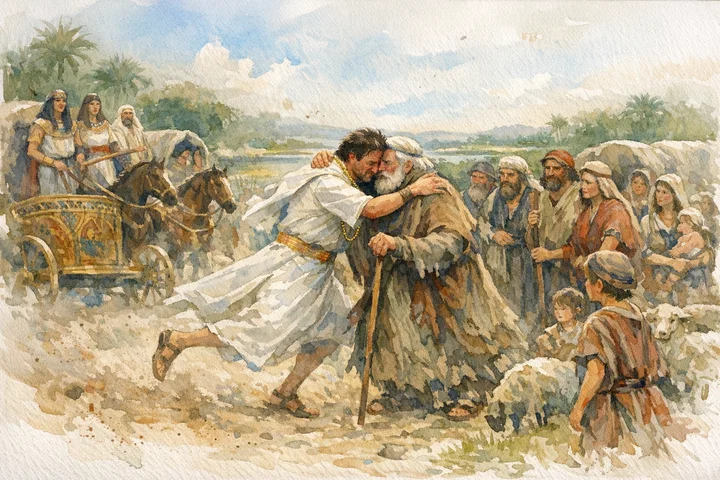
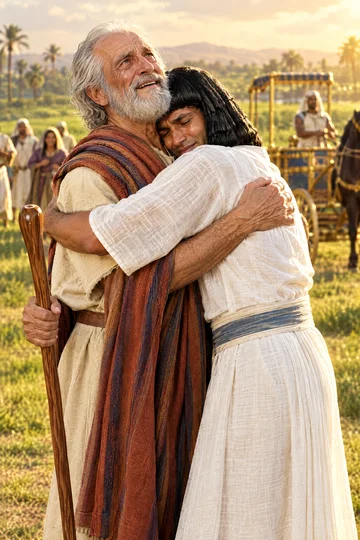
The words were spoken at Jacob's reunion with Joseph in Egypt after Jacob had journeyed down there with his family.ST Feb 5, 1880 As they met, Joseph left his chariot, ran to meet his father on foot, and they embraced and wept over each other in a very affecting meeting.ST Feb 5, 1880SG3 168.2 Jacob's answer expressed overwhelming relief and joy and joyful satisfaction at seeing Joseph alive after years of believing him lost and long mourning him as dead, fulfilling his deepest longing.1SP 152.2ST Feb 5, 1880SG3 168.2PP 233.1–3 Because he had now seen Joseph's face again and knew he was still alive, he declared himself content and willing to die in peace.1SP 152.2ST Feb 5, 1880SG3 168.2PP 233.1–3 Although he felt ready to die, he in fact lived for seventeen more years.PP 233.1–3
Sources
Pioneers and periodicals
8 sources
Israel spoke these words at his reunion with Joseph in Egypt after journeying down with his family, when they embraced and wept over one another.ST Feb 5, 1880RH Jan 20, 1916 They express his joy and relief at seeing his son's face alive again after long believing him lost and dead, so that his deepest desire was fulfilled and he felt he could now die content and in peace.ST Dec 1, 1898 His joy followed long mourning, for the first news seemed too good to be true and made him faint, but further proof revived his heart and lighted his countenance with inexpressible joy until the meeting left him full.RH Jun 25, 1872 The meeting shows God's providential care in directing Israel into Egypt to preserve His people from famine and to preserve the progenitors of the Seed, even leading by a roundabout path to the right end.RH Jan 19, 1860 The sorrows Jacob had thought were against him were working for his after good as steps bringing him to this reunion and to years of rest and thankfulness, revealing that God's thoughts toward him were thoughts of peace to give him this expected end.ST Dec 6, 1883
Reunion in Egypt
The verse stands in the closing chapters of Genesis, the Book of Beginnings, which tell of Israel's journey down into Egypt and his reception by Joseph and Pharaoh. It is spoken at the reunion in Egypt after Jacob had journeyed down with his family to see his son again.ST Feb 5, 1880 Joseph left his chariot, ran to meet his father on foot, and they embraced and wept over each other.ST Feb 5, 1880 That meeting came after Joseph had made himself known to his brothers following the testing of the brothers, and it belongs with the coming of the family to Goshen.RH Jan 20, 1916 It was there that Jacob went to see Joseph in his palace and answered the sight with joyful satisfaction that his son was yet alive.ST Feb 5, 1880ST Dec 6, 1883
The words express Israel's joy and relief at seeing Joseph's face alive again.ST Dec 1, 1898ST Dec 1, 1898RH Sep 21, 1911 He had believed his son lost, indeed dead, and to look on him living again filled his deepest desire.ST Dec 1, 1898ST Dec 1, 1898RH Sep 21, 1911 Seeing him again made him feel he could now die content.ST Dec 1, 1898 The reunion was so precious and fulfilling that he said he was ready to die in peace.ST Dec 1, 1898ST Dec 1, 1898RH Sep 21, 1911 That joy at seeing Joseph alive again is bound to Joseph's self-disclosure to his brothers.RH Jan 20, 1916
His joy followed long mourning for Joseph as dead.RH Jun 25, 1872 The first news that Joseph was alive seemed too good to be true and made Jacob faint.RH Jun 25, 1872 Further facts convinced him, his heart revived, his countenance was lighted with inexpressible joy, and his whole being was quickened.RH Jun 25, 1872 Their simple and affecting meeting then left him full and content even to die.RH Jun 25, 1872
Providence and Application
God's providence directed Israel in going into Egypt, for Genesis 46 shows how God sent His children there even though no Scripture says it in those direct words. The going had a twofold purpose, that God's own people might be preserved from famine and tried, and that Egypt might have constantly before them representatives of the truth of God. The verse belongs to the closing chapters of Genesis, the Book of Beginnings, which record Israel's journey to Egypt and his reception by Joseph and Pharaoh, and the meeting of Israel and Joseph alive in Egypt shows God's care for the preservation of the progenitors of the Seed.
As part of Joseph's history, the verse illustrates that God may lead by a roundabout path while guiding people to the right end.RH Jan 19, 1860 It shows Jacob recovering his long-lost son when he went to see Joseph in his palace, content to die since he had seen his face and knew he was yet alive.ST Dec 6, 1883 The sorrows Jacob had said were against him were not against him but were working for his after good as onward steps in the process bringing him to this reunion.ST Dec 6, 1883 The reunion gave him years of happiness with rest, thankfulness and joy, the Sabbath of his life, including taking his grandsons on his knees, which rebuked his hasty words.ST Dec 6, 1883 When he enters the heavenly land and sees God's purpose running through his life, the verse reveals that God's thoughts toward him were thoughts of peace and not of evil to give him this expected end.ST Dec 6, 1883
Sources