Translations
American King James Version, King James Version, KJV Cambridge Paragraph Bible, Revised Version, American Standard Version
And Israel beheld Joseph’s sons, and said, Who are these?
Webster Bible, Darby Translation
And Israel beheld Joseph's sons, and said, Who are these?
And Israel seeth the sons of Joseph, and saith, 'Who [are] these?'
Then Israel saw Joseph’s sons,—and said—Who are these?
Berean Standard Bible, Majority Standard Bible
When Israel saw the sons of Joseph, he asked, “ Who are these?”
Israel saw Joseph’s sons, and said, “ Who are these?”
Then Israel, looking at Joseph's sons, said, Who are these?
Then Israel beheld Iosephs sonnes and sayd, Whose are these?
Douay-Rheims (Challoner revision)
Then seeing his sons, he said to him: Who are these?
Pictures
Cross-references
- Jeremiah 31:9
They shall come with weeping, and with supplications will I lead them: I will cause them to walk by the rivers of waters in a straight way, wherein they shall not stumble: for I am a father to Israel, and Ephraim is my firstborn.
Ephraim is called firstborn despite being younger.
- Genesis 48:15-16
And he blessed Joseph, and said, God, before whom my fathers Abraham and Isaac did walk, the God which fed me all my life long unto this day,
question leads to prayer over the lads
- Genesis 46:26-27
All the souls that came with Jacob into Egypt, which came out of his loins, besides Jacob’s sons’ wives, all the souls were threescore and six;
listed together as lesson scripture
- Genesis 47:27-31
And Israel dwelt in the land of Egypt, in the country of Goshen; and they had possessions therein, and grew, and multiplied exceedingly.
listed together as lesson scripture
- Genesis 48:21
And Israel said unto Joseph, Behold, I die: but God shall be with you, and bring you again unto the land of your fathers.
blessing ends with assurance of return
- Genesis 49
And Jacob called unto his sons, and said, Gather yourselves together, that I may tell you that which shall befall you in the last days.
Jacob’s blessing on his sons completes Joseph’s story.
- Genesis 46:28-34
And he sent Judah before him unto Joseph, to direct his face unto Goshen; and they came into the land of Goshen.
listed together as lesson scripture
Commentary
Each commentary is drawn from primary sources: the writings of Ellen G. White and Adventist pioneers and periodicals. Each commentary is separate. Its own words are not a quotation; follow the references to read the source passages.
Ellen G. White
2 sources
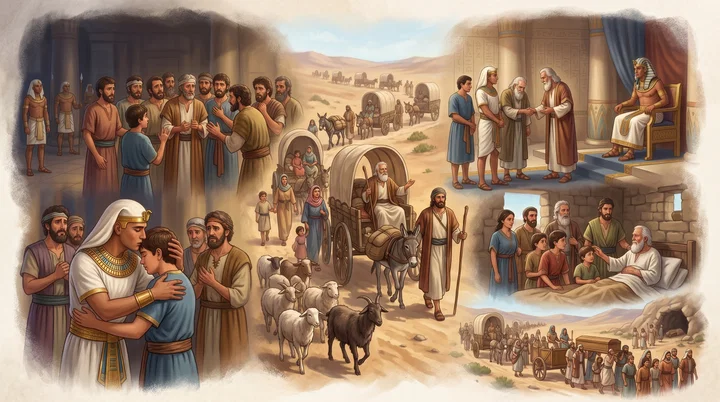
Joseph brought Ephraim and Manasseh to Jacob to be formally placed among the children of Israel as heads of separate tribes.PP 234.2–235.1 Jacob's eyes were dim with age, so he had not realized the young men were present, and seeing only the outline of their forms he asked who they were.PP 234.2–235.1 When told they were Joseph's sons, he called them to come near so he could bless them, then embraced and kissed them and laid his hands on their heads in blessing.PP 234.2–235.1
The verse belongs to the famine years when Jacob's sons went to Egypt for grain and bowed before Joseph as ruler of the land.PP 224.3–225.1 Joseph knew his brothers but they did not know him, because his Hebrew name had been replaced by the name bestowed by the king and there was little resemblance between the prime minister of Egypt and the youth sold to the Ishmaelites.PP 224.3–225.1 When Joseph saw his brothers stooping and making obeisance, his earlier dreams came to his mind.PP 224.3–225.1
Sources
Pioneers and periodicals
8 sources
The verse stands in the Book of Beginnings at the close of the story of Joseph and his brethren, a story full of lessons on the surface as well as deeper ones. Its setting is Israel's journey with all that he had and all his seed into Egypt, his reception by Joseph and Pharaoh, and his going down into Egypt before his death, following Joseph's meeting with his brethren and the fulfilment of his dreams.ST Dec 1, 1898ST Jan 28, 1913 In the immediate scene Israel is on his sickbed when Joseph brings his two sons Manasseh and Ephraim to him.ST Dec 1, 1898 Because his eyes are dim for age so that he cannot see, he asks who they are.ST Dec 1, 1898 Joseph answers that they are his sons whom God has given him in Egypt, and Israel tells him to bring them near so he can bless them, then kisses and embraces them.ST Dec 1, 1898
The verse marks the beginning of the blessing scene and opens Jacob's prophetic blessing upon Joseph's sons as he prepares to bless Ephraim and Manasseh.ST Dec 1, 1898 It belongs to the adoption of Joseph's sons among the twelve tribes.ST Jan 28, 1913 This is part of Israel's final days and his blessings and prophecy concerning his sons and grandsons, followed by his death and burial and finally the death of Joseph.ST Jan 28, 1913ST Jan 10, 1911
The chapter teaches that birthright or age does not ensure God's favor: Reuben lost the birthright, and in Joseph's family the elder Manasseh did not receive the precedence given to Ephraim when Israel laid his hands across them to give the birthright blessing to the younger.ST Jan 10, 1911ST Nov 15, 1910ST Oct 29, 1902 Firstborn standing and birthright come by God's appointment to preeminence, not by order of being born first, just as the birthright went to Jacob over Esau and to Joseph over Reuben.ST Nov 15, 1910ST Oct 29, 1902 This explains how Jesus is the First-born from the dead even though others were raised before Him, because He holds the place by preeminence as the One by virtue of whose offering and work all others are brought from the dead.ST Nov 15, 1910ST Oct 29, 1902
The passage manifests God's care for the preservation of the progenitors of the Seed. As part of Joseph's history, the verse shows that God can lead a person by a circuitous path and still guide him to the end God intends.RH Jan 19, 1860
Sources