Genesis 48:9
And Joseph said unto his father, They are my sons, whom God hath given me in this place. And he said, Bring them, I pray thee, unto me, and I will bless them.
Translations
And Joseph said to his father, They are my sons, whom God has given me in this place. And he said, Bring them, I pray you, to me, and I will bless them.
King James Version, KJV Cambridge Paragraph Bible
And Joseph said unto his father, They are my sons, whom God hath given me in this place. And he said, Bring them, I pray thee, unto me, and I will bless them.
And Joseph said to his father, They are my sons, whom God hath given me in this place. And he said, Bring them, I pray thee, to me, and I will bless them.
Revised Version, American Standard Version
And Joseph said unto his father, They are my sons, whom God hath given me here. And he said, Bring them, I pray thee, unto me, and I will bless them.
and Joseph saith unto his father, 'They [are] my sons, whom God hath given to me in this [place];' and he saith, 'Bring them, I pray thee, unto me, and I bless them.'
And Joseph said to his father, They are my sons, whom God has given me here. And he said, Bring them, I pray thee, to me, that I may bless them.
And Joseph said unto his father, My sons, they are, whom God hath given me, in this place. And he said—Bring them, I pray thee, unto me, that I may bless them.
Berean Standard Bible, Majority Standard Bible
Joseph said to his father, “ They are the sons God has given me in this place.”So Jacob said, “ Please bring them to me, that I may bless them.”
Joseph said to his father, “ They are my sons, whom God has given me here.”He said, “ Please bring them to me, and I will bless them.”
And Joseph said to his father, They are my sons, whom God has given me in this land. And he said, Let them come near me, and I will give them a blessing.
And Ioseph sayd vnto his father, They are my sonnes, which God hath giuen mee here. Then he sayd, I pray thee, bring them to me, that I may blesse them:
Douay-Rheims (Challoner revision)
He answered: They are my sons, whom God hath given me in this place. And he said: Bring them to me that I may bless them.
Pictures
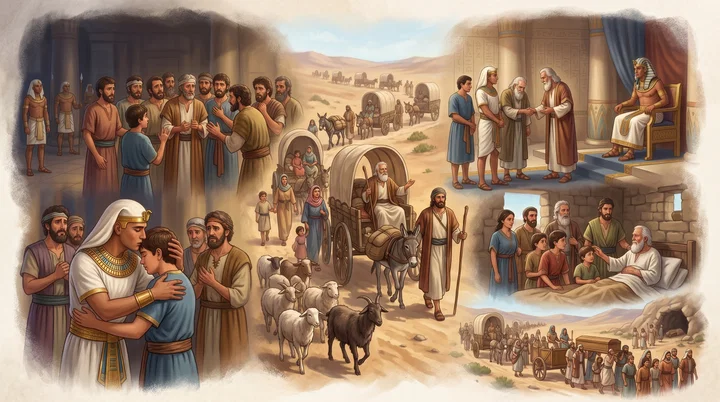
Cross-references
- Genesis 48:14-20
And Israel stretched out his right hand, and laid it upon Ephraim’s head, who was the younger, and his left hand upon Manasseh’s head, guiding his hands wittingly; for Manasseh was the firstborn.
Jacob blesses Joseph’s sons, giving Ephraim precedence over the firstborn Manasseh.
- Jeremiah 31:9
They shall come with weeping, and with supplications will I lead them: I will cause them to walk by the rivers of waters in a straight way, wherein they shall not stumble: for I am a father to Israel, and Ephraim is my firstborn.
Ephraim is called Israel’s firstborn despite being younger.
- Genesis 48:5
And now thy two sons, Ephraim and Manasseh, which were born unto thee in the land of Egypt before I came unto thee into Egypt, are mine; as Reuben and Simeon, they shall be mine.
Joseph’s sons are counted as tribes like Reuben and Simeon.
- Hebrews 7:7
And without all contradiction the less is blessed of the better.
States that the lesser is blessed by the greater, a principle applied to Jacob’s blessing.
- Genesis 35:11
And God said unto him, I am God Almighty: be fruitful and multiply; a nation and a company of nations shall be of thee, and kings shall come out of thy loins;
God’s promise that nations would come from Jacob frames his claim for Joseph’s sons.
- Genesis 48:21
And Israel said unto Joseph, Behold, I die: but God shall be with you, and bring you again unto the land of your fathers.
assurance given after the blessing
- Genesis 46:1-7
And Israel took his journey with all that he had, and came to Beer-sheba, and offered sacrifices unto the God of his father Isaac.
grouped in same lesson on Jacob going down to Egypt
- Genesis 47:27-31
And Israel dwelt in the land of Egypt, in the country of Goshen; and they had possessions therein, and grew, and multiplied exceedingly.
grouped in same lesson on Jacob going down to Egypt
Commentary
Each commentary is drawn from primary sources: the writings of Ellen G. White and Adventist pioneers and periodicals. Each commentary is separate. Its own words are not a quotation; follow the references to read the source passages.
Ellen G. White
2 sources
The verse stands within the seven years of famine foretold through Joseph, when dearth was in all lands and reached Canaan where Jacob lived.PP 224.3–225.1 Ten of Jacob's sons journeyed to Egypt to buy grain and bowed down before Joseph with their faces to the earth, without knowing him though he knew them, which brought his dreams to his mind.PP 224.3–225.1
At the moment of the verse Jacob's eyes were dim with age, so he was unaware of the presence of Ephraim and Manasseh until he caught the outline of their forms and asked who they were.PP 234.2–235.1 Joseph answered that they were the sons God had given him in that place, in Egypt, and Jacob asked for them to be brought to him so that he could bless them.PP 234.2–235.1 Their bringing for blessing was their formal instatement among the children of Israel.PP 234.2–235.1 By it Joseph in faith renounced for his sons all honors, wealth, distinction, and connection through their mother to the highest order of the Egyptian priesthood, choosing instead a place among the despised shepherd tribes entrusted with the oracles of God.PP 234.2–235.1 The blessing itself was given by embracing and kissing them and solemnly laying hands upon their heads.PP 234.2–235.1
Sources
Pioneers and periodicals
9 sources
Genesis 48:9 belongs to the account of Israel in Egypt, when Jacob went down into Egypt with all his seed to dwell in Goshen with Joseph in the time before Jacob's death.ST Dec 1, 1898 It is part of the larger account in Genesis 46 to 50 of Israel's journey to Egypt, their reception by Joseph and Pharaoh, Jacob's blessings, and Jacob's death and burial. In the verse Joseph identifies Ephraim and Manasseh as his sons whom God had given him in Egypt, in the place where he lived, and Jacob asks that they be brought to him so he can bless them.ST Jan 28, 1913ST Nov 15, 1910ST Jan 10, 1911ST Dec 1, 1898 His request begins the blessing in which he receives Joseph's sons as his own and blesses them under God's care, adopting them among the tribes of Israel.ST Jan 28, 1913ST Dec 1, 1898 Their blessing is part of Israel's prophetic blessing upon Joseph's sons and his own sons, together with his prophecy concerning them.ST Jan 10, 1911
In this account is seen God's care for the Seed and for the preservation of its progenitors. The bringing of the sons for blessing leads to Jacob giving the birthright to the younger Ephraim over the older Manasseh, just as Reuben's birthright had been given to Joseph.ST Nov 15, 1910ST Oct 29, 1902 Manasseh's age did not secure him the birthright, showing that firstborn standing comes by God's appointment and preeminence rather than by order of birth, and that birthright or age does not ensure favor with God.ST Nov 15, 1910ST Jan 10, 1911ST Oct 29, 1902 This illustrates Christ's preeminence as the First-born of the dead: although others were raised before Him, He holds firstborn standing because all are brought from the dead by virtue of His offering and work.ST Nov 15, 1910ST Oct 29, 1902
Joseph's history, including the giving of his sons to him where he lived, illustrates that God may lead a person by a winding path yet bring him where God intends.RH Jan 19, 1860 The verse illustrates gratitude for children as God's gifts and the giving of a father's blessing, and shows that God's blessing upon His children makes them blessings.ST Jan 10, 1911ST Aug 21, 1884 The verse holds principles designed to guide in dealing with the various contingencies of life.ST Nov 29, 1905 The underlying principles in Joseph's experience help and guide anyone called to pass through a similar experience, providing a human experience with a counterpart for others going through the same kind of trial.ST Nov 29, 1905 Its practical lessons should be as familiar as one's own name, for one's own soul's good and for the benefit of those who come for counsel in similar difficulties, as the Bible becomes more and more the guidebook to be trusted with confidence till the very end.ST Nov 29, 1905
Sources