Habakkuk 1:8
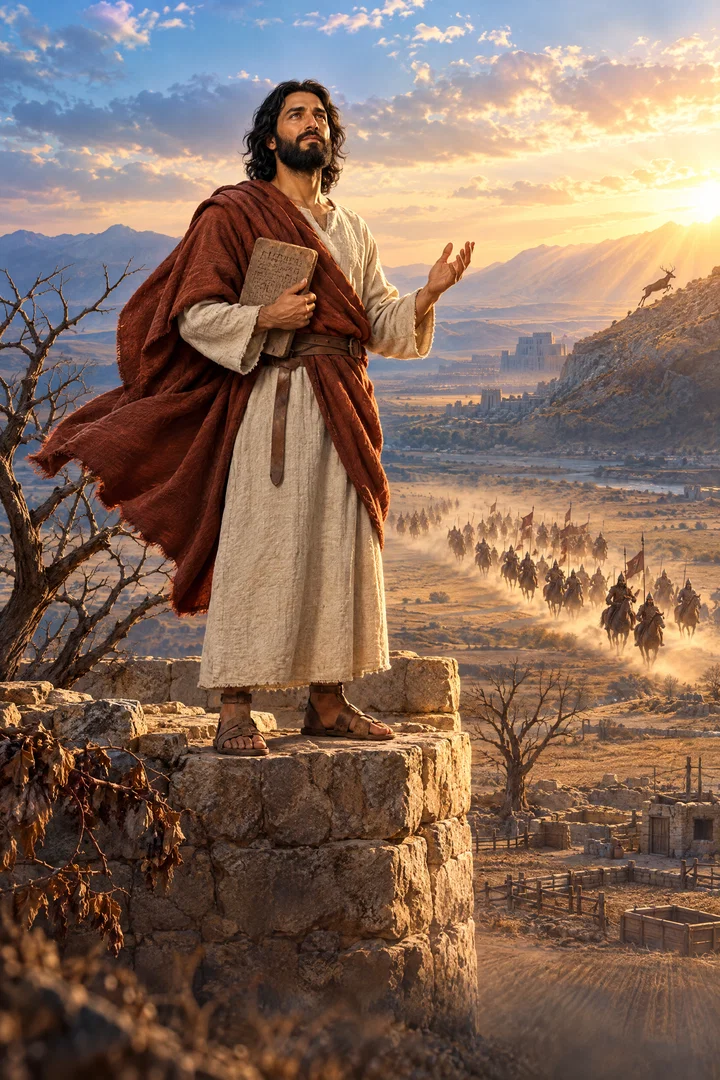
Their horses also are swifter than the leopards, and are more fierce than the evening wolves: and their horsemen shall spread themselves, and their horsemen shall come from far; they shall fly as the eagle that hasteth to eat.
Translations
Their horses also are swifter than the leopards, and are more fierce than the evening wolves: and their horsemen shall spread themselves, and their horsemen shall come from far; they shall fly as the eagle that hastens to eat.
King James Version, Webster Bible
Their horses also are swifter than the leopards, and are more fierce than the evening wolves: and their horsemen shall spread themselves, and their horsemen shall come from far; they shall fly as the eagle that hasteth to eat.
Their horses also are swifter than the leopards,
And are more fierce than the evening wolves:
And their horsemen shall spread themselves,
And their horsemen shall come from far;
They shall fly as the eagle that hasteth to eat.Their horses also are swifter than leopards, and are more fierce than the evening wolves; and their horsemen spread themselves: yea, their horsemen come from far; they fly as an eagle that hasteth to devour.
Their horses also are swifter than leopards, and are more fierce than the evening wolves; and their horsemen press proudly on: yea, their horsemen come from far; they fly as an eagle that hasteth to devour.
Swifter than leopards have been its horses, And sharper than evening wolves, And increased have its horsemen, Even its horsemen from afar come in, They fly as an eagle, hasting to consume.
And their horses are swifter than the leopards, and are more agile than the evening wolves; and their horsemen prance proudly, and their horsemen come from afar: they fly as an eagle that hasteth to devour.
Then, swifter than leopards, are his horses, and, more sharply they attack, than evening wolves, and forward have leapt his chargers,—Yea, his chargers, from afar, will come in, they will fly as an eagle hath hastened to devour.
Berean Standard Bible, Majority Standard Bible
Their horses are swifter than leopards,
fiercer than wolves of the night.
Their horsemen charge ahead,
and their cavalry comes from afar.
They fly like a vulture,
swooping down to devour.Their horses also are swifter than leopards, and are more fierce than the evening wolves. Their horsemen press proudly on. Yes, their horsemen come from afar. They fly as an eagle that hurries to devour.
And their horses are quicker than leopards and their horsemen more cruel than evening wolves; they come from far away, like an eagle in flight rushing on its food.
Their horses also are swifter then the leopards, and are more fierce then the wolues in the euening: and their horsemen are many: and their horsemen shall come from farre: they shall flie as the eagle hasting to meate.
Douay-Rheims (Challoner revision)
Their horses are lighter than leopards, and swifter than evening wolves; and their horsemen shall be spread abroad: for their horsemen shall come from afar, they shall fly as an eagle that maketh haste to eat.
Pictures
Cross-references
- Jeremiah 48:40
For thus saith the LORD; Behold, he shall fly as an eagle, and shall spread his wings over Moab.
Both describe an invading force flying like an eagle.
- Jeremiah 4:13
Behold, he shall come up as clouds, and his chariots shall be as a whirlwind: his horses are swifter than eagles. Woe unto us! for we are spoiled.
Both describe Babylon’s forces advancing with eagle-like swiftness.
- Deuteronomy 28:49
The LORD shall bring a nation against thee from far, from the end of the earth, as swift as the eagle flieth; a nation whose tongue thou shalt not understand;
A swift, distant invading force is pictured as an eagle.
- Isaiah 5:26-29
And he will lift up an ensign to the nations from far, and will hiss unto them from the end of the earth: and, behold, they shall come with speed swiftly:
same swift eagle-like conquest imagery
- Jeremiah 49:22
Behold, he shall come up and fly as the eagle, and spread his wings over Bozrah: and at that day shall the heart of the mighty men of Edom be as the heart of a woman in her pangs.
The conqueror is pictured with the speed of an eagle.
- Jeremiah 5:15
Lo, I will bring a nation upon you from far, O house of Israel, saith the LORD: it is a mighty nation, it is an ancient nation, a nation whose language thou knowest not, neither understandest what they say.
Describes the invading nation as ancient and mighty.
- Jeremiah 4:7
The lion is come up from his thicket, and the destroyer of the Gentiles is on his way; he is gone forth from his place to make thy land desolate; and thy cities shall be laid waste, without an inhabitant.
Both use fierce predator imagery to identify Babylon.
Commentary
Each commentary is drawn from primary sources: the writings of Ellen G. White and Adventist pioneers and periodicals. Each commentary is separate. Its own words are not a quotation; follow the references to read the source passages.
Pioneers and periodicals
24 sources
It portrays the Babylonians as a bitter, hasty and dreadful power raised up to sweep through lands, overrun Judah, overthrow Jerusalem and take captives.RH Feb 3, 1853ST Dec 15, 1909RH Feb 18, 1904 Its horses and horsemen picture exceptional military speed, ferocity and far reach, spreading in conquest and swooping like a bird of prey rushing to seize its food.ST Oct 1, 1885ST Jul 19, 1905ST Nov 29, 1905 That rushing bird explains the wings on the lion-like first kingdom in Daniel 7, marking Babylon and the rapidity of its conquests under Nebuchadnezzar and its earlier kings.ST Oct 1, 1885RH Feb 3, 1853RH Feb 8, 1870 Habakkuk's time and conditions mirror the present, so its destructive conquest depicts last-day violence, selfish competition, extravagant living and oppression of the poor by the rich.ST Feb 7, 1900ST Jul 19, 1905ST Jul 22, 1908 Such selfishness and disregard for the rights of others bring judgment, while the same swiftness urges haste in carrying the last message to every part of the world.RH Nov 24, 1904ST Sep 17, 1902
Setting and Plain Meaning
The verse describes the Chaldeans, that is the Babylonians, a bitter and hasty, furious, terrible and dreadful nation whom God would raise up to sweep over the land.RH Feb 3, 1853ST Dec 15, 1909 They would overrun Judah, advance to overthrow Jerusalem, and take captives.RH Feb 18, 1904RH May 21, 1908RH Jul 8, 1902 Their cavalry was exceptionally swift and fierce, arriving from far away and rushing upon its prey like an eagle, portraying the speed and violence of the Babylonian invasion.RH Feb 18, 1904RH Aug 15, 1907
Habakkuk prophesied not far after Nahum's time in the reign of Josiah. He prophesied about 604 B.C. in Jehoiakim's reign and the middle period of Jeremiah's career, as contemporary with Jeremiah.ST Dec 15, 1909 The warning that the Chaldeans would be raised up to overrun Judah and take captives was fulfilled within the generation then living.RH May 21, 1908
The invasion was God's judgment on the land for its wickedness. The people had persisted in merely formal worship and refused His warnings, and so judgment came upon Jerusalem.RH Jul 8, 1902 The verse reproves the oppressive and wealthy in Israel and warns them of the coming of the Chaldeans.
Its images mean exceptional military speed, ferocity, and far range.ST Jul 19, 1905ST Nov 29, 1905RH Nov 24, 1904 The horses are swifter than leopards and more fierce than evening wolves.ST Jul 19, 1905ST Nov 29, 1905RH Apr 23, 1857 The horsemen spread themselves in conquest, come from far away, and fly as an eagle rushing to seize prey and eat.ST Oct 1, 1885RH Nov 24, 1904RH Apr 23, 1857 Near the end of Babylon's power its forces are still described as swift, fierce, and advancing rapidly to feed.ST Nov 29, 1905
Prophecy and Scriptural Links
The flying like an eagle hastening to its prey explains the eagle's wings on the lion-like first beast of Daniel 7, identifying that empire as Babylon.ST Oct 1, 1885RH Feb 3, 1853RH Apr 23, 1857ST Jul 23, 1874RH Nov 14, 1854 The wings denote the rapidity with which Babylon extended its conquests, especially under Nebuchadnezzar and its earlier kings.RH Feb 3, 1853RH Feb 8, 1870RH Apr 23, 1857RH Aug 9, 1915RH Feb 17, 1874 The Chaldeans' horsemen advancing swiftly, spreading out in conquest, and coming from far away portray a rapid, far-reaching military power matching that symbol.ST Oct 1, 1885RH Feb 8, 1870RH Apr 23, 1857RH Aug 9, 1915 Their speed and ferocity, swifter than leopards and more fierce than evening wolves and swooping to feed, support the wings as a sign of swift conquest.ST Oct 1, 1885RH Apr 23, 1857ST Jul 23, 1874RH Aug 9, 1915
The same wings also represent the soaring pride of Babylon's monarchs and the strength of Nebuchadnezzar.RH Feb 3, 1853RH Feb 8, 1870RH Apr 23, 1857RH Nov 14, 1854RH Feb 17, 1874 The swift and fierce Babylonian attack against disobedient Israel fulfills Moses' warning that a nation would come as swiftly as an eagle.RH Oct 22, 1861 The same symbolism of swift movement is applied to the four wings of the leopard representing the Grecian Empire.RH Aug 9, 1915ST Sep 17, 1902 Those four wings mark the exceptionally swift campaigns of Alexander, just as the eagle image describes the speed of a conquering army in Babylon's rapid conquests.RH Aug 9, 1915ST Sep 17, 1902
Last-Day Warning and Application
Habakkuk's time is a type of the present time, and the description of the Chaldeans sweeping over the land on account of its wickedness clearly depicts last-day conditions. The prophecy is presented as foretelling signs of the last days, reproving the oppressive and wealthy in Israel and warning them of coming judgment.ST Jul 22, 1908 In that last-day reading it is associated with extravagant living, the accumulation of riches, and strife between labor and capital.ST Jul 22, 1908
The portrayal of fierce, swift conquerors and of destructive conquest is applied to selfish competition in which the powerful prosper through the ruin of others.ST Feb 7, 1900ST Jul 31, 1901 The swiftness, fierceness and far range figured by leopards, evening wolves and an eagle rushing to its prey is cited in connection with conflict between the wealthy and workers and the rise of socialism, as part of a warning about social strife.ST Jul 19, 1905 The same prophecy addresses the violence and injustice of the powerful and warns of perilous, unsettled times and violent upheaval arising from oppression of the poor and conflict between labor and capital.ST The wicked are thus seen devouring those more righteous than themselves, as the powerful prey on the vulnerable, and the warning is pressed home upon dangerous and harsh industrial conditions, including the coal miners with deaths, injuries, inadequate employment and reduced wages.ST Jul 31, 1901ST Sep 17, 1902
In that application selfishness and disregard for others' rights bring judgment. God has spoken about such times of injustice and oppression and will hold accountable those who could have improved conditions but failed to do so.ST Sep 17, 1902 The eagle's flight, representing swiftness and haste, is likened to the rapid movement of the armies represented in Daniel and, by comparison, to the urgency of carrying the last message to every part of the world.RH Nov 24, 1904 The evening wolves figure dangers threatening wandering sheep, with wolves seeking lambs lost in the wild while the Shepherd is entreated to call and guide them safely back to the fold.RH Apr 27, 1916
Sources