Isaiah 14:11
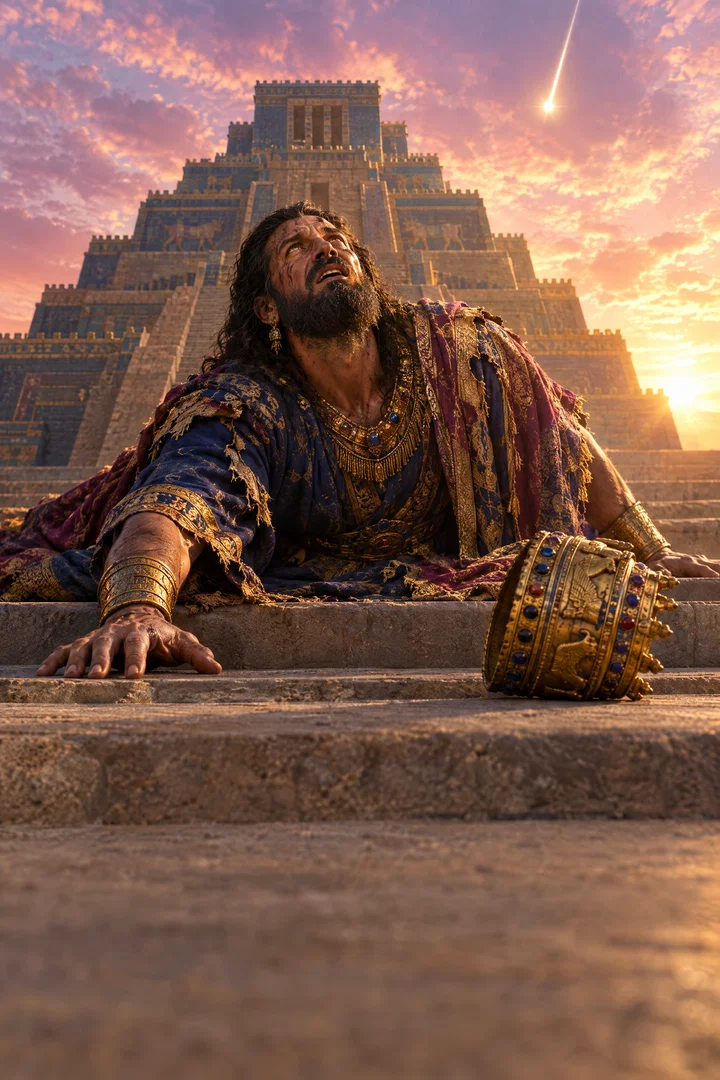
Thy pomp is brought down to the grave, and the noise of thy viols: the worm is spread under thee, and the worms cover thee.
Translations
Your pomp is brought down to the grave, and the noise of your viols: the worm is spread under you, and the worms cover you.
King James Version, Webster Bible
Thy pomp is brought down to the grave, and the noise of thy viols: the worm is spread under thee, and the worms cover thee.
Thy pomp is brought down to the grave, and the noise of thy viols:
The worm is spread under thee, and the worms cover thee.Thy pomp is brought down to hell, and the noise of thy viols: the worm is spread under thee, and worms cover thee.
Thy pomp is brought down to Sheol, and the noise of thy viols: the worm is spread under thee, and worms cover thee.
Brought down to Sheol hath been thine excellency, The noise of thy psaltery, Under thee spread out hath been the worm, Yea, covering thee is the worm.
— Thy pomp is brought down to Sheol, the noise of thy lyres: the maggot is spread under thee, and worms cover thee.
Brought down to Hades, thy pride. The hum of thy harps, Beneath thee, is spread out corruption, And, thy coverlet—worms!
Berean Standard Bible, Majority Standard Bible
Your pomp has been brought down to Sheol,
along with the music of your harps.
Maggots are your bed
and worms your blanket.Your pomp is brought down to Sheol, with the sound of your stringed instruments. Maggots are spread out under you, and worms cover you.
Your pride has gone down into the underworld, and the noise of your instruments of music; the worms are under you, and your body is covered with them.
Thy pompe is brought downe to ye graue, and the sounde of thy violes: the worme is spred vnder thee, and the wormes couer thee.
Douay-Rheims (Challoner revision)
Thy pride is brought down to hell, thy carcass is fallen down: under thee shall the moth be strewed, and worms shall be thy covering.
Pictures
Cross-references 20 of 31
- Ezekiel 32:18-32
Son of man, wail for the multitude of Egypt, and cast them down, even her, and the daughters of the famous nations, unto the nether parts of the earth, with them that go down into the pit.
Both portray the dead gathered in Sheol beneath the land of the living.
- Ezekiel 31:15-18
Thus saith the Lord GOD; In the day when he went down to the grave I caused a mourning: I covered the deep for him, and I restrained the floods thereof, and the great waters were stayed: and I caused Lebanon to mourn for him, and all the trees of the field fainted for him.
both locate sheol beneath in the earth
- Ecclesiastes 9:10
Whatsoever thy hand findeth to do, do it with thy might; for there is no work, nor device, nor knowledge, nor wisdom, in the grave, whither thou goest.
Both describe the dead as entering the grave, where there is no work or knowledge.
- Isaiah 14:15
Yet thou shalt be brought down to hell, to the sides of the pit.
Sheol is the king’s destination, contrasting with his former exaltation.
- Isaiah 5:14
Therefore hell hath enlarged herself, and opened her mouth without measure: and their glory, and their multitude, and their pomp, and he that rejoiceth, shall descend into it.
Both describe Sheol beneath in the earth.
- Mark 9:48
Where their worm dieth not, and the fire is not quenched.
The undying worm and unquenched fire echo Isaiah’s imagery of destruction.
- Job 17:13-16
If I wait, the grave is mine house: I have made my bed in the darkness.
Both describe the grave as darkness, corruption, and a resting place in dust.
- Isaiah 51:8
For the moth shall eat them up like a garment, and the worm shall eat them like wool: but my righteousness shall be for ever, and my salvation from generation to generation.
Both depict the worm consuming the wicked in destruction.
- Genesis 37:35
And all his sons and all his daughters rose up to comfort him; but he refused to be comforted; and he said, For I will go down into the grave unto my son mourning. Thus his father wept for him.
Both describe descent to Sheol, rendered “grave.”
- Psalms 141:7
Our bones are scattered at the grave’s mouth, as when one cutteth and cleaveth wood upon the earth.
Both locate Sheol beneath, in the earth.
- Numbers 16:30-33
But if the LORD make a new thing, and the earth open her mouth, and swallow them up, with all that appertain unto them, and they go down quick into the pit; then ye shall understand that these men have provoked the LORD.
Both describe the dead descending into Sheol beneath the earth.
- Isaiah 14:4
That thou shalt take up this proverb against the king of Babylon, and say, How hath the oppressor ceased! the golden city ceased!
Introduces the taunt against the king of Babylon.
- Psalms 6:5
For in death there is no remembrance of thee: in the grave who shall give thee thanks?
Says there is no remembrance or thanksgiving in Sheol.
- Isaiah 38:18
For the grave cannot praise thee, death can not celebrate thee: they that go down into the pit cannot hope for thy truth.
Both personify Sheol as the grave for its inhabitants.
- Isaiah 66:24
And they shall go forth, and look upon the carcases of the men that have transgressed against me: for their worm shall not die, neither shall their fire be quenched; and they shall be an abhorring unto all flesh.
Both depict worms feeding on the carcasses of the wicked.
- Jeremiah 51:39
In their heat I will make their feasts, and I will make them drunken, that they may rejoice, and sleep a perpetual sleep, and not wake, saith the LORD.
Both describe Babylon’s overthrow and its rulers’ perpetual sleep.
- Daniel 5:1-30
Belshazzar the king made a great feast to a thousand of his lords, and drank wine before the thousand.
Both describe the overthrow of Babylon’s king.
- Isaiah 14:19-20
But thou art cast out of thy grave like an abominable branch, and as the raiment of those that are slain, thrust through with a sword, that go down to the stones of the pit; as a carcase trodden under feet.
Both texts describe the ruler’s descent to Sheol and dishonorable treatment after death.
- Hosea 13:14
I will ransom them from the power of the grave; I will redeem them from death: O death, I will be thy plagues; O grave, I will be thy destruction: repentance shall be hid from mine eyes.
same sheol rendered grave
- Psalms 49:14
Like sheep they are laid in the grave; death shall feed on them; and the upright shall have dominion over them in the morning; and their beauty shall consume in the grave from their dwelling.
Sheol is also rendered “grave.”
Commentary
Each commentary is drawn from primary sources: the writings of Ellen G. White and Adventist pioneers and periodicals. Each commentary is separate. Its own words are not a quotation; follow the references to read the source passages.
Pioneers and periodicals
64 sources
The verse is a song of triumph over the king of Babylon, picturing all his splendor and revelry with music brought low into the grave to lie in corruption among worms.ST Feb 13, 1907RH Mar 28, 1865ST Mar 20, 1879 The grave is Sheol, the common abode of the dead beneath the earth, where pomp ends in darkness, silence and decay and the body is spread over worms and covered by them.ST Mar 13, 1879ST Jan 26, 1882RH May 5, 1874RH Jun 12, 1860ST Aug 18, 1881 The dead kings rising from thrones to meet and mock him is figurative personification to humble the proud oppressor to the level of his victims, and does not teach that the dead are conscious or active.RH Mar 28, 1865RH May 5, 1874RH Sep 3, 1872ST Aug 25, 1881ST Jul 22, 1886 Behind the earthly king the prophecy rises to Lucifer, once highest and most musical of created beings, who through pride and self-exaltation became Satan, the invisible ruler and inspirer of Babylon in all its oppression.STST Aug 9, 1905ST Jun 27, 1906ST Jun 4, 1912ST Aug 8, 1900 The worms feeding on the dead picture absolute consumption and extinction of being, the very opposite of eternal life in misery, showing that separation from God in pride and ambition to reign in His place ends in humiliation and destruction.ST Dec 16, 1903ST Oct 25, 1910ST Aug 8, 1900RH Dec 24, 1872ST Feb 2, 1882
Setting in Isaiah's Prophecy
Isaiah 14:11 stands in the taunt and proverb and ode of triumph in Isaiah 14:3-23 against the king of Babylon.ST Feb 13, 1907RH Mar 28, 1865ST Mar 20, 1879RH May 5, 1874RH Jun 29, 1916 That ode is one of the most poetical passages in literature.RH Jun 29, 1916 In it his pomp and music and earthly splendor are brought down to the grave, where worms cover him in humiliation and death.ST Feb 13, 1907RH Mar 28, 1865ST Mar 20, 1879RH May 5, 1874
Around it the dead already in sheol in its nether parts are stirred up to meet him when he goes down.ST Jun 23, 1881ST Mar 15, 1877RH Sep 3, 1872ST Jun 30, 1881ST Mar 15, 1877 The conquered kings he destroyed and laid low rise from thrones in that dark abode beneath to meet him with feigned obeisance, as real homage had been given in life, and mock him.ST Jun 23, 1881ST Mar 15, 1877RH Sep 3, 1872 They taunt him, Art thou also become weak as we, and declare his being brought down to their level, while onlookers narrowly look on him saying Is this the man that made the earth to tremble, that did shake kingdoms.ST Jun 23, 1881ST Mar 15, 1877RH Sep 3, 1872ST Jun 30, 1881RH May 12, 1874 The pomp brought down to the grave with worms spread under and over him shows death reducing the proud oppressor to the same condition as his subjects and prisoners.RH Sep 3, 1872ST Mar 15, 1877
The verse belongs to Isaiah's foretold burden and predictions concerning Babylon in Isaiah 13 to 16, including Palestina and Moab.ST Oct 7, 1930ST Sep 22, 1909 It was spoken many years before the fall, foretelling the destruction of Babylon and the downfall of Babylon as the head of gold and the end of its rule before the silver Persian empire takes its place, with its fulfillment to be seen in impartial history.ST Oct 7, 1930 The proverb is taken up by Israel after God chooses Israel again the second time and gives rest from sorrow and fear and hard bondage.RH Jan 10, 1856 Then it is declared that the oppressor has ceased, the golden city has ceased, the staff of the wicked and sceptre of the rulers is broken, he who smote the people and ruled nations in anger is laid down, and the whole earth is at rest and quiet and breaks into singing.RH Jan 10, 1856 The prophecy of Babylon begins with the earthly king of Babylon and rises to Lucifer, the day-star, son of the morning, who has inspired Babylon in all her wickedness.ST Jun 4, 1912
Grave Pomp and Worms
The word rendered hell in the verse is sheol, meaning the grave, the sepulchre, the underworld, the state of the dead, the abode of the dead and not a place of future punishment.ST Mar 13, 1879RH Jun 12, 1860 Grave would answer equally well there, and to render it hell gives no idea of future punishment.ST Aug 18, 1881 It is one of thirty-one places where sheol is rendered grave out of sixty-five total uses in the Scriptures, and one of the Old Testament places where sheol is translated grave.ST Aug 18, 1881ST Mar 15, 1877 Sheol is the Old Testament term corresponding in meaning to the New Testament term hades.RH Jun 12, 1860RH Mar 28, 1865
Sheol, or hades, is located in the bosom, heart, interior, and nether parts of the earth, beneath the earth in its depths.ST Jan 26, 1882RH May 5, 1874ST Jun 23, 1881RH Apr 20, 1869 It embraces the whole interior as the common region of the dead and the place of every grave.ST Jun 23, 1881 The descent to the grave supports that the dead enter the grave, not Paradise in heaven.RH Feb 22, 1870 Pomp and the sound of musical instruments are brought down to lie there among worms.RH Aug 27, 1872ST Jun 23, 1881
Pomp and the noise of viols are former splendor, musical splendor, and revelry brought low to corruption.ST Sep 24, 1894RH Aug 27, 1872RH Mar 28, 1865ST Mar 20, 1879 The fallen king's pomp and musical revelry are brought down to sheol, the place or state of the dead beneath the earth, in humiliation and death.RH Mar 28, 1865ST Mar 20, 1879 Sheol is a place of darkness and silence, and of silence, secrecy, sleep, rest and darkness.ST Jun 23, 1881ST Mar 20, 1879 For the fallen one after his fall, discord replaces the harmony he had as a created being with a highly musical nature.ST Sep 24, 1894
The worm spread under and the worms covering are the body laid beneath the ground among worms in corruption and death.ST Mar 13, 1879RH Jun 12, 1860ST Jun 23, 1881 The picture of pomp brought down to the grave and the body covered by worms points to death, not to a living soul dwelling there, since the inhabitants of hades are identified as the dead.RH May 19, 1874 Sheol is poetically personified and put by metonymy for its inhabitants, picturing the underworld as inhabited by the shades of the dead, the rephaim.ST Aug 25, 1881 It stands as an exception to the description of sheol as full of thickest darkness.ST Aug 25, 1881
King of Babylon Identified
The king of Babylon in the verse is fallen Lucifer, once the highest created being and light-bearer, who became Satan the adversary, the prince of darkness and the invisible king of Babylon.STST Aug 9, 1905ST Jul 26, 1899ST Nov 19, 1896RH Sep 13, 1915 His pomp and musical display are brought down to the grave, his body laid beneath the ground and covered by worms, showing his humiliation, defeat and death.STST Aug 9, 1905ST Jul 26, 1899ST Dec 16, 1903ST Nov 19, 1896 That bringing low belongs to the proud rebel who fell from heaven and sought to be like God, whose ambition to reign in God's place, to lead worship through apostasy, and to direct civil powers against Christianity ends in humiliation.STST Aug 9, 1905ST Jul 26, 1899ST Dec 16, 1903ST May 30, 1911 It expresses the final overthrow of this proud ruler and the defeat of the spirit of rebellion that began historical Babylon and marks every departure from God, while showing God's refuge from Babylon's doom.ST Jul 26, 1899ST Dec 16, 1903ST May 30, 1911
Lucifer was created wise and beautiful but chose pride and self-rule over God's way, becoming proud of the glory and beauty given him, treating them as his own, and selfishly rebelling against God's throne.ST Jul 26, 1899ST Jun 27, 1906ST Aug 8, 1900ST Jul 16, 1902ST Jul 11, 1911 His brightness and wisdom were turned toward self, so that the being who was once the day-star of God became Satan the adversary and a mighty power for evil, who proposed to reign even to the dethroning of God and to be like God.ST Jul 26, 1899ST Jun 27, 1906ST Jul 16, 1902ST Jul 24, 1901ST Jul 11, 1911 He led the great revolt in heaven with the ambition, I will ascend into heaven, I will exalt my throne above the stars of God, I will ascend above the heights of the clouds, I will be like the Most High, and was removed from the heavenly courts because of rebellious envy.ST Jun 27, 1906ST Aug 8, 1900ST Jul 16, 1902ST Jul 11, 1911ST Oct 19, 1915 His attempt to dethrone God brought abasement, bondage, suffering, destruction and death instead of the exaltation, freedom and life he sought, showing that separation from God, the source of life and freedom, ends in destruction and shows the outcome of unbelief and self-centeredness.ST Jun 27, 1906ST Aug 8, 1900ST Jul 16, 1902ST Jul 24, 1901ST Jul 11, 1911 His wisdom was perverted by the wine of Babylon, not necessarily or alone the wine of the bottle or flask, but ambition and unholy greed, which puffed him up and deadened human sensibility, and that same intoxication is the cause of inhuman oppression when man swallows up his fellow.ST Dec 16, 1903ST Jul 24, 1901ST Jul 11, 1911
Babylon is a satanically controlled power and false religious system proceeding from Satan, whose rule and influence continue through its laws and subjects and extend over the nations.RH Sep 13, 1915ST Jun 27, 1911ST Apr 30, 1896ST Mar 30, 1915ST Jul 1, 1903 The greatness of that ancient monarchy was the outward expression of the effort of the god of this world to establish his dominion upon this planet in open rebellion against God and to defeat God's plan to save the world.RH Sep 13, 1915ST Jun 27, 1911ST Apr 30, 1896 As the first head of the beast it gives the wider system its Babylonian character, opposing God and seeking to destroy His people.RH Sep 13, 1915ST Jun 27, 1911ST Jul 1, 1903 Babylon's persecution of God's people is attributed to the influence of this fallen ruler called the king of Babylon, whose prideful ambition to exalt himself above God represents the spirit behind Babylonian religion and its forms of self-salvation, coercion and domination.RH Sep 13, 1915ST Jun 27, 1911ST Apr 30, 1896ST Mar 30, 1915ST Jul 1, 1903 That spirit of Satan is manifest in every phase of the one great Babylonian system from Babylon of old to the present time, founded on self-salvation apart from God, the repetition of the old Babylonian cry to build a city and tower to reach heaven and make a name, joining salvation of soul and earthly preservation by the WE and the US, calling itself the gate of God while God calls it confusion, and showing itself in creed, arbitrary decrees, religious dogmas, state law, union of church and state, and religion by dictation, law and force, in opposition to the humility and meekness of Jesus Christ.ST Jul 11, 1911ST Jul 1, 1903
The king of Babylon is the Papal king of Mystery Babylon, whose pomp is brought down to the grave and whose noise of viols is ended when he was led captive and laid down in 1798.RH Jan 10, 1856RH Jan 10, 1856 The worm spread under him and the worms covering him denote a consuming process upon the Papacy synchronizing with the consumption decreed in Isaiah 10 and Daniel 7.RH Jan 10, 1856RH Jan 10, 1856 The verse belongs to the proverb Israel takes up against the king of Babylon after God chooses Israel again the second time and gives rest from sorrow and fear and hard bondage, declaring the oppressor has ceased, the golden city has ceased, the staff of the wicked and sceptre of the rulers is broken, he who smote the people and ruled nations in anger is laid down, and the whole earth is at rest and quiet and breaks into singing.RH Jan 10, 1856RH Jan 10, 1856 It proves that since 1798 no feller has come up against God's people, they have not again been brought under the galling yoke of an oppressor to be trodden under foot and delivered over to another oppressor, and the treading-under-foot indignation ceased in 1798.RH Jan 10, 1856RH Jan 10, 1856
Prophecy Fulfilled in History
The burden against Babylon was uttered before that power had reached the height of its strength and glory, when its apparent might made its ruin seem unlikely.RH Nov 11, 1862 It foretold the downfall of Babylon as the head of gold and the end of its rule before the silver Persian empire should take its place. That promised ruin was fulfilled as the city declined into desolation and ceased to be inhabited, a fact to be seen in impartial history.RH Nov 11, 1862
The pomp brought down to the grave and the ending of the noise of viols is the laying down of the Papal king of Mystery Babylon when he was led captive in 1798.RH Jan 10, 1856RH Jan 10, 1856 The worm spread under him and the worms covering him denote a consuming process upon the Papacy, synchronizing with the consumption decreed in Isaiah 10 and Daniel 7.RH Jan 10, 1856RH Jan 10, 1856 With that laying down the oppressor has ceased, the golden city has ceased, the staff of the wicked and sceptre of the rulers is broken, he who smote the people and ruled nations in anger is laid down, and the whole earth is at rest and quiet and breaks into singing.RH Jan 10, 1856 It proves that since 1798 no feller has come up against God's people, they have not again been brought under the galling yoke of an oppressor to be trodden under foot and delivered over to another oppressor, and the treading-under-foot indignation ceased in 1798.RH Jan 10, 1856RH Jan 10, 1856
The utter overthrow of the king of Babylon expresses the final overthrow of the proud ruler, once Lucifer, created wise and beautiful but choosing pride and self-rule to become the prince of darkness.ST Jul 26, 1899 The downfall of ancient Babylon represents the final judgment on Satan and those who follow him, and the defeat of the spirit of rebellion that began historical Babylon and marks every departure from God.ST Apr 22, 1897ST Jul 26, 1899 In that wonderful prophecy concerning Babylon and her highest king Lucifer is shown God's refuge from Babylon's doom.ST May 30, 1911 The bringing of pomp and music down to the grave with worms covering him portrays Satan's humiliation and powerless state during the thousand years, when he is cast onto the desolate earth and is greeted by the wicked dead while they remain dead in their graves.ST Mar 18, 1875
Death and Final Destruction
The grave, the worms, and the dead rising, speaking, mocking, and sitting on thrones are figurative personification and not a literal scene deep in the earth.RH Mar 28, 1865RH May 5, 1874RH Dec 23, 1862ST Jun 23, 1881ST Mar 15, 1877 The dead kings do not literally rise, literally converse, literally mock, literally sit on thrones in the underworld, and are not literally conscious, comforted, ashamed, or active there.ST Jun 23, 1881ST Mar 15, 1877ST Aug 19, 1880 It is the same figurative form as Pharaoh comforted among the slain with swords under their heads and Rachel weeping for her children long after her death, and as the familiar figurative form used by Jesus.ST Jun 23, 1881ST Mar 15, 1877 The dead in the grave are portrayed as seeing, looking, and speaking, and as addressing the fallen king as he descends, though the dead cannot literally speak to one arriving among them.RH Dec 23, 1862ST Aug 19, 1880
That personified speech is used to force truth upon the living and to show death reducing the proud oppressor to the same condition as his subjects and prisoners.RH Sep 3, 1872RH Jan 7, 1873 The pomp brought down to the grave with worms spread under and over shows that leveling, with the destroyed kings sitting on thrones beneath in the dark domain, rising in mock obeisance, and taunting him with becoming weak like them and being brought down to their level.RH Sep 3, 1872 It does not prove consciousness, knowledge, or activity in death, does not teach that disembodied spirits are conscious, and does not teach that the dead are conscious, since there is no knowledge in Sheol.RH Sep 3, 1872ST Aug 25, 1881ST Jul 22, 1886ST Jan 22, 1880RH Jan 7, 1873
Those who held a different reading taught that the king enters sheol, the underworld or place of departed spirits, after death among worms as part of a description of the dead entering a conscious state.RH Feb 11, 1873 In that reading the dead are pictured with differences in rank, as when kings sit on thrones, though it says nothing definite about separate places for the righteous and the wicked.RH Oct 12, 1869
The descent to the grave supports that the dead enter the grave, not Paradise in heaven.RH Feb 22, 1870 Sheol, or hades, is located in the bosom, heart, interior, and nether part of the earth, and this location proves Paradise cannot be a part of hades.ST Jan 26, 1882 For then Paradise and its tree of life would be flourishing in some cavern in the interior of the earth, and Paul when caught away in vision to Paradise would have been taken to the depths of the earth and not to the third heaven.ST Jan 26, 1882
The worm is an agent of destruction acting always in connection with death upon the dead, feeding on the dead and not the living.ST Jul 8, 1875RH Dec 24, 1872ST Feb 2, 1882 It is external to and distinct from the objects upon which it preys and completes their utter consumption.RH Dec 24, 1872ST Feb 2, 1882 It is not the remorse of a guilty conscience tormenting someone forever.ST Jul 8, 1875RH Dec 24, 1872ST Feb 2, 1882 The worms preying upon the carcasses of the dead picture absolute and complete destruction, utter consumption, and extinction of being, the very opposite of eternal life in misery for the wicked, the same symbol as the worm in Mark 9:44, 46, 48.ST Oct 25, 1910RH Dec 24, 1872ST Feb 2, 1882
Pride Oppression and Warning
The bringing of pomp down to the grave belongs to the prophecy about Lucifer as the king of Babylon, whose ambition was to reign in God's place.ST Dec 16, 1903 That humiliation is linked to pride and greed seeking power beyond all limits.ST Dec 16, 1903 His attempt to dethrone God brought abasement, bondage and death instead of the exaltation, freedom and life he sought, showing that separation from God as the source of life and freedom ends in destruction.ST Aug 8, 1900 The being whose brightness and wisdom were turned toward self became Satan the adversary, a mighty power for evil, and that perversion of what was good brought sin's ripened results of suffering, destruction and death, showing the outcome of unbelief and self-centeredness.ST Jul 16, 1902
Lucifer as king of Babylon proposed to reign even to the dethroning of God.ST Jul 24, 1901 His wisdom was perverted by the wine of Babylon, not necessarily or alone the wine of the bottle or flask, but ambition and unholy greed.ST Jul 24, 1901 That wine puffed him up and deadened human sensibility, and the same intoxication is the cause of inhuman oppression when man swallows up his fellow.ST Jul 24, 1901
The fallen Lucifer called king of Babylon stands behind a satanically controlled power that opposes God and seeks to destroy His people, and as the first head of the beast Babylon gives the wider system its Babylonian character.ST Jun 27, 1911 Babylon is a false religious system proceeding from Satan, whose rule and influence continue through its laws and subjects and extend over the nations, and its persecution of God's people is attributed to this fallen ruler.ST Apr 30, 1896ST Mar 30, 1915 His ambition to ascend into heaven, to exalt his throne above the stars of God, to ascend above the heights of the clouds, and to be like the Most High is the spirit of Satan manifest in every phase of the one great Babylonian system from Babylon of old to the present time.ST Jul 11, 1911ST Jul 1, 1903 That system is founded on self-salvation apart from God, repeating the old Babylonian cry to build a city and tower to reach heaven and make a name, joining salvation of soul and earthly preservation by the WE and the US, calling itself the gate of God while God calls it confusion.ST Jul 11, 1911 It shows itself in creed, arbitrary decrees, religious dogmas, state law, union of church and state, and religion by dictation, law and force, in opposition to the humility and meekness of Jesus Christ, with its prideful ambition to exalt self above God representing the spirit behind Babylonian religion and its forms of self-salvation, coercion and domination.ST Jul 11, 1911ST Jul 1, 1903
Sources