Isaiah 36:13
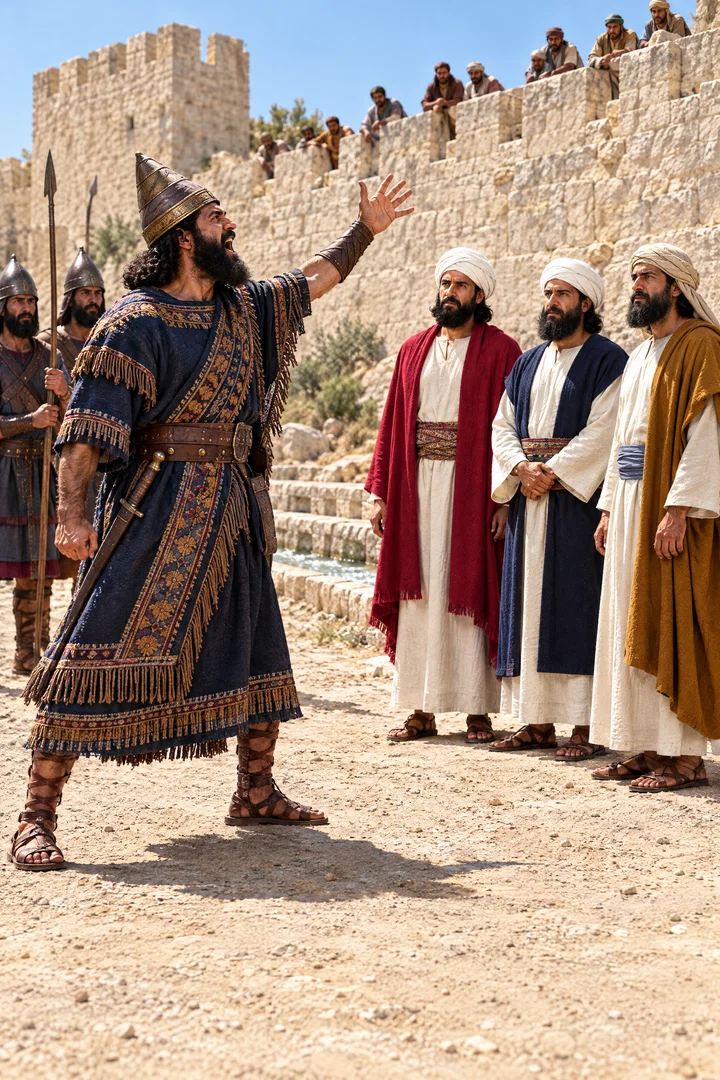
Then Rabshakeh stood, and cried with a loud voice in the Jews’ language, and said, Hear ye the words of the great king, the king of Assyria.
Translations
Then Rabshakeh stood, and cried with a loud voice in the Jews’ language, and said, Hear you the words of the great king, the king of Assyria.
King James Version, KJV Cambridge Paragraph Bible, Revised Version, American Standard Version
Then Rabshakeh stood, and cried with a loud voice in the Jews’ language, and said, Hear ye the words of the great king, the king of Assyria.
Then Rabshakeh stood, and cried with a loud voice in the Jew's language, and said, Hear ye the words of the great king, the king of Assyria.
And Rabshakeh standeth and calleth with a great voice [in] Jewish, and saith, 'Hear ye the words of the great king, the king of Asshur:
And Rab-shakeh stood and cried with a loud voice in the Jewish [ language], and said, Hear the words of the great king, the king of Assyria!
So then Rabshakeh took his stand, and cried out with a loud voice, in the Jews’ language, and said, Hear ye the words of the great king, the king of Assyria:
Berean Standard Bible, Majority Standard Bible
Then the Rabshakeh stood and called out loudly in Hebrew: “ Hear the words of the great king, the king of Assyria!
Then Rabshakeh stood, and called out with a loud voice in the Jews’ language, and said, “ Hear the words of the great king, the king of Assyria!
Then the Rab-shakeh got up and said with a loud voice in the Jews' language, Give ear to the words of the great king, the king of Assyria:
So Rabshakeh stood, and cryed with a loude voyce in the Iewes language, and sayd, Heare the wordes of the great King, of the King of Asshur.
Douay-Rheims (Challoner revision)
Then Rabsaces stood, and cried out with a loud voice in the Jews’ language, and said: Hear the words of the great king, the king of the Assyrians.
Pictures

Cross-references
- 2 Kings 18:28-35
Then Rab-shakeh stood and cried with a loud voice in the Jews’ language, and spake, saying, Hear the word of the great king, the king of Assyria:
Rabshakeh challenges Judah and urges them not to trust in the LORD.
- 2 Chronicles 32:18
Then they cried with a loud voice in the Jews’ speech unto the people of Jerusalem that were on the wall, to affright them, and to trouble them; that they might take the city.
Describes the same loud appeal to Jerusalem’s people in their language.
- 2 Kings 19:1
And it came to pass, when king Hezekiah heard it, that he rent his clothes, and covered himself with sackcloth, and went into the house of the LORD.
Hezekiah responds after hearing Rabshakeh’s speech.
- Isaiah 36:21
But they held their peace, and answered him not a word: for the king’s commandment was, saying, Answer him not.
Judah’s representatives obey the king’s command and do not answer Rabshakeh.
- 2 Kings 18:37
Then came Eliakim the son of Hilkiah, which was over the household, and Shebna the scribe, and Joah the son of Asaph the recorder, to Hezekiah with their clothes rent, and told him the words of Rab-shakeh.
The representatives report Rabshakeh’s words to Hezekiah.
- 2 Chronicles 32:21-23
And the LORD sent an angel, which cut off all the mighty men of valour, and the leaders and captains in the camp of the king of Assyria. So he returned with shame of face to his own land. And when he was come into the house of his god, they that came forth of his own bowels slew him there with the sword.
God defeats Sennacherib’s army and saves Jerusalem.
- Isaiah 37:33-35
Therefore thus saith the LORD concerning the king of Assyria, He shall not come into this city, nor shoot an arrow there, nor come before it with shields, nor cast a bank against it.
Isaiah promises Jerusalem’s protection from Assyria.
- Isaiah 37:36
Then the angel of the LORD went forth, and smote in the camp of the Assyrians a hundred and fourscore and five thousand: and when they arose early in the morning, behold, they were all dead corpses.
Records the outcome of the Assyrian threat against Jerusalem.
- 2 Kings 19:6-7
And Isaiah said unto them, Thus shall ye say to your master, Thus saith the LORD, Be not afraid of the words which thou hast heard, with which the servants of the king of Assyria have blasphemed me.
God promises Assyria’s defeat in answer to its challenge.
- 2 Chronicles 32:20
And for this cause Hezekiah the king, and the prophet Isaiah the son of Amoz, prayed and cried to heaven.
Hezekiah and Isaiah prayed in response to the Assyrian threat.
Commentary
Each commentary is drawn from primary sources: the writings of Ellen G. White and Adventist pioneers and periodicals. Each commentary is separate. Its own words are not a quotation; follow the references to read the source passages.
Ellen G. White
2 sources
He had been requested to speak in Syrian, yet in defiance of that request he lifted his voice to address the people themselves.RH May 27, 1915 Taking his stand, he cried out with a loud voice in the Jews' language so that those on Jerusalem's wall could hear the message sent by the Assyrian king.PK 352.3–354.1RH May 27, 1915 In doing so he exalted Assyria's ruler as the great king.PK 352.3–354.1
The public address was calculated to press Judah into surrender and submission to Assyria.PK 352.3–354.1RH May 27, 1915 At the same time it reviled God and worked to produce distrust of the Lord.PK 352.3–354.1RH May 27, 1915 It likewise urged Judah's leaders and people to distrust Hezekiah.RH May 27, 1915
Sources
Pioneers and periodicals
8 sources
Isaiah 36:13 belongs to the historical account of the Assyrian king's threat and invasion against Judah during Hezekiah's reign, specifically Sennacherib's wars and invasion in Hezekiah's time, and is part of the record of Hezekiah's triumph.ST Oct 6, 1909RH Jun 29, 1916ST Oct 6, 1909RH Jun 11, 1857 The account connects with the capture of Judah's cities, the siege of Lachish and the tribute exacted from Hezekiah, and the Assyrian threat against Jerusalem where the invading army was destroyed, a history confirmed by ancient records from Nineveh.RH Jun 11, 1857 Rabshakeh defied the request to speak in Syrian and instead stood and cried with a loud voice in the Jews' language, addressing the people on Jerusalem's wall directly in their own language on behalf of the king of Assyria so they could hear his message and demand.RH May 27, 1915ST Oct 6, 1909ST Jun 21, 1905RH May 21, 1908 Speaking directly to the people rather than to Hezekiah or his representatives was an unusual and discourteous appeal.ST Jun 21, 1905
The verse introduces a public challenge in which he urged Judah's leaders and people to distrust Hezekiah and the Lord and submit to Assyria, using the people's language to spread intimidation and to challenge trust in God's power to deliver Jerusalem.RH May 27, 1915RH May 21, 1908 It was meant to frighten and discourage them into surrender so the Assyrians could take the city.ST Jun 21, 1905RH May 21, 1908 The surrounding account contrasts this threat with God's deliverance of Judah.ST Oct 6, 1909 In Isaiah 36, the Assyrian threat to ruin the land illustrates destroy in the sense of laying waste and making desolate.RH Feb 14, 1865
Sources