Jeremiah 31:30
But every one shall die for his own iniquity: every man that eateth the sour grape, his teeth shall be set on edge.
Translations
But every one shall die for his own iniquity: every man that eats the sour grape, his teeth shall be set on edge.
King James Version, Webster Bible
But every one shall die for his own iniquity: every man that eateth the sour grape, his teeth shall be set on edge.
But every one shall die for his own iniquity:
Every man that eateth the sour grape,
His teeth shall be set on edge.Revised Version, American Standard Version
But every one shall die for his own iniquity: every man that eateth the sour grapes, his teeth shall be set on edge.
But — each for his own iniquity doth die, Every man who is eating the unripe fruit, Blunted are his teeth.
for every one shall die for his own iniquity; every man that eateth the sour grapes, his teeth shall be set on edge.
But, every one, for his own iniquity, shall die,—Any human being who eateth the sour grapes, his own teeth, shall be blunted.
Berean Standard Bible, Majority Standard Bible
Instead, each will die for his own iniquity. If anyone eats the sour grapes, his own teeth will be set on edge.
But everyone will die for his own iniquity. Every man who eats the sour grapes, his teeth will be set on edge.
But everyone will be put to death for the evil which he himself has done: whoever has taken bitter grapes will himself have his teeth put on edge.
But euery one shall die for his owne iniquitie: euery man that eateth the sowre grape, his teeth shalbe set on edge.
Douay-Rheims (Challoner revision)
But every one shall die for his own iniquity: every man that shall eat the sour grape, his teeth shall be set on edge.
Pictures
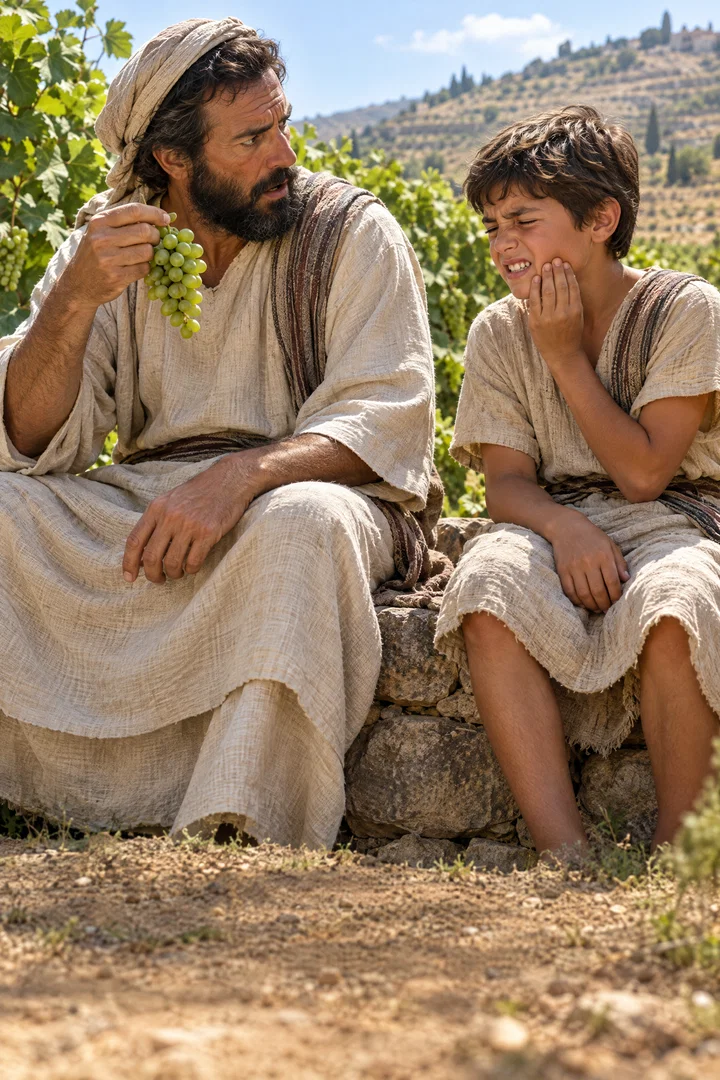
Cross-references
- Hebrews 8:8-12
For finding fault with them, he saith, Behold, the days come, saith the Lord, when I will make a new covenant with the house of Israel and with the house of Judah:
The new covenant promise includes God’s law written on hearts and forgiveness of sins.
- Ezekiel 18:20
The soul that sinneth, it shall die. The son shall not bear the iniquity of the father, neither shall the father bear the iniquity of the son: the righteousness of the righteous shall be upon him, and the wickedness of the wicked shall be upon him.
Each person bears the consequences of his own sin.
- Hebrews 9:15
And for this cause he is the mediator of the new testament, that by means of death, for the redemption of the transgressions that were under the first testament, they which are called might receive the promise of eternal inheritance.
Christ’s death brings redemption for transgressions committed under the first covenant.
- Ezekiel 18:2-4
What mean ye, that ye use this proverb concerning the land of Israel, saying, The fathers have eaten sour grapes, and the children’s teeth are set on edge?
Both reject children bearing their parents’ guilt and affirm each person’s responsibility.
- Exodus 20:5-6
Thou shalt not bow down thyself to them, nor serve them: for I the LORD thy God am a jealous God, visiting the iniquity of the fathers upon the children unto the third and fourth generation of them that hate me;
Contrasts consequences reaching generations with mercy to those who love God.
- Hebrews 10:16-18
This is the covenant that I will make with them after those days, saith the Lord, I will put my laws into their hearts, and in their minds will I write them;
The new covenant promises that God will remember sins no more, so no further offering is needed.
- Ezekiel 18:26
When a righteous man turneth away from his righteousness, and committeth iniquity, and dieth in them; for his iniquity that he hath done shall he die.
Both affirm that each person dies for their own sin.
- Galatians 6:7
Be not deceived; God is not mocked: for whatsoever a man soweth, that shall he also reap.
Each person bears the consequences of their own actions.
- Revelation 20:13
And the sea gave up the dead which were in it; and death and hell delivered up the dead which were in them: and they were judged every man according to their works.
Both texts affirm that each person is judged for his own deeds.
- Romans 2:6
Who will render to every man according to his deeds:
Both affirm that each person is accountable for their own deeds.
- 2 Corinthians 5:10
For we must all appear before the judgment seat of Christ; that every one may receive the things done in his body, according to that he hath done, whether it be good or bad.
Each person receives according to what was done in the body.
- Romans 6:23
For the wages of sin is death; but the gift of God is eternal life through Jesus Christ our Lord.
sin earns death
- Matthew 16:27
For the Son of man shall come in the glory of his Father with his angels; and then he shall reward every man according to his works.
Each person is judged according to his own deeds.
- Matthew 26:26-29
And as they were eating, Jesus took bread, and blessed it, and brake it, and gave it to the disciples, and said, Take, eat; this is my body.
These verses are cited in connection with the New Covenant’s introduction.
- Acts 3:26
Unto you first God, having raised up his Son Jesus, sent him to bless you, in turning away every one of you from his iniquities.
God fulfills Jeremiah’s promise by turning each person from their iniquities.
- John 9:2
And his disciples asked him, saying, Master, who did sin, this man, or his parents, that he was born blind?
The question reflects belief in inherited guilt, contrasted with each person bearing his own iniquity.
- Romans 8:4
That the righteousness of the law might be fulfilled in us, who walk not after the flesh, but after the Spirit.
The law’s righteousness is fulfilled in those who walk by the Spirit, not the flesh.
- Isaiah 53:6
All we like sheep have gone astray; we have turned every one to his own way; and the LORD hath laid on him the iniquity of us all.
all have gone astray
Commentary
Each commentary is drawn from primary sources: the writings of Ellen G. White and Adventist pioneers and periodicals. Each commentary is separate. Its own words are not a quotation; follow the references to read the source passages.
Pioneers and periodicals
18 sources
Every person answers for his own wrongdoing and dies for his own sin, with the sour grape showing that the one who eats it is the one whose teeth are set on edge.RH Jul 27, 1916RH Mar 19, 1857RH Aug 20, 1901 It brings to an end the saying that the fathers ate a sour grape and the children's teeth are set on edge, rejecting the thought that children are put to death for their parents' or mother's sins, after a captivity in which children suffered with guilty parents for sins they had not themselves committed.RH Mar 19, 1857RH Mar 10, 1868RH May 16, 1865RH Mar 10, 1868 It stands in the promise of the new covenant to Israel and Judah, in which God's law is written in heart and spirit, bringing individual accountability under the gospel, a promise fulfilled and established at Christ's first coming and not reserved for a future age.RH Feb 21, 1854ST Jul 18, 1911RH Jul 1, 1873RH Feb 7, 1856ST May 12, 1881 That covenant was ratified by Christ's death and confirmed to both houses through the last week of special confirmation, from His ministry to the lost sheep of Israel until the gospel turned to the Gentiles, while He ministers as High Priest and Mediator to forgive even transgressions under the first covenant and send the gospel from Jerusalem to all nations.RH Feb 7, 1856ST May 12, 1881 This accountability does not deny that children feel the physical and moral effects of their parents' vices and inherit from Adam a mortal nature, with evil tendencies that may largely be overcome by good surroundings and habits, yet final death comes for personal sin and not merely by descent.RH Aug 20, 1901RH May 16, 1865RH Oct 3, 1865 No national covenant at Sinai can save anyone by pledged obedience, since those saved then and now are saved individually by faith in Christ, receiving forgiveness and having God's law written within so that its righteousness is fulfilled in them.RH Oct 3, 1865ST Apr 22, 1913
Personal Accountability and Setting
Everyone will die for his own wrongdoing, with no one dying for another's sin.RH Jul 27, 1916RH Mar 19, 1857RH Aug 20, 1901RH Mar 10, 1868RH Feb 21, 1854 The sour-grape image means the eater himself feels the sharp edge on his own teeth, rather than another suffering for it.RH Jul 27, 1916RH Mar 19, 1857RH Aug 20, 1901RH Mar 10, 1868RH May 16, 1865 The former proverb assigning children the consequences of their parents' sins is brought to an end.RH Mar 19, 1857RH Feb 21, 1854RH May 16, 1865 That proverb — the fathers have eaten a sour grape and the children's teeth are set on edge — is what the people say, not what God ever said.RH May 16, 1865 It is thereby rejected that children should be killed for their mother's sins.RH Mar 19, 1857
In the earlier captivity children suffered alongside their parents for the parents' sins though the children were not guilty of those sins.RH Mar 10, 1868RH Mar 10, 1868 A coming time ends that pattern of inherited punishment, when each bears his own guilt and consequences for his own wrongdoing.RH Mar 10, 1868RH Mar 10, 1868 The prophecy has its general application to the time of the Babylonian captivity and exile.RH Mar 10, 1868RH Jul 27, 1916
It belongs to the weeping prophet's message in Judah amid false prophets, utter repudiation of God's law and righteousness, and persecutions of Jeremiah himself.ST Jul 29, 1913 It is left on record to show the enormity of sin and its sure consequences.ST Jul 29, 1913 This part of Jeremiah is not arranged chronologically and its book order is broken up.ST Jul 29, 1913ST Jul 12, 1910 In time order, as part of the section from chapter 20 onward, it follows chapters 24 and 29 and 30 and comes before chapters 27, 28 and 21.ST Jul 29, 1913ST Jul 12, 1910
New Covenant Promise Fulfilled
Under the gospel dispensation the old saying about inherited consequences gives way to individual accountability, so that each person answers for personal wrongdoing and dies for his own iniquity rather than suffering for the sins of parents.RH Feb 21, 1854 The sour-grape image marks that change, showing the new-covenant order in which responsibility rests on the one who commits the sin.RH Feb 21, 1854
The verse stands in a chapter that foretells the new covenant, whose people receive God's law written in their hearts and spirits.ST Jul 18, 1911 That promise made with the house of Israel and with the house of Judah was fulfilled and established at Christ's first coming, not reserved for a future age.RH Jul 1, 1873RH Feb 7, 1856ST May 12, 1881 It was ratified through Christ's death and confirmed to both houses before the gospel went to the Gentiles.RH Feb 7, 1856ST May 12, 1881
The confirmation came through the last week of special covenant confirmation cut off upon Israel and Judah in the seventy weeks, beginning with Christ's preaching to the lost sheep of the house of Israel and ending when the apostles turned to the Gentiles.RH Feb 7, 1856 The gospel of the kingdom had first to be spoken at Jerusalem and to the Jews, which proves the covenant was made with them, with Christ ministering as High Priest and Mediator to bring forgiveness even for transgressions under the first covenant, and then extending from them to all nations and to Gentiles.RH Feb 7, 1856 The verse also stands in the promise of return to Zion with songs and everlasting joy, and that return is altogether a type of the gospel dispensation.ST Apr 23, 1896
Individual Responsibility Applied
Each one dies for his own wrongdoing, and the sour grape image means the teeth set on edge are the teeth of the one who ate it, not punishment laid on a child as if a parent's sin were the child's own.RH Aug 20, 1901 This does not mean children escape what their parents pass down, for acquired evil tendencies can be transmitted and shape the child's nature.RH Aug 20, 1901 Those inherited effects may still be largely overcome through a favorable environment and the forming of good habits.RH Aug 20, 1901
The saying that the fathers ate a sour grape and the children's teeth are set on edge is what the people say, not what God ever said, and the promise is that no son bears the punishment due his father for his father's sin.RH May 16, 1865 The promise does not end the second commandment's visiting of the fathers' iniquity on the children to the third and fourth generation, because that visiting is the physical and moral effects of the fathers' vices seen in the children.RH May 16, 1865 That transmission of effects remains just as true under the gospel as under the former dispensation so long as sin is passed from father to son.RH May 16, 1865 Personal accountability was already God's rule under the old covenant, and the ceasing of the saying belongs to the time when God watches over Israel and Judah to build and to plant after plucking up and destroying.RH May 16, 1865
Death is not entailed merely by descent from Adam, for final destruction comes for personal sins.RH Oct 3, 1865 What is inherited from Adam in consequence of sin is a mortal, dying nature, while every one dies for his own iniquity.RH Oct 3, 1865
No national covenant saves individuals, for the covenant made with Israel at Sinai rested only on the people's own promises and proved that man has no power in himself to do God's will.ST Apr 22, 1913 Those who were saved then were saved individually by faith in Christ to come, receiving forgiveness of sins and having God's law written in heart and mind so that they obeyed God from the heart.ST Apr 22, 1913 The same is true now, for those who try to keep God's law in their own strength perish by the way.ST Apr 22, 1913 Those who by faith receive Christ's righteousness and life have the righteousness of the law fulfilled in them and obey God in every known duty.ST Apr 22, 1913
Sources