John 12:14
And Jesus, when he had found a young ass, sat thereon; as it is written,
Translations
American King James Version, King James Version, KJV Cambridge Paragraph Bible, Webster Bible
And Jesus, when he had found a young ass, sat thereon; as it is written,
Revised Version, American Standard Version
And Jesus, having found a young ass, sat thereon; as it is written,
and Jesus having found a young ass did sit upon it, according as it is written,
And Jesus, having found a young ass, sat upon it; as it is written,
And Jesus, finding a young ass, took his seat thereon, just as it is written—
Berean Standard Bible, Majority Standard Bible
Finding a young donkey, Jesus sat on it, as it is written:
Jesus, having found a young donkey, sat on it. As it is written,
And Jesus saw a young ass and took his seat on it; as the Writings say,
And Iesus found a yong asse, and sate thereon, as it is written,
Douay-Rheims (Challoner revision)
And Jesus found a young ass, and sat upon it, as it is written:
Pictures
Cross-references
- Zechariah 9:9
Rejoice greatly, O daughter of Zion; shout, O daughter of Jerusalem: behold, thy King cometh unto thee: he is just, and having salvation; lowly, and riding upon an ass, and upon a colt the foal of an ass.
Foretells the King’s humble entry riding on an ass.
- Matthew 21:1-11
And when they drew nigh unto Jerusalem, and were come to Bethphage, unto the mount of Olives, then sent Jesus two disciples,
Parallel account of Jesus entering Jerusalem on the colt.
- Mark 11:1-7
And when they came nigh to Jerusalem, unto Bethphage and Bethany, at the mount of Olives, he sendeth forth two of his disciples,
Jesus rides into Jerusalem on the colt his disciples bring.
- Luke 19:29-35
And it came to pass, when he was come nigh to Bethphage and Bethany, at the mount called the mount of Olives, he sent two of his disciples,
Parallel account of the young ass and Jesus’ entry.
- Matthew 21:9
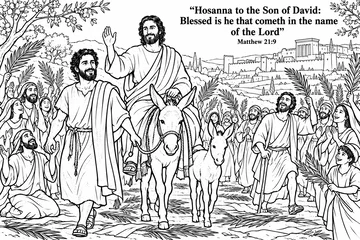
And the multitudes that went before, and that followed, cried, saying, Hosanna to the Son of David: Blessed is he that cometh in the name of the Lord; Hosanna in the highest.
The crowds welcome Jesus into Jerusalem with Hosannas and acclaim him as the Son of David.
- Psalms 118:25-26
Save now, I beseech thee, O LORD: O LORD, I beseech thee, send now prosperity.
The psalm supplies the crowd’s Hosanna acclamation and words of welcome.
- Luke 19:39-40
And some of the Pharisees from among the multitude said unto him, Master, rebuke thy disciples.
Jesus says the stones would cry out if the people were silent during his entry.
- Mark 11:4-8
And they went their way, and found the colt tied by the door without in a place where two ways met; and they loose him.
Describes the colt brought to Jesus and His riding it.
- Matthew 21:2
Saying unto them, Go into the village over against you, and straightway ye shall find an ass tied, and a colt with her: loose them, and bring them unto me.
same sending of two disciples for colt
- Luke 19:38
Saying, Blessed be the King that cometh in the name of the Lord: peace in heaven, and glory in the highest.
shares the blessed King acclamation
- John 12:19
The Pharisees therefore said among themselves, Perceive ye how ye prevail nothing? behold, the world is gone after him.
quotes rulers alarmed the world follows him
- 1 Kings 1:38-40
So Zadok the priest, and Nathan the prophet, and Benaiah the son of Jehoiada, and the Cherethites, and the Pelethites, went down, and caused Solomon to ride upon king David’s mule, and brought him to Gihon.
Solomon is publicly acclaimed king while riding a royal animal.
- 2 Kings 9:13
Then they hasted, and took every man his garment, and put it under him on the top of the stairs, and blew with trumpets, saying, Jehu is king.
Provides a parallel for spreading garments beneath a leader.
Commentary
Each commentary is drawn from primary sources: the writings of Ellen G. White and Adventist pioneers and periodicals. Each commentary is separate. Its own words are not a quotation; follow the references to read the source passages.
Ellen G. White
21 sources
Jesus on the first day of the week resumed His journey from Bethany to Jerusalem to keep the Passover just before His betrayal and death, deliberately finding a young colt on which no man had ever sat and sitting upon it.DA 569.3–4Ms 175, 1905, par. 2ST Jun 8, 1882ST Jul 22, 18862SP 383.2 In doing so He fulfilled what was written, especially Zechariah's prophecy that Zion's King would come humbly riding on an ass and its colt.DA 569.1–2COS 91.1–52SP 384.1–385.1 He enters Jerusalem as the promised King and Messiah, heir to David's throne, in the manner of a royal entry on the kind of animal ridden by Israel's kings, yet unlike the pageants of earthly conquerors and true to the life of humiliation He had accepted.DA 569.3–4DA 569.1–2DA 5694RED 120.24RED 116.1–117.2 On this occasion He accepted homage He had never before permitted and allowed the procession to publicly honor Him as Messiah and King, which the disciples and crowd took as a sign that He would proclaim Himself king, take David's throne, free Israel from Rome and establish an earthly kingdom.DA 569.3–4COS 91.1–54RED 116.1–117.22SP 384.1–385.1ST Jul 22, 1886 That earthly expectation was mistaken, for His path led to the cross; He accepted the homage to draw public attention to Himself as the world's Redeemer and to the sacrifice He was soon to make, so that after His death searching the prophecies would reveal Him as Messiah.2SP 384.1–385.14RED 115.3EW 206.4ST Jul 22, 18861T 57.3–58.1
Entry Setting and Manner
John 12:14 belongs to the triumphal entry into Jerusalem on the first day of the week, when Jesus resumed His journey from Bethany to Jerusalem to keep the Passover.Ms 175, 1905, par. 2ST Jul 22, 18862SP 383.2 It was just before His betrayal and death, in the beautiful season when many had come to the feast.Ms 175, 1905, par. 22SP 383.2Ms 128, 1899, par. 1 Multitudes who had flocked to Bethany to see Him accompanied Him, and other Passover pilgrims continually joined them on the way.ST Jul 22, 1886Ms 128, 1899, par. 1 He usually traveled on foot, but on this occasion He sent two of His disciples to bring a colt the foal of an ass for Him to ride into the city.ST Jul 22, 18862SP 383.2
The way lay amid rejoicing nature with trees clothed in verdure and fragrant blossoms.ST Jul 22, 1886 There was intense public excitement, for His fame had spread over all the land because He had raised Lazarus from the dead.4RED 105.2Ms 128, 1899, par. 1 Crowds were anxious to see and hear Him as a prophet, asking who He was, where He came from, whether Lazarus would accompany Him to Jerusalem, and whether He would be crowned king at the feast.4RED 105.2 The raising of Lazarus had drawn an enthusiastic multitude eager to see Jesus.4RED 105.2Ms 128, 1899, par. 1 The priests and rulers saw they were losing their hold on the minds of the people, and their rage increased as they waited for Him to come to gratify their revenge and remove Him forever, yet they grew excited and restless fearing He might not come because He had read their purposes, divined their thoughts, exposed their hidden motives, and baffled their murderous designs.4RED 105.2
For the ride Jesus deliberately selected a young ass, a colt the foal of an ass on which no man had ever sat.DA 569.3–4ST Jun 8, 18824RED 116.1–117.2ST Jul 22, 18862SP 384.1–385.1 Though He owned all things, He depended on a stranger's kindness for the animal.DA 569.3–4 His precise directions for obtaining it through two disciples showed His divine knowledge.DA 569.3–4ST Jul 22, 1886 The disciples took this unusual act as connected with hope of kingship.ST Jun 8, 1882ST Jul 22, 18862SP 383.2
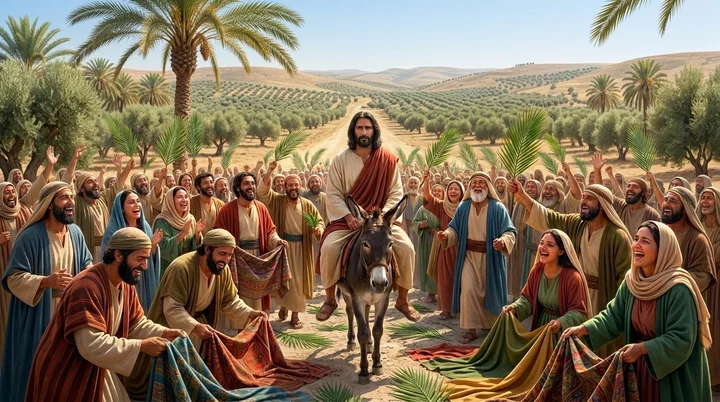
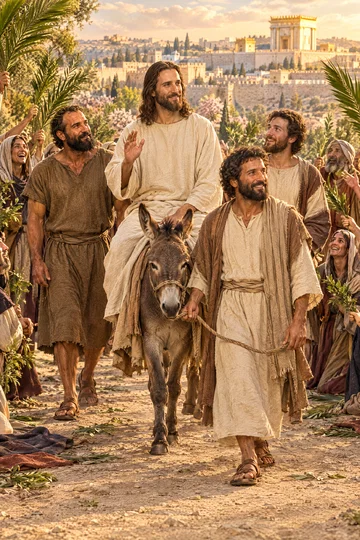
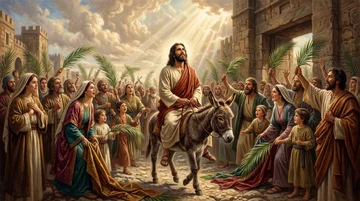
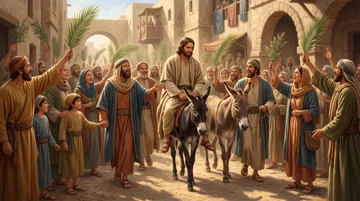
The disciples spread their garments on the colt and placed Jesus upon Him.4RED 116.1–117.2 Lazarus, who had been raised from the dead, guided the beast, and those around Him were living witnesses to His works of mercy, those He had healed or delivered praising Him.4RED 120.24RED 116.1–117.2 There was no outward pomp or costly gifts or royal standards, no escort by heavenly angels or heralding by the trumps of God, but the people gave Him the worship of happy hearts.4RED 116.1–117.2ST Jul 22, 1886 They spread outer garments as a carpet in His path, strewed olive and palm branches in the way, and waved palm boughs aloft as nature's emblem of victory, with loud acclamations and hosannas echoed from hills and valleys.4RED 116.1–117.2DA 546 The multitude continually grew with Passover pilgrims, and crowds from Jerusalem came to meet and conduct Him to the city with palm waving and sacred song, raising their hands in joy.4RED 116.1–117.2COS 90DA 546 Astonished spectators asked who He was and what the commotion meant, wondering at the change in One who had refused kingly honors and declared His kingdom was not of this world.4RED 116.1–117.2 He is seen wearing a blue robe over a white tunic, riding a gray donkey and young donkey through an arched city gate between tall stone walls and fortified towers, surrounded by men, women, and children, with palm trees above the buildings, flowering plants in the foreground, and hazy mountains in the distance.COS 90DA 546
Prophecy of Humble King
The finding and riding of the young ass happened as it was written, in fulfillment of prophecy, especially Zechariah's foretelling that Israel's King, Zion's King, would come humbly riding on an ass and its colt.DA 569.1–2COS 91.1–54RED 115.3EW 206.4 The colt had never been ridden, and the public procession that honored Him on it as Messiah and King was His royal entry, faintly prefiguring His future coming as Zion's King.2SP 384.1–385.1EW 206.4 The disciples and crowd took the ride as a signal that He would proclaim Himself king and exercise royal power and establish an earthly kingdom, though that expectation went beyond what the sign itself meant and was mistaken.4RED 115.3EW 206.4
The verse presents the coming of the King, for Jesus enters Jerusalem as the promised King and Messiah, heir to David's throne, coming to His kingdom in the manner of a royal entry.DA 569.3–4DA 569.1–2DA 569COS 91.1–5DA 570.1–571.1 The animal was the kind ridden by Israel's kings, and the Messiah had been foretold to come to His kingdom in this way, following their custom, with a humble royal entry on a colt that no one had ridden.DA 569.3–4ST Jun 8, 1882DA 570.1–571.1 Though He owned all things He depended on a stranger's kindness for the animal, and His precise directions for obtaining it through two disciples showed His divine knowledge.DA 569.3–4 As He rode the crowd acclaimed Him as Messiah and King, and His disciples took His acceptance of their homage as a sign that He would be acknowledged at Jerusalem as Israel's King, would claim an earthly throne, take David's throne, and free Israel from Roman rule.DA 569.3–4ST Jun 8, 1882COS 91.1–5
His triumphal procession was unlike the pageants of earthly conquerors, for He deliberately selected a humble beast, a young colt on which no man had ever sat.4RED 120.24RED 116.1–117.2 The disciples spread their garments on the colt and placed Him upon it, with Lazarus raised from the dead guiding the beast, while around Him were living witnesses to His works of mercy, those He had healed or delivered praising Him, fulfilling the prophecy of the lowly King entering Jerusalem.4RED 120.24RED 116.1–117.2 The moment He was seated a loud shout of triumph hailed Him as Messiah and King, homage He had never before permitted, which the disciples took as proof He would be acknowledged at Jerusalem as King of Israel.4RED 116.1–117.2 Without outward pomp or costly gifts or royal standards or escort by heavenly angels and heralding by the trumps of God, the people gave Him the worship of happy hearts, spreading outer garments as a carpet in His path, strewing olive and palm branches in the way, and waving palm boughs aloft as nature's emblem of victory with loud acclamations and hosannas echoed from hills and valleys.4RED 116.1–117.2ST Jul 22, 1886 The multitude continually grew with Passover pilgrims and crowds from Jerusalem coming to meet and conduct Him to the city with palm waving and sacred song, while astonished spectators asked who He was and what the commotion meant, wondering at the change in One who had refused kingly honors and declared His kingdom was not of this world.4RED 116.1–117.2 Though this startling ride was the one triumphal scene of His earthly life, calculated to be the talk of every tongue and to bring Him before every mind so that after His crucifixion it would be connected with His trial and death and searching the prophecies would reveal Him as Messiah and multiply converts in all lands, He remained true to the life of humiliation He had accepted, bearing the burden of humanity till His life was given for the life of the world.ST Jul 22, 1886
Hopes and Redemptive Purpose
On this occasion Jesus accepted homage He had never before permitted and allowed the procession to publicly honor Him as Messiah and King.4RED 116.1–117.22SP 384.1–385.1ST Jul 22, 1886 The moment He was seated on the colt a loud shout of triumph hailed Him.4RED 116.1–117.2 By so receiving the crowd's worship He let the ride stand openly as His royal entry.2SP 384.1–385.1ST Jul 22, 1886
The disciples and the crowd took the ride and His acceptance of homage as a sign that He would be acknowledged at Jerusalem as King of Israel.DA 569.3–4ST Jun 8, 18824RED 116.1–117.2ST Jul 22, 1886 They understood it to mean that He would proclaim Himself king and exercise royal power.4RED 115.3 They expected Him to take David's throne, free Israel from Roman rule, and establish an earthly kingdom.DA 569.3–4COS 91.1–5 The crowds hailed Him as the promised Messiah coming to reign in Jerusalem.ST Jun 8, 1882COS 91.1–5
That earthly expectation went beyond what the sign itself meant.4RED 115.3 The disciples took the event to mean He was about to set up an earthly kingdom, but their expectation was mistaken.EW 206.4 They and the people expected Him to reign as king on David's throne, yet His path led to the cross.1T 57.3–58.1 Their hopes were therefore disappointed.1T 57.3–58.1
He accepted the homage to draw public attention to Himself as the world's Redeemer and to the sacrifice He was soon to make.2SP 384.1–385.1 The startling ride was calculated to be the talk of every tongue and to bring Him before every mind.ST Jul 22, 1886 After His crucifixion it would be connected with His trial and death, and searching the prophecies would reveal Him as indeed the Messiah.ST Jul 22, 1886 Converts to faith in Him would thus be multiplied in all lands.ST Jul 22, 1886 His royal entry also faintly prefigured His future coming as Zion's King.2SP 384.1–385.1
Sources
Pioneers and periodicals
31 sources
Jesus found a young ass, a colt never ridden by anyone, and sat on it to enter Jerusalem, the only time he rode in all his travels, having sent two disciples to bring it.ST Jun 8, 1882ST Jul 22, 1886ST Jul 22, 1886
He rode after the manner of the kings of Israel when about to be crowned, on a humble yet honored beast whose use declared peace, presenting himself as the Prince of Peace and not as a warlike conqueror.ST Apr 12, 1905ST Sep 13, 1910ST
The act deliberately fulfilled what was written in Zechariah 9:9, that Zion's King would come meek and lowly, just and bringing salvation, as a sign of the first advent proving him the true Messiah.ST Apr 12, 1905ST Sep 27, 1899ST Apr 12, 1905RH Apr 17, 1855
In this ride he publicly accepted the title of Messiah and King and allowed the multitudes full sway in honoring him, though he had earlier prevented such proclamation.ST Jun 8, 1882ST Jul 22, 1886ST Jul 22, 1886
The disciples and multitude rightly hailed him as the promised King yet wrongly expected an immediate earthly reign, and their rejoicing was still right and required, showing that prophecy is fulfilled under God's hand even when those taking part misunderstand it.ST Jun 5, 1879RH Mar 25, 1875RH Aug 2, 1864RH Sep 18, 1855
The Triumphal Entry
John 12:14 records Jesus finding a young ass, a colt the foal of an ass that had never been ridden by anyone, and sitting upon it to enter Jerusalem.ST Jun 8, 1882ST Jul 22, 1886ST Apr 12, 1905ST Oct 17, 1895 It was the only time he rode during all his travels about the country, which made the act all the more significant.ST Apr 12, 1905 He arranged its use by sending two of his disciples to bring it, as told in full in the other Gospels.ST Jul 22, 1886ST Apr 12, 1905
He rode after the manner of the kings of Israel, for a Jewish king rode on an ass when about to be crowned.ST Sep 13, 1910ST Apr 12, 1905 The ass was a humble animal yet in high esteem in the East, statelier, livelier and swifter than elsewhere and among the rich a lordly beast with a coat as smooth and glossy as a horse's.ST Apr 12, 1905 The horse was used especially for war, but riding the ass was a symbol of peace, so that riding it presented Jesus as the Prince of Peace, not as a warlike conqueror.ST Apr 12, 1905ST Apr 12, 1905 His ride therefore declared his Messiahship.ST Sep 13, 1910
The ride belongs to the triumphal entry into Jerusalem in the last week of his earthly life.ST Apr 14, 1898ST Feb 14, 1878 It was on the first day of the week, the Sunday before Passover and the fourth day before it, when he resumed his journey from Bethany to join the Passover feast.ST Jul 22, 1886 It was near the close of his ministry, only a few days before his suffering, crucifixion and death, before Gethsemane, and associated with the temple cleansing at the close of his ministry.RH Apr 24, 1879ST Nov 8, 1883ST Feb 14, 1878ST Jul 22, 1886 It was when he declared that the hour had come for the Son of man to be glorified.RH Apr 24, 1879
The public demonstration would not have suited strict Sabbath observance. It is called Palm Sunday because the crowd strewed palm branches on the road. It occurred about five months after the raising of Lazarus, who had been dead four days.ST Nov 8, 1883ST Apr 14, 1898 It took place amid rejoicing nature with trees clothed in verdure and fragrant blossoms, accompanied by multitudes who had flocked to Bethany to see Jesus and by other Passover pilgrims continually joining on the way.ST Jul 22, 1886
The procession was unlike the triumphs of earthly conquerors, for its honor came from people Jesus had delivered and healed, who praised God for the mighty works they had seen, including healings and the raising of the dead.ST Jan 21, 1897ST Jan 21, 1897 They spread garments and branches on the road as is done for royalty only, waved palms, and pressed before and behind him.STRH Sep 18, 1855 They shouted Hosanna to the Son of David, Blessed be the King that cometh in the name of the Lord, Hosanna in the highest, quoting a psalm of the Messiah's future reign and triumph.RH Sep 18, 1855
In this ride Jesus publicly accepted the title of Messiah and King and allowed the multitudes full sway in honoring him, although he had earlier prevented people from proclaiming him king.ST Jun 8, 1882ST Jul 22, 1886ST Jan 21, 1897 It was the one instance in his life when he did so, a rare moment when people gave him the honor and adoration due him.ST Jul 22, 1886ST Before Gethsemane there is no more striking scene.ST Jul 22, 1886
In John's narrative the verse belongs to John 12:1-26, within the longer sequence from John 11:30 through John 15 that includes the resurrection of Lazarus, the last public discourse, the acknowledgment from heaven, the ordinance of humility, the pointing out of the betrayer, and the first two chapters of the farewell discourse.ST May 26, 1909 Luke 19 gives the fullest account of the entry scene, with Matthew 21 and Mark 11 also recording it.ST
Prophecy Fulfilled
Jesus finding the young ass and sitting on it was a deliberate and significant act, carrying out the prophetic sign of the coming King in fulfillment of what was written in Zechariah 9:9 about Zion's King coming riding on an ass's colt.ST Apr 12, 1905ST Sep 27, 1899ST Apr 12, 1905ST Jun 5, 1879 He fulfilled that prophecy in its season, only a few days before his crucifixion.RH Jul 4, 1871ST Nov 8, 1883 Riding an ass rather than a war-horse presented him as the Prince of Peace.ST Apr 12, 1905
The prophecy presents him as Messiah and King of Israel, and as Zion's King coming meek and lowly, just and bringing salvation, yet humble.ST Sep 27, 1899ST Jun 5, 1879ST Nov 8, 1883RH Mar 17, 1859 A Jewish king rode in this way when he was about to be crowned, so the ride declared his Messiahship.ST Sep 13, 1910 Those who recognized the sign gave him the allegiance due a king, while the rulers who rejected him brought swift destruction upon themselves.ST Sep 13, 1910 The people's hope that he would immediately take David's throne was not fulfilled, and within days he was crucified and his disciples scattered.RH Mar 17, 1859
Though Zechariah 9:9 is written in the imperative mood as a command, Rejoice greatly, O daughter of Zion; shout, O daughter of Jerusalem, it is simply a prediction that at a time far in the future such rejoicing and shouting would be done when Christ entered Jerusalem in the manner described.RH Jul 4, 1871 Likewise the alarm in Joel 2:1 was to be sounded when the day of the Lord was near, not when Joel wrote.ST May 9, 1878 The riding stands as one of the signs of the first advent giving evidence that Jesus is the true Messiah.RH Apr 17, 1855 The Jews had evidence of his identity in the prophecies he fulfilled, his miracles, and the purity of his life and teaching, and shortly before the entry he had raised Lazarus, who had been dead four days.ST Nov 8, 1883
The entry was a prophetic sign of the victory he would achieve gloriously and permanently, but that victory required him to die first, like a seed that dies before bearing fruit.ST Jun 14, 1905 It points ahead to his final triumph when he enters his kingdom to reign.ST Apr 14, 1898
Acclaim Despite Misunderstanding
The disciples and the multitude rightly hailed Jesus as the promised King and obeyed the prophecy's call to acclaim him.ST Jun 5, 1879RH Mar 25, 1875ST Nov 20, 1884 Moved by the Spirit of God, they saw the prophecy about Zion's King fulfilled as he rode and proclaimed the King in its words, with shouting that had to be uttered.ST Jun 5, 1879RH Mar 25, 1875ST Nov 20, 1884 By accepting their homage as Messiah and King he allowed the procession to honor him publicly, and the disciples took that acceptance as a sign that he would soon be acknowledged as Israel's King in Jerusalem.ST Jun 8, 1882ST Jul 22, 1886
They wrongly expected him to begin an earthly reign in Jerusalem, to take David's throne immediately, to remain with them, and to have God's kingdom appear at once.ST Jun 5, 1879RH Mar 17, 1859ST Nov 20, 1884 They looked toward an earthly result while he looked toward a different outcome, and they did not understand at the time, with the full meaning grasped only later.RH Mar 25, 1875RH Aug 2, 1864 Within days he was crucified instead of crowned and the disciples scattered, and their hopes were disappointed in sorrow.ST Jun 5, 1879RH Mar 25, 1875RH Aug 2, 1864RH Mar 17, 1859
Their mistaken expectation and sorrowful disappointment did not undo their genuine fulfillment of the prophecy.ST Jun 5, 1879RH Mar 25, 1875 Their shouting and rejoicing was right and required and rightly timed, for the prophecy had to be fulfilled under the moving of the Spirit of God, so that if they had held their peace the stones would immediately cry out.RH Mar 25, 1875RH Sep 18, 1855ST Nov 20, 1884 Even the crowd of young and old pressing before and behind him, spreading garments and branches as is done for royalty only and quoting a psalm of the Messiah's future reign as if its fulfillment had come, was right in its timing though mistaken about the immediacy of the kingdom and the event that would follow.RH Sep 18, 1855ST Nov 20, 1884
The event thus illustrates that a prophetic event can be fulfilled even when its participants misunderstand what it means.RH Mar 25, 1875RH Aug 2, 1864 It proves that God's controlling hand causes each predicted event to appear in given order despite human error and disappointment, as with Adventists in 1844.RH Mar 25, 1875 The startling ride was calculated to be the talk of every tongue and to bring Jesus before every mind, so that after his crucifixion it would be connected with his trial and death and searching the prophecies would reveal that he is indeed the Messiah, multiplying converts to faith in all lands.ST Jul 22, 1886 Though it was the one triumphal scene of his earthly life, he did not appear escorted by heavenly angels and heralded by the trumps of God, but remained true to the life of humiliation he had accepted, bearing the burden of humanity till his life was given for the life of the world.ST Jul 22, 1886
The joyful welcome is set against his sorrow for Jerusalem, for amid the hallelujah cry and waving palms and hosannas acclaiming him as the Son of David he wept over the city.STST He foresaw Roman banners on her walls, the temple in dust, and streets red with blood in her destruction by the Romans.STST He knew that many shouting praise, young and old, would cry Crucify before another Sabbath day.STST Those who recognized the sign of the coming King gave him the allegiance due a king, while the rulers who rejected him brought swift destruction upon themselves.ST Sep 13, 1910
Sources