John 12:13
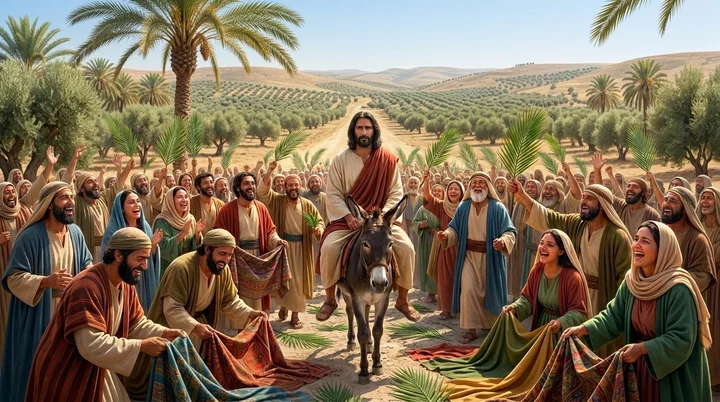
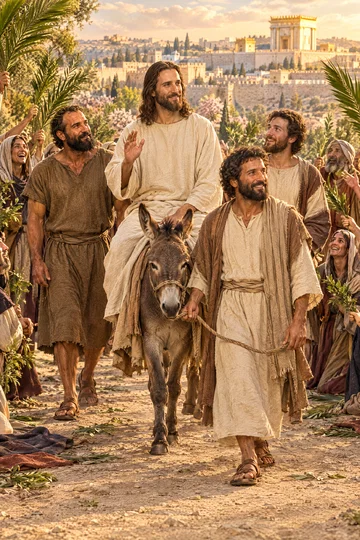
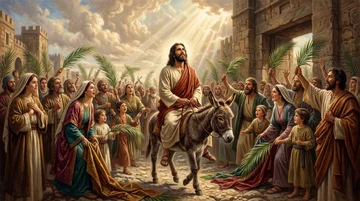
Took branches of palm trees, and went forth to meet him, and cried, Hosanna: Blessed is the King of Israel that cometh in the name of the Lord.
Translations
Took branches of palm trees, and went forth to meet him, and cried, Hosanna: Blessed is the King of Israel that comes in the name of the Lord.
Took branches of palm trees, and went forth to meet him, and cried, Hosanna: Blessed is the King of Israel that cometh in the name of the Lord.
took branches of palm trees, and went forth to meet him, and cried, Hosanna: Blessed is the King of Israel that cometh in the name of the Lord.
Took branches of palm-trees, and went forth to meet him, and cried, Hosanna; Blessed is the King of Israel that cometh in the name of the Lord.
Revised Version, American Standard Version
took the branches of the palm trees, and went forth to meet him, and cried out, Hosanna: Blessed is he that cometh in the name of the Lord, even the King of Israel.
took the branches of the palms, and went forth to meet him, and were crying, 'Hosanna, blessed [is] he who is coming in the name of the Lord — the king of Israel;'
took branches of palms and went out to meet him, and cried, Hosanna, blessed [ is] he that comes in the name of [ the] Lord, the King of Israel.
took the branches of the palm trees, and went out to meet him, and began crying aloud—Hosanna! Blessed is he that is coming in the name of the Lord,—even the King of Israel!
They took palm branches and went out to meet Him, shouting:
“ Hosanna!”
“ Blessed is He who comes in the name of the Lord!”
“ Blessed is the King of Israel!”They took palm branches and went out to meet Him, crying out: “ Hosanna!” “ Blessed is He who comes in the name of the Lord!” “ Blessed is the King of Israel!”
they took the branches of the palm trees and went out to meet him, and cried out, “ Hosanna! Blessed is he who comes in the name of the Lord, the King of Israel!”
Took branches of palm-trees and went out to him, crying, A blessing on him who comes in the name of the Lord, the King of Israel!
Tooke branches of palme trees, and went foorth to meete him, and cried, Hosanna, Blessed is the King of Israel that commeth in the Name of the Lord.
Douay-Rheims (Challoner revision)
Took branches of palm trees, and went forth to meet him, and cried: Hosanna, blessed is he that cometh in the name of the Lord, the king of Israel.
Pictures
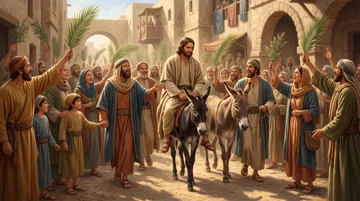
Cross-references 20 of 22
- Matthew 21:8-9
And a very great multitude spread their garments in the way; others cut down branches from the trees, and strawed them in the way.
Describes the crowd’s palm branches and praise as Jesus entered Jerusalem.
- Mark 11:8-10
And many spread their garments in the way: and others cut down branches off the trees, and strawed them in the way.
The crowd welcomes Jesus with branches and royal praises as he enters Jerusalem.
- Zechariah 9:9
Rejoice greatly, O daughter of Zion; shout, O daughter of Jerusalem: behold, thy King cometh unto thee: he is just, and having salvation; lowly, and riding upon an ass, and upon a colt the foal of an ass.
Foretells the King’s humble entry into Jerusalem on a colt.
- Luke 19:36-38
And as he went, they spread their clothes in the way.
The crowd spreads garments and praises Jesus as King as he approaches Jerusalem.
- Psalms 118:25-26
Save now, I beseech thee, O LORD: O LORD, I beseech thee, send now prosperity.
The crowd’s Hosanna and blessing echo the psalm’s plea and welcome.
- Luke 19:40
And he answered and said unto them, I tell you that, if these should hold their peace, the stones would immediately cry out.
Jesus says the stones would cry out if the praising crowd were silent.
- Revelation 7:9
After this I beheld, and, lo, a great multitude, which no man could number, of all nations, and kindreds, and people, and tongues, stood before the throne, and before the Lamb, clothed with white robes, and palms in their hands;
Both depict people holding palm branches as a sign of victory.
- Luke 19:30
Saying, Go ye into the village over against you; in the which at your entering ye shall find a colt tied, whereon yet never man sat: loose him, and bring him hither.
Jesus directs his disciples to obtain the colt for his entry.
- John 11:43-44
And when he thus had spoken, he cried with a loud voice, Lazarus, come forth.
Lazarus’s raising drew an eager crowd and strengthened belief in Christ’s identity.
- Mark 11:8
And many spread their garments in the way: and others cut down branches off the trees, and strawed them in the way.
People spread garments and branches in Jesus’ path.
- Matthew 21:8
And a very great multitude spread their garments in the way; others cut down branches from the trees, and strawed them in the way.
The crowd spreads garments and branches before Jesus as homage.
- Mark 11:1-7
And when they came nigh to Jerusalem, unto Bethphage and Bethany, at the mount of Olives, he sendeth forth two of his disciples,
Jesus sends disciples to obtain the colt for his entry into Jerusalem.
- Matthew 21:1-7
And when they drew nigh unto Jerusalem, and were come to Bethphage, unto the mount of Olives, then sent Jesus two disciples,
Jesus enters Jerusalem riding the colt brought by the disciples.
- Matthew 23:39
For I say unto you, Ye shall not see me henceforth, till ye shall say, Blessed is he that cometh in the name of the Lord.
Both texts speak of welcoming Jesus with the blessing on the one coming in the Lord’s name.
- John 12:17-18
The people therefore that was with him when he called Lazarus out of his grave, and raised him from the dead, bare record.
The crowd came because of the report of Lazarus being raised.
- John 12:19
The Pharisees therefore said among themselves, Perceive ye how ye prevail nothing? behold, the world is gone after him.
rulers alarmed by same welcoming crowd
- John 6:15
When Jesus therefore perceived that they would come and take him by force, to make him a king, he departed again into a mountain himself alone.
Jesus had earlier prevented people from making him king.
- Luke 13:35
Behold, your house is left unto you desolate: and verily I say unto you, Ye shall not see me, until the time come when ye shall say, Blessed is he that cometh in the name of the Lord.
It repeats the blessing on the one coming in the Lord’s name.
- Leviticus 23:40
And ye shall take you on the first day the boughs of goodly trees, branches of palm trees, and the boughs of thick trees, and willows of the brook; and ye shall rejoice before the LORD your God seven days.
Palm branches were used for the feast booths.
- John 19:15
But they cried out, Away with him, away with him, crucify him. Pilate saith unto them, Shall I crucify your King? The chief priests answered, We have no king but Cæsar.
Contrasts the earlier welcome with the later demand to crucify Jesus.
Commentary
Each commentary is drawn from primary sources: the writings of Ellen G. White and Adventist pioneers and periodicals. Each commentary is separate. Its own words are not a quotation; follow the references to read the source passages.
Ellen G. White
36 sources
The verse describes the Passover crowds going forth to meet Jesus on His entry to Jerusalem, waving palm branches as emblems of victory, strewing boughs and garments in His path, and shouting loud hosannas to Him as the King of Israel coming in the Lord's name.DA 569.3–4ST Jun 8, 18824RED 116.1–117.2ST Jul 22, 1886ST Jul 22, 1886 It was the fulfillment of Zechariah's prophecy of the promised heir to David's throne coming lowly to Jerusalem riding on a donkey's colt.DA 569.1–2ST Jun 8, 1882COS 91.1–5EW 206.4 Jesus accepted this public homage as Messiah and King, which He had never permitted before, so that prophecy would be fulfilled and unbelieving people would have evidence of His divine mission.ST Jun 8, 18824RED 116.1–117.2ST Jul 22, 1886 The multitude and even the disciples took it as the crowning day of a temporal prince who would free Israel from Rome and reign on David's throne, yet even in this one triumphal scene He remained true to His life of humiliation, for His kingdom was not of this world.DA 569.3–4ST Jun 8, 18824RED 116.1–117.2DA 570.1–571.1ST Jul 22, 1886 The praise was short-lived, and many who waved palms and shouted hosanna soon joined the cry to crucify Him only a few days later, crushing the disciples' hopes until they revived at His resurrection, while the startling ride was meant to bring Him before every mind so that after His death the searching of the prophecies would prove Him the Messiah.ST Oct 7, 1886ST Nov 16, 1882ST Jul 22, 18863SP 152.1–2DA 743.3
Passover Entry and Welcome
The welcome belongs to the journey to Jerusalem for the Passover, beginning with the stop at Bethany six days before the feast.ST Jul 22, 1886 The entry itself took place on the first day of the week as Jesus resumed His journey to join in the feast.ST Jul 22, 1886 It was the beautiful season of the year, when trees were clothed in verdure and blossom shedding delicate fragrance, and many visitors had already gathered.ST Jul 22, 1886Ms 128, 1899, par. 1 Vast Passover crowds fueled the welcome, for multitudes that had flocked to Bethany to see Jesus were eager to witness His entry and accompanied Him.ST Jul 22, 1886 They were continually joined by other companies on their way to the city to keep the Passover, while thousands of Hebrews gathered at Jerusalem went forth from the city to meet and escort Him, making a continually growing procession.ST Jul 22, 1886ST Jul 22, 1886ST Jun 8, 1882
Excitement was stirred by reports brought back from Bethany, by His fame as a prophet spread through all the land, and especially by the raising of Lazarus.2SP 372.24RED 105.2Ms 128, 1899, par. 1 People asked who the wonderful Teacher was and where He had come from, whether Lazarus who had been raised from the dead would accompany Him to Jerusalem, and whether the great prophet would be crowned king at the feast.4RED 105.2 Attention was entirely fixed on Jesus and His wondrous works, with the crowd's interest greatly stirred and all anxious to see and hear Him.4RED 105.2Ms 128, 1899, par. 1 The crowd waved palm branches, nature's emblem of victory, and with them gave joyful homage and royal tribute.DA 569.3–4ST Jun 8, 18824RED 116.1–117.2DA 570.1–571.1ST Jul 22, 1886 They cut spreading palm boughs and waved them aloft, strewed leafy olive and palm boughs in the way, and spread outer garments as a carpet in His path and branches before Him.ST Jun 8, 18824RED 116.1–117.22SP 384.1–385.1
The welcome was a loud, swelling triumph of repeated shouts of triumph, hosannas, and sacred song echoing and re-echoing from the surrounding hills and valleys.ST Jul 22, 1886ST Apr 1, 1889 It was a continual shout that swelled as new people constantly joined the procession, with few exceptions all catching the glad inspiration of the hour.ST Apr 1, 1889 The vast multitude seemed to seek to excel one another in answering a call from the prophetic past, as newcomers constantly sought to add to the acclamation.ST Jul 22, 1886ST Jun 8, 1882ST Apr 1, 1889 Jesus rode seated on a colt, the foal of an ass on which no man had ever sat.4RED 116.1–117.2 Two disciples had been sent to bring it and had spread their garments upon it and placed Him thereon, while rejoicing people pressed on leading the way.4RED 116.1–117.2ST Jul 22, 1886DA 546
Unlike the processions of earthly conquerors, there was no train of mourning captives, but the trophies surrounding the Saviour were labors of love for sinful people.4RED 120.2 The palm branches were broken off and waved most actively by the cripples He had healed, while the blind to whom He had given sight pressed on leading the way, and the hosannas were shouted loudest by the dumb whose tongues He had loosed.4RED 120.2 Captives rescued from Satan's power joined in praising God, widows and orphans exalted His name for mercy, and lepers cleansed by His word spread their untainted garments in His path and hailed Him as the King of Glory.4RED 120.2 Those awakened from the sleep of death were in the throng, including Lazarus restored from corruption in the grave to full strength, who guided the humble beast on which his Liberator rode.4RED 120.2 The demonstration drew such numbers that the priests' trumpet for evening service at the temple found few to respond, and the rulers were alarmed, saying the world had gone after Him.4RED 116.1–117.2ST Jul 22, 1886ST Jun 8, 1882 They saw they were losing their hold on the minds of the people, and as time passed they grew excited and restless and their rage increased.4RED 116.1–117.24RED 105.2
Hailed King Fulfilling Prophecy
The shout that met Him was a coronation cry, hailing Him as Israel's King and Messiah, the Son of David, the One who comes in the name of the Lord, taking up again a prophetic call from the past.DA 569.3–4ST Jun 8, 1882ST Jul 22, 18862SP 384.1–385.14RED 119.1 Palm boughs waved aloft were understood as nature's emblem of victory, and with hosannas they gave Him joyful homage as King.DA 569.3–4ST Jun 8, 1882DA 570.1–571.1ST Jul 22, 18862SP 384.1–385.1 This was the fulfillment of Zechariah's and other ancient prophecy, that the King would come to Jerusalem, the promised heir to David's throne, coming lowly and riding on a donkey's colt.DA 569.1–2COS 91.1–5EW 206.4ST Mar 28, 18783SP 22.2 He who had long refused royal honors now came openly in that character.DA 569.1–2COS 91.1–5
He accepted on that day the public homage as Messiah and King, and with it the office of King and Priest, which He had never permitted before.ST Jun 8, 18824RED 116.1–117.2ST Jul 22, 1886ST Mar 28, 18783SP 22.2 In doing so He gave an unbelieving people evidence of His divine mission, for prophecy had to be fulfilled.1T 57.3–58.1ST Mar 28, 18783SP 22.2 When priests and elders demanded the shouting be stopped, the answer was that even the stones would cry out if the people held their peace.1T 57.3–58.1 Yet even in this one triumphal scene of His earthly life He stayed true to the life of humiliation He had accepted.4RED 116.1–117.2DA 570.1–571.1ST Jul 22, 1886 He would not appear escorted by heavenly angels and heralded by the trumps of God, but bore the burden of humanity until His life should be given for the life of the world, for His kingdom was not of this world.4RED 116.1–117.2DA 570.1–571.1ST Jul 22, 1886
The people and the disciples read the hour otherwise, expecting Him to free Israel from Rome, restore it as an independent nation, and begin a prosperous reign as temporal prince on David's throne in Jerusalem.DA 569.3–4COS 91.1–5DA 570.1–571.14RED 119.1EW 206.4 They took that day as the crowning day of their lives and His acceptance as the sign that His kingship would now be recognized in Jerusalem.ST Jun 8, 1882ST Jul 22, 18864RED 119.1ST Apr 1, 18892SP 383.2 In that glad triumph the disciples forgot His repeated warnings of certain sacrifice.ST Jun 8, 18824RED 119.1ST Apr 1, 1889 They did not know, nor did the crowd understand, that the rejoicing was only a prelude to His suffering and death.ST Jun 8, 18824RED 119.1ST Apr 1, 1889
The crowd's joy therefore contrasted with His grief as He looked upon the city.ST Jul 22, 1886 When the people would have placed Him on the throne as King, He withdrew from the temple and went to Bethany.3SP 17.1
From Hosannas to Calvary
The palm branches and hosannas belong to the occasion just before betrayal and death, only a few days before the crucifixion, and they give words of Christ to present before large assemblies.Ms 175, 1905, par. 2ST Oct 7, 18863SP 152.1–2EW 143.3 The crowd welcomed Him into Jerusalem with joyful hosannas and palm branches, His followers crying Hosanna and spreading their garments and palm branches in His way.ST Oct 7, 18863SP 152.1–2EW 143.3 That praise was short-lived for many, for some who joined the popular celebration and acclaimed Him as Israel's king soon cried for His crucifixion.ST Oct 7, 18863SP 152.1–2ST Jul 18, 1878DA 743.3 Many who praised Him then later joined the cry for His crucifixion, showing their praise was often driven by popularity rather than lasting loyalty.ST Oct 7, 1886ST Nov 16, 18823SP 152.1–2
The disciples' hopes rose high at the entry, for they understood the welcome as signaling that He would take the kingdom and reign as a temporal prince over Israel on David's throne.DA 743.3EW 143.31T 57.3–58.1SG1 57.2 But as they later followed Him to Calvary in grief, their hopes were blighted when they saw their beloved Master humiliated and stretched on the cruel cross beneath mocking, taunting Pharisees.DA 743.3EW 143.31T 57.3–58.1SG1 57.2 They followed at a distance, filled with fear and despair, their high hopes crushed and the darkness of death closing about them, a disappointment greater than any later disappointment of His followers.DA 743.3EW 143.31T 57.3–58.1 Their joyful hopes died with Him, yet revived when He rose and appeared to them.EW 206.41T 57.3–58.1 He remained true to His promises, giving sweet consolation to His people and rich reward to the true and faithful.1T 57.3–58.1
The startling events of the triumphal ride with palm branches and shouts of Hosanna formed the one triumphal scene of His earthly life, meant to be the talk of every tongue and to bring Jesus before every mind.ST Jul 22, 1886 After His crucifixion those events would be joined to His trial and death, prophecies would be searched and would prove He was indeed the Messiah, and converts to faith in Jesus would be multiplied in all lands.ST Jul 22, 1886
Sources
Pioneers and periodicals
63 sources
The crowd took branches of palm trees and went out to meet Jesus coming to Jerusalem, hailing him with Hosanna as blessed King of Israel coming in the name of the Lord, as Messiah and Son of David.ST Jul 22, 1886ST Sep 27, 1899ST Apr 12, 1905RH Jan 29, 1914ST Jan 21, 1897 The waving and strewn palms and garments were symbols of triumph and victory and a royal tribute honoring him as King.ST Jun 8, 1882ST Apr 12, 1905RH Sep 1, 1904RH Aug 25, 1868ST Oct 1, 1902 In this he rode into Jerusalem humbly on a donkey, on a colt the foal of an ass, fulfilling Zechariah 9:9 of Zion's King coming to her bringing salvation.ST Jun 14, 1905ST Jun 5, 1879ST May 9, 1878RH Apr 17, 1855ST Apr 12, 1905 They welcomed him as the promised King because they believed the time had come for him to take David's throne immediately, deliver Israel from Rome, and reign in Jerusalem.ST Jun 5, 1879RH Mar 17, 1859RH Jun 10, 1858 They did not understand that this joyful scene came only days before his suffering and death, and their praise soon turned, with many who cried Hosanna joining the cry to crucify him.ST Jun 8, 1882ST Apr 1, 1889STST Its full meaning was understood only after his resurrection and glorification, and the welcome stands as a sign of his final triumph when he enters his kingdom to reign with palms in the hands of the redeemed.ST Jun 14, 1905ST Jun 5, 1879RH Aug 25, 1868RH Jun 10, 1858ST Jan 21, 1897
Time and Setting
The verse belongs to the journey to Jerusalem for the Passover, which began with the stop at Bethany six days before the feast and resumed on the first day of the week.ST Jul 22, 1886ST Jul 22, 1886 On that day Jesus resumed His journey to Jerusalem to join in the feast, accompanied by multitudes who had flocked to Bethany to see Him and were eager to witness His entry into the city.ST Jul 22, 1886 Those multitudes were continually joined by other companies on their way to keep the Passover, amid rejoicing nature with trees clothed in verdure and blossoms shedding delicate fragrance.ST Jul 22, 1886 As He went He sent two of His disciples to bring a colt, the foal of an ass, that He might ride into Jerusalem.ST Jul 22, 1886
It is the triumphal entry into Jerusalem, on the first day of the week known as Palm Sunday, in A.D. 31.ST Sep 27, 1899RH Jan 29, 1914 On the morrow the great multitude that had come to the feast heard that Jesus was coming to Jerusalem, took branches of palm trees and went forth to meet Him, crying Hosanna with blessing on Him who comes in the name of the Lord as the King of Israel.ST Sep 27, 1899 The demonstration joined multitudes going before and following, with spreading of garments and branches cut from the fields in the way.ST Sep 27, 1899 It was prompted by the testimony of those who had been with Jesus when He called Lazarus out of the tomb and raised him from the dead, because the multitude had heard He had done this sign, so that the Pharisees said the world is gone after Him.ST Sep 27, 1899ST Nov 8, 1883 His fulfilled prophecies, miracles, pure life and teaching, and recent raising of Lazarus after four days, gave the people ample proof of His identity as the King of Israel, the Messiah and heir to David's throne.ST Nov 8, 1883
The entry stands near the close of His ministry and within the last week of His earthly life, only a few days before His suffering and crucifixion and death.ST Oct 7, 1886ST Nov 8, 1883ST Apr 14, 1898ST Oct 17, 1895 It is connected with His final triumph when He enters His kingdom to reign.ST Apr 14, 1898 Only a few days later, many who had praised Him with joyful hosannas and palm branches joined the cry to crucify Him.ST Oct 7, 1886 Those who came out to see Him sought Him for varied reasons, including curiosity, hopes for political deliverance and favor, desire for physical relief, hostility, and genuine belief that He was the Son of God.ST Oct 17, 1895
The entry took place on Sunday, the fourth day before the Passover, and the crowd's public welcome with palm branches and acclaim of Him as Israel's King was not a Sabbath observance. The account is identified as the last Passover of His ministry and is linked with Matthew's account of the temple cleansing.RH Apr 24, 1879 Its fullest account is in Luke 19, with parallel accounts in Matthew 21 and Mark 11.ST The next event of importance after this entry was the institution of the Lord's Supper.ST
The event included His approach to Jerusalem from the Mount of Olives and His entrance into the temple, where He drove out the money changers and sellers.ST Feb 14, 1878 Jerusalem's people failed to value their privileges and heed God's warning, and their time of probation was nearly over.ST Feb 14, 1878 The same warning applies to those who disregard their privileges and the Spirit's warning.ST Feb 14, 1878
Crowd and Procession
On the morrow the great multitude that had come to the feast heard Jesus was coming to Jerusalem, and thousands of Hebrews gathered for the Passover went forth from the city to meet and escort Him to Jerusalem.ST Jul 22, 1886ST Sep 27, 1899 They were continually joined by other companies on their way to keep the Passover and by multitudes who had flocked to Bethany to see Him and were eager to witness His entry into Jerusalem.ST Jul 22, 1886ST Jul 22, 1886 The demonstration joined multitudes going before and following, spreading garments and branches cut from the fields in the way.ST Jun 8, 1882ST Sep 27, 1899 It became a joyful, growing procession greeting Him with waving palm branches and repeated shouts of triumph and sacred song echoing from the surrounding hills and valleys, with few exceptions all catching the glad inspiration of the hour and helping swell hosannas echoing and re-echoing from hill to hill and valley to valley.ST Jul 22, 1886ST Jun 8, 1882ST Apr 1, 1889
The crowd's response was prompted by the testimony of those who had been with Jesus when He called Lazarus out of the tomb and raised him from the dead after four days, because the multitude had heard He had done this sign.ST Sep 27, 1899ST Nov 8, 1883ST Jan 21, 1897 Lazarus, whom Jesus had raised, was present as a witness and guided the animal Jesus rode.ST Jan 21, 1897ST Jan 21, 1897 Their joy also expressed gratitude for the mighty works they had witnessed, including healings, cleansing of lepers, restored sight, and the raising of the dead. The procession displayed the people He had rescued and healed as living evidence of His work of love, with the healed and restored leading the celebration and praising God for their deliverance, so that unlike earthly conquerors Jesus was surrounded not by captured enemies but by people praising God for deliverance.ST Jan 21, 1897
Their public welcome made the arrival a striking demonstration that drew widespread attention and alarmed the rulers, so that the Pharisees said the world is gone after Him.ST Jun 8, 1882ST Sep 27, 1899 The welcome drew so many that the priests' trumpet for evening service at the temple found few to respond.ST Jul 22, 1886 People's reasons for seeking Jesus varied, including curiosity, hopes for political deliverance and favor, desire for physical relief, hostility, and genuine belief that He was the Son of God.ST Oct 17, 1895 The Greeks had heard of the triumphal entry into Jerusalem and wanted to learn about the Jewish hope concerning the Messiah.ST Jul 1, 1897
Palms and Acclamations Meaning
The Passover crowd welcomed Jesus into Jerusalem with palm branches and joyful cries of Hosanna, blessing him as Israel's King who comes in the Lord's name.ST Apr 1, 1889ST Apr 12, 1905RH Jan 29, 1914ST Jan 21, 1897 It was the welcome of his triumphal entry on the first day of the week, known as Palm Sunday.ST Apr 12, 1905RH Jan 29, 1914 Their response was prompted in part by the report of his raising Lazarus from the dead, and in that acclaim they hailed him as Messiah and Son of David.ST Jun 8, 1882ST Apr 1, 1889ST Jan 21, 1897 The disciples and crowd spread branches and garments in his path as a royal tribute, and Jesus accepted this public homage, which his disciples took as a sign that he would be acknowledged as King in Jerusalem.ST Jun 8, 1882ST Jul 22, 1886
Palm branches waved or strewn along the road were recognized symbols of triumph, victory, rejoicing, praise, joy and exultation, like honors given to ancient conquerors, and a natural emblem of victory.ST Jul 22, 1886ST Apr 12, 1905RH Aug 25, 1868ST Oct 1, 1902ST Aug 19, 1880 The palm boughs were an emblem of victory, and the palm itself stands among the trees especially noted in Scripture as a noted symbol of victory.ST Jun 8, 1882ST Jul 22, 1886ST Oct 1, 1902 Palms were also used for the booths at the Feast of Tabernacles, and palms appear in the hands of the redeemed in heaven.RH Aug 25, 1868ST Aug 19, 1880 The strewn branches were a token of victory and peace, marking Christ's entrance as a victory of peace and blessing, with his way strewn with palm branches because palms were abundant there, Bethany itself meaning house of dates.ST Jul 2, 1902
The branches are a sign of royal favor honoring him as King, the same honor still shown when palm leaves are held over the heads of earthly monarchs.RH Sep 1, 1904 The people honored Christ as King during his triumphant entry by laying palm and olive branches in his path, expressing their love and desire to honor him.ST Jun 8, 1882ST Jun 19, 1884 This was the one instance in Christ's life when he allowed the multitudes full sway in their demonstrations of honor to him.ST Jul 22, 1886 It was the one triumphal scene of his earthly life, when the startling events of the triumphal ride with palm branches and shouts of Hosanna were meant to be the talk of every tongue and to bring Jesus before every mind.ST Jul 22, 1886
Hopes and Disappointment
The crowd welcomed Jesus with palm branches as the promised King of Israel, the Messiah and Son of David, crying Hosanna and blessing his coming in the Lord's name.ST Jun 5, 1879RH Mar 17, 1859 They believed the appointed time had come for him to become king, to take David's throne immediately, to deliver Israel from Roman rule, to begin a prosperous reign in Jerusalem and to remain with them.ST Jun 8, 1882ST Jun 5, 1879RH Mar 17, 1859ST Dec 20, 1910 Some connected that welcome with the widespread expectation that he would come to the Passover and be crowned king.ST Dec 20, 1910 The disciples shared that hope, spreading garments and shouting Hosanna because they expected Christ then to take the kingdom and reign on David's throne.RH Jun 10, 1858
They expected the Messiah's kingdom to be established at that time and took up a psalm they understood to point to his future reign and triumph.RH Sep 18, 1855 Some believed he had driven the priests and rulers from the temple and would reign as king of Israel.ST Jul 1, 1897 The disciples welcomed him with palm branches, triumphal shouts and spreading of garments because they expected God's kingdom to appear soon and Christ as Son of David then to take the throne.RH Jun 10, 1858ST Nov 27, 1879 Their royal hope rested on a mistaken view of what would happen next, for they did not yet understand that he was going to Jerusalem to be condemned and crucified.ST Nov 27, 1879
They did not understand that the joyful scene was only a prelude to his suffering and death in Jerusalem.ST Jun 8, 1882ST Apr 1, 1889 Although Jesus had repeatedly told them of his certain sacrifice, in the glad triumph they forgot his sorrowful words and looked forward to his prosperous reign on David's throne.ST Apr 1, 1889 Their expectation about when those events would happen was mistaken, but their rejoicing and praise were right, so that if the people were silent the stones would cry out.RH Sep 18, 1855 Jesus accepted this public homage, and the disciples took his acceptance as a sign that he would be acknowledged as king in Jerusalem and took that day as the crowning day of their lives.ST Jun 8, 1882ST Jul 22, 1886ST Apr 1, 1889
His crucifixion soon crushed that expectation; instead of being crowned he was crucified, the disciples were scattered, their hope was gone and their joy was taken away.ST Jun 5, 1879RH Mar 25, 1875RH Mar 17, 1859RH Jun 10, 1858 That joy was revived by his resurrection.RH Jan 13, 1874 The full meaning was understood only later, after his resurrection, glorification and sending of the Comforter, when the disciples remembered that these things were written of him and done to him.ST Jun 5, 1879RH Jun 10, 1858ST Jan 21, 1897
The shout of praise was short-lived; many who praised him with joyful hosannas joined the cry to crucify him before another Sabbath day.ST Oct 7, 1886ST Nov 16, 1882ST Jul 18, 1878STST Their later rejection when he was betrayed and condemned revealed how fear and disappointment could overcome followers whose faith was weak or undecided.ST Oct 8, 1896 Their praise was often driven by popularity rather than lasting loyalty.ST Nov 16, 1882 The crowd's joy contrasts with Jesus' grief as he looked upon the city, foresaw Jerusalem's destruction and wept over it, and with his later loneliness in Gethsemane and absence of praise on the way to Calvary.ST Jul 22, 1886STST Aug 15, 1916
The first disciples' experience of welcoming Jesus with rejoicing and then being disappointed is compared with believers who rejoiced at the judgment-hour message and were disappointed, as disappointed as those who expected the second advent in 1844.RH Aug 2, 1864RH Jun 10, 1858 Such a disappointment in connection with a work does not prove it to be an error.
Prophecy Fulfilled and Foretold
The welcome with palm branches and the cry hailing the promised King of Israel fulfilled Zechariah's prophecy of Zion's King coming to her, Zechariah 9:9, when Christ rode into Jerusalem humbly on a donkey, on a colt the foal of an ass, bringing salvation.ST Jun 5, 1879RH Apr 17, 1855RH Jul 4, 1871ST Nov 8, 1883RH Mar 17, 1859 That entrance took place near the close of his ministry, only a few days before his suffering and crucifixion, and it stands as a sign evidencing Jesus as the true Messiah at his first advent.RH Apr 17, 1855ST Nov 8, 1883 His fulfilled prophecies, miracles, pure life and teaching, and the recent raising of Lazarus after four days, gave the people ample proof of his identity.ST Nov 8, 1883
The prophet's command to rejoice greatly and shout, though written in the imperative mood, is a prediction that people would do so far in the future.ST May 9, 1878RH Jul 4, 1871 It serves as an example of a prophetic command describing a future event not already at hand when written, and the shouting at Christ's entry is that predicted fulfillment.ST May 9, 1878RH Jul 4, 1871 The people and disciples hailed him as their promised King moved by the Spirit and under divine impulse to fulfill prophecy.ST Jun 5, 1879RH Mar 25, 1875 Though appointed by God to fulfill it they did not know what they were doing at the time, understanding only when Jesus was glorified and remembering that these things were written of him and done to him.RH Jun 10, 1858
Their words had to be heard at that time because God's word would be fulfilled even if the stones had to cry out, fulfilling a prophecy given hundreds of years before that had to be fulfilled.ST Sep 27, 1899RH Jun 10, 1858 His entry on an ass, in the manner of Israel's kings, marked him as the Prince of Peace, and his entry also fulfilled the prophecy that Zion's King would come riding on a colt.ST Jun 14, 1905ST Apr 12, 1905 The startling events of the triumphal ride were meant to be the talk of every tongue and to bring Jesus before every mind.ST Jul 22, 1886 After his crucifixion those events joined to his trial and death would be searched in prophecy and would prove he was indeed the Messiah, and converts to faith in Jesus would be multiplied in all lands.ST Jul 22, 1886
The disciples' shout fulfills the closing words of the prophecy in Psalm 118 about the day the Lord made for rejoicing and gladness, setting forth part of that foretold rejoicing.RH Jan 13, 1874 That day is broad, the same day Abraham rejoiced to see and Simeon rejoiced in, whose memorial is baptism, so the entry cry gives no warrant for making the resurrection day or the first day of the week sacred.RH Jan 13, 1874 The words blessing the one who comes in the Lord's name were prophetic of the Messiah and were fulfilled in part at that entry, and will be fulfilled again when those who rejected Jesus are forced to speak them, but too late.ST Feb 8, 1899 The crowd's welcome is a prophetic sign of the victory he would one day achieve gloriously and permanently, connected with Christ's final triumph when he enters his kingdom to reign and with Jesus' greater triumph with his people in heaven, when palms appear in the hands of the redeemed.ST Jun 14, 1905RH Aug 25, 1868ST Apr 14, 1898ST Aug 19, 1880 The cry welcoming the King of Israel is applied to Christ's coming again, with the cry Behold your King as a gospel message announcing the kingdom to be proclaimed throughout the world before the end, bringing in its fullness the King's coming.RH Sep 16, 1902
Kingship Mission and Application
The crowd proclaimed Jesus as Israel's King in fulfillment of ancient prophecy, greeting him as the long-expected King, the Messiah and heir to David's throne near the close of his ministry only a few days before his crucifixion.ST Mar 28, 1878ST Nov 8, 1883ST Sep 27, 1899 That entrance fulfilled Zechariah 9:9, and his fulfilled prophecies, miracles, pure life and teaching, crowned by raising Lazarus after four days, gave ample proof of his identity.ST Nov 8, 1883 Jesus accepted their homage and the office of King and Priest, giving an unbelieving people evidence of his divine mission, and their words had to be heard at that time because God's word would be fulfilled even if the stones had to cry out.ST Mar 28, 1878ST Sep 27, 1899 Why he accepted this royal title now, after previously preventing a movement to proclaim him king, stands as an unanswered question, with no explanation given of the palm branch's typical meaning.ST Jan 21, 1897
Even in this triumph he stayed true to the life of humiliation he had accepted, refusing to appear escorted by heavenly angels and heralded by the trumps of God, bearing the burden of humanity until his life was given for the life of the world.ST Jul 22, 1886 It was the one triumphal scene of his earthly life, and its startling events with palm branches and shouts of Hosanna were meant to be the talk of every tongue and to bring Jesus before every mind.ST Jul 22, 1886 After his crucifixion those events joined to his trial and death would cause prophecies to be searched and prove he was indeed the Messiah, and converts to faith would be multiplied in all lands.ST Jul 22, 1886 His kingship shown in that entry is one aspect of his character, contrasted with his humble service in washing his disciples' feet, yet both reveal the same principles of his character.ST Mar 11, 1897 The scene shows people publicly honoring and adoring him as their King, though still only the nearest approach to the honor due him.ST
He had already entered Jerusalem meekly yet triumphantly and was joyfully welcomed as the one who comes in the Lord's name, and the city's sealed gate associated by tradition with the Jewish Messiah's entry to take David's throne could not keep out the Messiah who had come.RH Jan 20, 1863 That entry with a multitude bearing palm branches was counted as evidence that he falsely called himself the King of Israel, for which Pontius Pilate condemned Jesus of Nazareth to die on the cross between two thieves.RH Sep 3, 1857ST Oct 28, 1875 The charge included that he entered the temple followed by a multitude carrying palm branches in their hands, treating his claim to be King of Israel as an accusation against him.RH Sep 3, 1857ST Oct 28, 1875 Jerusalem's people failed to value their privileges and heed God's warning with their time of probation nearly over, and the same warning applies to those who disregard their privileges and the Spirit's warning.ST Feb 14, 1878 The entry scene, which included his approach from the Mount of Olives and his entrance into the temple where he drove out the money changers and sellers, preceded Jerusalem's destruction by the Roman army a generation later.ST Feb 14, 1878ST Sep 27, 1899
The fickleness seen in his experience repeats in the lives of his followers, for the shout of praise and hallelujah was short-lived and those who joined it cried crucify before another Sabbath day.ST The multitude hailed him as their king and then rejected him when he was betrayed and condemned, revealing how fear and disappointment could overcome followers whose faith was weak or undecided.STST Oct 8, 1896 The branches laid in his path expressed love and desire to honor him as King, with palm and olive branches spread before him during that triumphal entry into Jerusalem.ST Jun 19, 1884 They remain a reminder that acts of kindness, faithful service and resisting temptation out of love for Christ honor him, which he notices and accepts with pleasure.ST Jun 19, 1884ST Jun 19, 1884 A palm branch represents victory over temptation, while acts of mercy and charity are like olive boughs and giving up one's life for love of Christ is like laying garments at his feet.ST Jun 19, 1884 Palms, waved as a sign of praise, joy and exultation in welcoming the Messiah, were also used for the booths at the Feast of Tabernacles and appear in the hands of the redeemed in heaven.ST Aug 19, 1880
Sources