John 20:27
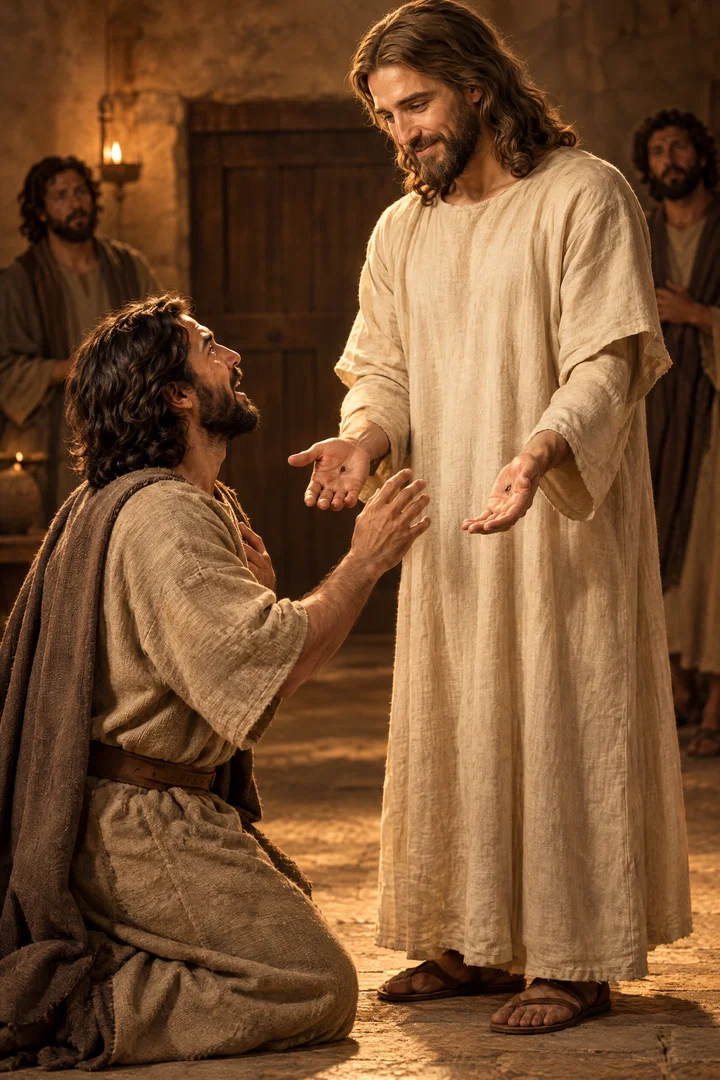
Then saith he to Thomas, Reach hither thy finger, and behold my hands; and reach hither thy hand, and thrust it into my side: and be not faithless, but believing.
Translations
Then says he to Thomas, Reach here your finger, and behold my hands; and reach here your hand, and thrust it into my side: and be not faithless, but believing.
King James Version, KJV Cambridge Paragraph Bible
Then saith he to Thomas, Reach hither thy finger, and behold my hands; and reach hither thy hand, and thrust it into my side: and be not faithless, but believing.
Then saith he to Thomas, Reach hither thy finger, and behold my hands; and reach hither thy hand, and thrust it into my side; and be not faithless, but believing.
Revised Version, American Standard Version
Then saith he to Thomas, Reach hither thy finger, and see my hands; and reach hither thy hand, and put it into my side: and be not faithless, but believing.
then he saith to Thomas, 'Bring thy finger hither, and see my hands, and bring thy hand, and put [it] to my side, and become not unbelieving, but believing.'
Then he says to Thomas, Bring thy finger here and see my hands; and bring thy hand and put it into my side; and be not unbelieving, but believing.
Then, saith he unto Thomas—Reach thy finger hither, and see my hands, and reach thy hand, and press into my side,—and become not disbelieving, but believing.
Berean Standard Bible, Majority Standard Bible
Then Jesus said to Thomas, “ Put your finger here and look at My hands. Reach out your hand and put it into My side. Stop doubting and believe.”
Then he said to Thomas, “ Reach here your finger, and see my hands. Reach here your hand, and put it into my side. Don’ t be unbelieving, but believing.”
Then he said to Thomas, Put out your finger, and see my hands; and put your hand here into my side: and be no longer in doubt but have belief.
After saide he to Thomas, Put thy finger here, and see mine hands, and put forth thine hand, and put it into my side, and be not faithlesse, but faithfull.
Douay-Rheims (Challoner revision)
Then he saith to Thomas: Put in thy finger hither, and see my hands; and bring hither thy hand, and put it into my side; and be not faithless, but believing.
Pictures
Cross-references 20 of 35
- Luke 24:39
Behold my hands and my feet, that it is I myself: handle me, and see; for a spirit hath not flesh and bones, as ye see me have.
The risen Jesus shows his hands and feet and invites the disciples to touch him.
- John 20:20
And when he had so said, he shewed unto them his hands and his side. Then were the disciples glad, when they saw the Lord.
The risen Jesus shows his hands and side to the disciples.
- John 19:34
But one of the soldiers with a spear pierced his side, and forthwith came there out blood and water.
The spear wound in Jesus’ side is the wound he shows Thomas.
- Mark 16:14
Afterward he appeared unto the eleven as they sat at meat, and upbraided them with their unbelief and hardness of heart, because they believed not them which had seen him after he was risen.
Jesus rebukes the disciples for not believing reports that he had risen.
- Acts 1:3
To whom also he shewed himself alive after his passion by many infallible proofs, being seen of them forty days, and speaking of the things pertaining to the kingdom of God:
Thomas’s invitation to examine Jesus’ wounds was one of the proofs that he was alive.
- Acts 10:41
Not to all the people, but unto witnesses chosen before of God, even to us, who did eat and drink with him after he rose from the dead.
The risen Jesus appeared to chosen witnesses, who ate and drank with him.
- Luke 24:42-43
And they gave him a piece of a broiled fish, and of an honeycomb.
The risen Jesus shows his body and eats food, confirming his bodily presence.
- 1 John 1:1
That which was from the beginning, which we have heard, which we have seen with our eyes, which we have looked upon, and our hands have handled, of the Word of life;
Both texts describe firsthand seeing and touching Christ.
- Revelation 1:7
Behold, he cometh with clouds; and every eye shall see him, and they also which pierced him: and all kindreds of the earth shall wail because of him. Even so, Amen.
At his coming, Christ is seen by those who pierced him.
- 1 Corinthians 15:20
But now is Christ risen from the dead, and become the firstfruits of them that slept.
Christ is risen from the dead as the firstfruits of those who have died.
- Isaiah 53:5
But he was wounded for our transgressions, he was bruised for our iniquities: the chastisement of our peace was upon him; and with his stripes we are healed.
Christ’s wounds for sinners are fulfilled literally in his body.
- John 20:19
Then the same day at evening, being the first day of the week, when the doors were shut where the disciples were assembled for fear of the Jews, came Jesus and stood in the midst, and saith unto them, Peace be unto you.
Christ’s greeting of peace accompanies the showing of his hands.
- Revelation 1:18
I am he that liveth, and was dead; and, behold, I am alive for evermore, Amen; and have the keys of hell and of death.
Both identify Jesus as risen from the dead and alive forever.
- 1 Corinthians 15:4
And that he was buried, and that he rose again the third day according to the scriptures:
The anecdote refers to Jesus rising on the third day.
- Psalms 22:16
For dogs have compassed me: the assembly of the wicked have inclosed me: they pierced my hands and my feet.
The pierced hands fulfill the prophecy at Jesus’ crucifixion.
- Zechariah 12:10
And I will pour upon the house of David, and upon the inhabitants of Jerusalem, the spirit of grace and of supplications: and they shall look upon me whom they have pierced, and they shall mourn for him, as one mourneth for his only son, and shall be in bitterness for him, as one that is in bitterness for his firstborn.
People look upon the one they pierced.
- 1 Corinthians 15:5-8
And that he was seen of Cephas, then of the twelve:
Both texts describe appearances of the risen Jesus to his followers.
- Revelation 5:6
And I beheld, and, lo, in the midst of the throne and of the four beasts, and in the midst of the elders, stood a Lamb as it had been slain, having seven horns and seven eyes, which are the seven Spirits of God sent forth into all the earth.
The Lamb remains marked by his sacrifice.
- Luke 24:36
And as they thus spake, Jesus himself stood in the midst of them, and saith unto them, Peace be unto you.
The risen Jesus stands among the disciples.
- John 21:9-13
As soon then as they were come to land, they saw a fire of coals there, and fish laid thereon, and bread.
The risen Jesus shares bread and fish with his disciples.
Commentary
Each commentary is drawn from primary sources: the writings of Ellen G. White and Adventist pioneers and periodicals. Each commentary is separate. Its own words are not a quotation; follow the references to read the source passages.
Ellen G. White
78 sources
Jesus meets Thomas in the upper chamber after the resurrection by inviting him to place his finger into the nail marks in His hands and his hand into His pierced side, showing He knew Thomas's private demand for proof though no one had told Him.6RED 38.2–39.23SP 220.2–221.2DA 802ST Sep 26, 1878 The invitation is both tender condescension and reproof, commanding him to stop being faithless and to believe instead of demanding sight and touch and rejecting the witness of others.Ms 5, 1867, par. 4–6EW 155.2ST Sep 26, 18783SP 222.1 The wounded hands, feet and side prove He is risen bodily as the same One who was crucified and not a spirit, and seeing them sweeps away Thomas's doubt so that he worships Him as his Lord and his God.6RED 38.2–39.23SP 220.2–221.2DA 802.1–803.23SP 236.1 Greater blessing and peace belong to those who have not seen His wounds and yet believe on the testimony of others, for requiring feeling added to sight would leave none to believe now, and waiting until every doubt is removed hardens the heart in settled unbelief.Ms 155, 1904, par. 14–17Ms 2, 1868, par. 1–2EW 155.26RED 39.36RED 59.3 Those marks remain in His glorified body forever as His glory, ever witnessing to His suffering for sinners, pleading for them before God, and to be seen by the redeemed and the wicked at His return.ExVEGW 33.24T 124.3EW 43.3Ms 43, 1910, par. 3Ms 23, 1910, par. 13–14
Upper Chamber Encounter
This saying belongs to the appearances after the resurrection in the upper chamber at Jerusalem during Passover week, when He came to the disciples there twice before they left for Galilee.6RED 43.2–44.1 Thomas was not present at the first meeting and so missed meeting Him, and absence or delay can cause such loss of interview and privilege even when spiritual advantages look small.Lt 5, 1877, par. 17–18 All must therefore be ready at all times, like minutemen never off duty, because being present to speak a word or do an act at the right moment can turn a soul toward truth and save to eternal life, and small influences exerted rightly can attract souls when a minister's labor would not touch the heart.Lt 5, 1877, par. 17–18
He answers Thomas's stated demand for physical proof by inviting him to put his finger into the nail prints in His hands and his hand into His pierced side.6RED 38.2–39.23SP 220.2–221.2DA 802ST Sep 26, 1878Ms 155, 1904, par. 14–17 The broader account joins the feet with the hands and side as the places offered for inspection.6RED 38.2–39.23SP 220.2–221.2 His words show He knew Thomas's private doubts, thoughts and exact words, including the demand to touch the nail marks and wounded side.6RED 38.2–39.23SP 220.2–221.2ST Sep 26, 18786RED 58.2–59.2DA 807.2–4 None of the disciples had seen Him for a week to tell Him of it, which proves He reads thoughts and words and needs no informant.3SP 220.2–221.2
The invitation carries both reproof and command, to stop being faithless and to believe.6RED 38.2–39.23SP 220.2–221.2DA 802ST Sep 26, 1878Ms 155, 1904, par. 14–17 It rebukes unbelief that rejects witness testimony and demands sight and touch, for Thomas would not humbly receive the report of the disciples who had seen the risen one and in this showed lack of confidence in his brethren.EW 155.2ST May 4, 1876SG1 74.2 The evidence was granted even though such unbelief did not please God, for it is the divine will that those who cannot themselves see and hear the risen Saviour receive the report of the disciples.EW 155.2 If all required the same evidence of feeling added to sight, none would now receive Him and believe in His resurrection.EW 155.2 There is no commendation in this for being slow of heart to believe, neither for Thomas nor for those in the last days who are slow of heart to believe.Ms 5, 1867, par. 4–6
Though Thomas had firmly and self-confidently dictated his own unreasonable, self-imposed conditions as the only basis for faith, He met him with tenderness, condescension, generous love, consideration and personal revelation rather than overwhelming reproach, argument or controversy.ST Sep 26, 18783SP 222.1DA 807.5–808.16RED 40.1 He did not reproach or argue, but revealed Himself as the crucified Saviour and broke down all the barriers Thomas had raised.ST Sep 26, 18783SP 222.1DA 807.5–808.16RED 40.1
Wounds Prove Resurrection
The wounded hands and side held out to Thomas, together with the wounded feet also shown, are the proof that Jesus is risen bodily and not a mere spirit, identifying the risen Lord as the very one who was crucified.3SP 236.1ST Oct 10, 18783SP 213.2–36RED 52.1–2 The marks in hands and side answer doubt by inviting examination, so that handling and seeing establish who He is and leave no ground for unbelief.DA 802.1–803.2ST Oct 10, 18786RED 52.1–23SP 234.1 The familiar voice heard with the sight of those wounds completes the recognition of the Master.3SP 213.2–3
Seeing the risen Saviour bearing the marks of crucifixion ends Thomas's doubts at once, so that he wants and needs no further evidence and does not need to carry out the touch he had demanded.6RED 58.2–59.23SP 235.26RED 52.3–53.26RED 72.3–73.2ST Oct 10, 1878 He leaps for joy that Jesus is indeed risen and falls at His feet in love and devotion. What he had refused to believe on the testimony of his companions is swept away by sight of his Lord.6RED 52.3–53.26RED 72.3–73.2ST Oct 10, 18786RED 59.3
In that revelation Thomas recognizes Him and worships, acknowledging Him as his Lord and his God with no room left for doubt and no desire for further proof.6RED 38.2–39.23SP 220.2–221.2ST Sep 26, 18786RED 58.2–59.2DA 807.2–4 The exact knowledge of his private demand shown in the invitation confirms that the one before him knows thoughts and words, and the crucified and risen Lord stands identified.6RED 38.2–39.23SP 220.2–221.2ST Sep 26, 1878DA 807.2–4
The disciples' seeing, hearing, and handling leave the eleven with no doubt that the risen Jesus is the crucified one.ST Oct 10, 18786RED 52.1–23SP 234.1 Thomas afterward recounts how his unbelief was swept away when the believers saw the marks of crucifixion still borne in hands and feet at His appearing among them.ST Oct 10, 18783SP 234.1DA 818.2–819.1
Believing Without Seeing
Refusing the report of the disciples until one receives personal sight is unbelief, showing lack of confidence in brethren, for it is God's will that those who cannot themselves see and hear the risen Saviour humbly receive the report of those who have.6RED 38.2–39.2ST Sep 26, 1878EW 155.26RED 58.2–59.2 Faith is to receive credible testimony rather than dictate sight and feeling as its only basis and demand personal sight and touch before believing.6RED 38.2–39.2ST Sep 26, 1878EW 155.26RED 58.2–59.2 Treating doubt as a virtue until unmistakable evidence removes every cause for doubting receives no commendation, and the command to stop doubting and believe is reproof, not praise.Ms 2, 1868, par. 1–2Ms 5, 1867, par. 4–62T 103.2–104.12T 695.1–696.1 No commendation is given either to Thomas for being slow of heart to believe the testimony of those who had seen the risen Christ, or to those in the last days who are slow of heart to believe and resist truth without diligently investigating it for themselves.Ms 2, 1868, par. 1–2Ms 5, 1867, par. 4–62T 695.1–696.1 Seeking evidence in a way that strengthens doubt instead of faith is therefore to be avoided.2T 103.2–104.12T 695.1–696.1
Greater blessing belongs to those who have not seen His wounds and yet have believed the disciples' testimony.Ms 2, 1868, par. 1–2EW 155.26RED 58.2–59.2ST May 4, 1876 God credits that belief, and Christ's peace and blessing are for those who believe their word.Ms 155, 1904, par. 14–17EW 155.26RED 58.2–59.2 Belief in Christ now rests on the testimony and word of others, and faith should not depend on demanding visible proof.Ms 155, 1904, par. 14–176RED 58.2–59.2ST May 4, 1876 For if all required the same evidence of feeling added to sight that Thomas firmly and self-confidently demanded, none would now receive Jesus and believe in His resurrection.EW 155.2
Waiting until every cause for doubt is removed can fix people in settled and entrenched unbelief, even when they have Thomas's evidence with testimony and further evidence in addition.6RED 39.36RED 59.33SP 221.3ST Sep 26, 1878 Thomas had the testimony of his companions yet refused to believe until he saw Jesus himself, and his experience does not justify waiting for every doubt to be removed.6RED 39.36RED 59.3ST Sep 26, 1878 Rejecting clear evidence of divine truth hardens the heart and blinds the understanding.6RED 39.36RED 59.33SP 221.3ST Sep 26, 1878 Neglected light fades from a mind unwilling to receive it, until received light is lost.6RED 39.36RED 59.33SP 221.3ST Sep 26, 1878
Wounds Endure Forever
The marks of crucifixion remain visible in His glorified, risen human body, presented in human form after the resurrection with the wounds in His hands and side still to be seen.ST Nov 22, 1883ST Jan 4, 18834SP 489.1–2Ms 94, 1897, par. 38–39 The hands held out to be touched still bore the bruises of the cruel nails, the same hands that had often been stretched forth to bless and heal the sick and afflicted and to rebuke demons.ST Nov 22, 1883 Those wounds remain as the sole reminder of the cruel work that sin has wrought, and the marks of the nails in His hands and feet remain His glory and testify to who He is.4SP 489.1–2Ms 94, 1897, par. 38–39
He will bear in His hands throughout eternity the prints of the cruel nails by which He was transfixed to the cross on Calvary, shown to Thomas to see and touch.Ms 43, 1910, par. 3Ms 23, 1910, par. 13–14 They will ever bear witness to the sufferings He endured so that penitent sinners might have life eternal and lost humanity might be redeemed to live with Him in glory.Ms 43, 1910, par. 3Ms 23, 1910, par. 13–14
The prints of the nails in His hands and in His feet and the place where the spear was thrust into His side are His glory, and the pierced side from which blood flowed to reconcile humanity to God is the hiding of His power.ExVEGW 33.2EW 43.3GC88 673.4–674.1 His wounded head, side, hands, and feet are the only lasting traces of sin's cruelty, testifying forever to His redeeming sacrifice, His power to save, and the praise due to Him.GC88 673.4–674.1 At the close of the thousand years, as He descends to the earth with angels and saints and the wicked dead are raised, the very men that pierced Him and the wicked see Him afar off in all His glory with these wounds visible and wail because of Him.ExVEGW 33.2EW 43.3
When He returns and raises the just from their graves, the redeemed will see those marks of Calvary and recognize the Saviour who gave His life for them, and their greatest joy will be being in His presence.ST Nov 22, 1883ST Jan 4, 1883 At His coming those who rejected the light will see these wounds, including His pierced side, and understand the sacrifice and love of the Redeemer made for them.RH Nov 22, 1906 The faithful who die before He comes will, if faithful, come forth from their graves at the resurrection of life to see Jesus in His glory and be made like Him, and will behold those same pierced hands stretched out in blessing and welcome.LSEGW 266.2 At the last those hands were mercifully extended over the disciples as if embracing the whole world and calling down blessing upon all followers, with beams of light emanating from them to fall upon the watching, waiting ones.ST Nov 22, 1883 That sight brings joy unspeakable, so that present toil and suffering do not matter if the resurrection of life is attained, calling for patient waiting until the trial ends in victory.LSEGW 266.2
Redemption Through Wounds
The risen hands held out to Thomas signify that He alone took away sin and ransomed humanity, and through that saving work peace with God is secured.GC88 152.1–4 His wounded hands and pierced side plead for fallen people, and His sacred blood continues to plead for sinners without its efficacy diminishing with time or events.4T 124.3 He still bears the prints of the nails as He stands before the throne interceding for sinners, holding back those who have almost gone over to the wrong side so they are not lost.4T 124.317MR 285.1–2 God accepts the merits of the slain Lamb to purify from sin, a redemption purchased at infinite cost.4T 124.3
Bearing in hands, feet and side the marks of the suffering by which He reconciled humanity to God, He reveals God's mercy, tenderness, forgiveness, equity and justice.AA 333.2 He paid a ransom so that penitent, believing sinners may live and be received by the Father through His merits.AA 333.2 He endured greater agony of body than anyone can endure, with hands pierced by cruel nails, and calls everyone to take hold of Him as He is by giving Him the heart in order to be saved.Ms 122, 1909, par. 33
Those crucifixion marks are a living witness that God's law can be kept, showing that people sin not because obedience is impossible but because they choose not to obey.RH May 28, 1901
Trusting and Helping Doubters
Some cannot believe testimony received through others and must have evidence for themselves, and they are not to be set aside but to be met with patience, kindness and brotherly love until they reach a settled position and decide where they stand.GW92 279.3–45T 668.1–21T 327.3–329.2Ms 3, 1862, par. 1–3 His hesitation pictures those who doubt visions and the published Testimonies and want assurance for themselves before believing, including one who at first doubts visions but afterward comes to recognize evidence of God's work.5T 668.1–2Ms 3, 1862, par. 1–31T 79.2–3CET 85.1–3 He was faithful and earnest yet slow of heart to believe, one of the first disciples who as future teachers represented widely varied types of character, and his demand to touch the wound made by the Roman soldiers revealed unbelief that later stirred the disciples' remorse over how little they had understood and appreciated Christ.DA 507.2–508.1ED 85.3
His example teaches how to treat those whose faith is weak and whose doubts about religious truth are made prominent.ST Sep 26, 1878DA 807.5–808.1 He had wrongly made his own self-imposed conditions the only basis for faith, yet he was met with tenderness, condescension, generous love, consideration and personal revelation rather than overwhelming reproach, argument or controversy, being invited to examine the wounds and called to believe.ST Sep 26, 1878DA 807.5–808.1 Persistent controversy seldom weakens unbelief but puts it on self-defense where it finds new support and excuse, while revealing Jesus as the crucified Saviour in love and mercy breaks down barriers and brings many once unwilling to acknowledge Him as Lord and God.ST Sep 26, 1878DA 807.5–808.1
Requiring even greater evidence than he required, through doubt, suspicion, fear and indifferent looking on instead of putting hand to the work with zeal and energy to build up what Christ requires to be built, joins combined distracting influences that hinder and tear down.5MR 61.27MR 114.1–4Lt 16, 1861, par. 12–14 Such doubting influence retards advance and reform among God's people.5MR 61.27MR 114.1–4Lt 16, 1861, par. 12–14 To be not faithless but believing is to lay aside trouble, anxiety and low, desponding, unbelieving talk and to live with faith, hope and cheerful courage, trusting wholly what He has said, since God has already said everything that can be said to inspire faith and hope so there is no excuse for doubt-filled conversation.Lt 93, 1903, par. 3Lt 161, 1901, par. 7–8Lt 42, 1897, par. 8–915MR 3.4–4.1 It means trusting the Chief Physician who knows every anxiety of mind and is acquainted with every difficulty, maintaining perfect confidence even amid affliction and rejoicing because the Lord has helped and spared life, leaning the whole weight upon the sympathizing Redeemer under God's approving look.Lt 93, 1903, par. 3Lt 161, 1901, par. 7–8Lt 158, 1903, par. 1–5 Such believing brings the Comforter to abide forever and gives power to discern and comprehend spiritual and divine things.Lt 158, 1903, par. 1–5
Believing is acting on what He has said with humble, childlike trust, guarding prayer with patience and expectancy and trusting that God answers sincere prayer even when the answer differs from expectation.Lt 26, 1880, par. 14Lt 30, 1893, par. 38–39 It is trusting God at every step even while recognizing personal weakness, drawing near to God and working together with Him so that weakness and mistakes are prevented, with self hidden in Christ and no human management of His cause left to self, so that all work is done in God.6T 51.4 For the tempted and sick who doubt whether God has forsaken them, it means coming to the Scriptures and intelligently taking God at His word, casting the helpless soul wholly on the merits of Christ just as it is without good works to recommend it, and hoping, trusting and resting in His promises whether happy feelings are present or not.Lt 82, 1889, par. 1–4Lt 158, 1903, par. 1–5 A good emotion does not prove sonship and disturbed, troubled, perplexing feelings do not disprove it, and even terrible doubts and waverings about God's existence assailing Christians of long experience do not make the case hopeless, but distressing unbelief must be fought with the good fight of faith to lay hold on eternal life.Lt 82, 1889, par. 1–4 Jesus meets the struggling doubter to give rest to the soul and is not unwilling to save one who struggles to believe, being near to hear heartfelt petitions in mercy when loved and prayed to in full, believing confidence.Lt 232, 1908, par. 7Lt 46, 1896, par. 4–5
In the place where faith has failed it calls for moral courage to stand where duty requires and to go forward without halting, accepting sorrow that leads to life and joy rather than death, and enduring God's proving and chastening as a son.Lt 50, 1880, par. 5–7 The trial is grievous for the present but afterward yields the peaceable fruit of righteousness, and if faith endures the test and comes forth as pure gold, God can then entrust work in His cause.Lt 50, 1880, par. 5–7 Believing instead of unbelief includes bringing offerings for God's cause from those who have money, trusting His treasury and the men He has honored by connecting them with His cause, and supporting buildings and facilities for spreading the truth without fear of losing money.Lt 65a, 1878, par. 6–7 Grasping money as a god, trusting it to men of no principle while the cause is straitened for want of means, pleading narrow selfish ideas that too much has been spent, withholding from God what He entrusted for advancement of His cause and belongs to Him, and fearing loss if entrusted to God shows lack of saving faith, displeases Him and brings loss.Lt 65a, 1878, par. 6–7 The hands pierced by cruel nails, having endured greater bodily agony than anyone can endure, call everyone to arise in the name of Jesus Christ of Nazareth, take hold of Him as He is, and give Him the heart in order to be saved.Ms 122, 1909, par. 33 To be not faithless but believing counsels trusting God wholly rather than allowing suspicion and mistrust of others to shake confidence.Lt 14, 1891, par. 8–11
Sources
Pioneers and periodicals
117 sources
Eight days after his first meeting with the disciples, Jesus met them again with Thomas present and answered his demand for proof by inviting him to touch the nail marks in his hands and the wound in his side, commanding him to stop doubting and believe.ST Sep 26, 1878ST Apr 22, 1897RH Oct 21, 1862ST Apr 11, 1900ST Oct 4, 1899 The invitation proves he rose bodily as the same Jesus who died on the cross, flesh and bones with the very scars retained, not a spirit, ghost, or bodiless phantom.ST Jun 3, 1897RH Nov 26, 1872RH Nov 26, 1872ST Aug 17, 1876 Those prints in his hands, feet, and side remain on his glorified body forever as his highest glory and the universe's constant evidence of the sacrifice that saves.ST Aug 17, 1876ST Apr 7, 1914ST Dec 5, 1916ST May 18, 1904ST Jun 21, 1899 His command teaches that faith resting on credible testimony without demanding sight is blessed, while demanding further proof after a fact is well proven is unreasonable faithlessness that hardens the heart.ST Sep 26, 1878ST May 4, 1876RH Apr 3, 1879RH Apr 21, 1868 The meeting was to prove the resurrection, reclaim Thomas from doubt, and establish witnesses, giving no warrant for making the day holy or changing the Sabbath from the seventh to the first, while those who held the differing position taught that his repeated blessings on the first day taught special sacredness for it.ST Apr 22, 1897ST Oct 4, 1899ST Nov 18, 1886ST Jun 2, 1898RH Apr 15, 1873
Time and Setting
The saying belongs to the second meeting with the disciples after the resurrection, eight days after the first, when Thomas was present with the rest.ST Apr 22, 1897RH Oct 21, 1862ST Oct 4, 1899ST Jun 2, 1898 These showings took place at intervals within the forty days before the ascension and are distinct from the future public appearing to the world.RH Aug 31, 1869RH Jun 25, 1872 Differences among the Gospel accounts do not make them contradictory, while the resurrection story points to the spiritual life of the church.ST Jun 26, 1901RH Aug 31, 1869
The meeting came after eight days, carrying the time over to the second or third day of the week and not to the next first day.ST Apr 22, 1897RH Sep 17, 1857 It is dated to the evening of the second day of the week.ST Jun 2, 1898RH Aug 1, 1854 Only one meeting was on the first day itself, at its very close as it merged into the second day, and the chapter tells the story of the first day after the resurrection.ST Apr 22, 1897ST Jun 2, 1909
The disciples were not gathered expecting him or to honor the day, for they did not believe he was risen.ST Apr 22, 1897ST Nov 18, 1886 They were frightened, supposing him a ghost, and were reproved for unbelief, being slow of heart to grasp his plain teaching.ST Apr 22, 1897ST Jun 26, 1901 Thomas had been absent at the earlier appearance and still did not believe, continuing in doubt after the others had come to believe.ST Nov 18, 1886ST Oct 7, 1880 He would not believe until he could see and touch the wounds of crucifixion, unaware of any plan to remove the body.ST Aug 12, 1880 Their surprise as disappointed followers at seeing him alive pictures how masses of professed disciples will be unprepared for his sudden appearance at the second advent, while those who love his appearing and believe his word will be looking for him.ST Jun 26, 1901
Thomas doubted a physical presence because the doors were shut, assuming a human body could not enter a closed room.ST Apr 1, 1880 What is impossible for a human body was natural to Christ, whose superior nature could take his physical body through closed doors.ST Apr 1, 1880
Thomas, called doubting Thomas, stands as a comparison for one who sincerely struggles to believe testimony about what God has revealed.GSAM 255.1–2 He later carried the gospel to India, and by legend may have reached China.ST May 22, 1907 The name also pictures those who doubt that a great work can be done quickly, as when mission and publishing work was thought impossible in a short time.ST Aug 1, 1878
Jesus Meets Thomas
Jesus meets Thomas eight days later when he is present with the disciples and answers the very conditions Thomas had set for believing he was alive.RH Oct 21, 1862ST Apr 11, 1900ST Apr 24, 1901ST Apr 24, 1901 He invites him to reach with his finger and behold the hands and to reach with his hand and thrust it into the side, offering direct examination of the wounds as proof of the resurrection.ST Sep 26, 1878RH Oct 21, 1862ST Apr 11, 1900ST Apr 24, 1901ST Apr 24, 1901 With that invitation he commands him to stop being faithless and unbelieving and to be believing instead.ST Sep 26, 1878RH Oct 21, 1862ST Apr 11, 1900ST Apr 24, 1901ST Apr 24, 1901 The signs recorded in this account are meant to lead people to believe that Jesus is the Christ, the Son of God, and to receive life through his name.
His words show exact knowledge of Thomas's private doubts and spoken demand to touch the nail prints and wounded side, though none of the disciples had seen him for a week to tell him of it.ST Sep 26, 1878 This proves he reads thoughts and words and needs no informant, and he responds with wisdom and compassion.ST Mar 23, 1888 He answers even an unreasonable dictating of the only conditions of faith with marked condescension, tenderness, generous love and consideration rather than overwhelming reproach, argument, or persistent controversy.ST Sep 26, 1878RH Mar 24, 1910 Persistent controversy seldom weakens unbelief but puts it on self-defense where it finds new support and excuse, while Jesus revealed in love and mercy as the crucified Saviour breaks down barriers, a lesson for treating with tender patience and solicitude those who doubt and make those doubts prominent.ST Sep 26, 1878RH Mar 24, 1910
Thomas needs no further proof and does not carry out the touching, for he is already fully convinced and joyful.ST Sep 26, 1878RH Sep 2, 1873ST Mar 23, 1888 He is convinced by Jesus' loving presence, tone, look, glory, and sight, recognizing him by sight before touching as his crucified and risen Lord.ST Sep 26, 1878ST Mar 23, 1888 He leaps for joy that Jesus is indeed risen and falls at his feet in love and devotion. That encounter moves him beyond his former love to confess him personally as my Lord and my God, claiming him as his own.ST Mar 23, 1888
The invitation proves Jesus is the crucified Lord risen and makes Thomas a competent firsthand witness who could know whether he had touched the nail holes and the spear wound.RH Oct 7, 1862 The apostles' testimony rests on such firsthand experience of seeing and feeling the risen Christ, seeing his nail-marked hands and side and physically handling him.RH Jan 11, 1915ST Dec 23, 1886 Those chosen witnesses who knew him before his death saw him risen, talked with him, walked with him, ate with him, and handled his body that could be touched, with above five hundred seeing him at once.ST Dec 23, 1886RH Jul 29, 1875 Together with seeing his power to raise the dead and hearing his promise to raise his followers at the last day, this contact gave strong reason for hope of eternal life and expectation of being made like him.RH Jul 29, 1875
After the resurrection his side still bore the large gaping wound made at the crucifixion, which did not heal without a scar.ST Dec 5, 1916 It pictures the way opened to his heart and to salvation.ST Dec 5, 1916 As Adam's side was opened while he slept so that his bride could be formed, Christ's side was opened in death so that his bride could be presented without spot or blemish.ST Dec 5, 1916
Bodily Resurrection Proved
The invitation to touch is one of the infallible proofs by sure signs that Jesus is alive and literally risen from the dead as the same Jesus.ST Jun 3, 1897RH Nov 26, 1872ST Feb 27, 1907 His resurrection was bodily, not merely spiritual, and He was no spirit, ghost, phantom, or bodiless being, but a real being of flesh and bones.ST Feb 27, 1907RH Nov 26, 1872RH Dec 18, 1855RH Jan 28, 1902 He was the same person who expired on the cross, whose body left the tomb, in contrast to alleged spirit contacts.RH Nov 26, 1872RH Jan 28, 1902ST Feb 11, 1886 The risen Jesus directed Thomas to examine the wounds in hands and side to demonstrate that the body presented was Jesus Himself still bearing the marks of crucifixion.RH Nov 26, 1872RH Nov 26, 1872RH Dec 18, 1855 Thomas could see and touch those wounds, proving a literal, tangible body that could be handled.RH Nov 26, 1872RH Dec 18, 1855ST Dec 4, 1879
That tangible body retained the very marks and scars made by the nails in the hands and the spear in the side, keeping the same form, outlines, and features by which the disciples recognized Him.ST Aug 17, 1876RH Jul 29, 1875ST Dec 4, 1879 It was nevertheless a spiritual, immortal, glorious, and incorruptible body, not a mortal and corruptible body like ours before resurrection, nor ethereal or immaterial.RH Nov 26, 1872ST Aug 17, 1876RH Jul 29, 1875 Glorious changes had taken place giving it angel-like powers to move rapidly, appear in their midst, veil itself from recognition, and ascend to the sky free from gravitation.RH Sep 15, 1874RH Jul 29, 1875 This is the immortal Spirit-born state of the just when the new birth begun in conversion is perfected, moving like the wind that is heard but cannot be traced as it comes and goes.RH Sep 15, 1874RH Jul 29, 1875 Christ after resurrection already stood in that condition as the example of immortalized saints, and the same condition will belong to every just person at the resurrection of the just.RH Sep 15, 1874ST Dec 4, 1879
The wounds establish bodily continuity and identity with the One who suffered and died, recognized by sight and touch and handling and seeing Him eat and drink.ST Oct 10, 1878ST Feb 21, 1878ST Feb 11, 1886RH Jul 29, 1875 Resurrection restores the very same actual, literal body with flesh and bones that went down into the grave and brings it forth, rather than creating a new being.ST Feb 11, 1886RH Jul 29, 1875 The same bodily Jesus who walked and sat and talked with His disciples and ate fish and honeycomb with them ascended bodily to heaven to plead as High Priest until He comes again just as literally as He was seen going.RH Jan 28, 1902ST Feb 11, 1886 His resurrection is the example, pledge, and pattern assuring that followers will also be raised bodily, mortal putting on immortality, tangible yet made like Him.ST Feb 11, 1886RH Jul 29, 1875ST Dec 4, 1879 Those who sleep in Jesus will arise in like manner as real, recognizable beings, recognized in personal appearance by friends from whom they were parted, not emaciated but in eternal health.ST Feb 21, 1878RH Feb 12, 1901
His words to Thomas indicate that after speaking with Mary He had ascended to the Father and His offering for fallen humanity had been accepted and presented that day.ST Mar 13, 1907ST May 24, 1899 Having presented that offering on behalf of humanity, He returned to prepare the disciples for their work.ST Mar 13, 1907ST May 24, 1899
The wounds identify the risen One and answer doubt, meeting Thomas's demand to see the nail prints and put his hand into the side.ST Oct 10, 1878ST Apr 24, 1901RH May 7, 1872RH Feb 12, 1901 Hands, feet, and side together with handling left no room for doubt among the eleven that He was the crucified One.ST Oct 10, 1878ST Feb 11, 1886 The pierced hands also identify Him to the Emmaus disciples when He blesses the bread, and recognizing Him they worship Him and become witnesses.ST Jun 18, 1894ST Feb 22, 1899 The marks remain the test of a claimed appearance, since a glorious figure without crucifixion marks is not Christ.ST Apr 24, 1901ST Feb 22, 1899ST Jan 18, 1877
Wounds Remain Forever
The risen body kept the very prints made in the mortal body, the marks of nails in the hands and the wound in the side remaining in the same form though made immortal and glorious.ST Aug 17, 1876ST Jun 21, 1899ST Apr 27, 1904ST Sep 23, 1908 The hands still bore the prints of the nails in tangible bodily presence, and the marks of crucifixion remain visible in the glorified body in heaven.ST Nov 22, 1883ST Aug 17, 1876ST Apr 27, 1904ST Sep 23, 1908 He rose not by leaving the body behind or replacing it with a spirit body but in his own body glorified, and he remains human, tangible in heaven.ST Aug 17, 1876ST Apr 27, 1904ST Sep 23, 1908 The marks remain as signs of crucifixion, not as scars that mar, but testifying to redemptive love and shining with glory.ST Nov 22, 1883ST Jun 21, 1899
They are retained forever in glorified human form, so the cost of sin and the sacrifice remain eternal.ST Apr 7, 1914ST May 18, 1904ST May 18, 1904 The nail-marked hands are lasting witnesses to loving sacrifice, the hands that helped and gave life wounded at Calvary to save sinners, wash sins by blood, and attest that the sins of those whose faith is fixed in him are washed away.ST Apr 7, 1914ST May 18, 1904ST May 18, 1904 They testify through eternity to the love that saves to the uttermost, giving reason for gratitude to the one who died, and they are treasured by the universe as his highest glory, exaltation, and power.ST Apr 7, 1914ST May 18, 1904ST Nov 19, 1896 The side still bore the large gaping wound that did not heal without a scar, picturing the way opened to his heart and to salvation, as the side opened in sleep to form the bride answers to the side opened in death so the bride may be presented without spot or blemish.ST Dec 5, 1916 They are the sole remembrance of sin after sin and all defiled by it are destroyed, warning of its cost so the tragedy need never be re-enacted.ST Jun 21, 1899
The redeemed will know him by those marks when they rise and see him face to face, finding greatest joy in being in his presence.ST Nov 22, 1883ST Jul 1, 1897ST Mar 11, 1875RH Dec 26, 1907 The nail prints in the hands, with scars in hands and feet, identify him after the resurrection and will identify him when his people meet him, giving concrete hope that death is not the end and that they will see him.ST Jul 1, 1897ST Mar 11, 1875RH Dec 26, 1907RH Sep 23, 1909 They will greet him first of all, clasp his bruised nail-pierced hands in their own, kneel to kiss his nail-pierced feet, and stand by his side.RH May 28, 1908RH Sep 23, 1909ST Apr 7, 1914 The weary faithful servant's hand will one day clasp those pierced hands, with nothing between.RH May 28, 1908RH Sep 23, 1909ST Apr 7, 1914
At his coming those who rejected light will see the wounds and understand the sacrifice and love of the Redeemer made for them.RH Nov 22, 1906 The prints in hands, feet, and side identify him as the one his enemies crucified, and his power as the returning King is bound to those wounds.ST May 23, 1911ST Nov 19, 1896ST Dec 2, 1913 The tokens of humiliation on earth remain through all eternity as tokens of exaltation and power, and when he comes from heaven in glory the brightness will shine brightest from the pierced side.ST May 23, 1911ST Nov 19, 1896ST Dec 2, 1913 The nail marks remain the identifying signs of the same Jesus who will return in glory, a shining badge of his power to save.ST May 23, 1911ST Dec 2, 1913
They are the same hands that had often been stretched forth to bless and heal the sick and afflicted and to rebuke demons, still bearing the bruises of the cruel nails when held out to be touched.ST Nov 22, 1883 At the last they were mercifully extended over the disciples as if embracing the whole world and calling down blessing upon all followers, with beams of light emanating from them to fall upon the watching, waiting ones.ST Nov 22, 1883 Those wounded hands bearing the trace of the iron nails are the Creator's hands that hurled the whirling earth into space and pressed the cross.ST Jan 25, 1899 With those same nail-marked hands the Master comes in majesty of love as lives move toward the judgment.ST Nov 22, 1883ST Jan 25, 1899
Faith Not Sight
The command moves from faithlessness to belief, inviting examination of hands and side while requiring trust in credible testimony rather than demanding personal sight and touch.ST Sep 26, 1878RH Apr 3, 1879RH Apr 21, 1868ST Sep 23, 1908 Doubt is not honorable once a fact is well proven and tested; to ask questions before learning is proper, but to demand further evidence afterward is unreasonable and voluntary.ST Sep 26, 1878RH Apr 3, 1879 Thomas demanded physical proof of nail marks and side wound, and though the evidence he asked for was granted, he was reproved for unbelief, since faith should not depend on demanding visible proof.ST May 4, 1876ST Sep 23, 1908 Believing without seeing is blessed, and such trust pleases the Lord and opens the way in spiritual matters to see the truth revealed.ST May 4, 1876RH Apr 21, 1868ST Sep 23, 1908
Believing without seeing is more blessed than believing after seeing, for Thomas believed only after seeing.ST May 4, 1876RH Apr 21, 1868RH Sep 2, 1873 Saving faith speaks of Christ as Lord and God, claiming him personally as mine, which through the Spirit in the heart is unlike the belief of devils.RH Nov 13, 1900 A doubting spirit hinders usefulness, while strong faith should be expressed by confession and a witnessing life for Christ.RH Sep 2, 1873 Christ supplies what is lacking to perplexed believers, so doubt can distress without destroying and need not lead to abandoning trust.RH Nov 13, 1900RH Nov 13, 1900
Thomas spent many days alone in gloom after Calvary, and his doubt kept him from rejoicing with the others and sharing communion with Jesus, showing faith more precious than doubt. His doubts stand for the perplexities Christians may face, and Jesus does not treat such doubt as sin to be merely rebuked but shows the more blessed state of believing without proof.RH Nov 13, 1900 God can make an apostle and saint from the despondent whom the world would reject.ST Mar 22, 1899 Even disciples could have weak wavering faith, and their faith was not confirmed until after resurrection and ascension.ST Mar 10, 1887 To be a Thomas among followers is to join at the table commemorating love while spiritually dried up and backslidden, with zeal gone and secret prayer abandoned, until thorough heart-work and deep re-conversion restore living faith.RH Sep 2, 1873RH Apr 9, 1872
Absence from the gathering lets doubts grow and weakens faith, warning against neglecting church worship.ST Oct 7, 1880 The return of the absent one, represented by Thomas, to the gathered flock finds the risen Savior present with blessing.ST Dec 1, 1881ST Aug 18, 1881 Thomas had been absent when the disciples first gathered and was present with them when the risen Savior appeared and blessed them.ST Dec 1, 1881ST Aug 18, 1881
Thomas would not believe until seeing and touching the wounds of crucifixion, unaware of any plan to remove the body.ST Aug 12, 1880 His hard demand for full assurance by display of nail marks and side wound illustrates wider unbelief that would not accept reports until seeing for itself.ST Aug 12, 1880RH Jun 3, 1873ST Aug 14, 1893 Doubters must weigh facts proving a work is from God and not from men, as seen in the united Sabbath reform and second advent proclamation commanding attention together, its growth and worldwide extension during forty years and in the present generation, and living witnesses still testifying, which should renew courage.RH Dec 3, 1908 Doubt is removed by direct personal observation, so that even the most doubting Thomas becomes convinced, as those doubting a school founded on combined study and daily physical labor on the Pacific Coast are convinced by visiting and seeing intelligent young men and women enjoying the system.RH Dec 3, 1908ST Aug 16, 1883
Sunday and Sabbath
The meeting with Thomas was to give proof of the resurrection, to reclaim him from doubt and unbelief, to establish witnesses, and to teach how blessed faith is, not to declare the day holy, to set it apart for worship, to commemorate the resurrection, to bless a day, or to appoint a day to be kept, and it gives no proof of changing the Sabbath from the seventh to the first day.ST Apr 22, 1897ST Oct 4, 1899ST Nov 18, 1886RH May 1, 1900RH Jun 19, 1860 Thomas had been absent at the earlier appearance and still did not believe Jesus had risen, so Jesus addressed his doubts by inviting him to examine the wounds in his hands and side that he might be convinced the risen Jesus was truly alive, commanding him to stop doubting and believe in order to more fully develop the fact of the resurrection.ST Oct 4, 1899ST Nov 18, 1886RH May 1, 1900RH Jun 19, 1860 Jesus appeared because doubting Thomas was present, and the account does not identify the meeting as occurring on a particular day of the week, while the record of a meeting on the first day of the week does not establish a first-day Sabbath.RH May 1, 1900ST Oct 21, 1897 The Gospels record only one meeting on the first day itself, at its very close as it merged into the second day, when the disciples were not gathered expecting him or to honor the day because they did not believe he was risen, but were frightened supposing him a ghost and were reproved for unbelief, so neither meeting was a keeping of the first day of the week as a Christian Sabbath.ST Apr 22, 1897
Counted after eight days, the second meeting falls on the second or third day of the week or the evening of the second day, not on the following Sunday, and it does not establish a first-day Sabbath or sacred gathering, nor does the resurrection itself on the first day prove an intended change.ST Apr 22, 1897ST Oct 4, 1899ST Jun 2, 1898RH Aug 1, 1854RH Sep 17, 1857 The appearance again eight days after the resurrection took place on the second day of the week, dated to the evening of the second day, when he spoke peace, and after more than eight days it could not have occurred earlier than the second or third day, so it does not establish a first-day observance or a transfer of the Sabbath.ST Apr 22, 1897ST Oct 4, 1899ST Jun 2, 1898RH Aug 1, 1854RH Sep 17, 1857 The meeting with Thomas present to show him the wounds in hands and side to overcome doubt is presented as evidence of Christ's resurrection, not as a sacred gathering or a commemoration of the first day, since the account does not say the day was holy or that the disciples met to honor its timing.RH Nov 24, 1868
Those who held the differing position taught that his repeated appearances to the disciples in their gatherings belonged together as instruction by presence and blessing.RH Apr 15, 1873 In that teaching, Christ appearing to his gathered disciples after his resurrection invited Thomas to examine his hands and side and urged him to believe.RH Apr 15, 1873 By those repeated appearances and blessings on those occasions he taught them to regard the first day of the week with special sacredness.RH Apr 15, 1873
Prophecy and Future Hope
The showing of the hands and side to Thomas fulfills the prediction of Psalm 22:16-17 that hands and feet would be pierced.RH Jun 24, 1858ST Oct 21, 1930 The risen Christ still bore a material, recognizable body with the distinctive marks of crucifixion, glorified yet retaining the attributes of humanity.RH Mar 10, 1863ST Jan 21, 1886 That literal, physical body could be handled and identified as the very same person who expired on the cross, proving the first advent was literal in every feature.ST Jan 21, 1886ST Mar 27, 1884RH Aug 10, 1876 Therefore this same real Jesus will come again personally, visibly and literally, and his return, reign, restoration of all things and kingdom will also be literal, calling for belief that his coming is near and readiness to receive him.RH Mar 10, 1863ST Jan 21, 1886RH Aug 10, 1876RH Dec 18, 1855
The invitation to behold and touch the prints of the nails and spear, with handling him and seeing him eat and drink, gave fullest assurance that the same person and body that was crucified, dead and buried left the tomb in a literal physical resurrection.ST Feb 11, 1886RH Jul 29, 1875 His resurrection is the example, pledge and pattern of the resurrection of believers, whose bodies are raised as their own bodies but made immortal and glorious.ST Feb 11, 1886 Those who sleep in Jesus will arise in like manner as real, recognizable beings, known in personal appearance by friends parted by death, not emaciated with disease but possessing the bloom of eternal health, with children gathered by angels to their mothers' arms.RH Feb 12, 1901 This shows a close relation between the future state and the present with Christ as head by whom and through whom all are united, and firsthand contact with his risen body with power to raise the dead and promise to raise followers at the last day gives strong hope of eternal life and expectation of being made like him.RH Feb 12, 1901RH Jul 29, 1875 The saints will be like him and see him as he is when he appears and raises them, which they cannot become while they remain in the grave.ST Mar 27, 1884RH Jul 29, 1875
The wounded hands and side are proof of his death and confirm the risen Christ bears the marks of the body in which he suffered.RH Jul 8, 1858 Those wounds represent the sacrifice he presents in intercession for humanity, testifying before the Father for forgiveness and giving power to his plea by his death and the enduring merit of his blood.RH Jul 8, 1858ST Feb 8, 1899 In the heavenly judgment Christ presents those wounds as man's advocate and pleads the merit of his blood, and the Judge accepts that sacrifice, blots out sins and retains the believer's name in the Lamb's book of life.ST Dec 2, 1897 He presents them to the Father as evidence of his sacrifice, pleading that the blessings of redemption be given to those who accept the merits of his blood.RH Jul 8, 1858ST Dec 2, 1897ST Feb 8, 1899
The marks of crucifixion borne on the risen Saviour's body are a living witness that God's law can be kept, showing that people sin not because obedience is impossible but because they choose not to obey.RH May 28, 1901 He told Thomas to touch his hands and put his hand into his side to prove his risen body from the tomb was real and physical, not a spirit only.ST Oct 6, 1909 Denying this bodily resurrection rejects a cardinal truth of faith and marks apostasy.ST Oct 6, 1909
Comfort and Christian Life
The nail-marked hands and wounded side remain as lasting witnesses to loving sacrifice, for the hands that helped and gave life were wounded at Calvary and their marks testify through eternity to the love that saves.RH Feb 24, 1863ST Apr 7, 1914 The risen one still bears wounds in hands and side as signs of a love that bears suffering, and those wounded hands are kind and healing.RH Jul 4, 1865 The print of the nails marks suffering and calls to willing sacrifice and faithful service, showing true fellowship by readiness to bear the cost of following.RH Apr 1, 1909RH Jul 4, 1865 Inviting touch of those wounds draws near in personal sacrificial love and urges clinging to the bleeding one and to the mighty one who suffered.RH Feb 24, 1863RH Jul 4, 1865 That call brings gratitude and everlasting praise, following through pain and loss, counting earthly honors dim, finding strength to suffer, and forgiving others in view of immeasurable debt washed by blood.ST Apr 7, 1914RH Apr 1, 1909
The pierced hand still reaches in love to lift from strife, carry burdens, guide the weary traveler, shield the journey, and knock at every heart.ST May 14, 1894ST Nov 4, 1930 It is identified by its wound marks as the one to follow, and those marks are pointed to as mighty saving love that calls to follow.ST May 14, 1894ST Nov 4, 1930 The risen master’s wounded hands touch the believer’s hands, leading to surrender of cherished things, receiving cleansing and calm, and dependence on his power so that human hands serve rightly only through his strength.RH Dec 15, 1904RH Mar 7, 1912 He still bears the wounds when meeting the believer alone in prayer, scarred yet kingly and sweet, side still bleeding, hands and feet still carrying the prints, lifting wounded hands in blessing over the sinner kneeling for forgiveness.RH Dec 15, 1904RH Mar 7, 1912 To one dying with sin and sorrow he gives forgiveness, life, strength and peace, for the pierced hand is the sign of sacrifice that brings pardon, with blood standing between sin and judgment and inviting the sinner to come.RH Dec 19, 1907RH Mar 7, 1912 Taking hold means accepting forgiveness, grace and eternal life, bringing comfort to mourners, wiping tears, and giving rest, healing, cleansing, calm and power for work through word, Spirit and prayer to transform the tempted and tired.RH Dec 15, 1904RH Dec 19, 1907RH Mar 7, 1912
The command to be not faithless but believing calls from unbelief to abiding faith and trust in the Redeemer whose blood atones, which is the chief concern of life worth more than approval, reputation, treasures and fame and the only thing of value when life-work is done.RH Aug 15, 1865RH Jan 21, 1909RH Feb 9, 1911 Because he has died, risen and been exalted, trust can be placed in him with personal needs, the needs of others, and the needs of the church and world, joined to hope in his return and in the resurrection of the dead.RH Aug 15, 1865RH Sep 5, 1865 To the doubting and sinful the invitation to reach out means coming for cleansing and purification through blood rather than trying to become worthy first.RH Sep 5, 1865RH Jan 21, 1909 Rejecting unbelief turns from discouragement that keeps from promised rest and from unbelief that keeps from blessing, giving confidence before God and readiness to claim promises including healing, with faith joined to corresponding works and consistent action.RH Feb 9, 1911RH Jan 8, 1857 That believing encourages hopeful labor with books and papers rather than discouraging effort, blessing through prayer and labor, mission after the disappointment in 1844, trust in financial crisis, reliance on the Spirit’s power, holding Sabbath truth against tradition, and confidence that even the weakest can help save souls.RH Aug 15, 1865RH Jan 8, 1857RH Nov 21, 1865
Sources