John 20:26
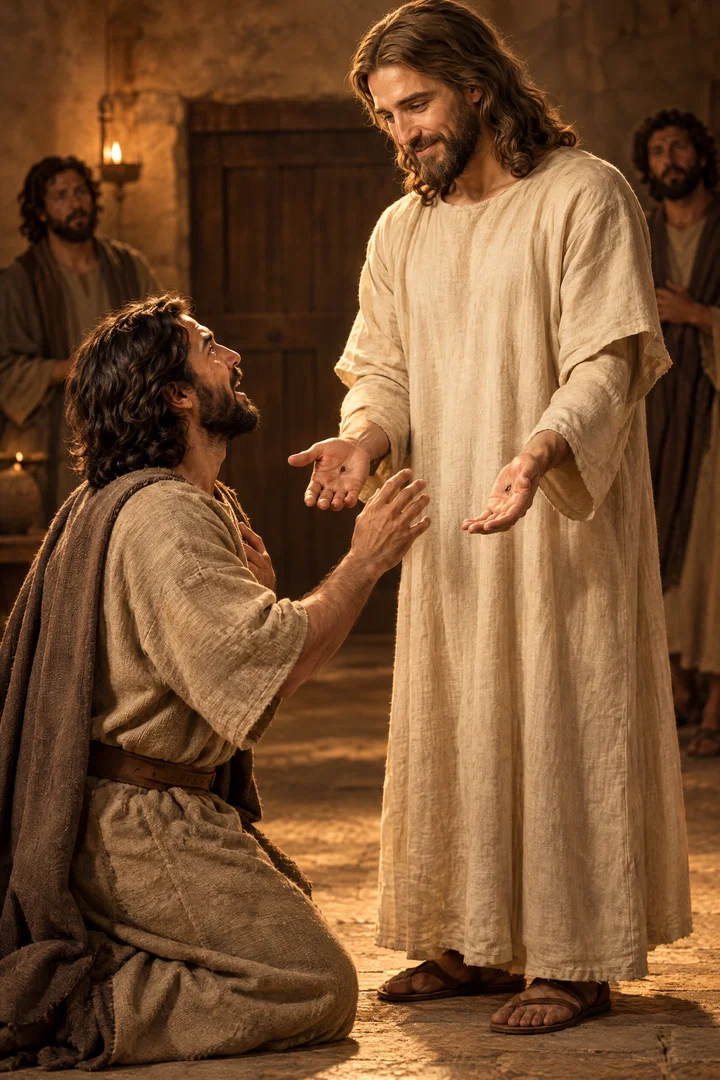
And after eight days again his disciples were within, and Thomas with them: then came Jesus, the doors being shut, and stood in the midst, and said, Peace be unto you.
Translations
And after eight days again his disciples were within, and Thomas with them: then came Jesus, the doors being shut, and stood in the middle, and said, Peace be to you.
King James Version, KJV Cambridge Paragraph Bible
And after eight days again his disciples were within, and Thomas with them: then came Jesus, the doors being shut, and stood in the midst, and said, Peace be unto you.
And after eight days again his disciples were within, and Thomas with them: then came Jesus, the doors being shut, and stood in the midst, and said, Peace be to you.
Revised Version, American Standard Version
And after eight days again his disciples were within, and Thomas with them. Jesus cometh, the doors being shut, and stood in the midst, and said, Peace be unto you.
And after eight days, again were his disciples within, and Thomas with them; Jesus cometh, the doors having been shut, and he stood in the midst, and said, 'Peace to you!'
And eight days after, his disciples were again within, and Thomas with them. Jesus comes, the doors being shut, and stood in the midst and said, Peace [ be] to you.
And, eight days after, his disciples again were within, and Thomas with them. Jesus cometh—the doors having been made fast—and stood in the midst, and said—Peace be unto you!
Berean Standard Bible, Majority Standard Bible
Eight days later, His disciples were once again inside with the doors locked, and Thomas was with them. Jesus came and stood among them and said, “ Peace be with you.”
After eight days, again his disciples were inside and Thomas was with them. Jesus came, the doors being locked, and stood in the middle, and said, “ Peace be to you.”
And after eight days, his disciples were again in the house and Thomas was with them. Though the doors were shut, Jesus came, and taking his place in the middle of them, he said, May peace be with you!
And eight dayes after, againe his disciples were within, and Thomas with them. Then came Iesus, when the doores were shut, and stood in the middes, and said, Peace be vnto you.
Douay-Rheims (Challoner revision)
And after eight days again his disciples were within, and Thomas with them. Jesus cometh, the doors being shut, and stood in the midst, and said: Peace be to you.
Pictures
Cross-references 20 of 38
- John 20:19
Then the same day at evening, being the first day of the week, when the doors were shut where the disciples were assembled for fear of the Jews, came Jesus and stood in the midst, and saith unto them, Peace be unto you.
Jesus’ first-day appearance to the gathered disciples begins the count of eight days.
- John 21:1-14
After these things Jesus shewed himself again to the disciples at the sea of Tiberias; and on this wise shewed he himself.
Jesus appeared to the disciples while they were fishing, showing his appearances were not confined to Sunday.
- Mark 16:14
Afterward he appeared unto the eleven as they sat at meat, and upbraided them with their unbelief and hardness of heart, because they believed not them which had seen him after he was risen.
Jesus appears to the gathered disciples and reproves their unbelief.
- Luke 24:36
And as they thus spake, Jesus himself stood in the midst of them, and saith unto them, Peace be unto you.
Jesus appears among the disciples and greets them with peace.
- Acts 1:3
To whom also he shewed himself alive after his passion by many infallible proofs, being seen of them forty days, and speaking of the things pertaining to the kingdom of God:
Jesus showed himself alive after his suffering by many proofs.
- Luke 24:39
Behold my hands and my feet, that it is I myself: handle me, and see; for a spirit hath not flesh and bones, as ye see me have.
The risen Jesus offers physical proof of his bodily presence.
- Acts 1:13
And when they were come in, they went up into an upper room, where abode both Peter, and James, and John, and Andrew, Philip, and Thomas, Bartholomew, and Matthew, James the son of Alphaeus, and Simon Zelotes, and Judas the brother of James.
Identifies the disciples’ common lodging where Jesus met them.
- John 20:1
The first day of the week cometh Mary Magdalene early, when it was yet dark, unto the sepulchre, and seeth the stone taken away from the sepulchre.
The first day of the week marks the resurrection day, from which the eight-day count is reckoned.
- Luke 24:30-31
And it came to pass, as he sat at meat with them, he took bread, and blessed it, and brake, and gave to them.
The risen Jesus is recognized by the disciples as he breaks bread with them.
- John 20:20
And when he had so said, he shewed unto them his hands and his side. Then were the disciples glad, when they saw the Lord.
The disciples rejoice when they see the risen Jesus and his wounds.
- 1 Corinthians 15:6
After that, he was seen of above five hundred brethren at once; of whom the greater part remain unto this present, but some are fallen asleep.
Connects the Galilean mountain appearance with the five hundred witnesses.
- 2 Corinthians 5:7
( For we walk by faith, not by sight:)
It connects Thomas’s demand for sight with believing without seeing.
- Luke 24:33
And they rose up the same hour, and returned to Jerusalem, and found the eleven gathered together, and them that were with them,
Describes the disciples gathered when Jesus appeared.
- Luke 24:1-3
Now upon the first day of the week, very early in the morning, they came unto the sepulchre, bringing the spices which they had prepared, and certain others with them.
The women find Jesus’ tomb empty after his resurrection.
- Mark 16:12
After that he appeared in another form unto two of them, as they walked, and went into the country.
Names an appearance to two disciples.
- 1 John 1:1
That which was from the beginning, which we have heard, which we have seen with our eyes, which we have looked upon, and our hands have handled, of the Word of life;
The disciples’ testimony rests on seeing and touching the risen Christ.
- John 20:14
And when she had thus said, she turned herself back, and saw Jesus standing, and knew not that it was Jesus.
Jesus appears to Mary on the resurrection day.
- Matthew 26:32
But after I am risen again, I will go before you into Galilee.
Jesus foretells that after rising he will go ahead of his disciples to Galilee.
- John 20:21
Then said Jesus to them again, Peace be unto you: as my Father hath sent me, even so send I you.
The risen Christ greets his disciples with peace.
- Acts 10:40-41
Him God raised up the third day, and shewed him openly;
The risen Jesus appeared to chosen witnesses who ate and drank with him.
Commentary
Each commentary is drawn from primary sources: the writings of Ellen G. White and Adventist pioneers and periodicals. Each commentary is separate. Its own words are not a quotation; follow the references to read the source passages.
Ellen G. White
53 sources
Eight days after His first meeting with the disciples, Jesus came again to them in the upper chamber at Jerusalem where they were gathered with Thomas, entering though the doors were shut and standing in their midst with words of peace.6RED 38.2–39.26RED 63.2–64.1Ms 155, 1904, par. 14–176RED 58.2–59.26RED 43.2–44.1 He knew Thomas's week of refusal to believe their testimony and met his demand by offering the sight and touch of the wounds in His hands and side, ending his doubt and drawing his confession of Him as Lord and God.3SP 220.2–221.2ST Sep 26, 18783SP 235.26RED 72.3–73.26RED 52.3–53.2 He reproved unbelief and taught that faith should rest on the testimony of those who saw Him, pronouncing blessed all who believe without seeing and promising His peace and blessing to them.3SP 220.2–221.2Ms 155, 1904, par. 14–17EW 155.2 He met the doubter not with reproach or argument but with condescension, tenderness and mercy, breaking down the barriers unbelief had raised.3SP 222.1ST Sep 26, 1878 The marks He showed that night remain forever as the signs of His glory and the price of redemption, for the peace He gives rests on His alone having taken away sin and ransomed the lost.GC88 152.1–4EW 43.3ExVEGW 33.2GC88 673.4–674.1
Time Place and Gathering
This was the second time the risen Jesus showed Himself to the disciples in the upper room at Jerusalem, eight days after the earlier showing.6RED 63.2–64.16RED 58.2–59.26RED 43.2–44.13SP 225.2 The disciples were still in Jerusalem, where they had remained through Passover week.6RED 63.2–64.16RED 43.2–44.1ST Oct 3, 18783SP 225.2 He met with them there twice and told them to remain in the city for a time before going to Galilee as He had directed.6RED 63.2–64.16RED 43.2–44.1ST Oct 3, 18783SP 225.2
The gathering was in the same upper chamber where the last supper had been eaten.Ms 55, 1911, par. 29 Several of the disciples lived there and came together there every evening. They were eating their customary evening meal and going over together the evidences for faith that Christ had given them in the prophecies.ST Sep 26, 1878
Though the doors were shut, He came in, stood in the midst of those gathered, and said peace to them.6RED 38.2–39.2Ms 155, 1904, par. 14–176RED 58.2–59.2DA 807.2–46RED 39.3 His unexpected presence startled them.DA 802.1–803.2 His voice and His greeting made known that He had risen.ST Sep 26, 1878DA 802.1–803.2
Thomas was with them on this evening, having at last decided to meet with them.6RED 38.2–39.23SP 220.2–221.2 He had not been present at the earlier meeting with Jesus and had spent the week since refusing the testimony of the others.6RED 38.2–39.2ST Sep 26, 1878Lt 5, 1877, par. 17–18 Yet he came despite his unbelief, cherishing a faint, unacknowledged hope that the news of the resurrection was true.3SP 220.2–221.2
He who appeared knew Thomas's private words, doubts, and unspoken thoughts.3SP 220.2–221.2ST Sep 26, 1878DA 807.2–4 His coming led straight to confronting Thomas and rebuking the refusal of the testimony of the witnesses.3SP 220.2–221.2ST Sep 26, 18786RED 58.2–59.2
Risen Body Revealed
The risen Jesus stood among His disciples as truly risen with a real body, not a spirit, made known by His wounded hands and feet and side, by His familiar voice, and by His eating before them.DA 802.1–803.2ST Oct 10, 18786RED 54.1–2 Though the doors were shut He came unexpectedly into their midst and greeted them with peace, startling them by His sudden presence.DA 802.1–803.2ST Oct 10, 18786RED 54.1–2 They recognized Him by His divine appearance and the wounds of crucifixion, and their startled doubt turned to faith and joy as they worshiped Him, confirmed that the crucified Jesus had risen and strengthened in faith.DA 802.1–803.2ST Oct 10, 18786RED 54.1–2 The same hands bruised by the cruel nails still bore their marks when He met them, hands once stretched to bless the sick and rebuke demons now mercifully extended toward His followers as if embracing the whole world and calling down blessing on all who follow Him, His countenance shining with heavenly brightness and smiling with love with beams of light falling upon the watching ones, so they looked on Him not with mourning but full of joy.ST Nov 22, 1883
Eight days later He appeared again with Thomas present, the doors being shut, stood in the midst with peace, and showed the marks of crucifixion in His hands and feet.3SP 235.26RED 72.3–73.2COS 185.4–6 He gave Thomas the very sight and touch of the wounds Thomas had demanded as the condition for belief.3SP 235.26RED 72.3–73.26RED 52.3–53.2COS 185.4–6 Seeing the Saviour bearing the marks of crucifixion swept Thomas's doubts away so that he needed no further evidence and confessed Him as Lord and God.3SP 235.26RED 72.3–73.26RED 52.3–53.2COS 185.4–6
Thomas afterward told the believers how his unbelief and doubts had been overcome, and his testimony helped others learn what had happened after the resurrection.DA 818.2–819.1 His refusal to believe the report until he could touch the wounds belonged to the disciples' broader unbelief and failure to recognize and appreciate Christ while He was with them, a failure whose memory later stirred remorse as they saw how unbelief had clouded their judgment.DA 507.2–508.1
Faith Without Seeing
When Thomas had refused to believe unless he could see and touch the wounds, he was met again with the other disciples present and was given the evidence he had demanded, yet his unbelief was reproved.3SP 220.2–221.2EW 155.2SG1 74.2ST May 4, 1876 Having believed only after seeing, he was taught that faith should not depend on personal sight and touch but should accept the testimony of those who saw the risen one.3SP 220.2–221.2EW 155.2SG1 74.2ST May 4, 1876 Those who believe without seeing are pronounced blessed.EW 155.2SG1 74.2ST May 4, 1876 The peace spoken in the midst of the gathered disciples belongs also to those who believe on Jesus through the word of the disciples without seeing His wounds and without putting finger and hand into them, and God credits that belief and lets His blessing rest on them.Ms 155, 1904, par. 14–17
Refusing clear evidence while waiting for further proof entrenches unbelief and leaves a person unable to perceive the evidence for Jesus.3SP 221.36RED 59.3ST Sep 26, 1878 Waiting until every cause for doubt is removed fixes the heart in unbelief, hardens the heart, and dims the light already received.3SP 221.36RED 59.3ST Sep 26, 1878 Resisting the testimony already given while demanding personal proof blinds the mind, so the evidence already available should be received in faith.3SP 221.36RED 59.3ST Sep 26, 1878 Thomas was faithful and earnest, yet slow of heart to believe, one of the first disciples who were to be the world's teachers, representing one widely varied type of character among them.ED 85.3 He was not left without comfort in his doubt but was met and brought to faith and rest, giving reason to trust Him as Redeemer.Lt 46, 1896, par. 4–5
Gentle Care for Doubters
When Thomas dictated the only conditions on which he would believe, taking a most unreasonable position, Jesus did not overwhelm him with reproach and did not enter into controversy or argument with him.3SP 222.1ST Sep 26, 18786RED 40.1DA 807.5–808.1 He met the doubting one with marked condescension and tenderness and with generous love, consideration and mercy, revealing Himself to him as the crucified Saviour.3SP 222.1ST Sep 26, 18786RED 40.1DA 807.5–808.1 That love broke down all the barriers Thomas had raised and led him to confess Him as Lord and God.3SP 222.1ST Sep 26, 18786RED 40.1 This is the pattern for treating those who doubt religious truth and make their doubts prominent.DA 807.5–808.1
Persistent controversy will seldom weaken unbelief, for it puts unbelief on self-defense where it finds new support and excuse and may even be strengthened.3SP 222.1ST Sep 26, 1878 By contrast, Jesus revealed in love and mercy as the crucified Saviour brings many once unwilling doubters to acknowledge Him as Lord and God.3SP 222.1ST Sep 26, 1878 Those who doubt should therefore be met with patience and with a loving revelation of Jesus rather than with prolonged argument.3SP 222.1ST Sep 26, 1878
Like Thomas, some cannot believe on published testimony nor receive evidence through the testimony of others, but must see and have the evidence for themselves.GW92 279.3–41T 327.3–329.25T 668.1–2Ms 3, 1862, par. 1–3 They should not be cast aside or set aside, and if their Christian course is otherwise correct they must not be deprived of the benefits and privileges of the church.1T 327.3–329.25T 668.1–2Ms 3, 1862, par. 1–3 Toward them long patience, kind forbearance and brotherly love must be exercised until they reach a settled position, find their place, and become established for or against.GW92 279.3–41T 327.3–329.25T 668.1–2Ms 3, 1862, par. 1–3
Such doubt about visions and supernatural testimony, waiting until convinced it is indeed the voice of God, can stand alongside a deeply moved heart.5T 668.1–2LSEGW 95.1–2CET 85.1–3 It can coexist with belief that the speaker is sincere, with inability to explain the wonderful things related, and with a desire to believe that would bring the greatest happiness if satisfied.LSEGW 95.1–2CET 85.1–3 Those who can receive by judging the tree by its fruits are contrasted with those who fight against visions of which they have no knowledge.5T 668.1–2 If doubters carry opposition so far as to oppose that in which they have had no experience, it may be known that they are not right.5T 668.1–2
To be a doubting Thomas is to demand greater evidence before believing, expressing doubt, suspicion and fears.7MR 114.1–45MR 61.2Lt 16, 1861, par. 12–14 It is to look on with indifference instead of putting hand to the work with zeal and energy to build up.7MR 114.1–45MR 61.2Lt 16, 1861, par. 12–14 Needing even greater evidence than Thomas retards advance and reform among God's people and breaks union.7MR 114.1–4Lt 16, 1861, par. 12–14 Such a course does not tear down directly but works indirectly, exerting an influence against the work rather than for it.7MR 114.1–4Lt 16, 1861, par. 12–14
Wounds Through Eternity
The nail marks in His hands and feet and the spear wound in His side remain visible when He returns in glory, and throughout eternity He will still bear in His hands the prints of the cruel nails by which He was transfixed to the cross on Calvary.EW 43.3ExVEGW 33.2Ms 23, 1910, par. 13–14 At the close of the thousand years the wicked dead are raised and see Jesus in glory with those marks, which are then part of His glory.EW 43.3ExVEGW 33.2
Those wounds are the only lasting traces of sin's cruelty, reminders of His saving sacrifice and signs of His glory and power.GC88 673.4–674.1 They testify that He suffered to reconcile humanity to God and gave His life to redeem lost humanity to live with Him in glory, so that penitent sinners might have life eternal.AA 333.2Ms 23, 1910, par. 13–14Ms 43, 1910, par. 3 Seen in the light of the cross they reveal God's mercy, tenderness, and forgiveness together with equity and justice, showing that His ransom makes life possible for penitent believers.AA 333.2
The same pierced hands remain on Him as He stands before the throne interceding for those who have almost gone over to the wrong side, pleading in their behalf to move them to pray earnestly, fervently and sincerely in His name, to repent wholly, to surrender all to the Lord, and to escape being taken captive by the enemy.17MR 285.1–2 With hands pierced by cruel nails and brow bleeding from the barbed crown placed on His head, having endured greater bodily agony than any person can endure, He is to be taken as He is, with the heart given to Him for salvation.Ms 122, 1909, par. 33 The same hands bruised by the cruel nails, once stretched out to bless the sick and afflicted and to rebuke demons, were mercifully extended toward His followers as if embracing the whole world and calling down blessing upon all who follow Him.ST Nov 22, 1883 His countenance shone with heavenly brightness and smiled with love, and beams of light fell from His hands upon the watching, waiting ones, so they looked on Him not with mourning but full of joy.ST Nov 22, 1883
Peace Salvation and Warning
The words of peace spoken on that meeting belong to sinners as the peace that comes because He alone has taken away their sins and ransomed them.GC88 152.1–4 Salvation therefore rests on Christ's work and not on human works, while true faith is then shown in a holy life and in service to others.GC88 152.1–4 That same greeting searches gatherings where little spiritual life is shown, where a molehill is made into a mountain and where people are easily aroused.Ms 155, 1904, par. 14–17
Missing the meeting through absence or delay shows how spiritual advantages and religious privilege can appear very small and yet cause a person to miss meeting Jesus, as Thomas missed an interview with Jesus because he was not present when Jesus met with the disciples.Lt 5, 1877, par. 17–18 Everyone can do a work for God and must be ready at all times and never off duty, because they may be needed at any moment.Lt 5, 1877, par. 17–18 A word spoken or an act performed at the right moment may turn a soul in favor of truth and save him to eternal life.Lt 5, 1877, par. 17–18 The risen Christ keeps forever in His hands the prints of the cruel nails by which He was transfixed to the cross on Calvary, ever bearing witness through eternity to the sufferings He endured when He gave His life to redeem lost humanity to live with Him in glory, so that penitent sinners might have life eternal.Ms 43, 1910, par. 3 Those who claim to follow Him will live with Him in the earth made new only if in this life they labor for souls as those who must give an account.Ms 43, 1910, par. 3
Sources
Pioneers and periodicals
145 sources
After eight days the disciples were inside at home together with Thomas present, when Jesus came though the doors were shut and stood among them with the greeting of peace.ST Aug 8, 1878RH Nov 29, 1853ST Apr 12, 1883RH Nov 26, 1872ST Apr 1, 1880 The wording is indefinite and names no weekday, and the weight of the teaching holds that it does not establish the next first day or any exact date, while those who held the first-day view teach that it records a second Sunday meeting honoring the resurrection day.ST Feb 10, 1887RH May 1, 1900RH Jun 24, 1873RH Apr 1, 1873 He came then because Thomas was there, to reclaim him from doubt and give ocular proof that his body was restored to life.ST Sep 26, 1878ST Aug 8, 1878RH Oct 21, 1862ST Oct 4, 1899RH May 1, 1900 The meeting gives infallible proof that he rose bodily with a real tangible immortal body, identified by the nail prints and spear wound as the same crucified Jesus.ST Jun 3, 1897RH Nov 26, 1872ST May 14, 1894RH Mar 15, 1906 His greeting reveals unchanging care bringing pardon and sustaining power, pronouncing more blessed those who believe without seeing, and the occasion supplies no command, example, or authority for Sunday sacredness or Sabbath change.ST May 19, 1909RH Jul 11, 1854RH Mar 7, 1912RH Jul 25, 1912
Timing Of After Eight Days
After eight days means a full eight days counted from the Sunday-evening meeting, placing the meeting with Thomas on Monday evening, one day more than a week.ST Oct 17, 1878ST Apr 12, 1883ST Feb 20, 1879RH Jun 5, 1860 After one day from Sunday evening is Monday evening, after two days Tuesday evening, and so on through after seven days as one week to after eight days as Monday evening.ST Oct 17, 1878ST Apr 12, 1883 What is called after six days is also called about eight days after, showing the same full reckoning.RH Jun 5, 1860 The disciples were within, at their own home where they lived, not gone out to a religious worship meeting, and Jesus came because Thomas was there.ST Apr 12, 1883ST Feb 20, 1879RH Jun 5, 1860ST Sep 16, 1875 If the phrase is indefinite no day can be fixed, and if definite it falls as late as Monday night and proves nothing for a first-day meeting.RH Jun 5, 1860ST Sep 16, 1875
After keeps its ordinary sense of behind, subsequently to, and following, and never means before or on, so after eight days carries the time to Monday or Tuesday of the next week and not to the next first day.ST Oct 4, 1899ST Jul 21, 1909ST Jul 21, 1909 Counted from the first meeting on Sunday night, the next meeting falls at least as late as Monday or Tuesday, with the purpose of reclaiming Thomas from doubt rather than honoring the resurrection or establishing sacredness.ST Oct 4, 1899ST Nov 11, 1889ST Apr 15, 1889 On that reckoning the following week is meant, no earlier than Monday and probably Tuesday or Wednesday.ST Feb 17, 1890
Counted from the first meeting near the close of the first day, the meeting fell on the second day of the week.RH Sep 25, 1856RH Jun 16, 1868RH Dec 9, 1852 On the view that after eight days means exactly one week, it occurred in the evening at the beginning of the second day by evening reckoning, since days reckoned from sunset place events after sunset in the next Jewish day.ST Apr 13, 1882RH Dec 9, 1852 It was the next recorded appearance after resurrection day and the night following, one of eleven recorded appearances.ST Jun 2, 1898 If the first meeting was on the first day, this meeting would fall on the second day rather than establishing that Jesus always met on Sunday.RH Sep 25, 1856RH Jun 16, 1868
The meeting fell no earlier than the second or third day of the week, at least as late as the third day.RH Dec 31, 1857RH Feb 11, 1858RH Sep 17, 1857 From the evening meeting that followed resurrection day, when the first day was merging into the second, after eight days carries over to the second or third day and certainly not to the next first day.ST Apr 22, 1897ST Jul 13, 1904ST Apr 22, 1897 Only one meeting is recorded on the first day, at its very close, when the disciples were gathered without knowing he must rise and without expecting him or honoring the day.ST Apr 22, 1897 The Bible speaks of the eighth day of a feast, but not an eighth day of the week.ST Jul 13, 1904
After eight days can mean the ninth day by literal or inclusive reckoning, or the ninth or tenth day, or about nine or ten days.ST Aug 13, 1874RH Feb 25, 1862 Just as after six days is also called about eight days after, after eight days can mean about ten days, and it may mean the sixth or tenth day.ST Aug 13, 1874RH Feb 25, 1862 Comparing after eight days with the parallel timing expressions in Matthew and Luke, the meeting could have been on the ninth day, a Tuesday, as evidence of resurrection to doubting disciples rather than authority for replacing the Sabbath.RH Jul 11, 1854RH May 5, 1851 Its uncertainty shows exact time was not the point, and the wording does not necessarily mean exactly one week later.RH Nov 1850RH May 5, 1851
A week is denoted by after seven days, while after eight days denotes more than seven days and does not denote just a week.ST Oct 17, 1878RH May 12, 1874 By inclusive counting the day of the occurrence is counted as first, making the same weekday a week later the eighth day.RH Sep 10, 1857 Days here means full twenty-four-hour periods of night and daylight in succession.RH Dec 12, 1871 Counted from Sunday night, the eight-day interval places the meeting later in the week than the first day.RH May 12, 1874
The wording is indefinite and does not name a weekday, and by itself cannot establish Sunday or any exact date.RH May 1, 1900ST Mar 11, 1886ST Mar 11, 1886 It does not say on the eighth day or on the seventh day afterwards, and does not specify the exact length of time.RH May 1, 1900ST Mar 11, 1886 Counting from the Sunday-night appearance, seven days would reach the next Sunday night and eight days Monday night, with after eight days pointing to a later unspecified time because Thomas was present and doubting.ST Feb 10, 1887RH May 1, 1900 The account does not specify whether they were gathered for worship or eating, and gives no sacredness or change of Sabbath.ST Feb 10, 1887RH Nov 1850
The meeting was not on the next first day by any known law of numbers.ST Aug 27, 1885ST Jul 23, 1894 It came after eight days from the resurrection-day meeting, beyond the next Sunday, since counting from the first meeting the seventh day would be the next first day.ST Aug 27, 1885RH Oct 23, 1856 Even an eighth-day reckoning does not prove a first-day meeting, and timing that may look like an arranged first-day gathering alone does not prove deliberate choice or apostolic Sunday observance.ST Jun 29, 1882
Place And Manner Appearing
The disciples were within, at home in their common abode where they lived together, not gone out to a religious worship meeting.ST Aug 8, 1878RH Nov 29, 1853ST Apr 12, 1883ST Feb 20, 1879RH Jun 5, 1860 Their being together indoors does not show a gathered worship, for they may simply have been at home and even sitting at meat, with no identification of worship or Sabbath observance.ST Aug 8, 1878RH Nov 29, 1853ST Apr 12, 1883ST Feb 20, 1879RH Nov 1850 Jesus appeared then because Thomas was present, having not yet seen him since the resurrection, to give the witnesses ocular proof of the resurrection rather than because of the day.ST Aug 8, 1878RH Nov 29, 1853ST Apr 12, 1883ST Feb 20, 1879RH Nov 1850
They met in the upper chamber where several lived and assembled every evening, during their customary evening meal while reviewing the evidences for faith from the prophecies.ST Sep 26, 1878RH Jan 10, 1871 The gathering took place on the evening Thomas finally decided to meet with them, cherishing despite unbelief an unacknowledged faint hope that the resurrection news was true.ST Sep 26, 1878 The earlier gathering had been in fear of the Jews and amid confusion and excitement, with the disciples terrified and unbelieving rather than assembled for religious purposes or first-day observance.ST Sep 26, 1878RH Apr 11, 1871RH Aug 1, 1854 That confusion supplies no command or example for a sacred day, and the claim about a common meal belongs to the resurrection-day accounts rather than to this later event as held by those who distinguish them.RH Jan 10, 1871RH Apr 11, 1871RH Aug 1, 1854
This later meeting was at Jerusalem in the same place as the first meeting, not the appointed meeting in Galilee.ST Oct 3, 1878RH Apr 8, 1873 It was one of two revelations in the upper chamber during Passover week when they were told to remain in Jerusalem for a while.ST Oct 3, 1878RH Apr 8, 1873
It was the second appearance to the disciples after the resurrection, the first having been on resurrection evening and the third at the Sea of Galilee, so that the meeting on the mountain in Galilee came still later after all three.ST Jul 19, 1883ST Feb 27, 1896ST Jun 2, 1898 In the fuller count it was the sixth showing alive in a sequence of ten appearances, following the fifth to the disciples when Thomas was absent and standing before the later appearances at the sea of Tiberias, on the mountain in Galilee, to James, and to all the apostles.ST Jul 19, 1883RH Apr 12, 1860ST Jun 2, 1898 The appearances during the forty days between resurrection and ascension were distinct manifestations and not one continuous presence, occurring on different weekdays including a fishing workday and the Thursday ascension, and the interval cannot be stretched to make this appearance and the earlier one both fall on Sunday or to show appearance only on Sundays.RH Aug 31, 1869ST Jun 2, 1898ST Apr 8, 1889 The record lists eleven recorded occasions, though not establishing these as all his interviews with them.RH Aug 31, 1869ST Jun 2, 1898
Though the doors were shut Jesus came, stood in the midst, and said Peace be unto you.RH Nov 26, 1872ST Feb 27, 1896ST Apr 1, 1880RH Nov 26, 1872ST Mar 27, 1907 His entering does not prove his body immaterial, for his resurrected body was a literal, changed, immortal body that could be seen and handled and still bore the marks of crucifixion.RH Nov 26, 1872ST Apr 1, 1880RH Nov 26, 1872 A body controlled by a superior spirit can pass through closed doors as naturally as through an open door, as light passes through solid glass, since what is supernatural to a lower being may be natural to a higher one, illustrating the glorious bodily form to which the prepared body will be made like.ST Apr 1, 1880RH Nov 26, 1872ST Mar 27, 1907 Those who held otherwise treated the shut-door entrance as evidence that the appearances were not ordinarily in his natural, material body, though he could sometimes assume an earthly form recognized through spiritual perception.RH Nov 26, 1872RH Nov 26, 1872
Purpose To Convince Thomas
Jesus came again after eight days because Thomas was with the disciples then, having missed the first meeting and not yet seen him since the resurrection.ST Aug 8, 1878ST Oct 4, 1899RH May 1, 1900RH Nov 29, 1853RH Nov 26, 1872 Their being together indoors was simply being at home, perhaps at meat, not proof of a worship gathering, and he could meet them on any day without the day itself carrying special meaning.ST Aug 8, 1878RH Nov 29, 1853RH Nov 26, 1872 The purpose of that meeting was to reclaim Thomas from doubt and unbelief, to cure his unbelief by giving him and the other witnesses ocular proof that his body had been restored to life.ST Oct 4, 1899RH May 1, 1900RH Nov 29, 1853RH Nov 26, 1872ST Mar 23, 1888
He came through shut doors, stood in the midst, and greeted them with peace, compassionately meeting deliberate unbelief.ST Sep 26, 1878RH Oct 21, 1862ST Mar 23, 1888 He knew what was in Thomas, even his private words and thoughts when absent, and invited him to examine the wounds in hands and side, urging him not to remain faithless but to believe.ST Sep 26, 1878RH Oct 21, 1862ST Mar 23, 1888RH Nov 26, 1872 Thomas saw the visible, tangible body of the same risen Jesus, recognized personal identity in the marks of crucifixion without needing further touch, believed, and confessed him.RH Oct 21, 1862RH Nov 26, 1872 Those signs and appearances were given as abundant proof that he rose from the dead, establishing the disciples as witnesses, and were recorded so that people would believe Jesus is the Christ, the Son of God, and have life through his name, with blessing pronounced on those who believe without seeing.RH Oct 21, 1862
The disciples had gathered at first without knowing he must rise and without expecting him or honoring the day.ST Apr 22, 1897 They were slow of heart to grasp his plain teaching, disappointed, unprepared followers who still did not understand his kingdom, mission, and atonement through his blood until they received the Spirit.ST Apr 22, 1897ST Jun 26, 1901 Thomas, separated from rejoicing communion with the risen Saviour and the other disciples, spent the intervening days in the gloom and grief left by Jesus' death, learning that faith is more precious than doubt.
No Proof For Sunday
The verse names no weekday and does not even allude to the first day, and what happened in it could with strictest propriety have happened on any day of the week.RH May 5, 1851RH May 12, 1874RH Dec 11, 1860 It declares nothing about sacredness of the day, about abstinence from labor, about keeping the Christian Sabbath, about change of the Sabbath from the seventh to the first day, and implies nothing of that kind.RH May 12, 1874 It supplies no command to keep Sunday as a Sabbath, no example of first-day observance, and no authority for Sunday observance, much less proof that the first day is the Lord's day.RH Jul 11, 1854RH Nov 14, 1871ST Oct 21, 1897 The phrase after eight days does not establish a meeting exactly one week later, for by more literal reckoning it can mean the ninth day, and by reckoning the week from evening the day could be the second day of the week; counting the interval from the resurrection does not make the meeting a first-day Sabbath without altering the ordinary length of a week, since a week is denoted by after seven days.RH Nov 14, 1871RH May 12, 1874 Even allowing it as the one possible first-day meeting after the resurrection-day meeting, it provides no evidence for repeated successive Sunday meetings.RH Jul 11, 1854RH Jun 19, 1856 The disciples could be together simply because they shared a common place to stay.RH Mar 31, 1874
Being together proves no holy day, for they were at home in their common home eating the common evening meal, not called together for worship and not observing the first day as a Sabbath.RH May 5, 1851RH Feb 25, 1862RH Nov 13, 1856 They were terrified at his presence, not believing he was risen, in fear and unbelief and rebuked for unbelief and hardness of heart, not holding a worship service to commemorate the resurrection or honor the day.ST Jul 1, 1880RH Feb 25, 1862 No worship purpose is stated, no sanctifying of the day for weekly observance is shown, and his greeting does not approve a Sunday meeting.ST Jul 1, 1880RH May 5, 1851RH Dec 11, 1860 After eight days can mean about ten days, just as after six days is also called about eight days after, and may mean the sixth or tenth day; its uncertainty shows exact specification of time was not the object.RH Feb 25, 1862RH Dec 11, 1860 Even if the appearance fell on Sunday, it proves nothing for Sunday sacredness, because the time did not determine the meeting and no command for a new Sabbath follows from it.ST Jul 1, 1880RH Dec 11, 1860
Merely meeting with the disciples cannot by itself prove a day's sacredness or make a day a Sabbath or a day of rest.RH Mar 31, 1874RH Feb 25, 1862RH Jun 19, 1856 If appearance on a particular day made that day sacred, then the day of this appearance after eight days, not seven, would also have a claim, and that reasoning would make other days sacred when he met with them.ST Aug 13, 1874ST Oct 21, 1889RH Feb 25, 1862 His later appearances on other days likewise do not make those days Sabbaths, any more than the fishing meeting with the disciples or the final meeting at the ascension from the Mount of Olives on Thursday made those days Sabbaths.RH Mar 31, 1874ST Aug 13, 1874RH May 12, 1874 Christ did no Sabbatical act on the occasion and said nothing about the day.ST Oct 21, 1889RH May 12, 1874 The meeting is unsurprising because they shared a common abode, and the eight-day interval places it later in the week than the first day.RH Mar 31, 1874RH May 12, 1874
The occasion was selected simply because Thomas was present, to satisfy the incredulity of the doubting disciple who had doubted the testimony of the others.RH Jun 19, 1860ST Nov 11, 1889RH Dec 11, 1860 Its purpose was to give Thomas further evidence that the body was truly raised, to address his doubt and establish conviction of the resurrection, and to instruct about future work.RH Jul 11, 1854ST Mar 23, 1882ST Nov 18, 1886RH Jun 19, 1860 It says nothing about Sunday becoming a sacred day, does not establish that the meeting commemorated the resurrection, and assigns no sacred observance to the first day.ST Mar 23, 1882ST Nov 18, 1886RH Jun 19, 1860 That silence about any change in the day's character shows no such change had taken place, and the appearance gives no scriptural authority for replacing the seventh-day Sabbath with Sunday, transferring the Sabbath, or appointing first-day worship.RH Jul 11, 1854ST Mar 23, 1882ST Nov 18, 1886
Claims Honoring First Day
John 20:26 records Jesus meeting the disciples on the first day of the week, eight days after the resurrection appearance, with Thomas present behind shut doors, as the second Sunday meeting in succession.RH Jun 24, 1873RH Apr 1, 1873RH Feb 25, 1862RH Aug 10, 1869RH Jan 23, 1855 After eight days uses a cardinal number to mean the eighth day, counted from and including the resurrection day to the first day of the following week.RH Jun 24, 1873RH Apr 1, 1873 The earlier evening and this evening are both treated as the first day of the week, and the gathering eight days later when Jesus came among them despite the shut doors and greeted them with peace is presented as describing the next Sunday and as evidence that the disciples met on Sunday again, making it the second Sunday they kept.ST Apr 8, 1889RH Jan 23, 1855 Alongside this, John 21:1-4 records a third meeting after the resurrection, on a fishing day.RH Aug 10, 1869 Jesus did not appear during the intervening days, including the seventh-day Sabbath, though the disciples may have met on other days.RH Apr 1, 1873
That return on the first day was his deliberate choice to honor that day, standing among them and blessing them with peace.RH Apr 1, 1873 The repeated first-day presence put special honor on the resurrection day as the Lord's day, taught regard for it as holy time, and gave the authoritative example of Christ as Lord of the Sabbath for keeping the first day instead of the seventh in honor of the resurrection and redemption completed by his rising from the dead.RH Feb 25, 1862ST Oct 21, 1889ST Sep 6, 1883 With no meeting on the seventh day, these notable appearances to his disciples, one of two Sunday appearances after the resurrection, are offered as an example for the claim that the day of rest was changed to the first day of the week.RH Feb 25, 1862ST Feb 17, 1890ST Jul 22, 1908ST Sep 6, 1883
That use is a man-made reason for observing the first day, not an inspired command to keep it.ST Jan 11, 1916 Whether meeting with the disciples on the first day of the week was intended as an example for believers is a question that must be proved.ST Mar 9, 1882 Appearing to the gathered disciples indoors with the doors shut, one week after his resurrection, does not by itself establish the day as a Sabbath, show that the seventh day ceased to be holy, or indicate that the seventh-day Sabbath had been changed to the first day.ST Jul 18, 1878RH Nov 29, 1853ST Mar 24, 1881ST Mar 22, 1883 Christ's resurrection appearances are not evidence of such a change, and do not establish a divine institution requiring the first day to be kept holy as a Christian Sabbath.ST Jul 18, 1878ST Mar 24, 1881
Bodily Resurrection And Wounds
John 20:26 belongs to the account given as the infallible proofs that Jesus rose from the dead.ST Jun 3, 1897 After the resurrection he gave physical, visible evidence that he was alive, confirming that he was not a spirit without a body.ST Feb 27, 1907RH Dec 18, 1855 His visible, tangible body was the risen Jesus himself, and the wounds established his personal identity and bodily resurrection, so that Thomas believed when he saw him.RH Nov 26, 1872 His wounded hands and feet, familiar voice, and eating before the disciples showed that he had a real body, and his appearance turned doubt into faith and joy.RH Nov 26, 1872 His resurrected body was a literal, changed, immortal body that could be seen and handled and still bore the marks of the crucifixion, and his appearing while the doors were shut does not make his body immaterial.RH Nov 26, 1872RH Dec 18, 1855
He stood among the disciples in his real body and could be handled, and his bodily resurrection supports the promise that the same Jesus who ascended will return bodily.RH Nov 26, 1872RH Dec 18, 1855 The risen Jesus is identified by the wounds in his hands, feet, and side, and those marks lead the disciples to recognize and follow him.ST May 14, 1894RH Mar 15, 1906 The nail marks in his hands and the wound in his side belong to the Savior who will appear in glory with the angels, and Thomas did not believe he had risen until he could examine the wounds in his hands.RH Mar 15, 1906ST Aug 12, 1880 Thomas recognized him by seeing him, without needing to touch the wounds, and the marks confirmed the resurrection to wavering believers.RH Feb 12, 1901 The scene points to the hope of seeing Jesus face to face and clasping the hand that bears the marks of his suffering.ST Jul 1, 1897ST Oct 11, 1905
The nail prints in his hands remain as lasting witnesses through eternity to his loving sacrifice, which saved humanity and saves the redeemed.ST Apr 7, 1914ST Apr 7, 1914 The scars in his head, side, hands, and feet testify to his sacrifice for sinners, and attest that those whose faith is fixed on him and whose hope is anchored within the heavenly veil have been washed clean from sin by his precious blood.ST May 18, 1904RH Mar 7, 1912 The marks remain in Christ, but they are not scars of defect or shame; they will shine as a sign of his crucifixion.ST Apr 7, 1914ST Jun 21, 1899 He still bears the nail-pierced hands and thorn-marred brow when he comes to the disciples and in heaven above where the saints enthrone him as the King of Love, reaching his nail-pierced hand down in love to lift people out of strife, so that everyone beseeching him finds eternal life.ST Nov 26, 1912RH Mar 7, 1912 With wounds still visible, features scarred yet kingly sweet, side bleeding and nail prints remaining in hands and feet, he stands with hands raised in blessing before the sinner who kneels and cries for forgiveness, and gives peace with strength forever from the boundless stores above.ST May 18, 1904RH Mar 7, 1912
His risen condition illustrates what it means to be born of the Spirit, and immortalized saints will likewise be perfected at the resurrection, while the saints still sleeping in death await that time.RH Sep 15, 1874 Their new birth through the Spirit is perfected at the resurrection, when the just become immortal.RH Sep 15, 1874 At the resurrection, when the trumpet sounds and the dead rise, they will know him by the marks of his crucifixion and recognize Jesus by the nail mark in his hand.ST Jul 1, 1897ST Oct 11, 1905 The resurrection preserves personal identity, and God's people will likewise recognize their loved ones and be recognized by their friends through personal appearance, though with the bloom of eternal health rather than the effects of disease.RH Feb 12, 1901 John's account of the resurrection includes details of touching hands, feet and wounds not given in the other Gospel accounts, and those differences reflect each writer's selection of events and do not by themselves make the accounts contradictory, while the existence and spiritual vitality of the Christian church and the New Testament stand as primary evidence for the resurrection alongside such appearance stories.ST Mar 5, 1912RH May 11, 1916
Peace And Believing Faith
The greeting of peace discloses unchanging care for his own even after they had deserted him and still struggled to believe, for he came uninvited and unexpected behind closed doors to stand among the gathered disciples, comfort them, restore their confidence and assure them of his presence.ST May 19, 1909RH Jun 16, 1903 That peace is an enduring promise joined to the hope and victory of the resurrection, bringing pardon and cleansing and grace and the Father's love and forgiveness and shelter, with strength from boundless stores above for all cares and conflict.ST May 19, 1909RH Mar 7, 1912RH Jul 25, 1912 It is able to sustain through suffering that would otherwise overwhelm, to bring comfort to those who grieve, and to calm hearts still through his Spirit.RH Jul 25, 1912RH Jun 16, 1903 He stands with wounds still visible and hands raised in blessing, the nail prints remaining and the side bleeding, before the sinner kneeling and crying for forgiveness and dying with sin and sorrow, giving peace and teaching how to live.RH Mar 7, 1912RH Jul 25, 1912RH Aug 1, 1854
Thomas received the physical evidence he had demanded and believed after seeing, yet the greater blessedness is pronounced on those who believe without seeing.ST May 4, 1876RH Oct 21, 1862RH Sep 2, 1873 His requested evidence was granted because he already believed in Jesus, and the sight confirmed that belief, illustrating that trust in Christ comes before spiritual sight and that those who refuse to believe cannot expect evidence to reveal truth to them.ST May 4, 1876ST Sep 23, 1908 Doubt is not condemned as sinful, but believing without visible proof is the higher state; Christians may face perplexities about doctrines or their supporting facts and should hold fast to God and conscience, treat doubts as difficulties rather than sins, trust that God has not abandoned them, and wait for Christ to supply what they lack rather than insisting on sight.RH Oct 21, 1862RH Sep 2, 1873RH Nov 13, 1900
Doubt was met with marked condescension and tenderness and generous love and consideration rather than reproach or controversy, even though the position taken dictated unreasonable conditions of faith, and that love broke down all barriers raised.ST Sep 26, 1878RH Mar 24, 1910 Persistent controversy will seldom weaken unbelief but puts it on self-defense where it finds new support and excuse, while Jesus revealed in love and mercy as the crucified Saviour brings many once unwilling doubters to acknowledge him as Lord and God.ST Sep 26, 1878 Demanding personal proof while resisting clear testimony already given is unreasonable because the truth had been well proved, and refusing it can harden the heart and blind the mind.ST Sep 26, 1878RH Nov 13, 1900RH Apr 3, 1879
When Thomas joined the gathered disciples again, the risen Saviour came among them with peace and benediction, illustrating the joy of those who return to the gathered community and find Christ present.ST Dec 1, 1881RH Aug 7, 1866ST Aug 18, 1881 When absent members return to gather with the church, as in a prayer meeting, they find the Saviour present bringing peace, and this returning fellowship marks the beginning of revival.ST Dec 1, 1881RH Aug 7, 1866ST Aug 18, 1881 The doubting Thomases who must see for themselves, who doubt that a great work can be accomplished quickly, who hesitate without facts, or who grow dry and backslidden through neglected prayer and secret sins, are pictured as bodily among the followers yet spiritually dry, having forsaken Sabbath-school work and left the seat empty in prayer-meeting, with secret prayer abandoned or kept as empty form and stealthy growth of secret sins in a parched soul, needing thorough heart-work and deep re-conversion to restore hale and happy usefulness.RH Apr 9, 1872ST Feb 7, 1906ST Aug 1, 1878 His presence and pierced hands still show loving appeal to bring lost sinners home trapped in sin, and lay duty on Christians to teach them of his life and death and saving power.ST Dec 1, 1881RH Aug 7, 1866ST Feb 7, 1906
Wider Links And Application
The slowness of heart that left the disciples disappointed and unprepared for the appearance alive in their midst with Thomas present eight days after the resurrection pictures the second advent.ST Jun 26, 1901 The masses of professed disciples will be just as ill prepared for his sudden appearance, and only those who love his appearing and believe his Word will be looking for him.ST Jun 26, 1901 The Jesus who was crucified bears the wounds in hands, feet and side when he comes again as Judge and King, and those nail marks testify to his identity and power as the same Jesus who will return in glory with shining power to save.ST May 23, 1911ST Dec 2, 1913
He still bears the nail-pierced hands and thorn-marred brow from the crucifixion when he came to the disciples and where saints enthrone him above as King of Love, reaching the nail-pierced hand down from a heart above in love to lift people out of strife so that everyone beseeching him finds eternal life.ST Nov 26, 1912 The same bruised hands that had blessed the sick and afflicted and rebuked demons were mercifully extended toward his followers as if embracing the whole world and calling down blessing on all who follow him, with countenance shining in heavenly brightness and smiling in love and beams of light falling from his hands upon the watching, waiting ones, so they looked on him full of joy and not with mourning.ST Nov 22, 1883 He comes near to gather and comfort those who are lonely, grieving, sick, weak or burdened by doubt, and his presence brings peace.ST Apr 10, 1907 His nail-pierced hand standing among them behind shut doors with the greeting of peace is a loving touch bringing comfort, joy and blessing to people in sorrow, care and hardship.ST Feb 6, 1896
The nail marks are a test of true fellowship with him, requiring those who serve him to stand by him, surrender what they love, and bear the cost of faithful service even to suffering or shame.RH Apr 1, 1909 They supply the sign distinguishing Christ from a deceptive apparition, testing whether anything truly bears the marks of Christ's self-denial.RH Sep 23, 1873 That self-sacrifice shown by Christ is to be reflected in aims, decisions, spending, ambitions and daily habits as the test of true discipleship.ST Sep 28, 1915 His pierced hands and wounded side show him to be the same Jesus who suffered on the cross, whose boundless patient love and mercy ground trust in him as a just and gentle judge who gave himself to pay for sin and ground asking him to help forgive those who have wronged.ST Nov 23, 1904ST Aug 19, 1880 Those same pierced hands shown to Thomas will clasp the weary hands of the good and faithful servant when Christ as Captain welcomes him with Well done and bids him lay down lamp and pitcher and trumpet and leave the camp, with nothing between his hands and Christ's.RH Sep 28, 1916
The doubts of Thomas and the weakness of the disciples did not end his love to his own, for he remained faithful to them despite unworthiness.RH Jun 4, 1914 He is seen not as crucified or suffering but as in his ministry in Galilee healing the sick.ST Oct 21, 1880 The appearance to Thomas with full assurance by the nail marks and the side wound is connected with an annual feast observed on the eighth day after the resurrection and celebrated with the supper.RH Jun 3, 1873 As Christ was betrayed and crucified and then rose again, so the Sabbath maligned under satanic opposition will shine more brightly and endure as the same yesterday and today and forever, its history of suffering making it more precious in eternity just as seeing his nail marks will deepen love for the Savior.ST Nov 21, 1900
A few days after he first appeared to them he came again while Thomas was with them as a second shower of blessing refreshing them through manifestation of the risen Lord.ST Nov 11, 1908 Their testimony that he is risen rests on encounter with him and makes them witnesses who must share the good news.ST Feb 22, 1899 His resurrection with wounds remaining after death grounds hope that he cares for and protects his followers through life and death and that they will stand with the redeemed in the first resurrection.RH Mar 19, 1914
Sources