John 20:19
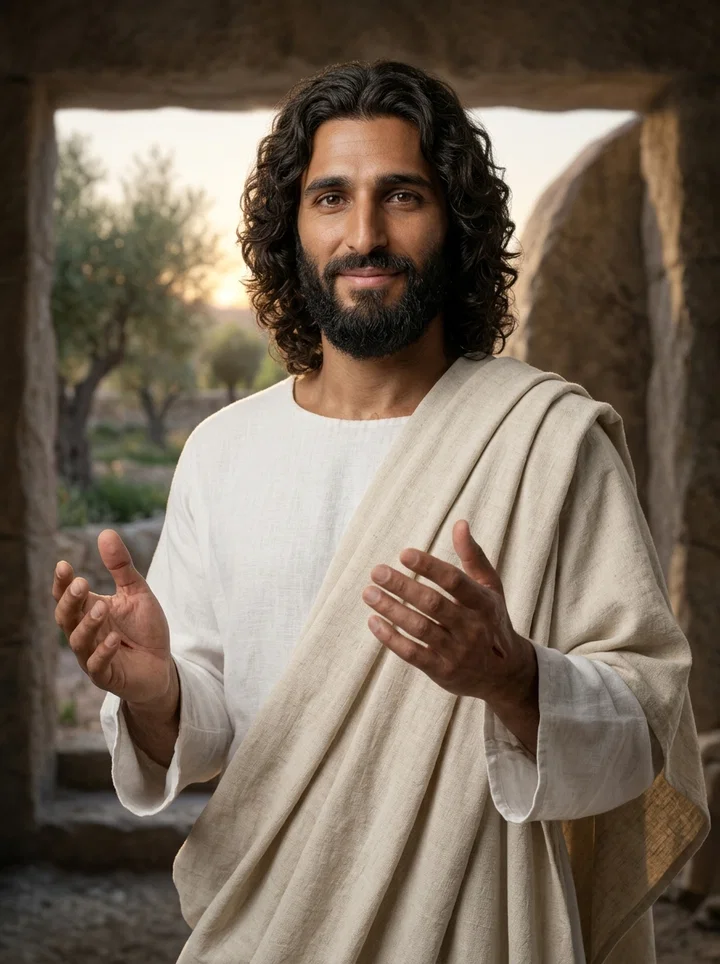
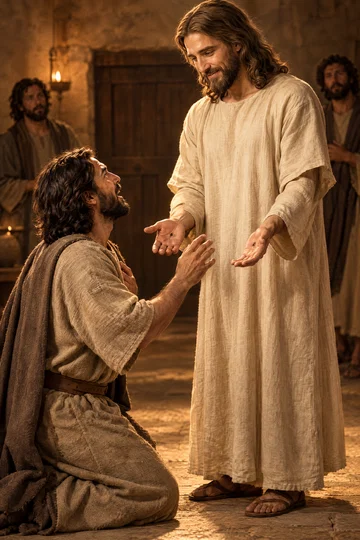
Then the same day at evening, being the first day of the week, when the doors were shut where the disciples were assembled for fear of the Jews, came Jesus and stood in the midst, and saith unto them, Peace be unto you.
Translations
Then the same day at evening, being the first day of the week, when the doors were shut where the disciples were assembled for fear of the Jews, came Jesus and stood in the middle, and says to them, Peace be to you.
King James Version, KJV Cambridge Paragraph Bible
Then the same day at evening, being the first day of the week, when the doors were shut where the disciples were assembled for fear of the Jews, came Jesus and stood in the midst, and saith unto them, Peace be unto you.
Then the same day at evening, being the first day of the week, when the doors were shut where the disciples were assembled for fear of the Jews, Jesus came and stood in the midst, and saith to them, Peace be to you.
Revised Version, American Standard Version
When therefore it was evening, on that day, the first day of the week, and when the doors were shut where the disciples were, for fear of the Jews, Jesus came and stood in the midst, and saith unto them, Peace be unto you.
It being, therefore, evening, on that day, the first of the sabbaths, and the doors having been shut where the disciples were assembled, through fear of the Jews, Jesus came and stood in the midst, and saith to them, 'Peace to you;'
When therefore it was evening on that day, which was the first [ day] of the week, and the doors shut where the disciples were, through fear of the Jews, Jesus came and stood in the midst, and says to them, Peace [ be] to you.
It being late, therefore, on that day, the first of the week,—and, the doors, having been made fast where the disciples were, for fear of the Jews, Jesus came, and stood in the midst, and saith unto them—Peace be unto you!
It was the first day of the week, and that very evening, while the disciples were together with the doors locked for fear of the Jews, Jesus came and stood among them. “ Peace be with you!” He said to them.
It was the first day of the week, and that very evening, while the disciples were gathered together with the doors locked for fear of the Jews, Jesus came and stood among them. “ Peace be with you!” He said to them.
When therefore it was evening on that day, the first day of the week, and when the doors were locked where the disciples were assembled, for fear of the Jews, Jesus came and stood in the middle and said to them, “ Peace be to you.”
At evening on that day, the first day of the week, when, for fear of the Jews, the doors were shut where the disciples were, Jesus came among them and said to them, May peace be with you!
The same day then at night, which was the first day of the weeke, and when the doores were shut where the disciples were assembled for feare of the Iewes, came Iesus and stoode in the middes, and saide to them, Peace be vnto you.
Douay-Rheims (Challoner revision)
Now when it was late that same day, the first of the week, and the doors were shut, where the disciples were gathered together, for fear of the Jews, Jesus came and stood in the midst, and said to them: Peace be to you.
Pictures
Cross-references 20 of 74
- Mark 16:14
Afterward he appeared unto the eleven as they sat at meat, and upbraided them with their unbelief and hardness of heart, because they believed not them which had seen him after he was risen.
Jesus appears to the disciples at a meal and rebukes their unbelief.
- John 20:26
And after eight days again his disciples were within, and Thomas with them: then came Jesus, the doors being shut, and stood in the midst, and said, Peace be unto you.
Jesus appears to the disciples again after eight days, with Thomas present.
- John 20:1
The first day of the week cometh Mary Magdalene early, when it was yet dark, unto the sepulchre, and seeth the stone taken away from the sepulchre.
Both texts identify the day as the first day of the week.
- Luke 24:1
Now upon the first day of the week, very early in the morning, they came unto the sepulchre, bringing the spices which they had prepared, and certain others with them.
Cited as another Gospel use of the phrase for the first day of the week.
- Matthew 28:1
In the end of the sabbath, as it began to dawn toward the first day of the week, came Mary Magdalene and the other Mary to see the sepulchre.
Both identify the first day of the week in connection with Jesus’ resurrection.
- Luke 24:36-43
And as they thus spake, Jesus himself stood in the midst of them, and saith unto them, Peace be unto you.
Parallel account of Jesus appearing to the gathered disciples.
- Mark 16:9
Now when Jesus was risen early the first day of the week, he appeared first to Mary Magdalene, out of whom he had cast seven devils.
Both identify the first day of the week as the day of Jesus’ resurrection and appearance to Mary Magdalene.
- Mark 16:2
And very early in the morning the first day of the week, they came unto the sepulchre at the rising of the sun.
Both identify the resurrection day as the first day of the week.
- Luke 24:33-35
And they rose up the same hour, and returned to Jerusalem, and found the eleven gathered together, and them that were with them,
The Emmaus disciples return and report seeing the risen Jesus before he appears to the group.
- Acts 20:7
And upon the first day of the week, when the disciples came together to break bread, Paul preached unto them, ready to depart on the morrow; and continued his speech until midnight.
Both texts describe disciples gathered on the first day of the week.
- Acts 1:3
To whom also he shewed himself alive after his passion by many infallible proofs, being seen of them forty days, and speaking of the things pertaining to the kingdom of God:
Jesus appeared to the disciples during the forty days after his resurrection.
- John 21:1-14
After these things Jesus shewed himself again to the disciples at the sea of Tiberias; and on this wise shewed he himself.
Jesus appears to the disciples again while they are fishing.
- Luke 24:13
And, behold, two of them went that same day to a village called Emmaus, which was from Jerusalem about threescore furlongs.
Places the Emmaus journey on the same day Jesus appeared to the disciples.
- 1 Corinthians 16:2
Upon the first day of the week let every one of you lay by him in store, as God hath prospered him, that there be no gatherings when I come.
Both use the same phrase for the first day of the week.
- John 14:27
Peace I leave with you, my peace I give unto you: not as the world giveth, give I unto you. Let not your heart be troubled, neither let it be afraid.
Jesus’ post-resurrection greeting fulfills his promise of peace to the disciples.
- Luke 24:41-43
And while they yet believed not for joy, and wondered, he said unto them, Have ye here any meat?
Jesus asks for food and eats before the disciples.
- 1 Corinthians 15:5
And that he was seen of Cephas, then of the twelve:
The risen Jesus appeared to the assembled disciples.
- Mark 16:12-13
After that he appeared in another form unto two of them, as they walked, and went into the country.
Jesus appears to disciples after rising; they report the appearance, but the others disbelieve.
- Luke 2:14
Glory to God in the highest, and on earth peace, good will toward men.
Jesus’ greeting after his resurrection echoes the angels’ announcement of peace at his birth.
- Acts 1:13
And when they were come in, they went up into an upper room, where abode both Peter, and James, and John, and Andrew, Philip, and Thomas, Bartholomew, and Matthew, James the son of Alphaeus, and Simon Zelotes, and Judas the brother of James.
Identifies the upper room where the disciples stayed together in Jerusalem.
Commentary part 1 of 2
Each commentary is drawn from primary sources: the writings of Ellen G. White and Adventist pioneers and periodicals. Each commentary is separate. Its own words are not a quotation; follow the references to read the source passages.
Ellen G. White
44 sources
On the evening of the resurrection day the sorrowing disciples were gathered in the upper chamber in Jerusalem with doors barred for fear of suffering their Teacher's fate, not to celebrate His rising which they had not yet believed.Ms 149, 1897, par. 4–718MR 96.4–97.2DA 842.2–8Ms 72, 1902, par. 23–246RED 63.2–64.1 Without knock or footstep Jesus suddenly stood in their midst with hands outspread in blessing, showing His pierced hands and side as proof He was the same crucified Jesus.Ms 149, 1897, par. 4–7Ms 144, 1897, par. 31–32DA 802.1–803.23SP 236.1 His greeting dispelled fear and doubt with gladness, giving peace in place of troubled uncertainty.18MR 96.4–97.2Ms 72, 1902, par. 23–24DA 802.1–803.2DA 803.36RED 56.1–2 That peace is His heavenly legacy to the church, won because He alone vanquished death, expiated sin and ransomed humanity, and it is the salvation through repentance and forgiveness of sins the disciples were sent to preach to all nations.18MR 96.4–97.2Ms 72, 1902, par. 23–24Ms 144, 1897, par. 31–32GC 152.1–4GC88 152.1–4 He still draws near to seeking hearts and to believers united in prayer and love, speaking the same greeting with sympathy to bring rest, trust and sustaining grace.Lt 64, 1886, par. 7–8ST Mar 16, 1882Ms 220, 1902, par. 3–418MR 125.1–3Ms 32, 1887, par. 14–17
Time, Place, and Fear
The meeting took place in the evening of the first day of the week, the very same day as the resurrection, late in the evening after the disciples had spent the Sabbath in mourning for Jesus.Ms 149, 1897, par. 4–7DA 802.1–803.2ST Oct 3, 18783SP 225.23SP 216.1 It was the evening of the resurrection day, when the risen Jesus came to disciples gathered behind shut doors and stood among them with His greeting of peace.Ms 149, 1897, par. 4–718MR 96.4–97.2Ms 72, 1902, par. 23–24DA 802.1–803.2 They were together in Jerusalem in the upper chamber, their common abode, during Passover week, and there Jesus appeared among them and told them to remain there for a time before going to Galilee.6RED 63.2–64.16RED 43.2–44.1ST Oct 3, 18783SP 225.2 That upper chamber was the same room where He had met with them for the last supper and where they saw Him after His resurrection, and He revealed Himself to them there twice in Jerusalem.6RED 43.2–44.13SP 225.2Ms 55, 1911, par. 29
The doors were shut, barred, closed and fastened because they feared the Jews, the priests, the people and spies.Ms 149, 1897, par. 4–7DA 802.1–803.2DA 793.5–794.33SP 216.1Ms 113a, 1897, par. 15 They feared that they too might suffer the fate of Jesus their Teacher, knowing His fate might at any time become theirs.DA 793.5–794.3AA 26.112MR 420.2 They remembered His words that if these things were done in the green tree, worse would be done in the dry.12MR 420.2 They were grief-stricken, sorrowing, lonely and sick at heart, with perished hopes, repeating that they had trusted He would redeem Israel.DA 793.5–794.3AA 26.112MR 420.2 They had not believed that He had risen and were unaware that they could rejoice in the risen Saviour, yet they were joyful while still having difficulty believing.DA 842.2–8DA 793.5–794.3Ms 155, 1904, par. 61–63 For that reason they were not gathered for a religious meeting or to celebrate the resurrection.DA 842.2–8
The verse gives no evidence that the first day was regarded as holy or had taken the place of the Sabbath.DA 842.2–8 The two travelers who had recognized Jesus in the breaking of bread had hurried back from Emmaus and arrived seeking certainty about what had happened to His body, telling the others they had found Him.Ms 155, 1904, par. 61–63Ms 113a, 1897, par. 15 He had been their unseen companion on the way, and He entered among the assembled disciples as they arrived behind the barred door.3SP 216.1 Thomas was absent from that first meeting, and when the others reported they had seen the risen Jesus he sank into despair because he thought the resurrection meant there could be no earthly kingdom, while jealousy and unbelief kept him from trusting their testimony.LSEGW 271.4–272.1DA 806.4–807.1 Unlike the fearful disciples who feared to show themselves openly as His followers after His death, Joseph and Nicodemus had openly come to His aid.DA 773.3–4
Sudden Appearance and Proof
No knock sounded and no footsteps were heard, yet Jesus suddenly stood among the disciples, with no one knowing how He had come.DA 802.1–803.23SP 236.1 Bolts and bars could not shut out the risen Son of God, and the priests and rulers feared meeting Him face to face.ST Oct 3, 1878
This was His first appearance and first meeting with the disciples after the resurrection.DA 803.3DA 806.4–807.1 He met them together in the upper chamber at Jerusalem during Passover week.6RED 63.2–64.16RED 43.2–44.13SP 225.2 He revealed Himself to them there twice in Jerusalem and told them to remain there for a time before going to Galilee.6RED 63.2–64.16RED 43.2–44.1ST Oct 3, 18783SP 225.2
He stood in the midst with hands outspread, raising His hands in blessing and greeting them with peace.ST Oct 14, 1889 He showed them His hands, side, and feet pierced on the cross as evidence that He was the same Jesus who had been crucified.Ms 149, 1897, par. 4–7Ms 144, 1897, par. 31–323SP 236.1 They recognized Him by His divine countenance and wounds and worshiped Him.3SP 236.1 Their fear was dispelled and they were made glad with joy and gladness at seeing Him.Ms 144, 1897, par. 31–32EW 151.2–152.2 The hands He raised in blessing were the same hands pierced on the cross, joining the encounter with the risen Christ to His crucifixion.ST Oct 14, 1889
On that same day He had ascended to the Father to hear that God accepted His sacrifice and to receive power from Him.EW 154.2–155.1 Having ascended and received that power, He returned and allowed the disciples to touch Him.EW 154.2–155.1SG1 74.1
Meaning of Christ's Peace
The greeting of peace brought comfort to disciples troubled by fear and uncertainty when the risen Jesus stood among them behind shut doors.DA 802.1–803.26RED 56.1–2EW 151.2–152.2 It gave peace in place of fear and doubt, dispelling their fear and bringing joy and gladness.6RED 56.1–2EW 151.2–152.2 That same peace is offered to people burdened by doubt and fear who open their hearts for Him to enter and remain.DA 803.3
That peace is His legacy left to His church, meeting His disciples in a time of fear and distress and in that trying hour placing them under the guidance of the Holy Spirit.18MR 96.4–97.2Ms 72, 1902, par. 23–24 It is the peace of Christ coming from heaven, different from the happiness friends can bring, and believers need it today.Ms 83, 1886, par. 249MR 257.2–258.1 To those who accept Christ by living faith He gives power to become sons of God, entering His school as His students, who need not be troubled or anxious because He will ratify His promise and fulfill all His promises.18MR 96.4–97.2 Living in it makes their course of life a light to a crooked and perverse nation.Ms 83, 1886, par. 249MR 257.2–258.1
The peace means that Christ alone has taken away sin and ransomed humanity, so salvation rests on His work and not on human works.GC 152.1–4GC88 152.1–4 His resurrection is the joyful news that He has vanquished death, expiated sin, shut the gates of hell, defeated death and opened the way to life.GC 152.1–4GC88 152.1–4 True faith is shown in a holy life and useful service to others, for good works do not earn salvation but are the grateful service of those God has saved.GC 152.1–4GC88 152.1–4
The peace He proclaimed after His suffering and resurrection is the peace of salvation through repentance and the forgiveness of sins and the Saviour's power to forgive sins.6RED 56.1–2 The disciples were commissioned to preach it to all nations, marking the beginning of their witness to the gospel of peace and salvation.6RED 56.1–23SP 218.1–2 That appearance joins together His greeting of peace, His showing of His wounds, their gladness at seeing Him, His commission to them, and His giving of the Holy Spirit.Ms 144, 1897, par. 31–32 His words were the same assurance He had given Gideon, the compassionate Saviour coming to encourage those who were afraid.ST Jun 23, 1881
Presence and Application Today
When a person draws near to God, Jesus draws near in return and speaks His present greeting to the seeking heart.Lt 64, 1886, par. 7–8 That greeting assures the trusting one that the Lord is helper and shield to be believed, whose supporting arm alone keeps from falling.Lt 64, 1886, par. 7–8 In distress He Himself draws near to believers and speaks peace, and His presence and words are felt in answer to prayer bringing relief, joy, comfort and love in a trying hour.Lt 26, 1885, par. 6–7 This gives fresh evidence that He loves and blesses the sufferer, as was known in the nearness and blessing experienced at Santa Rosa.ST Mar 16, 1882Lt 26, 1885, par. 6–7 That nearness is like His coming among His gathered disciples, with the light of heaven coming through the gates entered by the ascended Savior who now intercedes in heaven, expressing the wish that Christ abide with people and bring peace into their lives.ST Mar 16, 1882ST Jan 7, 1903
Christ is truly present with believers in united prayer, speaking peace to them with sympathy and with hands outspread.Ms 220, 1902, par. 3–418MR 125.1–3 His greeting gives sweet peace like a river that pervades the soul, rest of heart in the hope and faith of the gospel, and perfect security even though suffering remains.Ms 220, 1902, par. 3–418MR 125.1–3 It removes fear, gives trust without misgiving and grateful trust in His love and protection, with assurance of sustaining grace and Christ close by as hope, Redeemer, life and crown of rejoicing.Ms 220, 1902, par. 3–418MR 125.1–3 That peace comes under the deep influence of the Holy Spirit and is kept by repeating comforting scriptural promises during wakeful hours of night pain.18MR 125.1–3 Full trust in God and His Word is thus sufficient even when bodily suffering is not healed.18MR 125.1–3
He reveals Himself in person in the midst of His people when they stop quarreling and estrangement, confess sins to God and to one another with weeping, reconcile, press together in unity and forbearance and love, and pray together in the Spirit.Ms 32, 1887, par. 14–17 Then He is suddenly recognized among them, the place is filled with the mellow light of heaven, hearts break and then rejoice, and His musical voice speaks peace as a present reality.Ms 32, 1887, par. 14–172MR 123.2–127.2 His peace itself abides in the room as a real presence and power resting upon them, working through their influence to bring souls to the truth.Ms 32, 1887, par. 14–172MR 123.2–127.2 At first His presence may be veiled as a stranger with no freedom or refreshment in the meeting because love is wanting, and then He teaches, reproves lack of love, forbearance and unity, and calls to meek restoration until conviction, mutual confession and broken hearts lead to rejoicing.2MR 123.2–127.2 He cannot speak peace to professed followers while bickering and dissension, jealousy and evil surmisings continue, which must cease with hearts opened to the bright beams of the Sun of Righteousness so that love, faith, trust, forbearance, goodness and purity shine upon others.Ms 21, 1888, par. 2–6
Thomas was absent at that appearance, which warns against missing Christ's coming among His people and His words of peace, in contrast to elderly believers who eagerly attended meetings as if afraid of missing Him.LSEGW 271.4–272.1 Jesus entered the upper chamber where His disciples were assembled to give the peace that comes from heaven.Ms 83, 1886, par. 249MR 257.2–258.1 That gift is the peace of Christ, different from the happiness friends can bring, and believers today need this peace and true religion.Ms 83, 1886, par. 249MR 257.2–258.1 Receiving it enables a course of life that is a light to a crooked and perverse nation, and the light and instruction given to the apostles in His triumphant resurrection and revelation to them can also be received by those who connect with God.Ms 83, 1886, par. 249MR 257.2–258.1Ms 41, 1886, par. 18
Sources
Pioneers and periodicals
319 sources
On the evening of the same first day of the week on which Jesus rose, the disciples were assembled behind shut doors in Jerusalem for fear of the Jews, and Jesus came and stood among them greeting them with peace.RH Apr 1, 1873RH Mar 31, 1874ST Dec 15, 1881ST Apr 11, 1900 That evening was the close of the first day, which in Bible reckoning ends at sunset, while those who held otherwise teach the appearance came after sunset when the first day had ended and the second day had begun.ST Nov 10, 1914ST Sep 8, 1914RH May 17, 1860ST Jul 29, 1880 They were at their common abode eating supper, still unbelieving that he had risen and terrified supposing him a spirit, so he showed his hands and feet and side and ate before them to convince them he was truly risen and to reprove their unbelief.ST Oct 4, 1899RH May 1, 1900ST Feb 3, 1887RH Mar 31, 1874ST Dec 15, 1881 Their gathering was not for worship or to honor the resurrection or keep the day, and gives no example of first-day observance.ST Apr 15, 1889ST Feb 20, 1879RH Dec 6, 1853ST Oct 14, 1913ST Jul 12, 1905 The day is called only the first day of the week, with no sacred title as Sabbath or Lord's day and no blessing or hallowing of the day.ST Mar 16, 1882RH May 12, 1863ST Nov 8, 1905RH Apr 1, 1873 The meeting gives no command or example establishing the first day as sacred or changing the Sabbath from the seventh to the first.ST Mar 16, 1882RH May 12, 1863ST Nov 8, 1905RH Mar 31, 1874ST Dec 15, 1881
Words Naming the Day
In the phrase first day of the week the Greek word sabbaton properly means week, a seven-day period, when it follows a numeral naming a day of the week.RH May 31, 1864ST Apr 3, 1879RH May 31, 1864RH Oct 9, 1860 It is one of nine places where sabbaton is rendered week, and there is no authority for translating it Sabbath when it refers to the first day of the week.RH May 31, 1864RH Sep 25, 1856 The Greek word for first is feminine agreeing with the understood feminine noun for day, while sabbaton is neuter, so the expression means the first day of the week, not the first Sabbath.ST Apr 3, 1879RH May 31, 1864RH Mar 15, 1860RH Jul 24, 1866 The omitted noun understood with first is day, and first cannot modify Sabbath.RH Mar 15, 1860RH Jul 24, 1866ST Oct 21, 1889
The phrasing reflects the Hebrew way of numbering weekdays in relation to the Sabbath without special names, where days are called first, second, and so on of the week ending with the Sabbath.RH Jun 4, 1908RH Jan 2, 1900ST Feb 28, 1884RH Jan 2, 1908 The Jewish practice counted the days in relation to the Sabbath, with the first day meaning Sunday and the seventh day being the Hebrew Sabbath.ST Feb 28, 1884RH Apr 26, 1870 Because the Sabbath was the principal day the whole period was called Sabbath, but first day of the Sabbath means first day of the week.RH Oct 9, 1860ST Mar 24, 1887 First day no more means Sabbath than second day or any other day does, and the wording does not mean one day in a newly begun series of Sabbaths or that a new order of Sabbaths began at the resurrection.RH May 31, 1864RH Oct 9, 1860ST Mar 24, 1887
The Greek word is Sabbaton, spelled exactly as Sabbath and appearing in every resurrection first-day account, and the New Testament calls the first day sabbaton.RH Jan 23, 1866ST May 15, 1884RH Jan 30, 1866 Spelling alone does not decide translation, which must rest on lexical meaning and grammatical construction.ST May 15, 1884 The same plural form joined to a numeral here, in Colossians 2:16, and in Luke proves it does not always mean the seventh-day Sabbath.RH Nov 28, 1871 Luke uses the same form for a later first day, showing that the expression itself does not mark the day as the first Sabbath of a new series.RH Nov 28, 1871
The verse is used to question rendering the words as one of Sabbath or the one of Sabbaths, for if that rendering were correct the verse alone would not establish it means first day of the week.RH It is included among passages whose Greek wording is claimed to mean first day of the sabbaths proving a Christian Sabbath, and among the eight passages that use the expression first day of the week with sabbaton as the word for Sabbath.RH Aug 10, 1905RH Jan 30, 1866 Those who held the King James translators inserted the first day of the week though absent from the Greek taught it is therefore not evidence that the Sabbath was changed to the first day.RH Apr 28, 1859 Rendering it first of Sabbaths would make a first-day Sabbath begin Saturday evening while Jesus was still dead, rather than being instituted by his resurrection.RH Nov 28, 1871
The day is named only as the first day of the week, an ordinary weekday meaning Sunday, the day after the Sabbath and not the seventh day on which God rested.RH Apr 1, 1873ST Jun 12, 1879 First day of the week means the first day literally, the particular resurrection day returning weekly around the globe, while Sunday is a heathen name for that sun-dedicated day not found in Scripture.RH Jun 4, 1908RH Apr 28, 1853 The verse is one of only eight New Testament mentions of the first day, one of six or eight Gospel mentions connected with the resurrection, the only other scriptural first-day gathering besides Troas and the only first-day event in Christ's history identified here.ST Oct 14, 1913ST Mar 16, 1882RH Jan 30, 1866RH Mar 31, 1868RH Jun 5, 1860 The eight together are counted as zero for Sunday sacredness, with most proving the direct opposite, while the seventh day is called Sabbath fifty-nine times.ST Oct 14, 1913RH Mar 31, 1868RH Jun 5, 1860
John wrote about sixty-six years after the resurrection, in A.D. 97 after his return from Patmos and the vision of the Lord's day, yet still calls the day only by the common name first day of the week used by Matthew, Mark, Luke and Paul.ST Jan 8, 1885ST Jul 19, 1883 His and the apostles' continued use of that plain secular name proves the first day had not been renamed the Lord's day and that Revelation 1:10 is not the first day of the week.ST Jan 8, 1885ST Jul 19, 1883ST Oct 21, 1897 John's mention of the first day gives no explanation of the term in Revelation 1:10.ST May 20, 1889 The verse identifies the resurrection day as the first day of the week, the weekly day Sunday observance claims to commemorate wherever it arrives locally even when its hours differ by longitude.RH Apr 28, 1853
The theory discussed reconciles the evangelists' first day meaning Sunday with its claim that Sunday was the original seventh day by asserting God commanded Israel at the exodus to keep the fifteenth of Abib as its weekly Sabbath while the sixteenth remained the original Sabbath day.ST Jun 19, 1879ST May 8, 1879 On the reckoning opposed the week would begin with the original seventh day and end with its sixth, against the ordinary order of its days supported by the verse's numbering of the New Testament week.ST Jul 31, 1879ST May 8, 1879 The verse therefore identifies Sunday as the first day, not the seventh, and supports the distinction between that day and the Sabbath, which the Gospel accounts place on the preceding day.ST May 8, 1879ST Jun 12, 1879ST Apr 24, 1879
Evening Time and Setting
On the evening of the first day of the week, the day Jesus rose, he came and stood among the assembled disciples and greeted them with peace.RH Apr 1, 1873RH Mar 31, 1874ST Dec 15, 1881ST Mar 12, 1912ST Apr 15, 1889 The disciples were behind shut doors because they feared the Jews, gathered to eat and keep out of danger, not to commemorate the resurrection which they had not believed.RH Mar 31, 1874ST Dec 15, 1881ST Apr 15, 1889ST Jul 8, 1930 The meeting took place near the end of the day on which he rose, at their lodging, while they were terrified when he appeared among them.ST Dec 15, 1881ST Mar 12, 1912ST Apr 15, 1889 Though this would have been an ideal time to announce a change of the Sabbath from seventh to first, no such announcement was made.ST Mar 12, 1912ST Jul 8, 1930
The evening was the evening that closed the first day, with the Jewish day ending at six o'clock or sunset.RH May 17, 1860ST Jul 29, 1880 The Jews reckoned two evenings, one closing one day and one beginning the next.RH May 17, 1860ST In Bible reckoning the first day begins at sunset Saturday and ends at sunset Sunday and is not identical to secular Sunday beginning at midnight.ST Jul 29, 1880ST If the first day is sacred the whole day is to be observed, not merely part of it.ST
Evening is reckoned as two evenings: the first beginning about three o'clock, the ninth hour, when the sun declined and closing with the day at sunset, and the second beginning at sunset and merging into the next day.ST Nov 10, 1914ST Sep 8, 1914RH Mar 2, 1876 The time between about 3 P.M. and sunset is called between the two evenings, and the declining sun could also be called evening while true evening began at sunset.ST Nov 10, 1914ST Sep 8, 1914RH Mar 2, 1876 The day begins and closes at evening, with the first evening closing with the day while merging into the next day's evening.ST Nov 10, 1914 The word evening need not mean after sunset but may refer to the first of the two Jewish evenings from about the ninth hour until sunset, or is used broadly to span the close of one day and beginning of the next.ST Jan 11, 1905RH Jan 17, 1856RH Apr 20, 1876 Jesus came while the first day was far spent but not yet ended, in the first evening beginning about the ninth hour before the sun had set and before the second or real evening beginning at sunset.RH Jan 17, 1856RH Apr 20, 1876
Late evening after dark was still reckoned as part of the first day.RH May 8, 1879ST Sep 2, 1886 After reaching Emmaus, eating supper, returning to Jerusalem and speaking, the appearance took place at about eight or nine o'clock, at least two hours after sundown, yet is still called the evening of the first day.RH May 8, 1879 They may have gathered for their meal while it was still light, and Jesus may have come after dark, when the day was still reckoned as the first day of the week.ST Sep 2, 1886 This late evening, after dark, was reckoned as part of the first day of the week, not as part of the following day.RH May 8, 1879 The verse is cited as an apparent indication that the first day continued into the evening and thus as possible evidence for reckoning the day from midnight rather than sunset, presented as an objector's argument about the Sabbath, not as a conclusion.RH Apr 20, 1876RH May 17, 1870 It does not say the evening was added to the preceding day or that the first day thereafter began and ended at midnight.RH Apr 20, 1876RH May 17, 1870
The weight of the passages holds that Jesus' appearance occurred after sunset when the first day had ended and the second day had begun, so it was not on Sunday.ST Nov 10, 1914ST Sep 8, 1914ST May 24, 1910ST Feb 23, 1915ST Apr 13, 1882 The Emmaus journey of seven and one-half miles in the afternoon, reaching Emmaus toward evening when the day was far spent, eating, then returning seven and one-half miles requiring about two to two and one-half hours and arrival after dark, proves it was night and dark when Jesus came.ST Nov 10, 1914ST Sep 8, 1914ST May 24, 1910 The disciples had spent the day at work, and two had gone to Emmaus and returned to Jerusalem after the day was far spent.ST Sep 8, 1914RH Dec 9, 1852 The disciples were assembled in their common abode, eating supper and afraid, and Jesus came among them with no instruction about the day.ST Apr 13, 1882RH Dec 9, 1852 By modern reckoning this was evening on the first day, which was either the close of the Jewish first day or the early part of the second, since the Jewish day began at sunset.ST Apr 13, 1882RH Dec 9, 1852
The verse does not prove Jesus came before sunset.ST May 24, 1910RH May 8, 1879 The gathering in the evening may have begun in daylight and continued into the second day while the disciples prepared or ate a meal and waited for those returning from Emmaus, so the appearance may have been on the second day.RH May 8, 1879RH Sep 25, 1856ST Aug 13, 1912 If the day began at sunset the evening would belong to the second day.RH Sep 25, 1856 If its evening is read as Roman evening after sunset, the appearance occurred after the Jewish first day had ended, on the Jewish second day.RH Sep 25, 1856 The disciples assembled between the two evenings recognized in Scripture, the first beginning about 3 o'clock with declining sun and the second at sunset when night begins, meeting before the first day closed with Jesus coming after it had passed and the next day had begun.ST Nov 10, 1914ST Feb 23, 1915ST May 17, 1910
Because the biblical day runs from sunset to sunset, the meeting after the two travelers returned from Emmaus occurred after the first day had ended at the beginning of the second day, with Thomas absent and Christ saying nothing about the day.ST Apr 13, 1882ST Apr 13, 1882 The verse is one of three meetings said to have occurred on the second, not the first, Jewish day of the week.ST Apr 13, 1882 The meeting began so late in the evening that it may have extended into or merged into the second day of the week.RH Feb 25, 1862ST Apr 22, 1897 It therefore gives no proof that Jesus chose the first day as sacred or set it apart by the resurrection and establishes no new boundary for the day.RH Feb 25, 1862ST Apr 22, 1897
The appearance occurred on the same day Jesus rose, in the evening at the close of the first day, in its last moments on Sunday night in Jerusalem after the Emmaus meeting, while many disciples were still uncertain about what had happened to his body.ST Sep 15, 1887ST Jul 1, 1880RH Jan 23, 1866ST Feb 14, 1911 On Sunday evening when that first day, in whose morning the women had gone to the sepulcher, was nearly if not wholly past, after the two disciples had returned the same hour about eight miles from Emmaus to Jerusalem and told the eleven the Saviour was risen indeed but were not believed, he stood among them.ST Sep 15, 1887 He greeted them, rebuked unbelief, showed hands, feet and side, called for food and ate to convince them the crucified Jesus was risen.ST Jul 1, 1880 This is the only recorded appearance to them on a first day.RH Jan 23, 1866 The evening meeting occurred at the common abode after the day had gone by uncelebrated and unobserved.ST Sep 15, 1887ST Dec 11, 1901
The doors were shut, closed, bolted, or barred because the disciples feared the Jews, for personal safety, not to observe the Sabbath.ST Nov 10, 1914ST Mar 16, 1882ST Nov 8, 1905RH May 10, 1860RH Nov 29, 1853 On the evening of the first day disciples were gathered behind shut doors in Jerusalem because they feared the Jewish authorities, and Jesus came and stood among them greeting them with peace despite their fear.RH May 10, 1860ST Apr 11, 1900 The gathering was at the disciples' common abode, lodging, home, dwelling, or upper room in Jerusalem where they lived from Passover until Pentecost, including the upper chamber where Jesus had spent the night before his death, not at a specially appointed or called meeting.ST Nov 10, 1914RH Apr 8, 1873ST May 24, 1910 Going to Galilee that day was impossible because of distance.RH Apr 8, 1873ST Jul 19, 1883 Their common abode was where Peter, James, John, Andrew, Philip, Thomas, Bartholomew, Matthew, James son of Alphaeus, Simon the Zealot, and Judas son of James lived. They may have been sharing a lodging room, gathered there as the first day closed, and Jesus came to them later.ST May 24, 1910RH Nov 29, 1853
The disciples were all assembled in an upper chamber on the evening of the first day behind shut doors, divided and doubtful after three days apart, having deserted him.ST Apr 24, 1901RH Jul 8, 1909RH Jun 6, 1912 Jesus twice proclaimed peace to reassure and quiet fears, bringing assurance of peace with God, comfort, release from guilt and inner distress, and stability.ST Apr 24, 1901ST Apr 21, 1914 The verse places the evening assembly on the same first day as Jesus' morning meeting with Mary at the tomb, and describes the same evening appearance as Mark 16:14.RH Jan 2, 1900ST Nov 18, 1886 It counts as the last of four appearances on resurrection day.ST Jul 1, 1880ST Feb 3, 1887 The two returning from Emmaus reached Jerusalem by moonlight through the eastern gate, were let in by cautious hands with Jesus entering as unseen companion, and found the company already declaring the Lord risen indeed and appeared to Simon.ST Jun 3, 1897ST Nov 18, 1886
On Sunday evening when that first day was nearly if not wholly past, after the two disciples had returned and told the eleven the Saviour was risen indeed but were not believed, he stood among them, greeted them, rebuked unbelief, showed hands, feet and side, called for food and ate to convince them the crucified Jesus was risen.ST Jul 1, 1880ST Nov 18, 1886 The meeting occurred on the evening of the first day, the same day as the preceding eighteen verses, connected with the arrival of the two Emmaus disciples bringing joyful news.ST Jun 3, 1897ST Mar 8, 1905 After they entered and told what happened on the road, Jesus manifested himself among the gathered disheartened, doubtful, fearful disciples, dispelling sorrow and doubts and filling faith and hope, entering through the same door opened to admit them.ST Jun 3, 1897ST Mar 8, 1905 It was his fifth appearance since the resurrection, following the return from Emmaus and their report, his first meeting with the assembled disciples, eight days before another meeting with the twelve and before the seventh appearance to seven apostles on the northern shore of the Sea of Galilee near Capernaum by appointment several days after resurrection day.ST Apr 24, 1901ST May 30, 1895
The appearance is the fifth of ten recorded times Christ showed himself alive after his passion, when Thomas was not present.RH Apr 12, 1860ST Apr 13, 1882 It is one of the repeated appearances so that all later present on the mountain in Galilee had already seen him at least three times, most more often, yet some still doubted.RH Apr 12, 1860 The evening meeting is one of five recorded appearances on the day of the resurrection and the night that followed.ST Jun 2, 1898ST Apr 24, 1901 The appearance was the fifth on resurrection day, in the evening as the two from Emmaus reported, after appearances first to Mary Magdalene, second to the other women, third to Simon Peter, and fourth to Cleopas and his companion.ST May 30, 1895ST Apr 24, 1901 It was one of two appearances to Peter before the fishing at the Sea of Galilee, after which Jesus still came again to cheer the discouraged disciples who were to be the light of the world.ST Apr 24, 1901ST Apr 21, 1914 It is the first of three counted meetings with the disciples, followed by the meeting a week later and then the meeting at the Sea of Galilee, all before the appointed meeting on the mountain in Galilee whose weekday is not revealed.ST Jul 19, 1883ST May 30, 1895
The meeting is one of Jesus' separate manifestations during the forty days between resurrection and ascension; he was not continuously with them but appeared at intervals.ST Apr 24, 1901RH Aug 31, 1869 The account is part of John's resurrection narrative including details not recorded by Matthew; differences between the Gospel accounts reflect each writer's selection of events and do not by themselves make the accounts contradictory.RH Jan 2, 1900ST Mar 5, 1912 Thomas was absent from the gathering at home while eating supper behind shut doors.ST Feb 20, 1879ST Apr 13, 1882 On the evening of the resurrection day while gathered behind shut doors in Jerusalem, Jesus twice appeared among them and told them to remain there for a time before going to Galilee.ST Oct 3, 1878ST Apr 24, 1901
Gathering Not For Worship
The disciples were sitting at the evening meal or supper in their common lodging, home and regular shared dwelling in Jerusalem where they lived together, and Jesus met them there incidentally and not by appointment.RH Apr 8, 1873ST May 24, 1910RH May 10, 1860RH Nov 29, 1853 The promised meeting in Galilee happened later during the forty days after the resurrection, and Scripture does not state which weekday it occurred.RH Apr 8, 1873 The evening runs from the closing hours of the first day into the first part of the second day, because the day begins and closes at evening and the Jews recognized two evenings, the first beginning about three o'clock when the sun declined and closing with the day while merging into the next day's evening.ST Nov 10, 1914ST May 24, 1910 The disciples gathered in the closing hours of the first day, but when Jesus came the first day had passed and the second day had begun, so the meeting was not on Sunday but on the following day, with the gathering continuing until the second day had well begun.ST Nov 10, 1914ST May 24, 1910 The timing is proved by the Emmaus journey of seven and one half miles on that afternoon, reaching Emmaus toward evening when the day was far spent, eating, then rising the same hour to return seven and one half miles to Jerusalem requiring a walk of roughly two to two and a half hours with arrival after dark, with night on when Jesus appeared so they supposed He was an apparition.ST Nov 10, 1914ST May 24, 1910
They were together behind shut doors because they feared the Jews and the Jewish leaders, shut in for fear lest those who put Jesus to death would seek them out and kill them also, and this was their common living place, not an assembly for worship.RH May 10, 1860RH Nov 29, 1853ST Jul 12, 1905 They may have been sharing a lodging room, and Jesus appeared before the day ended to give the disciples, who were to witness to his resurrection, clear proof that he had risen.RH Nov 29, 1853 They were eating an ordinary meal, the last meal of the day in their usual upper room, and when Jesus stood among them He greeted them with peace but said nothing about changing the Sabbath.RH May 10, 1860ST Oct 4, 1899RH May 1, 1900RH Jun 5, 1860 To convince the terrified disciples he was a real risen being and not a phantom or spirit or ghost or dead man, he showed his hands, feet and side, had them handle him, asked for food, and ate a piece of broiled fish and honeycomb before them, giving them clear proof to be witnesses.ST Feb 3, 1887ST May 19, 1909 His words and the gift of the Holy Spirit were directed to the disciples and did not make the day sacred or approve their gathering as a religious service, for they were gathered around the supper table.ST Feb 3, 1887
The disciples had not believed Jesus had risen and did not yet know he must rise, having disbelieved Mary Magdalene when she told them he was alive and disbelieved the two who met him on the road to the country, so they were not meeting to celebrate or honor the resurrection.ST Apr 22, 1897ST Oct 4, 1899ST Feb 3, 1887 They were frightened supposing him to be a ghost, and He reproved them for unbelief and hardness of heart for not believing witnesses, even after he showed them his hands and his feet they yet believed not for joy.ST Apr 22, 1897RH Jun 5, 1860ST Feb 3, 1887 They had not believed reports that Jesus had risen, were gathered at their lodging or common abode to eat supper and to eat and keep out of danger, and were terrified; Jesus appeared to convince them he was alive and to reprove their unbelief and hardness of heart, not to commemorate the resurrection.RH Mar 31, 1874ST Dec 15, 1881ST Apr 15, 1889RH Apr 16, 1861RH Feb 25, 1862 His meeting with them does not establish a change of the Sabbath, and if they had changed the Sabbath that day they would have acted in unbelief.ST Dec 15, 1881RH Apr 14, 1874
They were gathered behind shut doors in an upper room in Jerusalem, their common lodging, eating supper, afraid of the Jews, unbelieving that Jesus had risen, sorrowful, bewildered and not knowing what to do, still troubled and not established in belief.RH Aug 1, 1854RH Sep 9, 1915ST Apr 24, 1901 Their fear made it appear that Jesus' cause had failed, and their fear reflects the threat of persecution against those who followed Christ and worshiped according to belief, with uncontrollable hopeless grief and inability to see triumph in his death.ST Jul 6, 1904RH Sep 9, 1915 They assembled on the evening of the first day with shut doors for fear of the Jews still believing Jesus was dead, in the place serving as their common abode or home where they lived together; they were not meeting to celebrate the resurrection or keep the day as a Sabbath, and the mere fact of meeting on that day does not make it a Sabbath.RH Dec 6, 1853ST Oct 14, 1913ST Jul 12, 1905 He gave no command to observe the first day, and there is no sign they had assembled for religious worship or a religious meeting.ST Jul 12, 1905
The account reports the events of the resurrection evening without assigning sacredness to the day, for it does not describe a religious meeting, call the day the Sabbath or Lord's day, or say that the disciples kept it or that Jesus instructed them to keep it, though they were gathered at home for supper behind shut doors because they feared the Jews.ST Apr 12, 1883 The disciples had been hurrying to share news of the resurrection, which few of them believed until late in the day; when Jesus appeared, they were sitting in a private room at their evening meal, and the verse records this first-day gathering and appearance but does not describe the day as a Sabbath.RH Apr 11, 1871 The gathering was not a religious meeting, worship service, or celebration in honor of the resurrection, and gives no example of first-day observance.ST Apr 15, 1889ST Feb 20, 1879RH Apr 9, 1861RH Aug 23, 1870ST Mar 11, 1889 It is the only such first-day assembly positively described, it does not establish that Jesus often met with his disciples on the first day or that this gathering was a worship service, and fear of the Jews was just as present after Christ rose as before.RH Apr 9, 1861RH Aug 23, 1870
They were not assembled to celebrate the resurrection or to keep a new Sabbath; they were at their common abode, and their fear and unbelief show that the first day had not become a Sabbath.ST Mar 11, 1889 The meeting was for their evening meal, not a gathering to celebrate the resurrection or a sign that the day was sacred, and Jesus came among them to reassure them and address their unbelief that He had risen. The disciples were assembled behind shut doors for fear of the Jews, not for worship, prayer, Sunday worship, keeping the day sacred, or commemorating the resurrection, which they did not yet believe; there is no description of worship, appointed first-day meeting, instruction to keep the day, or declaration consecrating those hours.ST Sep 15, 1887ST Mar 9, 1882ST Mar 11, 1880ST May 28, 1885 The later meeting after eight days reaches beyond a full week to Monday and possibly Tuesday, not Sunday, and Thomas was absent and later refused to believe the others' testimony, which further weakens any claim of an apostolic example for keeping the first day.RH Jan 27, 1874ST Sep 15, 1887 An event cannot be commemorated on the same day it occurs, and a weekly commemoration would occur a week later, not sooner.ST Mar 11, 1880
The verse does not say that the disciples had met each day of the preceding week, that Jesus' visit was intended to mark the first day as holy, or that they understood it as a lesson about the day's sacredness.RH Apr 1, 1873 Jesus met disciples on the evening of the first day behind closed doors for fear of the Jews, sitting at a meal in a private familiar place or usual quarters and place of safety, not in temple or synagogue for worship.ST Aug 4, 1898RH Aug 1, 1854RH Nov 19, 1872ST Mar 16, 1882 They did not yet believe he had risen and he reproved their unbelief before giving peace, calling for rebuke not praise.ST Aug 4, 1898RH Aug 1, 1854RH Aug 1, 1854RH Nov 19, 1872ST Mar 16, 1882 Their unbelief in reports of his resurrection called for rebuke, not praise, so this gathering does not establish that Jesus appointed the first day of the week as a day of worship or that the disciples could infer such an intention.RH Nov 19, 1872ST Mar 16, 1882
They assembled on the evening of the resurrection day not to celebrate the first day in honor of the resurrection; they gathered simply to eat their evening meal, and when Jesus stood among them he rebuked them for not believing his resurrection.RH May 12, 1874 The two appearances in 20:19-29 took place because disciples were assembled and afraid, not to honor the first day or commemorate the resurrection; they did not yet believe Jesus had risen, the account says nothing about the day being sacred or observed as a Sabbath, and the appearances served to establish the fact of the resurrection including overcoming Thomas's unbelief at the later meeting.RH Nov 24, 1868 The first meeting with followers after the resurrection was on the evening of the first day after that day had passed; the disciples did not yet believe he had risen, so the meeting is not evidence they regarded the first day as sacred or that Jesus established it as a day of worship.ST Jul 23, 1894 Their meeting was not to commemorate his resurrection, since they did not believe he had risen until he made himself known to them in the breaking of bread at their common place of abode apparently sharing a meal.RH Dec 31, 1857
The meeting may have occurred on that day by chance, not by appointment or to observe that day.ST Jun 29, 1882 The gathering is explained as a discussion of what the two travelers from Emmaus and Peter had seen, rejecting fear of the Jews as its cause in the teaching of those who held it; though cited in a dispute about first-day worship, the passage does not treat the gathering as evidence God instituted the first day as holy, but affirms instead that the seventh day is the Lord's Sabbath.ST Sep 11, 1893 The disciples met in fear on the evening of the first day after the crucifixion not to keep it holy but were together when Jesus appeared to show he had risen; their fear and doubt and need for proof show it was not a celebration of the first day, and by the time the Emmaus travelers reported what they saw the first day had passed according to Bible time.ST May 25, 1915 Jesus did not meet the apostles until the evening after the first day during its last hours while they ate their evening meal, the day having already passed since the day ended at sunset.ST May 19, 1909
Most disciples had not seen him all day and did not yet believe he had risen, were terrified thinking him a spirit, needed to handle him and see nail prints in hands and feet, and he ate fish and honey from their supper before they believed, which proves they did not keep that first day as a holy day.ST May 19, 1909 He showed them his hands and side to convince them that he had risen, a fact they had not yet believed.RH Apr 14, 1874 Having no faith that Christ had risen since he rebuked their hardness of heart for not believing witnesses, they assembled for fear of the Jews, not to worship or honor the resurrection; a weekly commemoration could begin only a week later, since to commemorate is to preserve memory by an act requiring the event to be past and impossible on the same day the event makes notable.RH Jan 27, 1874RH Jan 27, 1874 The next recorded meeting after eight days reaches to Monday and possibly to Tuesday, not Sunday.RH Jan 27, 1874
The disciples had spent the day at work, and two had gone to Emmaus and returned to Jerusalem after the day was far spent, and their gathering was an ordinary gathering on a working day.ST Sep 8, 1914 Jesus had rested in the tomb on the seventh day and spent the first day traveling and working, as in going to Emmaus, without reproving travel or calling the day a Sabbath, and he did not rebuke them for failing to rest that day.RH Dec 9, 1852RH Feb 26, 1901 His spending that same day traveling with two disciples to Emmaus without reproving travel and without calling the day the Sabbath shows the day had no Sabbath sacredness, and his appearing on that day gives no command to keep the first day as the Sabbath.RH Feb 26, 1901 They did not believe that he had risen until near the close of that day, so their gathering does not show that they were keeping the day as a Sabbath.RH Apr 11, 1871
Fear does not establish obedience to a commandment, since outward conduct motivated by fear is distinct from keeping God's command; this is contrasted with the holy women's Sabbath observance according to the commandment.RH Feb 3, 1852 The eleven were timid and shut doors around the supper table for fear of the Jews, which contrasts with the claim that they suddenly became bold enough to steal the body.RH Oct 14, 1862 The appearance on the evening of the first day while they sat at a meal served to convince them he had risen, rebuking their unbelief of witnesses, and was cited as evidence that he rose that morning and met them that evening; they were sharing an evening meal eating supper with Thomas absent, not convened for worship.ST Jul 1, 1880ST Oct 17, 1878 His blessing of peace does not show that he approved a Sunday meeting or established the first day as a day of worship, and the verse gives no indication that they were keeping the day sacred or that Jesus instructed them to do so.ST Jul 1, 1880ST Oct 17, 1878
Jesus came to convince the disciples that he had truly risen and to enable them to witness to the resurrection and to instruct them about what they should do next, showing his hands and feet; Thomas was absent on this occasion.ST Feb 10, 1887RH Apr 1, 1873ST Apr 24, 1901 His meeting with them did not make that day holy or change its character, as a meeting on a fishing day or on the day of his ascension likewise did not make those days holy, and the meeting gave them evidence of his resurrection but did not declare or establish that the day had become sacred.RH Apr 1, 1873ST Mar 23, 1882 The gathering on the evening of the resurrection day happened because they were abiding there for the time, still not established in belief in the resurrection, bewildered and not knowing what to do, with doors shut for fear of the Jews.ST Apr 24, 1901 The passage in 20:19-25 records Jesus appearing to the apostles after the resurrection while Thomas was absent; Thomas therefore missed the privilege of being present, seeing Jesus, and receiving the message of peace.ST Nov 24, 1898RH Apr 16, 1857ST Oct 21, 1930 This was one of several appearances to people who had known him before his death, helping establish that the risen person was the same Jesus.ST Aug 3, 1882
Sources