Joshua 6:13
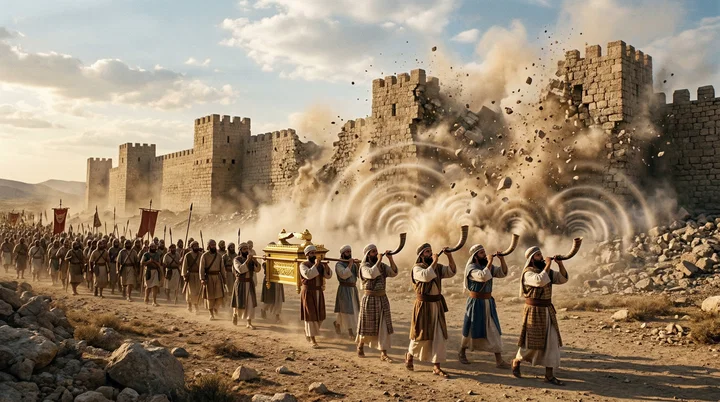
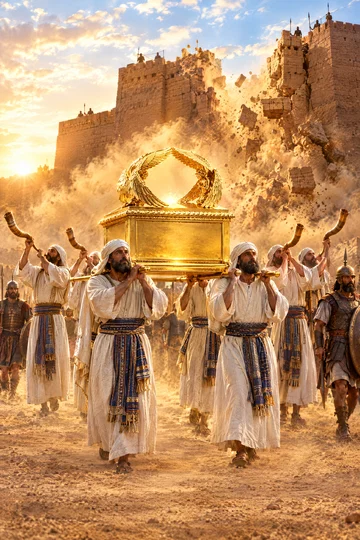
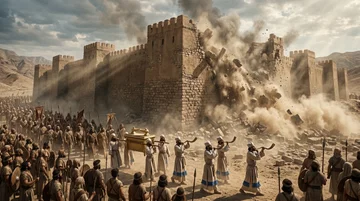
And seven priests bearing seven trumpets of rams’ horns before the ark of the LORD went on continually, and blew with the trumpets: and the armed men went before them; but the rereward came after the ark of the LORD, the priests going on, and blowing with the trumpets.
Translations
And seven priests bearing seven trumpets of rams’ horns before the ark of the LORD went on continually, and blew with the trumpets: and the armed men went before them; but the rear guard came after the ark of the LORD, the priests going on, and blowing with the trumpets.
And seven priests bearing seven trumpets of rams’ horns before the ark of the LORD went on continually, and blew with the trumpets: and the armed men went before them; but the rereward came after the ark of the LORD, the priests going on, and blowing with the trumpets.
And seven priests bearing seven trumpets of rams’ horns before the ark of the Lord went on continually, and blew with the trumpets: and the armed men went before them; but the rereward came after the ark of the Lord, the priests going on, and blowing with the trumpets.
And seven priests bearing seven trumpets of rams' horns before the ark of the LORD went on continually, and blew with the trumpets: and the armed men went before them; but the rear-guard came after the ark of the LORD, the priests going on, and blowing with the trumpets.
And the seven priests bearing the seven trumpets of rams’ horns before the ark of the LORD went on continually, and blew with the trumpets; and the armed men went before them; and the rearward came after the ark of the LORD, the priests blowing with the trumpets as they went.
And the seven priests bearing the seven trumpets of rams’ horns before the ark of Jehovah went on continually, and blew the trumpets: and the armed men went before them; and the rearward came after the ark of Jehovah, the priests blowing the trumpets as they went.
and seven priests bearing seven trumpets of the jubilee before the ark of Jehovah are walking, going on, and they have blown with the trumpets — and he who is armed is going before them, and he who is gathering up is going behind the ark of Jehovah — going on and blowing with the trumpets.
And the seven priests carrying the seven blast-trumpets before the ark of Jehovah went on and blew continually with the trumpets; and the armed men went before them, and the rearguard went after the ark of Jehovah; they blew with the trumpets in marching.
and, the seven priests who bare the seven rams’ horns before the ark of Yahweh, went on and on, and blew with the horns,—with, the armed host going on before them, and, the rear-guard, coming after the ark of Yahweh, going on and blowing with the horns.
Berean Standard Bible, Majority Standard Bible
And the seven priests carrying seven rams’ horns kept marching ahead of the ark of the LORD and blowing the horns. The armed troops went in front of them and the rear guard followed the ark of the LORD, while the horns kept sounding.
The seven priests bearing the seven trumpets of rams’ horns in front of the LORD’s ark went on continually, and blew the trumpets. The armed men went in front of them. The rear guard came after the LORD’s ark. The trumpets sounded as they went.
And the seven priests with their seven horns went on before the ark of the Lord, blowing their horns: the armed men went before them, and the mass of the people went after the ark of the Lord, blowing their horns.
Also seuen Priests bare seuen trumpets of rams hornes, and went before the Arke of the Lord, and going blewe with the trumpets: and the men of armes went before them, but the gathering hoste came after the Arke of the Lord, as they went and blewe the trumpets.
Douay-Rheims (Challoner revision)
And seven of them seven trumpets, which are used in the jubilee: and they went before the ark of the Lord walking and sounding the trumpets: and the armed men went before them, and the rest of the common people followed the ark, and they blew the trumpets.
Pictures
Cross-references 20 of 21
- Hebrews 11:30
By faith the walls of Jericho fell down, after they were compassed about seven days.
Jericho’s walls fell after Israel’s faithful march around them.
- Joshua 6:20
So the people shouted when the priests blew with the trumpets: and it came to pass, when the people heard the sound of the trumpet, and the people shouted with a great shout, that the wall fell down flat, so that the people went up into the city, every man straight before him, and they took the city.
The march and trumpet blasts culminated in Jericho’s walls falling.
- Joshua 5:13-15
And it came to pass, when Joshua was by Jericho, that he lifted up his eyes and looked, and, behold, there stood a man over against him with his sword drawn in his hand: and Joshua went unto him, and said unto him, Art thou for us, or for our adversaries?
The divine commander appears to Joshua before leading the victory at Jericho.
- Judges 7:20
And the three companies blew the trumpets, and brake the pitchers, and held the lamps in their left hands, and the trumpets in their right hands to blow withal: and they cried, The sword of the LORD, and of Gideon.
Both show God using feeble means to rout an enemy and win victory.
- Exodus 25:21
And thou shalt put the mercy seat above upon the ark; and in the ark thou shalt put the testimony that I shall give thee.
The ark and mercy seat accompany the march around Jericho.
- 1 Samuel 4:3-11
And when the people were come into the camp, the elders of Israel said, Wherefore hath the LORD smitten us to day before the Philistines? Let us fetch the ark of the covenant of the LORD out of Shiloh unto us, that, when it cometh among us, it may save us out of the hand of our enemies.
Israel brings the ark into battle but is defeated and loses it.
- Joshua 3:17
And the priests that bare the ark of the covenant of the LORD stood firm on dry ground in the midst of Jordan, and all the Israelites passed over on dry ground, until all the people were passed clean over Jordan.
Priests bearing the ark lead Israel at the Jordan and at Jericho.
- 1 Kings 16:34
In his days did Hiel the Beth-elite build Jericho: he laid the foundation thereof in Abiram his firstborn, and set up the gates thereof in his youngest son Segub, according to the word of the LORD, which he spake by Joshua the son of Nun.
Records the fulfillment of the curse against rebuilding Jericho.
- Joshua 2:1
And Joshua the son of Nun sent out of Shittim two men to spy secretly, saying, Go view the land, even Jericho. And they went, and came into an harlot’s house, named Rahab, and lodged there.
The spies first visited Jericho before its fall.
- Joshua 6:3-5
And ye shall compass the city, all ye men of war, and go round about the city once. Thus shalt thou do six days.
The Lord commands Israel to march around Jericho.
- Exodus 25:16
And thou shalt put into the ark the testimony which I shall give thee.
The ark carried the covenant testimony.
- Revelation 8:2
And I saw the seven angels which stood before God; and to them were given seven trumpets.
both feature seven trumpets
- Revelation 11:19
And the temple of God was opened in heaven, and there was seen in his temple the ark of his testament: and there were lightnings, and voices, and thunderings, and an earthquake, and great hail.
The ark carried by Israel is applied to the ark in heaven.
- Joshua 6:26
And Joshua adjured them at that time, saying, Cursed be the man before the LORD, that riseth up and buildeth this city Jericho: he shall lay the foundation thereof in his firstborn, and in his youngest son shall he set up the gates of it.
Both describe destruction as appointed judgment.
- 1 Samuel 4:21-22
And she named the child I-chabod, saying, The glory is departed from Israel: because the ark of God was taken, and because of her father in law and her husband.
The ark’s capture was mourned as the glory departing from Israel.
- Joshua 6:2
And the LORD said unto Joshua, See, I have given into thine hand Jericho, and the king thereof, and the mighty men of valour.
God declares that he has given Jericho into Israel’s hand.
- Hebrews 9:4
Which had the golden censer, and the ark of the covenant overlaid round about with gold, where in was the golden pot that had manna, and Aaron’s rod that budded, and the tables of the covenant;
The ark carried at Jericho is identified as the ark in the Most Holy.
- Numbers 14:44-45
But they presumed to go up unto the hill top: nevertheless the ark of the covenant of the LORD, and Moses, departed not out of the camp.
Defeat without the ark contrasts with Israel’s victory at Jericho.
- 2 Samuel 6:11-12
And the ark of the LORD continued in the house of Obed-edom the Gittite three months: and the LORD blessed Obed-edom, and all his household.
The ark’s presence brought blessing to Obed-edom’s household.
- Exodus 26:33
And thou shalt hang up the vail under the taches, that thou mayest bring in thither within the vail the ark of the testimony: and the vail shall divide unto you between the holy place and the most holy.
The ark’s place in the Most Holy shows its honor.
Commentary
Each commentary is drawn from primary sources: the writings of Ellen G. White and Adventist pioneers and periodicals. Each commentary is separate. Its own words are not a quotation; follow the references to read the source passages.
Ellen G. White
21 sources
Joshua 6:13 describes the ordered procession around Jericho with chosen armed men first, then seven priests continually blowing seven trumpets of rams' horns before the ark of the Lord, then the ark itself, then the rear guard, with the whole host following tribe by tribe under its standard.ST Oct 19, 1888PP 487.34T 160.1 The march was made in solemn silence except for the tread of the host and the peal of the trumpets, while the sacred dress of the priests and the glory surrounding the ark struck terror into the guarded city behind its closed gates.ST Oct 19, 18884T 160.1ST Apr 14, 1881 They compassed the city once a day for six days and seven times on the seventh day, when at the close of the circuit the trumpets sounded, the people shouted, and the massive stone walls fell in ruin before Israel took possession.ST Apr 14, 1881PP 488.3–491.14T 148.3 Heaven was present with the circuit, for Jesus the Captain of the Lord's host went before the ark attended by angels, and Christ and angels cast down the walls and delivered the city into Israel's hands.SG4 64.1–21SP 399.2 The conquest was wholly the Lord's and not by human strength or skill, and Israel's part was obedient faith in God's promise and directions under His appointed leadership, showing that God works by principles widely different from the world and gives victory when humble human effort unites with His power.ST Oct 19, 1888PP 487.3PP 488.3–491.14T 148.3
March Around Jericho
The procession was in strict order: a chosen body of armed men went first, then seven priests bearing seven trumpets of rams' horns before the ark of the LORD going on continually and blowing, then the ark itself carried by priests, then the rear guard coming after the ark, with the rest of the host following in perfect order each tribe under its standard.ST Oct 19, 1888PP 487.34T 160.1ST Apr 14, 1881PP 488.3–491.1 The armed men marched ahead and the rear guard followed behind as the priests kept blowing their trumpets before the ark in fulfillment of the commanded circuit.ST Oct 19, 1888PP 487.3Lt 58, 1895, par. 22–25 Each part — priests, armed men, and those bringing up the rear — carried out its assigned place in the ordered march around Jericho.ST Oct 19, 1888PP 487.3Lt 58, 1895, par. 22–25
The circuit was made in solemn silence except for the measured tread of the host and the peal of the trumpets echoing among the hills and through the streets, the only sounds to be heard.ST Oct 19, 18884T 160.1ST Apr 14, 1881PP 488.3–491.1 The people were to remain silent until commanded to shout at Joshua's word.ST Oct 19, 1888PP 488.3–491.1 The priests wore rich dress denoting their sacred office and the ark was surrounded by a halo of divine glory.ST Apr 14, 1881 The pomp and majesty of the armed guard, the priests, and the sacred ark struck terror and awe into the watchmen, priests, and people of Jericho behind closed and guarded gates.ST Apr 14, 1881
The army marched out from Gilgal, its first encampment in the promised land, to begin the conquest.ST Jul 27, 1882 Its object was Jericho, the key to Canaan, approached nearly forty years after the rebellion at Kadesh with the Lord's promise to go with them.4T 148.3PP 393.2–3 They compassed the city once each day for six days and seven times on the seventh day beginning at first dawn.ST Apr 14, 1881PP 488.3–491.1 After the trumpets had for an interval been silent they broke forth at the close of the seventh circuit in a blast that shook the earth, and the people shouted with a loud voice because God had given them the city.PP 488.3–491.1 Then the massive walls of solid stone with their towers and battlements tottered and heaved from their foundations and fell in ruin, the inhabitants were paralyzed with terror, and Israel marched in and took possession.PP 488.3–491.1 The ark was carried around the city for seven days in solemn silence, and when the trumpets sounded and the people shouted, the walls fell.
Heaven was present with the circuit, for Jesus the Son of God, the Captain of the Lord's host, went before the repository of His law attended by heavenly angels.SG4 64.1–21SP 399.2 Four angels always accompanied the ark in all its journeyings to guard it from all danger and to fulfill any mission required in connection with it.1SP 399.2 Christ and angels finally cast down the massive walls of the city and delivered Jericho into the hands of Israel.SG4 64.1–21SP 399.2
Victory Through Obedient Faith
The conquest of Jericho was wholly the Lord's work and not the product of Israel's strength, skill, or military power.ST Oct 19, 1888PP 487.3PP 488.3–491.1SG4 64.1–2 No human hand touched the walls, but the armies of the Lord's host under their heavenly General did the work, for it was Christ rather than Joshua who accomplished the victory.ST Oct 19, 1888SG4 64.1–2Ms 32, 1897, par. 7–10 The trumpet blast was made effective by God's power to overthrow His enemies, showing His power to defeat Israel's foes, strengthening the faith of Israel, and rebuking their earlier unbelief.PP 488.3–491.1SG4 64.1–2ST Jul 21, 1881 That victory was unlike any in the history of nations, won by simple means against all the power and skill of a bold, warlike race, and it must be ascribed to God alone to glorify His name and to bring His enemies to shame and confusion.ST Jul 21, 1881
The battle plan was simple by design of the mighty General of armies so that no human being could take glory to himself and no person could boast or claim credit.Lt 58, 1895, par. 22–25Ms 143, 1899, par. 22–23Lt 63, 1895, par. 34–38Lt 51, 1895, par. 8–13 God led the army and united divine and human agency, while no human hand touched the walls, and God alone was to receive the glory and be exalted.Lt 58, 1895, par. 22–25Lt 63, 1895, par. 34–38Lt 51, 1895, par. 8–13 The work must be left in the hands of the great I AM in His own way, for God is Instructor and Worker through whom He will, and men must not draw attention to themselves or their prominence, desire too much power and control, feel qualified to hold the highest place, or take to themselves glory for the work accomplished.Ms 143, 1899, par. 22–233MR 21.1–22.3
Israel's strength lay in walking in obedience and belief, trusting God's promise to give the land and obeying His directions and His appointed leaders under divine supervision, with whom no harm could come to them.4T 148.3PP 393.2–3 The sacredness of the ark and the promised blessing were bound to obedience to God's law contained in it, which represents God Himself, and not to the ark as a mere object or its bare presence.SG4 105.1–21SP 402.3–403.1 This obedient condition, when the ark was borne by holy men by express command with the Captain of the Lord's host going before the repository of His law to bring deliverance, stands in contrast to later going into battle without God and without appointed leadership, merely bringing the ark into camp when borne by sons of Belial, when following their own plans in opposition to divine counsel and authority the law under the mercy-seat condemned Israel to defeat, disaster, and death.SG4 105.1–21SP 402.3–403.1PP 393.2–3
The capture, in which no human general devised the plan and no human hand touched its massive walls, was to be kept fresh in memory and repeated to children when they inquired about memorials, as an exhibition of God's power.Lt 8a, 1896, par. 8–9 Like the deliverance from bondage that they might serve Him and keep His Sabbaths, the water from the rock, the bread sent from heaven, and the commandments often repeated and kept before the mind, the order of armed men, seven priests blowing trumpets of rams' horns before the ark of the Lord, and the rereward as the Captain of the Lord's host giving His orders to the heavenly army until down came the walls was to be told to children.Lt 8a, 1896, par. 8–9
God's principles and modes of working are widely different from those of the world, and it is not safe for God's people to adopt the maxims and customs of the ungodly.ST Jul 21, 1881 Human methods apart from God's power and wisdom fail, while even an unpromising method succeeds when God appoints it and His people act with humility and faith.ST Jul 21, 1881PP 553.2–554.1 The only sure ground of success is the help of God working with human effort, not trust in own wisdom and skill, through humble trust, faith, and implicit obedience irrespective of the world's opinion, preserving simplicity of faith.ST Jul 21, 1881 The work must be left in the hands of the great I AM in His own way, with men obeying God, following Jesus the Captain instead of running ahead of Him, giving God a chance to work rather than centering all ordering in finite men in one place or desiring too much power, control, and the highest place.Ms 143, 1899, par. 22–23Ms 32, 1897, par. 7–10 The same God is still willing to work by whom He will, not by might nor by power but by His Spirit, and the lesson is to follow the directions of Jesus with the faith of faithful Calebs, trusting Him in Christian spiritual warfare against unseen foes more formidable than giants, for the devil cannot be overcome save by the sword of the Spirit.ST Jul 21, 18813MR 21.1–22.3
Sources
Pioneers and periodicals
65 sources
The verse shows the ordered march around Jericho with armed men going ahead, seven priests carrying seven rams'-horn trumpets walking before the ark of the Lord and blowing continually, and the rear guard following behind the ark.ST Oct 19, 1888ST Apr 14, 1881ST Sep 12, 1895 The march moved in solemn silence apart from the tread of the host and the sound of the trumpets, until the final long blast and shout when the wall fell flat.ST Oct 19, 1888RH Feb 24, 1910RH Sep 8, 1904 The walls were thrown down not by human weapons or military skill but by the Lord and His heavenly host, received through faith that obeys His instructions even when the reason is not seen.ST Oct 19, 1888ST Mar 21, 1911ST Sep 12, 1895ST Oct 8, 1902ST Mar 20, 1901 Victory came by working in exact harmony with God's appointed way, time, place and order, each in his marked place, while deviation and carelessness mar the work.RH Feb 6, 1879 The circling through seven days including the Sabbath was commanded religious service and not a breach of the Sabbath, and the power attending the ark witnessed to the enduring authority of the law within it.RH Jan 21, 1862RH Jul 27, 1876RH Feb 3, 1852RH Dec 20, 1853RH Aug 11, 1853
Procession Order and Sound
The march was ordered with armed men going ahead, seven priests bearing seven rams'-horn trumpets walking before the ark of the LORD and going on continually blowing them, and the rear guard coming after the ark.ST Oct 19, 1888ST Sep 12, 1895RH Jan 21, 1862ST Oct 8, 1902 The seven priests kept marching before the ark with their seven trumpets and blowing them without ceasing, while the armed advance held the front and the rereward closed the procession behind the ark.ST Sep 12, 1895RH Jan 21, 1862ST Oct 8, 1902ST Mar 20, 1901 This was the commanded circuit around Jericho, carried out in obedience through the seven days until God brought the walls down.ST Sep 12, 1895ST Oct 8, 1902
It was made in solemn silence, with no sound except the tread of the host and the peal of the trumpets, the people remaining silent until commanded to shout.ST Oct 19, 1888ST Apr 14, 1881 At the end of the final circuit the priests sounded a long blast and the people shouted, and the wall fell flat.RH Feb 24, 1910RH Sep 8, 1904ST Mar 20, 1901 The whole people and not only the warriors took part in the circling, and the ark went with the host around the city once each day for six days and seven times on the seventh day.RH Feb 24, 1910RH Sep 8, 1904ST Mar 20, 1901
The armed advance was a chosen body set not to use skill in warfare but to trust and obey the instructions given.ST Apr 14, 1881 The ark was surrounded by a halo of divine glory and was carried by priests in rich dress denoting sacred office, and behind it the vast army followed in perfect order, each tribe under its standard.ST Apr 14, 1881 The pomp and majesty of guard, priests, and sacred ark, with the tramp and trumpet peal echoing among the hills and through the streets, struck terror and awe into the watchers, priests, and people behind Jericho's closed and guarded gates.ST Apr 14, 1881
Seven runs through the whole account, for seven priests bore seven trumpets for seven days, circled seven times on the seventh day, and the walls fell after the seventh round.RH Jan 22, 1857RH Sep 15, 1874 The verse continues the conversation between the Captain of the Lord's host and Joshua across the chapter division, with the first verse of chapter 6 standing as a parenthesis rather than a break.RH Jan 8, 1861
Historical Setting and Timing
Israel compassed Jericho with the ark once each day for six days and seven times on the seventh day.ST Apr 14, 1881RH Feb 24, 1910 The march went out from Gilgal, Israel's first encampment in the promised land, for the overthrow of the city.ST Jul 27, 1882 Jericho was the first city taken after crossing the Jordan, forty years after the spies came, and its siege ended with the overthrow of its walls by faith.RH Aug 24, 1905 The movement from Egypt to the promised land passed through the heaped-up Jordan to Jericho, whose ramparts fell before Israel came on into Palestine with its hills, vales, brooks, springs, milk and honey.RH Nov 21, 1854 The ordered march around the city had armed men in front, priests blowing trumpets before the ark, and a rear guard following.RH Feb 24, 1910ST May 27, 1908
Jericho was the first-fruit of the evil land of Canaan, appointed to utter destruction at Joshua's hands as a devoted city.ST Mar 21, 1911RH Aug 24, 1905 The conquest of Canaan under Joshua belongs to the fifteenth century before Christ.RH Aug 31, 1905 It is corroborated by the Tel el-Amarna tablets, letters between Asiatic and Egyptian kings in which Canaanite rulers including Abdi-Hiba of Jerusalem implore Egypt to send troops against the Habiri making inroads and taking the king's land, and those Habiri are the Hebrews.RH Aug 31, 1905 That conquest is a real historical event, not a fiction.ST Apr 20, 1904
The circling continued for seven consecutive, successive days, so that one of the days was the Sabbath.RH Jan 21, 1862RH Feb 3, 1852RH Jun 19, 1856 In all probability Israel went around seven times on the Sabbath.RH Apr 11, 1854 Yet the first day and the seventh day are the first and seventh days of the compassing, not the first and seventh days of the week, just as first day and seventh day in the feasts are days of the feast.RH Oct 15, 1872 Therefore the account does not require that the final day, when the city was taken, was the Sabbath.RH Jan 21, 1862RH Oct 15, 1872
The week-long march gave Jericho's inhabitants time to open their gates and receive God's people.ST Mar 20, 1901 It was part of the opportunity given them to welcome Israel before the walls fell. The march gave the people time to turn to Jehovah's mercy, and those willing to trust Him could be saved, as Rahab and her household were.ST Oct 8, 1902 Jericho's destruction could have become its salvation if it had welcomed Israel.
Faith Obedience and Victory
The walls fell not by human power, weapons, or military skill but by the Lord and His heavenly host leveling them, with the Captain of Jehovah's hosts present in the work of victory and myriads of unseen angels throwing them down, while Israel's part was only to march and sound the trumpets around the city.ST Oct 19, 1888ST Mar 21, 1911ST Mar 20, 1901ST Oct 20, 1914RH Jul 1, 1873 The ordered march belonged to God's plan to take the city, and after the final trumpet blast and the people's shout God's invisible army brought the walls down.ST Oct 20, 1914ST Mar 20, 1901 Jericho fell through faith that obeys God's word and instructions even when the reason was not understood, perfecting faith before God gave the victory.ST Sep 12, 1895ST Oct 8, 1902RH Sep 8, 1904 The whole people and not only the warriors took part, in persistence, order, and earnest action after preparation, carrying out the appointed marches in a campaign marked by haste rather than delay, and the overthrow is presented as a Bible incident illustrating faith as the means by which victory was given.RH Nov 22, 1906RH Mar 21, 1912RH Sep 8, 1904RH Aug 24, 1905
Success came from working in harmony with God's plan and doing all He said in the exact way, time, and place He commands, each part in its marked place with armed men before, seven priests bearing seven trumpets before the ark going on continually and blowing, and the rear guard after the ark.RH Feb 6, 1879 The march succeeded because the angels of God cooperated at the appointed time on the very days God told them to act, and had Israel taken their own time they might have marched long without angelic help. Doing what God commands is easy when done with the Spirit of Christ, so the work seemed hard is done easily and quickly by angels, while any substitution, carelessness, or deviation mars the work, costs time and labor to correct, and may result in utter ruin.RH Feb 6, 1879 The triumph was fully organized from least to greatest, with Joshua taking all the people for the finishing of the conflict.RH Sep 8, 1904RH Oct 29, 1914
The fall pledged that the same mighty power would give deliverance and victory at every step, possession of all the land, and the promised rest if Israel wholly surrendered and obeyed.ST Mar 21, 1911ST Mar 10, 1909ST Jan 22, 1894ST Mar 10, 1909 The victory at Jericho, first-fruit of the evil land of Canaan, came by trust in contrast to the defeat at Ai when Israel failed to trust, and had Israel stayed faithful they would soon have possessed all the land and found rest.ST Mar 21, 1911ST Feb 14, 1906 But Achan's covetousness and disobedience with sin remaining in the camp halted the advance, and after the triumph general backsliding brought defeat, repeated captivity, and years lived in adversity that might have been lived in prosperity.ST Mar 21, 1911ST Jan 22, 1894ST Feb 14, 1906 The strength was not the wooden chest itself but the law of God within the ark, and the victory did not come from the ark as a mere object or material symbol.ST Jun 10, 1875RH Dec 10, 1861 Its sacredness and the promised blessing were bound to God's law and Israel's obedience, with the mercy seat above the law signifying mercy toward the sinful city, so the sacred principles of His holy law had to be part of the very lives of the people.ST Mar 20, 1901
Form and external machinery without moral and spiritual conditions could not give victory, and without God's presence the ark could not conceal sin or avert punishment when brought into battle in rebellion after He had departed.RH Aug 28, 1856RH Apr 20, 1876 Those commandments in the ark remain binding until heaven and earth pass away, and when iniquity is regarded in the heart the Lord will not hear.RH Dec 10, 1861 God's principles and modes of working are widely different from those of the world, using simple and feeble weapons such as rams'-horn trumpets to accomplish mighty results.ST Jul 21, 1881ST May 6, 1875RH Apr 15, 1875 Walled cities could not prevent Him from giving what He promised, as the overthrow of Pharaoh and the opening of the Red Sea and the dry-shod crossing of the Jordan had already shown, and success is certain when labor is done in God even through severe toil.ST May 13, 1889ST May 6, 1875RH Jul 1, 1873
The victory was unlike any in the history of nations, won by simple means against all the power and skill of a bold, warlike race, and must be ascribed to God alone.ST Jul 21, 1881 It glorified God's name, strengthened Israel's faith, and brought enemies to shame and confusion.ST Jul 21, 1881 The only sure ground of success is the help of God working with human effort, not trust in own wisdom and skill, and it is not safe to adopt the maxims and customs of the ungodly.ST Jul 21, 1881 The only safe course is to preserve simplicity of faith, with humble trust in God and faithful, implicit obedience to His commands irrespective of the world's opinion, which remains essential in Christian spiritual warfare.ST Jul 21, 1881 When walking in obedience the ark was borne by holy men by express command with the Captain going before the repository of His law and His arm bringing deliverance, in wide contrast to following own plans in opposition to divine counsel with the ark borne by sons of Belial when the law under the mercy-seat condemned Israel to defeat, disaster, and death. That same implicit willingness to do anything God asks will enable the 144,000, naturally the weakest people, to stand calmly without fear through scorching sun, earthquakes, darkened nature, and great hail while others hide, and to sing the song of Moses and the Lamb.
Sabbath Law and Sanctuary
The march around Jericho continued for seven consecutive days and therefore included a Sabbath, yet carrying the ark, sounding the sacred trumpets, and circling the city did not violate the fourth commandment because the work was religious service performed by God's express command rather than ordinary labor forbidden on the Sabbath.RH Jan 21, 1862RH Jul 27, 1876RH Feb 3, 1852RH Jun 19, 1856RH Apr 11, 1854 The Sabbath forbids man's own work, not obedience to what God directs, so the commanded procession with armed men ahead, seven priests continually blowing rams'-horn trumpets before the ark of the LORD, and the rear guard following after it was lawful on that day.RH Jan 21, 1862RH Jul 27, 1876RH Feb 3, 1852RH Jun 19, 1856 God's own working on that day to throw down the walls for Israel was likewise not contrary to His own precepts concerning the day.RH Apr 11, 1854 The account does not require that the final day of compassing, when the city was taken, was the Sabbath, though those who held the other reckoning taught that in all probability the seven circuits fell on the Sabbath.RH Jan 21, 1862RH Apr 11, 1854
The ark that accompanied the march was beautiful, overlaid and inlaid with purest gold, and it held the ten precepts spoken by God at Sinai amid smoke, lightning, and thunder and engraved by His finger on tables of stone, including the fourth commandment.RH Dec 20, 1853RH Aug 11, 1853 It stood at the center of Israel's religious system as the glory of Israel and was afterward placed in the Most Holy of the earthly sanctuary.RH Dec 20, 1853RH Aug 11, 1853 It accompanied Israel's victories and held the fourth commandment, showing its place at the center of Israel's religious life.RH Dec 20, 1853RH Aug 11, 1853RH Aug 13, 1857
The divine power attending the ark and the law within it at Jericho, at the crossing of the Jordan, and in battle proves the enduring authority of that law and its Sabbath precept.RH Dec 20, 1853RH Aug 11, 1853 The walls did not fall from the priests' trumpet blasts alone but through obedience to God's command to follow the ark containing the Ten Commandments, which remain binding until heaven and earth pass away.RH Dec 20, 1853RH Aug 11, 1853RH Dec 10, 1861 It is therefore preposterous to suppose that God, having so honored the law in the ark, would abolish the Sabbath without one plain testimony of Inspiration, and awfully presumptuous to risk eternal salvation by violating the fourth commandment on mere inferences.RH Dec 20, 1853RH Aug 11, 1853 Israel's triumph is linked with having the ark with them, for the priests blowing trumpets before the ark marched in the procession and the ark accompanied their victories.RH Aug 13, 1857RH Dec 11, 1866
That success at Jericho later led Israel to suppose that merely bringing the ark into battle would protect them.RH Aug 28, 1856RH Apr 20, 1876 The ark itself, however, could not protect them after God had departed from them, nor conceal their sin nor avert punishment when they brought it into battle while living in rebellion.RH Aug 28, 1856RH Apr 20, 1876
Practical Applications for Believers
The march around Jericho teaches zeal, service and obedience through a consecrated people who follow God's instructions rather than win by fighting, with God Himself accomplishing the work when the seventh circuit was completed and the shout was given.RH May 29, 1913RH Jan 28, 1902 When God's people sanctify themselves and move forward in faith, obstacles give way and the way to the promised inheritance is opened, for the victory is already theirs through God.RH Jan 28, 1902RH Sep 21, 1916 The lesson is to trust Christ's accomplished victory and press on rather than celebrating before the outcome is reached, acting in dependence on God in undertakings that seem difficult.RH Jan 28, 1902RH Dec 18, 1900 In the crisis after Moses, God had Joshua to lead across the Jordan and bring down the walls, willing in the day of God's power, showing that in every crisis God has a people willing to meet the issue.RH May 13, 1915
The triumph came when Joshua took all the people with him and organized them from least to greatest for finishing the conflict, and that complete organization is the pattern for finishing God's work now.RH Oct 29, 1914 Every believer from oldest pioneer to little children must join in whole-hearted consecration and active service, placing life, property and all at God's disposal, which will speedily finish the work and bring certain victory at the Lord's appearing.RH Oct 29, 1914 The priests marching before the ark and continually blowing the trumpets as Israel advanced is invoked as the image for accomplishing difficult work through united action.RH Dec 28, 1911 So too the marching and trumpet-blowing becomes marching around New England by prayer, meeting early every morning to wrestle with God for blessing, for removal of reproach, for cheering tried workers in a hard field, and for dear friends outside the ark of safety.RH Aug 3, 1876
The approaching walls that did not stop Israel when God led them picture canvassers advancing in God's work through humble, despised means.RH Oct 8, 1908 The rams'-horn trumpets carried before the ark were feeble weapons, yet God used them to accomplish the mighty overthrow of the city, proving that God can use weak instrumentalities to do great things.ST May 6, 1875RH Apr 15, 1875 Success is certain when labor is done in God even through severe toil and painful labor, as in printing truth in many languages for Europe and in hard press labor, so literature circulation that God leads cannot be stopped by walls.RH Oct 8, 1908ST May 6, 1875RH Apr 15, 1875
Taking up the ark of truth and marching around courageously in the fear of the Lord breaks down the wall of debt.RH Jul 2, 1901 The ark is the truth, the march is all God's people pulling together in united giving, and marching around enough times means persisting until God moves men and women to liberality.RH Jul 2, 1901 Then the wall of debt is eternally leveled never to rise again.RH Jul 2, 1901
The priests were the chief campaigners in taking the city, remaining with the people under Joshua instead of leading from safety.RH Nov 16, 1905 Godly leadership therefore takes its position in front, shares the danger and labor, and stays with the people through the battle.RH Nov 16, 1905 Church officers are to follow that pattern to sound courage, marshal the forces, and stand firm until victory is won.RH Nov 16, 1905
The seven-day march whose walls fell is an example of a stronghold overthrown, like medical work breaking down prejudice.RH Sep 14, 1911 Bold Christian preaching may likewise bring down religious superstition as the religious campaign went around the walls blowing rams' horns.RH Sep 5, 1871 Taking Jerichos means gaining converts and preparing to enter the heavenly Canaan, but the campaign must include only truly converted workers, since an Achan among them can bring defeat.RH Apr 3, 1913 The order of advance with armed men before, seven priests blowing trumpets before the ark, and the rear guard after the ark pictures taking America as Canaan after the desert, with successors as Joshuas going to the Jordan, to Jericho, to Ai and to Jerusalem, with little chapels as fortified camps and men sent as advance guards pointing to new fertile fields where souls are gathered as sweet and beautiful grapes.RH Nov 2, 1911
Fortified Jericho stands for sins entrenched in human nature, and its fall shows that even deeply entrenched sins can be driven out by God's grace, with believers having already overcome many sins and able to keep overcoming through His help.ST Feb 11, 1889 When conviction of wrong comes, meeting it at once with full purpose of heart and whole soul depending on the grace of Christ brings complete victory over sin and appetite.ST Nov 29, 1910 If the wrong is temporized with and yielded to again and again, victory is held for a while then lost, and the appetite is kept alive, God allowing it to remain as a thorn until all compromise is utterly abandoned and the whole soul is cast upon God.ST Nov 29, 1910 The capture teaches children that they face real battles against evil and must fight the battle of faith, sometimes by following God's direction to march around the enemy rather than strike directly.RH Nov 17, 1910RH Sep 23, 1862
Sources