Exodus 26:33
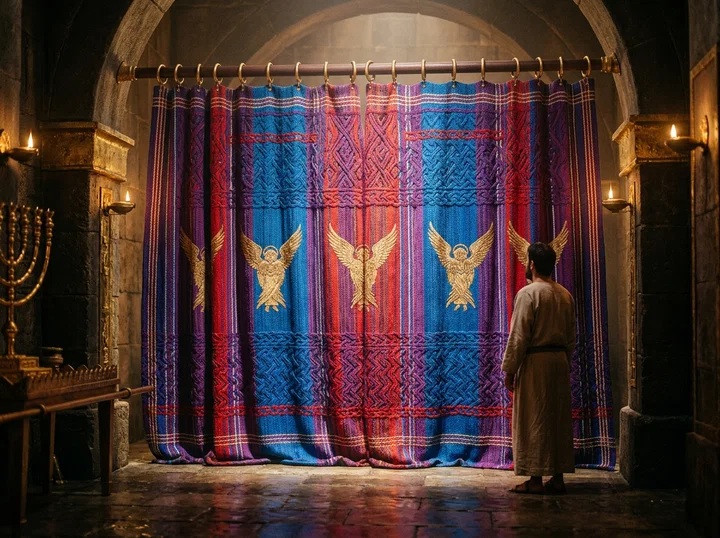
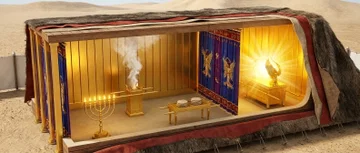
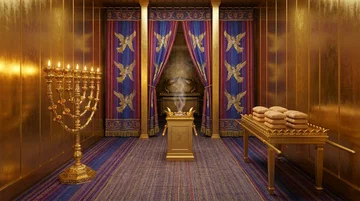
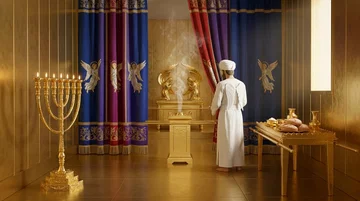
And thou shalt hang up the vail under the taches, that thou mayest bring in thither within the vail the ark of the testimony: and the vail shall divide unto you between the holy place and the most holy.
Translations
And you shall hang up the veil under the clasps, that you may bring in thither within the veil the ark of the testimony: and the veil shall divide to you between the holy place and the most holy.
And thou shalt hang up the vail under the taches, that thou mayest bring in thither within the vail the ark of the testimony: and the vail shall divide unto you between the holy place and the most holy.
And thou shalt hang up the vail under the taches, that thou mayest bring in thither within the vail the ark of the Testimony: and the vail shall divide unto you between the holy place and the most holy.
And thou shalt hang the vail under the buttons, that thou mayst bring in thither within the vail the ark of the testimony: and the vail shall divide to you between the holy place and the most holy.
And thou shalt hang up the veil under the clasps, and shalt bring in thither within the veil the ark of the testimony: and the veil shall divide unto you between the holy place and the most holy.
And thou shalt hang up the veil under the clasps, and shalt bring in thither within the veil the ark of the testimony: and the veil shall separate unto you between the holy place and the most holy.
'And thou hast put the vail under the hooks, and hast brought in thither within the vail the ark of the testimony; and the vail hath made a separation for you between the holy and the holy of holies.
And thou shalt bring the veil under the clasps, and bring in thither, inside the veil, the ark of the testimony; and the curtain shall make a division to you between the holy [ place] and the holiest of all.
And thou shalt hang up the veil under the clasps,—and shalt bring in thither, within the veil the ark of the testimony; and the veil shall make a division for you between the holy [place] and the most holy.
Berean Standard Bible, Majority Standard Bible
And hang the veil from the clasps and place the ark of the Testimony behind the veil. So the veil will separate the Holy Place from the Most Holy Place.
You shall hang up the veil under the clasps, and shall bring the ark of the covenant in there within the veil. The veil shall separate the holy place from the most holy for you.
And you are to put up the veil under the hooks, and put inside it the ark of the law: the veil is to be a division between the holy place and the most holy.
Afterward thou shalt hang the vaile on the hookes, that thou mayest bring in thither, that is (within the vaile) the arke of the Testimonie: and the vaile shall make you a separation betweene the Holy place and the most holy place.
Douay-Rheims (Challoner revision)
And the veils shall be hanged on with rings, and within it thou shalt put the ark of the testimony, and the sanctuary, and the holy of holies shall be divided with it.
Pictures
Cross-references 20 of 56
- Hebrews 9:1-5
Then verily the first covenant had also ordinances of divine service, and a worldly sanctuary.
Describes the two apartments and the ark behind the veil.
- Exodus 25:8-9
And let them make me a sanctuary; that I may dwell among them.
The command to make God a sanctuary introduces the sanctuary whose construction Exodus 26:33 details.
- Hebrews 8:1-2
Now of the things which we have spoken this is the sum: We have such an high priest, who is set on the right hand of the throne of the Majesty in the heavens;
Christ ministers as high priest in the true heavenly sanctuary, foreshadowed by the earthly tabernacle.
- Exodus 25:21-22
And thou shalt put the mercy seat above upon the ark; and in the ark thou shalt put the testimony that I shall give thee.
God meets and speaks above the mercy seat between the cherubim.
- Hebrews 9:24
For Christ is not entered into the holy places made with hands, which are the figures of the true; but into heaven itself, now to appear in the presence of God for us:
The earthly holy places are figures of the true heavenly sanctuary where Christ appears.
- Exodus 25:16
And thou shalt put into the ark the testimony which I shall give thee.
The testimony is placed inside the ark, which stands behind the veil.
- Revelation 11:19
And the temple of God was opened in heaven, and there was seen in his temple the ark of his testament: and there were lightnings, and voices, and thunderings, and an earthquake, and great hail.
The heavenly temple is opened, and the ark of God’s covenant is seen.
- Exodus 40:21
And he brought the ark into the tabernacle, and set up the vail of the covering, and covered the ark of the testimony; as the LORD commanded Moses.
Moses brings the ark into the tabernacle and covers it with the veil.
- Leviticus 16:2
And the LORD said unto Moses, Speak unto Aaron thy brother, that he come not at all times into the holy place within the vail before the mercy seat, which is upon the ark; that he die not: for I will appear in the cloud upon the mercy seat.
The ark and mercy seat lie within the veil, where the high priest may enter only at the appointed time.
- Hebrews 8:5
Who serve unto the example and shadow of heavenly things, as Moses was admonished of God when he was about to make the tabernacle: for, See, saith he, that thou make all things according to the pattern shewed to thee in the mount.
The divided earthly sanctuary follows a pattern of heavenly things.
- Acts 7:44
Our fathers had the tabernacle of witness in the wilderness, as he had appointed, speaking unto Moses, that he should make it according to the fashion that he had seen.
The wilderness tabernacle was made according to the pattern shown to Moses.
- Exodus 25:40
And look that thou make them after their pattern, which was shewed thee in the mount.
The sanctuary was made according to the pattern shown to Moses on the mountain.
- Hebrews 9:8
The Holy Ghost this signifying, that the way into the holiest of all was not yet made manifest, while as the first tabernacle was yet standing:
The veil marked the sanctuary division, showing that the way into the holiest was not yet manifest.
- Hebrews 6:19-20
Which hope we have as an anchor of the soul, both sure and stedfast, and which entereth into that within the veil;
Hope enters within the veil, where Jesus has gone as forerunner and high priest.
- Deuteronomy 10:4-5
And he wrote on the tables, according to the first writing, the ten commandments, which the LORD spake unto you in the mount out of the midst of the fire in the day of the assembly: and the LORD gave them unto me.
The commandments were placed in the ark behind the veil.
- Hebrews 10:19
Having therefore, brethren, boldness to enter into the holiest by the blood of Jesus,
Its plural wording refers to the sanctuary’s holy places.
- Exodus 31:18
And he gave unto Moses, when he had made an end of communing with him upon mount Sinai, two tables of testimony, tables of stone, written with the finger of God.
Identifies the testimony as the commandments written on stone tablets.
- Hebrews 9:6-7
Now when these things were thus ordained, the priests went always into the first tabernacle, accomplishing the service of God.
Describes priestly service in both apartments and the high priest’s annual entry into the Most Holy.
- Hebrews 9:11
But Christ being come an high priest of good things to come, by a greater and more perfect tabernacle, not made with hands, that is to say, not of this building;
Christ ministers as High Priest in the greater heavenly sanctuary.
- Revelation 15:5
And after that I looked, and, behold, the temple of the tabernacle of the testimony in heaven was opened:
Names the heavenly temple as the tabernacle of the testimony.
Commentary
Each commentary is drawn from primary sources: the writings of Ellen G. White and Adventist pioneers and periodicals. Each commentary is separate. Its own words are not a quotation; follow the references to read the source passages.
Ellen G. White
17 sources
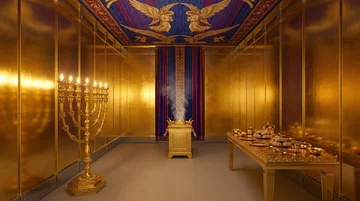
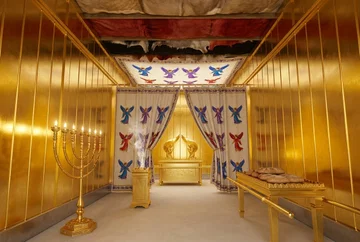
The veil was hung beneath the clasps so that the ark of the testimony could be brought inside it, and it formed the division between the holy place and the most holy.Ms 97, 1899, par. 3–4RH Nov 9, 1905GC 411.2–412.3 It was a rich and beautiful curtain of fine linen in blue, purple, and scarlet with cherubim wrought in gold and silver thread, matching the veil at the entrance and the ceiling curtains of the tabernacle.RH Nov 8, 1915ST Mar 4, 1903DA 774.1 Within that veil above the mercy seat between the cherubim dwelt the glory of the Holiest in His sacred audience chamber, so holy that no one could enter unbidden without death and only the high priest entered once a year with trembling while incense veiled the glory and all worshiped in silent awe.8T 284.3–285.1MH 437.1DA 774.1 At the death of Christ the veil was torn from top to bottom, laying the most holy open and showing that type had met antitype in the infinite sacrifice for sin so that the ritual service with the blood of bulls and goats had no further value.DA 774.1 The earthly sanctuary with its two apartments was a pattern of the heavenly sanctuary, where Jesus lifts the veils to give entrance and offer the prayers of the saints with incense by the ark, passing through the second veil into the most holy in 1844 to intercede where the Ten Commandments are kept.RH Jul 21, 1851CET 91.2–3SG1 158.1ST Mar 4, 1903EW 25.6
Veil in Tabernacle Structure
The veil was to hang beneath the clasps so that the ark of the testimony could be brought within it, and it was to divide between the holy place and the most holy.Ms 97, 1899, par. 3–4RH Nov 9, 1905GC 411.2–412.3GC88 411.1–412.3Ms 2, 1852, par. 2 The wilderness tabernacle built at God's command as His earthly dwelling while Israel journeyed had, besides an outer court containing the altar of burnt offering, two apartments called the holy and the most holy.RH Nov 8, 1915 Though so constructed that it could be taken apart and carried from place to place in all their journeyings, it was a structure of great magnificence.RH Nov 8, 1915ST Mar 4, 1903 Its walls were upright boards heavily plated with purest gold set in sockets of silver, and its roof was formed of layered curtains or coverings, the outer of skins and the innermost of fine linen beautifully wrought with figures of cherubim.RH Nov 8, 1915ST Mar 4, 1903
The dividing curtain was a rich and beautiful veil, a heavy tapestry of pure linen in varied colors most beautifully arranged, wrought with gold, scarlet and purple.RH Nov 8, 1915ST Mar 4, 1903DA 774.1GC88 411.1–412.3 Cherubim were inwrought with threads of gold and silver.ST Mar 4, 1903DA 774.1 A similar veil closed the entrance to the first apartment, and these veils together with the curtain forming the ceiling of the tabernacle matched in material and workmanship.RH Nov 8, 1915ST Mar 4, 1903
The ark placed within the veil in the most holy place is called the ark of the testimony because it contained the stone tables bearing God's Ten Commandments.1SP 273.1SG1 158.1 The veil did not reach to the top of the building, so the glory above the mercy seat could be seen from both apartments, though less clearly from the holy place.1SP 273.3 Its specifications, like the skill and wisdom used to build the tabernacle, were given by God for His glory.Ms 97, 1899, par. 3–4 The tabernacle was God's dwelling place on earth where He met with people after the fall and where His voice was often heard.Ms 97, 1899, par. 3–4Ms 126, 1901, par. 4–6
Guarded Divine Presence
Within the veil, above the mercy seat between the cherubim, dwelt the glory of the Holiest with worshiping angels.8T 284.3–285.1MH 437.1GC88 411.1–412.3 The most holy place was therefore God's sacred audience chamber, where He met with the high priest to communicate His glory.DA 774.1GC88 411.1–412.3 The divine presence was manifested there in a cloud of glory above the ark, and that one apartment was sacred to His presence.8T 284.3–285.1MH 437.1GC88 411.1–412.3 It was glory upon which no man might look and live.MH 437.1
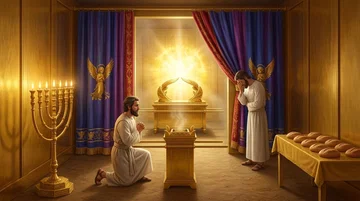
That place was sacred and could not be entered unbidden without death.8T 284.3–285.1MH 437.1 Its veil was not to be lifted by any hand save one, and to lift it and intrude unbidden into the sacred mystery was death.MH 437.1 Only the high priest entered, on the one appointed day each year, with trembling, while clouds of incense veiled the glory from his sight.8T 284.3–285.1MH 437.1 Throughout the courts every sound was hushed, no priests ministered at the altars, and the host of worshipers bowed in silent awe offering petitions for mercy.MH 437.1
Beyond that inner veil was the holy of holies, where the symbolic service of atonement and intercession centered.1SP 273.3RH Nov 9, 1905 The priest praying toward the unseen mercy seat portrays God's people directing their prayers by faith to Christ as Mediator before the mercy seat in the heavenly sanctuary and confidently receiving the benefits of His mediation.1SP 273.3 At the death of Christ the heavy veil was torn from top to bottom, laying the most holy place open to every eye and no longer recognized by the Lord.DA 774.1 This showed that type had met antitype in an infinite sacrifice for the sins of the world and that offering the blood of bulls and goats and performing the ritual service had no further value.DA 774.1 The ark abiding within the veil calls God's people to have right hearts and to die to self.Ms 2, 1852, par. 2
Heavenly Sanctuary Revealed
The veil that divided the earthly sanctuary into the Holy Place and the Most Holy Place where the ark of the testimony stood shows that its two apartments and their furnishings were a pattern of the heavenly sanctuary.SG1 158.1ST Mar 4, 1903 The cherubim inwrought with threads of gold and silver in those veils and in the ceiling curtain represent the angelic host who are connected with the work of the heavenly sanctuary.ST Mar 4, 1903 They are ministering angels to the saints upon the earth.ST Mar 4, 1903
The temple in the Holy City in heaven has the same division between the Holy Place and the Most Holy.RH Jul 21, 1851CET 91.2–3 A first veil opens into the holy place, which contains the altar of incense, the candlestick with seven lamps, and the table on which is the showbread.RH Jul 21, 1851CET 91.2–3 A second veil divides between the holy place and the most holy and opens into the Holy of Holies.RH Jul 21, 1851CET 91.2–3 Within it is the ark with cherubim on each end with wings spread and faces turned toward each other and looking downward, a golden censer between them, and an exceeding bright glory above the ark like a throne where God dwells.CET 91.2–3
Both veils are raised by Jesus to bring into view the glory within and to give entrance.RH Jul 21, 1851CET 91.2–3 The way leads through the first veil into the holy place, then Jesus raises the second veil to allow entry into the most holy place.RH Jul 21, 1851CET 91.2–3EW 25.6 There He stands by the ark to offer the prayers of the saints to the Father with the smoke of the incense from the censer.CET 91.2–3 When Jesus finished ministering in the Holy Place in 1844, He passed through the second veil into the Most Holy Place, where the ark contains the Ten Commandments and He intercedes for the prayers of the saints.SG1 158.1
Sources
Pioneers and periodicals
83 sources
God commanded the inner curtain to be hung under the clasps and the ark of the testimony to be brought behind it, so dividing the tent into the holy place and the most holy place.RH Jan 20, 1859ST Dec 24, 1894ST Apr 1, 1889RH Jan 6, 1853ST Nov 11, 1897 The curtain was of blue and purple and scarlet and fine linen with cherubim worked into it, hung on four gold-covered pillars, screening the ark with the tables of the Ten Commandments covered by the mercy-seat where God dwelt in glory between the cherubim.RH Jan 20, 1859ST May 23, 1878ST Nov 14, 1892RH Jan 4, 1870ST Oct 29, 1894 The arrangement was made after the pattern shown in the mount, a figure of the heavenly sanctuary with its two holy places and its ark and mercy-seat.ST Nov 12, 1912ST Oct 22, 1874ST May 16, 1878RH Jul 7, 1853RH Aug 28, 1853 Within the veil the law stands as the foundation of God's government and covenant, with mercy interposed above it for the pardoning of the transgressor through atonement.ST May 20, 1880RH May 27, 1852RH Jan 6, 1916RH Feb 18, 1904ST Apr 8, 1889 None but the high priest might pass beyond the veil, and only once a year with blood for atonement and cleansing, pointing to Christ who has entered within the veil as forerunner and high priest.RH Jun 14, 1864ST Oct 25, 1905RH Jan 12, 1911RH Nov 10, 1904
Setting in Exodus History
The verse stands in Exodus 19-26, the account of the giving of the law of Ten Commandments upon Mount Sinai.ST Mar 3, 1914 It belongs to the second, chiefly legislative division of Exodus, chapters 19-40, in which the ransomed people are bound to Jehovah by solemn covenant and provided with legal ordinances. It is part of the detailed instructions for the construction of the tabernacle and its furniture given by God to Moses during his forty days' stay in the mountain, together with the tables of stone. Those instructions came after the Ten Commandments and other statutes were proclaimed from Sinai and ratified over the book of the covenant and before the sin of the golden calf. They came before the sanctuary was built and set up, and were afterward carried out in the preparation and fitting of the tabernacle, which was set up on the first day of the first month of the second year from the Exodus.ST Dec 10, 1896
The sanctuary so described in Exodus 25-31 and 35-40 and summarized in Hebrews 9:1-5 was the dwelling-place of God among Israel, built from the willing offerings of the people.ST Jun 4, 1885 It remained so in the wilderness and through the time of the judges, Samuel, Saul, and David, until Solomon built the temple after the same pattern, which from the day the glory of the Lord filled the house of the Lord was the dwelling-place of the Lord among Israel.ST Jun 4, 1885 Sanctuary generally means that building, the inner tabernacle, erected by Israel at the command of God in the wilderness as told in Exodus 25 to 40, afterward replaced by Solomon's portable tabernacle's successor, Solomon's temple.ST Jun 19, 1907 In both buildings the worship of God upon the earth centered, and all earthly worship and service revolved around the holy of holies separated by the veil, where rested the law of God with the mercy-seat over it.ST Jun 19, 1907
The verse belongs to the law of Moses commanded in Horeb with statutes and judgments, which includes the Ten Commandments together with civil regulations, sacrifices and offerings, health laws, ceremonial laws and moral laws. It is to be remembered in the last days with Exodus 20 to 40 and Leviticus because its offerings, sacrifices and types reveal shadows whose substance is traced in the new dispensation. Within those instructions it is distinguished from the Ten Commandments spoken directly by God and written on the stone tablets, being among the instructions given through Moses.ST Apr 15, 1886ST Jul 8, 1886 It belongs to the ordinances written out after the moral law and is identified as part of the ceremonial law, among the ceremonial requirements in Exodus 25-30 described as burdensome and temporary, imposed until the time of reformation, in contrast with the enduring commandments of God.ST Apr 15, 1886ST May 6, 1875ST Jul 8, 1886 The veil dividing the holy place from the most holy place, where the ark of the testimony was brought, shows that the ten commandments were set apart from the other laws.ST Apr 22, 1880 It describes part of the worldly sanctuary connected with the first covenant, the veil hung to divide between the holy place and the most holy for the ark of the testimony, and with the ordinances of divine service belonging to that covenant its ministration is called a ministration of death.ST Aug 5, 1889
God's explicit instructions to Moses for building the sanctuary and preparing its services show how particular God was about what pertained to His worship.ST Mar 25, 1889 The sanctuary, including its divisions, served as an earthly object lesson of God's plan for salvation from sin and of how He deals with sinners, and its services were intended to bring people into harmony with God's holy law.ST Mar 25, 1889 Its precise instructions, placing the veil so that it divides the tabernacle into the holy place and the most holy place with the ark of the testimony brought within it, invite careful study for their instructive lessons, even when their full meaning and purpose cannot be fathomed.ST Jun 10, 1908 Yet its meaning must not be reduced to its physical construction, to boards, coverings, furnishings, and materials, which are not the limit or substance of the heavenly truth it patterns.RH May 25, 1905 God placed His Spirit upon Bezalel and Oholiab with other devoted men and women so the building would be properly erected and the work properly done, showing God blesses consecrated workers in material things as much as workers in spiritual things.ST Jan 27, 1909
Veil Materials and Dimensions
The dividing curtain was to be hung up under the taches or clasps, and it is the second or inner veil, distinct from the hanging for the door of the tent and from the court entrance, so that the word veil alone does not necessarily identify this dividing curtain.RH Jan 20, 1859ST Apr 1, 1889ST Dec 2, 1889RH Oct 28, 1909 It hung beneath the clasps and marked the division between the holy place and the most holy place, with the ark of the testimony brought in thither within the veil into the most holy.RH Jan 20, 1859ST Apr 1, 1889ST Dec 2, 1889 This was the veil meant when hope is said to enter within the veil.ST Dec 2, 1889
It was made of blue and purple and scarlet cloth and fine-twined linen with cherubim wrought into it with threads of gold and silver, of the same materials, colors, and workmanship as the entrance veil.ST Mar 4, 1903RH Jan 20, 1859ST Nov 14, 1892ST May 13, 1897 The cherubim inwrought into the veils and ceiling represented the heavenly angels surrounding God's throne, the angelic host connected with the heavenly sanctuary and ministering to the saints on earth.ST Mar 21, 1911ST Mar 4, 1903ST Oct 29, 1894 The most holy apartment so separated, though containing very few pieces of furniture, held highly significant pieces preaching precious gospel truths profitable only when mixed with faith.ST May 13, 1897
The dividing veil hung from four gold-covered acacia or shittim-wood pillars set in sockets of silver, while the entrance curtain hung on five pillars.RH Jan 20, 1859ST May 20, 1880RH Aug 4, 1863ST Nov 14, 1892ST Oct 29, 1894 Linen curtains embroidered with cherubim formed the door, the second veil, and the tabernacle covering, with protective outer layers of goats' hair and red-dyed rams' skins and badgers' or seals' skins laid over them.ST Oct 29, 1894 The Hebrew word paroketh is used for this dividing veil that screened the ark of the testimony, while masak is also applied to sanctuary hangings and veils.RH Oct 5, 1916 Because the outer door hanging was like the inner veil in size, fabric, and color, both sanctuary entrances could be called veils, the outer one being the first veil and the partition the second veil, made of the same material and nearly the same pattern.RH Aug 3, 1916RH Apr 8, 1873RH Apr 8, 1873
The tabernacle building was about thirty cubits or forty-five feet long, ten cubits or about eighteen feet wide, and ten cubits high, of upright acacia boards overlaid with gold within and without and set in sockets of silver.ST Feb 17, 1890ST Jun 4, 1885ST Aug 19, 1913 It had a magnificent layered roof and walls, with a ceiling of fine-twined linen wrought with needlework and figures of angels covered by a tent roof of goat's hair, red ram-skins, and seal skins, portable yet capable of being taken apart and carried with Israel in all their journeyings.RH Nov 8, 1915ST Mar 4, 1903ST Feb 17, 1890 It opened toward the east so that the ministering priest stood with his back to the entrance and his face to the west.ST Feb 17, 1890ST Aug 19, 1913 Though so constructed that it could be removed from place to place, it was a structure of great magnificence without and of richly adorned interior picturing God's glorious presence, with walls heavily plated with purest gold.RH Nov 8, 1915ST Mar 4, 1903
The proportion of the division is not stated in the verse but is the same as afterward observed in the temple, with two-thirds of the space allotted to the first apartment and one-third to the second.RH Aug 4, 1863 The first apartment is twice the size of the second, the holy place occupying thirty feet at the front of the forty-five-foot-long building and the most holy a perfect cube of ten cubits or about fifteen feet in height, width, and length at the rear.ST Mar 10, 1898ST May 8, 1901ST Dec 29, 1909ST Apr 1, 1889 So also the temple proper, twenty cubits wide and sixty cubits long with its oracle or most holy place a perfect cube twenty cubits on a side, was built after a pattern with one apartment twice as large as the other.ST May 8, 1901 The veil belongs to the Sanctuary proper committed to the sons of Kohath with the ark, table, candlestick, altars, and vessels of ministry, distinct from the tabernacle structure, tent, coverings, court hangings, boards, bars, pillars, and cords committed to the sons of Gershon and Merari.RH May 5, 1851 The tabernacle structure itself is only an adjunct to the Sanctuary to hide its most sacred parts and services from common gaze, and the veil itself was renewed yearly.RH May 5, 1851
Division and Furnishings Inside
The veil divides the sacred tent into two apartments, the first and larger eastern room called the holy place and the second and smaller room called the most holy place or holy of holies.ST Dec 24, 1894RH Jan 6, 1853ST Nov 11, 1897RH Jul 27, 1916 The ark of the testimony is to be brought in thither within the veil into the inner apartment behind it, where it was placed beyond the boundary the veil marked.ST Dec 24, 1894RH Jan 6, 1853ST Nov 11, 1897RH Jul 27, 1916 That ark contained the tablets of the covenant, the Ten Commandments, and the sanctuary with its priesthood was ordained for ministry before it.RH Dec 31, 1861 The tabernacle had two distinct apartments separated in this way, with the ark containing the law written on stone kept behind the veil.RH Dec 31, 1861
Moses fulfilled the command when he reared the tabernacle by carrying the ark with the testimony inside and hanging the veil in front of it before it.RH Jan 6, 1853RH Mar 1, 1870 He left the table on the north side, the candlestick on the south side, and the golden altar before the veil without the veil in the holy place, while the mercy-seat was to be put upon the ark of the testimony in the most holy place.ST Dec 23, 1889RH Jan 6, 1853 The ark stood in the middle of that inner room, directly opposite the altar of incense, centered from side to side and near the veil, leaving most of the room in front of the ministering priest.ST Apr 13, 1904 Its staves rested against the veil, and with the next verse the mercy seat is assigned to stand over the ark behind the veil.ST Apr 13, 1904RH Jan 4, 1870
The holy place held the golden candlestick with seven lamps on the south, the table of showbread with the bread of the presence on the north just inside the door, and the altar of incense at the west close to the veil in the back center of the room.ST Jun 4, 1885ST May 8, 1901ST Oct 25, 1905 There sweet incense, symbol of Christ's continual intercession, was burned morning and night, while the table bore its ever-renewed bread and the candlestick its seven lights.RH Jan 6, 1916ST Apr 1, 1889 Behind the veil the most holy place held the ark of the covenant, a wooden chest overlaid with gold, topped by the mercy-seat of pure gold with a cherub on each end stretching wings on high covering the mercy seat.ST Jun 4, 1885RH Jan 6, 1916ST Apr 1, 1889 From between the cherubim above the mercy seat God meets and communes in commandment to the children of Israel.ST Jun 4, 1885ST May 8, 1901 The building itself was about forty-five feet long and about eighteen feet wide, ten cubits wide and thirty cubits long, with the holy place occupying thirty feet at the front and the most holy a perfect cube of fifteen feet at the rear in height, width, and length.ST Jun 4, 1885ST May 8, 1901ST May 8, 1901 So too the temple proper, built after the same pattern, was twenty cubits wide and sixty cubits long with its oracle or most holy place a perfect cube twenty cubits on a side, one apartment twice as large as the other.ST May 8, 1901
The ark contained the testimony, meaning the Ten Commandments written by God's finger on tables of stone, and the testimony gives its name to the tables, to the ark, to the veil, and to the tabernacle itself.ST May 23, 1878RH Jan 4, 1870 The tabernacle of the testimony therefore means the tabernacle of the Ten Commandments in heaven as well as on earth, especially its second apartment.ST May 23, 1878RH Jan 4, 1870 Later placed in the ark were Aaron's rod that budded, forever confirming his divine appointment as high priest and the priesthood of the tribe of Levi as a type of Christ's priesthood forever after the order of Melchizedek, and the pot of manna as a reminder of God's provision in need.ST Apr 23, 1912 That manna recalled the threefold weekly miracle for forty years teaching the sanctity of God's Sabbath as the sign of His creative and redemptive power.ST Apr 23, 1912 The tabernacle proper was a rectangle perfect in proportion with width equaling height, divided into two compartments by the veil, and the same plan built in the wilderness was later crystallized in more permanent and magnificent form in Solomon's temple at Jerusalem.ST Apr 23, 1912
The ark held God's commandments as the rule of human life, and the mercy-seat rested upon it as the place where mercy and pardon are found through Christ's blood for breaking the law.ST Oct 22, 1874RH May 27, 1852RH Oct 7, 1873 The veil hung from four gold-covered pillars, with the ark, mercy seat, and cherubim in the inner apartment, where God manifested His presence and communicated with Israel.ST May 20, 1880 Above the ark shone the visible glory of the Lord, the Shekinah, between the cherubim marking God's dwelling and throne.RH Jan 6, 1916ST Apr 1, 1889 That glory was separated by the veil from the priests serving in the first apartment, though it could be partially visible over the veil.ST Jun 24, 1880 The earthly arrangement corresponds to the heavenly sanctuary, where both the ark and the mercy seat exist together and where Christ ministers.ST Oct 22, 1874RH May 27, 1852RH Oct 7, 1873 There the law is the foundation of His government and the mercy seat typifies the interposition of mercy and pardon for the sinner, with two cherubim of gold at either end whose wings met on high and whose faces looked ever toward the mercy seat, a type of the throne of God with angels about the throne, typical of God's grace and mercy to the repentant sinner condemned before His holy eternal law.RH Jan 6, 1916ST Apr 23, 1912
Heavenly Pattern and Law
The tabernacle with its vessels was made according to the pattern shown to Moses in the mount, so its division by the veil into two holy places, with the ark containing the tables of the law in the second apartment, was a divinely appointed figure and object lesson of the heavenly temple.ST May 16, 1878RH Jul 7, 1853RH Aug 28, 1853RH Jan 4, 1870RH Feb 3, 1853 The earthly holy place and most holy place, the first separated from the second where the ark of the testimony was brought within the veil, correspond to and must have counterparts in two holy places in the heavenly sanctuary.RH Jul 7, 1853RH Aug 28, 1853RH Jan 4, 1870RH Feb 3, 1853RH Mar 8, 1870 Earthly things cannot fully represent heavenly things, yet the two-room arrangement itself is the pattern.ST May 16, 1878RH Mar 8, 1870
The whole two-part building, not only the most holy place, was the pattern of the heavenly sanctuary. The two earthly apartments were figures of holy places in heaven, and a veil is also associated with the heavenly sanctuary where Jesus entered as forerunner and serves as high priest.ST Nov 11, 1897
The placing of the ark in the most holy place behind the veil, where the visible presence was manifested above the mercy-seat, shows that both the ark and the mercy-seat exist together in the heavenly sanctuary where Christ ministers.ST Nov 12, 1912ST Oct 22, 1874RH May 27, 1852RH Oct 7, 1873 There the ark is seen and the Lord reveals His name as merciful and gracious and long-suffering.ST Nov 12, 1912 The inner apartment held the ark containing God's law, covered by the mercy-seat and cherubim with the Shekinah between the cherubim marking God's dwelling and throne, and God's glory moved from the outer apartment to the inner throne between the cherubim.RH Oct 8, 1903 In vision the temple in the Holy City in heaven likewise has a first veil opening into the holy place containing the altar of incense, the candlestick with seven lamps, and the table of showbread, and a second veil opening into the Holy of Holies, both veils raised by Jesus to bring into view the glory within.RH Jul 21, 1851
Within the inner veil the most holy place held the ark containing the tables of the law written with the finger of God, covered by the golden mercy-seat with two cherubim of gold whose wings met on high and whose faces looked toward the mercy-seat.RH Jan 6, 1916ST Apr 23, 1912 The law is the foundation of God's government, the basis of the covenant, declaring the transgressor's death, while the mercy-seat above it represents God's presence and the interposition of mercy and pardon for the sinner through atonement, where mercy and truth meet and righteousness and peace are joined.RH Jan 6, 1916RH Feb 18, 1904 The ark's holiness was derived from the holy law it contained, while the law's holiness was absolute and eternal.ST Apr 8, 1889 All worship and service revolved around the Ten Commandments kept in the holy receptacle made expressly for them with the mercy-seat over them, displaying by every means the holiness, perfection and completeness of the Decalogue as the great summary of all morality, and the cherubim overshadowing in holy awe represent the spirit in which all the angelic host regard God's law and government and His love and mercy manifested in the gift of His Son.ST Apr 23, 1912ST Sep 9, 1913
The tabernacle served for sacrifices and offerings, which passed away when Christ died once for all, and it typified the heavenly temple where Christ now ministers.ST Jan 24, 1911 Its objects and ceremonies pointed to Christ and His work, and its typical service ended at Christ's death when the temple veil was torn and the earthly system passed away.ST Jun 26, 1907 The sanctuary, including its holy things, was cleansed yearly by blood, not fire, and served as a type of the new-covenant sanctuary.RH Sep 30, 1852 Though entered by none but the high priest and only at a special time in the year, and though containing very few pieces of furniture, the most holy apartment holds highly significant pieces preaching precious gospel truths which profit only when mixed with faith.ST May 13, 1897
Ministry Atonement and Application
The priests were set apart by God as a holy and separate order for ministry in holy things, fitted for that work by anointing with holy oil and clothing in holy garments for service in the holy place and the most holy divided by the veil.RH Jan 12, 1911 The ark of the testimony with the two tables of stone was placed within the veil in the most holy place, with the mercy-seat upon it as God's dwelling-place where He met and communed from between the cherubim.RH Jun 14, 1864 None but the high priest alone was permitted to approach that ark beyond the veil, and only once a year with blood for himself and for the errors of the people to bring before it and make atonement and cleanse the sanctuary.RH Jun 14, 1864RH Jun 21, 1864 On that Day of Atonement he entered not only into the holy place as on other days but within the veil into the most holy place.ST Oct 25, 1905
Through the year the priests ministered by sprinkling blood before the veil to transfer sin into the sanctuary, until the tenth day of the seventh month when service was performed in the most holy place to close the yearly round and cleanse the sanctuary.ST May 17, 1877 The veil marks the boundary between the two apartments, and its entry in the heavenly sanctuary is associated with the sanctuary's cleansing and the making of atonement. Beyond that inner veil is the holy of holies, where the symbolic service of atonement and intercession centered as the link between heaven and earth.RH Nov 9, 1905 The two apartments and their services must not be confounded, because they were performed at different times and under different circumstances, a distinction recognized in the New Testament exposition.RH Mar 17, 1853 The terms the most holy place and heaven itself in Hebrews 9 are not convertible, for the contrast in verse 24 is between the holy places made with hands and heaven itself.RH Mar 17, 1853
The veil also provides the picture of entering within it, for Christ has gone within the veil as the sure and steadfast anchor of the soul.RH Nov 10, 1904 Understanding His work beyond the veil, including His intercession for humanity, is necessary to understand redemption and to have a Christian experience.RH Nov 10, 1904 The ancient arrangement with its separate courts and holiest room holding the sacred ark is paralleled by Abyssinian churches, which likewise have separate courts and a holiest room containing a sacred ark.RH Mar 25, 1909 The inmost sanctuary is also the sanctuary of home, where a true gentleman is kindest to his nearest intimates and associates and dependents so that those who know him best love him most, while those who are gentlemen only beyond the family pale and cruel within are counterfeits.RH Nov 24, 1863 The sacredness of the most holy place makes bringing unconverted performers into it an improper violation of God's arrangements for distinct sacred spaces divided by the veil.
Sources