Joshua 8:32
And he wrote there upon the stones a copy of the law of Moses, which he wrote in the presence of the children of Israel.
Translations
And he wrote there on the stones a copy of the law of Moses, which he wrote in the presence of the children of Israel.
King James Version, KJV Cambridge Paragraph Bible, Webster Bible
And he wrote there upon the stones a copy of the law of Moses, which he wrote in the presence of the children of Israel.
Revised Version, American Standard Version
And he wrote there upon the stones a copy of the law of Moses, which he wrote, in the presence of the children of Israel.
and he writeth there on the stones the copy of the law of Moses, which he hath written in the presence of the sons of Israel.
And he wrote there on the stones a copy of the law of Moses, which he had written before the children of Israel.
Then wrote he there, upon the stones, a copy of the law of Moses, which he wrote, in the presence of the sons of Israel.
Berean Standard Bible, Majority Standard Bible
And there in the presence of the Israelites, Joshua inscribed on the stones a copy of the law of Moses, which he had written.
He wrote there on the stones a copy of Moses’ law, which he wrote in the presence of the children of Israel.
And he made there on the stones a copy of the law of Moses, writing it before the eyes of the children of Israel.
Also he wrote there vpon the stones, a rehearsall of the Lawe of Moses, which he wrote in the presence of the children of Israel.
Douay-Rheims (Challoner revision)
And he wrote upon stones the Deuteronomy of the law of Moses, which he had ordered before the children of Israel.
Pictures
Cross-references
- Deuteronomy 27:2-8
And it shall be on the day when ye shall pass over Jordan unto the land which the LORD thy God giveth thee, that thou shalt set thee up great stones, and plaister them with plaister:
Israel is commanded to write the law on stones after entering Canaan.
- 2 Corinthians 3:7
But if the ministration of death, written and engraven in stones, was glorious, so that the children of Israel could not stedfastly behold the face of Moses for the glory of his countenance; which glory was to be done away:
Contrasts the law engraved in stone with Joshua’s writing on stones.
- Deuteronomy 27:12-13
These shall stand upon mount Gerizim to bless the people, when ye are come over Jordan; Simeon, and Levi, and Judah, and Issachar, and Joseph, and Benjamin:
The tribes are divided between Gerizim to bless and Ebal to curse.
- Deuteronomy 27:8
And thou shalt write upon the stones all the words of this law very plainly.
Commands that the law be written plainly on stones.
- Deuteronomy 11:29
And it shall come to pass, when the LORD thy God hath brought thee in unto the land whither thou goest to possess it, that thou shalt put the blessing upon mount Gerizim, and the curse upon mount Ebal.
Commands the proclamation of blessing and curse at the two mountains.
- Exodus 20:1-17
And God spake all these words, saying,
Joshua wrote the law of Moses for Israel, including these commandments.
- Genesis 12:6-7
And Abram passed through the land unto the place of Sichem, unto the plain of Moreh. And the Canaanite was then in the land.
God’s promise to Abraham is among the sacred associations of Shechem.
- Exodus 32:16
And the tables were the work of God, and the writing was the writing of God, graven upon the tables.
The writing on the stone tablets was engraved by God.
- Deuteronomy 28
And it shall come to pass, if thou shalt hearken diligently unto the voice of the LORD thy God, to observe and to do all his commandments which I command thee this day, that the LORD thy God will set thee on high above all nations of the earth:
Blessings for obedience and curses for disobedience were recited aloud.
- Joshua 24:1
And Joshua gathered all the tribes of Israel to Shechem, and called for the elders of Israel, and for their heads, and for their judges, and for their officers; and they presented themselves before God.
Both describe Israel assembling at Shechem before God.
- Deuteronomy 27:1
And Moses with the elders of Israel commanded the people, saying, Keep all the commandments which I command you this day.
both describe law written on stones
- Deuteronomy 5:22
These words the LORD spake unto all your assembly in the mount out of the midst of the fire, of the cloud, and of the thick darkness, with a great voice: and he added no more. And he wrote them in two tables of stone, and delivered them unto me.
Contrasts the plaster writing with the commandments engraved on stone.
- Exodus 31:18
And he gave unto Moses, when he had made an end of communing with him upon mount Sinai, two tables of testimony, tables of stone, written with the finger of God.
Both texts describe God’s law written on stone tablets.
- Hebrews 8:10
For this is the covenant that I will make with the house of Israel after those days, saith the Lord; I will put my laws into their mind, and write them in their hearts: and I will be to them a God, and they shall be to me a people:
The law is written in the heart rather than on stones.
- Deuteronomy 31:24
And it came to pass, when Moses had made an end of writing the words of this law in a book, until they were finished,
same law placed with the ark
- Genesis 33:18
And Jacob came to Shalem, a city of Shechem, which is in the land of Canaan, when he came from Padan-aram; and pitched his tent before the city.
Both texts refer to the same place Jacob came to.
- 1 Kings 12:1
And Rehoboam went to Shechem: for all Israel were come to Shechem to make him king.
Shechem is where Israel gathered to make Rehoboam king before the kingdom’s revolt.
- Genesis 37:12-14
And his brethren went to feed their father’s flock in Shechem.
Both texts mention Shechem.
Commentary
Each commentary is drawn from primary sources: the writings of Ellen G. White and Adventist pioneers and periodicals. Each commentary is separate. Its own words are not a quotation; follow the references to read the source passages.
Ellen G. White
4 sources
The writing upon the stones took place after the judgment upon Achan and the victory over Ai, as Israel gathered in solemn assembly before taking possession of their inheritance.PP 499.2–3ST May 12, 1881 The setting was Shechem, at Mount Ebal and Mount Gerizim, a place already tied to God's covenant dealings with Abraham and Jacob.PP 499.2–3Ms 135, 1899, par. 7PP 522.4 Joshua assembled the whole people in obedience to Moses' instructions, including women and children and resident strangers, mindful that their only hope was in obedience to God.PP 499.2–3ST May 12, 1881
The purpose was public recognition of God's law and renewal of covenant loyalty.PP 499.2–3PP 522.4 He rehearsed to them the blessings that would follow obedience to the law and the curses that would fall for disregarding it, and repeated before them the law of the Ten Commandments together with all the statutes and precepts which Moses had recorded.PP 499.2–3ST May 12, 1881PP 522.4 Ebal and Gerizim stood as silent witnesses of the vows made on entering Canaan.Ms 135, 1899, par. 7PP 522.4
Israel later assembled again at Shechem in Joshua's old age to renew those vows in his presence, surrounded by evidences of what God had done in giving them a land for which they had not labored, and cities which they had not built, and vineyards and olive groves which they had not planted.Ms 135, 1899, par. 7PP 522.4 While Israel remained faithful, God protected them even while traveling among unconquered enemies.PP 499.2–3 He wrought mightily for them and gave their armies fresh courage with every victory.ST May 12, 1881
Sources
Pioneers and periodicals
23 sources
Joshua built an altar of whole stones covered with plaster on Mount Ebal and wrote upon that plaster in the presence of Israel a copy of the law of Moses, in obedience to the command given through Moses as Israel's first duty after entering the promised land about forty years after Sinai.ST May 12, 1881RH Apr 30, 1857RH Sep 6, 1864 This belonged to the conquest and division of Canaan after crossing the Jordan and circumcision had dedicated the people to God and after the Captain of the Lord's host appeared to cooperate with Joshua, following Achan's sin and the defeat at Ai in renewed triumph by faith over Ai after humiliation for self-sufficiency.ST Sep 26, 1906ST Mar 17, 1909 Between Mount Gerizim the mount of blessing and Mount Ebal the mount of cursing, with the ark resting midway in the valley, the law was publicly read to the whole assembly of men, women, children and strangers divided with six tribes on each slope, with blessings pronounced toward Gerizim and curses toward Ebal and answered with loud amens.ST Sep 3, 1894RH Apr 29, 1875ST Sep 8, 1898 The copy inscribed and read included not only the Ten Commandments but also the statutes and precepts Moses had received and written in a book, and it is distinct from the Ten Commandments engraved by God Himself on the stone tablets at Sinai.ST May 12, 1881RH Apr 30, 1857RH Jan 29, 1861RH Jun 18, 1901 Paul's reference in 2 Corinthians 3 to what was written and engraved in stones is to Moses coming down after forty days and nights with the tables and shining face, not to this writing commanded in Deuteronomy 27, since this later copy could not have caused his face to shine forty years earlier.RH Sep 6, 1864ST Oct 16, 1884ST Jun 5, 1879 The altar standing where the curse was pronounced signified that transgression of the law deserved God's wrath while its sacrifices represented Christ's atonement, foreshadowing the final judgment when obedience or disobedience to the Ten Commandments will have placed all people among the blessed or the cursed.ST Apr 7, 1909
Words, Setting, Ceremony
This writing stands after Israel had crossed the Jordan and been circumcised, which cut them off from all unholy intercourse with the world and dedicated them to God, and after the Captain of the Lord's host had appeared to cooperate with Joshua in the work given him to do. It belongs to the conquering of the Canaanites and the division of the land, coming after Achan's sin and its fearful consequences.ST Mar 17, 1909 It follows Israel's first defeat at Ai and belongs to the renewed attack under different circumstances in which the city was conquered.ST Sep 26, 1906ST Mar 17, 1909 It stands in the final triumph by faith over Ai after humiliation for self-sufficiency, following the conquest of Canaan.ST Sep 8, 1898RH Apr 20, 1911
The writing was done in obedience to the command given through Moses, as Israel's first duty after entering the promised land after the long wanderings.RH Apr 30, 1857 Joshua assembled all the people as commanded.ST May 12, 1881 Mindful that their only hope was in obedience to God, he gathered them after the judgment upon Achan and the victory over Ai.ST May 12, 1881
Joshua built an altar of whole stones, a heap of stones covered with plaster, on Mount Ebal.RH Apr 30, 1857RH Jan 29, 1861RH Oct 4, 1864 He wrote a copy of the law of Moses upon the stones, that is upon the plaster covering them, in the presence of the children of Israel, not engraved into the stones themselves.RH Apr 30, 1857RH Sep 6, 1864RH Jan 29, 1861RH Jun 18, 1901RH Oct 4, 1864 This was about forty years after the law was given at Sinai.RH Oct 4, 1864
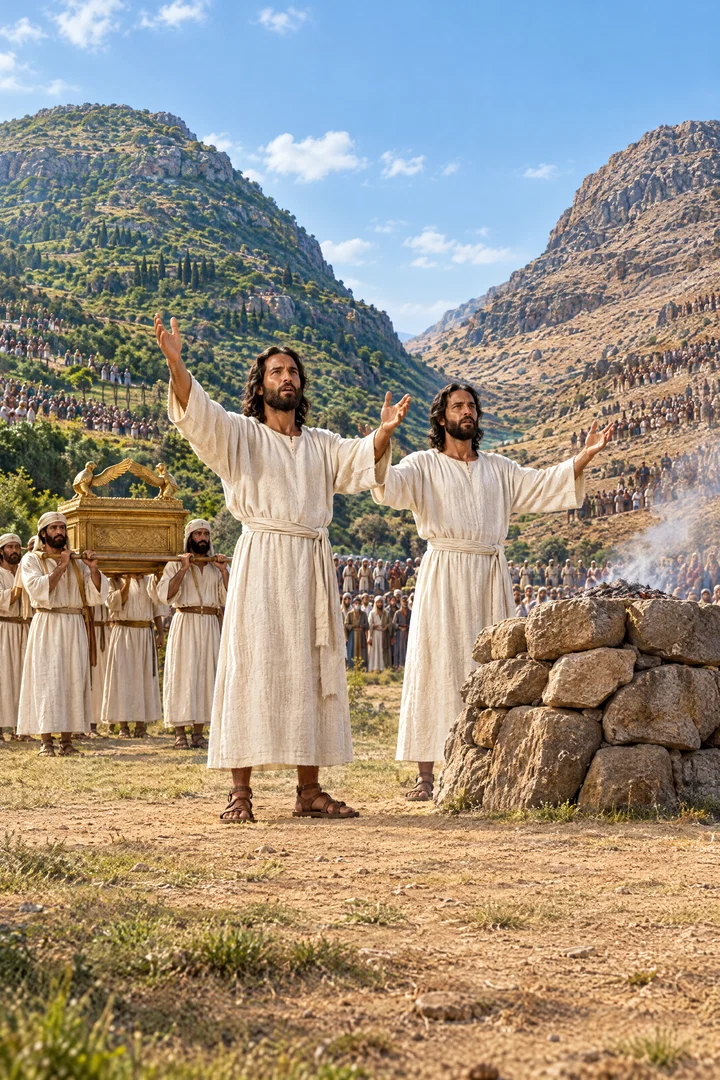
The ceremony took place in the valley of Sychar at Shechem, on the saddle and watershed between the Jordan and the Mediterranean a short distance east of Shechem, between Mount Gerizim the mount of blessing and Mount Ebal the mount of cursing.RH Apr 29, 1875ST Sep 8, 1898ST Sep 8, 1898 The ark bearing the mercy-seat and cherubim under the Shekinah rested midway in the valley with the priests and Levites between the two hosts.RH Apr 29, 1875 Mount Ebal is 3,077 feet high and barren from the base, and Mount Gerizim is 2,848 feet high and green with verdure at the foot.ST Sep 8, 1898 From Ebal the view is extensive to the hills of Samaria, the Mediterranean, the site of Caesarea in clear weather, Mount Carmel, the hills of Galilee, Mount Hermon, and the hills east of the Jordan to the Dead Sea, and nearly as extensive from Gerizim.ST Sep 8, 1898
The law written on the stones was publicly read from the book of the law to the gathered assembly including women, children, and strangers.RH Apr 30, 1857 Six tribes stood on the slope of Gerizim and six on the slope of Ebal.RH Jan 4, 1912ST Sep 8, 1898 The priests and Levites pronounced the blessings toward Gerizim and the curses toward Ebal, turning first toward Gerizim to pronounce blessing and then toward Ebal to pronounce cursing.RH Apr 29, 1875 The tribes ranged on each hand answered with loud amens in fear and awe.RH Apr 29, 1875 So the whole assembly including listening children stood present to witness the imposing scene and never forget it.RH Apr 29, 1875
Teaching and Doctrinal Distinctions
The copy set upon the plastered stones held not only the Ten Commandments but also the laws Moses had received and written in a book, together with all the statutes and precepts Moses had recorded, and that same law was read from the book of the law to the assembly.ST May 12, 1881RH Apr 30, 1857 The altar stood on Mount Ebal where the curse was pronounced, signifying that Israel's transgression of the law deserved God's wrath, while the sacrifices offered upon it represented Christ's atonement.
This writing is distinct from the Ten Commandments engraved by God on the stone tablets at Sinai, for it was a copy written upon plaster covering stones of an altar built of whole stones, not engraved into the stones themselves.RH Jan 29, 1861RH Jun 18, 1901RH Oct 4, 1864 It was made about forty years after the law was given at Sinai, after Moses' death and after Israel crossed the Jordan.RH Oct 4, 1864RH Sep 6, 1864RH Sep 6, 1864 It is distinguished from the event in Exodus 34 when Moses came down from the mountain with the tablets in his hands and his face shone.ST Oct 16, 1884RH Sep 6, 1864RH Sep 6, 1864
Paul's reference in 2 Corinthians 3 to the ministration written and engraved in stones is not to this writing commanded in Deuteronomy 27 but to Moses coming down after forty days and forty nights communing with the Lord with the two tables of stone in his hands.RH Sep 6, 1864ST Oct 16, 1884ST Jun 5, 1879 Then his face shone with glory from the presence of the Lord so that the people could not look upon him, and he put a veil over his face while he talked with them.ST Oct 16, 1884ST Jun 5, 1879 This writing by Joshua took place about forty years after Moses came down from Sinai with the tablets, so it could not have caused Moses' face to shine forty years earlier, and to identify the stones in 2 Corinthians 3 with these altar stones is a false argument.RH Sep 6, 1864RH Sep 6, 1864RH Sep 6, 1864RH May 9, 1865
The copying of the law of Moses upon stones in the presence of the children of Israel shows the Levitical law given to the children of Israel, distinct from the perpetual law of God.RH Aug 20, 1872 That Levitical law is temporary and was abolished by Christ, while the law of God remains holy, just, and good.RH Aug 20, 1872 The ceremony at Ebal and Gerizim, where Israel heard the blessings for keeping God's law and the curses for breaking it, presents God's will expressed in the Ten Commandments and foreshadows the final judgment, when all people's choices regarding God's law will have formed their characters and placed them among the blessed or the cursed, and God's wisdom and justice will be recognized.ST Apr 7, 1909
Prophecy, History, Application
The curses pronounced from Mount Ebal have been literally fulfilled, as seen in the present condition of the valley and land around Shechem, Jacob's well, and Joseph's burial place, where fertile ground now lies indifferently cultivated.ST Sep 8, 1898 The reading of the blessings at Mount Gerizim forms the background to the later dispute over whether Mount Gerizim or Jerusalem was the true place of worship.ST Sep 3, 1894 The altar was reared in what became Samaritan territory, where the Samaritans' ancestors worshiped for more than four hundred years before Christ.ST Sep 3, 1894 This was Israel's first duty after entering the promised land after the long wanderings, done in obedience to the command through Moses, to rear an altar of stones on Mount Ebal and inscribe the law of Moses upon it, with six tribes standing on the slope of Ebal and six on the slope of Gerizim while the Levites pronounced the curses of the law from Ebal and the blessings from Gerizim.
Joshua assembled all the people as commanded after the judgment upon Achan and the victory over Ai, mindful that their only hope was in obedience to God.ST May 12, 1881 He rehearsed to them the blessings that would follow obedience to the law and the curses that would fall for disregarding it, and repeated before them the law of the Ten Commandments together with all the statutes and precepts which Moses had recorded.ST May 12, 1881 After this the Lord wrought mightily for Israel and their armies gained fresh courage with every victory.ST May 12, 1881
The setting is Israel's final triumph by faith over Ai after humiliation because of self-sufficiency.RH Apr 20, 1911 That triumph shows that God has already given victory by faith over every sin of commission and omission, over indolence and slothfulness, over every besetment, over pride, love of the world, and selfishness, and over every wrong word and action.RH Apr 20, 1911 This victory is to be believed and taken now by faith to enter the freedom of the children of the King.RH Apr 20, 1911 Such faith brings the gracious manifestation of the Spirit and revealed divine power, with truth shining in clear strong rays turning many souls from error, the earth lighted with glory, the latter rain as on Pentecost, the cutting short of the work in righteousness, and the coming of the Lord in power and great glory to gather His people home.RH Apr 20, 1911
Sources