Judges 2:3
Wherefore I also said, I will not drive them out from before you; but they shall be as thorns in your sides, and their gods shall be a snare unto you.
Translations
Why I also said, I will not drive them out from before you; but they shall be as thorns in your sides, and their gods shall be a snare to you.
King James Version, KJV Cambridge Paragraph Bible, Revised Version, American Standard Version
Wherefore I also said, I will not drive them out from before you; but they shall be as thorns in your sides, and their gods shall be a snare unto you.
Wherefore I also said, I will not drive them out from before you; but they shall be as thorns in your sides, and their gods shall be a snare to you.
And I also have said, I do not cast them out from your presence, and they have been to you for adversaries, and their gods are to you for a snare.'
Wherefore I also said, I will not drive them out from before you; but they shall be [scourges] in your sides, and their gods shall be a snare unto you.
Wherefore also I said, I will not drive them out from before you,—but they shall be your adversaries, and, their gods, shall become unto you a snare.
Berean Standard Bible, Majority Standard Bible
So now I tell you that I will not drive out these people before you; they will be thorns in your sides, and their gods will be a snare to you.”
Therefore I also said, ‘ I will not drive them out from before you; but they shall be in your sides, and their gods will be a snare to you.’”
And so I have said, I will not send them out from before you; but they will be a danger to you, and their gods will be a cause of falling to you.
Wherefore, I sayd also, I wil not cast them out before you, but they shalbe as thornes vnto your sides, and their gods shalbe your destruction.
Douay-Rheims (Challoner revision)
Wherefore I would not destroy them from before your face: that you may have enemies, and their gods may be your ruin.
Pictures
Cross-references
- Joshua 23:13
Know for a certainty that the LORD your God will no more drive out any of these nations from before you; but they shall be snares and traps unto you, and scourges in your sides, and thorns in your eyes, until ye perish from off this good land which the LORD your God hath given you.
The remaining nations would become snares and thorns to Israel.
- Exodus 23:33
They shall not dwell in thy land, lest they make thee sin against me: for if thou serve their gods, it will surely be a snare unto thee.
Israel is warned that the inhabitants and their gods will become a snare.
- Numbers 33:55
But if ye will not drive out the inhabitants of the land from before you; then it shall come to pass, that those which ye let remain of them shall be pricks in your eyes, and thorns in your sides, and shall vex you in the land wherein ye dwell.
Remaining inhabitants become thorns and lead Israel astray.
- Judges 2:20-22
And the anger of the LORD was hot against Israel; and he said, Because that this people hath transgressed my covenant which I commanded their fathers, and have not hearkened unto my voice;
God refuses to drive out the nations because Israel broke his covenant, leaving them to test Israel’s obedience.
- Judges 2:11
And the children of Israel did evil in the sight of the LORD, and served Baalim:
Israel’s service of Baalim is the later fruit of the warned snare.
- Judges 2:16
Nevertheless the LORD raised up judges, which delivered them out of the hand of those that spoiled them.
God raised up judges to deliver Israel from its oppressors.
- Joshua 24:14-28
Now therefore fear the LORD, and serve him in sincerity and in truth: and put away the gods which your fathers served on the other side of the flood, and in Egypt; and serve ye the LORD.
Joshua charges Israel to serve God alone, a charge they failed to keep.
- Deuteronomy 7:2-4
And when the LORD thy God shall deliver them before thee; thou shalt smite them, and utterly destroy them; thou shalt make no covenant with them, nor shew mercy unto them:
Israel was forbidden to make treaties or intermarry with Canaan’s nations.
- Deuteronomy 12:2-3
Ye shall utterly destroy all the places, wherein the nations which ye shall possess served their gods, upon the high mountains, and upon the hills, and under every green tree:
Commands Israel to destroy Canaanite shrines and images.
- Judges 1:19
And the LORD was with Judah; and he drave out the inhabitants of the mountain; but could not drive out the inhabitants of the valley, because they had chariots of iron.
The verse’s failure to drive out the inhabitants is explained by Israel losing God’s support.
- Joshua 23:8-11
But cleave unto the LORD your God, as ye have done unto this day.
listed together as revivals to study
Commentary
Each commentary is drawn from primary sources: the writings of Ellen G. White and Adventist pioneers and periodicals. Each commentary is separate. Its own words are not a quotation; follow the references to read the source passages.
Ellen G. White
2 sources
The verse records God's sentence after Israel disobeyed His command to make no league with the inhabitants of the land, to throw down their altars, and to dispossess them.RH Sep 25, 1900PP 564.2
Because they did not obey His voice, He would not drive those peoples out from before them, but they would remain among them as a painful affliction as thorns in their sides, and their gods would become a trap and snare leading them astray.RH Sep 25, 1900PP 564.2
The warning brought contrition and weeping at Bochim, with confession to God and to one another and with sacrifice.RH Sep 25, 1900
Because the repentance was genuine, forgiving grace and the grace of Christ worked in their hearts and God forgave them.RH Sep 25, 1900
That forgiveness produced a genuine revival and reformation that kept them true to the covenant all the days of Joshua and of the elders who outlived him.RH Sep 25, 1900
Although the disobedience was repented of and forgiven, the seed of evil sown by sparing the nations remained and afterward sprang up to bear fruit when a new generation departed from God into mingled worship, erroneous principles, ambitious pride, and service of other gods.RH Sep 25, 1900
Israel's tolerance of heathen injustice and participation in their degrading practices left the people oppressed when obedience would have spared them that degradation, and even when God raised up a deliverer they often abandoned him and joined their enemies.PP 564.2
Sources
Pioneers and periodicals
12 sources
The verse stands at the opening of Judges after the death of Joshua and the settling of the land, showing that Israel had failed through lack of faith and slowness to take full possession by driving out the inhabitants, making no league with them, and throwing down their altars.RH Sep 25, 1900ST Mar 17, 1909 Because they did not obey His voice and broke the covenant, God declared He would no longer drive the remaining peoples out, but they would stay as thorns in their sides and their gods as a snare into idolatry; this was not failure on His part, for He had kept His promise to bring them in and failed in not one good word, but they lost the victory and help He meant to give.ST Jul 7, 1914ST Mar 28, 1911ST Dec 12, 1895 For their good He left those nations to prove whether they would keep the way of the Lord and hearken to the commandments by Moses, and to prove and teach those who had not known the wars of Canaan, reviving work, faith, hardship and the need of God so that many forsook sin and could be blessed with victory. The sentence brought intermittent oppression and captivity for about 118 years scattered over roughly 400 years, from which He raised up judges as saviours to deliver them and lead them back, while peace and safety were the times they were most likely to forget Him and return to idolatry.ST Dec 12, 1895ST Mar 17, 1909 Delivered as a public reproof by the angel of the Lord, the warning brought weeping at Bochim with confession and sacrifice and a genuine revival that kept them true all the days of Joshua and the elders that outlived him, yet the seed of evil sown by sparing the nations remained to spring up in the next generation in mingled worship and service of other gods.RH Sep 25, 1900ST Jan 16, 1907RH Feb 4, 1875
Context and Meaning
Judges stands at the opening after the death of Joshua and after the division and settling of the land in Joshua 11 to 21, and its first chapters form an introduction showing that Israel had not possessed all the land through lack of faith and slowness.ST Mar 17, 1909 The division itself displays that slowness in taking possession, yet God wrought all that He had promised so that not one good word failed. In that setting the declaration belongs to God's response to Israel's failure to carry out His instructions to drive out the Canaanites, with consequent captivity to follow and help to come through the judges or saviours whom the Lord would raise up.ST Mar 17, 1909
The specific disobedience behind the declaration was failure to drive out the inhabitants as commanded, to make no league or treaties with them, and to throw down their altars instead of leaving them standing and tolerating them.RH Sep 25, 1900ST Jun 2, 1881ST Jun 2, 1881 That mixing with the nations against His command led to recurring idolatry.RH Apr 3, 1879 Because they did not obey His voice, God said He would not drive those peoples out from before them.RH Sep 25, 1900ST Jul 7, 1914ST Mar 28, 1911ST Mar 28, 1911
They would instead remain as thorns in their sides, a continual trouble, and their gods would be a snare tempting them into idolatry.ST Jun 2, 1881ST Mar 28, 1911ST Mar 17, 1909 After Israel sinned and served Baalim He withdrew His support and left their enemies among them. Their disobedience meant losing the victory and help He had intended to give them.
The outcome was the consequence of Israel's broken covenant and backsliding, set within the account of that backsliding and God's dealings with His people.ST Jun 2, 1881ST Jun 2, 1881ST Dec 12, 1895 It was not a failure of God to keep His promises, for He had kept His covenant promise to bring Israel into the land.ST Jun 2, 1881ST Jun 2, 1881 Israel had violated its covenant with Him, while He remained steadfast to His covenant promises and later delivered them through judges who sought to lead them back to Him despite their unfaithfulness.ST Jun 2, 1881ST Dec 12, 1895
Purpose, History and Application
God foresaw the apostasy and indolence and love of ease of the second generation after Joshua, and for their good purposely left those nations and did not deliver them into Joshua's hand, turning their presence and the apparent curse into a blessing. They were left to prove Israel, whether they would keep the way of the Lord to walk therein as their fathers did and hearken to the commandments commanded by Moses, and to prove those who had not known all the wars of Canaan. They were left to teach them war and to revive the spirit of warfare and work and faith and hardship they needed most, so that being forced to fight showed them their need of God and revived faith. That necessity led many to forsake sin and serve God faithfully so that He could bless them and give victory over their enemies.
The sentence leads to consequent captivity, with the surrounding nations remaining as a thorn because God did not drive them out.ST Mar 17, 1909 Over roughly 400 years the oppression was intermittent, with Israel oppressed for about 118 years in periods lasting seven to forty years. Help came through the judges, or saviours, whom the Lord raised up to guide the people and deliver them from oppressors and lead them back to Him despite their unfaithfulness.ST Dec 12, 1895ST Mar 17, 1909 When the land had rest the people repeatedly returned to idolatry, since peace and safety were times when they were especially likely to lose sight of God.
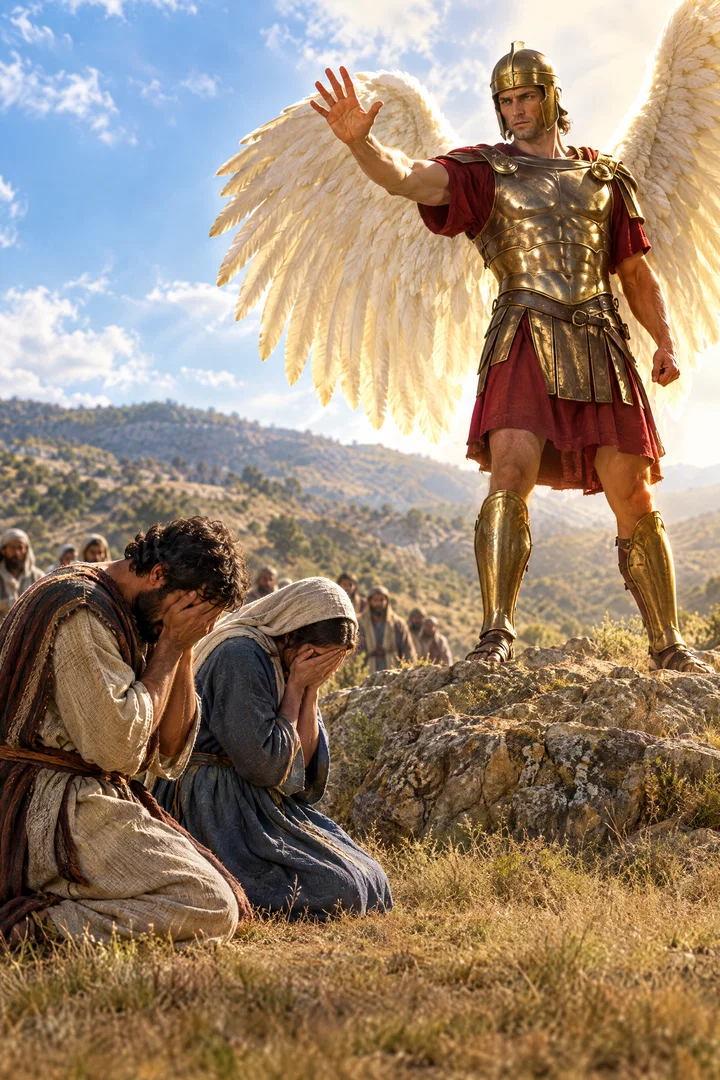
The sentence was delivered as a public reproof by the angel of the Lord to all Israel, after which the whole congregation wept.RH Sep 25, 1900ST Jan 16, 1907 The warning brought contrition and weeping at Bochim, with confession to God and to one another and with sacrifice.RH Sep 25, 1900 Because their repentance was genuine the grace of Christ wrought in their hearts and God forgave them, producing a genuine revival and reformation that kept them true to the covenant all the days of Joshua and of the elders that outlived him.RH Sep 25, 1900 Though those sins were repented of and forgiven, the seed of evil sown by sparing the nations remained and afterward sprang up to bear fruit when a new generation departed from God into mingled worship and erroneous principles and ambitious pride and service of other gods.RH Sep 25, 1900
Its warning about an opposing people remaining as a lasting trouble and snare applies to allowing popish clergy to retain authority and a voice in the national council, who would burden the church and become an obstacle that could not later be removed.ST Jul 14, 1881 Bochim as the place of weeping where God's rebuke brings His people to tears and repentance is repeated when the house of God becomes another Bochim.RH Feb 4, 1875 That comes through plain, loving preaching without stern words that leads the church to repent and weep with aching hearts unto relief.RH Feb 4, 1875 It leads to confession of its own sins and need of repentance and first love, and to receiving the freeness of pardon through Christ.RH Feb 4, 1875 It leads to coming up with one heart to the help of the Lord, with many turned from their sins to praise redeeming love.RH Feb 4, 1875
Sources