Translations
American King James Version, King James Version, KJV Cambridge Paragraph Bible
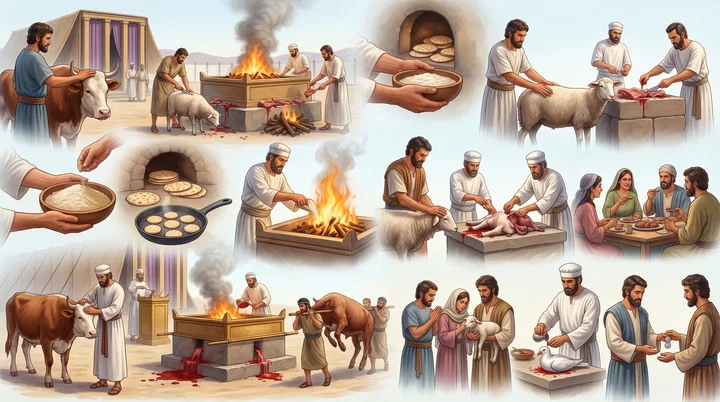
And he shall flay the burnt offering, and cut it into his pieces.
And he shall flay the burnt-offering, and cut it into its pieces,
And he shall flay the burnt offering, and cut it into its pieces.
And he shall flay the burnt-offering, and cut it into its pieces.
'And he hath stripped the burnt-offering, and hath cut it into its pieces;
And he shall flay the burnt-offering, and cut it up into its pieces.
Then shall he flay the ascending-sacrifice,—and cut it up into its pieces.
Berean Standard Bible, Majority Standard Bible
Next, he is to skin the burnt offering and cut it into pieces.
He shall skin the burnt offering and cut it into pieces.
And the burned offering is to be skinned and cut up into its parts.
Then shall he fley the burnt offering, and cut it in pieces.
Douay-Rheims (Challoner revision)
And when they have flayed the victim, they shall cut the joints into pieces,
Pictures
Cross-references
- Hebrews 10:4
For it is not possible that the blood of bulls and of goats should take away sins.
Animal sacrifices recalled sin but could not take it away.
- Leviticus 7:8
And the priest that offereth any man’s burnt offering, even the priest shall have to himself the skin of the burnt offering which he hath offered.
The priest receives the skin of the burnt offering.
- Hebrews 9:22
And almost all things are by the law purged with blood; and without shedding of blood is no remission.
The shedding of blood in sacrifice is linked to remission.
- Isaiah 53:6
All we like sheep have gone astray; we have turned every one to his own way; and the LORD hath laid on him the iniquity of us all.
The victim foreshadows Christ bearing the iniquity of all.
- Genesis 15:10
And he took unto him all these, and divided them in the midst, and laid each piece one against another: but the birds divided he not.
Both texts describe dividing an animal offering into pieces.
- Leviticus 1:17
And he shall cleave it with the wings thereof, but shall not divide it asunder: and the priest shall burn it upon the altar, upon the wood that is upon the fire: it is a burnt sacrifice, an offering made by fire, of a sweet savour unto the LORD.
The bird remains undivided, unlike the animals cut into pieces.
- 1 Kings 18:38
Then the fire of the LORD fell, and consumed the burnt sacrifice, and the wood, and the stones, and the dust, and licked up the water that was in the trench.
Fire consuming the sacrifice illustrates God’s acceptance.
- Leviticus 6:8-13
And the LORD spake unto Moses, saying,
Sets out the regular burnt offering service.
- Hebrews 9:11-12
But Christ being come an high priest of good things to come, by a greater and more perfect tabernacle, not made with hands, that is to say, not of this building;
Christ’s once-for-all sacrifice surpasses the earthly sacrificial service.
Commentary
Each commentary is drawn from primary sources: the writings of Ellen G. White and Adventist pioneers and periodicals. Each commentary is separate. Its own words are not a quotation; follow the references to read the source passages.
Ellen G. White
1 source
The burnt offering ritual required that the victim be skinned and then divided into its pieces.ST Jul 15, 1880 That sacrificial ritual was the appointed means through which Christ represented His own ministry and death.ST Jul 15, 1880 Its prescribed outward acts therefore signified something far more important than the ceremony itself.ST Jul 15, 1880
Sources
Pioneers and periodicals
28 sources
After it was killed, the offerer himself was to remove the skin of the burnt offering and cut the animal into pieces, which the priests then arranged on the altar to be burned.RH Feb 3, 1916ST May 29, 1901ST Jan 20, 1914 The pieces were laid out with the head and the fat, while the inner parts and legs were washed, and the whole was burned, the cutting serving for convenience when the animal was too large to burn whole.ST May 29, 1901ST Feb 9, 1915ST Sep 12, 1900 These appointed acts were the way of approach to God for reconciliation and peace, and their blood could not itself take away sin but pointed to Jesus Christ, the Lamb of God, whose death and ministry in the heavenly sanctuary bring justification and freedom from bondage to sin.ST Jul 15, 1880ST Oct 25, 1905ST Feb 9, 1915ST Feb 3, 1909 The burnt offering in particular is the sacrifice of consecration, representing the surrender of all the powers of one's being to God to be used as He alone directs and consumed on His altar.ST Jan 20, 1914ST Jan 31, 1911ST Sep 12, 1900 Its skin, the part seen before the offering, represents the past life given into the priest's hands, and its divided flesh represents human weaknesses that cannot be laid on the altar alone but can be placed in the hands of Christ the High Priest, for the offering must be whole and entirely burned, speaking of complete consecration and never of a divided heart.ST Jan 20, 1914ST Sep 12, 1900ST Sep 12, 1900ST Jan 20, 1914ST Sep 12, 1900
Ritual Procedure and Setting
After the burnt offering was killed, the one who brought it was himself to take off its skin and cut the animal into its pieces, and only then did the priests take the parts to arrange them on the altar for burning.RH Feb 3, 1916ST May 29, 1901ST Jan 20, 1914ST Feb 17, 1890ST Apr 2, 1912 The hide was removed and the body divided as the preparation of the offering after it was slain, the animal standing as the substitute for the one who brought it.ST May 29, 1901ST Feb 17, 1890ST May 29, 1901 The offering so prepared expressed faith in the coming Redeemer.ST Apr 2, 1912
Once divided, the pieces were laid out on the altar together with the head and the fat, while the inner parts and the legs were washed, and the whole offering was then burned.ST May 29, 1901 Dividing was only for convenience when the animal was too large to burn whole, for if small enough to burn whole it was not to be divided, whereas birds were never divided.ST Feb 9, 1915ST Sep 12, 1900 When division was made, the divided pieces were set opposite one another.ST Feb 9, 1915
The direction belongs to the instructions for individual burnt offerings in Leviticus 1-7, brought by persons for their own sins as part of the daily and personal services.RH Feb 25, 1858RH Feb 3, 1853RH Mar 8, 1870ST That individual work belonged to the daily ministry in the first tabernacle, the holy place, together with the regular morning and evening burnt offering, the morning and evening burning of sweet incense at the lighting of the lamps, and the special offerings for the Lord's Sabbaths, the annual sabbaths, the new moons, and the feasts.RH Mar 8, 1870 This daily holy-place ministration is the first of the two great divisions of the earthly sanctuary service, distinct from the yearly work in the most holy place.RH Mar 8, 1870
In that service the offerer laid a hand on the victim and confessed over it, and the animal was slain in the sinner's place as the substitute bearing the penalty.RH Feb 25, 1858RH Mar 28, 1854 Its life paid the penalty, and its blood, which is identified with life, was carried by the priest and sprinkled in the sanctuary.RH Mar 28, 1854 By that blood the guilt was transferred from the person to the victim and then to the sanctuary, where the forgiven sins remained before the ark through the year until they were cleansed on the tenth day of the seventh month.RH Feb 25, 1858RH Feb 3, 1853RH Mar 28, 1854ST
The direction belongs to the law of types communicated through Moses, in contrast with the moral law spoken directly by God from Sinai, and that Levitical law was abolished by Christ.RH Aug 20, 1872 That typical system of sacrifices and offerings was introduced at the fall, transmitted through the faithful, and given to Adam's family; Abel's offering of a lamb accorded with it in every respect, while Cain's offering of the fruit of the ground broke it because a lamb had been commanded and fruit had not.ST Feb 15, 1905ST Jul 16, 1894 After Israel's deliverance from Egypt it was enlarged, centralized, and embodied in the sanctuary and its elaborate services, belonging peculiarly to that dispensation in which the promised Seed, the Redeemer, was being brought in through Israel, and it was involved in the promises and compact then made which as a whole is called the old covenant.ST Feb 15, 1905 Its instructions for burnt offerings were already known before the Babylonian captivity, as shown by the sacrifices offered according to them at the Jewish temple at Elephantine.RH Jul 4, 1912
The burnt-offering instructions graded the offering to means, so that the rich brought a more costly animal while the poor might bring a less costly offering, even meal or fine flour in extreme poverty.RH Jan 20, 1859 In this way the service was made accessible to the poorest, yet everyone was required to bring something because all had sinned.RH Jan 20, 1859
Typical Meaning and Application
The outward acts prescribed for flaying and dividing the burnt offering signified far more than ceremony, for they provided the appointed approach to God's presence at the sanctuary for healing of conscience, reconciliation, and peace with God.ST Jul 15, 1880ST Oct 25, 1905 Their fuller symbolism pointed ahead to the time when the type would meet its Antitype, since through them Christ represented His own ministry and death.ST Jul 15, 1880ST Oct 25, 1905
These offerings show God's hatred of sin and that sin requires a penalty and must be put away.ST Feb 3, 1909 Their blood could not itself take away sin, but as types they point to Jesus Christ, the Lamb of God and the great Sacrifice who brings freedom from the bondage of sin.ST Feb 9, 1915ST Feb 3, 1909 They portray His once-for-all ministry in the heavenly sanctuary and represent His ministry and death, and they were offered in faith in the coming Redeemer through whom people can be justified while God remains just.ST Jul 15, 1880ST Nov 28, 1895ST Apr 2, 1912
The burnt offerings chiefly point to worship, and the burnt offering in particular is the sacrifice of consecration following confession and acceptance.ST Jan 20, 1914ST Jan 31, 1911ST Sep 12, 1900 It represents surrendering all the powers of one's being to God to be used as He alone directs and consumed on His altar.ST Jan 20, 1914ST Sep 12, 1900 The skin, the part visible before the offering, represents the offerer's past life given into the priest's hands, and the divided flesh represents the offerer's weaknesses.ST Jan 20, 1914ST Jan 20, 1914 This teaches that people cannot lay their own weaknesses on the altar by their own efforts but can place them in the hands of Christ, their High Priest, who can lay them there.ST Jan 20, 1914ST Jan 20, 1914
The offering must be a clean, sound, whole burnt offering with all of it burned, and cutting never means dividing the offering.ST Sep 12, 1900ST Sep 12, 1900ST May 28, 1902 If small enough to burn whole it must not be divided, and if too large it may be cut into pieces only for convenience, but all of it must still be burned, and woe to him who brings a divided heart.ST Sep 12, 1900ST Sep 12, 1900 Only the slain offering with shed blood and burned flesh speaks of complete consecration through death, for the killing and shedding of blood means the giving of the life without which there is no remission, and the flesh consumed on the altar means the consecrated life wholly offered to God.ST Sep 12, 1900ST Sep 12, 1900 A bruised and beaten animal let go would speak only of partial consecration willing to go to Gethsemane and to Pilate's judgment hall, but only the slain offering with flowing blood and burned flesh speaks of willingness in His strength to go with Him even to Calvary.ST Sep 12, 1900 Its truest and fullest illustration is the life of Jesus, wholly given to be consumed in daily service under divine love burning on the altar of His heart, poured out day by day to be ignored, despised, or received ungratefully, and in the end to be hated, mocked, spit upon, crucified, and covered with dust.ST Sep 12, 1900
The fire that burned it must be only the sacred consecrated fire first kindled by God Himself and carefully and constantly kept burning.ST Sep 12, 1900 It was usually taken from the altar of incense, though on special occasions God kindled the sacrifice directly by a flash from on high, and no other fire must be used, since offering strange fire brings consumption by the Lord's displeasure.ST Sep 12, 1900 These Scriptures reveal God's way, power, and glory, were written for learning that through patience and comfort hope may be had, and are profitable for doctrine, for reproof, for correction, and for instruction in righteousness.ST Jun 19, 1907 As a pattern, shadow, type, and impressive object-lesson of God's temple in heaven and Christ's priestly service there as High Priest, study of the verse enables understanding of the heavenly reality and gives clearer views of the Saviour and His work in behalf of men.ST Jun 19, 1907
Sources