Leviticus 5:7
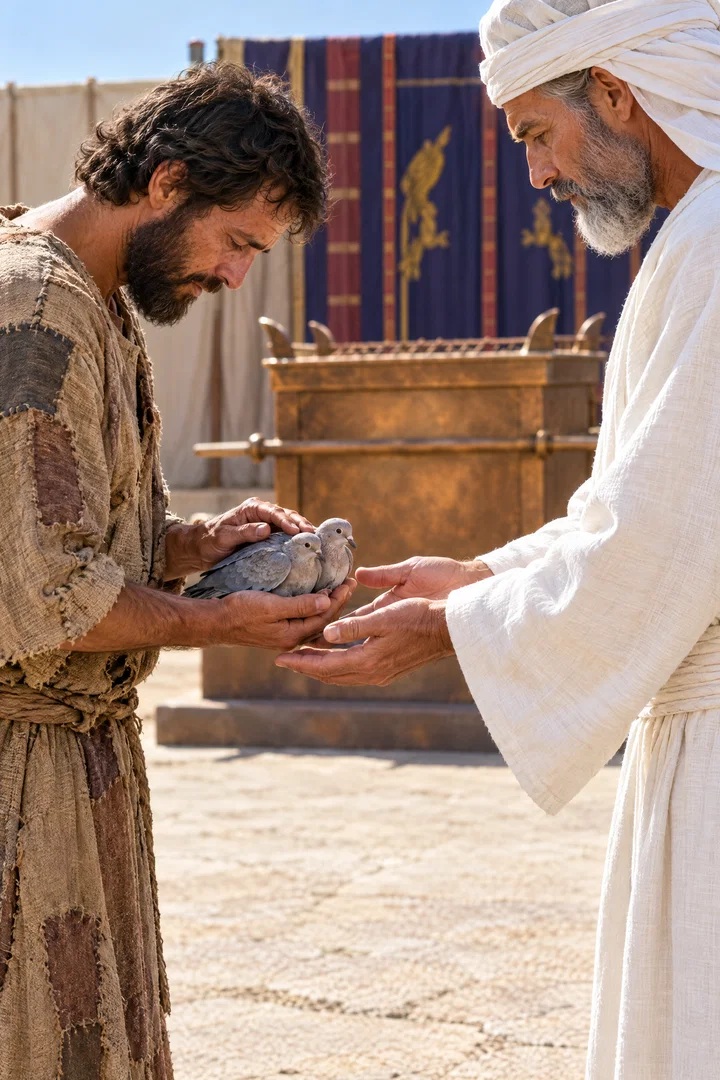
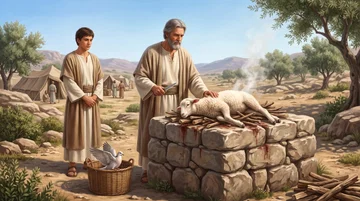
And if he be not able to bring a lamb, then he shall bring for his trespass, which he hath committed, two turtledoves, or two young pigeons, unto the LORD; one for a sin offering, and the other for a burnt offering.
Translations
And if he be not able to bring a lamb, then he shall bring for his trespass, which he has committed, two turtledoves, or two young pigeons, to the LORD; one for a sin offering, and the other for a burnt offering.
And if he be not able to bring a lamb, then he shall bring for his trespass, which he hath committed, two turtledoves, or two young pigeons, unto the LORD; one for a sin offering, and the other for a burnt offering.
And if he be not able to bring a lamb, then he shall bring for his trespass, which he hath committed, two turtledoves, or two young pigeons, unto the Lord; one for a sin offering, and the other for a burnt offering.
And if he shall not be able to bring a lamb, then he shall bring for his trespass which he hath committed, two turtle-doves, or two young pigeons, to the LORD; one for a sin-offering, and the other for a burnt-offering.
And if his means suffice not for a lamb, then he shall bring his guilt offering for that wherein he hath sinned, two turtledoves, or two young pigeons, unto the LORD; one for a sin offering, and the other for a burnt offering.
And if his means suffice not for a lamb, then he shall bring his trespass-offering for that wherein he hath sinned, two turtle-doves, or two young pigeons, unto Jehovah; one for a sin-offering, and the other for a burnt-offering.
'And if his hand reach not to the sufficiency of a lamb, then he hath brought in his guilt-offering — he who hath sinned — two turtle-doves or two young pigeons to Jehovah, one for a sin-offering, and one for a burnt-offering;
And if his hand be not able to bring what is so much as a sheep, then he shall bring for his trespass which he hath sinned two turtle-doves or two young pigeons, to Jehovah; one for a sin-offering, and the other for a burnt-offering.
And, if his hand cannot reach sufficient for a lamb, then shall he bring in to bear his guilt—for that he hath sinned—two turtle-doves, or two young pigeons unto Yahweh,—one for a sin-bearer, and one for an ascending-sacrifice.
Berean Standard Bible, Majority Standard Bible
If, however, he cannot afford a lamb, he may bring to the LORD as restitution for his sin two turtledoves or two young pigeons— one as a sin offering and the other as a burnt offering.
“‘ If he can’t afford a lamb, then he shall bring his trespass offering for that in which he has sinned, two turtledoves, or two young pigeons, to the LORD; one for a sin offering, and the other for a burnt offering.
And if he has not money enough for a lamb, then let him give, for his offering to the Lord, two doves or two young pigeons; one for a sin-offering and one for a burned offering.
But if he be not able to bring a sheepe, he shall bring for his trespas which he hath committed, two turtle doues, or two yong pigeons vnto the Lord, one for a sinne offring, and the other for a burnt offring.
Douay-Rheims (Challoner revision)
But if he be not able to offer a beast, let him offer two turtles, or two young pigeons to the Lord, one for sin, and the other for a holocaust,
Pictures
Cross-references
- Leviticus 4
And the LORD spake unto Moses, saying,
Together the texts give instructions for sin offerings and obtaining forgiveness.
- Leviticus 5:11
But if he be not able to bring two turtledoves, or two young pigeons, then he that sinned shall bring for his offering the tenth part of an ephah of fine flour for a sin offering; he shall put no oil upon it, neither shall he put any frankincense thereon: for it is a sin offering.
Flour is allowed as a sin offering when even doves are unattainable.
- Leviticus 7:1-8
Likewise this is the law of the trespass offering: it is most holy.
Further instructions explain the law for guilt offerings.
- Leviticus 17:11
For the life of the flesh is in the blood: and I have given it to you upon the altar to make an atonement for your souls: for it is the blood that maketh an atonement for the soul.
Atonement for sin is made through sacrificial blood.
- Luke 2:24
And to offer a sacrifice according to that which is said in the law of the Lord, A pair of turtledoves, or two young pigeons.
Mary and Joseph offered the provision for those unable to bring a lamb.
- Leviticus 4:22-24
When a ruler hath sinned, and done somewhat through ignorance against any of the commandments of the LORD his God concerning things which should not be done, and is guilty;
Both describe offerings for sin and the prescribed sacrifice.
- Leviticus 4:28-29
Or if his sin, which he hath sinned, come to his knowledge: then he shall bring his offering, a kid of the goats, a female without blemish, for his sin which he hath sinned.
Both describe offerings brought for sin committed by an ordinary person.
- Hebrews 9:12
Neither by the blood of goats and calves, but by his own blood he entered in once into the holy place, having obtained eternal redemption for us.
Christ’s once-for-all ministry contrasts with the recurring offerings of the law.
- Malachi 1:8
And if ye offer the blind for sacrifice, is it not evil? and if ye offer the lame and sick, is it not evil? offer it now unto thy governor; will he be pleased with thee, or accept thy person? saith the LORD of hosts.
Both address offering an unfit animal for sacrifice.
- Leviticus 10:17
Wherefore have ye not eaten the sin offering in the holy place, seeing it is most holy, and God hath given it you to bear the iniquity of the congregation, to make atonement for them before the LORD?
The sin offering bears the people’s iniquity and makes atonement for them.
- Hebrews 2:17
Wherefore in all things it behoved him to be made like unto his brethren, that he might be a merciful and faithful high priest in things pertaining to God, to make reconciliation for the sins of the people.
Christ makes reconciliation for sins as the merciful and faithful High Priest.
Commentary
Each commentary is drawn from primary sources: the writings of Ellen G. White and Adventist pioneers and periodicals. Each commentary is separate. Its own words are not a quotation; follow the references to read the source passages.
Ellen G. White
1 source
If a person was not able to bring a lamb for his trespass, he was permitted to bring two turtledoves or two young pigeons to the Lord instead, one for a sin offering and the other for a burnt offering, yet the humbler substitute was to be prepared with the same care and exactness as the costlier animal.ST Jul 15, 1880 This provision shows that the poor are as precious in God's sight as the most wealthy when they are willing and obedient.ST Jul 15, 1880 The most humble offering is accepted when it is all the poor can bring, and this assurance stands on record for their encouragement.ST Jul 15, 1880
It was fulfilled in the parents of Jesus, who were poor and could bring only a pair of turtledoves or two young pigeons in connection with the priceless gift of the Son of God.ST Jul 15, 1880 The poor often give more freely and with greater sacrifice in their simple dove offerings than the wealthy who give from abundance and feel no personal inconvenience.ST Jul 15, 1880 Such simple, cheerful freewill gifts are far more acceptable and fragrant to God than thousands of gold and silver given grudgingly.ST Jul 15, 1880
Sources
Pioneers and periodicals
22 sources
Leviticus 5:7 belongs to the laws for individual sin and trespass offerings, directing one who is unable to bring a lamb to bring two turtledoves or two young pigeons to the Lord, one for a sin offering and the other for a burnt offering.ST Aug 8, 1916RH Sep 16, 1852RH Feb 3, 1853 The requirement was graded according to ability and wealth, reaching from costly animals down to birds and even to meal, so that its benefits lay within reach of the poorest.ST Aug 16, 1883RH Jan 20, 1859RH Jun 27, 1912 Atonement was made not by the death of the victim alone but through the priest's sanctuary service with its blood, by which the confessed sin was transferred in figure to the sanctuary, and once atonement was made the person was forgiven and free from that iniquity until the yearly cleansing.ST Aug 8, 1916RH Sep 30, 1852ST Feb 17, 1890ST Each kind of sacrifice points in type as a shadow to the sacrifice, life, and work of Jesus Christ, in whom those burdened with sin expressed faith, and the verse was fulfilled in the parents of Jesus who being poor could bring only a pair of turtledoves or two young pigeons in connection with the priceless gift of the Son of God.ST Jul 15, 1880ST Feb 7, 1911ST Feb 3, 1909ST Feb 13, 1912ST Apr 2, 1912 Justice is mingled with mercy, for the poor are not shut out but stand in just the same relation to God as one able to bring a bullock, yet every sinner must bring something according to wealth, and even the smallest substitute must be the best without blemish and is accepted when freely given.ST Jul 15, 1880RH Jan 20, 1859ST Dec 13, 1905RH Jun 27, 1912ST Oct 29, 1912
The Provision for Poverty
Leviticus 5:7 belongs to the laws for individual sin and trespass offerings, prescribing that one unable to bring a lamb shall bring two turtledoves or two young pigeons unto the LORD, one for a sin offering and the other for a burnt offering.ST Aug 8, 1916RH Sep 16, 1852RH Feb 3, 1853ST Sep 7, 1904ST It is included among the instructions for the individual offerings brought during the year for atonement and forgiveness of sins, with the trespass or guilt offering divided so that one bird was offered as a sin offering and the other as a burnt offering.ST Aug 8, 1916RH Sep 16, 1852RH Sep 30, 1852RH Feb 3, 1853 The requirement was graded according to ability and wealth, with the cost varying with the wealth or position of the one making the offering, so that true worship was never without personal cost.ST Aug 16, 1883RH Jan 20, 1859 Justice is mingled with mercy in requiring an offering from every sinner according to ability, the rich bringing the most costly animals and the poor who cannot bring bullock, heifer, goat, sheep, calf, kid or lamb bringing a turtledove or young pigeon.ST Aug 16, 1883RH Jan 20, 1859RH Jun 27, 1912 The scale reaches down even to meal or fine flour, with wild turtledoves to be caught if he does not possess pigeons and a small portion of fine flour if he is too feeble to capture the wild doves, so that the benefits of sacrificial service lie within reach of the poorest of the poor.RH Jan 20, 1859RH Jun 27, 1912
When a man sinned, which is the transgression of the law, he brought a clean beast without blemish, a kid or lamb if able to provide one, to the door of the tabernacle of the congregation.ST Feb 17, 1890ST Apr 22, 1913 He laid hands on its head while confessing sin, in figure transferring sin to the victim and accepting it as his substitute and signifying his need of a sacrifice.ST Feb 17, 1890ST Apr 22, 1913 He shed its innocent blood, thus acknowledging that he himself was worthy of death.ST Feb 17, 1890 The priest then made atonement by taking the blood, in which the life is represented, and carrying it into the holy place to sprinkle it before the altar of incense and put some on the horns of the altar.RH Sep 30, 1852ST Feb 17, 1890 In some cases where the blood was not taken in, the flesh was eaten in the holy place, and the sins were transferred in that way, so the sin was transferred in figure to the sanctuary.ST Feb 17, 1890
Once the priest made atonement with its blood the person was forgiven and free from that iniquity.RH Sep 30, 1852 An offering made in faith transferred the penitent's sins in figure to the sanctuary through the sacrifice's blood or the priest.RH Sep 30, 1852ST The forgiven sins remained in figure there until the yearly cleansing service, where the iniquity conveyed to the sanctuary is later cleansed.RH Sep 30, 1852ST Even the smaller substitute had to be the best the offerer had, without blemish and prepared with the same care and exactness as a costlier animal.ST Jul 15, 1880ST Dec 13, 1905ST Apr 22, 1913 The soul that brings the offering means a person bringing an offering to the Lord, as when one unable to afford a lamb brings birds instead.ST Sep 7, 1904
Atonement Through Christ
Atonement was made not by the death of the animal alone but through the priest's work with its blood in the sanctuary.ST Aug 8, 1916 The sinner brought and slew the offering, one bird for a sin offering and one for a burnt offering when unable to bring a lamb, and the priest then used its blood in the sanctuary service to make atonement.ST Aug 8, 1916 The law to which this provision belongs is the ceremonial law instituted in consequence of sin.RH Jan 10, 1916 Its instructions for offerings show that sin demands a penalty.ST Feb 3, 1909
The details of the sacrifices and offerings have meaning, and their fuller meaning is found in the sacrifice, life, and work of Jesus Christ.ST Feb 7, 1911 They are shadows of their fulfillment in Jesus Christ.ST Feb 3, 1909 Each different kind of sacrifice described points in type to some aspect of the work of Jesus Christ.ST Feb 13, 1912 The individual offerings brought by those burdened with sin expressed faith in the Redeemer who was to come.ST Apr 2, 1912 The yearly round of sanctuary services to which this provision belongs typified Christ's ministry and was repeated each year, while Christ's corresponding service was once for all.ST Nov 28, 1895
The further provision for still deeper poverty allowed a small portion of fine flour, even for one too feeble to catch wild turtledoves when he did not possess pigeons, and the crushed grain typifies the broken body of the Saviour.RH Jun 27, 1912 A handful of the flour is burned, corresponding to the burning of the fat, typifying the final destruction of sin, and the remainder eaten by the priest typifies the bearing of sins by the Saviour.RH Jun 27, 1912 Through this ample provision the poor sinner stands forgiven in just the same relation to God as one able to bring a bullock.RH Jun 27, 1912 This law was fulfilled when the parents of Jesus, being poor, could bring only a pair of turtledoves or two young pigeons in connection with the priceless gift of the Son of God.ST Jul 15, 1880
That fulfillment shows God allowed the poor to bring a dove or pigeon instead of a more expensive animal, while requiring the same care and exactness in preparation.ST Jul 15, 1880 The poor are as precious in the sight of God as the most wealthy if willing and obedient, and the most humble offering is accepted if it is all the poor can bring and is placed on record for their encouragement.ST Jul 15, 1880 The poor often give more freely and make more sacrifice in their simple dove offerings than the wealthy who give from abundance without personal inconvenience.ST Jul 15, 1880 Such free, cheerful gifts, simple as they may be, are far more acceptable and fragrant to God than thousands of gold and silver given grudgingly.ST Jul 15, 1880
Accepted Worship and Duty
The law mingles justice with mercy by laying a trespass offering upon every sinner according to ability, so that the rich bring the most costly animals while the poor who cannot bring bullock, heifer, goat, sheep, calf, kid or lamb may bring a turtledove or young pigeon, with the scale reaching down even to meal or fine flour so that the benefits of the sacrificial service lie within reach of the poorest of the poor, yet still requiring every man to bring something because every man has sinned.RH Jan 20, 1859 The poor were not shut out from bringing an offering for sin, for one unable to afford a lamb could bring two pigeons or turtledoves for the trespass offering.ST Jul 15, 1880RH Jun 27, 1912ST Oct 29, 1912 The forgiven poor sinner who brings what is allowed stands in just the same relation to God as one able to bring a bullock, being as precious in His sight as the most wealthy if willing and obedient.ST Jul 15, 1880RH Jun 27, 1912
Poverty is no excuse for giving God no offering at all, and to withhold even that small offering is to rob God in tithes and offerings.RH Dec 25, 1860 These sin-offerings, peace-offerings, and thank-offerings were made in addition to tithes and cost the offerer something according to wealth or position, so that if he was not able to bring a lamb he could bring two turtledoves or two young pigeons instead, one for a sin offering and the other for a burnt offering, proving that true worship was never dead-head worship without personal cost.ST Aug 16, 1883 The most humble offering is accepted if it is all the poor can bring, and is placed on record for their encouragement.ST Jul 15, 1880 Such free, cheerful, simple gifts are far more acceptable and fragrant to God than thousands of gold and silver given grudgingly, for the poor often give more freely and make more sacrifice in their simple dove offerings than the wealthy who give from abundance and feel no personal inconvenience.ST Jul 15, 1880
The law of offerings for sin shows that sin remains sin even when a person does not recognize it or acted with good intentions, and once recognized it is to be confessed, repented of, and put away.RH Apr 28, 1910 The rule of action is to do the best one knows how by daily seeking Jesus for wisdom, rather than bringing what is lame or blind when an offering is brought.RH Dec 25, 1860
Sources