Leviticus 6:12
And the fire upon the altar shall be burning in it; it shall not be put out: and the priest shall burn wood on it every morning, and lay the burnt offering in order upon it; and he shall burn thereon the fat of the peace offerings.
Translations
And the fire on the altar shall be burning in it; it shall not be put out: and the priest shall burn wood on it every morning, and lay the burnt offering in order on it; and he shall burn thereon the fat of the peace offerings.
King James Version, KJV Cambridge Paragraph Bible
And the fire upon the altar shall be burning in it; it shall not be put out: and the priest shall burn wood on it every morning, and lay the burnt offering in order upon it; and he shall burn thereon the fat of the peace offerings.
And the fire upon the altar shall be burning on it; it shall not be extinguished: and the priest shall burn wood on it every morning, and lay the burnt-offering in order upon it; and he shall burn on it the fat of the peace-offerings.
And the fire upon the altar shall be kept burning thereon, it shall not go out; and the priest shall burn wood on it every morning: and he shall lay the burnt offering in order upon it, and shall burn thereon the fat of the peace offerings.
And the fire upon the altar shall be kept burning thereon, it shall not go out; and the priest shall burn wood on it every morning: and he shall lay the burnt-offering in order upon it, and shall burn thereon the fat of the peace-offerings.
'And the fire on the altar is burning on it, it is not quenched, and the priest hath burned on it wood morning by morning, and hath arranged on it the burnt-offering, and hath made perfume on it [with] the fat of the peace-offerings;
And the fire upon the altar shall be kept burning on it: it shall not be put out; and the priest shall burn wood on it every morning, and lay the burnt-offering in order upon it; and he shall burn thereon the fat of the peace-offerings.
And, the fire on the altar, shall be kept burning therein, it shall not be suffered to go out, but the priest shall kindle up thereon pieces of wood, morning by morning,—and shall set in order thereupon the ascending-sacrifice, and shall make a perfume thereon with the fat-pieces of the peace-offerings:
Berean Standard Bible, Majority Standard Bible
The fire on the altar shall be kept burning; it must not be extinguished. Every morning the priest is to add wood to the fire, arrange the burnt offering on it, and burn the fat portions of the peace offerings on it.
The fire on the altar shall be kept burning on it, it shall not go out; and the priest shall burn wood on it every morning. He shall lay the burnt offering in order upon it, and shall burn on it the fat of the peace offerings.
The fire on the altar is to be kept burning; it is never to go out; every morning the priest is to put wood on it, placing the burned offering in order on it, and there the fat of the peace-offering is to be burned.
But the fire vpon the altar shall burne thereon and neuer be put out: wherefore the Priest shall burne wood on it euery morning, and lay the burnt offering in order vpon it, and he shall burne thereon the fat of the peace offrings.
Douay-Rheims (Challoner revision)
And the fire on the altar shall always burn, and the priest shall feed it, putting wood on it every day in the morning, and laying on the holocaust, shall burn thereupon the fat of the peace offerings.
Pictures
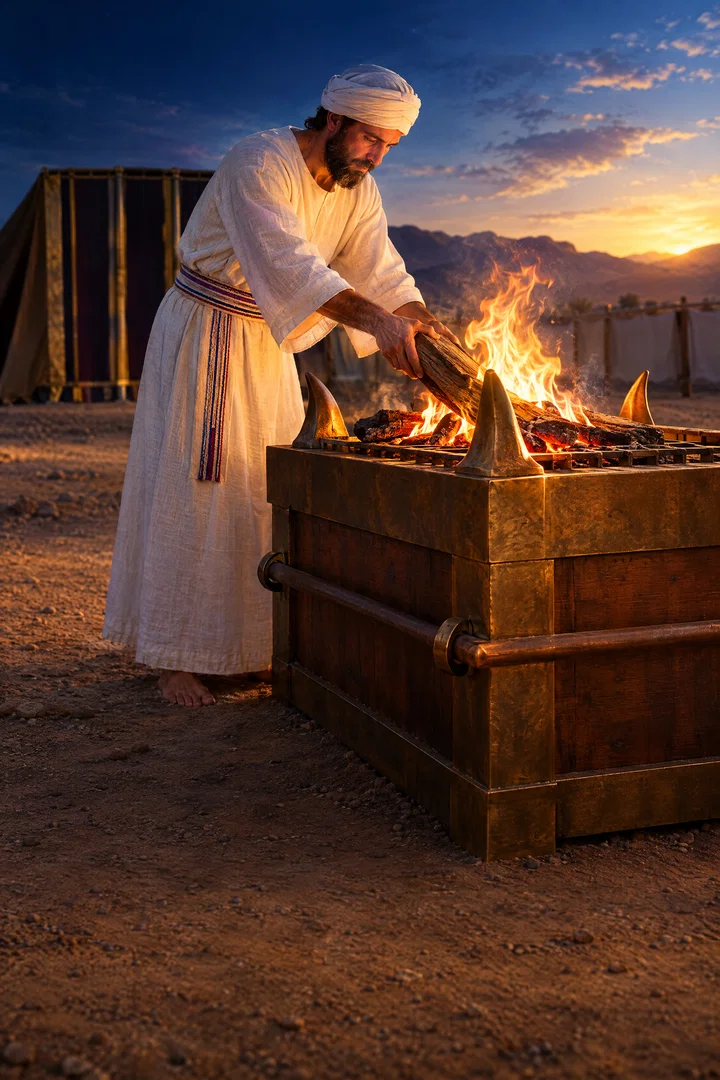
Cross-references
- Leviticus 10:1-2
And Nadab and Abihu, the sons of Aaron, took either of them his censer, and put fire therein, and put incense thereon, and offered strange fire before the LORD, which he commanded them not.
Unauthorized fire is contrasted with the commanded altar fire.
- Numbers 28:3-4
And thou shalt say unto them, This is the offering made by fire which ye shall offer unto the LORD; two lambs of the first year without spot day by day, for a continual burnt offering.
Both describe the continual burnt offering, with one lamb offered morning and evening.
- Exodus 29:38-42
Now this is that which thou shalt offer upon the altar; two lambs of the first year day by day continually.
Sets out the continual morning and evening burnt offerings.
- Hebrews 8:1-2
Now of the things which we have spoken this is the sum: We have such an high priest, who is set on the right hand of the throne of the Majesty in the heavens;
Earthly altar service foreshadows Christ’s ministry in the heavenly sanctuary.
- Leviticus 9:24
And there came a fire out from before the LORD, and consumed upon the altar the burnt offering and the fat: which when all the people saw, they shouted, and fell on their faces.
Fire from the Lord consumes the offering on the altar.
- 1 Kings 18:38
Then the fire of the LORD fell, and consumed the burnt sacrifice, and the wood, and the stones, and the dust, and licked up the water that was in the trench.
God sent fire to consume Elijah’s sacrifice on Carmel.
- Numbers 28:10
This is the burnt offering of every sabbath, beside the continual burnt offering, and his drink offering.
The Sabbath burnt offering is additional to the continual daily offering.
- Hebrews 8:5
Who serve unto the example and shadow of heavenly things, as Moses was admonished of God when he was about to make the tabernacle: for, See, saith he, that thou make all things according to the pattern shewed to thee in the mount.
The earthly sanctuary follows the pattern of heavenly things.
- Hebrews 9:23-24
It was therefore necessary that the patterns of things in the heavens should be purified with these; but the heavenly things themselves with better sacrifices than these.
Earthly altar service reflects the heavenly sanctuary.
- Hebrews 9:6-7
Now when these things were thus ordained, the priests went always into the first tabernacle, accomplishing the service of God.
Describes the recurring services of the earthly sanctuary.
- Romans 12:1
I beseech you therefore, brethren, by the mercies of God, that ye present your bodies a living sacrifice, holy, acceptable unto God, which is your reasonable service.
Both connect continual worship with offering oneself to God.
- Revelation 8:3-4
And another angel came and stood at the altar, having a golden censer; and there was given unto him much incense, that he should offer it with the prayers of all saints upon the golden altar which was before the throne.
Incense rises with the prayers of the saints.
- Malachi 3:2-3
But who may abide the day of his coming? and who shall stand when he appeareth? for he is like a refiner’s fire, and like fullers’ soap:
Refining fire depicts the Spirit’s purifying work.
Commentary
Each commentary is drawn from primary sources: the writings of Ellen G. White and Adventist pioneers and periodicals. Each commentary is separate. Its own words are not a quotation; follow the references to read the source passages.
Ellen G. White
7 sources
The fire on the altar was kindled by God Himself and was to be kept burning continually, without interruption and never to be put out.2RED 82.1–2LC1 186.1Ms 109, 1899, par. 5–6Ms 122, 1897, par. 25–26RH Mar 25, 1875 The priest was to tend it every morning by burning wood on it, laying the burnt offering in order upon it, and burning thereon the fat of the peace offerings.LC1 186.1RH Mar 25, 1875 This same fire was to be used for all sacrifices and for the sanctuary service.2RED 82.1–2Ms 109, 1899, par. 5–6Ms 122, 1897, par. 25–26 No common fire was to be used in sacred service or substituted for this God-kindled fire.2RED 82.1–2LC1 186.1Ms 109, 1899, par. 5–6Ms 122, 1897, par. 25–26RH Mar 25, 1875
The sacred fire represented God Himself.Ms 109, 1899, par. 5–6 It represented the divinely established communication and connection between God and humanity opened through Jesus Christ.2RED 82.1–2LC1 186.1RH Mar 25, 1875 Incense kindled from this fire was placed in censers and offered so that its fragrance rose before God with the prayers of the people waiting on Him, representing Christ's mediation.LC1 186.1RH Mar 25, 1875Ms 18, 1895, par. 15–16
The verse requires worship to follow God's instructions exactly with strict obedience, preserving the distinction between what is sacred and what is common.2RED 82.1–2LC1 186.1Ms 109, 1899, par. 5–6 Using unauthorized, common fire violates His express directions and dishonors His holiness.2RED 82.1–2Ms 109, 1899, par. 5–6 Nadab and Abihu violated this command by using common fire that God had not commanded.Ms 109, 1899, par. 5–6Ms 122, 1897, par. 25–26
The continually maintained fire for God's people is like the living water Christ gives, which continually meets spiritual need and springs up to everlasting life.Ms 18, 1895, par. 15–16 Spiritually, only at God's altar can people kindle their lights with divine fire.GW 255.1 That light reveals human weakness and Christ's perfection and purity.GW 255.1 Beholding Jesus awakens the desire to be like Him, seeing His righteousness creates hunger for it, and earnest prayer brings the heart's desire to God.GW 255.1
Sources
Pioneers and periodicals
21 sources
The fire on the altar was to be kept burning at all times and never allowed to go out, with fresh wood added every morning and the burnt offering laid in order upon it with the fat of the peace offerings.RH Aug 15, 1865ST May 29, 1901ST Apr 2, 1912 That flame had been kindled by God Himself and was to be guarded as sacred, so no common fire could be substituted for it.ST May 29, 1901RH Feb 2, 1911ST Sep 12, 1900 As part of the round of offerings and priestly work, it was a type and shadow of Christ's ministry in the heavenly sanctuary, given to provide clearer views of the Saviour and His priestly work.RH Jan 10, 1916RH Mar 8, 1870ST Jun 19, 1907 No sacrifice was acceptable without that divine fire, because it represented the fellowship between God and man opened through Jesus Christ alone, with incense kindled from it rising as an emblem of His mediation mingled with the prayers of the people.ST Mar 4, 1875RH Mar 25, 1875 The same fire represents one phase of the work of the Holy Spirit in cleansing and refining the surrendered heart by consuming sin, so the command to keep it burning continually means the Spirit is to abide forever and must not be quenched by withholding the continual surrender of whatever He shows to be wrong.ST May 29, 1901RH Nov 27, 1913
The Continual Altar Service
The fire on the altar was to be kept burning continually and never allowed to go out.RH Mar 25, 1875RH Aug 15, 1865ST May 29, 1901ST Apr 2, 1912RH Feb 2, 1911 The priest was to burn wood on it every morning, and lay the burnt offering in order upon it, and burn thereon the fat of the peace offerings.RH Mar 25, 1875RH Aug 15, 1865ST May 29, 1901ST Apr 2, 1912RH Feb 2, 1911
The fire was first kindled by the Lord Himself.ST Mar 4, 1875RH Mar 25, 1875ST May 29, 1901RH Feb 2, 1911ST Sep 12, 1900 Thereafter it was carefully maintained as sacred fire, and no other or common fire was permitted in its place.ST Mar 4, 1875RH Mar 25, 1875ST Sep 12, 1900 On special occasions God kindled the sacrifice directly, as with Elijah on Mount Carmel.ST Sep 12, 1900
This continual fire sustained the daily burnt offering of one lamb with meal and oil in the morning and the same at evening, doubled on the Sabbath, continuing day by day through the year.RH Aug 15, 1865ST Apr 2, 1912 The evening offering burned through the night and the morning offering through the day.RH Aug 15, 1865 The continual offering was maintained even on the Day of Atonement, while the high priest performed the sanctuary service, so that offerings continued at the altar during that day.RH Aug 15, 1865
This work belonged to the daily ministration in the first apartment or holy place, the regular work done for individuals and for the nation as they presented their particular offerings through the year.RH Mar 8, 1870RH Feb 3, 1853STST Apr 2, 1912 It was the first grand division of sanctuary work, distinct from the yearly work in the most holy place for the sins of the people and the cleansing of the sanctuary.RH Mar 8, 1870 It ranked among the permanent acts of divine worship, together with the incense, the showbread, the lamp, and the morning and evening offerings.ST Mar 12, 1912 Its fire supplied the censer for the incense service at the golden altar, where sweet incense was burned morning and evening.ST Mar 4, 1875ST Apr 1, 1913
Christ Foreshadowed by Fire
The verse belongs to the ceremonial law instituted in consequence of sin, to the instructions for Israel's offerings and priesthood.RH Jan 10, 1916ST Feb 3, 1909ST Feb 13, 1912 It is part of the yearly round of Levitical service in the sanctuary commanded through Moses, and of the daily ministration in the first apartment for individuals as they presented their particular offerings through the year, distinct from the yearly work in the most holy place for cleansing the sanctuary.RH Mar 8, 1870ST Jun 19, 1907ST Nov 28, 1895 Those services and types teach God's hatred of sin and that sin demands a penalty, and they are types and shadows pointing forward to their fulfillment in Jesus Christ and His more excellent ministry in the true tabernacle in heaven.RH Mar 8, 1870ST Feb 3, 1909ST Nov 28, 1895ST Feb 13, 1912 The earthly sanctuary and its service were a pattern and shadow, an impressive object-lesson concerning God's temple in heaven and Christ's priestly service therein as High Priest and Minister of the heavenly sanctuary.RH Mar 8, 1870ST Jun 19, 1907 They were not written in vain but with purpose, profitable for doctrine, reproof, correction and instruction in righteousness that the man of God may be perfect, and written for learning that through patience and comfort of the Scriptures hope may be had, so that study of the verse gives clearer views of the Saviour and His work in behalf of men.ST Jun 19, 1907
The fat represented sin, so its separating and burning on the altar fire kept continually burning by the priest's daily care pictured God's work of separating sin from the sinner and ultimately destroying sin.RH Nov 27, 1913 The daily morning burnt offering laid in order on wood kept continually burning belonged to the regular work in the holy place that in figure transferred the penitent's sins through the blood of the sacrifice or the person of the priest into the sanctuary.ST There the forgiven sins were left before the ark through the year until they were confessed out and removed on the tenth day of the seventh month.ST The daily ministration for the nation kept the fire on the altar of burnt offering continually burning while the priest burned wood every morning and laid the burnt offering in order upon it, one lamb with meal and oil in the morning and the same at evening, doubled on the Sabbath, continuing day by day through the year.ST Apr 2, 1912 It combined all the individual offerings brought day by day by burdened sinners showing faith in the Redeemer to come into one constant offering for the nation, making constant remembrance of sin in the sanctuary by constantly offered beasts, as the daily part of one entire yearly round looking forward to the future antitype and closing with the cleansing of the sanctuary on the Day of Atonement.ST Apr 2, 1912
The fire on the altar was kindled by God Himself and was to burn day and night without ever going out, kept burning perpetually with wood added by the priest each morning, and it was not to be replaced with common fire.ST Mar 4, 1875RH Mar 25, 1875ST May 29, 1901 That divine fire seasoned every sacrifice, and no sacrifice was acceptable to God without it, because it represented the communication between God and man opened through Jesus Christ alone.ST Mar 4, 1875RH Mar 25, 1875 It supplied the censer for the incense service, and incense kindled by this holy fire rising before God mingled with the earnest prayers of the people without was an emblem of the mediation of Christ.ST Mar 4, 1875RH Mar 25, 1875 Any deviation from God's express directions for this holy service was an insult to the infinite God punishable with death, as with Nadab and Abihu's use of common fire and as with Cain's offering with no divine Saviour represented.ST Mar 4, 1875
The fire represents one phase of the work of the Holy Spirit in baptizing with fire and cleansing and refining.ST May 29, 1901 In a heart fully surrendered to God it keeps burning as sin and the dross of character are consumed.RH Nov 27, 1913 The command to keep it burning continually and never let it go out means the Spirit is to abide forever and must not be quenched, but kept alive by presenting the body as a living sacrifice with whole burnt offerings and the fat of sin offerings and by continual surrender of whatever the Spirit reveals to be wrong.ST May 29, 1901RH Nov 27, 1913
Spiritual Moral Application
The altar fire was kept continually burning by the priest's daily care and the burning of sacrificial fat.RH Nov 27, 1913 The fat represented sin, so its separating and burning pictured God's work of separating sin from the sinner and ultimately destroying sin.RH Nov 27, 1913 For the believing worshiper the sacrifice was therefore not merely a symbol of pardon but, through faith, a means of receiving the saving blessings of the gospel.RH Nov 27, 1913
The fire once kindled by God was to be kept burning continually and never allowed to go out, with wood burned on it every morning and the burnt offering laid in order upon it and the fat of the peace offerings burned thereon.ST May 29, 1901 That fire represents one phase of the work of the Holy Spirit in baptizing with fire and cleansing and refining, and the command to keep it burning continually means the Spirit is to abide forever and must not be quenched.ST May 29, 1901RH Nov 27, 1913 It keeps burning in a heart fully surrendered to God as sin and the dross of character are consumed, unless the person quenches it.RH Nov 27, 1913 It is kept alive by presenting the body as a living sacrifice with whole burnt offerings and the fat of sin offerings.ST May 29, 1901 This refining process requires continual surrender of whatever the Spirit reveals to be wrong.RH Nov 27, 1913
The continual flame illustrates the enduring love that should be maintained between husband and wife.RH Aug 19, 1902 It likewise supplies the image of altar fires that must be kept burning as applied to the need to keep spiritual fervor bright amid discouragement and hostile surroundings.RH Mar 15, 1906 Missionaries especially must keep that fervor bright amid discouragement and hostile surroundings.RH Mar 15, 1906
Sources