Leviticus 7:32
And the right shoulder shall ye give unto the priest for an heave offering of the sacrifices of your peace offerings.
Translations
And the right shoulder shall you give to the priest for an heave offering of the sacrifices of your peace offerings.
And the right shoulder shall ye give unto the priest for an heave offering of the sacrifices of your peace offerings.
And the right shoulder shall ye give unto the priest for a heave offering of the sacrifices of your peace offerings.
And the right shoulder shall ye give to the priest for a heave-offering of the sacrifices of your peace-offerings.
And the right thigh shall ye give unto the priest for an heave offering out of the sacrifices of your peace offerings.
And the right thigh shall ye give unto the priest for a heave-offering out of the sacrifices of your peace-offerings.
and the right leg ye do make a heave-offering to the priest of the sacrifices of your peace-offerings;
And the right shoulder of the sacrifices of your peace-offerings shall ye give as a heave-offering unto the priest.
But, the right shoulder, shall ye give as a heave-offering, unto the priest,—from among your peace-offerings
Berean Standard Bible, Majority Standard Bible
And you are to give the right thigh to the priest as a contribution from your peace offering.
The right thigh you shall give to the priest for a heave offering out of the sacrifices of your peace offerings.
And the right leg you are to give to the priest for an offering to be lifted up out of what is given for your peace-offerings.
And the right shoulder shall ye giue vnto the Priest for an heaue offering, of your peace offrings.
Douay-Rheims (Challoner revision)
The right shoulder also of the victims of peace offerings shall fall to the priest for firstfruits.
Pictures
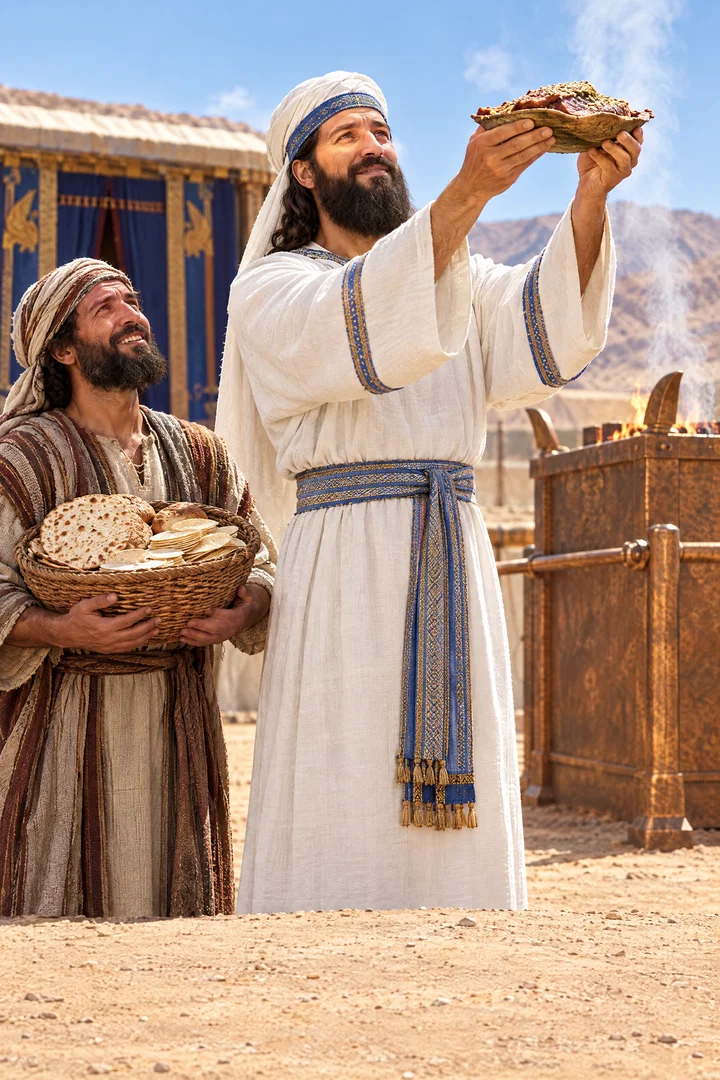
Cross-references
- Hebrews 8:1-5
Now of the things which we have spoken this is the sum: We have such an high priest, who is set on the right hand of the throne of the Majesty in the heavens;
Earthly priestly service is a pattern of Christ’s heavenly ministry.
- 1 Samuel 2:13-16
And the priests’ custom with the people was, that, when any man offered sacrifice, the priest’s servant came, while the flesh was in seething, with a fleshhook of three teeth in his hand;
Eli’s sons take offering meat contrary to the prescribed priestly portion.
- Deuteronomy 18:3-5
And this shall be the priest’s due from the people, from them that offer a sacrifice, whether it be ox or sheep; and they shall give unto the priest the shoulder, and the two cheeks, and the maw.
Lists portions of sacrifices assigned to the priests.
- Leviticus 10:14-15
And the wave breast and heave shoulder shall ye eat in a clean place; thou, and thy sons, and thy daughters with thee: for they be thy due, and thy sons’ due, which are given out of the sacrifices of peace offerings of the children of Israel.
Identifies the heave shoulder from peace offerings as a priestly portion.
- Numbers 18:11
And this is thine; the heave offering of their gift, with all the wave offerings of the children of Israel: I have given them unto thee, and to thy sons and to thy daughters with thee, by a statute for ever: every one that is clean in thy house shall eat of it.
Identifies who among the priest’s household could share sacred offerings.
- Leviticus 7:15-21
And the flesh of the sacrifice of his peace offerings for thanksgiving shall be eaten the same day that it is offered; he shall not leave any of it until the morning.
Gives rules for eating the flesh of peace offerings.
- Leviticus 3:3-5
And he shall offer of the sacrifice of the peace offering an offering made by fire unto the LORD; the fat that covereth the inwards, and all the fat that is upon the inwards,
The peace offering’s fat is burned on the altar, while its right shoulder is given to the priest.
- 1 Samuel 9:24
And the cook took up the shoulder, and that which was upon it, and set it before Saul. And Samuel said, Behold that which is left! set it before thee, and eat: for unto this time hath it been kept for thee since I said, I have invited the people. So Saul did eat with Samuel that day.
Saul received the shoulder portion assigned to the priest in peace offerings.
- John 1:29
The next day John seeth Jesus coming unto him, and saith, Behold the Lamb of God, which taketh away the sin of the world.
peace offering pointed forward to it
Commentary
Each commentary is drawn from primary sources: the writings of Ellen G. White and Adventist pioneers and periodicals. Each commentary is separate. Its own words are not a quotation; follow the references to read the source passages.
Ellen G. White
2 sources
The peace offering was especially an expression of thanksgiving to God, designed to preserve faith in the coming Redeemer by pointing forward to the death of Christ, so that all hearts would be directed in gratitude and faith to the great Sacrifice that would take away the sin of the world.PP 576.1–2 In this law the fat alone was to be burned upon the altar, for it belonged to God and was not to be eaten.ST Oct 14, 1913PP 576.1–2 A specified portion, including the right shoulder as a heave offering, was reserved for the priests as their allotted share.ST Oct 14, 1913PP 576.1–2
The greater part, the rest of the offering, was returned to the one who brought it to be eaten by him and his friends in a sacrificial feast.ST Oct 14, 1913PP 576.1–2 These directions were precise, keeping each portion clear.ST Oct 14, 1913 Eli's sons served as priests though wholly unfit for the priesthood, and they disregarded the law of the offerings.PP 576.1–2
Hophni and Phinehas violated this order by demanding the meat before the fat had been burned to God and refusing to wait for that burning.ST Oct 14, 1913PP 576.1–2 Not content with the allotted portion, they demanded an additional portion and persisted in claiming whatever portion pleased them.PP 576.1–2 Using the great number of sacrifices at the annual feasts to enrich themselves at the people's expense, they took more than their rightful share and threatened to take it by violence when denied, even by force.ST Oct 14, 1913PP 576.1–2
Sources
Pioneers and periodicals
20 sources
The right shoulder of the peace offering was set apart as a heave offering for the priest to eat with the breast, while the fat was burned on the altar to God and not eaten and the remainder belonged to the one who brought it.ST Dec 1, 1881ST Oct 14, 1913RH Mar 31, 1868ST Jun 5, 1901ST Oct 22, 1896 The peace offering comes after the sin or trespass offering by which the repentant sinner is pardoned and reconciled, and after the burnt offering by which the renewed life is consecrated to God's service.ST Sep 19, 1900 The shoulder points to Christ, upon whose shoulder the government rests, who carries His people and gives strength and blessing as the Prince of Peace.RH Jun 13, 1912RH Jun 6, 1912 The fat burned on the altar was a type of Christ's sacrifice and the priests' eating of their appointed portions represented His bearing of sins, so peace comes only when the offerer gives his own life to be used in the service of others under Christ's control.ST Dec 1, 1881ST Apr 6, 1888ST Sep 19, 1900RH Jun 6, 1912
Ritual Words and Setting
The Hebrew term for the allotted portion is connected with a runner's lower leg and is rendered in different versions as right shoulder, thigh, hip, or leg.ST Aug 14, 1901 The right shoulder of the peace offering was to be given to the priest as a heave offering, and together with the breast it formed the priest's portion to eat.RH Mar 31, 1868ST Jun 5, 1901RH Jun 13, 1912RH Feb 3, 1853RH Mar 8, 1870 That regulation belonged to the distribution of the peace offerings, which included meat for eating.ST Jun 5, 1901ST Oct 22, 1896RH Jun 13, 1912 It governed the individual offerings brought during the year as part of the daily ministration of the earthly sanctuary.RH Feb 3, 1853RH Mar 8, 1870
The fat belonged to God to be burned on the altar upon the burnt offering and was not to be eaten, while after the priest's specified share with certain smaller portions the rest belonged to those who brought the offering.ST Dec 1, 1881ST Oct 14, 1913ST Sep 19, 1900 The priest's share was the right shoulder with the breast, and all the fat with other portions was burned on the altar upon the burnt offering.ST Dec 1, 1881RH Mar 31, 1868ST Sep 19, 1900 The law of the peace offering is one of five distinct kinds of offerings — burnt, meal, peace, sin, and trespass — each with its own purpose and manner to be clearly defined and distinguished.RH Feb 3, 1916
Peace offerings were special sacrifices involving a real cost to the worshiper, varying according to wealth or position.ST Aug 16, 1883 They expressed thanksgiving, included meat for eating, were not always animals but could consist of grain or wine, and when they included flesh the priests' meat was limited lean meat from healthy, young animals with the fat offered to God.ST Dec 1, 1881RH Mar 31, 1868ST Oct 22, 1896ST Aug 16, 1883 The verse belongs to the ceremonial law instituted in consequence of sin.RH Jan 10, 1916 It is part of the instructions for individual offerings made during the year, belonging to the yearly service of the Levitical sanctuary.RH Feb 3, 1853RH Mar 8, 1870ST Nov 28, 1895ST
Those individual offerings, when offered in faith, expressed faith in the coming Redeemer and represented the transfer of the penitent's sins to the sanctuary through the sacrifice's blood or through the priest.STST Apr 2, 1912 The peace offering follows in order after the sin offering or trespass offering by which the repentant soul is accepted, pardoned, and reconciled to God, and after the burnt offering by which the renewed life is consecrated to be poured out and consumed in God's service.ST Sep 19, 1900 Even a share in the continual morning and evening burnt offering is closed to a conscious trespasser until he brings his personal trespass offering and consecrates himself anew.ST Sep 19, 1900
Christ Foreshadowed and Applied
The details of the sacrificial laws had meaning, and their fuller meaning is found in the sacrifice, life, and work of Jesus Christ.ST Feb 7, 1911 They teach that God hates sin and that sin requires a penalty, as shadows of their fulfillment in Christ.ST Feb 7, 1911ST Feb 3, 1909 The appointments, priesthood, and rites of the Levitical sanctuary represented Christ and his priesthood in the heavenly sanctuary, and its yearly service typified his once-for-all ministry.ST Nov 28, 1895
The fat burned on the altar was a type of Christ's sacrifice.ST Dec 1, 1881 The priests' eating of the appointed portions represented Christ bearing people's sins in the heavenly sanctuary.ST Apr 6, 1888 The shoulder points to Christ, upon whose shoulder the government rests and who carries the lambs.RH Jun 13, 1912 It points to his strength and blessing, for as the Prince of Peace he bears the government of those who trust him.RH Jun 6, 1912
The precise directions kept the portions clear, giving the priest the right shoulder as his allotted sacred share alongside the breast and certain smaller portions, reserving the fat for the altar to be burned and leaving the rest for those who brought the offering.ST Dec 1, 1881ST Oct 14, 1913 Hophni and Phinehas violated them by demanding the meat before the fat was separated and burned, taking more than their rightful share and even what was reserved for the altar, by force and at will.ST Dec 1, 1881ST Oct 14, 1913ST Apr 6, 1888 In so doing they deprived the offerers of their rightful portion and obscured the offering's meaning as a type of Christ's sacrifice.ST Dec 1, 1881ST Apr 6, 1888
The offering stands for the offerer and its life for his life, so peace comes only when a person willingly gives his own life to be sprinkled by the High Priest and used as he directs in the service of others.ST Sep 19, 1900 When people place control of their affairs in Christ's hands, he opens paths they should take and closes paths they should avoid, bringing unending peace.RH Jun 6, 1912 Saul's receiving a shoulder portion after his anointing as king illustrated that he should have placed his kingdom's government under Christ rather than ruining his life's work.RH Jun 6, 1912
Sources