Leviticus 7:33
He among the sons of Aaron, that offereth the blood of the peace offerings, and the fat, shall have the right shoulder for his part.
Translations
He among the sons of Aaron, that offers the blood of the peace offerings, and the fat, shall have the right shoulder for his part.
King James Version, KJV Cambridge Paragraph Bible
He among the sons of Aaron, that offereth the blood of the peace offerings, and the fat, shall have the right shoulder for his part.
He among the sons' of Aaron that offereth the blood of the peace-offerings, and the fat, shall have the right shoulder for his part.
He among the sons of Aaron, that offereth the blood of the peace offerings, and the fat, shall have the right thigh for a portion.
He among the sons of Aaron that offereth the blood of the peace-offerings, and the fat, shall have the right thigh for a portion.
he of the sons of Aaron who is bringing near the blood of the peace-offerings, and the fat, his is the right leg for a portion.
He of the sons of Aaron that presenteth the blood of the peace-offerings, and the fat, shall have the right shoulder for [ his] part.
he that bringeth near the blood of the peace-offerings and the fat from among the sons of Aaron, to him, shall belong the right shoulder for a portion.
Berean Standard Bible, Majority Standard Bible
The son of Aaron who presents the blood and fat of the peace offering shall have the right thigh as a portion.
He among the sons of Aaron who offers the blood of the peace offerings, and the fat, shall have the right thigh for a portion.
That man, among the sons of Aaron, by whom the blood of the peace-offering and the fat are offered, is to have the right leg for his part.
The same that offreth the blood of ye peace offrings, and the fatte, among the sonnes of Aaron, shall haue the right shoulder for his parte.
Douay-Rheims (Challoner revision)
He among the sons of Aaron, that offereth the blood, and the fat, he shall have the right shoulder also for his portion.
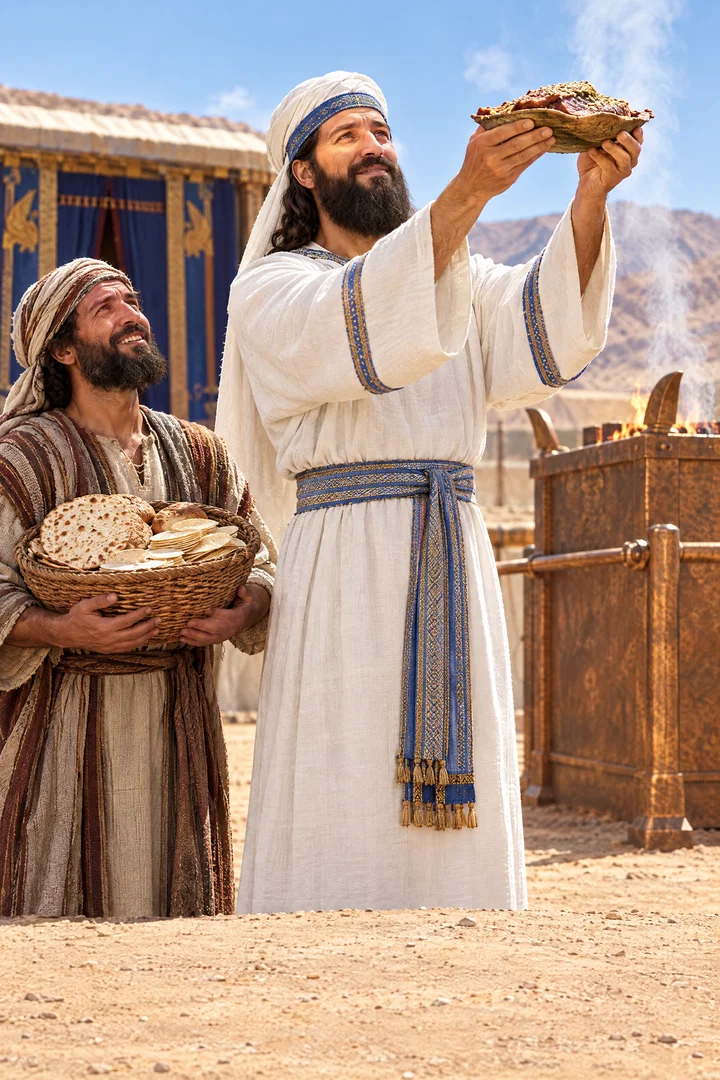
Pictures
Cross-references
- Leviticus 3:17
It shall be a perpetual statute for your generations throughout all your dwellings, that ye eat neither fat nor blood.
Both texts forbid eating the fat of the peace offerings.
- 1 Samuel 2:13-16
And the priests’ custom with the people was, that, when any man offered sacrifice, the priest’s servant came, while the flesh was in seething, with a fleshhook of three teeth in his hand;
Eli’s sons seized portions of the offerings beyond the priests’ allotted share.
- Hebrews 8:3-4
For every high priest is ordained to offer gifts and sacrifices: wherefore it is of necessity that this man have somewhat also to offer.
Earthly priests offer sacrifices according to the law, while Christ ministers as high priest in heaven.
- Deuteronomy 18:3-5
And this shall be the priest’s due from the people, from them that offer a sacrifice, whether it be ox or sheep; and they shall give unto the priest the shoulder, and the two cheeks, and the maw.
defines the priest's due from offerings
- Leviticus 10:14-15
And the wave breast and heave shoulder shall ye eat in a clean place; thou, and thy sons, and thy daughters with thee: for they be thy due, and thy sons’ due, which are given out of the sacrifices of peace offerings of the children of Israel.
Describes the breast and shoulder portions from peace offerings given to the priests.
- Leviticus 7:23-27
Speak unto the children of Israel, saying, Ye shall eat no manner of fat, of ox, or of sheep, or of goat.
forbids eating fat
- Leviticus 3:16
And the priest shall burn them upon the altar: it is the food of the offering made by fire for a sweet savour: all the fat is the LORD’s.
All the fat belongs to the Lord and is burned on the altar.
- Leviticus 7:15-21
And the flesh of the sacrifice of his peace offerings for thanksgiving shall be eaten the same day that it is offered; he shall not leave any of it until the morning.
Defines the limited portion of the peace offering assigned to the priest.
- 1 Samuel 9:24
And the cook took up the shoulder, and that which was upon it, and set it before Saul. And Samuel said, Behold that which is left! set it before thee, and eat: for unto this time hath it been kept for thee since I said, I have invited the people. So Saul did eat with Samuel that day.
Saul receives the shoulder portion as a sign of his coming kingship.
- Numbers 18:11
And this is thine; the heave offering of their gift, with all the wave offerings of the children of Israel: I have given them unto thee, and to thy sons and to thy daughters with thee, by a statute for ever: every one that is clean in thy house shall eat of it.
Allows the clean members of the priest’s household to share the offering.
Commentary
Each commentary is drawn from primary sources: the writings of Ellen G. White and Adventist pioneers and periodicals. Each commentary is separate. Its own words are not a quotation; follow the references to read the source passages.
Ellen G. White
2 sources
The peace offerings were especially an expression of thanksgiving to God.PP 576.1–2 The breast and the right shoulder of the peace offering belonged to the officiating priest as his allotted, specified share.ST Oct 14, 1913PP 576.1–2 The greater part was returned to the offerer to be eaten by him and his friends in a sacrificial feast.PP 576.1–2 The fat alone belonged on the altar and had to be burned as an offering to God, not eaten, and the priests had to wait until this was done.ST Oct 14, 1913PP 576.1–2
These strict directions guarded against confusion and were meant to prevent the priests from taking more than their rightful portion, so they had to be strictly heeded.ST Oct 14, 1913PP 576.1–2 The whole service, including the offering of the fat on the altar, pointed forward to the death of Christ.ST Oct 14, 1913PP 576.1–2 It was designed to preserve faith in the coming Redeemer and to direct all hearts to him in gratitude and faith, to the great Sacrifice that was to take away the sin of the world.PP 576.1–2
The sons of Eli broke this law by not being content with their allotted part.PP 576.1–2 They demanded an additional portion and claimed whatever portion pleased them, refusing to wait until the fat had been burned.PP 576.1–2 They threatened to take it by violence if denied, and used the great number of sacrifices at the annual feasts to enrich themselves at the expense of the people.PP 576.1–2
Sources
Pioneers and periodicals
18 sources
The verse assigns the right leg of each peace offering to the Aaronic priest who sprinkles its blood and burns its fat, while the breast goes to Aaron and his sons, with all fat burned on the altar as food of the offering by fire and never eaten.ST Apr 6, 1888ST Feb 7, 1911RH Mar 31, 1868ST Jun 5, 1901ST Sep 19, 1900 It belongs to the ceremonial law given as an object lesson of Christ's priestly work, where each detail of sacrifice finds fuller meaning in Jesus, and by partaking of the sacrifice and bearing the people's sins before God the priests represented Christ bearing sins in the heavenly sanctuary.ST Feb 7, 1911RH Jan 10, 1916ST Jun 19, 1907ST Nov 28, 1895ST The fat burned to God serves as a type of Christ's sacrifice on Calvary, and the priest's shoulder portion points to government borne on His shoulder, so the believer who entrusts personal affairs to His control receives strength and lasting peace.ST Apr 6, 1888ST Oct 14, 1913ST Dec 1, 1881RH Jun 6, 1912 Its exact directions guarded against appetite and covetous gain by priests taking more than their rightful portion, as Eli's sons did by seizing flesh with the flesh-hook before the fat was separated and stripping the offerings of sacred meaning, and it gives no license to eat swine's flesh or diseased and fat meat unfitted for health.ST Apr 6, 1888ST Oct 14, 1913ST Dec 1, 1881RH Mar 31, 1868
Terms and Offering Ritual
The word rendered shoulder in the King James Version is rendered thigh in the Revised Version, coming from a root meaning to run after and defined as the lower leg, like a runner's, and it has also been translated hip and leg.ST Aug 14, 1901
The right shoulder of each peace offering belongs as his portion to the son of Aaron who offers its blood and fat, while the breast is given to Aaron and his sons.ST Apr 6, 1888ST Feb 7, 1911RH Mar 31, 1868ST Jun 5, 1901ST Feb 3, 1909 The breast and right shoulder together form the priest's allotted share, with the fat belonging on the altar to be burned as an offering to God and not eaten.ST Oct 14, 1913
All the fat was to be offered to the Lord and burned on the altar of burnt offering upon the burnt offering as the food of the offering made by fire unto the Lord, and never to be eaten.ST Oct 14, 1913ST Dec 1, 1881RH Mar 31, 1868ST Sep 19, 1900 The blood was to be sprinkled by the priest around the altar of burnt offering, the animal being without blemish and slain by the one who brings it.ST Sep 19, 1900 Certain portions of the meat were to be eaten by the priests in the tabernacle as part of the solemn service, and the remainder was to be eaten by those who brought the offering.ST Apr 6, 1888ST Dec 1, 1881ST Sep 19, 1900
The priests could eat flesh from very few offerings, wave offerings, peace offerings, and oblations, which were not always flesh but sometimes corn, wine, wheat, and other produce, with no part of the real burnt offerings and no meat of beasts whose blood was carried into the sanctuary.RH Mar 31, 1868 That meat was lean only because all fat was to be offered to the Lord and burned and the people were positively forbidden to eat any fat.RH Mar 31, 1868 It was from young creatures without blemish, only healthy young animals, and the amount was quite limited.RH Mar 31, 1868
The verse gives part of the manner of the peace offering, which is one of five kinds of offerings, burnt, meal, peace, sin, and trespass, whose purpose and manner are to be clearly defined.RH Feb 3, 1916 It belongs to the regulations for special and individual offerings brought during the year as part of the priests' continuing service in the first apartment of the sanctuary and to the yearly service.RH Feb 3, 1853ST Aug 16, 1883ST Nov 28, 1895ST These offerings cost the worshiper something, and their cost varied according to the wealth or position of the person making them.ST Aug 16, 1883 Peace offerings as expressions of thanksgiving to God were presented in great numbers when the people assembled at the annual feasts.ST Dec 1, 1881
Sanctuary Shadow of Christ
Leviticus 7:33 belongs to the ceremonial law that was instituted in consequence of sin.RH Jan 10, 1916 It stands among the instructions describing the main features of the sanctuary service, which were written for learning and instruction in righteousness.ST Jun 19, 1907 The earthly sanctuary and its service were an object lesson of God's way and of Christ's priestly work in the heavenly sanctuary.ST Jun 19, 1907
Each detail of Israel's laws for sacrifices and offerings had meaning, finding its fuller meaning in the sacrifice, life, and work of Jesus Christ.ST Feb 7, 1911 The offering instructions of the chapter show that the sacrifices point forward as shadows to their fulfillment in Jesus and teach that sin requires a penalty.ST Feb 3, 1909 They have typological significance concerning the work of Jesus Christ.ST Feb 3, 1909ST Feb 13, 1912
The priesthood and ceremonies of the Mosaic sanctuary served as a type of Christ's priesthood in the heavenly sanctuary, and the yearly services represented Christ's work accomplished once for all.ST Jun 19, 1907ST Nov 28, 1895 An offering made in faith by a sinner, together with the daily offering, represented the transfer of the penitent's sins to the sanctuary through the sacrificial blood or the priest, leaving those sins there in figure until the yearly cleansing.ST Jun 19, 1907ST By partaking of the sacrifice and bearing the people's sins before God in solemn service in the tabernacle, the priests represented Christ bearing sins in the heavenly sanctuary.ST Apr 6, 1888 The fat belonging on the altar and burned as an offering to God served as a type of the great Sacrifice, representing Christ's sacrifice on Calvary.ST Apr 6, 1888ST Oct 14, 1913ST Dec 1, 1881
The offering stands for the offerer and its life for his life, meaning peace comes only when a person willingly gives his own life to be sprinkled by the High Priest and used as He directs in the service of humanity.ST Sep 19, 1900 The sin offering or trespass offering must come before the burnt offering and the burnt offering before the peace offering, so the repentant soul is first accepted, pardoned, and reconciled to God, then in the burnt offering shows renewed life consecrated to God to be poured out and consumed in His service, and on that consecration the fat of the peace offering is burned.ST Sep 19, 1900 Even the continual morning and evening burnt offering belongs to no conscious trespasser until he brings his personal trespass offering, and then with the others he can consecrate himself anew in the burnt sacrifice and so find peace.ST Sep 19, 1900 There is no peace unto the wicked who are like the troubled sea, while great peace belongs to those who love the law.ST Sep 19, 1900
The priest's shoulder portion points to Christ bearing government on His shoulder.RH Jun 6, 1912 The believer who entrusts Christ with control of personal affairs receives strength and lasting peace, for Christ opens paths that no earthly power can shut and closes paths that would lead into danger.RH Jun 6, 1912 The shoulder given to Saul after Samuel anointed him as king taught that he should have placed the kingdom's government on the Prince of Peace rather than relying on himself.RH Jun 6, 1912
Reverence and Daily Peace
The breast and the right shoulder with some minor parts of each peace offering were assigned to the priest as his allotted share and perquisite, while the fat belonged on the altar and had to be burned as an offering to God and never eaten, with the remainder to be eaten by those who brought the offering.ST Oct 14, 1913ST Dec 1, 1881 These directions were most exact and minute to guard against confusion and to prevent priests from taking more than their rightful portion.ST Oct 14, 1913ST Dec 1, 1881 Such precision was necessary because appetite and covetous desire for gain might lead a priest to appropriate to himself sacrifices solemnly devoted to the Lord.ST Dec 1, 1881 The peace offerings were expressions of thanksgiving to God presented in great numbers when the people assembled at the annual feasts, and the fat burned upon the altar served as a type of the great Sacrifice.ST Dec 1, 1881
The priest's share was to be eaten in the tabernacle as part of a solemn service, for by partaking of the sacrifice and bearing the people's sins before God the priests represented Christ bearing sins in the heavenly sanctuary.ST Apr 6, 1888 Selfish, avaricious priests departed from these instructions to enrich themselves at the expense of the people, not content with their rightful share.ST Dec 1, 1881 As Eli's sons did, they demanded whatever portion they wanted, taking extra with the flesh-hook and demanding flesh before the fat had been separated, even taking it by force when the offerer objected, including the part reserved for the altar which represented Christ's sacrifice on Calvary.ST Apr 6, 1888ST Dec 1, 1881 Their irreverence allowed appetite, selfishness, and avarice to triumph at the very time every heart should have been directed in penitence and faith to the great Sacrifice which was to take away the sins of the world, and this stripped the offerings of their sacred meaning and led the people to despise them and fast lose all sense of the sacredness of the offerings and the importance of the sanctuary services.ST Apr 6, 1888ST Dec 1, 1881
The portion belongs to the very few offerings of which priests could eat flesh — wave offerings, peace offerings, and oblations, which were not always flesh but sometimes corn, wine, wheat, and other produce — with no part of the real burnt offerings and no meat of beasts whose blood was carried into the sanctuary.RH Mar 31, 1868 All the fat was to be offered to the Lord and burned, and the people were positively forbidden to eat any fat, so the meat was lean only.RH Mar 31, 1868 It was from young creatures without blemish, only healthy young animals, and the amount was quite limited.RH Mar 31, 1868 It therefore gives no license to eat swine's flesh swimming in grease, and there is nothing in it to weigh against the fact that diseased and fat meat is unwholesome and unfitted for feeble men and women of this age.RH Mar 31, 1868
Sources