Luke 1:10
And the whole multitude of the people were praying without at the time of incense.
Translations
American King James Version, King James Version, KJV Cambridge Paragraph Bible
And the whole multitude of the people were praying without at the time of incense.
And the whole multitude of the people were praying without, at the time of incense.
Revised Version, American Standard Version
And the whole multitude of the people were praying without at the hour of incense.
and all the multitude of the people were praying without, at the hour of the perfume.
And all the multitude of the people were praying without at the hour of incense.
and, all the throng of the people, was praying outside, at the hour of the incense offering.
Berean Standard Bible, Majority Standard Bible
And at the hour of the incense offering, the whole congregation was praying outside.
The whole multitude of the people were praying outside at the hour of incense.
And all the people were offering prayers outside, at the time of the burning of perfumes.
And the whole multitude of the people were without in prayer, while the incense was burning.
Douay-Rheims (Challoner revision)
And all the multitude of the people was praying without, at the hour of incense.
Pictures
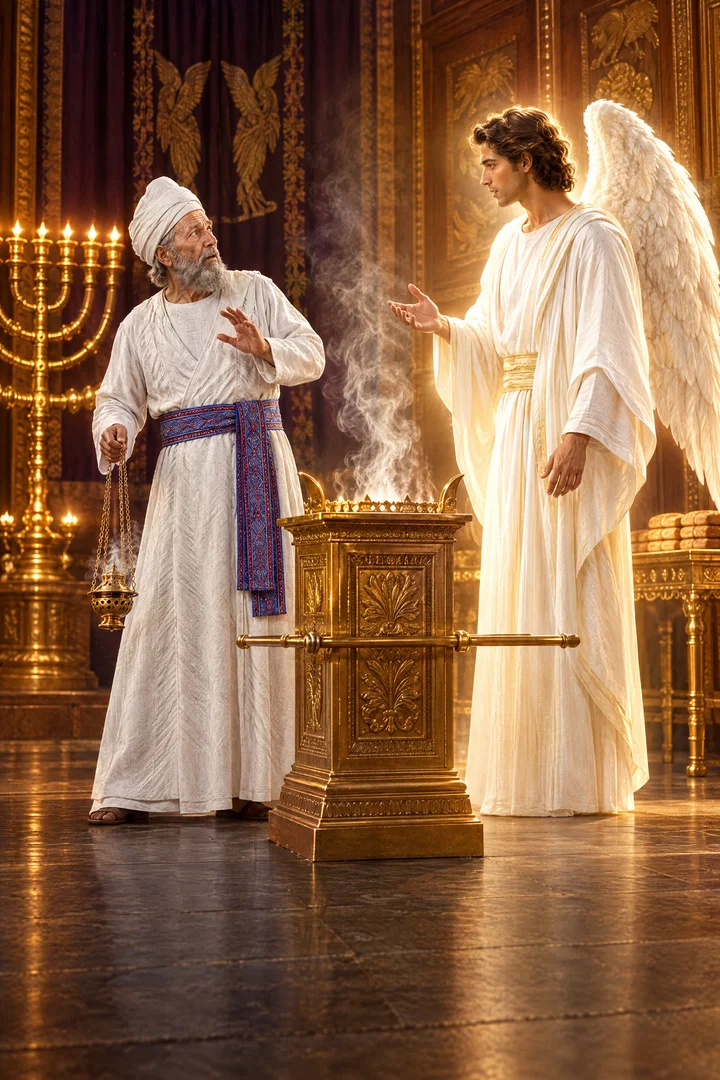
Cross-references
- Exodus 30:7-8
And Aaron shall burn thereon sweet incense every morning: when he dresseth the lamps, he shall burn incense upon it.
The priest burned incense inside as the people prayed outside.
- Revelation 8:3-4
And another angel came and stood at the altar, having a golden censer; and there was given unto him much incense, that he should offer it with the prayers of all saints upon the golden altar which was before the throne.
Incense is offered at the altar with the prayers of God’s people, rising before God.
- Exodus 29:38-41
Now this is that which thou shalt offer upon the altar; two lambs of the first year day by day continually.
Daily lamb offerings accompanied the incense service and the people’s prayers.
- Psalms 141:2
Let my prayer be set forth before thee as incense; and the lifting up of my hands as the evening sacrifice.
Prayer is compared to incense offered before God.
- Revelation 5:8
And when he had taken the book, the four beasts and four and twenty elders fell down before the Lamb, having every one of them harps, and golden vials full of odours, which are the prayers of saints.
Incense represents the prayers of the saints.
- Exodus 37:25-28
And he made the incense altar of shittim wood: the length of it was a cubit, and the breadth of it a cubit; it was foursquare; and two cubits was the height of it; the horns thereof were of the same.
Describes the altar of incense Luke shows in use.
- Daniel 9:21-23
Yea, whiles I was speaking in prayer, even the man Gabriel, whom I had seen in the vision at the beginning, being caused to fly swiftly, touched me about the time of the evening oblation.
Gabriel brings a heavenly message to Daniel, as he later does to Zacharias.
- Leviticus 16:13
And he shall put the incense upon the fire before the LORD, that the cloud of the incense may cover the mercy seat that is upon the testimony, that he die not:
The incense cloud covering the mercy seat typifies Christ covering daily mistakes.
- Numbers 28:3-8
And thou shalt say unto them, This is the offering made by fire which ye shall offer unto the LORD; two lambs of the first year without spot day by day, for a continual burnt offering.
Both describe the morning-evening offering alongside prayer.
- 1 Kings 18:36
And it came to pass at the time of the offering of the evening sacrifice, that Elijah the prophet came near, and said, LORD God of Abraham, Isaac, and of Israel, let it be known this day that thou art God in Israel, and that I am thy servant, and that I have done all these things at thy word.
Both refer to prayer at the time of the evening sacrifice.
- Ezra 9:5
And at the evening sacrifice I arose up from my heaviness; and having rent my garment and my mantle, I fell upon my knees, and spread out my hands unto the LORD my God,
Both describe prayer at the time of the evening sacrifice.
- Acts 10:3-4
He saw in a vision evidently about the ninth hour of the day an angel of God coming in to him, and saying unto him, Cornelius.
Cornelius receives a vision at an hour of prayer.
- Exodus 29:42
This shall be a continual burnt offering throughout your generations at the door of the tabernacle of the congregation before the LORD: where I will meet you, to speak there unto thee.
The regular burnt offering was part of the service associated with incense.
- Numbers 16:46-48
And Moses said unto Aaron, Take a censer, and put fire therein from off the altar, and put on incense, and go quickly unto the congregation, and make an atonement for them: for there is wrath gone out from the LORD; the plague is begun.
Incense accompanies atonement and intercession for the people.
- Luke 1:19
And the angel answering said unto him, I am Gabriel, that stand in the presence of God; and am sent to speak unto thee, and to shew thee these glad tidings.
Gabriel brings Zechariah news of John’s birth.
- Acts 3:1
Now Peter and John went up together into the temple at the hour of prayer, being the ninth hour.
Both describe worshipers keeping a set hour of prayer.
- 1 Chronicles 24:10
The seventh to Hakkoz, the eighth to Abijah,
The eighth priestly course, Abijah’s, is listed among the orders serving at the temple.
- Daniel 6:10
Now when Daniel knew that the writing was signed, he went into his house; and his windows being open in his chamber toward Jerusalem, he kneeled upon his knees three times a day, and prayed, and gave thanks before his God, as he did aforetime.
Daniel prayed toward Jerusalem, as the people prayed at the sanctuary.
- Hebrews 8:5
Who serve unto the example and shadow of heavenly things, as Moses was admonished of God when he was about to make the tabernacle: for, See, saith he, that thou make all things according to the pattern shewed to thee in the mount.
temple incense hour ordered as shadow of heavenly things
Commentary
Each commentary is drawn from primary sources: the writings of Ellen G. White and Adventist pioneers and periodicals. Each commentary is separate. Its own words are not a quotation; follow the references to read the source passages.
Ellen G. White
9 sources
By lot in the order of his priestly course Zacharias entered the temple into the holy place to burn incense before the golden altar, while the whole multitude of the people prayed outside without.DA 97.2ST Apr 16, 18962SP 42.1–3RH Feb 14, 1856Ms 127, 1899, par. 15–20 The people were gathered outside the sanctuary in prayer at the time of incense, as pious Jews were earnestly longing for the coming Messiah.ST Apr 16, 18962SP 42.1–3RH Feb 14, 1856 The rising cloud of incense ascended together with the prayers of the people of Israel before God, for the incense service took place at a time of public prayer.DA 97.2DA 97.3ST Oct 11, 1877 That hour was a special time when the prayers of penitent people, with confession of sins, ascend to heaven.RH Feb 14, 1856
The prayers then offered, by the people and by Zacharias on their behalf, were for pardon of public and national sins and for the long-expected coming Messiah and Redeemer.2SP 42.1–3DA 97.32SP 45.1 They included Zacharias's own prayers offered for many years for the coming of the Redeemer, which were then about to be answered by the sending of heaven's messenger.DA 97.3 When Zacharias delayed inside, the people waited to learn whether God had shown approval and then feared the delay signaled displeasure.2SP 45.1 He emerged with his face shining with reflected heavenly light but unable to speak, signaling that an angel had appeared and that his unbelief had left him speechless until the prediction was fulfilled.2SP 45.1
At the altar of incense, standing at its right hand, the angel announced to Zacharias that his aged and childless wife Elizabeth would bear a son John who would bring joy.ST Apr 16, 1896Ms 127, 1899, par. 15–20 He would be great in the sight of the Lord, drink neither wine nor strong drink, and be filled with the Holy Ghost from his mother's womb.ST Apr 16, 1896Ms 127, 1899, par. 15–20 He would go before the Lord in the spirit and power of Elijah to turn many of the children of Israel to God and turn the hearts of the fathers to the children and the disobedient to the wisdom of the just, to make ready a people prepared for the Lord.ST Apr 16, 1896Ms 127, 1899, par. 15–20 Because John's work required sound physical, mental, and moral strength, his habits were to be carefully regulated from infancy, and his parents had to train him in harmony with God in retirement from city temptation, showing parents' serious responsibility to shape their children's health and character.ST Apr 16, 1896HSFM 208.3–209.2 The foretold work was preaching repentance because the kingdom of heaven is at hand, which is referred to in the parable of the two sons, where open transgressors afterward repented and went while those who professed obedience refused.Ms 127, 1899, par. 15–20
Sources
Pioneers and periodicals
35 sources
The verse describes the daily morning and evening service when the priest burns sweet incense on the golden altar inside the holy place while the whole multitude stands without in the courts praying at the same appointed hour.ST Apr 22, 1897ST Dec 25, 1893ST Jan 7, 1886RH Nov 28, 1912 The ascending smoke is the divinely appointed emblem of true prayer going up before God, with the prayers of all the people united with the incense and the whole burnt offering of the lamb.ST Apr 22, 1897ST Apr 22, 1889RH Feb 19, 1901ST May 15, 1901RH Jan 6, 1853 That incense makes sinful worship acceptable because it represents the merits, perfect righteousness and continual intercession of Christ, with the brazen altar putting away the sin that blocks answers so prayer can ascend as sweet fragrance.RH Nov 28, 1912ST Jun 27, 1911ST Nov 26, 1912ST Apr 22, 1889 While Zacharias ministers at that hour an angel is sent to him as the first earthly step in sending the Son, promising the aged and childless Elizabeth a son John to go before the Lord in the spirit and power of Elijah and make ready a people for Christ.ST Apr 16, 1896RH Apr 10, 1913ST May 17, 1905ST Jun 28, 1905 From that morning and evening hour of prayer united with sacrifice and incense comes the pattern for every Christian family to gather morning and evening around the family altar in praise and supplication before the throne of mercy.ST Nov 26, 1912RH Sep 12, 1871
Temple Scene and Setting
Luke 1:10 pictures the priest burning incense inside the sanctuary while the whole multitude of the people prays outside at the same time.ST Apr 22, 1897ST Dec 25, 1893ST Jan 7, 1886ST Apr 22, 1889RH Mar 12, 1908 The incense is offered within and the people pray without at the appointed public hour of worship.ST Oct 11, 1877ST May 27, 1908RH Mar 12, 1908ST Feb 7, 1911 Their prayers accompany and are associated with the incense offering.ST Apr 22, 1889ST Feb 7, 1911
The entire congregation is gathered together at the entrance of the court and in the courts, meeting for prayer while the incense burns.ST Jul 8, 1930RH Mar 12, 1908RH Nov 10, 1863 They pray each separately for forgiveness of sins at a time of public prayer.ST Oct 11, 1877RH Nov 10, 1863 Those living near the temple gather for this appointed time of incense.ST May 27, 1908ST Nov 26, 1912
This is the regular daily morning and evening worship.RH Nov 28, 1912ST Jun 27, 1911RH Feb 19, 1901ST Jul 8, 1930 Each morning and evening a year-old lamb is burned as a whole burnt offering in the court for the people's sins and for consecration, sweet incense is offered in the holy place, and the lamps burn within, while the whole congregation stands without praying.ST Jun 27, 1911RH Feb 19, 1901ST Nov 19, 1912ST Jul 8, 1930 Their prayer is part of that morning and evening service associated with the incense and the lamb.RH Nov 28, 1912 The people's prayer accompanies the whole burnt offering in the court and the incense and burning lamps within, forming a threefold service of sacrifice, incense, and lamps that carries a daily lesson as a type.ST Nov 19, 1912ST Nov 26, 1912
The incense is renewed on the golden altar in the morning as the sun is rising and in the evening as the sun is setting, with the whole burnt offering on the brazen altar in the court.ST Nov 26, 1912 The golden altar is an altar of continual intercession and the brazen altar an altar of continual atonement, and the whole burnt offering for the congregation expresses desire to put away sin and consecrate so prayers can ascend with the fragrant incense.ST Nov 26, 1912
Zacharias is an ordinary priest serving in the order of his course, chosen by lot for this turn.RH Oct 2, 1855ST Dec 25, 1893 With many thousands of priests such service might come only once in a lifetime and some were never chosen, making the angel's appearance an especially important event in his life.ST Dec 25, 1893
He burns incense at the altar in the first apartment, on the altar of incense in the holy place just before the veil to the most holy place, not in the Most Holy Place as high priest.ST Mar 14, 1911RH Oct 2, 1855ST May 15, 1901 The scene therefore does not describe the high priest entering the Most Holy Place at the cleansing of the sanctuary.RH Oct 2, 1855 That altar is one of the vessels made after the pattern shown to Moses for appointed burning before God, overlaid with gold, about three and a half feet high and nearly two feet square.RH Mar 1, 1870
The event belongs to the restored true service after the return from Babylonian captivity, when the incense offering had recovered the significance lost through idolatry.ST May 15, 1901 It belongs to the events surrounding John's birth about 5 B.C., about four years before A.D. 1 as fixed by the age of Jesus when He began His ministry in A.D. 27.ST Dec 3, 1896ST Mar 12, 1896 While Zacharias ministers at the altar an angel appears to him, showing angels are personal heavenly messengers and not merely influences.RH Apr 10, 1913 The Father sends Gabriel, the mightiest angel, to announce both John's birth and work and Christ's birth and work.ST Jun 28, 1905
Incense and United Prayer
The incense offering represents true prayer ascending to the Lord, and reveals the original design of the altar of incense as an altar of prayer to present the prayers of God's people before God.ST Apr 22, 1897ST May 15, 1901RH Jan 6, 1853 The prayers of the whole people were united with the ascending smoke morning and evening as the daily method of approaching God.ST Apr 22, 1889RH Feb 19, 1901ST May 15, 1901 Their prayer accompanied and was associated with the incense and the lamb offered each morning and evening for the people's sins, and prayer alone was not sufficient without the incense offered with it.ST Apr 22, 1889RH Feb 19, 1901 After the return from Babylonian captivity the offering of incense had recovered the significance lost through idolatry, restoring this true service in the days of Zacharias.ST May 15, 1901
It was a special time when penitent people with confession of sins prayed.RH Feb 14, 1856 The people gathered in the courts prayed, each separately, for forgiveness of sins.RH Nov 10, 1863 They prayed that the sign of their faith would be accepted by God and that their sins would be forgiven through the great Sacrifice represented by the lambs.ST Apr 22, 1889
The incense with the prayers symbolizes the sufferings and sacrifice of the Son of God offered on humanity's behalf.RH Nov 28, 1912 It is what makes prayers acceptable: the merits and intercession of Christ, His perfect righteousness, which through faith is imputed to His people, and which alone can make the worship of sinful beings acceptable to God.ST Jun 27, 1911ST Apr 22, 1889 The golden altar was an altar of continual intercession for prayers coming up continually, while the brazen altar was an altar of continual atonement for putting away the sin that blocks answers.ST Nov 26, 1912 The whole burnt offering of the morning and evening lamb for the congregation showed desire to put away sin and consecrate themselves so prayers could ascend with the fragrant incense, offered in the morning as the sun was rising and in the evening as the sun was setting, a service ordered as an example and shadow of the continual intercession of Christ's righteousness for struggling souls day and night.ST Nov 26, 1912 From this worship came the habit of morning and evening prayer in homes, and the faithful far from the temple prayed with face toward the temple where incense ascended morning and evening.ST Nov 26, 1912
The incense represents the grace of supplication, the favor of God that makes the imperfect prayers of mortals acceptable to God.ST Mar 14, 1911 Prayers clothed and shaped and refined by the Spirit rise as sweet incense, and are remembered and recorded before Him to be answered in due time.ST Mar 14, 1911 The same presenting of prayers continues in the heavenly temple since Jesus became High Priest, where the heavenly service joins the prayers of God's people with that offering before God.RH Nov 28, 1912ST May 15, 1901 The verse proves that the angel of incense precedes the angel of strife, giving assurance that God hears and makes effectual the prayers of His people before He permits war and calamity to come.ST Mar 14, 1911 The hour of incense is a time of prayer and worship when God reveals important things, illustrating angels as invisible keepers of His courts among whom His people walk.ST Jan 9, 1893RH Aug 21, 1855
Prophecy Gospel and Worship
Gabriel's appearing to Zacharias while he offered incense with all the people praying outside was the first event on earth in preparation for God sending His Son, coming when the appointed hour struck in the prophetic period of the twenty-three hundred days or years.ST May 17, 1905 Those who so held it placed that setting on the most solemn day of the year, the Day of Atonement.ST May 17, 1905 Gabriel was still in divine employ more than four hundred years after his charge to make Daniel understand the vision, sent on sacred missions to Zacharias and to Mary.RH Jul 14, 1863 This proves he did not leave part of Daniel's vision forever unexplained and did not become disobedient or fallen, so he must have somewhere resumed and completed instruction on the part that remained unexplained, namely the 2300 days.RH Jul 14, 1863
Luke 1, with Matthew 1 and John 1:1-18, gives the account of Christ's birth to be carefully studied, the birth occurring about four years before A.D. 1, the date being fixed by Luke 3:23 giving the age of Jesus when He began His ministry in A.D. 27.ST Dec 3, 1896 Luke's account marks the fulfillment of the Gospel promises of the Old Testament. Its first chapter is the background for the birth of Christ in Bethlehem and for the announcement to the shepherds and the presentation in the temple in Luke 2:8-33.ST Jan 22, 1894
At that moment John was promised: while Zacharias burned incense in his appointed turn, an angel appeared at the altar of incense to announce that his aged and childless wife Elizabeth would bear a son named John.ST Apr 16, 1896 He would be great in the sight of the Lord, filled with the Holy Ghost from his mother's womb, abstinent from wine and strong drink, and go before the Lord in the spirit and power of Elijah to turn many in Israel to God and make ready a people prepared for Christ.ST Apr 16, 1896 The Father sent John the Baptist to prepare the way for Christ's work on earth, and Gabriel, the mightiest angel in heaven, was sent to announce both John's birth and work and Christ's birth and work.ST Jun 28, 1905 His parents must train him in harmony with God in retirement from city temptation to fit him for that work.ST Apr 16, 1896 That account belongs with the prayers and tears of faithful parents that helped prepare the way for their children's godly lives.RH Jul 28, 1904
The verse records the Jewish custom of a morning hour of prayer and an evening hour of prayer, when the pious people prayed while the priests interceded for them through sacrifice and burning incense.RH Sep 12, 1871 The whole multitude gathered in prayer without at the appointed time of incense during the daily morning and evening sacrifice.RH Sep 12, 1871 The habit of morning and evening prayer in homes came from this worship, and the faithful far from the temple prayed with face toward the temple where incense ascended morning and evening.ST Nov 26, 1912 It gives the pattern for every Christian family to assemble morning and evening around the family altar with grateful praise and earnest supplication so the voice will go up before the throne of mercy and God will meet His children there as He met the children of Israel before the door of the tabernacle.RH Sep 12, 1871
Sources