Luke 1:9
According to the custom of the priest’s office, his lot was to burn incense when he went into the temple of the Lord.
Translations
American King James Version, King James Version
According to the custom of the priest’s office, his lot was to burn incense when he went into the temple of the Lord.
according to the custom of the priest’s office, his lot was to burn incense when he went into the temple of the Lord.
According to the custom of the priests' office, his lot was to burn incense when he went into the temple of the Lord.
Revised Version, American Standard Version, World English Bible
according to the custom of the priest’ s office, his lot was to enter into the temple of the Lord and burn incense.
according to the custom of the priesthood, his lot was to make perfume, having gone into the sanctuary of the Lord,
it fell to him by lot, according to the custom of the priesthood, to enter into the temple of the Lord to burn incense.
according to the custom of his priesthood, it fell to his lot to offer incense, entering into the Temple of the Lord;
Berean Standard Bible, Majority Standard Bible
he was chosen by lot, according to the custom of the priesthood, to enter the temple of the Lord and burn incense.
And as was the way of the priests, he had to go into the Temple to see to the burning of perfumes.
According to the custome of the Priests office, his lot was to burne incense, when he went into the Temple of the Lord.
Douay-Rheims (Challoner revision)
According to the custom of the priestly office, it was his lot to offer incense, going into the temple of the Lord.
Pictures
Cross-references 20 of 22
- Exodus 30:7-8
And Aaron shall burn thereon sweet incense every morning: when he dresseth the lamps, he shall burn incense upon it.
Prescribes the priests’ regular morning and evening incense offering.
- Luke 1:13-17
But the angel said unto him, Fear not, Zacharias: for thy prayer is heard; and thy wife Elisabeth shall bear thee a son, and thou shalt call his name John.
Gabriel announces John’s birth and his work preparing a people for the Lord.
- Exodus 29:38-41
Now this is that which thou shalt offer upon the altar; two lambs of the first year day by day continually.
The daily lamb offerings accompanied the incense service.
- Revelation 8:3-4
And another angel came and stood at the altar, having a golden censer; and there was given unto him much incense, that he should offer it with the prayers of all saints upon the golden altar which was before the throne.
Incense is offered before God with the prayers of the saints.
- Psalms 141:2
Let my prayer be set forth before thee as incense; and the lifting up of my hands as the evening sacrifice.
Prayer is compared to incense offered before God.
- 1 Chronicles 24:1-19
Now these are the divisions of the sons of Aaron. The sons of Aaron; Nadab, and Abihu, Eleazar, and Ithamar.
Describes the priestly courses and their assigned service.
- Revelation 5:8
And when he had taken the book, the four beasts and four and twenty elders fell down before the Lamb, having every one of them harps, and golden vials full of odours, which are the prayers of saints.
Incense represents the prayers of the saints.
- Hebrews 9:6-7
Now when these things were thus ordained, the priests went always into the first tabernacle, accomplishing the service of God.
Describes the sanctuary’s daily and yearly ministrations.
- 2 Chronicles 26:16-20
But when he was strong, his heart was lifted up to his destruction: for he transgressed against the LORD his God, and went into the temple of the LORD to burn incense upon the altar of incense.
Describes the priestly duty of burning incense.
- Exodus 30:9
Ye shall offer no strange incense thereon, nor burnt sacrifice, nor meat offering; neither shall ye pour drink offering thereon.
Forbids unauthorized offerings on the incense altar.
- Exodus 37:25-28
And he made the incense altar of shittim wood: the length of it was a cubit, and the breadth of it a cubit; it was foursquare; and two cubits was the height of it; the horns thereof were of the same.
Describes the making of the incense altar used in temple worship.
- Exodus 28:41-43
And thou shalt put them upon Aaron thy brother, and his sons with him; and shalt anoint them, and consecrate them, and sanctify them, that they may minister unto me in the priest’s office.
Describes the priests’ service in the sanctuary.
- Luke 1:21
And the people waited for Zacharias, and marvelled that he tarried so long in the temple.
The people waited while Zacharias performed his temple service.
- Luke 1:5
There was in the days of Herod, the king of Judæa, a certain priest named Zacharias, of the course of Abia: and his wife was of the daughters of Aaron, and her name was Elisabeth.
Zechariah and Elizabeth are presented as a married couple.
- Leviticus 10:1-2
And Nadab and Abihu, the sons of Aaron, took either of them his censer, and put fire therein, and put incense thereon, and offered strange fire before the LORD, which he commanded them not.
Nadab and Abihu offer unauthorized incense and are punished.
- Numbers 18:1-5
And the LORD said unto Aaron, Thou and thy sons and thy father’s house with thee shall bear the iniquity of the sanctuary: and thou and thy sons with thee shall bear the iniquity of your priesthood.
Assigns priests duties connected with the sanctuary.
- Hebrews 8:5
Who serve unto the example and shadow of heavenly things, as Moses was admonished of God when he was about to make the tabernacle: for, See, saith he, that thou make all things according to the pattern shewed to thee in the mount.
Priestly service follows a pattern of heavenly things.
- Leviticus 16:12-13
And he shall take a censer full of burning coals of fire from off the altar before the LORD, and his hands full of sweet incense beaten small, and bring it within the vail:
Describes priestly incense service in the sanctuary.
- Numbers 28:3-4
And thou shalt say unto them, This is the offering made by fire which ye shall offer unto the LORD; two lambs of the first year without spot day by day, for a continual burnt offering.
Both describe the regular daily temple service, morning and evening.
- Exodus 29:42-43
This shall be a continual burnt offering throughout your generations at the door of the tabernacle of the congregation before the LORD: where I will meet you, to speak there unto thee.
God meets Israel at the sanctuary, as He meets praying families.
Commentary
Each commentary is drawn from primary sources: the writings of Ellen G. White and Adventist pioneers and periodicals. Each commentary is separate. Its own words are not a quotation; follow the references to read the source passages.
Ellen G. White
10 sources
This verse belongs to the account of Zacharias and Elizabeth, a faithful and righteous couple who were promised a son destined to go before the Lord and prepare His way.DA 97.1 It shows Zacharias ministering in Jerusalem in the order of his priestly course.DA 97.2ST Apr 16, 18962SP 42.1–3Ms 127, 1899, par. 15–20Ms 27, 1898, par. 4–6 Priests served for a week twice each year.DA 97.2
According to the custom of the priest's office, his lot when he went into the temple of the Lord was to burn incense.DA 97.2ST Apr 16, 18962SP 42.1–3Ms 127, 1899, par. 15–20Ms 27, 1898, par. 4–6 The service was performed inside the holy place at the golden altar with solemn reverence.Ms 27, 1898, par. 4–6DA 97.3 Incense was offered there daily morning and evening.Ms 27, 1898, par. 4–6
While he offered the incense, the whole multitude of the people were praying outside.ST Apr 16, 18962SP 42.1–3Ms 127, 1899, par. 15–20Ms 27, 1898, par. 4–6RH Jan 7, 1873 The people waited in the outer court praying and confessing their sins until the priest should come out and dismiss them with his blessing, and the cloud of incense ascended before God with the prayers of Israel.Ms 27, 1898, par. 4–6DA 97.3 That service included praying for pardon for the people's public and national sins and earnestly praying for the long-expected Savior.2SP 45.1
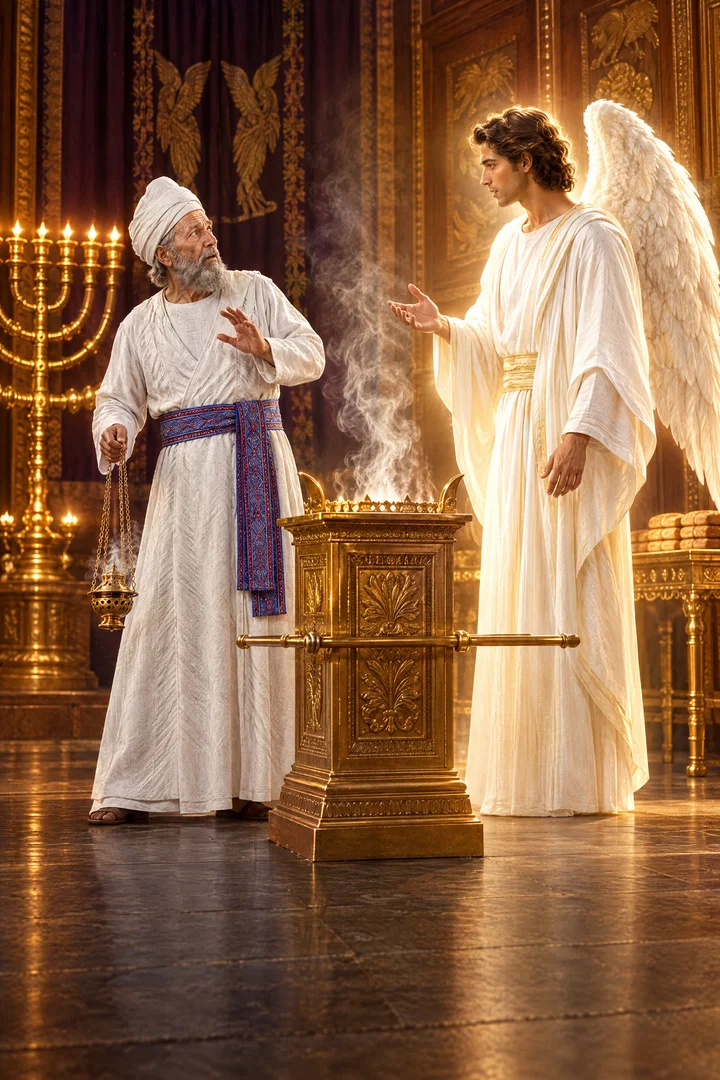
As he ministered, heaven answered his many years of prayer for the coming of the Redeemer by sending its messenger.DA 97.3 While he was thus executing the priest's office, the angel Gabriel appeared standing beside the altar of incense, on the right side as an indication of favor, between the altar and the table of shewbread.ST Apr 16, 18962SP 42.1–3Ms 127, 1899, par. 15–20Ms 27, 1898, par. 4–6DA 97.3 Zacharias was filled with fear and self-condemnation because the mercy seemed too great to credit.DA 97.3
The angel foretold the birth and work of John the Baptist, who would be great in the sight of the Lord, filled with the Holy Ghost from his mother's womb, and go before the Lord in the spirit and power of Elias to turn many in Israel to God and make ready a people prepared for the Lord, the same work of calling to repentance John later did in the wilderness that exposed the Pharisees as those who said they would obey but did not.Ms 127, 1899, par. 15–20 The visitation gave Zacharias, identified as the father of John the Baptist, with Elizabeth the instruction and duty to faithfully cooperate with God in training their promised son as the messenger to announce Christ, which they fulfilled by moving to a retired place in the country where he would not be exposed to city temptations and by giving him counsel and instruction that would keep him from departing from God's purpose.ST Apr 16, 1896HSFM 208.3–209.2
Sources
Pioneers and periodicals
29 sources
According to the custom of the priest's office, the lot to burn incense in the temple of the Lord fell to Zacharias.ST Apr 22, 1897ST Apr 22, 1889RH Nov 28, 1912 He was serving in his appointed priestly course as an ordinary priest and not as high priest, ministering at the altar of incense in the first apartment while the congregation gathered at the entrance.ST Apr 16, 1896ST Dec 25, 1893RH Jul 6, 1911ST Jul 8, 1930RH Oct 2, 1855 The offering was made morning and evening with the daily sacrifice, while the whole multitude of the people prayed without and joined their prayers with the rising smoke.RH Nov 28, 1912RH Feb 19, 1901 The incense represents true prayer ascending to the Lord, even the prayers of the saints, made acceptable to God only through the merits and intercession of Christ and His perfect righteousness imputed by faith.ST Apr 22, 1897ST Apr 22, 1889ST Jun 27, 1911ST May 15, 1901 While Zacharias was burning incense and the people were praying outside, the angel Gabriel appeared beside the altar to announce that Elizabeth would bear John, the forerunner of the Messiah.ST Apr 16, 1896ST Dec 25, 1893RH Jul 6, 1911
Priestly Lot and Setting
According to the custom of the priest's office, the duty of burning incense in the temple was assigned by lot, and the lot fell to Zacharias to perform that priestly service.ST Apr 22, 1897ST Apr 22, 1889RH Nov 28, 1912RH Feb 19, 1901RH Apr 10, 1913 He received by lot the turn to enter the Lord's temple and burn incense there as priests ministered in the earthly sanctuary.ST Dec 25, 1893RH Nov 28, 1912RH Feb 19, 1901RH Apr 10, 1913ST Nov 1, 1877 Zacharias was thus carrying out his appointed priestly course and executing the priest's office before God when the angel appeared to him.ST Apr 16, 1896ST Dec 25, 1893RH Jul 6, 1911 He was serving in his course as an ordinary priest, not as the high priest, performing the priest's office in the order of his course.ST Apr 16, 1896ST Dec 25, 1893RH Jul 6, 1911RH Oct 2, 1855 He belonged to the course of Abijah, the eighth of the twenty-four priestly divisions.ST Dec 25, 1893 Because there were many thousands of priests, a priest was unlikely to be chosen more than once in his lifetime and some were never chosen, so this temple service was a rare and important occasion for Zacharias that might come only once in a lifetime or never.ST Dec 25, 1893
The service took place in the temple of the Lord, where incense was offered in the first apartment while the congregation gathered at the court entrance for prayer.ST Jul 8, 1930RH Oct 2, 1855RH Jan 6, 1853 The altar of incense was used for this purpose to burn incense before God as a priestly duty performed in the temple.ST Jul 8, 1930RH Jan 6, 1853RH Mar 1, 1870 The incense was burned on the altar in the first apartment, not in the Most Holy Place.RH Oct 2, 1855 This was therefore not the high priest's entrance into the Most Holy Place and not an example of the cleansing of the sanctuary.RH Oct 2, 1855 The temple where this service occurred is God's house, whose courts were invisibly guarded by angels.ST Jan 9, 1893
Incense, Prayer, and Intercession
The incense was offered each morning and evening alongside the daily lamb offering, while the whole multitude of the people prayed outside and joined their prayers with the rising smoke.RH Nov 28, 1912RH Feb 19, 1901ST May 15, 1901RH Sep 12, 1871 The priest burned incense inside as intercession for the people through sacrifice and incense, while the families of Israel were engaged in prayer and the pious multitude stood without at the time of the offering.RH Nov 28, 1912ST Mar 14, 1911RH Sep 12, 1871 The service took place at the altar of incense in the holy place just before the veil separating from the most holy place, with the three acts of lamb, incense, and prayer associated together in the sanctuary service.RH Feb 19, 1901ST Mar 14, 1911 The incense offering at the appointed time represented true prayer ascending to the Lord.ST Apr 22, 1897ST Apr 22, 1889ST May 15, 1901 It represented the prayers of the saints, expressing the people's prayers ascending to God as in the original morning and evening worship.ST Apr 22, 1889ST May 15, 1901
The daily incense service represents Christ's merits and intercession, His perfect righteousness imputed to His people through faith, which alone makes the worship of sinful people acceptable to God.ST Jun 27, 1911 Together the incense and the prayers outside illustrate how the prayers of sinful people are made acceptable through Christ's intercession and perfect righteousness.ST Jun 27, 1911 The incense also represents the grace of supplication and the favor of God that clothes imperfect prayers and makes them effectual, shaped and refined by the Spirit of God as sweet incense.ST Mar 14, 1911 Assurance that the prayers of His people are heard and made effectual precedes permitted war, with the angel of incense preceding the angel of strife.ST Mar 14, 1911 Prayers remembered and recorded before God will be answered in time even if nations must be overthrown to do it.ST Mar 14, 1911
The hour of incense was a set time of prayer and worship when God revealed visions.RH Aug 21, 1855 The morning and evening hour of incense with the continual daily burnt offerings establishes set morning and evening worship times.RH Nov 28, 1912RH Sep 12, 1871 Though burnt offerings for sin, temple rites, and an earthly holy temple have passed away through Christ's one offering, the pattern remains.RH Sep 12, 1871 Every Christian household should therefore gather morning and evening around the family altar in grateful praise and earnest supplication that ascends before the throne of mercy sweeter than any offering made by fire, where God meets His children as He met Israel before the door of the tabernacle.RH Sep 12, 1871
Angel Announcement and Application
Zacharias was carrying out his appointed priestly course in the temple, chosen by lot to burn incense while the whole multitude prayed outside, when the angel appeared to him.ST Apr 16, 1896ST Dec 25, 1893ST Dec 25, 1893 Gabriel stood beside the altar of incense during that service and announced that Elizabeth would bear John as the Messiah's forerunner, and messages then followed first to Zacharias about John the Baptist and then to Mary about Jesus' birth.RH Jul 6, 1911RH Apr 25, 1871 The incense service in which this occurred belonged to the morning and evening worship, with the people praying outside while Zacharias ministered within.ST Apr 16, 1896
The appearing of angels in this account shows that angels are personal heavenly beings acting under God's direction rather than mere influences.RH Apr 10, 1913 The same angelic work supports identifying Christ's angel with Gabriel, who also conveyed the prophecies recorded in Daniel.RH Apr 25, 1871
The verse belongs to Luke's account of Jesus' birth and the events surrounding it, which mark the fulfillment of the Gospel promises of the Old Testament.ST Mar 12, 1896 Within that account the burning of incense in the priests' temple service provides the setting for one of the incidents connected with Christ's forerunner, the birth of John the Baptist.ST Mar 12, 1896 In that temple service the nearness of Christ's coming was announced.ST May 27, 1908
John's selection as God's forerunner of Christ was fitted rather than arbitrary, for his parents would order their household aright and the circumstances of his birth and early life suited him for the work.ST Dec 12, 1892 The temple visitation laid upon Zacharias and Elizabeth as parents the duty to cooperate faithfully with God in forming in John a character fit for his assigned work in preparing a messenger to announce Christ.ST Apr 16, 1896 They fulfilled this through faithful care, prayers and tears, by moving to a retired place in the country where he would not be exposed to city temptations, and by counsel and instruction that would keep him from departing from God's purpose.ST Apr 16, 1896RH Jul 28, 1904
The moment when Zacharias burned incense in the temple while the people prayed outside came at an appointed moment in the twenty-three-hundred-year prophetic period, when Gabriel delivered God's message announcing the preparatory event before the sending of His Son.ST May 17, 1905 Those who held this teaching identified the occasion as the solemn Day of Atonement.ST May 17, 1905 The chapter to which the verse belongs brings to view Rome as the fourth and last universal kingdom, the legs of iron, because Caesar Augustus sent out a decree that all the world should be taxed, proving his jurisdiction over all the world as Roman emperor and therefore the universality of his kingdom.ST May 3, 1877 The verse belongs to the account of the promised birth of John the Baptist, whose Nativity is kept as a feast with an octave on the Sunday preceding the Feast of Peter and Paul.ST Nov 28, 1911
Sources