Luke 15:18
I will arise and go to my father, and will say unto him, Father, I have sinned against heaven, and before thee,
Translations
I will arise and go to my father, and will say to him, Father, I have sinned against heaven, and before you,
King James Version, KJV Cambridge Paragraph Bible
I will arise and go to my father, and will say unto him, Father, I have sinned against heaven, and before thee,
I will arise and go to my father, and will say to him, Father, I have sinned against heaven, and before thee,
Revised Version, American Standard Version
I will arise and go to my father, and will say unto him, Father, I have sinned against heaven, and in thy sight:
having risen, I will go on unto my father, and will say to him, Father, I did sin — to the heaven, and before thee,
I will rise up and go to my father, and I will say to him, Father, I have sinned against heaven and before thee;
I will arise, and go unto my father, and will say unto him—Father! I have sinned against heaven, and before thee:
Berean Standard Bible, Majority Standard Bible
I will get up and go back to my father and say to him, “ Father, I have sinned against heaven and against you.
I will get up and go to my father, and will tell him, “ Father, I have sinned against heaven and in your sight.
I will get up and go to my father, and will say to him, Father, I have done wrong, against heaven and in your eyes:
I wil rise and goe to my father, and say vnto him, Father, I haue sinned against heaue, and before thee,
Douay-Rheims (Challoner revision)
I will arise, and will go to my father, and say to him: Father, I have sinned against heaven, and before thee:
Pictures
Cross-references 20 of 45
- Luke 15:7
I say unto you, that likewise joy shall be in heaven over one sinner that repenteth, more than over ninety and nine just persons, which need no repentance.
Heaven rejoices over one sinner who repents.
- Luke 15:10
Likewise, I say unto you, there is joy in the presence of the angels of God over one sinner that repenteth.
Angels rejoice over one sinner who repents.
- Luke 15:24
For this my son was dead, and is alive again; he was lost, and is found. And they began to be merry.
The father rejoices that his lost son is found and alive again.
- Romans 2:4
Or despisest thou the riches of his goodness and forbearance and longsuffering; not knowing that the goodness of God leadeth thee to repentance?
God’s goodness leads the sinner to return in repentance.
- Psalms 103:13
Like as a father pitieth his children, so the LORD pitieth them that fear him.
The father’s compassionate welcome illustrates the Lord’s pity for his children.
- Luke 15:28-32
And he was angry, and would not go in: therefore came his father out, and intreated him.
The elder brother resents the father’s welcome to the repentant son.
- Isaiah 55:7
Let the wicked forsake his way, and the unrighteous man his thoughts: and let him return unto the LORD, and he will have mercy upon him; and to our God, for he will abundantly pardon.
The wicked are called to return to the Lord, who abundantly pardons.
- Galatians 4:7
Wherefore thou art no more a servant, but a son; and if a son, then an heir of God through Christ.
The returning servant is received as a son and heir.
- Ezekiel 33:11
Say unto them, As I live, saith the Lord GOD, I have no pleasure in the death of the wicked; but that the wicked turn from his way and live: turn ye, turn ye from your evil ways; for why will ye die, O house of Israel?
God calls sinners to turn from sin and live.
- Isaiah 44:22
I have blotted out, as a thick cloud, thy transgressions, and, as a cloud, thy sins: return unto me; for I have redeemed thee.
God blots out sins and calls the sinner to return, promising redemption.
- 1 John 2:1
My little children, these things write I unto you, that ye sin not. And if any man sin, we have an advocate with the Father, Jesus Christ the righteous:
Christ advocates before the Father for the repentant sinner.
- Jeremiah 3:22
Return, ye backsliding children, and I will heal your backslidings. Behold, we come unto thee; for thou art the LORD our God.
God calls backsliding children to return and promises to heal them.
- 2 Corinthians 7:10
For godly sorrow worketh repentance to salvation not to be repented of: but the sorrow of the world worketh death.
Godly sorrow leads to repentance, as the son confesses his sin and returns to his father.
- Hosea 6:1
Come, and let us return unto the LORD: for he hath torn, and he will heal us; he hath smitten, and he will bind us up.
Both call the sinner to return to God.
- Malachi 3:7
Even from the days of your fathers ye are gone away from mine ordinances, and have not kept them. Return unto me, and I will return unto you, saith the LORD of hosts. But ye said, Wherein shall we return?
God calls those who have turned from him to return.
- Hosea 14:1-2
O Israel, return unto the LORD thy God; for thou hast fallen by thine iniquity.
The sinner returns to God, confesses sin, and asks for gracious forgiveness.
- Luke 15:1-2
Then drew near unto him all the publicans and sinners for to hear him.
Jesus’ parable answers the complaint that he welcomes sinners.
- Matthew 18:12-14
How think ye? if a man have an hundred sheep, and one of them be gone astray, doth he not leave the ninety and nine, and goeth into the mountains, and seeketh that which is gone astray?
The Father’s care for the lost sheep recalls the returned son and the Father’s joy.
- Luke 15:22
But the father said to his servants, Bring forth the best robe, and put it on him; and put a ring on his hand, and shoes on his feet:
The father orders the best robe as a sign of his son’s restoration.
- Proverbs 28:13
He that covereth his sins shall not prosper: but whoso confesseth and forsaketh them shall have mercy.
Confessing and forsaking sin brings mercy.
Commentary
Each commentary is drawn from primary sources: the writings of Ellen G. White and Adventist pioneers and periodicals. Each commentary is separate. Its own words are not a quotation; follow the references to read the source passages.
Ellen G. White
114 sources
The verse is the resolve of the humbled prodigal, brought to want and misery by his own selfish departure and sinful waste, to arise and go back to his father confessing his guilt and unworthiness.ST Jan 29, 1894Ms 147, 1897, par. 31–333T 101.3–102.23T 100.3–101.2MYP 408.1 Arising means a decisive turning from the service of sin and rebellion to return to the Father's house and service, confessing sin against God and others and seeking pardon, restoration and reconciliation.SC 53.2–54.1Ms 194, 1898, par. 2Lt 59, 1886, par. 1–5Lt 59, 1886, par. 6ST May 8, 1901 That longing to return is awakened by the Spirit, for God's love and goodness lead to repentance and grace already goes forth to meet even the feeble first desire before the prayer is spoken.SC 53.2–54.1ST Jun 2, 19095T 632.1–2ST Jun 2, 1909ST Jan 22, 1894 The Father sinned against sees the son while still far away and hastens to receive him with compassion, pity and forgiveness, welcoming him without reproach or reminders of unworthiness.ST Jan 29, 18943T 103.5–104.1COL 202.3–203.1COL 203.2–205.1TCBMP 128.1 He receives him not as a hired servant but as a son, covering his shame, pardoning and forgetting the past, clothing him with righteousness and restoring him to favor and a child's place, with great joy in heaven over the one who was dead and is alive again.COL 197.2RH Jan 19, 1911COL 203.2–205.1Lt 80, 1898, par. 9–13GW 140.2
Parable Setting and Figures
Luke 15:18 belongs to the parable of the prodigal son, one of the parables told in response to the complaints of the scribes and Pharisees about association with publicans and sinners, to teach mercy and forgiveness toward those who have sinned.Ms 102, 1894, par. 12–14 The way back to the Father's house is through Christ, who saves from sins and not in sins, and whose light makes the path a path of holiness.ST Jan 22, 1894 Even the scribes and Pharisees can be saved, but only through faith in Jesus Christ.ST Jan 22, 1894
The parable belongs together with the lost sheep and the lost coin as lessons on seeking the lost that must be studied together, studied carefully, and obeyed, for practicing them involves eternal interests.Lt 71, 1895, par. 27 The church had failed to seek the lost and bring them into the fold and needed to recognize and acknowledge this failure.Ms 16, 1868, par. 2–3 Those in councils with the Spirit of Christ must go out to search for, find, and bring back souls strayed from the fold instead of leaving them unrecovered in darkness and confusion, wounding them and driving them away.Lt 71, 1895, par. 27Ms 81, 1893, par. 61–63
The younger son's departure from his father's home pictures sinners separating themselves from God into a self-serving life apart from Him.COL 198.4–199.1COL 199.2–200.3 That separation wastes the blessings received through self-indulgence, wastes life itself, and leaves the person spiritually impoverished and enslaved to sin.COL 198.4–199.1COL 199.2–200.3 Far from his father's house and perishing with hunger, the prodigal represents people perishing in sin who need compassion and the saving knowledge of truth.9T 50.2Ms 45, 1901, par. 8 His story illustrates the lost being reclaimed and brought back to the Father's house through the saving grace of Christ, whose love seeks to restore the lost.ST Oct 31, 1916Ms 41, 1890, par. 45–51
God regards those wanderers with love, having sent His Son at Calvary to be the propitiation for their sins and not for theirs only but for the sins of the whole world, and He calls His people to cooperate with Him in rescuing them.RH Nov 26, 1901 The parable shows His tender pity for those who have turned away and welcomes those led back from straying.COL 198.1 It presents His dealing with those who have known the Father's love but have been led captive by the tempter.COL 198.2–3 Though they turn away and follow their own course, He does not leave them in misery but with pitying love reaches those exposed to temptation with tenderness, compassion, sympathy, and earnest labor rather than severe judgment.Lt 80, 1898, par. 1Lt 16a, 1887, par. 411MR 367.1
The son's recognition that his wrong is sin against God and his father and his resolve to return and confess it illustrates how sinners who know they are lost need a Saviour, for Christ's mission is to recover the lost, not to condemn and destroy them.ST Jan 29, 1894 The parable also represents God's loving relationship with Israel as mercy offered though resisted.ST Feb 27, 1896 Like a loving father, God was willing to suffer for His people's sins and bear their guilt, repeatedly sending warnings, appeals, and invitations calling them back.Ms 56, 1902, par. 5
The prodigal also pictures professed commandment keepers who are in reality transgressors of the law, unthankful and unholy, employing entrusted talents to counterwork God, having no light in them but darkness, with influence not unto sanctification or holiness, whom Jesus yearns after and longs to bless but cannot because of perversity of character.Ms 75, 1898, par. 13–14 He further pictures a person ruined by selfish indulgence and fallen from former ambition and success into sin and discouragement, whom Christ meets with tender sympathy and words suited to need.Ms 22, 1898, par. 19 The same figure applied to Amos as one who had left his Father's house with a history like the prodigal's own, and to a man degraded by liquor who was deeply moved by the story of turning toward the father and wanted to become fully converted.Lt 52, 1899, par. 1Lt 28, 1874, par. 6–7
Christ loved to use this story to teach lessons of truth and immortal truth, with a spirit open to the influences of nature and delight in gathering spiritual teaching from the surroundings of daily life.3MR 333.2–3 Like His other illustrations it is drawn from facts of life and facts of experience familiar to the hearers, with something to interest every mind and appeal to every heart.3MR 333.2–3 Thus familiar scenes from daily life and everyday events become reminders of the spiritual and unseen, so that the daily task instead of being a mere round of toil bereft of higher thoughts is brightened and uplifted.3MR 333.2–3ED 102.3–4Lt 223, 1905, par. 8–10
Departure Into Want and Misery
The departure began when the son selfishly asked for his share of the estate and left to live apart from his father's counsel, correction, advice, reproof, restraint, and mutual obligation.TCBMP 123.1 He selfishly demanded his share when he had no rightful claim to anything, wanting to separate his interest to manage it to suit his own inclination, and he withdrew to a distance to forget his father, despised restraint, and was determined to have pleasure in any way he chose.3T 100.3–101.2
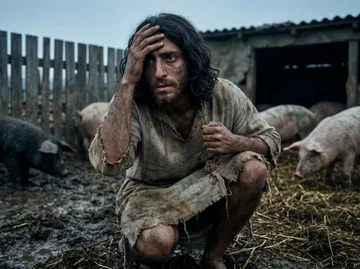
He wasted the undeserved treasure in sinful indulgence, extravagant pleasure, and pleasure-loving spendthrift living until it was all spent and his portion expended, forsaking the fountain of living waters for broken cisterns that hold no water.3T 100.3–101.2MYP 408.1 He was brought from indulgence to friendlessness in a strange country, clad in rags, hungry and longing even for the refuse fed to swine, destitute and deprived of decent clothing until reduced to feeding swine.3T 100.3–101.2MYP 408.1TCBMP 124.1 Famine brought pinching want and destitution that led him to regret his sinful course.3T 100.3–101.2TCBMP 124.1
His separation, suffering, and misery resulted from his own disobedience, sin, and folly.3T 101.3–102.2ST Jun 2, 1909COL 202.1–2ST Jan 29, 1894ST Apr 20, 1915 The deception that had held him was broken when he recognized this.COL 202.1–2 Many become prodigals through indulgence at home and failed home training: too much freedom with will and inclination indulged, parental neglect to restrain and command education at the dawn of reason in the fear and love of God, lack of firm sanctified principles enforced with consistency, affection, and example, and parents permitting self-chosen ways while not doing the Word.11MR 40.3–41.2Lt 117, 1898, par. 4–5
Resolve to Return Confessing
Humbled by want and adversity after wasting everything, the son comes to recognize his condition, need and guilt, seeing that his separation, suffering and misery came from his own disobedience, sin and folly, and the deception that held him is broken.3T 101.3–102.2COL 202.1–2ST Jan 29, 1894TCBMP 124.1 Destitute in a strange country, friendless, clad in rags, hungry and longing even for the refuse fed to swine, deprived of decent clothing until reduced to feeding swine, he is brought by pinching want and famine to regret his course and to remember that there is food in his Father's house.ST Jan 29, 1894TCBMP 124.1 He decides to arise and go to his father, resolving to return and confess that his wrongdoing is sin against God and against his father.ST Jan 29, 1894Ms 147, 1897, par. 31–333T 101.3–102.2 His return shows how sinners who know they are lost need a Saviour, for Christ's mission is to recover the lost, not to condemn and destroy them.ST Jan 29, 1894 His request for only a hired servant's place, admitting he is no longer worthy to be called a son, shows he has not yet grasped the full measure of his father's love and still has too limited a view of it, though the assurance of his father's love gives him hope and draws him home.ST Jun 2, 1909COL 202.1–2ST Apr 20, 1915ST Apr 20, 1915
Returning begins with confessing sin against heaven and against the Father and against others, asking the Father for pardon, admitting dishonor and broken commandments, acknowledging unworthiness to be called a son, and seeking restoration and reconciliation in God's appointed way.SC 53.2–54.1Ms 194, 1898, par. 2Ms 132, 1902, par. 9Ms 23, 1897, par. 24–26 Even after abusing the Father's love and squandering His blessings, the sinner may come back asking only to be treated as a hired servant, and the Father receives the returning wanderer with compassion, tender joyful care, forgiveness and forgetfulness of the past.RH Jan 19, 1911 God's love and goodness lead sinners to repentance, and the longing to return, even the feeble desire, is awakened by the Spirit drawing the wanderer, pleading with him while he is still far off wasting what was given.SC 53.2–54.1ST Jun 2, 19095T 632.1–2 Grace is already at work to meet the first desire before the prayer is spoken, for God hears the contrite heart, every faltering prayer, secret tear and sincere desire, and His Spirit goes forth to meet it.ST Jun 2, 1909COL 205.2–206.1 Even one step toward God in repentance is met by His loving welcome, for He hastens to receive the contrite; the sinner need not make himself better before coming, and no sinner who comes to God in contrition is beyond hope despite Satan's efforts to make God seem unwilling to forgive.ST Jun 2, 1909ST Apr 20, 1915ST Jul 29, 1913ST Dec 5, 1892COL 205.2–206.1
What is required is penitence expressed in a broken and contrite heart and honest confession, turning from pride and folly with enlightened conscience and humbled heart, with full decision of soul through repentance and prayer, returning to God whose mercy and love have been neglected.ST Jan 29, 1894Lt 178, 1902, par. 28–30Lt 27, 1890, par. 18–19Lt 33, 1896, par. 12Lt 72, 1890, par. 7 Arising means turning square about from thorough backsliding, leaving the service of Satan and sin and rebellion to return to the Father's house and to the Father's service on God's ground, not one's own.Lt 59, 1886, par. 1–5ST May 8, 19013MR 64.5–65.3 It means personal surrender to God and receiving Jesus as Saviour and King, so that a new life from above may begin through the Spirit, walking in accordance with His Word under His dominion and reign.ST May 8, 1901Lt 27, 1890, par. 8 One who has long been separated, stayed away, denied Jesus and by denial pierced Him and put Him to open shame can still arise and come back, grasping Christ by faith, fixing the eye upon Him, casting himself helpless upon His mercy, ceasing to do known sin and giving the little remnant of life to Jesus to be saved by His cleansing blood, because heaven must not be lost.2T 295.1Lt 1a, 1890, par. 1 God is ready to accept and pardon all transgressions if he will but come, the Majesty of Heaven invites him now to come that he may have life and Christ is ready to cleanse him when he lays hold upon Him, for serving sin and the flesh and the devil brings no profit but only poor wages, so he must not linger with false hopes or neglect but turn and live rather than perish, leaving rebellion behind with immediate response.2T 295.1Lt 76, 1898, par. 3–5
The resolve must be immediate and not delayed for worldly advantage such as keeping employment or finishing a trade, even if keeping the Sabbath costs the position, because staying away grieves the heart of Christ who died to redeem the sinner, and harsh treatment or mistakes by brethren give no excuse or reason to stay away from Christ.Lt 59, 1886, par. 1–53MR 64.5–65.3 The return is made in a definite promise before God and angels and witnesses to be a Christian from that day, with earnest prayer, putting the person in a new channel with purified thoughts and changed purposes, a solemn sense of responsibility, and happy thankfulness for evidenced pardon and love.3MR 64.5–65.3 Backsliders return when they seek the Lord with confession and contrition of soul under the convicting power and deep movings of the Holy Spirit, coming to Jesus and turning toward heaven from a backslidden condition, met by the tender compassion and pitying love of Christ who died to save sinners, in firm trust that He will do all He has promised for those who believe, so that none who seek Him seek in vain.Ms 21, 1889, par. 96–97Lt 27, 1890, par. 1Lt 59, 1886, par. 6 The verse means turning from wandering to confess wrong and come back to God for forgiveness and restoration, fulfilled when backslidden souls are awakened by the Lord, make confessions, and are baptized again as wandering sheep brought to the fold.21MR 296.5–6 The prodigal was welcomed home, but enjoying a son's privileges requires complying with its conditions with cordial assent and willing obedience: claiming privileges means accepting obligations, remaining under the Father's care in the fold and not renewing wanderings, renouncing the world's favor and friendship, receiving Christ as Saviour and King, walking by His Word under His reign, and repaying love by staying through the gift of the whole life in self-denial, obedience and submission to control and care.Lt 164, 1900, par. 21–23Ms 98, 1901, par. 17–20Ms 183, 1901, par. 12ST May 8, 190110MR 110.3–5 The verse illustrates the invitation to come back and respond to God's love, showing that those who have failed may come, tell God their mistakes and seek strength and help found in Jesus to begin again, and those willing to receive truth may be guided toward salvation through wise spiritual care and the longing to return to the Father's house.Lt 200, 1902, par. 8–10MYP 97.1SC 4.1Lt 15, 1899, par. 9–11
Father's Compassionate Forgiving Welcome
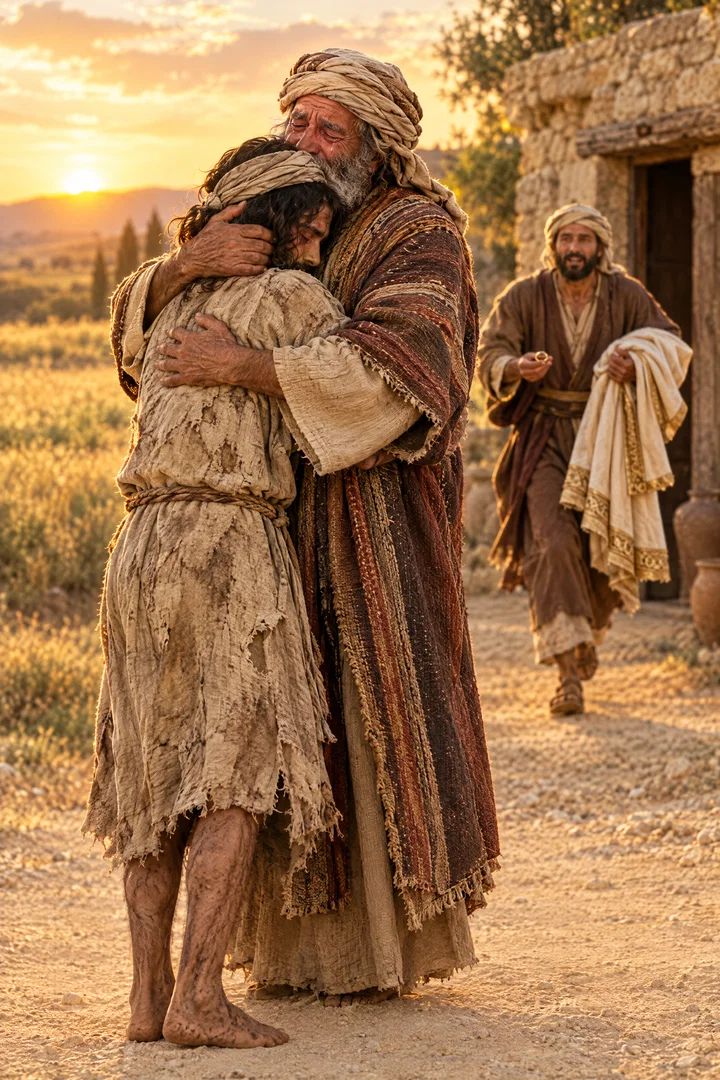
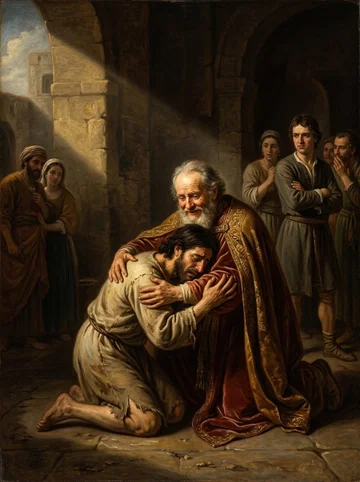
The one sinned against sees the returning son while still far away and meets him with compassion, pity, forgiveness and tender embrace, with great joy that the son believed dead to all filial affection has become sensible of his great sin and neglect and has come back appreciating his love and acknowledging his claims.3T 103.5–104.1COL 202.3–203.1TCBMP 128.1 The son who has pursued a course of sin comes because he has suffered and felt his need and knows his Father as the only one who can supply that great need.3T 103.5–104.1TCBMP 128.1 His degradation does not hide him from his Father's love.COL 202.3–203.1
God is a waiting Father who yearns for the wanderer even while he is far off wasting what was given, cherishes him, and hastens to receive the contrite without meeting him with accusations of wrath, but welcoming his return with a feast.GW 157.3ST Jan 22, 1894 He hears the sinner's cry and knows every faltering prayer, secret tear and feeble sincere desire for Him, and His Spirit goes forth to meet it, so that even the first step toward God is met by His love.ST Jun 2, 1909 The longing to return is itself the pleading of His Spirit drawing the wanderer back, for He has already taken the first step to seek the sinner while still in rebellion and brings back to the Father's house everyone who lets Him do so.ST Jan 22, 1894
The repentant soul is welcomed without reproach or reminders of unworthiness, without contempt, punishment or accusations of wrath.ST Jan 29, 1894COL 203.2–205.1GW 157.3 What is required is penitence expressed in a broken and contrite heart and honest confession that sin has been committed against heaven and before the Father, with acknowledgment of unworthiness to be called a son.ST Jan 29, 1894COL 203.2–205.1 That confession is met with compassion and welcome, for God longs to receive the sinner who returns, forgives and forgets the past, and welcomes the repentant with fatherly love.RH Jan 19, 1911COL 203.2–205.1
He fully pardons and welcomes with pitying love the one who confesses and returns, restoring the one who comes back, and no sinner who comes to God in contrition is beyond hope, for the Father is ready to meet the returning sinner with love and compassion and to forgive.RH Jan 19, 1911ST Jul 29, 1913Lt 18e, 1890, par. 2 This is His invitation to His children to return and repent, and His willingness to pardon their sins and transgressions.Lt 18e, 1890, par. 2 The son is received as a son, not made a servant, though humbled enough to ask only for a servant's place.COL 202.3–203.1COL 203.2–205.1
The Father covers his rags, shame and nakedness, covers him with the robe of righteousness, which is Christ's righteousness, restores him with a ring as a sign of his standing as a son, and restores him to the place of a beloved child at His table despite past separation and errors.Lt 80, 1898, par. 9–13GW 140.2Ms 40, 1899, par. 10–1211MR 370.2–371.1Lt 76, 1898, par. 18–20 God's love remains strong for the sinner, and coming to God in sorrow is not degrading.Lt 80, 1898, par. 9–13Lt 76, 1898, par. 18–2011MR 370.1 Though departure caused grief, the Father still loves him and receives him when he repents.11MR 370.1
Through Christ's goodness and mercy the sinner is restored to divine favor, and God in Christ is ready to receive and welcome the sinner, with Christ's dying love on Calvary assuring acceptance, peace and love.Lt 15a, 1890, par. 9–11Ms 82, 1894, par. 22–24 This return is made possible by the Father's infinite love in the gift of His beloved Son as a sacrifice, which made a channel for the outflow of His love to the fallen race.Lt 85, 1886, par. 17–18 All who believe on Jesus Christ are restored to favor, made obedient to all of God's commandments, and have life in Jesus Christ, for Christ has purchased him with His blood, and faith in Christ, learning from Him and following Him, lead to eternal life and heaven's imperishable riches.Lt 85, 1886, par. 17–18Lt 52, 1899, par. 3
The return brings joy in heaven and rejoicing over the son thought dead but alive, with praise to God and the Lamb for mercy and loving-kindness when a person is brought back to God.COL 197.219MR 259.1–3Ms 24, 1891, par. 88 The prodigal's return in repentance, acknowledging his sin, brings joy among the heavenly host.Ms 19, 1890, par. 21 There is greater joy over one repentant sinner than over ninety-nine needing no repentance, and heaven rejoices when even the poorest person comes to God.STA 14.15T 604.1
Seeking and Welcoming the Lost
Those who have themselves been rescued from sin can understand the lost and help them find their way back to the Father, for the resolve to arise and return marks the turning point where the sinner recognizes guilt and decides to come home.MH 179.1–2Lt 59, 1886, par. 6 A backslider's leaving of a backslidden condition to return to God and to His service comes about through earnest Christian labor bestowed on the erring.Lt 59, 1886, par. 6
Those who have strayed and left the Father's house are to be encouraged to come back to Him.STB 147.5STB 620.1–2RH Mar 16, 1905STB 119.1 Those willing to receive truth can likewise be guided toward salvation through wise, spiritual care.Lt 200, 1902, par. 8–10
The resolve to return illustrates the repentance erring people need, and it calls for meeting the fallen with Christlike compassion and helping them toward the sin-pardoning Saviour rather than abandoning or condemning them so harshly that they lose hope of restoration.RH Nov 25, 1902Lt 16, 1887, par. 7–14 The awakening to sin and degradation and the decision to return call for tender sympathy, encouragement, hope, pardon, pity, love, and rejoicing over the return, following the father's example rather than the elder brother's coldness, cold rejection, and condemnation.Lt 45, 1894, par. 21–24RH Nov 25, 1902 Fallen people who have come under temptation need sympathy and prayer in view of Jesus' love and tenderness, not severe judgment, and a soul trying to return needs Christlike pity and sympathy rather than censure, reproach, suspicion, or jealousy.16MR 339.3Lt 45, 1894, par. 25–27 Harsh treatment by Christians can keep those who have gone astray from the kingdom instead of helping them.Lt 50, 1893, par. 8–9
The one who has pursued a course of sin and now repents comes suffering, feeling need, desponding and discouraged, as one who can be supplied only by the Father, and needs pity, love, help, sympathy, and free forgiveness.3T 103.5–104.1TCBMP 128.2 He is not to be made to feel where he erred by repeated reminders of mistakes, as the elder brother did, whose complaints were natural but not right, and resentment at such a welcome is wrong.3T 103.5–104.1TCBMP 128.2 The father's welcome rather than the elder brother's cold rejection is the right response to those gone astray, giving tempted people room to recover from the enemy's snare instead of treating them harshly or condemning them.Ms 113, 1902, par. 30
Those who claim to love God must properly represent Him by receiving the returning wanderer with joy rather than wounding and driving away the lost instead of seeking them.Lt 71, 1895, par. 27 All heaven rejoices in the finding of the lost, and those who handle sacred things must partake of that spirit and rejoice over the returning wanderer instead of manifesting indifference, careless disregard, and an elder-brother spirit that refuses to sympathize and rejoice.Lt 71, 1895, par. 25 The lessons of the lost sheep, the lost coin, and the prodigal son belong together, mean much, must be carefully studied, and involve eternal interests in the practicing of them.Lt 71, 1895, par. 27
Those already in the church ought to rejoice when backslidden souls are awakened, confess wrong, come back to God for forgiveness and restoration, and are baptized again as wandering sheep brought to the fold.21MR 296.5–6 When instead they are envious and jealous because more labor is given to new interests than to them, they act out the elder son of the same parable.21MR 296.5–6Ms 49, 1898, par. 24–25 That resentful, jealous, complaining spirit in members who resent rejoicing and labor for the returned and the lost sorely displeases the Lord.Ms 49, 1898, par. 24–25
A living church is not a gossiping church planting doubt, questioning, evil surmising, and jealousy, but an earnest, working church whose members know God and Jesus Christ whom He has sent.Ms 49, 1898, par. 24–25 If Christ is formed within as the hope of glory they will seek to save the lost as chosen vessels carrying salvation, bearing light and reflecting truth to all they contact by precept and example.Ms 49, 1898, par. 24–25 They stretch out hands all day in burden for souls and sincere prayer, hunt for souls and bring truth close to hearts, and do righteousness in their own homes and in the church rather than expecting to be constantly fed with sermons while ministers should be giving truth to those who know it not.Ms 49, 1898, par. 24–25
Harsh treatment of youthful errors by brethren does not excuse leaving Christ, whose tender love and received pardon call the backslider back to the Father's service in a decisive turn away from Satan and sin.Lt 59, 1886, par. 1–5 The call to come back with humble heart, confessing sin and waywardness and seeking forgiveness, finds deliverance through Jesus' strength and not one's own, and applies also to reconciliation such as Charley's relationship with his parents.Lt 18f, 1890, par. 2
Sources
Pioneers and periodicals
149 sources
The verse is the resolve of the starving younger son in the far country to leave his ruin and go home to his father confessing wrong done against God and against his father.ST Jan 29, 1894ST Apr 2, 1896ST Aug 6, 1894ST May 4, 1904ST May 4, 1904 It is the turning point of the story, when coming to himself he rises in repentance, faith and obedience to begin the journey that ends in welcome and restoration.ST Jan 18, 1905RH Jul 15, 1862 True returning is humble, full confession without excuse, forsaking the old life and coming as he is to be cleansed and made new.RH Jul 15, 1862ST Dec 15, 1887RH Aug 27, 1872ST Aug 1, 1878ST Dec 24, 1902 That return is drawn by knowledge of the father's love and bounty, and it is met by a father who sees from afar, runs with compassion, freely forgives, and restores sonship instead of servanthood with joy in heaven.ST Mar 25, 1880ST Jun 2, 1909ST Aug 29, 1895RH Jan 12, 1911 Therefore every wanderer and backslider is to arise at once without delay, confess each sin to God and to the one wronged, and keep returning daily to find bread, rest and fellowship at home.RH Jul 15, 1862ST Aug 23, 1899ST Apr 25, 1878RH Jun 18, 1861RH Apr 14, 1863
Parable Words and Setting
The words are the resolve spoken by the younger son when he came to himself in want in the far country after wasting his substance with riotous living.ST Aug 6, 1894ST May 4, 1904ST May 4, 1904 Perishing with hunger in famine, reduced to feeding swine and so destitute he would willingly have eaten their food, he saw the vanity and fleeting unsatisfying character of earthly pleasure and sensual gratification.ST Jan 29, 1894ST Nov 22, 1899 Remembering the bountiful supply in his father's house set against the world's poor fare that cannot give lasting happiness and peace, he determined to arise and go to his father and confess his fault in his sight.ST Aug 6, 1894ST May 4, 1904RH Feb 28, 1871 Sorry for his wayward and sinful course, he made the high resolve to forsake it and lead a different life, and then carried out his resolution and started for home.ST Jan 29, 1894ST Nov 22, 1899
To have sinned against heaven is to have sinned against God, and the planned confession admits wrong against both God and the father.ST Jan 29, 1894ST Apr 2, 1896ST Oct 17, 1900ST May 4, 1904 The lost son recognizes his sin against God and his father and decides to return home and confess it, and that resolve to arise and go is the first step in his return which he afterward carries out.ST Oct 17, 1900ST Apr 2, 1896 Repentance begins with this turning back to the Father, and even one step toward Him in repentance is met by His willingness to receive the sinner with love.ST Apr 2, 1896ST May 4, 1904 His return illustrates the return of those lost in sin to the house of the Father, showing how sinners who know they are lost need a Saviour whose mission is to recover the lost rather than to condemn and destroy them.ST Jan 29, 1894ST Apr 2, 1896
The confession before the father shows that wrongs done to another are to be confessed to the one wronged as well as to God.RH Jun 18, 1861RH Apr 21, 1859RH Jul 27, 1869 When a brother, sister, church, or neighbor has been wounded, true repentance freely confesses the wrong to those harmed before going to God, for prayers and confessions to God alone do not replace that duty.RH Apr 21, 1859RH Jul 27, 1869 That confession is joined to reform, forgiveness, restored love, joy, peace and confidence, and to making wrongs right and restoring what was taken through wrongdoing.RH Apr 21, 1859ST May 12, 1914 Approaching with an offer to do something instead would not express repentance or bring the same welcome, for repentance must come before good works and gives reason to hope for reform.RH Apr 14, 1863ST May 12, 1914 After sincere contrition the sinner may then rejoice in the forgiveness and peace God offers rather than remain weighed down by sorrow or regret.RH Apr 14, 1863
In the parable the prodigal is the younger son and the story gives its largest part to him, though it begins with a certain man having two sons and gives large place also to the elder brother.STRH Jul 3, 1900 He represents the Gentiles, and also publicans and sinners, backsliders, all penitent sinners, and every wandering sinner, while the elder brother represents the Jews, the scribes and Pharisees.STST Oct 17, 1900ST Mar 28, 1906 Those who have wandered from God remain His children and can turn back in this present life to acknowledge Him as Father and become sons indeed.ST Mar 8, 1899 The verse displays the great love and mercy of God to the undeserving, whether Jew or Gentile, sinner or backslider, for God is no respecter of persons, and it reproves refusal to welcome lost people who come for salvation, unlike the joy shown when lost property is recovered.STRH Jul 3, 1900ST Mar 28, 1906
The verse is the turning point that prompts the return, when the lost son recognizes his desperate need and his perishing condition and resolves to return to his father as his last hope.ST Jan 18, 1905RH Jul 15, 1862RH Jul 15, 1862 Every sinner is a wanderer from his Father's house spending his substance in recklessness of sin and folly, and to arise and go to the Father is to show the first inclination to return.RH Jul 15, 1862ST Jun 15, 1904 That rising is through repentance, faith and obedience in reform to the heavenly Father, and slight conviction is not enough to produce this saving decisive step.RH Jul 15, 1862RH Jul 15, 1862 In his misery he comes to himself and turns back toward home, his view of his father changing from stern and severe to loving, and the return belongs to the finding of the lost in which the father rejoices to receive him.ST Dec 18, 1901ST Jun 15, 1904 The Father's love reaches out for the wanderer and watches for that first sign of return, and there is joy in the presence of the angels of God over one sinner that repents.ST Jun 15, 1904
Awakening to Need
The resolve to arise and go to the father follows coming to himself and recognizing desperate need.ST Jan 18, 1905ST May 4, 1904ST Dec 18, 1901 The wanderer sees his own folly, his perishing condition, his misery, his spiritual famine, and the vanity of earthly pleasure.RH Jul 15, 1862ST May 4, 1904ST Dec 18, 1901RH Jun 14, 1870ST Jan 4, 1905 Hunger, trouble and affliction mercifully awaken the desire for home, and in hunger he decides to return and confess sin against God and his father rather than remain where he is.ST Dec 18, 1901RH Jun 14, 1870ST Jan 4, 1905 Remembering the father's home and care prompts the turning point, and even one step toward him in repentance is met by willingness to receive with love.ST Jan 18, 1905ST May 4, 1904 The decisive step is to arise and go home, leaving the place of failure instead of staying away and relying on own efforts which leave no strength to resist evil.RH Jun 14, 1870ST Jan 4, 1905
Remembrance of the father's house, where even hired servants have bread enough and to spare, awakens consciousness of guilt and unworthiness and draws the wanderer homeward.ST Mar 25, 1880ST Mar 25, 1880RH Feb 15, 1912ST Nov 22, 1883RH Feb 28, 1871 Hardship and suffering clear vision, so the home once despised for worldly pleasure rises before him in reproachful magnificence with its holiness and purity, its peace and plenty, while he perishes with hunger.RH Feb 15, 1912RH Nov 17, 1868 He does not sense the blessing of home until beyond its bounties as a sinner and an outcast, and his soul cries out for even the most menial position there with only thought and longing desire for home and a place once more in its restful, sheltering embrace.ST Mar 25, 1880RH Feb 15, 1912 Through humiliation and want he comes as a destitute beggar in rags, emaciated with hunger, acknowledging sin in leaving his father, declaring no more worthiness to be called a son and no claim to former privileges, begging only to be counted as a hired servant and greatly fearing to be disowned.ST Mar 25, 1880ST Mar 25, 1880 The memory of home can visit him when far from home and from God because the home had not been repulsive and the father had not been stern and forbidding, and this silent influence of a pious home restrains from sin and turns steps homeward into righteousness.RH Feb 15, 1912RH Nov 17, 1868 What is needed is available from the Father for the asking, so the lesson is to return daily to the Heavenly Father rather than remain spiritually starved among demoralizing habits, for this world with its poor fare cannot give lasting happiness and peace.ST Nov 22, 1883RH Feb 28, 1871
Sinners must repent or perish, and the prodigal seeing that he is perishing decides to return to his father as his last hope and is saved.RH Jul 15, 1862RH Jul 15, 1862 Slight conviction will not produce this saving step in the awakened sinner who must recognize danger in remaining in sin and make a decisive return to God.RH Jul 15, 1862RH Jul 15, 1862 There must be firm resolve to break free from Satan's hold, forsaking sin, turning with the whole heart, and humbly seeking help and blessing.RH Jun 14, 1870RH May 30, 1871 The decision to rise and return and confess sin against God and father follows surrender of the will to believe.RH May 30, 1871RH May 30, 1871 Overcoming an enslaving habit requires a firm decision to quit, not merely an attempt or compromise, and one troubled by doubts after turning from prayer and neglecting prayer must choose to trust and return, which leads to repentance and recognition that doubting God and His word was sin.RH Jan 1, 1861RH May 30, 1871
The depth of sin is realized by seeing what might have been in the Father's house if one had stayed at home with Him. Wandering far from the Father's house brings a faint and hungry soul for want of heavenly food, desolation and barrenness on every side, and utter unworthiness to look up to heaven because of sin, which is the condition of one spiritually dying.RH May 8, 1866 The distance comes when cares and pleasures are let in between the soul and God and secret prayer in the closet is neglected.RH May 8, 1866 To arise and go to the Father means to speedily find the way back to the living fount, for unless return is speedy spiritual life will soon be dead.RH May 8, 1866 The true parent's love is not destroyed by turning away from all counsel that love gives and leaving home to return no more, nor by insults, hard unfeeling speeches, nor falls into ruin, but there remains an aching void and a chamber in the heart dedicated to memory where the erring one is written.ST Aug 22, 1911
The longing to return is itself the pleading of God's Spirit, the echo of His call.ST Apr 30, 1894 God seeks the lost and has already taken the first step while the sinner is still in rebellion, cherishing the wanderer while far off wasting what he has been given and bringing back to the Father's house everyone who lets Him do so.ST Jan 22, 1894 The desire to return home is given by God Himself, and God answers that desire while it is still forming, before the confession is made, and more abundantly than asked.ST Jun 2, 1909RH Jun 4, 1901 Even the first step toward God, the feeble sincere desire, the faltering prayer and secret tear, is met by His love, for His Spirit goes forth to meet it and He hastens to receive the contrite.ST Jun 2, 1909RH Jun 4, 1901 Any backslider who longs to return may come with simple faith in God's goodness as the son did and be welcomed, for God is even more willing to receive than the earthly father was, having made the way home and welcoming for Jesus' sake.ST Apr 30, 1894RH Aug 26, 1862
What True Repentance Does
Repentance is more than resolving to change, for merely wanting the bread in the father's house would not have saved the prodigal if he had remained still, and turning over a new leaf succeeds only when he leaves the place of failure and returns to the father.ST Jan 4, 1905RH Aug 12, 1915 Acknowledging wrong and yearning for a better way must lead to action, for going and not merely resolving brings joy to the father and restores the wanderer to his place in the household.RH Jan 19, 1911RH Aug 12, 1915RH Jul 21, 1910 Resolutions without returning leave a person dependent on own efforts and without strength against evil, while coming to the Father gives access to provision, power and wisdom to live rightly and to the sustaining bread of life.RH Jan 19, 1911RH Jul 21, 1910RH Jul 21, 1910 Overcoming sin requires more than a weak wish, so the sinner must resolve to act in Jesus' name, trusting that God is willing to help and already seeking the lost, a confidence resting on Christ's victory and the promise of strength through the Spirit, so that even the weakest can be courageous.RH Jul 21, 1910
True repentance is free and full confession from humility and a broken heart rather than pride, stripping the returning sinner of self-esteem and self-claimed worthiness so that Christ becomes righteousness, sanctification and redemption.RH Jul 15, 1862ST Feb 18, 1886 It takes personal responsibility without blaming people or circumstances, expressing earnestness and sincerity that makes the sinner ready to receive welcome and to trust divine grace as a lost sinner.ST Dec 15, 1887RH Oct 29, 1872 It is honest acknowledgment before God and another person, a conscience turned against wrongdoing and not mere regret over consequences or reform for practical advantage, abandoning sin without concealment, excuse or defense, with deeds as evidence though God who knows the heart does not wait for evidence before forgiving.ST Aug 1, 1878ST Feb 20, 1879ST Feb 18, 1886 Confession comes before blessing and must be open rather than concealed, and had innocence been pleaded after guilt was confessed there would have been no winning of the father's heart nor robe and feast.ST Feb 20, 1879RH Oct 29, 1872 Nor should confession wait until feeling is complete, for pardon meets the returning sinner at the first true confession and sorrow may deepen afterward in the experience of mercy.ST Aug 1, 1878
The returning sinner counts himself no more worthy to be called a son and asks only to be made as a hired servant, approaching humbly with sorrow and shame and seeking only a lowly place in the household.ST Aug 26, 1875ST Nov 19, 1902 This is coming without self-justification, with clear sense of sin and lostness, turning back to the one wronged and willing to accept the lowest place in God's family.RH Jul 15, 1862RH Feb 16, 1869 It is turning back wearied, stricken and sore under heavy burden, with faltering feet and stained hands and heart having nothing to lay on the altar but sin and pain, having exchanged favor's white robes for tattered garments, spoiled given fields, fed on husks with swine, and left pure springs for rioters' wine.ST Mar 25, 1880 So defiled and ashamed, asking only a servant's bread and waiting in the dust, willing even for the rod if it hastens meeting with God, the penitent is met with cleansing, healing and pardon, leaving sin behind, pressing onward clasping the cross, and from the lowliest place beholding mercy in the pardoning face.ST Mar 25, 1880 When the father meets the son a great way off with affection, the confession is still made but the request for servantship is left out, showing the change from depression that dares hope only for pardon and lowest place to faith that casts aside fear and appropriates the privileges and provisions of an accepted son.ST Aug 26, 1875ST Feb 24, 1887
Repentance forsakes sin and begins reform by leaving it behind, as the prodigal left the swine trough, wine and harlots rather than carrying those sins with him, though he had no goodness to offer.RH Aug 27, 1872ST May 8, 1884 It is humble resolve to leave sin and return confessing wrong, for those who persist remain in the enemy's country feeding on its husks, while the penitent who wanders is welcomed and forgiven.RH Jan 27, 1863ST May 8, 1884 Coming to the Father means admitting wandering far from home, spending gracious gifts, feeding on husks, and standing in nakedness of soul clothed only in rags of own righteousness and unworthy even to lift eyes to heaven.ST Dec 24, 1902 It means casting all self-righteousness aside and pleading in Jesus' name to have transgressions covered with His blood, to be clothed with spotless righteousness, to have lips touched with sin-consuming fire, and to receive new thought, purpose and desire with daily grace and guidance in the narrow way.ST Dec 24, 1902 It is an honest acknowledgment that begins return and opens mercy and restored fellowship, a return to loyalty and obedience bringing the father joy, breaking the heart, bowing the stubborn will, humbling the proud nature, and putting away wickedness so not one particle cleaves longer.RH Jan 27, 1863RH Aug 3, 1869ST Jul 2, 1885 This is an elevated, honorable, sacred, noble and dignified work, wrought by the Spirit of God with human consent and active cooperation, opposite to sin which is abominable and hated by God and the only real cause for shame, and it adds to the exalted bliss of angels who rejoice over one sinner.RH Aug 3, 1869
The sinner must come as he is without first trying to make himself better or more acceptable, trusting God's willingness and power to save for Jesus' sake rather than waiting to become better or to feel more sorrow.ST Apr 20, 1915RH Jan 27, 1916ST Nov 6, 1901 Even one step toward God in repentance is met by loving welcome, for the first step is turning toward the Father and resolving to confess.ST Apr 20, 1915ST Oct 3, 1895 When the repentant first sincerely asks mercy, God sends His Spirit into the heart, makes him a son, and enables him to call God Father with confidence and joy, meeting and embracing him before the servant's request can be finished.ST Feb 24, 1887 A soul weary of sin and longing for mercy and love is already near the Father's house and need only arise in penitence and enter.ST Oct 3, 1895
Sorrow that includes grief for pain caused the father by waywardness, and not merely regret over personal suffering, is still only thought and not action, and by itself does not complete repentance or show full appreciation of grace.ST May 7, 1894ST May 7, 1894 Being enlightened through the convicting power of the Spirit shows true repentance not only sorrows but acts and seeks pardon, reaching out to God for strength to act, for thus far self is uppermost where hundreds of thousands stop in mere sorrow for consequences, like the grief of Cain.ST May 7, 1894ST May 7, 1894 Full repentance therefore joins sorrow and humble confession with making wrongs right, confessing and forsaking sin, submitting to God, giving life to His service, seeking His will daily and obeying by His grace.RH Nov 30, 1869RH Jan 27, 1863 Confession of worldly-mindedness and wandering with wasting of what the Father gave is to be made without delay, turning back at once. After sincere contrition the sinner may then rejoice in forgiveness and peace rather than remain weighed down by sorrow or regret, with pardon bringing reconciliation and faithfulness leading to the crown of life.RH Nov 30, 1869
Drawn by the Father's Love
The resolve to return is born of knowing the father's love and friendship and bounty, and that knowledge gives hope and draws the wanderer homeward.ST Jun 2, 1909ST Apr 20, 1915ST Apr 20, 1915RH Jan 12, 1911RH Jan 12, 1911 God's love and goodness themselves lead sinners to repentance, and the assurance that there is bread enough and to spare meets the despair of one who fears he is past help.ST Jun 2, 1909ST Sep 12, 1911ST Apr 20, 1915ST Apr 20, 1915RH Jan 12, 1911 Against Satan's effort to hold the soul in captivity by picturing God as stern and inexorable and unwilling to pardon, the gift of His Son as heaven's choicest gift and the opening of heaven's treasures to the repenting soul prove willingness to receive.ST Sep 12, 1911 The plan to ask only for a hired servant's place shows the penitent has not yet grasped the full measure of that love, for the father will welcome him as a son with more than he expected.ST Jun 2, 1909ST Apr 20, 1915ST Apr 20, 1915RH Jan 12, 1911RH Jan 12, 1911
Nothing in the Father hinders that return; He acts to hasten it, yearns to help the helpless, and waits and longs for the wanderer to come seeking welcome, with Christ's death making the welcome possible.ST Jun 2, 1909ST Jan 22, 1894ST Aug 11, 1914RH Jun 4, 1901 Even while the sinner is far off wasting what has been given, the Father cherishes him and has already taken the first step, seeking him while still in rebellion and bringing back to the Father's house everyone who will let Him.ST Jan 22, 1894 The desire to return is itself given by God, and He answers it while it is still forming, before the confession is spoken, and more abundantly than asked.RH Jun 4, 1901 Even the first step is met by love hastening to receive the contrite, hearing the cry and knowing every faltering prayer and secret tear and feeble sincere desire, with His Spirit going forth to meet it.ST Jun 2, 1909
The earthly picture of that drawing power is the cherished memory of a Christian home, whose holiness and purity and peace and plenty rise before the outcast in reproachful magnificence once hardship has cleared his vision.RH Feb 15, 1912RH Nov 17, 1868 Because the home was not repulsive and the father was not stern and forbidding, its memory can visit the far country like the song of the sea heard in a shell, awakening consciousness of guilt and unworthiness and a longing desire for even the most menial place in its restful, sheltering embrace.RH Feb 15, 1912RH Nov 17, 1868 Faithfulness with God and family altars gives family religion this lasting power to restrain sin and crime and turn steps homeward into righteousness, giving reason to take courage and persevere for prodigals.RH Nov 17, 1868 Remembrance of a praying mother, of motherly love and early conscience, stirs the straying one toward the path of duty, and a mother's faithful love points onward to the greater love of Calvary and to Jesus' continuing love that receives the sin-beset comer.ST Oct 22, 1894RH Oct 22, 1914RH Oct 14, 1915 Such mother-love and father-love for the wayward child reflects the everlasting love of God for sinners.ST Oct 4, 1899
The Father's heart yearns over the fallen as a true parent's does, and no insults or hard speeches or falls into ruin can destroy it; there remains a dedicated chamber of memory and an aching void that time cannot heal.ST Aug 22, 1911 His thoughts toward His children, faithful and prodigal alike, are thoughts of peace and kindness and mercy and love, and eternity itself will not remove His love for the lost who turn a deaf ear and go out from His presence.ST Apr 17, 1907ST Aug 22, 1911 That love embraces prodigal sons and daughters alike, counting a sister's life just as precious and worthy of mercy and help as a brother's.RH Nov 3, 1904 The wandering boy who has gone astray draws the strongest affection and time and thought and prayer and care, a faint glimmer of heavenly light reaching toward the unlovely and forsaken, brought from heaven by Jesus to take root in humanity as He walked and worked and healed among the lowly as the Friend of publicans and sinners.ST Jun 13, 1916 In that love God rejoices over the redeemed and delights in them as over the lost son come home.
Welcome and Restoration
The father sees the returning son while he is yet a great way off and runs to meet him with compassion, pity, love and kisses, embracing him and drawing him to breast and heart.ST Mar 25, 1880ST Mar 25, 1880ST Nov 22, 1899 He does not wait for the confession to be finished or for proof that sorrow is genuine, but welcomes the first thought and faltering step of return with joy and affection before a word is heard.ST Aug 11, 1914ST Nov 22, 1899ST Aug 6, 1894 There is no reproach, no recital of the wrong course, no coldness, rebuke or distance, no probation to prove permanent reformation, and no penance required.ST Mar 25, 1880ST Mar 25, 1880ST Aug 29, 1895ST Nov 22, 1899ST Aug 6, 1894 Those who have erred in this way suffer in feeling and are desponding and discouraged, and what they need above all is free forgiveness with sympathy and help, not efforts to make them feel where they erred and reminders of their error.ST Mar 25, 1880ST Mar 25, 1880 The deeper sense of ungratefulness comes after this kindness is felt, when the before subdued heart is broken for having grieved such love and can no longer doubt the father's goodness.ST Mar 25, 1880ST Aug 11, 1914
God in this welcome freely forgives penitent sinners, receives the one who comes back in contrition, and is ready to meet every such sinner with love and compassion so that none is beyond hope.RH Jan 19, 1911ST Jul 29, 1913RH Jul 15, 1862 The sin confessed is settled forever, treated as forgiven, forgotten and blotted out, remembered no more and never again brought up, so there is no need to keep lamenting and asking forgiveness for sins already forgiven.RH Jan 19, 1911RH Jul 15, 1862ST May 27, 1897RH Jul 21, 1863RH Dec 23, 1915 The kiss, robe, ring and feast are His welcoming thoughts in action, showing forgiveness without taunting for the evil course.RH Jul 21, 1863RH Dec 23, 1915 The returning sinner no longer claims worthiness, submits to God, confesses and forsakes sin and finds mercy, with Christ as righteousness, sanctification and redemption, both justifying through His blood and giving power over sin.ST Jul 29, 1913RH Jul 15, 1862
The father does not accept the offer of a servant's place, and the request to be made as a hired servant is left out when forgiveness and grace are believed to be received.ST Aug 26, 1875ST Nov 19, 1902ST Aug 11, 1914 Instead he receives the destitute beggar in rags, emaciated with hunger and nearly naked, and restores him as a son and heir with honor and rejoicing.ST Mar 25, 1880ST Aug 29, 1895ST Aug 6, 1894 He orders the best robe and a joyful feast, wraps his own rich robe about the naked form, covers shame, silences shame, shares his abundance, and does not dwell on the past.ST Mar 25, 1880ST Aug 11, 1914ST Dec 10, 1894ST Dec 15, 1909 The change is from depression that dares hope only for pardon and the lowest place to faith that casts aside fear and appropriates the privileges and provisions of an accepted son, including the children's bread and a spotless robe of righteousness.ST Aug 26, 1875ST Dec 10, 1894ST Dec 15, 1909
The return is a source of the greatest joy because the son who was dead to all filial affection now lives again, and the lost is found to new life in the kingdom.ST Mar 25, 1880ST Jun 15, 1904 There is mercy, love, forgiveness, pardon and reconciliation with open arms, and the household rejoices with the father.ST Mar 25, 1880ST Jun 11, 1896ST Jul 7, 1909 There is joy in the presence of the angels of God over one sinner that repents, for the Father's love is reaching out for the wanderer and watching for that first inclination to return.ST Jun 15, 1904RH Dec 25, 1913ST Jun 11, 1896 Hearing of that decision to turn back to God and confess sin against God and against the one wronged brings joy, as the response gospel preaching seeks to awaken.RH Dec 25, 1913ST Jul 7, 1909
Coming home turns from sin to spiritual nourishment, for remaining in sin and worldly pleasure ends in spiritual famine and leaves the soul starved among husks and demoralizing habits in the enemy's country.ST Nov 14, 1900ST Oct 17, 1900ST Nov 22, 1883 The Father's house satisfies the famished soul with the bread of life, spreads a feast of love, feeds with heavenly manna with all wants sustained, and gives rest in Christ, holiness through faith in Jesus, and fellowship in the family and fold.ST Nov 14, 1900ST Sep 9, 1875ST Nov 22, 1883ST Mar 17, 1898RH Sep 1, 1874 Though coming clad in rags and defiled by sin, the child is embraced, pardoned and reconciled in the Lamb, put in the children's place to gaze upon His face, to bear Christ's name and wear His spotless robe and so share the Father's love.ST Sep 9, 1875RH Sep 1, 1874 Outside is danger where Satan and his agents lead farther from the warmth of the Father's house to the bleak moors of sin and destruction, while inside are peace, hope, joy, righteousness and eternal life, with wandering feet set on the Rock unto full joy and at last shining in His likeness to everlasting joy to His glory.ST Sep 9, 1875ST Mar 17, 1898RH Sep 1, 1874 What is needed is available from the Father for the asking, and the wanderer should return daily rather than remain starved, coming back to the society and care of God's people.ST Nov 22, 1883RH Sep 1, 1874
Salvation from sin is offered even to those who have strayed far from God, to the lost world and to sufferers, presenting hope through divine love and redemption.ST Dec 18, 1901ST Sep 24, 1896 It reaches every type from Pharisee to prodigal, for even scribes and Pharisees can be saved, but only by entering through faith in Jesus Christ.ST Jun 25, 1912ST Jan 22, 1894 The way back is salvation from sins, not permission to remain in them, with Christ saving people from their sins and His light and righteousness making the path one of holiness.ST Jun 25, 1912ST Jan 22, 1894 Christ's mission is to seek and save the lost with tender concern for the outcast, treating those who stray with tenderness to bring them back in order to save and not to condemn or destroy, and He receives sinners today as then.RH Nov 9, 1916ST Sep 24, 1896
Doctrine and Warning
The way home runs straight to the Father, with confession made to Him and restoration received in His house without stopping aside to confess to a priest or to receive priestly absolution.ST May 4, 1876RH Jun 30, 1874 The story in Luke 15:11-32 lays out that direct return of a sinner to God, and the reinstatement that follows is to former honors in the Father's house and to friendship with God.ST May 4, 1876RH Jun 30, 1874 Humble admission of having sinned against God and against the father gives ground to hope for reform, whereas coming with an offer to do something for the father would not express repentance nor draw the same welcome.RH Apr 14, 1863 Repentance therefore stands before good works, and confession is what opens the expectation of a changed life.RH Apr 14, 1863
The parable sets forth the leading marks of Christ's kingdom as love to God as Father and the common brotherhood of all as children of God, with the rights of all however poor, degraded, or despised upheld.RH Oct 8, 1861 By precept and example it teaches the dignity of labor and of the laborer and the consequent equality, political and religious, which is the very opposite of chattel slavery and of property in man.RH Oct 8, 1861 It is to be taken as parable, not as a record of actual historical events, in contrast with the account of creation and the fall in Genesis which stands as history.ST Jun 18, 1885
The resolve to repent and return came after coming to himself, yet there were many opportunities to repent during the time among the swine, and the end could instead have been to remain unrepentant and die hardened.ST Jun 21, 1883 The story is about sin and repentance, not about an unrepentant transgressor being assured of another chance in the next life, and to turn the father's welcome into such assurance is sentimentalism that obscures the need for Christ and His cross.ST Jul 22, 1908 The same history shows that one who has been converted can turn away again and go back to worldly life.ST Aug 1, 1916 The return is a return to loyalty and obedience, and that turning back brings the father joy.ST Jul 2, 1885 It is a return to God on God's ground and not man's, won by Infinite Love back from the far country to the Father's house.ST May 8, 1901 Enjoying the privileges of sonship then requires complying with the conditions of sonship with cordial assent and willing obedience, renouncing the favor and friendship of the world, receiving Christ as Saviour and King, and walking in accordance with His Word under His dominion and reign.ST May 8, 1901 That free submission of the sovereign will and repentant soul to God's precepts, and submission of the heart's love to the Love that won it, letting God work His will in the life, is true Sabbath-keeping and true Sabbath reform, which can never be forced upon any person by human power through fear of fines and penalties.
Call to Arise Today
The resolve to arise and go to the father is a call to every sinner, wanderer and backslider to act at once without delay, for the season to reform may end and the perishing must repent or perish.RH Jul 15, 1862ST Aug 23, 1899ST Apr 25, 1878 Anyone not yet cleansed is to do the same, arising to confess sin against heaven and before the Father and admitting unworthiness to be accepted.ST Aug 23, 1899ST Apr 25, 1878ST Jun 4, 1912 The turning is to be immediate and continual, confessing each sin as soon as it is recognized and laying it on Christ, keeping short accounts with God, returning daily rather than remaining starved, and so preparing to meet Christ in peace.ST Mar 11, 1889ST Jun 4, 1912RH Oct 7, 1915 Even when feet have gone astray and cares burden the soul, saying I will arise expresses hope rather than despair, trust that God is present, and determination to press onward in His strength to fulfill His purpose.ST Jun 4, 1912RH Oct 7, 1915
The same call is pressed upon those who have known the Lord and left His house, backsliders, Sabbath-keepers, church members and youth, urging them to remember the former life, confess sins before God, seek Him anew while there is hope, renew the covenant, and keep struggling until free.ST Oct 4, 1877RH Sep 5, 1871 A backsliding Christian is like the son repeating his folly and leaving again, becoming spiritually starved and hungry, yet able as before to come to himself, turn from need, and find bread enough and welcome at home.ST Oct 4, 1877RH Oct 21, 1858 One who has lost living connection can return and be received again with the best robe, even after traveling many years away, going almost to apostasy and being almost lost in self-complacency, though light may come slowly after going so far.RH Sep 5, 1871ST Aug 5, 1875ST Sep 13, 1910
Parents, churches and workers are to seek the lost by personal care for the one needy soul, by prayer, song and kindly help rather than censure, cold rejection or condemnation.RH Nov 25, 1902ST May 3, 1899RH Jul 29, 1858 One who turns back in penitence and prayer is to be met with mercy, sympathy and love, not judged to despair, and the church is to rejoice as the father rejoiced when the wanderer comes home.RH Nov 25, 1902RH Jul 29, 1858RH Jun 29, 1869 Those who have themselves been sought, restored and weighed down by guilt and weakened by sin know the hope of being brought back in contrition, and they can help bring other prodigals to the Father.ST Sep 8, 1914ST Jun 3, 1908
The resolve supplies the very language of returning testimonies, in which sinners recognize the far country, ask to go home and be forgiven, and find welcome with fervent love, thankful prayer and a renewed heart.ST Feb 15, 1883ST Jul 4, 1900RH Jul 13, 1905 So Mike was moved toward seeking mercy, Jeff returned and was welcomed, and one who went forth with evil thoughts fell into hardship, turned back, and was received with undeserved kindness.ST Feb 15, 1883ST Jul 4, 1900RH Jul 13, 1905 Others after years away came back to God and the Christian fold with renewed joy in the Lord's love, and a roaming son in angry scorn, ill-used by the world and finding no friend like home, came back repentant, shamed and sorrowing yet hopeful for rest and forgiveness to a mother whose face was abloom after tears and weary nights of fear and prayer.RH May 30, 1907 That inner decision to give the heart to the Lord brings assurance of pardon with new joy, lifting burdens to give peace and new life, freeing from degrading habit and slavery, from condemnation of conscience and from fear to meet the Maker in judgment, and leading to full decision to keep the Sabbath, be baptized, join the church, and redeem wasted years in Christian manhood.ST Nov 25, 1930
Returning restores kinship, for the wanderer remains under the same fatherhood though estranged, and reconciliation begins in acknowledging the father and coming back into the family relation that was rejected.RH Sep 15, 1910ST Feb 10, 1904ST Mar 8, 1899 It replaces disloyalty and indifference, even hatred, with loyalty, love and concern, and brings the unwilling outsider back into harmonious fellowship as a son indeed, though it cannot be forced and persistence in separation leads at last to disinheritance.RH Sep 15, 1910ST Feb 10, 1904ST Sep 28, 1904 Restored fellowship then awakens concern for brothers and sisters still lost, and the faithful brother watches and prays while the returned one seeks to help bring them home.ST Sep 28, 1904ST Feb 10, 1904RH Sep 15, 1910
The resolve belongs to the mission to recover the lost rather than condemn and destroy them, showing that sinners who know they are lost need a Saviour.ST Jan 29, 1894RH May 9, 1871RH Dec 13, 1906 The first step toward the father reveals willingness to pardon the truly repentant, compassion for the sinful and desperate, and a father's loving welcome to the one who turns back in recognition of sin and unworthiness.RH May 9, 1871RH Dec 13, 1906ST Nov 22, 1899 That turning back in contrition and penitence, confessing wrongdoing and asking to be received again, gives the wayward hope through song and proclamation, courage for the despondent to come home, and provision through Calvary.ST Jan 29, 1894ST Dec 29, 1909ST Apr 14, 1909
Sources