Luke 16:10
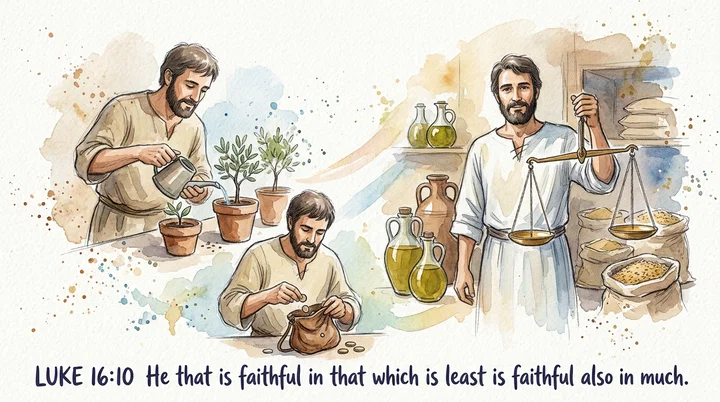
He that is faithful in that which is least is faithful also in much: and he that is unjust in the least is unjust also in much.
Translations
American King James Version, King James Version, KJV Cambridge Paragraph Bible
He that is faithful in that which is least is faithful also in much: and he that is unjust in the least is unjust also in much.
He that is faithful in that which is least, is faithful also in much; and he that is unjust in the least, is unjust also in much.
Revised Version, American Standard Version
He that is faithful in a very little is faithful also in much: and he that is unrighteous in a very little is unrighteous also in much.
'He who is faithful in the least, [is] also faithful in much; and he who in the least [is] unrighteous, is also unrighteous in much;
He that is faithful in the least is faithful also in much; and he that is unrighteous in the least is unrighteous also in much.
The faithful in least, in much also, is, faithful, and, he that in least is unrighteous, in much also, is, unrighteous.
Berean Standard Bible, Majority Standard Bible
Whoever is faithful with very little will also be faithful with much, and whoever is dishonest with very little will also be dishonest with much.
He who is faithful in a very little is faithful also in much. He who is dishonest in a very little is also dishonest in much.
He who is true in a little, is true in much; he who is false in small things, is false in great.
He that is faithfull in the least, hee is also faithful in much: and he that is vniust in the least, is vniust also in much.
Douay-Rheims (Challoner revision)
He that is faithful in that which is least, is faithful also in that which is greater: and he that is unjust in that which is little, is unjust also in that which is greater.
Pictures
Cross-references 20 of 41
- Matthew 25:21
His lord said unto him, Well done, thou good and faithful servant: thou hast been faithful over a few things, I will make thee ruler over many things: enter thou into the joy of thy lord.
The servant faithful over a few things is entrusted with more.
- Luke 19:17
And he said unto him, Well, thou good servant: because thou hast been faithful in a very little, have thou authority over ten cities.
Faithfulness in a small trust is rewarded with greater responsibility.
- 1 Corinthians 4:2
Moreover it is required in stewards, that a man be found faithful.
Both texts require faithfulness in what is entrusted to a steward.
- Luke 16:2
And he called him, and said unto him, How is it that I hear this of thee? give an account of thy stewardship; for thou mayest be no longer steward.
A steward must give an account of entrusted resources.
- Matthew 25:27
Thou oughtest therefore to have put my money to the exchangers, and then at my coming I should have received mine own with usury.
Entrusted talents are to be put to use and yield a return.
- Mark 12:42-44
And there came a certain poor widow, and she threw in two mites, which make a farthing.
The widow’s small gift shows fidelity beyond its monetary value.
- Colossians 3:23
And what soever ye do, do it heartily, as to the Lord, and not unto men;
Daily duties are done as service to the Lord.
- Matthew 25:29
For unto every one that hath shall be given, and he shall have abundance: but from him that hath not shall be taken away even that which he hath.
The parable of the talents likewise teaches that what a person does with a present trust determines whether more is given or what they have is taken away.
- Matthew 25:23
His lord said unto him, Well done, good and faithful servant; thou hast been faithful over a few things, I will make thee ruler over many things: enter thou into the joy of thy lord.
Faithfulness in small responsibilities leads to the Lord’s approval and greater responsibility.
- Matthew 25:15
And unto one he gave five talents, to another two, and to another one; to every man according to his several ability; and straightway took his journey.
The talents illustrate entrusted goods and accountability.
- 2 Corinthians 5:10
For we must all appear before the judgment seat of Christ; that every one may receive the things done in his body, according to that he hath done, whether it be good or bad.
Each person is judged by Christ according to what they have done.
- James 2:10
For whosoever shall keep the whole law, and yet offend in one point, he is guilty of all.
Both connect faithfulness in one precept with one’s relation to the whole law.
- Luke 19:13
And he called his ten servants, and delivered them ten pounds, and said unto them, Occupy till I come.
Servants are commanded to faithfully use what their master entrusted to them.
- Revelation 20:12
And I saw the dead, small and great, stand before God; and the books were opened: and another book was opened, which is the book of life: and the dead were judged out of those things which were written in the books, according to their works.
The dead are judged according to their works recorded in books.
- Daniel 1:8
But Daniel purposed in his heart that he would not defile himself with the portion of the king’s meat, nor with the wine which he drank: therefore he requested of the prince of the eunuchs that he might not defile himself.
Daniel’s choice of food illustrates faithfulness in a seemingly small matter.
- Zechariah 4:10
For who hath despised the day of small things? for they shall rejoice, and shall see the plummet in the hand of Zerubbabel with those seven; they are the eyes of the LORD, which run to and fro through the whole earth.
The passage echoes the call not to despise small things.
- Matthew 6:19-21
Lay not up for yourselves treasures upon earth, where moth and rust doth corrupt, and where thieves break through and steal:
Faithful use of earthly goods lays up treasure in heaven.
- Matthew 7:2
For with what judgment ye judge, ye shall be judged: and with what measure ye mete, it shall be measured to you again.
The measure used toward others is returned to us.
- Matthew 10:42
And whosoever shall give to drink unto one of these little ones a cup of cold water only in the name of a disciple, verily I say unto you, he shall in no wise lose his reward.
A cup of water is a small righteous act that will not lose its reward.
- Matthew 25:42-45
For I was an hungred, and ye gave me no meat: I was thirsty, and ye gave me no drink:
Neglecting people in need is neglecting Christ.
Commentary part 1 of 2
Each commentary is drawn from primary sources: the writings of Ellen G. White and Adventist pioneers and periodicals. Each commentary is separate. Its own words are not a quotation; follow the references to read the source passages.
Ellen G. White
158 sources
What is small and what is large is not measured by human size but by God's trust, for the small is the earthly goods lent for this life to be held and used for Him, and the large is the true and eternal riches that will be given as one's own.1T 198.1–2ST Nov 25, 1886Ms 4, 1900, par. 2–4 To be faithful with the little proves faithful with the much, and to be unjust with the little proves unjust with the much, because conduct in lesser responsibilities reveals the character that will govern greater ones.1T 198.1–2MYP 230.1ST Nov 25, 1886 This life is a probationary testing in which God entrusts physical, mental and spiritual gifts to prove whether eternal riches can be safely entrusted.TEPD 66.1Ms 19, 1898, par. 13–14Ms 198, 1903, par. 2 Faithfulness is not measured by the amount entrusted but by faithful use, so one ability used faithfully has far more value than many left unused, and God's approval rests on fidelity and motive rather than size or results.Ms 99, 1902, par. 53Lt 15, 1902, par. 5–6ST Oct 9, 1884 Unfaithfulness in the least leads on to unfaithfulness in the much, so small dishonesties, neglected duties and selfish use of means disqualify for higher trust and are registered until removed by confession, repentance, restitution and pardon.TEPD 66.1Lt 40, 1901, par. 22ST Oct 30, 1901Ms 59, 1900, par. 1–2MC 60.1–3
Least, Much and Setting
The least is earthly possessions lent by God for this life, held in trust and not owned, including money, trade stock, bank stock, buildings, property, time, strength, means, knowledge and mental ability, while the much is the true riches, the eternal riches, the immortal inheritance and what will be one's own.1T 198.1–2ST Nov 25, 1886TEPD 66.1Ms 19, 1898, par. 13–14Ms 4, 1900, par. 6–7 Making a judicious and generous use of lent means to advance God's cause proves true to Christian profession and worthy to be entrusted with the immortal inheritance, increases love for His cause, does not make poorer in this world, and lays up a good foundation to lay hold on eternal life.1T 198.1–2ST Nov 25, 18861T 538.2–539.1 Withholding from God what He has lent, refusing to give means to support the warfare against moral darkness, and selfish use of earthly possessions prove unfaithfulness in the things of God in every respect and unworthiness of eternal life, and keeping means from doing good often causes what was committed to trust to be taken away.1T 198.1–2ST Nov 25, 1886TEPD 66.1 Earthly goods are held only as pilgrims and strangers with a grant of what is necessary for health and life, given in this probationary time to prove whether eternal riches can be trusted to them, and those who stand the proving as faithful stewards will in the active life of heaven be entrusted with much, receiving as their own the purchased possession of glory, honor and immortality.Ms 4, 1900, par. 2–4TEPD 66.1Ms 19, 1898, par. 13–14 Faithfulness is not measured by the amount entrusted, so one faithful in small duties will also be faithful with greater responsibility, while unfaithfulness in small things reveals broader unfaithfulness, because God-given abilities and all possessions test character and whether responsibilities are recognized and discharged.1T 538.2–539.1Ms 19, 1898, par. 13–144T 450.1
The verse is Christ's lesson from the parable of the unjust steward about stewardship of money and trust, teaching faithful use of unrighteous mammon and of what is another man's to prove fitness for true riches and what would be one's own.Ms 4, 1900, par. 2–4Lt 65, 1884, par. 6–114T 450.1 Selfish living and dishonest handling of unrighteous mammon disqualify for true riches, and careful and diligent use of entrusted time and means shows whether a person is fit for greater responsibilities and eternal riches, while unfaithfulness in a small trust reveals unfitness for a greater one.Ms 4, 1900, par. 2–4Lt 65, 1884, par. 6–114T 450.1 Christ does not commend the unjust steward for dishonesty but commends those who do not live for selfish interests and who make mammon serve the interests of God's kingdom.Ms 4, 1900, par. 2–4Ms 4, 1900, par. 1
The verse rebukes selfishness, avarice, pride and covetousness, showing that grasping riches, serving mammon, obtaining riches by robbery and unjust dealing, and laying up wealth by fraud, cunning and deceit bring no lasting gain.Ms 4, 1900, par. 5Ms 4, 1900, par. 1Ms 4, 1900, par. 6–7 A selfish grasping of riches and a selfish use of them, laying up wealth by fraudulent means and squandering it on palaces, expensive gardens and luxuries, prove unfaithfulness to trust and disqualify for higher trusts.Ms 4, 1900, par. 5Ms 4, 1900, par. 1Ms 4, 1900, par. 6–7 All are on trial to prove whether worldly ambition, greed, or selfish grasping of every advantage for self alone will characterize life, and those in peril of being put out of stewardship often do not realize their danger, though if they saw it they would change as people in financial embarrassment set to work to save themselves from ruin.Ms 4, 1900, par. 5Ms 4, 1900, par. 1 In the parable this rebuked the scribes and Pharisees and the Jewish nation in impenitence, pride and covetousness for serving mammon instead of making mammon serve God's kingdom on earth.Ms 4, 1900, par. 5Ms 4, 1900, par. 1
In the story of the rich man the verse means faithfulness with the least light proves faithfulness with much, so refusing to be enlightened by Moses and the prophets and demanding a miracle would not lead to conviction even if granted.Ms 6, 1899, par. 15–21ST Jun 1, 1915COL 265.4 Human responsibility is proportionate to opportunity and privilege, and God gives every person enough light and grace to fulfill the duties assigned according to opportunities and privileges.Ms 6, 1899, par. 15–21COL 265.4ST Oct 9, 1884 If a duty that even a little light makes clear is neglected, greater light will expose further unfaithfulness rather than lead to obedience, and refusing to act on light already given does not become faithfulness when more evidence is offered.Ms 6, 1899, par. 15–21ST Jun 1, 1915COL 265.4 Faithfulness in small everyday duties reveals spiritual character and fitness for greater trust, and daily conduct records moral worth and indicates spiritual advancement, while wealth itself is not sinful but spending entrusted means selfishly brings condemnation.ST Jun 1, 1915COL 265.4ST Oct 9, 1884
Faithfulness Reveals Character
He who is faithful in what is least is faithful also in much, and he who is unjust in the least is unjust also in much, so conduct in small responsibilities reveals the character that will govern greater responsibilities.1T 198.1–2MYP 230.1ST Nov 25, 1886Ms 20, 1896, par. 1Lt 123, 1904, par. 42 Earthly possessions lent by God for this life are the least things, and making a judicious and generous use of them to advance His cause proves true to Christian profession and worthy to be entrusted with the immortal inheritance, while withholding from God what He has lent proves unfaithfulness in the things of God in every respect and unworthiness of eternal life.1T 198.1–2ST Nov 25, 1886Ms 4, 1900, par. 2–4 This applies to every kind of work, requiring faithfulness, care, economy, and thoroughness to mark even the least task and not only work that attracts notice.MYP 230.1Ms 20, 1896, par. 1 No work done faithfully is insignificant, for even a small offering is valuable when it is the giver's best given wholeheartedly with whole heart, mind, soul, and strength and without letting other concerns take priority, as the widow's two mites illustrate.Ms 20, 1896, par. 1 Those who honor God in the smaller duties of daily life are honored in this life and grow into men and women of sound judgment who stand firm for the right whatever trial comes and will not fail when greater tests come.Lt 123, 1904, par. 42
It is Christ's lesson from the parable of the unjust steward about stewardship of money and trust, that selfish living and dishonest handling of unrighteous mammon and of what is another man's disqualifies for the true riches and for what would be one's own.Ms 4, 1900, par. 2–4 He does not commend the unjust steward for dishonesty but commends those who do not live for their own selfish interests.Ms 4, 1900, par. 2–4 Faithfulness in little things prepares for and leads to faithfulness in greater trusts, while unfaithfulness in the least leads on to unfaithfulness in much, so no one can tamper with dishonest practices without advancing in evil.Lt 40, 1901, par. 22ST Oct 30, 1901CH 448.2CH 434.1TCBMP 24.2 Being trustworthy in small duties leads to being trusted with larger responsibilities, and faithfully doing the preparatory work of perfecting Christian character gains a grand, eternal victory.Lt 40, 1901, par. 22ST Oct 30, 1901Ms 81, 1901, par. 30–31 Those who improve opportunities to gain knowledge of God, walk in the light, and do faithfully the work given them form a character that can be approved, so that though feeling very weak, when giving themselves and all interests to God they are used as His helping hand, with doing small things with God's glory in view training them to do larger things the same way.Ms 81, 1901, par. 30–31
Success in this life and in gaining the future life depends largely on faithfulness in little things, and those who seek greater responsibilities should first be faithful in the duties given them where they are.CH 448.2 The seemingly minor events of daily life shape character, and faithfully meeting these small tests trains the mind to put right and duty above inclination and pleasure and to stand for what is right when trials and opposing influences make the stakes greater.CH 434.1TCBMP 24.2PP 222.3 Actions often repeated form habits, habits form character, and character shapes destiny, so defects in minor matters are carried into larger responsibilities.MYP 148.1COL 355.1–357.13T 22.2 In the sight of Omnipotence every duty is important and in true Christian life there are no non-essentials, so the little duties must be performed patiently and with whole heart and faithfulness in small things must not be undervalued, because slothful and divided service leaves character-building unsatisfactory.MYP 148.1 Neglecting small duties robs God of service and deprives a person of the grace and strength of character gained through surrender to Him, while faithfulness in little things trains the soul for greater trust, as Daniel's care in small duties prepared him to represent God in Babylon and calls God's people to reveal His kingdom's principles in both smallest and largest affairs.COL 355.1–357.1
Nothing in daily life is really small, and the varied circumstances met day by day are designed to test faithfulness and qualify for greater trusts, for by holding to principle in ordinary dealings the mind learns to put duty above pleasure and inclination, becomes steady instead of wavering between right and wrong, forms habits of loyalty, fidelity and truth, and gains strength for larger responsibilities.3T 22.2PP 222.37T 199.4 A person who is untrue to principle in little things fails to do God's will in greater things and acts according to principles formed by habit.7T 199.4 Taking only a little does not make the act less sinful, repeated small acts accumulate into substantial loss, and treating small transgressions as harmless trains the conscience to lose sensitivity to right and wrong.CH 438.3–439.1HPMMW 17.2–18.1 Those who disregard what is right in little things are learning to disregard it in greater things as well.CH 438.3–439.1 Even taking a small amount of food belonging to others is not made right by its smallness, and carelessness causing harm to another's property must be corrected and made good, because neglecting small duties is sin and can harden the conscience toward dishonest dealings and turning from truth and righteousness.HPMMW 17.2–18.1Ms 2, 1897, par. 34–37Lt 5, 1869, par. 6–7
A person who is not conscientious in little things will not gain moral strength to resist greater temptations merely through laws, restrictions, or penalties, for integrity must guide conduct even when no one is watching and no personal gain is at stake, and one with principle acts honorably even alone and unobserved, refusing selfish gain because wrongdoing would damage personal integrity.CH 440.2–34T 574.1 The size of a transaction does not make it fair or unfair, and a false representation in a small matter is as dishonest as one in a large matter, so even a small departure from honesty weakens barriers against further wrongdoing.4T 486.3–487.2Lt 3, 1878, par. 8ST Mar 27, 18794T 310.2–311.1 Someone who gains advantage by cheating a neighbor over even a small amount is prepared to commit greater injustice when given chance and will cheat on a larger scale when tempted.4T 486.3–487.2Lt 3, 1878, par. 8ST Dec 20, 1883 Christians must therefore maintain complete fairness in every detail of life and reject fraud, extortion, profiting from another's ignorance, weakness or misfortune, and even the least departure from integrity, practicing strict integrity even in smallest matters.Lt 3, 1878, par. 8ST Dec 20, 1883
Everyday business dealings test character before God, and dealings with other people show how a person will deal with God, so honest conduct in temporal affairs reflects integrity in religious life while unfaithfulness with worldly wealth means a person cannot be trusted with true riches and dishonesty in business leads to dishonesty toward God including withholding tithes and offerings.ST Mar 27, 18794T 310.2–311.1 Faithfulness is not measured by the amount entrusted but by faithful use, so one ability used faithfully has far more value than many abilities left unused or used wrongly.Ms 99, 1902, par. 53Lt 15, 1902, par. 5–6 Doing small, humble, nearest duties with faithfulness proves faithfulness in much and fits a person for larger responsibilities, applying to all who take up appointed work no matter how small it seems instead of looking for distinguishing service of marked talent or aspiring to do some great thing.Ms 99, 1902, par. 53Lt 15, 1902, par. 5–6 A few pence well handled are of more use than pounds lying unused, and one using one talent faithfully is of far more value than one having many talents but refusing right use while looking down on humble workers, for every Spirit-prompted word and faithfully performed duty is a seed sown unto eternal life.Lt 15, 1902, par. 5–6
Work should be done conscientiously and well even when no person is watching or offering praise, because God sees and judges how life's duties are performed.ST Oct 9, 1884 God's approval rests not on size of work or results achieved but on fidelity even in few things and on motives behind the work, and the reward depends not on size of talents or responsibilities but on faithfulness with which they are used.ST Oct 9, 1884ST Dec 26, 1892 Even a small talent has place and appointed work, and wisely using it and faithfully doing little duties builds influence for God's work, while God multiplies the results.MYP 297 God judges people by how faithfully they fulfill responsibilities, not by how important or elevated their roles are.ST Oct 9, 18846T 439.3
Probation Judgment and Reward
This life is a probationary time in which God tests people through entrusted gifts, possessions and responsibilities to prove whether eternal riches can be trusted to them.TEPD 66.1Ms 19, 1898, par. 13–14Ms 198, 1903, par. 2Lt 80, 1903, par. 7–9SG4 197.2 Physical, mental and spiritual gifts, along with time, strength, means, knowledge and mental ability, are trusts by which character is tested during present probation.Ms 198, 1903, par. 2Lt 80, 1903, par. 7–9ST Jan 28, 1886 Earthly goods are the least because they are not owned but lent by God to pilgrims and strangers with only a grant of what is necessary for health and life, to be used wisely and given freely to advance His cause.TEPD 66.1SG4 197.2 Faithfulness is not measured by the amount entrusted, so faithfulness in small duties proves faithfulness when given greater responsibility, while unfaithfulness in small things reveals broader unfaithfulness.Ms 19, 1898, par. 13–14Ms 198, 1903, par. 2Lt 80, 1903, par. 7–9 A right use of present trusts honors God, while failure to honor Him now would not change in heaven, and withholding what belongs to God reveals unfaithfulness in spiritual matters as well.SG4 197.2ST Jan 28, 1886
Making a judicious and generous use of lent means to advance God's cause proves true to Christian profession and worthy to be entrusted with the immortal inheritance.1T 198.1–2ST Nov 25, 1886SG4 197.2 Such judicious use increases love for His cause, does not make poorer in this world, and lays up a good foundation to lay hold on eternal life.ST Nov 25, 1886 Withholding from God what He has lent proves unfaithfulness in the things of God in every respect and unworthiness of eternal life, including refusing to give means to support the warfare against moral darkness flooding the world.1T 198.1–2ST Nov 25, 1886 Keeping means from doing good in the cause of God often causes what was committed to trust to be taken away, though redemption is already purchased.ST Nov 25, 1886SG4 197.2
Selfish living and dishonest handling of the unrighteous mammon and of what is another man's disqualifies for the true riches and for what would be one's own.Ms 4, 1900, par. 2–41T 538.2–539.1TEPD 66.1 People entrusted with earthly means must faithfully use what belongs to God for His glory and to do good, for selfish use proves unfaithfulness to God and disqualifies for higher, heavenly trusts.1T 538.2–539.1TEPD 66.1 Those who stand the proving and show themselves faithful stewards will in the active life of heaven be entrusted with much, receiving as their own the purchased possession of glory, honor and immortality, including the true riches of everlasting life.TEPD 66.1ST Jun 15, 1882 Those who prove unworthy show themselves unworthy to have the heavenly gift entrusted to them.TEPD 66.1
The Lord honors in this life those who are faithful in little things, who will not fail when greater tests come.Lt 123, 1904, par. 42 Those who honor God in the smaller duties of daily life grow into men and women of sound judgment who stand firm for the right whatever trial comes to them.Lt 123, 1904, par. 42 God tests people entrusted with more by allowing poverty and adversity to affect others, and faithful stewards of His goods are judged worthy to walk with Him in white and to become kings and priests to God.STMW6 35.3–36.1
Small dishonest business dealings such as false statements, forgery, robbery, theft and squandering an employer's money prove injustice in the least and unworthiness to be entrusted with eternal life in heaven.Ms 59, 1900, par. 1–2 God tests and proves people in this life, and those unfaithful in little things will be found wanting in the day of judgment and shut out for eternity because God cannot trust them in heaven.Ms 59, 1900, par. 1–2 Every dishonest transaction is registered in the books of heaven and remains there until removed by confession, repentance, restitution and pardon from God.TEPD 66.1Ms 59, 1900, par. 1–219MR 313.1–3 People will be judged by their works because their works have determined their character, and dishonesty never pays because even what escapes detection in probationary time will be laid open in the final reckoning.Ms 59, 1900, par. 1–2MC 60.1–3Lt 45, 1894, par. 18–20 Hidden dishonesty will be exposed at the final reckoning, and unfair dealing with the Lord's goods and with other people shows a character that cannot be trusted with greater responsibilities or to enter the Lord's courts.MC 60.1–319MR 313.1–3Lt 45, 1894, par. 18–20
Unfaithfulness with obligations to God, especially during the holidays, is tested in the handling of tithes and offerings.Ms 150, 1898, par. 20–21 A person in debt or misfortune who uses profits, earnings and tithe to pay fellow men before returning God's specified portion robs the Giver, breaks the contract, commits breach of trust, takes God's specified treasury portion for selfish use, and makes a double debt that must be settled with God for tying up His money for personal convenience.Ms 150, 1898, par. 20–21 Such unfaithfulness is written in the books of heaven, and the lack of principle shown in misappropriating God's means will appear in management of all other business matters.Ms 150, 1898, par. 20–21 Robbing God reveals traits of character that shut a person out from God's family in the mansions of heaven.Ms 150, 1898, par. 20–21
God will not overlook unfaithfulness in minor affairs and ordinary business of life, and He can in no way sanction or tolerate evil.PP 202.34SP 437.3 Those who excuse or conceal their sins and leave them on the books of heaven unconfessed and unforgiven will be overcome by Satan and remain unprepared for the day of God and the time of trouble.PP 202.34SP 437.3 The more exalted a person's profession and the more honorable the position held, the more grievous such a course is in the sight of God and the more certain the triumph of the adversary.PP 202.3
If a duty that even a little light makes clear is neglected, greater light will expose further unfaithfulness rather than lead to obedience.Ms 6, 1899, par. 15–21COL 265.4 Every person receives enough light and grace to fulfill the duties assigned in keeping with opportunities and privileges, for human responsibility is proportionate to opportunity and privilege.Ms 6, 1899, par. 15–21COL 265.4 Failure to do the duty that little light reveals proves unfaithfulness and neglect to improve blessings given, and those who reject the light already given in Scripture and refuse to be enlightened by Moses and the prophets and demand a wonderful miracle would not be convinced even if their wish were granted.Ms 6, 1899, par. 15–21COL 265.4
Faithfulness in that which is least is itself precious to God.Lt 116, 1910, par. 2–6 His approval of a person as faithful in what is least is worth more than gold, silver or precious stones.Lt 116, 1910, par. 2–6 Such faithfulness belongs to a humble walk with God and to responsible service to the Lord.Lt 116, 1910, par. 2–6
Stewardship of Entrusted Wealth
Faithfulness in the least means obtaining money in strictest honesty and investing it as God's means to represent His character, His love and His tender mercy for all His works, using riches not to be hoarded but to bring blessing to suffering humanity, to relieve suffering and save souls, and to reveal God's liberality and benevolence and kindness and love.Ms 4, 1900, par. 6–7Ms 4, 1900, par. 12Ms 19, 1898, par. 17 Money, trade stock, bank stock, buildings and property are the least, borrowed from God as another man's goods and not owned by the holder, with God to make a settlement with every man for them.Ms 4, 1900, par. 6–7Ms 4, 1900, par. 12 Faithful stewardship does not seek always to add to wealth for popularity with the world and self-estimation as men of worth, for riches do a man no good unless he acts out God's benevolence.Ms 4, 1900, par. 6–7Ms 4, 1900, par. 12
Judicious and generous use of earthly possessions lent by God for this life to advance His cause proves true to Christian profession and worthy to be entrusted with the immortal inheritance, while withholding from God what He has lent proves unfaithfulness in the things of God in every respect and unworthiness of eternal life.1T 198.1–2ST Nov 25, 1886 Making judicious use of entrusted means increases love for His cause, does not make poorer in this world, and lays up in store a good foundation against the time to come to lay hold on eternal life.1T 198.1–2ST Nov 25, 1886ST Mar 22, 1883 Refusing to give means to support the warfare against moral darkness flooding the world is unfaithfulness in the least, and keeping means from doing good in God's cause often causes what was committed to trust to be taken away, with the faithful laying up treasure in heaven and the misuser losing both increase and trust and having no welcome in the everlasting home of the righteous.ST Nov 25, 1886ST Mar 22, 1883
Money is a constant test of the affections and of faithfulness in little things, not in itself a curse but of high value when rightly used to save souls and bless those poorer than ourselves.TEPD 67.1 By improvident and unwise use it becomes a snare and a curse, especially when employed to gratify pride and ambition, and whoever gains more than sufficient for real needs must seek wisdom and grace to know his own heart and keep it diligently lest imaginary wants make him an unfaithful steward wasting his Lord's capital with prodigality.TEPD 67.1 When God is loved supremely temporal things stay in their right place and humble earnest seeking for knowledge and ability to make right use of the Lord's goods brings wisdom from above, but when the heart follows its own preferences and cherishes the thought that money can give happiness without God's favor, money becomes a tyrant ruling the man, receiving confidence and esteem and worshiped as a god, while honor, truth, righteousness and justice are sacrificed on its altar and God's commands are set aside for customs ordained by mammon.TEPD 67.1
Selfish grasping of riches and selfish use of them proves unfaithfulness to trust and disqualifies for higher trusts, for unfaithfulness in little things means unfaithfulness in larger matters.Ms 4, 1900, par. 5Ms 4, 1900, par. 6–7 All are on trial to prove whether worldly ambition, greed, or selfish grasping of every advantage for self alone will characterize life, and those in peril of being put out of stewardship often do not realize their danger though they would change if they saw it as men in financial embarrassment set to work to save themselves from ruin.Ms 4, 1900, par. 5 Laying up wealth by fraudulent means, cunning and deceit, and squandering it on palaces, expensive gardens and luxuries, proves unfaithfulness in the least.Ms 4, 1900, par. 6–7Ms 4, 1900, par. 12
Unfaithfulness with worldly wealth means a person cannot be trusted with true riches, for faithfulness or dishonesty in small matters reveals the same character that will govern greater matters and the size of a transaction does not make it fair or unfair.ST Mar 27, 18794T 310.2–311.1ST Oct 9, 1884 Everyday business dealings test character before God, a person's dealings with others show how he will deal with God, and honest conduct in temporal affairs reflects integrity in religious life.ST Mar 27, 18794T 310.2–311.1 Dishonesty in business leads to dishonesty toward God, including withholding tithes and offerings, and daily conduct records moral worth and indicates spiritual advancement.ST Mar 27, 1879ST Oct 9, 1884
Withholding tithes and offerings is unfaithfulness with earthly things that calls into question whether a person can be entrusted with heavenly things, for faithfulness with a small trust proves faithfulness with a large trust and dishonesty with a small trust proves dishonesty with a large trust.Ms 150, 1898, par. 20–21COL 144.3–5 A person in debt who uses profits, earnings and tithe to cancel debts before returning to God what belongs to Him breaks the contract, takes God's specified treasury portion for selfish use, commits breach of trust and robs the Giver.Ms 150, 1898, par. 20–21 One suffering misfortune and debt must not take the Lord's reserved portion to pay fellow men but must recognize the transaction as a test, since all possessions are owed to God and taking His reserve makes a double debt written in heaven's books that must be settled with God for tying up His money for personal convenience, and the lack of principle in misappropriating God's means will appear in all other business and reveals traits shutting a person out from God's family in the heavenly mansions.Ms 150, 1898, par. 20–21
Tithes and money entrusted for a purpose must promptly go where designated and every penny be carefully recorded for that purpose, and funds must not be diverted to meet an emergency on the assumption they can later be replaced, for that is unfaithful stewardship and a temptation leading astray.IRCUP 12.1 Those entrusted with donations for the Southern Field were unfaithful when they failed to send consecrated offerings to the field for which they were given, thereby showing themselves untrustworthy servants.Lt 98, 1899, par. 7 Grasping all advantages for work in one's own portion of the field while selfishly refusing to help fellow workers is condemned as unwise stewardship, for the Lord proves every man to see whether he will deal wisely with the Master's goods.Lt 98, 1900, par. 39–41
Gathering all that can be obtained to manage according to one's own wisdom, uplifting self as very wise, helping only the portion of the vineyard in which one is interested while allowing other portions to get along as they can, and neglecting places where God's work is in greatest need, fails to do God's will.Lt 98, 1900, par. 39–41 Such a course robs the Lord of glory due Him in establishing churches in new territories and deprives fellow workers of means God designed for them, greatly displeasing the Lord who gave His means for wise distribution in consideration of all doing His service while His workmen pray for facilities.Lt 98, 1900, par. 39–41 These selfish stewards have not the mind of Christ, who would share blessings so fellow workers sent into the new field may have a chance to invest the Lord's abundant provision in other portions of the vineyard that His work may be a praise in all parts of the earth.Lt 98, 1900, par. 39–41
Money spent on unnecessary things is diverted from its proper use, so economy should be taught by example and instruction, and careful diligent stewardship without waste or neglect shows fitness for greater trust including eternal riches, while waste harms the cause and brings accountability.STPW91 22.1–2CTBH 62.3–63.3FE 151.3–152.3STPW 22.4 Faithfulness in small duties is the measure of faithfulness in larger ones, requiring attending to minor tasks, doing every task carefully and thoroughly with integrity, managing resources economically so nothing is wasted, and avoiding carelessness and sloth which disqualify for the Lord's service.STPW91 22.1–25T 413.3RH Jun 27, 1907STPW 22.4 Wealth itself is not sinful, but spending entrusted means selfishly brings condemnation, and refusing to act on light already given does not become faithfulness when more evidence is offered.ST Jun 1, 1915
Integrity in Daily Work
Veracity, faithfulness and integrity are tested and proved in temporal things and the ordinary business of life, and faithfulness in small, ordinary responsibilities shows fitness for greater and sacred trusts, while unfaithfulness in small matters shows unfaithfulness in greater ones.3T 555.3ST Feb 13, 18794T 309.1–2RH May 6, 1909ST Jul 31, 1879 Expecting Christ's soon return does not excuse carelessness, idleness, neglect or unfinished daily work, nor is careless inattention to the things of this life evidence of spirituality and separation from the world, which is a great deception.ST Feb 13, 18794T 309.1–2ST Jul 31, 1879 Those who look for His appearing are diligent in business, acting with honesty, promptness and thoroughness in temporal affairs, and poor management is not proof of a call to preach but calls for acknowledging failure, overcoming it and accepting counsel and instruction.ST Feb 13, 1879RH May 6, 1909ST Jul 31, 1879 Character is tested in temporal affairs, integrity in this life is indispensable to forming a righteous character and is connected with the hope of immortal life, and dishonesty in dealings with others is evidence of unfaithfulness, not spirituality.4T 309.1–2ST Jul 31, 1879
All work is done in the sight of God and heavenly angels, who observe each act, and God justly weighs motives and deeds, so work must be done honestly, thoroughly and well in a way that can bear His inspection and pass the final review.Ms 13, 1893, par. 62T 83.2–32T 158.13MR 302.4–303.1ST Oct 9, 1884 Careless, negligent or unfinished work is marked unfaithful, and without repentance it must be answered for in the judgment.Ms 13, 1893, par. 62T 83.2–33MR 302.4–303.1 Work should be done conscientiously and well even when no person is watching or offering praise, because God sees and judges how life's duties are performed, and reward depends not on the size of talents or responsibilities but on faithfulness in using them.ST Oct 9, 1884Ms 2, 1875, par. 33–35 A careless habit in lesser matters carries into weightier work and brings disgrace on the cause of truth, so exactness and integrity are required in ordinary business as well as in sacred responsibilities.Lt 12, 1897, par. 11Ms 2, 1875, par. 33–35
Consistency and order in everyday details, including business relations, help sustain consistency in larger responsibilities, and self-control and obedience in little things must be practiced continually until they become habits.Lt 6a, 1893, par. 4–5Lt 12, 1897, par. 117MR 26.2 Order and exactness in everyday matters carry over into religious life, while careless handling of ordinary work carries over into higher responsibilities and makes service to God haphazard.Lt 6a, 1893, par. 4–5Lt 12, 1897, par. 11Lt 12, 1897, par. 8 Reliability and sound principle in the smallest duties show fitness for greater service, and carrying out divine directions in minor points gives strength to follow in major matters, so principles of truth must guide every purpose and action.Lt 12, 1897, par. 87MR 26.2Ms 45, 1911, par. 16–17 Faithfulness requires doing everything in God's way, giving a true representation of Christ through kindness, sympathy and goodness, curing mistakes without sharp, abrupt rebukes and making no wrong impressions on workers' minds.Lt 207, 1905, par. 20–22 God does not accept careless, lazy or indolent work, whether for few or many, and His servants must do their best and give best instruction even to a small congregation, because every hearer is precious to Him.Lt 207, 1905, par. 20–22Ms 25, 1885, par. 14–165MR 158.1–3
In school life faithfulness in little things must be the leading, controlling influence, preparing students for greater things by overcoming faults of character and taking unselfish interest in the welfare of the school.Ms 70, 1904, par. 11–12RH Sep 1, 1904STB 568.1–2 This requires at once repairing with hammer and nails a loose board in the walk or a loose paling on the fence, allowing nothing in house or about premises, barn and stable to look slack and dilapidated, keeping horses carefully stabled with everything neat and clean, and carefully examining and repairing wagons, harnesses and horses, since sending them out dilapidated endangers human life.Ms 70, 1904, par. 11–12Lt 215, 1904, par. 21–22RH Sep 1, 1904Lt 233, 1904, par. 4–614MR 40.1–2 Such attention to little things is vital in education, shapes the judgment of observers, determines future usefulness, and makes schooling fully valuable through thoroughness in all that is done.Ms 70, 1904, par. 11–12Lt 215, 1904, par. 21–22RH Sep 1, 1904 Leaving small needs for days and weeks till they become unsightly neglect teaches slack, shiftless habits that cling for a lifetime, greatly hinder work, demoralize others, leave students unneeded in the world, and cut education to less than half its value, and businessmen form their opinions from outward signs like the appearance of wagons and harnesses.Ms 70, 1904, par. 11–12Lt 215, 1904, par. 21–22RH Sep 1, 190414MR 40.1–2 Schools must not be run in a cheap, careless manner, and a head who lets things go at loose ends sets an example influencing all around and sowing seeds of neglect and carelessness, for if little things are left uncorrected there is danger larger evils will be regarded indifferently, and the faithful steward corrects small mistakes at once with every stroke done well in cultivating land or building.Lt 233, 1904, par. 4–6Ms 12, 1905, par. 19–21
Those who have not proved faithful in lesser duties should not be given major responsibilities, and seeking high positions without faithfully doing the lesser work shows unfitness, while faithful use of what is entrusted with thoroughness and care, mastering duties step by step, qualifies for heavier burdens.CH 288.2CH 286.2CH 285.1 Workers just beginning practice who feel ready for large responsibilities cannot safely be trusted with them until proved faithful in smaller work, and becoming uneasy, unsettled, self-sufficient and unreliable when flattered with promises of better positions elsewhere shows unfaithfulness in the least.HPMMW 29.2Lt 75, 1898, par. 21–22 Those who serve faithfully in humble tasks may in due time be entrusted with greater work, but God rather than themselves determines when and how they are lifted to larger service, and capacities and powers are shown by the work done.CH 286.2ST Mar 9, 1888Lt 75, 1898, par. 21–22 No duty however small was neglected by Christ, whose example shows doing great good requires faithfulness in the little things of everyday life, performing even the smallest duty with care, cheerfulness and reverence.Lt 28, 1903, par. 11RH Apr 7, 1904Lt 3, 1881, par. 7–8 Ordinary tasks such as washing dishes and sweeping floors matter and help perfect experience, to be done promptly, cheerfully and for Jesus rather than as a burden left until insisted upon, after the pattern of Jesus' obedience as a child and labor as a carpenter.Lt 28, 1903, par. 11Lt 3, 1881, par. 7–8
Cheating a neighbor over even a small amount prepares the heart to commit greater injustice when chance and temptation come, for no deviation from fairness is truly small and even a small departure from honesty weakens barriers against further wrongdoing.4T 486.3–487.2ST Feb 19, 1902ST Dec 20, 1883 Christians must practice strict integrity in every detail and ordinary dealing, rejecting fraud, extortion, selfish gain and any attempt to profit from another's ignorance, weakness or misfortune, and must be careful and conscientious in financial dealings including paying just debts.4T 486.3–487.2ST Feb 19, 1902Lt 46, 1874, par. 4–5ST Dec 20, 1883 Faithfulness in little things and integrity in every action must mark life, so none should act unjustly or selfishly especially by oppressing the hireling and exploiting the poor, since the way people treat others will be returned to them and adversity may take away far more than such gain brings.2T 158.1 Carelessness that harms another's property must be corrected and made good, because neglecting small duties is sin and can harden the conscience toward dishonest dealings.ST Dec 20, 1883Ms 2, 1897, par. 34–37 In God's work faithfulness includes recording time accurately, using work time diligently, avoiding even the smallest dishonest use of what belongs to God, and remaining the same whether employer is present or absent from love of what is right and duty to God rather than human praise.3T 25.1 Faithful service done carefully, thoroughly and economically so nothing is wasted develops character and talents, exercising every ability and faculty even in little things builds power for larger duties, Christ increases the abilities of faithful workers, and full honor and reward come at the judgment.RH Jun 27, 1907ST Oct 23, 1901CT 475.2Lt 1, 1885, par. 23
Training in Home and Youth
Children and youth are to be trained to do ordinary tasks carefully, diligently and usefully, for faithfulness in small responsibilities shows the same character needed for greater responsibilities and prepares a person to carry them faithfully.Lt 28, 1890, par. 27–29Lt 80, 1895, par. 3–4Ms 191, 1903, par. 11–12 Those who strive to be faithful in little things and serve faithfully in the home in ordinary responsibilities are becoming qualified for greater responsibilities and prepared not to neglect greater duties.Lt 80, 1895, par. 3–4Ms 2, 1903, par. 21 Young people should honor parents and be thorough and responsible in the overlooked duties at home directly before them, rather than neglecting these duties while seeking education, and they should be trained to do little things faithfully, truthfully and with respect for the value of time so they will also be faithful in larger responsibilities.Ms 191, 1903, par. 11–12Ms 2, 1871, par. 2
Humble ordinary duties of home life are important tests of character, including household chores, errands, washing dishes, sweeping floors, keeping one's room clean and orderly, and helping parents cheerfully and sharing their burdens.Lt 72, 1903, par. 11–128MR 443.1–46T 171.22T 308.2–309.1MYP 339.1–2 Even the simplest daily and household duties are to be done faithfully, cheerfully and in the fear and love of God, and doing ordinary tasks promptly, neatly, thoroughly and conscientiously is a practical witness for Christ and evidence that Bible religion shapes conduct and is practiced religion.Lt 72, 1903, par. 11–128MR 443.1–4Ms 34, 1896, par. 126T 171.2 Failing to do such service willingly creates deficiencies in character, limits usefulness and can burden others in lasting ways, while neglecting the little duties of family life creates serious disorder and adds up to serious disorder.2T 308.2–309.12T 698.2–700.1Ms 5, 1867, par. 18–19 Faithfully doing each small part contributes to the family's happiness, well-being and order, and avoiding such duties for selfish ease deprives young people of valuable experience needed for a successful life.2T 698.2–700.1MYP 339.1–2Ms 5, 1867, par. 18–19
Daniel's faithfulness in little things taught him the need for faithfulness in larger responsibilities and gave completeness to his whole life, and his firm stand for the right kept his three companions firm.Ms 113, 1901, par. 19–23 Youth are therefore to be faithful in little things, true to principle in the small things of life, doing what is worth doing well and bringing work as near perfection as possible, conquering unlawful appetites and passions and looking to God for strength, so they will not hesitate when the larger test of sacrifice comes even though life is involved.Ms 113, 1901, par. 19–23 Daniel and his companions were prepared for positions of trust and to represent God in Babylon because they honored God in both the smallest duties and the larger ones, and neglect of small duties robs God of service and deprives a person of grace and strength of character while defects in minor matters carry into larger responsibilities.COL 355.1–357.1PK 487.2–3 God calls His witnesses to reveal His kingdom's principles in every part of life, in both smallest and largest affairs, rather than waiting for a great task while neglecting daily opportunities to serve faithfully.COL 355.1–357.1PK 487.2–3
Elisha learned obedience and proved faithful in the common work nearest to him, including ordinary work in his father's household and humble service as Elijah's attendant pouring water on his hands and doing whatever was directed, which was a discipline in faithfulness that trained him in humility and service.ED 58.2–3PK 222.2–3ED 58.4–5 That faithfulness in ordinary work develops character and prepares a person to serve, instruct and lead, for every act reveals character and only those who prove trustworthy in small duties can be honored with higher service.PK 218.2–3 Having been faithful in what was least, Elisha when standing in Elijah's place and succeeding him proved faithful in much in the larger work and mission God had given him, remaining steadfast through temptation, trial and loss of his former home as true to his trust.PK 228.3–4ED 60.1–2PK 222.2–3 Joseph likewise learned obedience to duty and remained true in the lowly station of a slave, and faithfulness in every station trained his powers for higher service.ED 52.3–4
Success in this life and in gaining the future life depends largely on faithful, conscientious attention to little things, and those who seek higher responsibilities should first be faithful in the duties placed before them where they are.CH 448.24T 590.3PP 574.2 Perfection is seen in the least works of God no less than in the greatest, and as God is perfect in His sphere people are to be perfect in theirs, with faithfulness to characterize life in least details as well as greatest.PP 574.2 A strong, beautiful, symmetrical character is built up by individual acts of duty, by integrity in little things and by little acts of fidelity and little deeds of kindness, which gladden the path of life, influence others for good and exert an influence that never perishes.CE 217.1–218.1PP 574.2 Work meets inspection only when it includes diligent, economical care for little things as well as great ones, and young people who are faithful in their duties can serve God and make a strong contribution to reform.CE 217.1–218.14T 572.1
Faithfulness includes little acts of charity and self-denial, helpful words, resistance to small sins, gratitude for daily blessings, wise use of opportunities and small talents, diligent care of entrusted talents, and daily Christian politeness, courtesy, sympathy, thoughtfulness, kindness, honesty, justice, integrity, generosity and patience in family life.MYP 143.1–3ST Oct 30, 1879Ms 59, 1897, par. 10 Practicing these makes the life useful and fragrant, wins esteem, prepares character for companionship with angels, builds Christian character and leads to usefulness in every good work and a life ready for every good work.ST Oct 30, 18794T 543.1Ms 59, 1897, par. 10 Such kindness, courtesy, generosity and patience in family life and steady faithful doing of little things prepare a person to deny self and make sacrifices when greater demands come, and are more valuable to God than doing one great work.MYP 143.1–3MYP 369.3–4 Repeated faithful service gives young people a good report and strengthens character.MYP 369.3–4
Faithfulness in daily private life — including self-control, purity of thought, meekness, faith, piety, patience under provocation, self-surrender, devotion to God and representing Jesus at home — reveals character and is faithfulness to God.GW92 217.1COL 403.2–3 Such quiet fidelity, with temptations resisted, repentance over evil thoughts, humility and victories in the struggle against self, is precious to God and may be more valuable in His sight than conspicuous sacrifice of missionary work or martyrdom.GW92 217.1COL 403.2–3 Becoming trustworthy comes through faithfulness in little things, especially by guarding carefully against little irritations and not allowing them to harass the soul, which brings many victories and prepares a person to resist the enemy manfully and nobly when greater troubles come.Lt 123, 1904, par. 36 Those who honor God in the smaller duties of daily life grow into men and women of sound judgment who stand firm for the right whatever trial comes, and the one faithful in small things will not fail when greater tests come.Lt 123, 1904, par. 42
Seemingly minor events of daily life shape character, and faithfully meeting these small tests and holding to principle in ordinary dealings trains the mind to put right and duty above inclination, pleasure and opposing influences and to stand firmly for what is right when trials, difficulties and greater stakes arise.CH 434.1TCBMP 24.24T 561.1PP 222.3 Faithfulness in the least builds acquired strength to choose what is right and remain true to principle in greater tests, forming habits of loyalty, fidelity, truth and integrity, making the mind steady instead of wavering between right and wrong, and qualifying for greater trusts.TCBMP 24.2PP 222.3 Parents should preserve truthfulness in children even in smallest things and model the character they want their children to have, training them to be honest and truthful, kind and patient for the future immortal life and being personally all that is desired for the children to be.Ms 77, 1902, par. 49–50Ms 91, 1893, par. 4 One who has only one talent must not bury it but make the most of it by faithful use in little things, using to best advantage what is given and wasting no power in gratification of appetite or pride of appearance, knowing there will be inquiry into what was done with the entrusted talent, and parents who neglect their God-given duty to train children as Christians are unfaithful stewards for whom no excuse will be accepted.Ms 77, 1902, par. 49–50COL 195.2
Students should not let study keep them from essential duties but cultivate willingness to do necessary work they dislike, for their use of knowledge and handling of ordinary responsibilities reveal whether they can be trusted with greater service.3T 223.1–2CE 246.1–2 Sabbath-school teachers show faithfulness in little things by taking duties seriously, since neglect can become a habit leading to neglect of salvation and unreadiness for the kingdom.ST Mar 6, 1879 Medical students should be conscientious and faithful in smaller duties, preserve integrity and remain loyal to God and true to others, and workers just beginning medical practice who feel ready for large responsibilities cannot safely be trusted with them until proved faithful in smaller work, with uneasiness, unsettledness, self-sufficiency and unreliability when flattered with promises of better positions elsewhere showing lack of faithfulness in the least.HPMMW 29.2CT 474.2 Service for Christ calls for the whole person with whole heart, mind, soul and strength and undivided devotion, doing work thoroughly and best without letting other concerns take priority, and no work done faithfully for Christ is insignificant to God.Ms 20, 1896, par. 1Lt 24b, 1896, par. 38–39 Even a small offering is valuable when it is the giver's best given wholeheartedly, as the widow's two mites illustrate.Ms 20, 1896, par. 1Lt 24b, 1896, par. 38–39 Living faith must run through even the smallest duties, and faithful performance of daily work with continual looking unto Jesus and love for Him gives vital force to everything undertaken and promotes Christian growth, linking a person by a golden chain to the higher world through right use of talents, with true sanctification consisting in cheerful performance of daily duties in perfect obedience to God's will.ST Dec 9, 1908
Sources