Matthew 25:23
His lord said unto him, Well done, good and faithful servant; thou hast been faithful over a few things, I will make thee ruler over many things: enter thou into the joy of thy lord.
Translations
His lord said to him, Well done, good and faithful servant; you have been faithful over a few things, I will make you ruler over many things: enter you into the joy of your lord.
King James Version, KJV Cambridge Paragraph Bible
His lord said unto him, Well done, good and faithful servant; thou hast been faithful over a few things, I will make thee ruler over many things: enter thou into the joy of thy lord.
His lord said to him, Well done, good and faithful servant; thou hast been faithful over a few things, I will make thee ruler over many things: enter thou into the joy of thy lord.
His lord said unto him, Well done, good and faithful servant; thou hast been faithful over a few things, I will set thee over many things: enter thou into the joy of thy lord.
His lord said unto him, Well done, good and faithful servant: thou hast been faithful over a few things, I will set thee over many things; enter thou into the joy of thy lord.
'His lord said to him, Well done, servant, good and faithful, over a few things thou wast faithful, over many things I will set thee; enter into the joy of thy lord.
His lord said to him, Well, good and faithful bondman, thou wast faithful over a few things, I will set thee over many things: enter thou into the joy of thy lord.
His lord said unto him—Well-done! good and faithful servant,—Over a few things, wast thou faithful, over many things, will I appoint thee: Enter into the joy of thy lord.
Berean Standard Bible, Majority Standard Bible
His master replied, ‘ Well done, good and faithful servant! You have been faithful with a few things; I will put you in charge of many things. Enter into the joy of your master!’
“ His lord said to him, ‘ Well done, good and faithful servant. You have been faithful over a few things. I will set you over many things. Enter into the joy of your lord.’
His lord said to him, Well done, good and true servant: you have been true in a small thing, I will give you control over great things: take your part in the joy of your lord.
His master saide vnto him, It is well done good seruant, and faithfull, Thou hast bene faithfull in litle, I will make thee ruler ouer much: enter into thy masters ioy.
Douay-Rheims (Challoner revision)
His lord said to him: Well done, good and faithful servant: because thou hast been faithful over a few things, I will place thee over many things: enter thou into the joy of thy lord.
Pictures
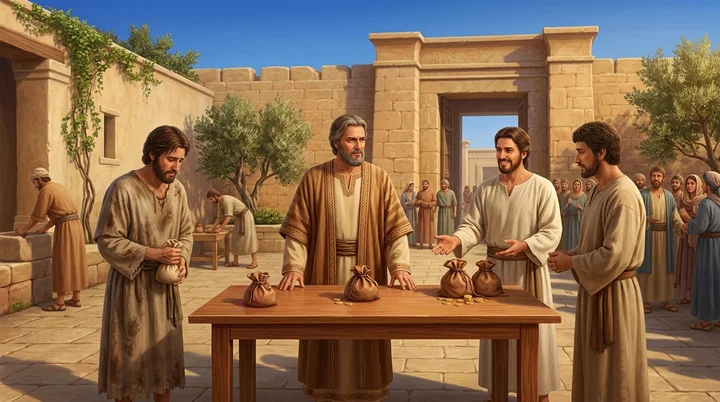
Cross-references 20 of 62
- Matthew 25:14-15
For the kingdom of heaven is as a man travelling into a far country, who called his own servants, and delivered unto them his goods.
The master entrusts servants with different amounts of his goods according to their ability.
- Luke 19:12-27
He said therefore, A certain nobleman went into a far country to receive for himself a kingdom, and to return.
The parallel parable uses pounds to illustrate the same entrusted gifts and their use until the nobleman returns.
- Revelation 22:12
And, behold, I come quickly; and my reward is with me, to give every man according as his work shall be.
Christ brings each person a reward according to their work.
- Luke 16:10
He that is faithful in that which is least is faithful also in much: and he that is unjust in the least is unjust also in much.
Faithfulness in little things demonstrates faithfulness in much.
- Luke 12:48
But he that knew not, and did commit things worthy of stripes, shall be beaten with few stripes. For unto whomsoever much is given, of him shall be much required: and to whom men have committed much, of him they will ask the more.
Both connect what a servant receives with the responsibility and judgment required of him.
- 1 Corinthians 4:2
Moreover it is required in stewards, that a man be found faithful.
Both require faithful stewardship of what is entrusted.
- 2 Corinthians 5:10
For we must all appear before the judgment seat of Christ; that every one may receive the things done in his body, according to that he hath done, whether it be good or bad.
Both describe servants answering before Christ for their deeds and receiving accordingly.
- Luke 19:17
And he said unto him, Well, thou good servant: because thou hast been faithful in a very little, have thou authority over ten cities.
The parallel account rewards faithful service with greater responsibility.
- Romans 14:12
So then every one of us shall give account of himself to God.
Each person must give an account of himself to God.
- Mark 13:34
For the Son of man is as a man taking a far journey, who left his house, and gave authority to his servants, and to every man his work, and commanded the porter to watch.
Both describe servants entrusted with assigned work while their master is away.
- Matthew 25:18
But he that had received one went and digged in the earth, and hid his lord’s money.
The buried talent illustrates failing to use what God entrusts, unlike faithful service.
- 1 Peter 4:10
As every man hath received the gift, even so minister the same one to another, as good stewards of the manifold grace of God.
Both teach that what God entrusts is to be faithfully used in service.
- Matthew 25:10-13
And while they went to buy, the bridegroom came; and they that were ready went in with him to the marriage: and the door was shut.
The faithful servant’s welcome contrasts with the unready virgins’ rejection at the Bridegroom’s coming.
- Matthew 25:30
And cast ye the unprofitable servant into outer darkness: there shall be weeping and gnashing of teeth.
The unfaithful servant is cast into outer darkness, contrasting with the faithful servant’s reward.
- Matthew 25:27
Thou oughtest therefore to have put my money to the exchangers, and then at my coming I should have received mine own with usury.
The master expects servants to put what was entrusted to them to use and produce increase.
- 1 Corinthians 3:13-14
Every man’s work shall be made manifest: for the day shall declare it, because it shall be revealed by fire; and the fire shall try every man’s work of what sort it is.
Work is tested at the reckoning, and work that endures receives a reward.
- Matthew 16:27
For the Son of man shall come in the glory of his Father with his angels; and then he shall reward every man according to his works.
The Lord rewards each person according to their work at his coming.
- Luke 16:2
And he called him, and said unto him, How is it that I hear this of thee? give an account of thy stewardship; for thou mayest be no longer steward.
Both require stewards to give an account of their stewardship.
- Luke 19:20
And another came, saying, Lord, behold, here is thy pound, which I have kept laid up in a napkin:
Both parables contrast hiding entrusted resources with faithful stewardship.
- 1 Peter 5:4
And when the chief Shepherd shall appear, ye shall receive a crown of glory that fadeth not away.
The Chief Shepherd rewards faithful service with an unfading crown of glory.
Commentary part 1 of 5
Each commentary is drawn from primary sources: the writings of Ellen G. White and Adventist pioneers and periodicals. Each commentary is separate. Its own words are not a quotation; follow the references to read the source passages.
Ellen G. White
868 sources
The verse is the Master's commendation in the parable of the talents in Matthew 25:14-23, spoken to the disciples as part of the discourse in Matthew 24 and 25 about watching for His second appearing.ST Nov 20, 188419MR 385.2–386.1Lt 108, 1896, par. 2–9 What is entrusted is the Lord's own property lent in sacred trust, comprising every natural and spiritual gift, ability, opportunity and resource to be used for His glory and increased for Him.19MR 389.2–4Ms 26, 1899, par. 4–8Lt 108, 1896, par. 13–15ST Jan 23, 1893RH Oct 26, 1911 Gifts are distributed according to each servant's known ability to use them, and reward rests on faithfulness rather than on size, amount or outward success as measured by men.RH Dec 17, 1901ST Jul 2, 1902Ms 73, 1900, par. 3–4Lt 36, 1877, par. 6STMW9 43.2 Being faithful over a few things means diligently trading with what is given to gain positive increase instead of burying it unused, and such use doubles capability and effectiveness through cooperation with God.COL 325.1–2GW 296.9ST Apr 22, 1875COL 353.1COL 329.1 At His return Christ reckons with each steward by name, and faithful use even of what is small is met with greater responsibility and rulership over many things and with entrance into the joy of seeing souls redeemed.DA 523.51T 197.1ST Jul 23, 1894STB 685.1–52T 667.3–668.2
Parable Setting and Story
The saying belongs to the parable of the talents in Matthew 25:14-23, the last of the many parables in Christ's public teachings to the disciples.ST Nov 20, 188419MR 385.2–386.1Lt 108, 1896, par. 2–9 It was given as part of the discourse in Matthew 24 and 25 shortly before entering Gethsemane, spoken early in the morning after crossing the mount.ST Nov 20, 188419MR 385.2–386.1Lt 108, 1896, par. 2–9 It gives warning in regard to His second appearing in the clouds of heaven.19MR 385.2–386.1Lt 108, 1896, par. 2–9 Its setting shows servants entrusted with talents, teaching that God gives people natural and spiritual abilities to be used for His glory and the good of the world, to grow in fitness for heaven by laying hold of Christ's righteousness and following His example, and that those gifts can be abused or misapplied.STBk 10.1LSEGW 233.1 Service in the parable involves work, responsibility, and improving one's abilities for the lord's purpose.HSFM 280.4
In the parable a lord traveling into a far country delivers his own goods to his servants according to ability, the kingdom of heaven is represented, and after a long time he returns to reckon and settle accounts with them.STB 685.1–5ST Oct 22, 1894 The servant entrusted with five talents traded with them and gained five more, and on hearing his report the lord calls him good and faithful, declares him faithful over few things, promises to make him ruler over many things, and bids him enter into the joy of his lord.STB 685.1–5 Faithfulness in managing even a small trust is honored with greater responsibility and the joy of the Lord, and the reward is proportionate to improvement.GW92 270.22T 667.3–668.2ST Oct 22, 1894 The talents belong to the master and are lent as capital that is not our own for investment in His work, so each servant must account personally for whether they were improved or abused, and the time to use them faithfully is now, before opportunity ends and the account is fixed.2T 667.3–668.2ST Oct 22, 1894 Faithfulness means active trading to gain increase, in contrast to digging in the earth and hiding the lord's money, letting capital lie dormant, hoarding it, or spending it as one pleases, and the servant who hides his talent through fear and distrust is condemned as wicked and slothful, with the unused trust taken away and given to one who will use it well.STB 685.1–5ST Oct 22, 18945T 282.2
Watching for Christ's return means diligent service rather than idle waiting.COL 325.1–2 The parable of the talents follows the parable of the ten virgins, teaching vigilant watching and sanctified waiting, with no relaxation of effort to secure eternal life.Ms 28, 1888, par. 14 Its lesson applies to the urgent work before Christ's return, that every talent is to be improved in service now, waking from stupor and deathlike slumber to realize the great work to be done and the great issues to be met.Ms 27, 1907, par. 52–56Lt 183, 1898, par. 5 In the 1844 movement, the prophetic and ceremonial arguments were understood to point to the bridegroom's coming, and the midnight cry aroused people to prepare to meet the Lord, while the waiting and slumber of the believers are followed by that coming.GC 400.1–401.2
The commendation of well done to the good and faithful servant is connected with Christ's words of praise to the church of Ephesus, though that praise is followed by a warning that the church has left its first love.16MR 101.2–3
Talents Entrusted by God
The talents entrusted are a sacred loan of grace and endowments for eternal interests, comprising all natural and spiritual gifts and abilities whether original or acquired, not earthly goods or worldly abilities only, nor ability to preach only, to be used for God's glory and not buried in worldly enterprises or used merely to accumulate worldly goods.19MR 389.2–4Ms 26, 1899, par. 4–8Lt 108, 1896, par. 13–15ST Jan 23, 1893RH Oct 26, 1911 Faithfulness in that trust even in humble service is rewarded with greater responsibility and entrance into the Lord's joy, and eternity is to be kept in view.19MR 389.2–4Ms 26, 1899, par. 4–8Lt 108, 1896, par. 13–15 Each person must employ his own gifts in Christ's service rather than delegate that duty to another, and entire obedience was secured by Christ at the cost of His own blood and sufferings, so that even humblest service becomes a consecrated gift when done in doing the Master's bidding and promoting His glory.Ms 26, 1899, par. 4–8Lt 108, 1896, par. 13–15
The talents include mind, speech, thought, influence, time, health, strength, intellect, affections, sympathies, conscience, position, possessions, opportunities, probationary time, education, and religious experience, including eyes to discern opportunities, ears, knees for prayer, and feet to run in God's commandments, as well as pen, press, voice, purse, sanctified affections, words, money, light of truth received, medical knowledge and practical skill.ST Jan 23, 1893RH Oct 26, 1911GW92 434.2GC 487.2RH Apr 9, 1901 They all belong to God and are to be used in Christ's work for salvation of souls, guarding mind and body for service, bringing habits into conformity with His will, looking to God for counsel to meet human needs, with responsibility applying to everyone from least to greatest.RH Oct 26, 1911GW92 434.2GC 487.2RH Apr 9, 1901 Faithful unselfish diligence in using even a single talent can bear fruit to bless and elevate others, while careless words, trifling conduct, self-indulgence and misuse waste, corrupt and weaken them.ST Jan 23, 1893
Money, means, property, houses, lands, tithes, offerings, prosperity, brain power and mechanical power are talents placed in trust to be traded upon and increased for God, not hoarded, buried, selfishly retained, spent on self, or claimed as one's own with right to do what one pleases.1T 197.1ST Jul 23, 18942T 243.2–244.1ST Nov 25, 18864T 46.1–47.1 Trading and doubling means using the Lord's money in practical benevolence so souls are saved, helping spread truth and bring others to serve God, which gives spiritual life and turns selfish covetous worshipers of mammon into earnest faithful co-workers with Christ.1T 197.1ST Nov 25, 18864T 46.1–47.1 Faithfulness is recorded in judgment and faithful use even of a small trust leads to greater responsibility, crowns, eternal reward and sharing the Master's joy, requiring return of both principal and interest, while the unfaithful lose what was entrusted.1T 197.1ST Jul 23, 18942T 243.2–244.13T 123.1
Light, present truth, knowledge of vital thrilling truth heralding the second coming, the Word, fresh bright ideas opened by the Holy Spirit, justification by faith and the righteousness of Christ, and the inherited trust of light from patriarchs, prophets and apostles are talents to be reflected, imparted, sown and multiplied, not hoarded, quarrelled over, or kept to self where of no benefit.RH Apr 2, 1908ST Jun 3, 18897MR 162.1Ms 70, 1895, par. 7–918MR 148.5–149.2 Being faithful over a few things means using that light as God's entrusted agents, letting it shine upon others for own growth and to enlighten unbelievers and make men wise unto salvation, including what is done with time, pen, voice, money, influence and intellect for the poor, afflicted, orphan, fatherless, sick, hungry and destitute of clothing.RH Apr 2, 1908ST Jun 3, 1889Ms 70, 1895, par. 7–9 Faithful imparting brings increase with greater wisdom, richer mind, brighter thoughts, strength to overcome objections and more to give, and awakens praise and rejoicing in heaven, while God's truth entrusted not for quarrelling makes people light-bearers who persuade others, sowing seeds bearing fruit for righteousness and preparing for heaven and the Lord's joy.7MR 162.1Ms 70, 1895, par. 7–918MR 148.5–149.2
What is entrusted remains the Lord's property, loan, capital and trust by creation and by redemption through Christ's humiliation, agony, blood, suffering and death on Calvary, lent to dependent people to trade with, improve, double and return with increase, leaving weighty responsibility and no freedom to use for own pleasure.2T 243.2–244.1Lt 171, 1897, par. 12ST Aug 1, 1911Ms 16, 1890, par. 2–3 Christ bought right to service and paid ransom for every son and daughter of Adam, securing willing service as fellow workers with God, and at reckoning He requires His own with usury, scrutinizing every talent and expecting interest in proportion to capital entrusted.Lt 171, 1897, par. 12Ms 16, 1890, par. 2–3 The talents are all capabilities, opportunities, time, influence to lift Christ up and draw men, intellect, sympathy and affection sacredly guarded, and divine treasures of truth to be presented to all men for good of humanity and glory of God with kingdom first, increasing as used, while burying in earth, world and worldly business brings no return, robs and reproaches Maker and Redeemer, imperils spiritual interests, loses eternity of bliss and faces retribution.ST Aug 1, 1911Ms 16, 1890, par. 2–3ST Aug 1, 1911
Talents are not given only to a chosen few with superior endowments, exalted education or intellect, but every person, high and low, rich and poor, learned and unlearned, man, woman, child and youth, from lowliest obscure to highest trust, is entrusted with some peculiar gift and given his own work according to ability, whether one talent or two or five, and none is accountable for talents never had nor excused as idler.ST Jan 23, 1893Ms 81, 1893, par. 69–721MR 23.2–35T 461.2RCOC 19.2 Everyone whether serving God or pleasing self possesses this trust under obligation, and refusing to employ it or acknowledge God's claims does not lessen guilt.ST Jan 23, 1893Ms 81, 1893, par. 69–72 One talent well used gains other talents and is judged as faithful as five, reaching a class those with two or five cannot approach, so those with larger trusts must not silence, condemn, discourage or restrict humbler workers, but let all work in own sphere with own armor, hands strengthened, doing best possible service where they can without merging individuality into another man, council, conference or publishing house.Lt 55, 1895, par. 35–411MR 23.2–35T 461.2
Particular trusts include ability to write a book and its income, the physician's timely word, the farm and school at Huntsville, household goods, the religion of Christ carried to the sick room, the gift for speaking truth to hundreds, and the talent of singing and influence, with every person having his own work appointed and diversities of moral and spiritual capital entrusted to use for the Master.Lt 55, 1895, par. 35–41GW 202.2TCBMP 70.2–71.16T 431.2SBAWP 27.2–3 Talents belong to God, are given to everyone to benefit others, and each person must make the most of them and grow in usefulness, with faithfulness over few commended, given greater responsibility and welcomed into the Lord's joy.Ms 34, 1901, par. 12–13HSFM 285.3–4 Entrusted light and gifts must shape character into growth in knowledge, holiness and fitness for eternal life, calling for self-examination, surrender, yoking with Christ, daily conversion, lifelong character building, gathering inherited light from patriarchs, prophets and apostles, seeking truth as treasure, shining as lighthouse to make Christ known and warn souls with greater obligation today, and laying hold of Christ's righteousness.ST Apr 8, 1913STMW9 43.3TCBMP 70.2–71.1MYP 39.1–2RH Aug 21, 1900 Using them for worldly interest, self-pleasing and self-exaltation is unfaithful, requiring digging up hidden abilities to benefit others, making truth known, spending strength to save perishing souls, learning meekness, bearing burdens and promoting godliness, while grudging giving mocks omniscient God who needs no people, and unfaithfulness loses privileges with condemnation at last day for refusing leading of truth reaching understanding.ST Apr 8, 1913RH Aug 21, 19005T 263.2
Gifts, property, mental powers, spiritual strength, resources, abilities, money, possessions, intellect, knowledge and affection are lent not for selfish advantage, ambition, extravagance or ownership, but to bless others and honor God by advancing Christ's cause and benefiting humanity in His generous spirit through copying His unselfish self-sacrificing life and supporting the weak and suffering.6T 243.1–244.3GW 335.2Ms 26, 1891, par. 6–9 Talents include money together with mind, intellect and experience, designed so all classes combine different talents in unity in diversity to enlarge the work and bless workers bound together, and sanctified wisdom united with unselfish investment makes the talent efficient in cooperation devised by God.Lt 170, 1899, par. 21–22 Using money for self turns blessing to curse, and self-serving schemes under pretense of service reveal an aristocracy the heavenly universe will not tolerate.Lt 170, 1899, par. 21–22 Even a little faith is a talent to be exercised by helping others and refusing to speak words of doubt, and the Lord increases exercised faith.Lt 29a, 1892, par. 6
Abilities, opportunities, time, talents and property are the Lord's goods and sacred trusts lent to be cultivated, exercised wholeheartedly for Him and His glory rather than for self or self-glory, and servants are accountable to God and Christ as Master above every earthly master for how they use them.ST May 20, 1913Ms 25, 1897, par. 29Lt 136a, 1898, par. 294T 562.4STB 342.1 Each gift is investigated under solemn scrutiny to see if it was improved, enlarged by doing good and returned sanctified by truth, for possessing ability is not enough without diligent exercise in faithful service.Ms 25, 1897, par. 29Lt 136a, 1898, par. 29Ms 8, 1892, par. 18–21 What the Lord entrusts in the parable is meant to be used for good and to accomplish good, and misusing it fails its purpose, while wealth that lets sons spend fruits of others' labor without learning its value leads them to misuse what the Lord intended for that purpose.RP 24.1RH Oct 3, 1912 Every talent belongs to God and must be used to His glory to very best account and not rust through inaction, including appreciating spiritual blessings, gathering every precious ray of light, being careful and economical in temporal things, and using physical energies and personal influence, since blessings are not given to those who do not value them and neglect makes indifferent.Lt 5, 1884, par. 11
Money is a talent lent by God, not a saviour, to be traded wisely on His goods to honor Him rather than used for self-gratification to dishonor His name and misrepresent His character.Lt 173, 1899, par. 3 Faithfulness over this talent begins with fear of the Lord as fear to dishonor Him rather than slavish fear, trusting God instead of taking self into self-keeping, to whom God gives wisdom, sanctification and righteousness, making the trusting person His instrument to promote sacredness of His pure holy character to highest ends of His work, reaching perfection of character revealed in Christ's humanity as gospel enriches and beautifies disciples with His attributes and grace.Lt 173, 1899, par. 3 People entrusted with abilities, resources and the Word they have received and sought to understand are stewards who should use them faithfully for God's glory, sharing gifts to advance righteousness and truth and build up His work and kingdom.Ms 32, 1901, par. 16Lt 49a, 1900, par. 8
Talents, gifts, abilities, resources, opportunities, time and all powers belong to the Lord and are entrusted to people accountable to Him for faithfully using, developing, improving, investing and returning them with increase rather than neglecting, burying, leaving idle or claiming them selfishly.10MR 280.2Ms 8a, 1888, par. 39–41Lt 18, 1902, par. 12–1320MR 40.4–5Ms 21, 1896, par. 20–24 Wise faithful use benefits those within influence and increases moral power to be a light to others, which requires educating and training all powers, seeking His guidance on how to use them well, and Christlike humility and self-denying love without which pride and self-sufficiency take their place and the work is bungled.10MR 280.2Ms 21, 1890, par. 10–13Ms 8a, 1888, par. 39–41 Faithfulness means using gifts for God's glory not self-glorification or personal distinction, to bring others to Jesus and share light of truth, while turning gifts to oppression and harm betrays trust and faces consequences.20MR 40.4–5Ms 21, 1896, par. 20–24
Distribution According to Ability
Gifts are not handed out at random but are measured to each servant's known capacity to handle them, five to the one who can employ five, two to the one who can improve two, and one to the one who can wisely manage only one, from lowest to highest.ST Jul 2, 1902Lt 36, 1877, par. 6STMW9 43.2CT 512.4–513.1 The Master knows what each can carry and assigns work accordingly, lending talents as capital that remains His own to be invested and answered for, whether used or abused.ST Oct 22, 1894Lt 7, 1896, par. 21–23Lt 77, 1896, par. 19–21 No one is left to remain idle with even a few gifts, but each is to trade on what is held with integrity, consulting the expressed will to know what is required, and faithful use enables gain of more.STMW9 43.2CT 512.4–513.1Lt 77, 1896, par. 19–21
Return is demanded in proportion to what was lent, with increase and interest expected in proportion to capital, for God accepts a person according to what is possessed and not according to what is not possessed.ST Jul 2, 1902STMW9 43.2CT 512.4–513.1ST Oct 22, 1894 Ten talents increase is never demanded from one talent, yet one talent put to the best account is accepted, while capital left dormant, buried, hoarded, or spent at pleasure brings punishment according to abuse when account is required with interest.ST Jul 2, 1902ST Oct 22, 1894 Each sphere has its own expected yield, and reward follows improvement of the trust rather than its size.Lt 36, 1877, par. 6CT 512.4–513.1ST Oct 22, 1894
Reward turns on faithfulness rather than amount, position, or results as reckoned by men, so one talent faithfully improved is rewarded as surely as five.RH Dec 17, 1901Ms 73, 1900, par. 3–4Ms 81, 1898, par. 27Lt 122, 1902, par. 13–14Lt 55, 1895, par. 35–41 Soul, body, and spirit are lent to be sacredly employed and wisely increased, and whether the trust was large or small those who put it to use and gain more receive equal approval, greater responsibility, and a share in the Master's joy.RH Dec 17, 1901Ms 73, 1900, par. 3–4Lt 122, 1902, par. 13–14 Judgment looks to love, earnestness, piety, and motive rather than eloquence, intellect, or large donations, and the one with fewer gifts who does his best receives hearty approval just as the one who accomplishes more.Ms 81, 1898, par. 27Lt 55, 1895, par. 35–41Ms 94, 1902, par. 23–24 No one is accountable for talents never had, none should complain of small gifts or despise them by human estimate, and each must trade personally on what is held instead of merging individuality and stewardship into another person or council.Lt 122, 1902, par. 13–14Lt 55, 1895, par. 35–41Ms 94, 1902, par. 23–24
Responsibility is measured not by present resources and capacities but by powers originally bestowed and possibilities for improvement, including work negligently done or left undone, powers left unused, knowledge that could have been gained, and neglected opportunities.5T 457.2–459.1ST Sep 30, 1886MYP 309.2ST Nov 25, 1903Lt 12, 1893, par. 38–42 Unused capabilities are brought into account as much as those improved, and men are held responsible for all they might have become through right use and for all that might have been had but was missed through devotion to the world.5T 457.2–459.1MYP 309.2ST Nov 25, 1903 Inability to work for others does not excuse, since that inability was produced by inactivity and deliberate choice and perpetuated by neglect, and even where the soul is not lost there will be realized in eternity the result of unused talents and eternal loss for ability not gained.5T 457.2–459.1MYP 309.2ST Nov 25, 1903 Neglect of plainly specified duties such as watching and praying, making God counselor and dependence, and warning others in danger disqualifies from the field that might have been occupied, grieves and dishonors God, and charges the defaulter for the whole amount entrusted but not diligently employed, for evil arising through conscious or unconscious influence, and for souls lost that might have been saved, preparing for the second death unless there is confession with repentance toward God and faith toward the Lord Jesus Christ.ST Nov 25, 1903Lt 12, 1893, par. 38–42Lt 79, 1897, par. 16–18
Greater light, grace, truth, opportunities, privileges, and clearer understanding of Scripture bring heavier obligation, and failure to improve them brings condemnation proportionate to what was given.Lt 23, 1885, par. 23–25ST Nov 12, 1885Lt 1, 1883, par. 60–63Lt 7, 1896, par. 21–23Lt 77, 1896, par. 19–21 Faith, obedience, and love are to grow in keeping with light and privileges received, opening the way for promises and blessings, while unbelief and neglect hold back from God, dishonor Him, and bring decrease of light and blessings.Lt 23, 1885, par. 23–25ST Nov 12, 1885Lt 1, 1883, par. 60–63 Those whose means, opportunities, and abilities are greatest have the greatest responsibilities, yet no more is asked than each can do in his sphere, for poverty is not expected to give alms it has not to give nor the feeble to exert the energies of the healthy.Lt 1, 1883, par. 60–63Lt 7, 1896, par. 21–23Lt 77, 1896, par. 19–21
Ability and cultivated intellect enlarge responsibility where great light has been given, and must be sanctified, wholly yielded, and rightly directed by religion to strengthen in God, advance intelligent experience in overcoming with daily victories, and help others in the way of life.5T 570.3HSFM 183.3–4Lt 15, 1873, par. 2–3 Intellect alone is insufficient, for men may honor intellect yet despise the heart if it is not wedded to true goodness, and ability not yielded to Christ proves dangerous to owner and others, leading them apart from truth and away from Christ and, put to wrong use, aiding evil and ruining souls.5T 570.3Lt 15, 1873, par. 2–3 Talents of influence are gifts for service that must not be wasted or given to Christ's enemies but consecrated to His work, and faithfulness with a small trust leads to greater responsibility and entrance into joy.5T 570.3HSFM 183.3–4Lt 15, 1873, par. 2–3
Faithfulness in what is given determines greater responsibility and reward entrusted later, with talents expected and returns expected measured according to what each received.Lt 2, 1901, par. 4–8TCBMP 166.1–169.1STMW7 10.2 Guilt is measured by light, opportunities, and privileges left unused, and judgment also accounts for influence exerted in encouraging others to sin or keeping them from serving in soul-saving work, while faithfulness to Christ would bring not only eternal life but help draw others into the kingdom.Lt 2, 1901, par. 4–8
Abilities and privileges are entrusted for His service to be valued, used well, and cultivated through sustained effort to bless others, preparing servants to be a blessing.TCBMP 166.1–169.1STMW7 10.2RH Dec 26, 1912FE 87.2 Talents not improved or put to work for the cause bring condemnation and darkness in proportion to light received, failing stewardship includes neglecting available means to improve abilities, and careless use weakens ability to serve.TCBMP 166.1–169.1STMW7 10.2RH Dec 26, 1912FE 87.2
Faithfulness, not the number of gifts, is the measure of service, requiring each to use talents to the utmost and to best capacity for the Lord with integrity rather than for human approval, selfish rivalry, selfishness, or carelessness.RH Apr 13, 1905 Such service sets an example others can safely follow and helps form one's own character and the family's character for the higher life, and faithfulness with few or many merits honor, commendation, greater responsibility, and sharing the Lord's joy.RH Apr 13, 1905
Faithful Use and Increase
Being faithful over a few things means diligently and wisely using what has been given to serve God and advance truth, actively trading with it to gain increase and putting it out to the exchangers instead of returning it unused, and gifts improve and multiply when so used in service.COL 325.1–2GW 296.9ST Apr 22, 1875ST Oct 23, 1901Ms 19, 1899, par. 5–7 Faithfulness in a small responsibility is commended and becomes the ground for greater responsibility and rulership over many things, together with entrance into the joy of the lord.COL 325.1–2GW 296.9Ms 19, 1899, par. 5–7 The faithful servant who uses entrusted resources to advance the work and save souls receives approval, and servants who improve and double what was entrusted receive that commendation and welcome.ST Apr 22, 1875Lt 11, 1865, par. 2–3 The Lord expects His own with usury or positive increase and is not satisfied with bare return, and merely retaining capital without trading, letting it lie dormant, or wrapping it in a napkin is unfaithfulness.ST Oct 22, 1894ST Jul 23, 18941T 197.12T 660.1–2ST Jul 2, 1902 Entrusted resources, money, means and influence are to be put to work in the Master's service and returned with increase, and each person saved becomes a talent gained who can in turn help save others, continually increasing the harvest returned as both principal and interest according to work.Lt 305, 1904, par. 10–11Ms 156, 1904, par. 47–51ST Jul 23, 18941T 197.12T 660.1–2 The present is the gracious opportunity to trade for glory and invest for salvation, relieving the widow and fatherless, because probation may end and the account be forever fixed, with joy at reaping time and sheaves gathered as the recompense of fidelity and unselfish use.ST Oct 22, 18941T 197.1
Faithful use doubles talents and increases capability, grace, effectiveness, knowledge and power, for God works with exerted ability and strengthens abilities through earnest service, sacrifice and cooperation with the Holy Spirit, bringing dormant powers to new life.COL 353.1COL 329.1RH Jun 27, 1907CT 234.2–235.1MYP 300.4 All blessings belong to Him and are to be used according to His Word for building up truth, keeping self out of sight with no selfishness or worldly ambition, and doing one's utmost whether many or few, with the Spirit leading continually to greater efficiency.RH Jun 27, 1907MYP 300.4 The talent is multiplied through use, and even the one-talented man was expected to do his best, for had he traded his talent would have been multiplied, while failure to improve falls short of the high standard privileged to be reached.CT 234.2–235.1MYP 300.43T 53.4 Faithfulness means whole-hearted earnest sacrifice and cooperation with God, yielding as an instrument for the Holy Spirit, giving self first, with daily surrender, prayer, watchfulness, industry, economy and exact honesty, and with eye single to God's glory.ST Jul 2, 1902CT 491.1Lt 76, 1894, par. 23Ms 110, 1898, par. 13–14ST Jul 24, 1901 As an instrument cherishing and obeying His promptings, God works with the servant to increase and strengthen every faculty, deny old inclinations, overcome propensities, form new habits, enlarge the heart for more power, rouse dormant energies, and do more and better work with greater gifts and every provision for increase.ST Jul 2, 1902CT 491.1
Time and speech are precious entrusted gifts to be wisely used in trading, which cannot be done without close connection with Christ, and those vitalized by His divine nature work in His lines.Lt 76, 1894, par. 23Ms 110, 1898, par. 13–14 The talents are mind to understand how to work, eyes to discern opportunities and do no shiftless work, means to invest, ears to listen for commands, knees to bow in heartfelt prayer, and feet to run in the way of commandments, with blessing resting on receiving from God and rendering back to Him.Ms 110, 1898, par. 13–14ST Jul 24, 1901 Right use cultivates the highest powers to highest spiritual efficiency in spirit, word and action, puts means out to the exchangers where it blesses one who blesses another so money in circulation steadily multiplies itself, and makes men and women channels of usefulness under the law of giving.Ms 81, 1893, par. 69–72ST Jul 24, 1901 Faithfulness means cultivating, improving, disciplining and directing the mind and its powers, since ignorance does not increase humility or spirituality, and Christ is best glorified by those who understand truth and represent Bible religion to promote His glory.ST Dec 9, 1897FE 119.2Ms 77, 1902, par. 47–48Lt 29, 1897, par. 14–15Lt 34, 1886, par. 26–31 God assigns work according to powers and requires every faculty including intellect to be put to use and developed lifelong for practical service in temporal and religious work, with responsibility increasing with amount received, yet consecrated talents growing through grace and faithful diligent use of even a little preparing for greater service.Ms 77, 1902, par. 47–48Lt 29, 1897, par. 14–15Lt 34, 1886, par. 26–31Lt 192, 1903, par. 26
Entrusted means and wages of suffering and blood are a loan and trust to be handled with personal responsibility and put into circulation freely, unselfishly and cheerfully to work unworked barren fields until they become fruitful trees of righteousness through knowledge of God and His Word.Lt 34, 1886, par. 26–31Lt 192, 1903, par. 26 Each person must employ his own gifts rather than delegate, transfer, bargain away or merge stewardship into another, conference, publishing house or leading mind, and no person or council may weigh, lessen, control or take over another's gifts and individuality.8T 170.2–171.1SPBC 183.1–22T 656.2–657.2SPBC 185.517MR 204.1–205.1 Each is responsible for the particular resources given, the one given one talent answering for that one and not for five or two, and is not accountable for gifts never had, with small gifts no reason for complaint since faithful use of little is judged as faithful as much.SPBC 183.1–22T 656.2–657.21T 530.1–2 Entrusted means remain a responsibility that cannot be escaped by transferring them to family, but are to be used willingly and not grudgingly, improved for glory and returned as consecrated offering, with even the humblest having something to impart.1T 530.1–2SPBC 185.517MR 204.1–205.1 The time to use talents faithfully is now during probation before opportunity ends and the account is fixed, work must be done while it is day, trading at once on the first endowment and redeeming the time in light of the nearness of the coming.ST Oct 22, 18942T 667.3–668.2STA 87.1–88.1Lt 171, 1897, par. 12ST Nov 20, 1884 Readiness for the coming requires unselfish vigilant labor with prayerful meditation and personal piety, neither quiet devotion alone nor constant activity without inner life being enough, and faithfulness in present responsibilities prepares for greater service instead of idleness.ST Nov 20, 1884STB 743.5STB 684.2–6
Faithful servants gain increase only through God's gift and grace and can claim no independent merit, yet God rewards sincere service as though the merit were theirs, and the servant takes no credit because gift and power to use it come from God.Ms 21, 1899, par. 20STA 87.1–88.1STM2 15.1ST2 31.1–2STBk 87.1 The approval may come as surprise to the steward who knows he has only done duty, and eternal rewards are purchased by Christ not earned, yet judgment takes works into account and each may strive for the highest reward in exact proportion to work done and improvement made.Ms 21, 1899, par. 20GW92 450.3 Abilities are learned by putting them to work, idle ones should be given work and have mistakes corrected so they can serve again, and teaching people how to serve helps them use and increase talents.6T 432.1STE 147.1–149.18T 54.2GW 200.3TEPD 41.1 Gifts can be abused, misapplied or perverted, and must not be, but are to be wisely improved in self-denying service, sowing truth by teaching and example, proclaiming present truth including in cities, and leading others to truth as part of bearing the burden with spiritual growth and heavenly cooperation.LSEGW 233.18T 54.2GW 200.3TEPD 41.1 As talents are faithfully used, the Holy Spirit recalls God's truths and makes the Word a living power from God working with human effort, not human learning, so praise belongs to God.8T 55.2
Using talents in God's work increases talents, as Moses became eloquent, patient, self-reliant, and competent for the greatest work ever entrusted to mortals, and the same character change comes whenever people give themselves wholly to God and obey His commands.ST Jul 8, 1913 Spiritual life must grow, with Christians making best use of gifts and opportunities and steadily advancing in knowledge of Christ and Christlike character.RH May 9, 1907 Gifts are to be used wisely and faithfully in service, and faithful use can increase influence for good.Lt 89, 1902, par. 4–7 Doing precious work requires earnest, devoted, daily, hourly, momentary consecration, the Lord accepts no superficial work, and cultivating other traits to combine with and sanctify strong traits already possessed makes a person a power for good.Lt 48, 1888, par. 15 Faithfulness over a few things means enduring God's test and proving, whether entrusted with one, five, or ten talents, by perseveringly seeking the Lord, giving self wholly to Him, being willing to do anything even in the humblest unpleasing position, holding every capability and every dollar as a trust with nothing misapplied to please self and the eye single to God's glory.Lt 119, 1893, par. 19–20
An abundance of means can weaken incentive to develop talents and spoil faithful service.Ms 65a, 1898, par. 19 Increased responsibility requires bearing burdens and growing by effort, directing and carrying out plans, not confining interests to one locality or multiplying facilities in one place since the field is the world, improving time, money, means, and opportunities instead of wasting them, and awaking from slumber since slothfulness provokes wrath.Ms 70, 1895, par. 1–2 Faithfulness is putting talents to work for others' good in the master's service rather than hoarding knowledge or abilities, serving the redeemer without seeking thanks.Ms 117a, 1901, par. 8 Talents are to be put to use and develop through use, with education and service extending from the church to regions beyond.Lt 74, 1901, par. 18 Faithfulness includes diligently using, developing, and persevering in improving entrusted abilities for God's glory, with work, forethought, care, and self-denial training people to become faithful stewards, and practical obedience strengthens confidence, multiplies talents, and prepares for greater responsibility and entering God's kingdom.GC 67.3MYP 163.2ST Nov 28, 1906
Servants are to improve and faithfully use entrusted abilities, opportunities, and powers consecrated to Him and increased in God-given work, keep laboring vigilantly rather than becoming satisfied with having done a little, and become efficient thorough workers performing duties without loss, which God can use to sow seed or reap harvest in conversion of souls.RH Nov 12, 19038T 27.3GW 410.3STPW 27.2SCE 2.1 Talents and sacred truth must be used and shared, developed and improved, multiplied and returned with increase through constant use, and not hidden, left idle, or left unused, and being good and faithful means steady spiritual growth where truth as seed must be nourished or it loses germinating power, leaving the unnourished as lifeless branches and stumbling blocks with untrimmed lamps and no strength for warfare.8T 140.2–141.27MR 156.1Ms 84, 1893, par. 13–15Lt 34, 1894, par. 27–33Lt 5, 1884, par. 11 No one is stationary but all true subjects advance according to spiritual advantages received, growing up into the living Head in piety, and faithfulness means using gifts to bless others and bring praise rather than spending them in criticism.Ms 84, 1893, par. 13–15Lt 148, 1902, par. 4Lt 34, 1894, par. 27–33 Every talent belongs to God and must be used to very best account without rusting through inaction, appreciating spiritual blessings and gathering every ray of light while being careful and economical in temporal things, including physical energies and personal influence, since blessings are not given to those who do not value them.Lt 5, 1884, par. 11
Using talents for God's glory requires putting away selfishness and self-confidence and allowing the Holy Spirit to govern and sanctify powers, mind, and heart.Lt 68, 1897, par. 13 The Lord gives every person his work and requires a return, and being good and faithful means receiving and believing in Christ and cooperating with God, gaining right knowledge of God which is life and peace, and standing ready for aggressive warfare against evil.Ms 56, 1898, par. 26–27Ms 8, 1904, par. 33–34 Faithfulness begins by first giving self to the Master, then using talent in helpful service in every land and community, seeking families needing spiritual help, refusing to hoard money while missionary work remains, and spending means for foreign causes, translation and distribution of books, and new enterprises.Ms 8, 1904, par. 33–34
Unfaithful Neglect and Loss
Hiding the talent in the earth means hiding it in the world and in worldly business interests where it brings no return to God, through self-seeking, careless inaction, indifference, neglect of what might have been done, idleness, love of pleasure and love of this world, business cares and perplexities, misuse of bounties to weaken the body, laziness, dishonesty, reckless spending and wasting of life.ST Jul 2, 1902Ms 16, 1890, par. 2–3ST Jan 27, 18766T 337.3–338.2TCBMP 71.2–72.2 Such burying, wrapping in a napkin and merely retaining capital without trading, letting it lie dormant and returning it unused, is a great wrong that disappoints the Master, deprives Him of increase with usury, imperils spiritual interests, may bring suffering and want, and causes eternal loss of opportunities, of souls that might have been saved, and of an eternity of bliss, for which the slothful untrustworthy servant is held responsible and falls under denunciation and penalty when the Master comes to investigate each course.ST Jul 2, 1902Ms 16, 1890, par. 2–318MR 140.2–4ST Jan 27, 18766T 337.3–338.2 Merely returning what was entrusted while neglecting what could have been gained or done is not enough, for rewards scrutinize every talent and expect interest in proportion to capital, talents increase as used, and neglect of opportunities and abilities made available through Christ is also brought to account.ST Jul 2, 1902Ms 16, 1890, par. 2–318MR 140.2–4
Fear and a false view of God lead to hiding talents instead of serving, for complaint of severe requirements reveals no trust in free mercy.Ms 9, 1891, par. 1–3Ms 150, 1899, par. 57–595T 282.2 God is not a harsh judge and exacting creditor but a rich giver and rich provider, a fountain of inexpressible love, who bestows gifts according to ability to trade upon His goods and lay up a good foundation, placing men in His vineyard to return fruit and to relieve suffering humanity bought with blood, yet receives very little.Ms 150, 1899, par. 57–59 The unfaithful servant hides from selfish anxiety to benefit himself, thinking improvement will require giving all back to the owner.Ms 150, 1899, par. 57–59
Having only one talent or small gifts does not excuse burying them, comparing resources with others, complaining about limited ability, withholding through fear or love of money, shrinking through distrust and fear of criticism or loss, risking means in alluring schemes, or leaving them idle.ST Oct 1, 18942T 665.1–3MYP 300.4 Each remains responsible for using what he has in God's work for its advancement and success, for faithfulness is measured by use of what one has and not by greatest ability or highest position, and fidelity and loyalty with few talents satisfy the Lord as surely as with many.ST Oct 1, 18942T 665.1–3 Fear and distrust do not excuse neglect, for the hider is condemned as wicked and lazy and the unused trust is taken away and given to one who will use it well, while faithfulness may require taking prudent risks rather than cowardice, since caution that encourages inaction is harmful.5T 282.2 Even the one-talented man was expected to do his best, and had he traded his talent would have been multiplied.MYP 300.4
Doing nothing is sinful neglect, for feeling no interest for sinners while seeking merely to save one's own soul and remaining indifferent to the condition and destiny of fellow men is hiding talents in the earth.6T 434.1SBAWP 21.2ST Jul 2, 1902 There will be no idlers in the kingdom of heaven, and burying instead of using in soul-saving service is slothfulness.6T 434.1SBAWP 21.2 Those who do this cannot long retain God's favor, will fail to put forth sufficient effort to secure their own salvation, forfeit favor and the star-gemmed crown, and throw away opportunity to obtain reward.6T 434.1SBAWP 21.2
Unfaithfulness includes reckless spending, self-indulgence, misuse and weakening of mind and body, selfishly spending property, time, strength, mental ability and opportunities on self, withholding help from those in need, love of money, frivolous worldly self-centered life, trusting riches and impatience of restraint, and turning the talent into wrong channels to glorify self or satisfy selfish desires.9T 245.34T 619.1–2CEv 65.4Ms 9, 1891, par. 30–31 Life, health, reasoning powers and physical and mental strength are gifts to guard, preserve and employ diligently for God's glory and the upbuilding of His kingdom, bringing habits into conformity with His will and seeking His wisdom.9T 245.3CEv 65.4 Turning prosperity, money and property held in trust to do good into wrong channels does positive harm to the holder and tempts and harms souls for whom Christ died.16MR 262.1
Unused talents are lost and given to those who will work, for talents improve and multiply as used in the Master's service and the servants who gained more had used what they received.COL 329.1RH Jun 27, 1907CT 234.2–235.1MYP 300.4 Burying leaves ability to degenerate and light to diminish, failing to improve means falling short of the high standard one is privileged to reach, and brings loss of everlasting life and eternal inheritance and exclusion, with condemnation proportionate to light neglected.3T 53.4CH 573.15T 92.2GW92 213.1 Faithfulness over few leads to responsibility over many and entry into joy, while failure to develop God-given abilities leads to loss and faithfulness and overcoming lead to reward according to works and eternal glory.CT 234.2–235.1GW92 213.1
Refusal to give self to God and serve Him, refusal to improve light, privileges, exalted attainments freely presented though purchased at immense cost, minds, senses, effort and opportunities, turning gifts against God or using them to lead others away, and perverting talents to Satan's service forfeits fitness for the heavenly kingdom and favor and casts away the crown of life.6T 297.45T 92.2ST Sep 18, 1884HSFM 285.5 Every talent misused is recorded as robbery in heaven and must be answered for when each is judged according to deeds.HSFM 285.5 Anything short of full devotion with money, consecration and entire heart, soul, mind and strength to save souls opposes the work, for there are only two places to deposit treasures, in God's storehouse or in Satan's, and all not devoted to Christ's service is counted on Satan's side to strengthen his cause.6T 447.2–448.1
Feeling one's testimony is not needed in a large church and therefore doing nothing is burying one's talent.2T 114.2–4 Faithfulness over few requires taking special burden upon oneself, knowing where to take hold to labor, and working with energy, watchfulness, prayer and diligent performance of duty.2T 114.2–4 Seeking religious privileges or greater profits while taking no burden, laying off former burden and doing scarcely anything is unfaithfulness, making idlers in the vineyard, dead weights increasing the labor of burden-bearers, and withered branches with dearth of soul.2T 114.2–4
Sources