Luke 19:13
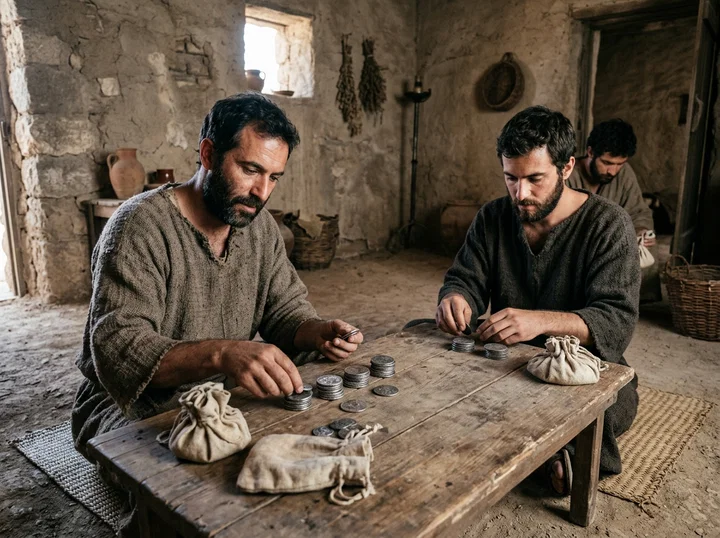
And he called his ten servants, and delivered them ten pounds, and said unto them, Occupy till I come.
Translations
American King James Version, Webster Bible
And he called his ten servants, and delivered them ten pounds, and said to them, Occupy till I come.
King James Version, KJV Cambridge Paragraph Bible
And he called his ten servants, and delivered them ten pounds, and said unto them, Occupy till I come.
Revised Version, American Standard Version
And he called ten servants of his, and gave them ten pounds, and said unto them, Trade ye herewith till I come.
and having called ten servants of his own, he gave to them ten pounds, and said unto them, Do business — till I come;
And having called his own ten bondmen, he gave to them ten minas, and said to them, Trade while I am coming.
And, calling ten servants of his own, he gave unto them ten minas, and said unto them—Do business, till I come.
Berean Standard Bible, Majority Standard Bible
Beforehand, he called ten of his servants and gave them ten minas. ‘Conduct business with this until I return,’ he said.
He called ten servants of his and gave them ten mina coins, and told them, ‘Conduct business until I come.’
And he sent for ten of his servants and gave them ten pounds and said to them, Do business with this till I come.
And he called his ten seruants, and deliuered them ten pieces of money, and sayd vnto them, Occupie till I come.
Douay-Rheims (Challoner revision)
And calling his ten servants, he gave them ten pounds, and said to them: Trade till I come.
Pictures
Cross-references 20 of 34
- Matthew 25:14-30
For the kingdom of heaven is as a man travelling into a far country, who called his own servants, and delivered unto them his goods.
Both parables entrust servants with resources to use while their master is away and hold them accountable.
- Matthew 25:27
Thou oughtest therefore to have put my money to the exchangers, and then at my coming I should have received mine own with usury.
Both parables require servants to put entrusted resources to work for their master.
- Romans 14:12
So then every one of us shall give account of himself to God.
Each person gives an account of their life to God.
- Mark 13:34
For the Son of man is as a man taking a far journey, who left his house, and gave authority to his servants, and to every man his work, and commanded the porter to watch.
Christ gives each servant work while he is away.
- Luke 16:10
He that is faithful in that which is least is faithful also in much: and he that is unjust in the least is unjust also in much.
Both teach faithfulness in entrusted responsibilities, with small duties preparing for greater ones.
- Matthew 25:21
His lord said unto him, Well done, thou good and faithful servant: thou hast been faithful over a few things, I will make thee ruler over many things: enter thou into the joy of thy lord.
The returning Lord commends servants who faithfully use what he entrusted to them.
- Revelation 22:12
And, behold, I come quickly; and my reward is with me, to give every man according as his work shall be.
Christ returns to reward each servant according to their work.
- 1 Peter 4:10
As every man hath received the gift, even so minister the same one to another, as good stewards of the manifold grace of God.
Both teach using what is received as a steward to serve others.
- Matthew 16:27
For the Son of man shall come in the glory of his Father with his angels; and then he shall reward every man according to his works.
Christ returns to reward each person according to his works.
- Matthew 25:1-13
Then shall the kingdom of heaven be likened unto ten virgins, which took their lamps, and went forth to meet the bridegroom.
Waiting for the bridegroom’s coming parallels waiting for the king’s return.
- Luke 19:23
Wherefore then gavest not thou my money into the bank, that at my coming I might have required mine own with usury?
The master requires his own with increase.
- Luke 12:45-47
But and if that servant say in his heart, My lord delayeth his coming; and shall begin to beat the menservants and maidens, and to eat and drink, and to be drunken;
Warns against neglecting the Lord’s will because his return seems delayed.
- Matthew 25:14
For the kingdom of heaven is as a man travelling into a far country, who called his own servants, and delivered unto them his goods.
Both parables portray a traveling master entrusting resources to his servants.
- Matthew 25:19
After a long time the lord of those servants cometh, and reckoneth with them.
Both parables describe the master’s return and his reckoning with the servants.
- Matthew 25:23
His lord said unto him, Well done, good and faithful servant; thou hast been faithful over a few things, I will make thee ruler over many things: enter thou into the joy of thy lord.
Faithfulness over entrusted property is rewarded.
- Luke 19:27
But those mine enemies, which would not that I should reign over them, bring hither, and slay them before me.
The enemies face judgment when the king returns.
- 1 Corinthians 4:2
Moreover it is required in stewards, that a man be found faithful.
God’s servants are entrusted with what belongs to him and required to be faithful.
- Luke 12:37
Blessed are those servants, whom the lord when he cometh shall find watching: verily I say unto you, that he shall gird himself, and make them to sit down to meat, and will come forth and serve them.
Blesses servants whom the returning Lord finds watching.
- Luke 19:17
And he said unto him, Well, thou good servant: because thou hast been faithful in a very little, have thou authority over ten cities.
Faithfulness in a small trust is rewarded with authority over cities.
- Matthew 25:24-25
Then he which had received the one talent came and said, Lord, I knew thee that thou art an hard man, reaping where thou hast not sown, and gathering where thou hast not strawed:
Both portray an unfaithful servant making an excuse for failing to use what was entrusted to him.
Commentary
Each commentary is drawn from primary sources: the writings of Ellen G. White and Adventist pioneers and periodicals. Each commentary is separate. Its own words are not a quotation; follow the references to read the source passages.
Ellen G. White
75 sources
Christ, as the nobleman going to receive a kingdom and return, calls His servants and entrusts to each capital to trade with faithfully until He comes.Ms 9, 1898, par. 1–6Lt 44, 1900, par. 6Ms 76, 1900, par. 6Ms 8, 1859, par. 25 All that a person is and has belongs to the Lord by creation and redemption, so the pound is a loan and not personal property, and any increase comes from Him and returns to Him with praise.Ms 57, 1901, par. 15Lt 60, 1896, par. 26–27Lt 97, 1898, par. 24RH Dec 10, 1901Lt 192, 1903, par. 29 Every soul in every age is given a work and abilities suited to capacity, so there are no idlers and none is excused, yet each is accountable only for what was actually received.Ms 8, 1892, par. 22–25ASCOP 20.2–21.1Ms 57, 1900, par. 9ST Oct 22, 1894SPBC 183.1–2 To occupy means to put what is entrusted out to active use — laboring to save souls, communicating truth in word and deed, putting means to work for God rather than hoarding or spending on self, and being faithful in the smallest opportunity — and gifts so used increase while unused powers decay.Lt 24, 1900, par. 5ST Aug 8, 1900Ms 8, 1892, par. 22–25Ms 9, 1891, par. 45–46ST Dec 10, 1894 The charge lasts only for present life while probation continues, for at His coming He will reckon with each servant personally, rewarding faithful, persevering, unselfish trading with approval and joy and condemning the slothful servant who buries his trust.Ms 13, 1895, par. 7Lt 59, 1893, par. 11–13Lt 55, 1897, par. 40–422T 667.3–668.2ST Oct 22, 1894
Parable Setting and Wording
The verse presents Christ as the nobleman who goes away to receive a kingdom, calling His ten servants, delivering to each one a pound, and charging them to trade with it till He comes, as a man going into a far country to receive a kingdom and return.Ms 9, 1898, par. 1–6Ms 8, 1859, par. 25 The entrusting itself is an act of great mercy and love.Ms 9, 1898, par. 1–6 The servant who hides his pound and charges his Lord with being austere, taking up where He laid not down and reaping where He did not sow, puts his own spirit upon his Lord, manifesting an avaricious, ungenerous and unjust spirit, a claimed discernment that is distrust of those serving God and jealousy of God, and his words show he does not know the Lord, while the principles leading him to rob God of the entrusted gift make him ungenerous and lead him to covet what is not his own.Ms 9, 1898, par. 1–6
Together with the hatred of the citizens and their refusal to have Him reign over them, the charge foretold the curse the Jewish nation would bring upon itself by refusing Jesus as its Prince.Ms 76, 1900, par. 6 It also teaches service before triumph, for Christ had to suffer, be rejected and be crucified before His victory was complete, and His servants must labor and face conflict before being honored as conquerors.Lt 44, 1900, par. 6 Christ entrusts His servants with His goods and commands them to work faithfully until He returns, using the light of truth and all placed in their care, knowing they must give God an account.Lt 44, 1900, par. 6 He entrusts work to His servants to carry on during His absence.Ms 76, 1900, par. 6
To occupy means to trade, to improve in the sense of making progress and employing what has been given, and to put the talent out to the exchangers.Lt 147a, 1897, par. 12–14Ms 9, 1891, par. 45–46 Every man has talents, and only those who put them to use double them, by working with personal abilities for those around to bring souls to the Master.Ms 9, 1891, par. 45–46 Using even one talent to bring one soul to heaven multiplies, for that soul will bring another and that one another, widening like circles from a pebble thrown into a lake until reaching the shore.Ms 9, 1891, par. 45–46 His return calls for vigilant, faithful work joined with prayerful waiting and watching.Lt 147a, 1897, par. 12–14 Occupying till He comes also means waiting and watching and praying with a living daily connection with God complete, having grace today, and not being surfeited and drunken with the cares of this life so that day comes as a thief unready, and not being like the foolish virgins.Ms 9, 1891, par. 45–46
Till I come limits the duty to present life and opportunity while probation lasts, for it lasts only while life and the opportunity to labor continue.Ms 13, 1895, par. 72T 667.3–668.2ST Oct 22, 189410MR 227.1–2 When every case is decided there will be no further opportunity to work for souls, and the command to keep working in the Master's vineyard ends only when the decree fixing the unjust, the filthy, the righteous and the holy goes forth and there is no more occasion to labor for souls.Ms 13, 1895, par. 710MR 227.1–2 There is no second probation, and just now day by day and hour by hour every person is building for the last great day by trading on the Lord's money, working for time and for eternity, making records in the books of heaven and preparing reward or punishment proportionate to the work done.MC 67.1 These gifts are the Master's property, not the servants' own, and must not be hoarded or used selfishly or extravagantly, but put to work to bring others salvation, support God's cause, and relieve widows and orphans, which glorifies God, while faithful, unselfish use brings blessing and joy at the harvest and each servant must give a personal account with the Master requiring His own with increase and rewards or punishments corresponding to use or abuse.2T 667.3–668.2ST Oct 22, 1894 The command binds every individual follower for the rest of life, even if only a few years remain, to awake and seek diligently, prayerfully, with intense interest and sacrifice to find lost souls like lost pearls buried in the rubbish of wicked cities full of iniquity and place them in the Saviour's hands, even when Satan says it is impossible to do them any good and even though the cities are sadly neglected and need a hundred workers where there is one.10MR 227.1–2
Divine Ownership of Gifts
Every human being with mind, heart, soul and strength belongs to the Lord both by creation and by redemption, having been bought with a price through death to give life and immortality.Lt 60, 1896, par. 26–27Lt 97, 1898, par. 24 No one therefore has a right to existence in himself, no one may claim himself as his own property, and no one may do as he pleases with himself.Lt 60, 1896, par. 26–27Lt 97, 1898, par. 24 All money, time and talents belong to God and are only lent by Him to accomplish the work He has given to do, so that all that is handled is the Lord's.Lt 97, 1898, par. 24 The command to occupy till He comes is His charge to keep using what He has lent until Christ returns, each person individually doing the work God gives, placing himself in readiness to do just what God appoints with self surrendered, using the powers as talents lent to do His will on earth to His glory, and each must give account of this stewardship.Lt 60, 1896, par. 26–27Lt 97, 1898, par. 24
The pound is capital advanced by the Lord, a loan and not personal property to use as one pleases.Ms 57, 1901, par. 15RH Dec 10, 1901 No gain can be made unless there has first been a deposit, and there can be no interest without the principal, for any increase depends on what He first provides and all success in trading comes from Him.Ms 57, 1901, par. 15RH Dec 10, 1901Lt 192, 1903, par. 29 The faithful servant therefore takes no credit to himself and claims no personal merit, but gives Him all praise and glory and gives Him the credit, saying in effect Thou deliverest unto me Thy pound.Ms 57, 1901, par. 15RH Dec 10, 1901Lt 192, 1903, par. 29 The time of service is a day of trust followed by the Lord's day of reckoning, in which the entrusted resources, including tithes and offerings to be brought willingly and abundantly into His treasury according as He has prospered, are to be used diligently in His service and put to work for His cause.Ms 57, 1901, par. 15RH Dec 10, 1901Lt 192, 1903, par. 29
The steward acts in the master's place, treating the master's interests as his own and using what has been entrusted for the master's purposes, and the trust is an honorable position.Ms 33, 1907, par. 6 Using gains from the master's goods for personal advantage perverts that trust, for the gifts are not merely for personal or worldly gain but to support God's work and help bring others to the truth.ST Apr 22, 1875Ms 33, 1907, par. 6 Selfishly appropriating what belongs to God is covetousness, which is idolatry.RH Dec 10, 1901 Worldly cares and love of money can absorb a steward's attention, hide the light entrusted to him, and keep him from using influence and resources for others.ST Apr 22, 1875
The entrusted gifts differ in amount from person to person according to varied capabilities, proportioned individually from the lowliest and most obscure to those in highest positions of trust, and responsibility increases with what has been received.Lt 236, 1903, par. 6–7Ms 81, 1893, par. 69–729T 245.3Lt 29, 1897, par. 14–15 They include physical, mental and moral powers, speech, memory, time, property, money, houses, lands, influence, the light of truth and all spiritual advantages, which are not our goods but the Master's entrusted capital to invest and increase as wise stewards.Lt 44, 1900, par. 7–9Ms 81, 1893, par. 69–729T 245.3Lt 20, 1897, par. 20–23 They are not reserved for a favorite few exalted in education or intellect, but talents in trust to every man with earnest, sacred, solemn work to do for the Master.Ms 81, 1893, par. 69–72 Having little is no reason to do nothing and even one talent has a place of service, for each is responsible for using what has been given and should seek God's wisdom in doing so, including using both mental and physical powers well to advance God's work, build His kingdom, support missions and save souls rather than serve self-glory or selfish desires.Lt 236, 1903, par. 6–7Lt 44, 1900, par. 7–99T 245.3Lt 29, 1897, par. 14–15Lt 20, 1897, par. 20–23
Universal Stewardship Charge
Christ gives every person in every age a work with abilities entrusted to be used faithfully until He returns.Ms 8, 1892, par. 22–25ASCOP 20.2–21.1Ms 57, 1900, par. 9Ms 81, 1893, par. 69–72RH Apr 9, 1901 There can be no idlers in His vineyard and none is excused, for God has given talents in trust to every man and given to every man his work.Ms 8, 1892, par. 22–25Ms 81, 1893, par. 69–72RH Apr 9, 1901 The duty belongs not to ministers alone but to every soul who gives his heart to God, who is called to take up the work presented and keep laboring in His vineyard until He returns.Ms 57, 1900, par. 9Ms 81, 1893, par. 69–72GW 202.1 It applies to a minister’s wife as well as to her husband, for she has an individual responsibility to work with him that must not be lightly set aside, willingly sacrificing natural wishes, pleasures, and tastes when doing so helps her serve others.GW 202.1 The command calls for wise, diligent, earnest service aimed at saving souls and advancing God’s kingdom, putting entrusted gifts including speech, memory, influence, and property to faithful use for God’s glory, with increase through diligent work.Ms 8, 1892, par. 22–25ASCOP 20.2–21.1Ms 81, 1893, par. 69–72RH Apr 9, 1901GW 202.1
Wasted time, neglected opportunities, neglected duties, and unfinished duties are failures to carry out that charge, and every person’s work, stewardship, and record of service will face solemn scrutiny.Ms 8, 1892, par. 22–25ASCOP 20.2–21.1Ms 81, 1893, par. 69–72 The time to act is limited because death may be near, yet those who have fallen behind can still make faithful use of what remains.Ms 8, 1892, par. 22–25 God-given powers grow weak when left unused, but God blesses the right use of these gifts.Ms 8, 1892, par. 22–25RH Apr 9, 1901 A servant means a worker, one who bears cares, burdens, and responsibilities, and those chosen by grace as His servants, united with Christ by living faith, are laborers together with God.Ms 81, 1893, par. 69–72 The talents are not reserved for a favorite few exalted in education or intellect, but are endowments bestowed individually from the lowliest and most obscure to those in highest positions of trust, proportioned to varied capabilities.Ms 81, 1893, par. 69–72
Each is responsible only for what was actually given according to ability and capacity, not for what was never received or for what circumstances and abilities cannot provide.ST Oct 22, 1894SPBC 183.1–2RH Apr 9, 1901 God does not require from one with little what He requires from one with much, and no one should complain that gifts are small.ST Oct 22, 1894SPBC 183.1–2RH Apr 9, 1901 Even one talent used to the best account is accepted, and work entrusted to a servant with one talent is as valuable in God’s sight as work entrusted to one with five, for the Lord commends faithful use, not the size of the endowment.ST Oct 22, 1894SPBC 183.1–2RH Apr 9, 1901Ms 25, 1899, par. 20 Faithful use of one entrusted gift can lead to further gifts and greater responsibility, and the light God gives and the talents entrusted multiply as they are shared and increase through trust in God, humility, and consecrated work by which He cooperates with His servants.SPBC 183.1–2RH Apr 9, 1901Lt 26, 1894, par. 21 This responsibility belongs to each person and cannot be transferred to another or taken over by human judgment, and the servant who hides his talent neglects work he could have done, since even greater resources would not have changed his unfaithfulness.ST Oct 22, 1894SPBC 183.1–2RH Apr 9, 1901 Faithfulness in small opportunities matters, no task in God’s work is insignificant, what is entrusted must be put to use and increased and not merely returned unused, and the faithfulness with which each task is done determines its reward.RH Apr 9, 1901Ms 25, 1899, par. 20Lt 26, 1894, par. 21
The work is Christ’s work, not man’s own, done in co-partnership as laborers together with God in a work of mercy and love just in Christ’s lines, and not merely attending to one’s own self or personal interests but entering a broader field.Ms 11b, 1894, par. 7–8Ms 11, 1894, par. 6–75MR 37.1–39.2Ms 1, 1899, par. 7–8 It is carried out through cooperation with God and empowered by the Spirit of Christ and by grace received from above, which cannot be bought, and not by intellect, education, money, eloquence, or power of intellect alone.Ms 11b, 1894, par. 7–8Ms 11, 1894, par. 6–75MR 37.1–39.2 Each person is to serve according to the knowledge received and to the very best knowledge possessed, accept and sense responsibility, and let light shine to those around them, which is doing God’s work by presenting obedience to the requirements, commandments, and law of Jesus Christ as freedom, liberty, and salvation that looses the bands of wickedness, lets the oppressed go free, and breaks every yoke.Ms 11b, 1894, par. 7–8Ms 11, 1894, par. 6–75MR 37.1–39.2 Doing this places men and women where they cooperate in the most perfect harmony with His appointed agencies in molding human character after the divine similitude, trading upon talents and thus increasing them and obtaining power thereby.Ms 1, 1899, par. 7–8 God is robbed when men and women do not connect with Him in such a way that mind, soul, and strength are controlled by the Holy Spirit, and using the talents is an individual work to be sought with earnest effort for peace in Christ.Ms 1, 1899, par. 7–8
Obeying the charge engages all of one’s abilities and warms the heart to the work, enlisting all powers of the soul under Christian obligation.CT 309.1Ms 51, 1893, par. 31–32STE 195.2FE 229.2 Talents are to be used as stewards of Christ’s grace under Christian duty to bless self and others to the glory of God, for one’s own good as well as for others, and teachers and students share in this high and important stewardship.CT 309.1Ms 51, 1893, par. 31–32STE 195.2FE 229.2 It stands in contrast to play and amusement, for which Christ gave no example or instruction.Ms 51, 1893, par. 31–32 It calls for earnest, diligent discharge of every obligation laid upon them in gratitude to God for the gift of His Son and everlasting life through faith.CT 309.1Ms 51, 1893, par. 31–32STE 195.2FE 229.2
Faithful Trading in Practice
Occupying is unceasing active service to save perishing souls until Christ comes, doing all in one's power and even what seems beyond one's power.Lt 24, 1900, par. 5ST Aug 8, 1900 It is unearthing the talent instead of burying it in a napkin in the earth in idleness and sleep, and putting it out to the exchangers by ministering to others, enlightening souls, and teaching church members to labor effectually.Ms 9, 1891, par. 45–46Ms 151, 1897, par. 28–29 That faithful labor furnishes diligent workers for the harvest field and develops men for positions of trust and influence while accomplishing great good.Ms 151, 1897, par. 28–29 It includes seeking diligently, prayerfully, with intense interest and sacrifice for lost souls as lost pearls buried in the rubbish of wicked, iniquitous, sadly neglected cities where Satan says no good can be done and where a hundred workers are needed for every one present.10MR 227.1–2 Using even one talent to bring one soul to heaven multiplies, for that soul will bring another and that one another, widening like circles from a pebble thrown into a lake until reaching the shore.Ms 9, 1891, par. 45–46 Putting money out to usury in this sense is working for neighbors' interests, publishing the gospel of peace everywhere, showing decided interest in all the Redeemer's purchase, and converting souls who will go to work to convert others, with personal influence winning more souls.Ms 156, 1904, par. 47–51
Trading is using money, abilities, influence, knowledge, speech, memory and means to spread the light of present truth to those in darkness and error.ST Dec 10, 1894Lt 35, 1898, par. 6–8Lt 47, 1895, par. 14–15 Every converted soul is appointed witness and steward to trade on every talent of light, ability and influence, communicating what is known to those who do not know it.Lt 35, 1898, par. 6–8 The light is to shine not in much talk only but in good works and perfect obedience used for the Lord and not for self-pleasing, presenting obedience to His requirements as liberty.Lt 35, 1898, par. 6–8 What is imparted is received more richly, for the light multiplies as it is shared and faithful use of one gift leads to further gifts and greater responsibility.Lt 26, 1894, par. 21Lt 47, 1895, par. 14–15Lt 49, 1895, par. 13–15 Such faithful use loosens attachment to temporal things, directs affection to eternal treasures, and develops characters of increasing consecration, efficiency and tact as laborers together with God.Lt 35, 1898, par. 6–8Lt 97, 1895, par. 66–68 Talents left unused that might have been put out to the exchangers will be required again with the improvement required, and they are to be put to work to bring people to knowledge of the truth so they may increase.Lt 35, 1898, par. 6–8Lt 49, 1895, par. 13–15
Entrusted means are to be put to work for God and His cause rather than hoarded, buried, wasted on self, extravagance or needless display, or merely saved to be left for children to use.RH Aug 25, 1874Ms 87, 1894, par. 27RH Dec 10, 1901 Through self-denial and self-sacrifice even those with no money can save something by denying inclination, and even gifts that seem too small become valuable when laid on the altar because God blesses them to surprising results.Lt 24, 1900, par. 5ST Aug 8, 1900 Tithes and offerings belong to this trading and are to be brought willingly and abundantly into the treasury according as He has prospered.Ms 57, 1901, par. 15RH Dec 10, 1901 Resources are to support missions, suffering institutions, the poor, widows and orphans, help others, show Christ's compassion and love, and prepare people for His coming, for large sums are needed.RH Aug 25, 1874Ms 87, 1894, par. 27 Burying resources in worldly possessions or spending them needlessly instead of investing them brings condemnation, while faithful use for saving souls brings approval and joy.RH Aug 25, 1874 Spending God's money on liquor, alcohol and self-gratification that destroys brain and nerve power and weakens reasoning is forbidden, and money kept for self is worthless when Christ comes.Ms 156, 1904, par. 47–51
Faithfulness in small opportunities matters, for no task in God's work is insignificant and the faithfulness with which each task is done determines its reward.Ms 25, 1899, par. 20 Work with one talent is as valuable in God's sight as work with five, and having little is no reason to do nothing.9T 245.3Ms 25, 1899, par. 20 Talents are a personal stewardship to be used wisely where the Spirit indicates and not handed to others to decide or surrendered to another.Lt 43, 1899, par. 34–36Lt 34a, 1886, par. 28–29 Each is to seek God's wisdom, serve in the way best suited, work actively to increase usefulness, and meet the needs of His work and help others.9T 245.3Lt 43, 1899, par. 34–36Lt 93, 1901, par. 13 All means belong to God, including money, houses and lands, to advance His work and build His kingdom rather than serve self-glory or selfish desires.9T 245.3
Gifts honestly put to work increase in capability and power, while powers left unused grow weak and capacities diminish.Ms 8, 1892, par. 22–25Ms 76, 1900, par. 9Ms 9, 1898, par. 9–10 The more talents are exercised the greater the increase of capability, as seed must struggle above the soil and spring into life or lose all power to germinate.Ms 76, 1900, par. 9 This calls for mental and moral improvement and growing in grace and in knowledge of Jesus Christ, watching for opportunity to represent truth and win souls.Ms 76, 1900, par. 9 Those given spiritual advantages are accountable for using them, for neglecting them sacrifices spirituality and diminishes capacity.Ms 10, 1892, par. 18 Persistent refusal to use them leads to loss and separation from God, though those who have fallen behind can still make faithful use of what remains while time lasts because death may be near.Ms 8, 1892, par. 22–25Ms 9, 1898, par. 9–10
Genuine trading is love shown by works, for mere profession of faith has no value and a name on church books does not secure entrance into the kingdom.4SP 311.2 It means using opportunities for service and for development of Christian character, obeying the known will of God, seeking to benefit and bless those needing help and encouragement, and doing something to help in salvation. It includes appreciating the daily work of purifying, refining and sanctification that lifts character higher, and sensing the worth of souls for whom Christ died, since neglect leaves one in peril. To occupy is to serve faithfully while maintaining vital living connection with Christ, which leads believers to love one another and display His character and unity.Ms 24, 1896, par. 15 In that living faith in His divinity, grasped in humanity, lies power to overcome evil, bad tempers, wrong dispositions and unbelief in the battle faced.Ms 123, 1909, par. 19–20
Final Account and Reward
The coming of Christ is a reckoning when each servant must give a personal account of the trust and its gain, for what was lent as capital to trade with until He comes must be returned as principal with increase and usury.Lt 55, 1897, par. 40–422T 667.3–668.23T 123.1TCBMP 159.1ST Nov 25, 1886 Responsibility in that account is measured according to what was actually given, whether the time to work was brief or long, and reward or punishment corresponds to faithful use or abuse.Lt 59, 1893, par. 11–132T 667.3–668.2MC 67.1 The examination covers time, resources, influence, knowledge, and all entrusted means and capabilities, because the property in hand belongs to the Master and is not for hoarding, selfish use, or shifting the work to children to do after death.2T 667.3–668.23T 123.1TCBMP 159.1ST Nov 25, 1886 The present life is the opportunity to employ it for good and for God's glory, especially in saving souls, before probation ends and no further working for souls remains.Lt 59, 1893, par. 11–132T 667.3–668.2
Faithful, persevering, unselfish trading receives the Master's approval, blessing, and joy, including the joy of souls saved and a loosened hold on temporal things.RH Aug 25, 18743T 385.3–387.1Ms 150, 1898, par. 23–24 The reward is proportionate to the work done, corresponding to effort, zeal, faithfulness, and success, as responsible beings working for time and eternity make their record in the books of heaven day by day and hour by hour.4T 51.1–2MC 67.1Lt 1a, 1872, par. 17–19 This duty rests on everyone who can reason, to serve according to ability, and wealth is not given for selfish pleasure, needless display, or extravagance.Lt 1a, 1872, par. 17–19Ms 150, 1898, par. 23–24 Hiding resources in worldly possessions and interests, spending them needlessly, or diverting wealth from God's work and the needs of others brings condemnation, represents failure to serve, and hinders the spread of His kingdom.RH Aug 25, 18744T 51.1–23T 385.3–387.1Ms 150, 1898, par. 23–24
Fidelity in this life determines position and reward in the future life, for Christ is absent and all are tested by how they do the work given them in His absence, and that work decides destiny.Lt 52, 1891, par. 42–45Lt 72, 1902, par. 10 The appointed judgment opens every secret thing, condemning every thought, work, and moral duty left undischarged because the omission affects God's plan and makes others suffer, while heaven notes the smallest faithful act done from a heart principle of obedience.Lt 52, 1891, par. 42–45 Impenitence, selfishness, self-serving, and covetousness are guilt of the highest order that cannot be passed by, and those justified by faith are judged by works, since faith works by love and purifies the soul from moral defilement.Lt 52, 1891, par. 42–45Ms 81, 1893, par. 69–72 Hence servants are to fear falling short of God's plan, be ever on duty, and labor always for the uplifting of those for whom He gave His life.Lt 72, 1902, par. 10
The slothful servant who hides his pound in a napkin and buries it in the earth embezzles the Lord's goods, takes them away from His cause, and misappropriates His money into channels that bind it away from where the field is in greatest need, under His displeasure and retarding His work.Ms 81, 1893, par. 69–72Ms 172, 1901, par. 1–4Ms 57, 1901, par. 7 By charging his Lord with austerity, as taking up where He laid not down and reaping where He did not sow, he puts his own avaricious, ungenerous, unjust, distrustful, and jealous spirit upon his Lord, and his words show he does not know Him.Ms 9, 1898, par. 1–6 The principles that lead him to rob God make him ungenerous and lead him to covet what is not his own, and hoarding the Lord's goods to do nothing with it costs the soul.Ms 9, 1898, par. 1–6Ms 81, 1893, par. 69–72 Spending God's money on liquor, alcohol, and self-gratification destroys brain and nerve power and weakens the reasoning faculties needed to work with the Master and overcome, and money kept for self or lined in coffin and shroud is worthless when Christ comes to take those who love Him to Himself.Ms 156, 1904, par. 47–51
Sources
Pioneers and periodicals
100 sources
Christ called his own servants before leaving them, placed his own capital in their hands, one portion to each, and charged them to trade with it and make it increase until he returned to require an account.ST Sep 14, 1882ST Sep 10, 1894ST Apr 30, 1896ST Aug 21, 1893 The parable was spoken because the kingdom was expected to appear at once, yet the nobleman must first go away to receive the kingdom and return afterward, so the kingdom remains future during the servants' time of service.ST Dec 11, 1879ST Nov 10, 1881RH May 11, 1869ST Feb 19, 1880RH Jan 10, 1854 The nobleman is Christ, the far country is heaven where he went at his ascension, and his return is his personal second advent, when he comes as King after receiving the kingdom from the Father at the close of his priestly work.GSAM 67.2–68.1RH Dec 11, 1866ST Aug 5, 1889ST Oct 13, 1898 What is entrusted is the same as the talents and spiritual gifts given at his ascension and at Pentecost to every believer for use until he comes, together with every temporal blessing of property, means, time, strength, intellect, influence and opportunity, of which men are stewards and not owners.ST Mar 15, 1910STRH Oct 27, 1863RH Sep 28, 1869 What is lent must be put to active profitable use, for faithful labor in love gains more and is rewarded at his reckoning with authority over cities and entrance into the joy of the Lord, while hiding it through sloth or fear loses even what was given; therefore expectation of his soon return spurs diligence in ordinary work, in relieving the needy, and above all in saving souls and spreading the truth to the ends of the earth until he comes.ST Apr 30, 1896RH May 30, 1854RH Sep 18, 1856RH Nov 6, 1916ST Feb 19, 1902
Words and Parable Setting
Luke 19:13 belongs to a parable spoken as Jesus went toward Jerusalem shortly before his crucifixion because those with him thought God's kingdom should immediately appear.ST Dec 11, 1879ST Nov 10, 1881RH Jan 10, 1854ST Sep 16, 1889RH Sep 22, 1863 The nobleman's going to a far country to receive a kingdom and afterward returning shows delay and intervening events, with the kingdom not then immediately manifest but still future at his appearing while the servants are entrusted with work.ST Dec 11, 1879ST Nov 10, 1881RH Jan 10, 1854ST Sep 16, 1889RH Sep 22, 1863 Even if heard then, the parable did not fully remove the mistaken expectation from the disciples, for on entering Jerusalem they still hailed Jesus as son of David and as king in triumph with palm branches and shouts of triumph.ST Sep 16, 1889ST Nov 27, 1879 They rejoiced before him as a king in his triumph without realizing he was going into the city to be condemned and crucified as a malefactor.ST Sep 16, 1889ST Nov 27, 1879
The nobleman is Christ, the far country is heaven where he went after his resurrection at his ascension to the Father to receive the kingdom, and his return is his second advent to earth to reign and take his people to himself.GSAM 67.2–68.1RH Dec 11, 1866ST Oct 6, 1914ST Nov 22, 1899 His ten servants are his church and the inhabitants of this world who have yielded to him and are consecrated by his Spirit, not angels, and the citizens who hated him are also on earth.RH Dec 11, 1866ST Jul 9, 1912 He leaves his servants responsible to serve faithfully until his return, and on his return he calls them to account and then exercises power over the kingdom.ST Nov 10, 1881ST Oct 6, 1914ST Jul 9, 1912 The kingdom is therefore received in the presence of the Father before the return and is not established on earth until after the second coming.GSAM 67.2–68.1ST Nov 10, 1881RH Dec 11, 1866
Before departing he calls his ten servants and delivers them ten pounds, one to each, as entrusted trading capital belonging to him and not their own independent possession.ST Sep 10, 1894ST Apr 30, 1896ST Nov 20, 1884 He commands them to trade with it and put what is given to active use until he returns, defining a period of service during his absence in heaven before his return and the establishment of his kingdom.ST Sep 10, 1894ST Apr 30, 1896ST Nov 3, 1914ST Apr 30, 1896 While the master is away receiving the kingdom from his Father, the servants are to carry on his business in his service.ST Nov 3, 1914ST Nov 20, 1884ST Apr 30, 1896 When he returns as King he will require a strict account from every servant for what was entrusted and for its use.ST Apr 30, 1896ST Nov 3, 1914ST Nov 20, 1884
To occupy means to do business, trade diligently, minister faithfully as good stewards, and produce an increase, not merely to possess, preserve intact, keep safely, or let it lie idle unused.ST Sep 14, 1882ST Aug 21, 1893ST Sep 14, 1882ST Aug 19, 1889 The equal amount to each can represent God's truth given to all, with his Spirit available even to the poorest and weakest who ask in faith for increase rather than unused keeping.ST Sep 14, 1882ST Sep 14, 1882 The pound is the highest denomination of Roman money, just as the talent in Matthew 25:14-30 is the highest denomination of Jewish money, showing the great and precious value of what is entrusted, worth far more than pence or shekels or other inferior coins.ST Aug 21, 1893ST Aug 19, 1889ST Jul 8, 1889 Even the humblest and most ordinary gift is therefore a supernatural heavenly bestowment of inestimable value to the one who uses it rightly, while to the one who slights divinely given opportunity it becomes a weighty cross.ST Aug 21, 1893ST Aug 19, 1889ST Jul 8, 1889
The parable covers the whole Christian dispensation, the whole Christian era, the long interval and long journey between Christ's ascension to the Father after the resurrection and his coming again.ST Aug 19, 1889ST Oct 13, 1898RH Aug 11, 1910RH Sep 25, 1866 During that long years and centuries of labor his church occupies with the pounds till he comes again, assigned every man his work amid contending with principalities and powers while beaten, buffeted, persecuted, disappointed in hopes and plans, and seemingly defeated.ST Oct 13, 1898ST Mar 17, 1909RH Aug 11, 1910 The world's conversion through human effort is not what ends this interval, and the gospel mission in it is to save and not to condemn, so the reckoning and destruction of enemies only at and after his return give no reason for religious prosecution or persecution.ST Oct 13, 1898RH Sep 25, 1866
Kingdom Timing and Return
The parable was spoken to correct the expectation that the kingdom of God should immediately appear, for the nobleman goes into a far country to receive a kingdom and returns afterward having received it.RH May 11, 1869ST Feb 19, 1880ST Nov 19, 1894ST Jun 11, 1896RH Feb 25, 1875 Christ therefore receives His kingdom before He returns, and the kingdom remained still future while the servants were left to occupy.RH May 11, 1869ST Feb 19, 1880ST Nov 19, 1894ST Jun 11, 1896RH Feb 25, 1875 He entrusts money to His servants and on His return calls them to account, with the reception of the kingdom joined to His return and followed by the fate of His enemies.RH May 11, 1869ST Feb 19, 1880ST Nov 19, 1894RH Feb 25, 1875ST Oct 6, 1914
Heaven is the distant country where He goes to receive His kingdom, and His return to earth corresponds to the nobleman's return, so the kingdom is not established on earth until after the second coming.RH Dec 11, 1866ST Aug 5, 1889ST Jul 1, 1889ST Nov 3, 1914ST Dec 13, 1905 Having redeemed the world He leaves it and goes to the Father, the Ancient of Days, to receive the kingdom, then returns to judge the world and take possession.RH Dec 11, 1866ST Aug 5, 1889ST Jul 1, 1889ST Nov 3, 1914ST Dec 13, 1905 He now reigns as priest upon His Father's throne, the throne of grace, gathering out of the world those who will be subjects of His everlasting kingdom.RH Dec 11, 1866ST Aug 5, 1889ST Oct 13, 1898ST Jul 1, 1889ST Nov 3, 1914 At the close of His priestly work the kingdom is given to Him, for He did not receive it at His ascension but receives His own kingdom at the time of the judgment when His priesthood is over, in the investigative judgment while men are still in probation.ST Aug 5, 1889ST Oct 13, 1898ST Jul 1, 1889ST Nov 3, 1914ST Dec 13, 1905 Then at His coming He begins His reign and comes forth as King of kings exercising royal authority, taking the throne of David before His second coming to execute wrath upon a guilty world, when the judgment takes place and then and not till then are His enemies destroyed.RH Dec 11, 1866ST Aug 5, 1889ST Oct 13, 1898ST Nov 3, 1914ST Dec 13, 1905
The kingdom is established when the King returns, with His coming and the arrival of the kingdom together.ST Jan 12, 1882RH Jun 7, 1915RH Dec 10, 1857RH Sep 23, 1862ST Aug 19, 1880 Its commencement as a literal reign is at or about the time of His coming, when He comes bearing the name King of kings and Lord of lords to destroy His enemies, not on the day of Pentecost.ST Jan 12, 1882RH Jun 7, 1915RH Dec 10, 1857RH Sep 23, 1862RH Apr 9, 1872 It was not set up at His first coming as the Jews expected, nor by a millennium of holiness brought about by the church's conquest of the world, nor by human legislation, for the servants live amid the continuing present state of evil until the Master returns and brings a new order.ST Jan 12, 1882RH Jun 7, 1915RH Dec 10, 1857RH Sep 23, 1862RH Apr 9, 1872 His kingdom on His return is a direct and definite rule manifested in the person of Christ that destroys and displaces human governments, not an indirect spiritual rule in individual hearts through this age.ST Jan 12, 1882RH Jun 7, 1915RH Dec 10, 1857RH Sep 23, 1862ST Aug 19, 1880 Then the faithful enter that kingdom and are rewarded, while those who reject His reign are brought forth and slain in His presence in connection with the judgments of the second advent.ST Jan 12, 1882RH Jun 7, 1915RH Dec 10, 1857ST Aug 19, 1880RH Apr 9, 1872
The command to continue work until He comes points to a literal, personal return, rather than an invisible coming through the Holy Spirit or at death.ST Aug 12, 1886ST Apr 25, 1900RH Jun 19, 1856ST May 18, 1915 The dying thief trusted that his request would be fulfilled when the Lord returned to His kingdom exalted above His enemies.ST Aug 12, 1886ST Apr 25, 1900RH Jun 19, 1856ST May 18, 1915 That return is attested as certain to come again.ST Aug 12, 1886ST Apr 25, 1900RH Jun 19, 1856ST May 18, 1915
His coming is soon and immediate, as the immediate return of the nobleman who is the Redeemer and coming Saviour.RH Apr 22, 1858 The true explanation of the sanctuary in clearing obscurity from prophecy gives double force to the doctrine of His immediate return.RH Apr 22, 1858
Gifts Entrusted to Servants
The entrusted pounds are the same as the talents and the same as the spiritual gifts, bestowed by the same Lord at His departure from the world and ascension on high, with the first marked fulfillment at Pentecost, upon the same people for the same purpose and for the same period until He comes.ST Mar 15, 1910ST Aug 19, 1889ST Aug 21, 1893ST Sep 13, 1899 They are to be kept and used in the church until the church is complete, built up, perfected, and brought to unity of faith and knowledge of the Son of God unto a full-grown man unto the measure of the stature of the fullness of Christ, for the perfecting of the saints, for the work of ministry, for the building up of the body, and for witnessing to gather living stones.ST Mar 15, 1910ST Oct 13, 1898ST Aug 21, 1893ST Sep 13, 1899 Pastors, evangelists and teachers are no more temporary than prophets, apostles and gifts of healing, for the same Spirit gave them all for the same length of time until God's work in the earth is done, not to be buried in the world in a church divided by discordant creeds.ST Oct 13, 1898ST Aug 21, 1893ST Sep 13, 1899 The word for the pound denotes the highest denomination of Roman money, just as talent denotes the highest of Jewish money, showing the great and precious value of the gifts, and to occupy means to minister the gift faithfully as a good steward with solemn responsibility, man's part being consecration while God is the giver.ST Aug 19, 1889ST Aug 21, 1893ST Sep 13, 1899
They are supernatural heavenly bestowments, not natural inherited talents, faculties, or abilities that existed before the entrusting.STST Aug 19, 1889ST Jul 1, 1889 They are given to Christ's own servants, to every believer with at least one to every soul, divided according to each person's ability to use as the Spirit wills in wisdom and not by human choice.STST Aug 21, 1893ST Aug 19, 1889 Even the humblest and most ordinary gift is precious, a talent of gold being worth about $25,000, and even one pound can gain ten or five, for the lesson lies not in numbers but in bestowal and use.STST Jul 8, 1889ST Aug 19, 1889 Receiving only one does not mean inability to improve or certain failure, for such increase is the privilege of every child of God.STST Jul 8, 1889ST Aug 19, 1889
What is entrusted also includes every temporal and spiritual blessing lent as working capital: property, money, means, acquisitions and ability to gain property, time, strength, health, intellect, memory, speech, influence, opportunity, God's truth open to all, and faith.ST Apr 22, 1875RH Oct 27, 1863RH Sep 28, 1869RH Sep 12, 1865RH Feb 9, 1905 All property in hand is entrusted property, not to be used merely as one pleases, for all that is possessed belongs to the Lord and men are stewards and agents, not owners, to employ time and riches in the right manner taught in Scripture so as to meet His approval.RH Oct 27, 1863RH Sep 28, 1869RH Sep 12, 1865ST Aug 29, 1895RH May 20, 1858 These resources test whether the giver is loved more than the gift, for worldly cares and love of money can absorb attention, hide the entrusted light, and keep influence and resources from being used to support God's work and bring others to the truth.ST Apr 22, 1875RH Oct 27, 1863 Those without property are likewise entrusted, to use strength through industrious work to help the interests of the cause, and none may waste the Lord's goods or money on what is a curse.ST Apr 22, 1875RH Oct 27, 1863RH May 20, 1858
The command does not make preserving farms, shops, businesses, or shares of stock the chief duty, nor does it command accumulating worldly wealth until He returns.RH Jul 31, 1856ST Jul 19, 1883ST Jul 19, 1883RH Jul 31, 1856 The pound is a responsibility to be faithfully used, not a farm, store, or share to accumulate for personal wealth, and gains cannot be read as farms multiplying into farms.RH Jul 31, 1856ST Jul 19, 1883ST Jul 19, 1883RH Jul 31, 1856 That reading would make greater wealth earn greater blessing and exaltation or rule in His kingdom, leave the poor who own no farms out of view as if condemned for failing to multiply what they do not have, and turn service of mammon into the opposite of Christ's words.ST Jul 19, 1883ST Jul 19, 1883RH Jul 31, 1856 Using the command to excuse neglect of proclaiming the Lord's coming or withholding resources from God's cause reverses proper priority, for people should be diligent in ordinary work with the interests of God's truth first, and the aim of active use is to glorify God and benefit others, not to gain wealth, honor, success, or self-display.RH Jul 31, 1856ST Jul 19, 1883ST Jul 19, 1883RH May 21, 1901
Faithful Use and Reckoning
What is lent must be put to active and profitable use to increase it, not hidden, hoarded, or left idle through sloth or fear.ST Feb 19, 1902RH Apr 9, 1861RH May 26, 1868ST Apr 10, 1884 Smallness of gift, having only one talent, being counted less than ordinary, or comparing with another's greater gifts never excuses idleness.RH Nov 6, 1916ST Feb 19, 1902RH Apr 9, 1861 Faithfulness in little duties works on the plan of addition while God works for the faithful on the plan of multiplication.ST Feb 19, 1902 The entrusted gift is a loan belonging to the Lord and not one's own, lent for a purpose and not given for selfish keeping, and each servant must answer for how faithfully it was used.ST Feb 19, 1902RH May 26, 1868ST Apr 10, 1884
Faithful use in love for Christ and for souls brings increase.ST Jul 8, 1889ST Jul 8, 1889 Using one gift leads the Spirit to add others, grace attracts more grace, and the servant who distributes well is given more.ST Aug 19, 1889ST Jul 8, 1889ST Aug 27, 1894 One servant gained ten pounds and another five from one pound received, and such increase is the privilege of every child of God, for the lesson lies not in the numbers but in bestowal and use.ST Jul 8, 1889ST Aug 19, 1889 Neglecting divinely given opportunity leaves no increase, and what was entrusted is taken away, becoming a weighty cross to the slighter.ST Aug 19, 1889 Even those the world counts as less than ordinary can do mighty work by faithful use, while unbelief and lack of consecration limit what can be done through a person.ST Jul 8, 1889ST Jul 8, 1889
At his return after receiving the kingdom he reckons with his servants individually and renders to each according to deeds and faithfulness, not equal results from unequal abilities.ST Apr 30, 1896RH May 30, 1854 The faithful who gain more are commended as good and faithful, set over many things, given authority over cities, ten for one and five for another, and enter the joy of their Lord.ST Apr 30, 1896RH May 30, 1854RH Sep 18, 1856ST Feb 19, 1902 They are crowned as kings and priests in the regeneration, rewarded at the resurrection of the just before the thousand years with inheritance and authority belonging to the saints on the new earth.RH May 30, 1854RH Sep 18, 1856 The wicked and slothful who plead smallness or hardness lose even what they have and are cast out, and his enemies are destroyed.RH May 30, 1854ST Aug 19, 1880ST Feb 19, 1902 Judgment decisions are thus made before the second coming and executed at the last day, during a period of service before his return when use of what was given is accounted for.ST Apr 30, 1896RH May 30, 1854ST Aug 19, 1880
The master could at least have received his own with interest, so taking reasonable interest is not wrong in itself but depends on circumstances and love of neighbor toward the poor in hardship.RH Dec 31, 1861 The Master requires his own with usury, demanding fidelity without perversion to self-indulgence and sagacity for the largest gains.ST Nov 25, 1886RH Oct 25, 1906 Bringing back the pound without profit brings condemnation upon wasters and hoarders alike, because the fault is not using it so as to increase the entrusted goods.ST Nov 25, 1886RH Oct 25, 1906 The great day of account brings an awful reckoning for failure to trade diligently and make gain for him.RH Dec 10, 1901RH Oct 25, 1906
All property in hand is entrusted property, entrusted capital and not independent ownership, to be used as Scripture teaches while awaiting return.RH Aug 25, 1874RH Dec 10, 1901ST Sep 10, 1894RH Sep 12, 1865ST Nov 20, 1884 Means called one's own are God's property lent for service, with solemn responsibility and consecration, and selfish appropriation of what belongs to God is covetousness which is idolatry.RH Aug 25, 1874RH Dec 10, 1901ST Mar 24, 1887 Each servant has an assigned task whether great or small, whether active work or appointed waiting, and must be ready at any moment to give an account of stewardship.RH Aug 25, 1874ST Nov 20, 1884ST Mar 24, 1887 No gain is made unless there has first been a deposit, and there can be no interest without the principal, for capital is advanced by the Lord and all success comes from him, so the faithful take no credit but give all praise to him.RH Dec 10, 1901 God's knowledge and judgment exceed human accusation, and he will require a strict account from every servant and expect an increase.RH Aug 25, 1874RH Dec 10, 1901ST Nov 20, 1884
Diligent Service Until Return
Expectation of a personal return spurs diligence rather than idleness or fanaticism, laying down the Christian duty to keep occupying until he comes by putting entrusted resources to active use for him.RH Mar 17, 1903RH Jan 9, 1900RH Apr 13, 1905RH Jun 2, 1868RH Jun 2, 1868 Nearness of the end, brevity of life, and growing opportunity make the call urgent, and the prospect of the return motivates faithful service in the work each servant is assigned.RH Jan 9, 1900RH Jun 2, 1868RH Jun 2, 1868 Believers are to keep diligently at entrusted work, ordinary occupations, family care, planting, labor with the hands, repairing houses, keeping farms in condition, paying debts, overcoming sin, and rendering due service, bringing God into every endeavor and using gain to bless others toward eternal life.RH Mar 17, 1903RH Nov 11, 1915 Such diligence is not for accumulating property but to sustain God's cause, with greater efforts than ever before because doors are opened and the harvest is ripe, and quitting before the end is not enduring.RH Nov 11, 1915
Occupying means doing all in one's power and even beyond apparent power to save perishing souls through self-denying labor, self-denial and self-sacrifice that disciplines disciples, where even those with no money can save something by denying inclination and even gifts that seem too small become valuable on the altar through God's blessing to surprising results.ST Aug 8, 1900 It means dedicating physical and mental faculties, time, money, and all possessed to glorifying Christ, praying and working against evil, spreading light and truth, and warning sinners and seeking their conversion rather than becoming inactive because of the world's condition or its refusal to be converted before he comes.ST Mar 2, 1882 It means spreading the gospel in newly opened and difficult fields such as China, Arabia, Armenia, Abyssinia, Africa, and Russia, carrying the third angel's message of God's commandments and faith, circulating message-filled tracts, books, and papers whose profits aid foreign missions, and occupying mission ground.ST Jul 15, 1889 Open doors create responsibility not to be neglected through lukewarm indifference, but to be met urgently with men, money, and above all prayer, with laborers sent into the harvest field and upheld by continual prayer and free giving of means so honest souls see and accept present truth and are gathered into the soon-coming kingdom.ST Oct 31, 1911ST Oct 30, 1907RH Jan 17, 1907ST Jul 15, 1889
True prayer compels self-surrender and liberality in offering self and substance, keeps a firm hold at home for those who go into dark lands of heathenism, sends men and women to the field as witnesses to the ends of the earth, and alone with God exposes selfishness and illiberality, humbles the soul conscious of unclean lips, and brings cleansing from the heavenly altar and a tongue of fire.ST Oct 30, 1907RH Jan 17, 1907 Lukewarm neglect of this privilege and duty is Laodicean failure bringing woe, while embracing it is Philadelphian privilege and duty, tested and mercilessly exposed in the closet of secret communion where without prayer workers and gifts cannot meet the need.ST Oct 30, 1907RH Jan 17, 1907
It means using means for God's glory to relieve widows, orphans, neighbors, afflicted brethren, and suffering institutions, supporting God's work and bringing others to the truth, bringing tithes willingly and abundantly into the treasury according as prospered, giving large sums at once and accepting small gifts, practicing economy, and developing character fit for eternity.ST Apr 22, 1875RH Dec 10, 1901ST Oct 22, 1894 The means called one's own are God's property lent as capital for trading, where no gain is made without first a deposit and no interest without the principal, since capital is advanced by the Lord and all success comes from him, so the faithful servant takes no credit but gives all praise and glory to the Lord.RH Aug 25, 1874RH Dec 10, 1901 Selfishly appropriating what belongs to God is covetousness which is idolatry, and burying resources in worldly possessions or spending them needlessly instead of investing them for saving souls brings condemnation, while worldly cares and love of money absorb attention, hide entrusted light, and keep influence and resources from helping others.ST Apr 22, 1875RH Aug 25, 1874RH Dec 10, 1901 Stewards have no right to waste the Lord's goods or spend his money on what is a curse, refusing waste on tobacco, needless finery, display, status, luxury, fashions, or corrupting papers, using education and every lawful endeavor wisely, and faithfully using responsibility and collective influence to oppose laws licensing the liquor trade and protect nation and fellow people from its harm, ready to answer before the judgment throne.RH May 20, 1858ST Feb 22, 1883ST Feb 26, 1880
Such active obedience alone revives, for inactivity causes decline and deep sleep of soul while activity causes new life, as exercised muscles grow strong and unused muscles grow weak, and believers must not wait for a miracle to make them feel like working nor stand idly waiting for a greater work but do present duty with might, since small duties faithfully done prepare the way for a more extended field of labor anywhere.RH Sep 3, 1872 Obeying gives health to the soul because exercising grace promotes spiritual vigor and drives away lack of comfort, does good to the world because the unconverted who will not hear the gospel and do not understand justification by faith can understand a holy consistent thoroughgoing life, and trains believers for the glorious home and inheritance of the saints in light where there is no sickness and saints and angels wait on the Lord with unwearied activity serving day and night like the angels Jacob saw ascending and descending with none standing still. It brings joy in work, comfort in trials, open doors of usefulness, consolation in sickness, hope in death, a good testimony after burial, blessing at harvest, peaceful quiet without anxiety since Christ attends to the rest including bringing his own to himself at his coming, confidence at his return, and a great crown at the day of reward, commending heirs of the kingdom not for doing no harm nor for great acts in the sight of men but for activity and work in the vineyard letting light shine upon neighbors and others.ST Oct 22, 1894RH Sep 3, 1872RH Nov 19, 1872
The field is to be occupied continuously without stopping until his coming, covering the whole Christian era and the church's long years and centuries of labor contending with principalities and powers while beaten, buffeted, persecuted, disappointed in hopes and plans, and seemingly defeated, each remaining at the appointed post with a willing mind while looking for the Lord from heaven.ST Oct 13, 1898ST Feb 5, 1902RH Aug 11, 1910RH Nov 19, 1872 The nobleman goes to a distant country to receive a kingdom and then return, so the kingdom is Christ's to receive and is not prepared for him by human effort, and he now sits as priest on his Father's throne receiving his own kingdom at the time of judgment when his priesthood is over.ST Oct 13, 1898ST Sep 12, 1895 Preparation for the kingdom is individual responsibility, for on his return he reckons with servants as individuals not with nations as such, and if a believer dies before that day the hope is to rest in expectation of the blessed resurrection and the Lord's coming.ST May 13, 1897RH Aug 15, 1865 The gospel mission is to save not condemn, and judgment will be the Lord's and will not take place till the last day with enemies destroyed then and not till then, so the verse gives no reason for religious prosecution or persecution.ST Oct 13, 1898
Sources