Luke 2:22
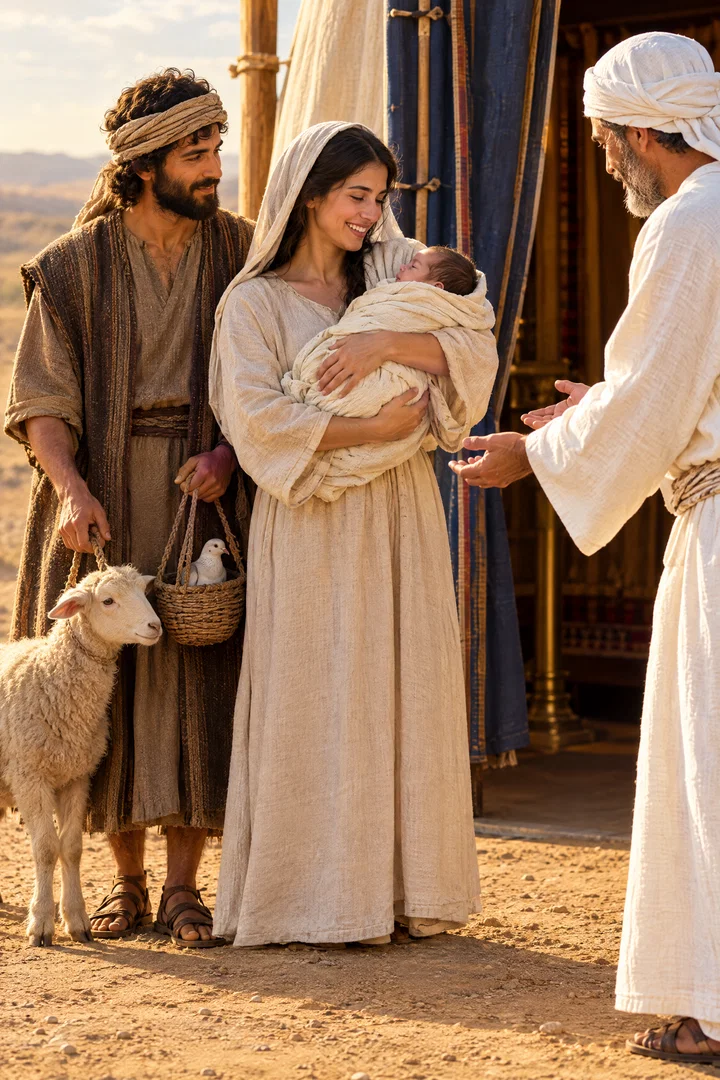
And when the days of her purification according to the law of Moses were accomplished, they brought him to Jerusalem, to present him to the Lord;
Translations
American King James Version, King James Version, KJV Cambridge Paragraph Bible, Webster Bible
And when the days of her purification according to the law of Moses were accomplished, they brought him to Jerusalem, to present him to the Lord;
Revised Version, American Standard Version
And when the days of their purification according to the law of Moses were fulfilled, they brought him up to Jerusalem, to present him to the Lord
And when the days of their purification were fulfilled, according to the law of Moses, they brought him up to Jerusalem, to present to the Lord,
And when the days were fulfilled for their purifying according to the law of Moses, they brought him to Jerusalem to present [ him] to the Lord
And, when the days of their purification, according to the law of Moses, were fulfilled, they took him up into Jerusalem, to present [him] unto the Lord,—
Berean Standard Bible, Majority Standard Bible
And when the time of purification according to the Law of Moses was complete, His parents brought Him to Jerusalem to present Him to the Lord
When the days of their purification according to the law of Moses were fulfilled, they brought him up to Jerusalem to present him to the Lord
And when the necessary days for making them clean by the law of Moses had come to an end, they took him to Jerusalem to give him to the Lord
And when the daies of her purification after the Lawe of Moses were accomplished, they brought him to Hierusalem, to present him to the Lord,
Douay-Rheims (Challoner revision)
And after the days of her purification, according to the law of Moses, were accomplished, they carried him to Jerusalem, to present him to the Lord:
Pictures
Cross-references
- Leviticus 12:6-8
And when the days of her purifying are fulfilled, for a son, or for a daughter, she shall bring a lamb of the first year for a burnt offering, and a young pigeon, or a turtledove, for a sin offering, unto the door of the tabernacle of the congregation, unto the priest:
Prescribes the offering required when purification ended, including two birds for those unable to afford a lamb.
- Luke 2:39
And when they had performed all things according to the law of the Lord, they returned into Galilee, to their own city Nazareth.
Both accounts describe Jesus’ parents fulfilling the Lord’s law.
- Leviticus 12:2-4
Speak unto the children of Israel, saying, If a woman have conceived seed, and born a man child: then she shall be unclean seven days; according to the days of the separation for her infirmity shall she be unclean.
Prescribes the purification period completed before the visit.
- Luke 2:29-30
Lord, now lettest thou thy servant depart in peace, according to thy word:
Simeon's words spoken while holding Jesus
- Exodus 34:20
But the firstling of an ass thou shalt redeem with a lamb: and if thou redeem him not, then shalt thou break his neck. All the firstborn of thy sons thou shalt redeem. And none shall appear before me empty.
Requires redemption of a firstborn son.
- Numbers 3:13
Because all the firstborn are mine; for on the day that I smote all the firstborn in the land of Egypt I hallowed unto me all the firstborn in Israel, both man and beast: mine shall they be: I am the LORD.
Explains the Lord’s claim on every firstborn.
- Luke 2:36-38
And there was one Anna, a prophetess, the daughter of Phanuel, of the tribe of Aser: she was of a great age, and had lived with an husband seven years from her virginity;
aged prophetess witnessing the presentation
- Exodus 4:22
And thou shalt say unto Pharaoh, Thus saith the LORD, Israel is my son, even my firstborn:
Israel is called God’s firstborn, giving the origin of the presentation ceremony.
- Luke 2:32
A light to lighten the Gentiles, and the glory of thy people Israel.
Candles represent Simeon’s words about Christ as light to the Gentiles.
- 1 Samuel 1:27-28
For this child I prayed; and the LORD hath given me my petition which I asked of him:
Hannah prayed for Samuel and dedicated him to the Lord’s service.
- Luke 2:7
And she brought forth her firstborn son, and wrapped him in swaddling clothes, and laid him in a manger; because there was no room for them in the inn.
birth in stable contrasts house where Magi found Him
- Acts 15:5
But there rose up certain of the sect of the Pharisees which believed, saying, That it was needful to circumcise them, and to command them to keep the law of Moses.
Uses the name “law of Moses” for this law.
- 1 Peter 1:19
But with the precious blood of Christ, as of a lamb without blemish and without spot:
The lamb without blemish represents Christ, free from defect.
Commentary
Each commentary is drawn from primary sources: the writings of Ellen G. White and Adventist pioneers and periodicals. Each commentary is separate. Its own words are not a quotation; follow the references to read the source passages.
Ellen G. White
13 sources
About forty days after His birth, when He was six weeks old, Joseph and Mary brought Jesus to the temple at Jerusalem to present Him to the Lord and offer sacrifice according to the law of Moses for the first-born son.DA 50.1COS 15.1–16.1Ms 104, 1900, par. 1 The law called for a year-old lamb for a burnt offering and a young pigeon or turtledove for a sin offering, but allowed poor parents to bring two turtledoves or two young pigeons instead, which is what they brought.DA 50.2–3ST Oct 21, 1889Ms 8, 1880, par. 12–15 Though He was God's own Son and the Prince of heaven, the Saviour of the world and High Priest of the heavenly temple, He was made obedient in all things as man's substitute to conform to the law in every particular, and His bringing was His dedication to the work He had come to do.DA 50.1COS 15.1–16.1DA 55.1–221MR 224.1–5Ms 104, 1900, par. 1 The priest saw only a helpless, ordinary infant of simple working people, but Simeon, guided by the Holy Spirit, recognized Him as the promised Consolation of Israel and God's salvation for all people and took Him in his arms in peace, while the aged prophetess Anna was also present.COS 17.5DA 55.1–221MR 224.1–5COS 14 Their poor offering of two doves was precious and acceptable to God, showing He values a gift by willing heart, love, and motive rather than monetary amount, and their thanks and prayers ascending with the altar's smoke give a pattern for families to remember God's goodness and bring Him a thank offering with gratitude.ST Oct 21, 1889Ms 8, 1880, par. 12–1521MR 224.1–521MR 224.8–225.2Ms 8, 1880, par. 18–20
Setting and Legal Background
About forty days after birth, when He was six weeks old, at the appointed time Joseph and Mary brought Jesus to Jerusalem to the temple to present Him to the Lord and to offer sacrifice.DA 50.1COS 15.1–16.1Ms 104, 1900, par. 1 Mary held the swaddled child with Joseph standing beside her as they brought Him to present Him at the temple.DA 50COS 17.5 They appeared as simple working people with nothing outwardly different from the many other fathers and mothers bringing their children every day.COS 17.5
This was done according to the law of Moses given to Israel and Jewish custom.DA 50.1COS 15.1–16.1Ms 104, 1900, par. 1 The presentation applied only to the first-born son of each family to remember when Israel was enslaved in Egypt and God sent Moses to demand the release of Israel as His first-born son.COS 15.1–16.1 The law required for the mother's purification a year-old lamb for a burnt offering and a young pigeon or turtledove for a sin offering, with provision for poor parents to bring two turtledoves or two young pigeons instead, one for each offering.DA 50.2–3ST Oct 21, 1889Ms 8, 1880, par. 12–1521MR 224.1–5 The offerings presented had to be without blemish, and because they represented Christ this shows Jesus was free from physical deformity, with no defect marring His structure, strong and healthy in body, living in conformity to nature's laws as physically as well as spiritually an example of what obedience makes humanity.DA 50.2–3
Christ's Obedience and Identity
About forty days after His birth Joseph and Mary took Him to Jerusalem to present Him to the Lord and to offer sacrifice, and this was done according to the Jewish law.DA 50.1Ms 104, 1900, par. 1 As man's substitute and humanity's substitute He had to conform to the law in every particular.DA 50.1Ms 104, 1900, par. 1 He had already been circumcised as a pledge of His obedience to the law.DA 50.1
Though He was God's own Son and the Prince of heaven, He was made obedient in all things, and by His example teaches obedience.COS 15.1–16.1 His bringing to the temple was His dedication to the work He had come to do.DA 55.1–2 He was in fact the Saviour of the world and the High Priest of the heavenly temple, and the Son of the living God.COS 17.521MR 224.1–5
The priest saw only a helpless, ordinary infant in Jesus, as fathers and mothers with nothing outwardly different were coming every day with their children.COS 17.5DA 55.1–2 Had the priest been obedient to God's word the Lord would have taught him who the child was.COS 17.5 But Simeon, guided by the Holy Spirit, recognized Him as the promised Consolation of Israel and God's salvation for all people.DA 55.1–2 The aged Simeon took the child in his arms and declared that he could now depart in peace because his eyes had seen God's salvation, with the aged prophetess Anna also present and watching.DA 55.1–2COS 14
Worship Pattern for Families
Joseph and Mary were poor and could not bring a costly or great offering, so they brought two doves or turtledoves according to the provision the law made for the poor.ST Oct 21, 1889Ms 8, 1880, par. 12–1521MR 224.1–5 Though they had little to give, their willing heart and love made the offering acceptable to God.ST Oct 21, 1889Ms 8, 1880, par. 12–1521MR 224.1–5 He values a gift by its motive rather than its monetary amount, and accepts offerings according to what a person has, whether rich or poor.ST Oct 21, 1889Ms 8, 1880, par. 12–1521MR 224.1–5 After giving ourselves, the best offering to God is our property, and what is required is a gift according to what a man has, be it ever so simple.21MR 224.1–5 Even so simple a gift as two turtledoves is accepted and precious in His sight in return for His great gift.ST Oct 21, 1889Ms 8, 1880, par. 12–1521MR 224.1–5
At the temple they gave thanks to God for the gift of His Son and that He had provided them an offering to bring to Him.21MR 224.8–225.2Ms 8, 1880, par. 18–20 Their prayers went up with the smoke ascending from the altar.21MR 224.8–225.2 True worship joins prayer, gratitude, and a tangible offering to God.21MR 224.8–225.2Ms 8, 1880, par. 18–20
Their example gives a pattern for birthdays and for family life.21MR 224.8–225.2Ms 8, 1880, par. 18–20 Parents are to remember God's goodness and care and His mercies and preservation through the year with a thank offering, including on a child's birthday.21MR 224.8–225.2Ms 8, 1880, par. 18–20 They are to teach children to do the same, to remember God's mercies and to bring God a thank offering instead of cultivating selfishness by giving presents only to one another.21MR 224.8–225.2Ms 8, 1880, par. 18–20
Sources
Pioneers and periodicals
31 sources
After he was circumcised on the eighth day and named Jesus, when the days of Mary's purification under the law of Moses were fulfilled forty days after his birth, his parents brought him to Jerusalem to the temple to present him to the Lord, where Simeon and Anna gave thanks and prophesied over him.ST Jan 22, 1894ST Dec 20, 1910RH Apr 16, 1908ST Dec 22, 1898RH May 15, 1900 The offering then made was two pigeons or doves, the provision for one unable to bring a lamb, signifying the family's poverty, and as firstborn son he was also presented and redeemed according to the law.ST Dec 22, 1898ST Jan 22, 1894 The requirement is called both the law of Moses and the law of the Lord, because the Lord was its author and Moses the means through whom it was given, and it belongs to the ceremonial law of ordinances written by Moses in a book, distinct from the Ten Commandments spoken by God to all the people and engraved on stone.ST May 20, 1875RH Jan 20, 1853RH Feb 18, 1873 Brought to the temple according to the law, the child is the fulfillment of the promised Messiah and the Old Testament gospel promises, recognized by Simeon, led by the Holy Spirit, as the Lord's Christ and God's salvation.RH Aug 17, 1876 Though carried as a helpless infant by a poor mother, he is the power and salvation of God whose weakness shows God's strength made perfect in weakness, whose mother's willing offering of little was acceptable because God values motive above amount, and whose presentation shows God's prior claim on a child's life, calling parents to dedicate their children to God and his service from their earliest years.ST Oct 21, 1889STRH Aug 5, 1902RH Nov 28, 1912RH Oct 3, 1907
Setting and Timing
After he was circumcised on the eighth day and called Jesus, when the days of purification were fulfilled his parents brought him up to Jerusalem to the temple to present him to the Lord, followed by Simeon's and Anna's thanksgiving and prophecy, and this belongs to the events of his infancy and first advent.ST Jan 22, 1894RH May 15, 1900ST Aug 13, 1912 The presentation occurred when Mary's days of purification under the law of Moses were completed, forty days or several weeks after his birth, when Jesus was forty days old.ST Dec 20, 1910RH Apr 16, 1908ST Dec 22, 1898RH Jun 16, 1874 The word day here means a full twenty-four-hour period.RH Dec 12, 1871 The shepherds greeted him on the night he was born in a stable, then the rites of circumcision, purification, and presentation were accomplished, and only afterward the wise men found him in a house.ST Dec 20, 1910ST Jul 30, 1912 The presentation took place before the Magi visit, and immediately after their visit Joseph took the child to Egypt, so the return to Nazareth mentioned afterward did not happen immediately because the flight into Egypt intervened.ST Dec 20, 1910RH Jun 16, 1874ST Jul 30, 1912
Together with the return to Nazareth, the completed forty days helps establish that Jesus was born some time before Herod's death, likely in the latter part of 5 B.C.RH Apr 16, 1908 His parents were Jews of the tribe of Judah and the family of David, with Joseph a carpenter from Nazareth, and he was truly human, born of Mary in Bethlehem during the reign of Augustus Caesar.RH Nov 14, 1854ST Apr 23, 1894 His temple presentation in Jerusalem is one of the events of his early life and his first public appearance, where prophets recognized him.ST Apr 17, 1884RH Jul 21, 1903 The Lord to whom the child was presented is Jehovah, showing that the title Lord is used of God, as it is also applied to Christ in the New Testament.ST Jun 18, 1894
At the presentation the offering was two pigeons or doves, the provision allowed for one unable to bring a lamb, which signified the family's poverty and extreme poverty.ST Jan 22, 1894RH Aug 5, 1902 As firstborn son Jesus also had to be presented and redeemed according to the law, including the fixed sum and observance for redeeming a son.ST Dec 22, 1898 The verse shows his parents were expected to observe the law of Moses by presenting him at Jerusalem after the required period.ST Mar 8, 1910 While they may have been in Bethlehem or Jerusalem while waiting, it does not state where they actually remained.ST Mar 8, 1910
Law of Moses Meaning
The requirement is called both the law of Moses and the law of the Lord for the same duties of purification and presentation, including the priestly provisions, because the Lord was its author and Moses was the means through whom it was given and delivered.ST May 20, 1875RH Jan 20, 1853RH Feb 18, 1873 It is properly called the law of the Lord because the Lord authored the ceremonies, and properly called the law of Moses because God delivered them to Moses alone for him to write in a book and present to the people.RH Jan 20, 1853 These purification and presentation duties belong to the ceremonial law, the handwriting of ordinances.RH Jan 20, 1853
They are distinct from the Ten Commandments, which were spoken by God directly to all the people and engraved on tables of stone without Moses speaking or writing them, and which alone are properly called the law of God containing the principles of His moral government.RH Jan 20, 1853 The phrases law of God, law of Moses, book of the law of God, book of the law of Moses, and law of the Lord are frequently used interchangeably, and the law of the Lord here includes the whole Mosaic code with its remedial and ceremonial laws.RH Feb 18, 1873RH Jun 10, 1862 This interchange of names does not mean the Ten Commandments and the law of Moses signify precisely the same thing, and it gives no argument against keeping the seventh-day Sabbath.RH Jun 10, 1862
The offering made by Mary was prescribed in the law of the Lord, showing that this phrase can refer to a temporary Mosaic regulation rather than only to the Ten Commandments.ST Oct 15, 1912 Such sacrificial laws were limited in duration and ended at the cross.ST Oct 15, 1912 Even as ceremonial commands, the purification after childbirth and the presentation in Jerusalem were also commands of God carrying moral obligation, so the ceremonial law cannot simply be treated as non-moral.ST Sep 3, 1912
Salvation and Application
The presentation marks the fulfillment of the promised Messiah's coming and of the Gospel promises made in the Old Testament.RH Aug 17, 1876 When the days of purification required by the law of Moses were complete, the Child was brought to Jerusalem to the temple and presented to the Lord according to the law.RH Aug 17, 1876 Joseph, a carpenter from Nazareth, presented the firstborn Child according to the law, including the observance associated with redeeming a son. There Simeon, led by the Holy Spirit to the Child, recognized Him as the Lord's Christ and God's salvation, God's Anointed.RH Aug 17, 1876
The verse belongs to a chapter whose general subject is the grace of the Lord in becoming man and the lofty jubilee song of the angels.ST Jan 5, 1882 It should be taught to give a true conception of that grace and to awaken the heart to that song, rather than taken as a sentence standing alone for occasional explanatory remarks and passing moral reflections.ST Jan 5, 1882 It is associated with the gospel as a message of comfort, in contrast to the law's sentence of despair.RH Apr 30, 1867 In keeping with the law of Moses, Mary and Joseph brought Jesus to Jerusalem and offered two doves.ST Oct 21, 1889 Though Mary had little to give, her willing heart and love made the offering acceptable to God, who values a gift by its motive and not its monetary amount.ST Oct 21, 1889
The offering of Christ in the temple shows that God has a prior claim on a child's life, and parents should guide their children toward service to God from their earliest years.ST Mary is an example of a mother who dedicated her child to God and his service.RH Nov 28, 1912 Children dedicated to God are to be entrusted to His care through earnest, persistent parental prayer, ministering angels guard them, and seeing them saved is reward enough for parents' sacrifices.RH Nov 28, 1912 Jesus began His missionary work as a helpless babe when His presentation to the Lord in the temple brought joy to Simeon and Anna and drew them to Himself, before His public work of preaching and healing began.RH Oct 3, 1907 Though an infant carried by a poor mother, with birds offered instead of a lamb indicating the family's extreme poverty, He is the power and salvation of God.RH Aug 5, 1902 His weakness teaches that God's strength is made perfect in weakness, and that people can be strong in the Lord even in their lowest state by confessing Christ and believing in Him.RH Aug 5, 1902
The purification named in the verse became the subject of the church observance called Candlemas, which honored the Virgin Mary's purification. That event of Mary's purification and Christ's presentation in the temple at Jerusalem is kept in memory on February 2 as Candlemas Day.ST Feb 20, 1896 The name comes from candle and mass.ST Feb 20, 1896
Sources