Luke 21:23
But woe unto them that are with child, and to them that give suck, in those days! for there shall be great distress in the land, and wrath upon this people.
Translations
But woe to them that are with child, and to them that give suck, in those days! for there shall be great distress in the land, and wrath on this people.
But woe unto them that are with child, and to them that give suck, in those days! for there shall be great distress in the land, and wrath upon this people.
But woe unto them that are with child, and to them that give suck, in those days, for there shall be great distress in the land, and wrath upon this people.
But woe to them that are with child, and to them that nurse infants in those days! for there shall be great distress in the land, and wrath upon this people.
Revised Version, American Standard Version
Woe unto them that are with child and to them that give suck in those days! for there shall be great distress upon the land, and wrath unto this people.
'And woe to those with child, and to those giving suck, in those days; for there shall be great distress on the land, and wrath on this people;
But woe to them that are with child and to them who give suck in those days, for there shall be great distress upon the land and wrath upon this people.
Alas! for the women with child, and for them who are giving suck, in those days; for there will be great distress upon the land, and anger against this people.
Berean Standard Bible, Majority Standard Bible
How miserable those days will be for pregnant and nursing mothers! For there will be great distress upon the land and wrath against this people.
Woe to those who are pregnant and to those who nurse infants in those days! For there will be great distress in the land and wrath to this people.
It will be hard for women who are with child, and for her with a baby at the breast, in those days. For great trouble will come on the land, and wrath on this people.
But woe be to them that be with childe, and to them that giue sucke in those dayes: for there shalbe great distresse in this land, and wrath ouer this people.
Douay-Rheims (Challoner revision)
But woe to them that are with child, and give suck in those days; for there shall be great distress in the land, and wrath upon this people.
Pictures
Cross-references 20 of 23
- Matthew 24
And Jesus went out, and departed from the temple: and his disciples came to him for to shew him the buildings of the temple.
Parallel account of Jesus’ prophetic discourse.
- Mark 13
And as he went out of the temple, one of his disciples saith unto him, Master, see what manner of stones and what buildings are here!
A parallel account of Christ’s Mount of Olives predictions.
- Matthew 24:3
And as he sat upon the mount of Olives, the disciples came unto him privately, saying, Tell us, when shall these things be? and what shall be the sign of thy coming, and of the end of the world?
The disciples ask about the sign of Christ’s coming and the end.
- Matthew 24:21-22
For then shall be great tribulation, such as was not since the beginning of the world to this time, no, nor ever shall be.
Describes the great distress and its shortened duration.
- Mark 13:24-27
But in those days, after that tribulation, the sun shall be darkened, and the moon shall not give her light,
Parallel prediction of signs before Christ’s coming.
- Daniel 9:27
And he shall confirm the covenant with many for one week: and in the midst of the week he shall cause the sacrifice and the oblation to cease, and for the overspreading of abominations he shall make it desolate, even until the consummation, and that determined shall be poured upon the desolate.
Its prophecy of Jerusalem’s desolation foretells the calamities Christ describes.
- Luke 19:41-44
And when he was come near, he beheld the city, and wept over it,
Jesus weeps over Jerusalem and foretells its destruction.
- Mark 13:4
Tell us, when shall these things be? and what shall be the sign when all these things shall be fulfilled?
Records the disciples’ question about the signs of the end.
- Matthew 24:15-18
When ye therefore shall see the abomination of desolation, spoken of by Daniel the prophet, stand in the holy place, ( whoso readeth, let him understand:)
Both warn of distress and urge people in Judaea to flee without delay.
- Matthew 24:29
Immediately after the tribulation of those days shall the sun be darkened, and the moon shall not give her light, and the stars shall fall from heaven, and the powers of the heavens shall be shaken:
A parallel account connects celestial signs with the tribulation.
- Mark 13:14-16
But when ye shall see the abomination of desolation, spoken of by Daniel the prophet, standing where it ought not, ( let him that readeth understand,) then let them that be in Judæa flee to the mountains:
Both warn of distress and urge immediate flight.
- Mark 13:19-20
For in those days shall be affliction, such as was not from the beginning of the creation which God created unto this time, neither shall be.
Places the signs after the persecution.
- Deuteronomy 28:53-57
And thou shalt eat the fruit of thine own body, the flesh of thy sons and of thy daughters, which the LORD thy God hath given thee, in the siege, and in the straitness, wherewith thine enemies shall distress thee:
Describes calamities linked to the judgment on the Jews.
- Matthew 24:16
Then let them which be in Judaea flee into the mountains:
commands flight to mountains when sign appears
- Luke 19:43-44
For the days shall come upon thee, that thine enemies shall cast a trench about thee, and compass thee round, and keep thee in on every side,
Jesus foretells Jerusalem’s siege and destruction.
- Mark 13:7-8
And when ye shall hear of wars and rumours of wars, be ye not troubled: for such things must needs be; but the end shall not be yet.
Both describe signs and turmoil preceding the end.
- Matthew 24:20
But pray ye that your flight be not in the winter, neither on the sabbath day:
Both warn about the timing and hardship of flight from Judea.
- Matthew 24:6-8
And ye shall hear of wars and rumours of wars: see that ye be not troubled: for all these things must come to pass, but the end is not yet.
Both describe signs of distress preceding the end.
- Daniel 11:31
And arms shall stand on his part, and they shall pollute the sanctuary of strength, and shall take away the daily sacrifice, and they shall place the abomination that maketh desolate.
The Roman soldiers’ banner is identified with the prophetic abomination.
- Daniel 9:26
And after threescore and two weeks shall Messiah be cut off, but not for himself: and the people of the prince that shall come shall destroy the city and the sanctuary; and the end thereof shall be with a flood, and unto the end of the war desolations are determined.
The coming prince’s people are identified as the Romans who destroyed Jerusalem and the temple.
Commentary
Each commentary is drawn from primary sources: the writings of Ellen G. White and Adventist pioneers and periodicals. Each commentary is separate. Its own words are not a quotation; follow the references to read the source passages.
Ellen G. White
8 sources
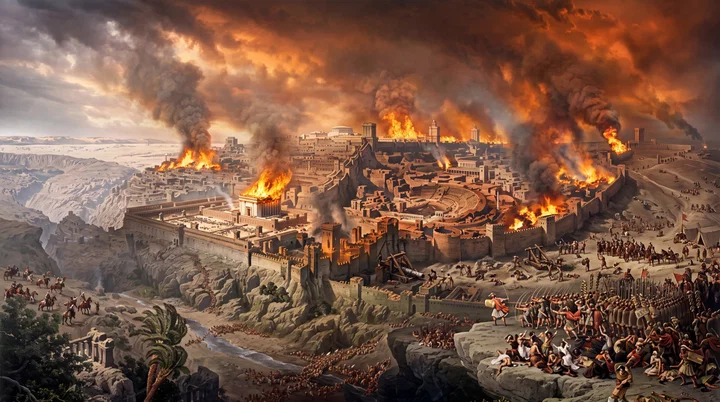
The woe is spoken to those with child and to those giving suck in those days, for special hardship and grief would fall on pregnant women and nursing mothers amid great distress in the land and wrath upon the people in Jerusalem's destruction.DA 627.1–3Lt 110, 1901, par. 8–11Ms 34b, 1885, par. 5GC88 30.4–31.1COL 269.2 The warning belongs to the prophecy of Jerusalem's siege and fall, when the city would be surrounded and thousands would perish.DA 627.1–3GC88 30.4–31.1COL 213.1–3 That word was fulfilled about forty years later when the Roman army destroyed Jerusalem.COS 95.3–6
The desolation came because the people rejected Christ, though had they received Him the city could have stood secure and become a source of peace to the nations.COS 95.3–6 The warning gave a sign and instruction to flee, so that when Jerusalem was surrounded those who heeded had opportunity to escape before the later calamities.GC88 30.4–31.1 The foretold distress and wrath included starvation and multitudes being crucified, suffering the same kind of death inflicted on Christ, and when calamity came the people remembered the warning.DA 840.5COL 269.2
Calamities befalling individuals were warnings to an equally guilty nation, urging repentance while there was still time to find refuge in Christ and know what belonged to its peace, since suffering followed neglect to let God-given light shine to the world.COL 213.1–3COL 269.2 The discourse reaches beyond the fall of Jerusalem to the final judgment and presents what may be expected in the time before Christ's coming.DA 627.1–3Lt 110, 1901, par. 8–11 The warning is also applied to the present time, when bringing children into the world is an occasion of grief rather than joy because children receive little parental care, are under Satan's influence, and may soon die.Ms 34b, 1885, par. 5
Sources
Pioneers and periodicals
73 sources
The verse plainly warns that pregnant women and nursing mothers will face exceptional suffering because flight and siege conditions will be especially hard for them, and that severe calamity and divine judgment will fall on the Jewish people and their land.ST Oct 8, 1894RH Sep 3, 1857ST May 14, 1896RH Jun 23, 1863ST Nov 14, 1900 The signal to flee Judea at once to the mountains without turning back is the abomination of desolation standing in the holy place, which is Roman armies surrounding the holy city and desecrating the temple with idolatrous standards, and the flight was to be prayed over that it not be in winter nor on the Sabbath.ST Nov 15, 1899ST Jan 24, 1906ST May 14, 1902ST Mar 4, 1903 Those who heeded the warning escaped during the unexpected withdrawal of Cestius Gallus to Pella before the final siege, when Jerusalem was surrounded and overrun under Titus in A.D. 70, its temple thrown down and the nation dispersed and trodden down by the Gentiles.RH Sep 3, 1857RH Dec 22, 1904ST Jan 24, 1906RH Dec 24, 1903ST May 14, 1902 That distress was fulfilled horribly in famine in which women ate their own children, because Jerusalem rejected Jesus as Messiah and the gospel, and when sin reached its limit the city was left desolate.ST Dec 11, 1928ST Mar 4, 1903ST Jan 11, 1905RH Oct 30, 1856 The fall was a real but only partial fulfillment, serving as a type of the greater events leading to the second coming, so the signs show the end is near and God's people must watch, be ready, and proclaim the last message of mercy.RH Feb 17, 1916ST Jun 3, 1897ST Apr 22, 1889
Words and Historical Setting
The woe falls upon women who are pregnant and upon mothers nursing infants in those days, marking them out because flight and siege conditions will bear upon them with exceptional hardship and suffering.ST Oct 8, 1894RH Sep 3, 1857ST May 14, 1896ST Jan 24, 1906ST Jun 11, 1896 Their state will make haste and endurance especially hard when great distress and divine wrath fall upon the people in those days.ST Oct 8, 1894RH Sep 3, 1857ST May 14, 1896ST Jul 21, 1898
The second half foretells great distress in the land and wrath upon this people, meaning severe calamity and divine judgment falling upon the Jewish people and their country.RH Jun 23, 1863ST Dec 11, 1928ST Mar 4, 1903ST Mar 4, 1903 That distress and wrath belong to the time of Jerusalem's final destruction, which followed rejection of Jesus as Messiah, when the city was laid to the ground and the inhabitants led captive among the nations.RH Jun 23, 1863ST Dec 11, 1928 Fulfilled horribly in the siege under Titus, it brought intensified suffering and such terrible famine that women ate their own children, and it is distinct from the troubles of the last days that will bring suffering and horror far in excess of Jerusalem's destruction.ST Mar 4, 1903ST Mar 4, 1903
The words were spoken on the Mount of Olives in A.D. 31 as part of Jesus' answer after the disciples pointed to the temple stones and buildings and He foretold that not one stone would be left upon another.ST Nov 15, 1899ST Jan 11, 1905 They reply to their questions about when the temple would fall, what would be the sign of His coming, and what would mark the end of the age.ST Nov 15, 1899ST Jan 17, 1906 Luke gives portions of that answer while Matthew and Mark preserve other portions, so all three accounts in Matthew 24, Mark 13, and Luke 21 must be studied together and compared with other prophecies of the same period to grasp its full meaning and to know the signs of the coming and of the end of the age.ST Jan 17, 1906ST Aug 14, 1893 The nearer destruction of Jerusalem was a real but partial fulfillment, depicting scenes belonging to the distant future and the end of the age, standing at the beginning of the Christian dispensation which runs down to the final ending of the controversy between Christ and Satan.RH Feb 17, 1916ST Jan 11, 1905
The verse means what it says in its most literal, obvious sense, stated in simple plain language as literal prophecy.ST Nov 8, 1905ST Apr 9, 1896RH Feb 21, 1856 Its predictions are set forth so clearly that even the simple and unlearned can understand, and only those who will not understand fail to understand.ST Aug 14, 1893ST Apr 9, 1896 As literal prophecy it foretells signs before His coming and marks the last days of earth's sorrow and travail with particular distinctness, showing that God gives a particular portion of truth applicable to each age of the world, as with Noah, with Lot, with Israel leaving Egyptian bondage, and with Jonah.ST Nov 8, 1905RH Feb 21, 1856
Command to Flee Jerusalem
Those in Judea were required to flee at once to the mountains when the time came.ST Nov 15, 1899ST Mar 4, 1903 The flight was to be with such haste that no one on a housetop or in a field would turn back for goods, and for that reason the condition of women with child and mothers giving suck was singled out as facing exceptional hardship.ST Nov 15, 1899ST Mar 4, 1903 The signal for that immediate flight was the abomination of desolation standing in the holy place, which was the Roman armies encompassing the holy city in the siege that overthrew Jerusalem.ST Nov 15, 1899ST May 14, 1902ST Mar 4, 1903 Their pagan soldiery would desecrate the temple and its holy precincts and plant their idolatrous standards there, hateful to the Jews and an abomination to the Lord.ST Mar 4, 1903
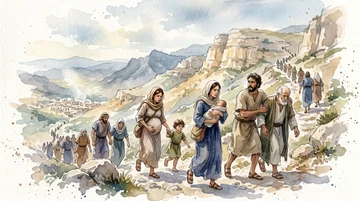
The disciples were to keep praying through the years until those events came that their flight would not be in winter nor on the Sabbath.ST Nov 15, 1899ST Jan 24, 1906 That answered prayer spared them added hardship from winter conditions and the burden of violating conscience and God's law by fleeing on the Sabbath.ST Nov 15, 1899ST Jan 24, 1906 Christians who heeded the signal were able to leave during the unexpected withdrawal of the Romans under Cestius Gallus after he had besieged Jerusalem.RH Sep 3, 1857ST Jan 24, 1906ST May 14, 1902 God thereby opened a plain way of escape even though they had been surrounded by hostile forces, and they escaped to Pella before the horrors of the final siege under Titus.RH Sep 3, 1857ST Jan 24, 1906ST May 14, 1902
The warning was given about forty years beforehand with advance signs, so the Jews could repent and the righteous could escape the coming distress and wrath.ST Sep 9, 1880RH Feb 21, 1856 It shows that God gives a particular portion of truth applicable to each age of the world, as with Noah, with Lot, with Israel leaving Egyptian bondage, and with Jonah, and so a like particular portion applies to the end of the world.RH Feb 21, 1856 That calamity upon Jerusalem and the final dispersion of the Jewish people was preceded by a faithful warning from God, and because the people rejected the gospel preached to them the destruction came without excuse for neglecting it.ST Sep 9, 1880ST Feb 19, 1880RH Mar 18, 1873
Fulfillment in Jerusalem's Fall
The great distress and wrath fell in the destruction of Jerusalem in A.D. 70, when the city was surrounded and overrun by the Roman army under Titus.RH Dec 22, 1904ST Jan 24, 1906RH Dec 24, 1903RH Mar 25, 1858RH Jan 7, 1904 Its temple and towers were brought down, the land was made desolate, and the second destruction and final dispersion of the Jewish nation was accomplished.RH Dec 22, 1904RH Dec 24, 1903ST Mar 4, 1903RH Oct 30, 1856ST This overthrow stands in Christ's outline of coming events from His time to the present, with only the final act still future.RH Dec 22, 1904RH Dec 24, 1903RH Jan 7, 1904RH Dec 10, 1903 Believers were given opportunity to flee, and the instruction to pray that flight would not be in winter or on the Sabbath spared them added hardship and the burden of violating conscience and God's law.ST Jan 24, 1906
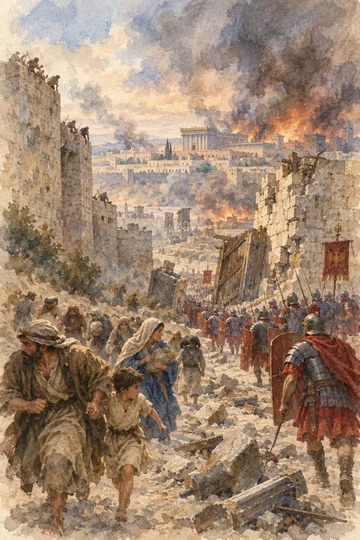
The siege brought terrible suffering that fulfilled the warning horribly, for famine grew so severe that women ate their own children.ST Mar 4, 1903 Mothers wailed as walls and towers fell and the temple burned, while pagan soldiery desecrated the temple and its holy precincts and planted idolatrous standards there.ST Mar 4, 1903 That fall brought a darker calamity than the earlier Babylonian assault.RH Oct 30, 1856
After the overthrow the inhabitants were carried captive among the nations and scattered, Jerusalem was laid to the ground and trodden down by Gentile powers until their probationary time ended.RH Mar 25, 1858ST Dec 11, 1928RH Jun 11, 1872RH Oct 18, 1870 After the return from the seventy years captivity in Babylon the Jews were never afterward an independent nation but were subject to the various ruling monarchies until that destruction in A.D. 70, and since then the Jews as a people have had no place on earth.ST Jul 23, 1885 Their continued agreement about the seventh day amid that scattering is evidence that the weekly reckoning was preserved, and the scattering of their children among the nations remains a sign that God's word does not fail.RH Jun 2, 1851RH Oct 18, 1870
The judgment came because Jerusalem had taken sides almost wholly with the forces of evil.ST Jan 11, 1905 It followed rejection of Jesus as the Messiah and rejection of the gospel preached by Him and the apostles, when only few decided in a way that saved them from the ruin hanging over the Jews and their city.ST Dec 11, 1928RH Dec 23, 1858ST That judgment followed accumulated crimes and apostasy, including responsibility for the Messiah's blood, and brought prolonged woe upon their descendants.RH Mar 30, 1869ST Apr 20, 1876 When sin reached its limit and iniquity was full the city was left a desolation, and its destruction stands at the beginning of the Christian dispensation running down to the destruction of Satan and his armies and the forever ending of the controversy between Christ and Satan.ST Jan 11, 1905
Prophecy Beyond Jerusalem's Destruction
Luke 21 belongs to a prophetic outline reaching from the destruction of Jerusalem to the second advent, tracing coming events in sequence from Christ's time to the present age. STRH Dec 22, 1904RH Dec 24, 1903RH Jan 7, 1904RH Nov 5, 1903 Its predictions, parallel to Matthew 24 and Mark 13, have been fulfilled and illustrated from the overthrow of Jerusalem in A.D. 70 onward, while only the final act remains future. RH Dec 22, 1904RH Dec 24, 1903RH Jan 7, 1904RH Dec 10, 1903RH Nov 5, 1903 The foretold conditions are manifest now, and the heavenly signs indicate the approach of the end, so that its last events are able to occur at almost any time. STRH Dec 22, 1904RH Dec 24, 1903
The capture of Jerusalem was a real but partial fulfillment, whose immediate reference is the tribulation of that time. RH Feb 17, 1916ST Apr 22, 1889RH Apr 12, 1915ST Aug 21, 1893ST Oct 20, 1909 That nearer destruction depicts scenes belonging to the distant future, symbolizing and serving as a type of the greater events leading to the end of the world and the second coming. RH Feb 17, 1916ST Jun 3, 1897ST Apr 22, 1889RH Apr 12, 1915ST Oct 20, 1909 The prophecy was therefore not exhausted by A.D. 70, its statements are not necessarily fulfilled in the order given, and the world at the second advent will be much like Jerusalem when its destruction was warned of. ST Jun 3, 1897ST Apr 22, 1889RH Apr 12, 1915ST Aug 21, 1893ST Oct 20, 1909
The great distress in the land and wrath upon the people belongs with the first clause of the next verse to that destruction, fulfilled in the suffering of the siege by the Romans. ST Mar 4, 1903 Jerusalem being trodden down by the Gentiles continues onward, even until the last sinner is saved for the kingdom, while the times of the Gentiles are prophetic periods described especially in Daniel when unconverted nations held supremacy, with a definite period ending in 1844 and an indefinite period then continuing until the close of probation and Christ's second coming. ST Aug 27, 1896ST Mar 4, 1903 That distress is distinct from the troubles of the last days in the following verses, including the seven last plagues, which will bring suffering and horror far in excess of the destruction of Jerusalem. ST Mar 4, 1903
In the sequence of the prophecy Luke's account of distress and wrath upon the Jews and their continuing suffering is distinguished from Matthew's and Mark's account of the long tribulation upon the church. ST Apr 24, 1879GSAM 67.2–68.1ST Jul 30, 1902ST Feb 17, 1881 That tribulation of Dark Ages persecution is dated as the 1,260 years from 538 to 1798, restrained by the Reformation so that it had ceased before that period ended. ST Apr 24, 1879GSAM 67.2–68.1 After it came definite heavenly signs showing His coming was near, the darkening of the sun and moon and the falling of the stars fulfilled November 13, 1833, which the generation bearing the last message of mercy after the end of the 2,300 days in 1844 must proclaim in fullness with all the prophecies. ST Apr 24, 1879GSAM 67.2–68.1 A long sequence stood before the end, with wars and rumors of wars and nation rising against nation impossible under Roman rule as only the beginning of sorrows, then the destruction of Jerusalem, the great tribulation running its course, false christs and false prophets including Mormonism and Spiritualism deceiving many, and worldwide trouble with perplexity, men's hearts failing for fear, and shaking of the powers of heaven, after which the Son of Man will be seen coming in a cloud with power and great glory, so that only the generation seeing the culmination of these things will not pass till all is fulfilled. ST Jul 30, 1902
The surrounding chapter foretells signs in sun, moon, and stars and distress among nations with the sea and waves roaring before Christ's coming, when His followers should look up because redemption draws near. STRH Sep 10, 1857RH Mar 16, 1869 Those foretold conditions of severe distress and calamity are applied to the present age and point to the coming destruction of the evil world, manifest in disasters such as Papeete, in wars, calamities, corruption and extravagance of nations, and in rapidly fulfilling signs warning that redemption is near. ST Mar 21, 1906STST Nov 14, 1900RH Sep 27, 1906 Extraordinary events in nature are thus explained as signs pointing to remarkable events in human history. RH Sep 10, 1857RH Mar 16, 1869
Links to Other Scriptures
Luke 21 belongs to one of three Gospel accounts of the same answer about the destruction of the temple, the coming of Christ, and the end of the age, with Luke giving portions and Matthew 24 and Mark 13 preserving other portions, so all three must be studied together and compared with other prophecies of the same period to grasp its full meaning and to obtain clear information about the signs of His coming.ST Jan 17, 1906ST Jul 30, 1902 It is Christ's own foretelling of world history and outline history of the world in His own words, fulfilled in consecutive order from His time to the present, from the overthrow of Jerusalem in A.D. 70 and Vesuvius and Pompeii in A.D. 79 through modern political upheavals and social disturbances among the nations, with only the final act still future.RH Jan 7, 1904RH Dec 15, 1904 The discourse was called forth by His declaration after viewing the temple stones that not one stone would be left upon another, and by the question of four disciples when these things would be and what would be the sign of His coming and of the end of the age. While the day and hour of His coming cannot be fixed, the signs given in this discourse show when He is nigh, even at the doors.ST Jun 30, 1909
Luke 21 with Matthew 24 and Mark 13 gives the signs of His coming and of the end of the age, including wars and rumors of wars and nation rising against nation and kingdom against kingdom, which were not manifest or possible then under Roman government and were only the beginning of sorrows with the end not yet.ST Jul 30, 1902 The destruction of Jerusalem with great distress in the land and wrath upon this people must come, the great tribulation must run its course, false christs and false prophets including Mormonism and Spiritualism must deceive many, and definite signs in the sun, moon, and stars with worldwide trouble, perplexity, men's hearts failing for fear, and shaking of the powers of heaven must appear, and then the Son of Man will be seen coming in a cloud with power and great glory.ST Jul 30, 1902 Jesus did not expect His second coming eighteen hundred years ago but placed this long sequence of events before it, so only the generation that sees the culmination of these things will not pass till all is fulfilled, for this does not mean His contemporaries.ST Jul 30, 1902 These heavenly signs include the darkening of the sun and of the moon and the falling of the stars coming at a particular time after the long tribulation of Dark Ages persecution, the 1,260 years, with the falling of the stars fulfilled November 13, 1833. These signs must be seen in the light of prophecy, and they are to be proclaimed in their fullness, with all the various prophecies of His Word, by the generation that bears to the world the last message of mercy after the end of the 2,300 days in 1844, the threefold message of Revelation 14:6-14 that the hour of His judgment is come.
The verse stands among the signs of Christ's coming and of the judgment that Christ gave in Matthew 24, Luke 21, Mark 13, and Revelation 6.RH Dec 9, 1851 Like the other prophecies named, Luke 21 begins at a different point in world history and carries the hearer forward to the glorious consummation of Christ's kingdom.ST Aug 5, 1913 It is one of twelve lines of symbolic and literal prophecy in Daniel, Revelation, Matthew 24, Mark 13, Luke 21, and 2 Thessalonians 2 whose concurrent agreement and fulfillment demonstrate progress through the Christian era and that the present time is the closing years of this dispensation and that the next great event is the second coming of Christ.ST Sep 10, 1894 It is part of a prophetic timetable of events marking progress through the Christian era toward Christ's coming.ST Oct 20, 1909 The object of these signs, in connection with the unsealed prophecies of Daniel and John, is that His people may know His coming is nigh, even at the doors, and only the generation able to know this nearness from the signs and the unsealed prophecies could give the judgment-hour message.RH Dec 9, 1851
The distress and wrath upon the people are among the signs that would precede Jerusalem's destruction, which came upon the Jews and Jerusalem, but the prophecy did not end with the city's destruction because Jerusalem remains trodden down by the Gentiles.RH Jun 23, 1863 The times of the Gentiles in Luke 21:20-24 are prophetic periods described especially in Daniel, when unconverted nations held supremacy and oppressed God's people.ST Aug 27, 1896 The definite period associated with these prophecies ended in 1844, and an indefinite period then continued until the close of probation and Christ's second coming.ST Aug 27, 1896 The solemn warnings in Matthew 24 and Luke 21 are handed down to the last generation, showing that God's children may know when Christ's coming is near, so when they see all these things, including great distress in the land, they know He is near, even at the doors.RH Dec 31, 1903ST Jun 30, 1909 As the fig tree shows summer is near, so when all the signs are seen it is to be known that He is near, even at the doors, that this generation, the generation witnessing all these signs of His coming, shall not pass till all these things be fulfilled, and that heaven and earth shall pass away but His words shall not pass away.ST Nov 28, 1895
Evidence and Present Warning
The fulfilled predictions surrounding this verse give mighty evidence of the divine stamp upon the canon of Scripture, showing divine authority behind it.ST May 1, 1907ST Sep 26, 1895 They stand among the strongest proofs of divine revelation and supports for Christianity, decisive even taken by themselves. The great distress that came upon Jerusalem when Roman legions besieged and destroyed the city fulfilled God's sure prophecy.ST Aug 18, 1909
The scattering of the Jews among the nations after Jerusalem's destruction left them still agreeing about the seventh day, which evidences that the weekly reckoning was preserved unbroken.RH Jun 2, 1851 The discourse containing this verse traces leading events from the first advent to the second, and its statements about definite time were difficult to reconcile with that outline in 1844.ST Dec 3, 1874RH Jan 21, 1873 It therefore strengthens the warning against claiming to know the time of the Second Advent, for the day and hour cannot be fixed.RH Jan 21, 1873 The chapter points to Christ's second coming as still future, not as something expected in His own lifetime, and its warning against setting definite time applies to the last generation.ST Mar 3, 1909RH Jan 21, 1873
Advance warning was given that Jerusalem would be destroyed, and all who cast their lot with Jerusalem were destroyed with it.ST Jun 16, 1898 Judgment falls not only on the doomed place but on all who join themselves to it, as with Sodom, and so it will be at the final overthrow of the world and its governments.ST Jun 16, 1898 Those who show by worldly banners that they are of the world will fall in the general collapse.ST Jun 16, 1898 Ruin hung over the Jews and their city while Christ and the apostles preached to them, and only few decided in a way that saved them from that ruin, proving that wrong decisions in matters of eternal consequence bring fatal destruction.RH Dec 23, 1858 The last days are evil and marked by great distress, and the world will not be converted before the end but will continue to oppose Christ and His true church until the end of the age, so believers must watch and wait for the return of the Son of man.ST Jul 1, 1908ST Aug 7, 1901
This literal prophecy of Christ's coming gives signs of that coming for those living just before it, who would also know other prophecies about events leading to the same climax. It belongs to Jesus' answer about signs preceding His coming, making it possible to know when the end is near, even at the doors. It is part of Christ's outline of events and trials leading to the end, in which the waymarks also mark changes in the duties of His people. It stands among the prophetic lines pointing toward the second coming, counted among the prophetic outlines shown to be fulfilled in the present generation.ST Nov 28, 1900RH Feb 6, 1855 The backsliding of the church and her union with the world leads her to seek more political power until church and state are united again with persecutions as in the Dark Ages against those who do God's will, while corruption and extravagance of the nations betoken disintegration and destruction, proving the world is living in the last days and that Christ's coming is near.ST Jan 2, 1907
Sources