Luke 19:43
For the days shall come upon thee, that thine enemies shall cast a trench about thee, and compass thee round, and keep thee in on every side,
Translations
For the days shall come on you, that your enemies shall cast a trench about you, and compass you round, and keep you in on every side,
King James Version, KJV Cambridge Paragraph Bible
For the days shall come upon thee, that thine enemies shall cast a trench about thee, and compass thee round, and keep thee in on every side,
For the days shall come upon thee, that thy enemies shall cast a trench about thee, and encompass thee, and keep thee in on every side,
Revised Version, American Standard Version
For the days shall come upon thee, when thine enemies shall cast up a bank about thee, and compass thee round, and keep thee in on every side,
'Because days shall come upon thee, and thine enemies shall cast around thee a rampart, and compass thee round, and press thee on every side,
for days shall come upon thee, that thine enemies shall make a palisaded mound about thee, and shall close thee around, and keep thee in on every side,
Because days will have come upon thee, that thine enemies will throw around a rampart against thee, and enclose thee; and hem thee in from every side,—
Berean Standard Bible, Majority Standard Bible
For the days will come upon you when your enemies will barricade you and surround you and hem you in on every side.
For the days will come on you when your enemies will throw up a barricade against you, surround you, hem you in on every side,
For the time will come when your attackers will put a wall round you, and come all round you and keep you in on every side,
For the dayes shall come vpon thee, that thine enemies shall cast a trench about thee, and compasse thee round, and keepe thee in on euery side,
Douay-Rheims (Challoner revision)
For the days shall come upon thee, and thy enemies shall cast a trench about thee, and compass thee round, and straiten thee on every side,
Pictures


Cross-references 20 of 23
- Matthew 23:37-38
O Jerusalem, Jerusalem, thou that killest the prophets, and stonest them which are sent unto thee, how often would I have gathered thy children together, even as a hen gathereth her chickens under her wings, and ye would not!
Jerusalem’s rejection of Christ’s care is joined to its coming desolation.
- Luke 21:20-24
And when ye shall see Jerusalem compassed with armies, then know that the desolation thereof is nigh.
Both describe Jerusalem surrounded by armies and the desolation and suffering that follow.
- Matthew 24:2
And Jesus said unto them, See ye not all these things? verily I say unto you, There shall not be left here one stone upon another, that shall not be thrown down.
Both foretell Jerusalem’s destruction, including the temple’s complete ruin.
- Daniel 9:26
And after threescore and two weeks shall Messiah be cut off, but not for himself: and the people of the prince that shall come shall destroy the city and the sanctuary; and the end thereof shall be with a flood, and unto the end of the war desolations are determined.
Foretells Jerusalem’s destruction after the Messiah is cut off.
- Deuteronomy 28:52-57
And he shall besiege thee in all thy gates, until thy high and fenced walls come down, wherein thou trustedst, throughout all thy land: and he shall besiege thee in all thy gates throughout all thy land, which the LORD thy God hath given thee.
Describes famine and distress during an enemy siege, as Jerusalem faced under blockade.
- Luke 13:35
Behold, your house is left unto you desolate: and verily I say unto you, Ye shall not see me, until the time come when ye shall say, Blessed is he that cometh in the name of the Lord.
Jerusalem’s rejection of Christ is followed by its house being left desolate.
- Matthew 24:15
When ye therefore shall see the abomination of desolation, spoken of by Daniel the prophet, stand in the holy place, ( whoso readeth, let him understand:)
The abomination warning precedes Jerusalem’s coming siege and destruction.
- Zechariah 12:8-9
In that day shall the LORD defend the inhabitants of Jerusalem; and he that is feeble among them at that day shall be as David; and the house of David shall be as God, as the angel of the LORD before them.
God promises to defend Jerusalem and destroy the nations that attack it.
- Matthew 23:38
Behold, your house is left unto you desolate.
Jerusalem’s desolation is pronounced before the coming siege.
- Nehemiah 1:3
And they said unto me, The remnant that are left of the captivity there in the province are in great affliction and reproach: the wall of Jerusalem also is broken down, and the gates thereof are burned with fire.
Both describe Jerusalem’s walls broken down and the people in distress.
- Matthew 22:7
But when the king heard thereof, he was wroth: and he sent forth his armies, and destroyed those murderers, and burned up their city.
The king’s army destroys the city as judgment after rejection.
- Luke 19:14
But his citizens hated him, and sent a message after him, saying, We will not have this man to reign over us.
Refusal to have the king reign echoes the rejection that brought the siege.
- John 11:47-53
Then gathered the chief priests and the Pharisees a council, and said, What do we? for this man doeth many miracles.
The leaders seek Jesus’ death to avert Roman destruction, but their decision leads toward Jerusalem’s fate.
- Mark 13:14
But when ye shall see the abomination of desolation, spoken of by Daniel the prophet, standing where it ought not, ( let him that readeth understand,) then let them that be in Judæa flee to the mountains:
Jesus warns of Jerusalem’s encirclement and urges people to flee.
- 2 Chronicles 36:19
And they burnt the house of God, and brake down the wall of Jerusalem, and burnt all the palaces thereof with fire, and destroyed all the goodly vessels thereof.
Jerusalem’s walls were broken down and the city destroyed.
- Jeremiah 38:17-18
Then said Jeremiah unto Zedekiah, Thus saith the LORD, the God of hosts, the God of Israel; If thou wilt assuredly go forth unto the king of Babylon’s princes, then thy soul shall live, and this city shall not be burned with fire; and thou shalt live, and thine house:
Zedekiah was told surrender would spare the city from siege and destruction.
- Zechariah 14:1-2
Behold, the day of the LORD cometh, and thy spoil shall be divided in the midst of thee.
Foretells nations gathering against Jerusalem and the city’s devastation.
- Micah 3:12
Therefore shall Zion for your sake be plowed as a field, and Jerusalem shall become heaps, and the mountain of the house as the high places of the forest.
Foretells Jerusalem becoming a plowed field.
- Jeremiah 19:11
And shalt say unto them, Thus saith the LORD of hosts; Even so will I break this people and this city, as one breaketh a potter’s vessel, that cannot be made whole again: and they shall bury them in Tophet, till there be no place to bury.
The shattered vessel pictures Jerusalem’s coming ruin.
- Deuteronomy 28:45
Moreover all these curses shall come upon thee, and shall pursue thee, and overtake thee, till thou be destroyed; because thou hearkenedst not unto the voice of the LORD thy God, to keep his commandments and his statutes which he commanded thee:
Disobedience brings pursuing calamity upon the people.
Commentary
Each commentary is drawn from primary sources: the writings of Ellen G. White and Adventist pioneers and periodicals. Each commentary is separate. Its own words are not a quotation; follow the references to read the source passages.
Ellen G. White
79 sources
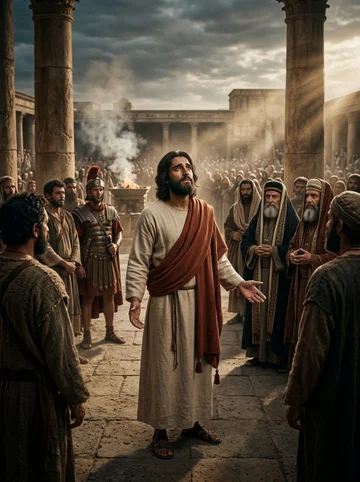
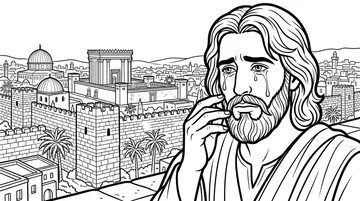
Spoken as He halted on the crest of Olivet overlooking Jerusalem during His triumphal entry, the verse foretells that enemies would cast siegeworks about the city, surround it on every side, shut its people in without escape, and lay it even with the ground with starvation, suffering and death till not one stone stood upon another.2SP 392.1–393.1GC 17.14RED 124.1–125.1DA 577.1–3Ms 54, 1886, par. 4–7 He spoke it amid triumphal shouting while foreseeing Calvary before Him and the coming mighty host, and His joy broke into wailing lament with tears bedewing the palm branches strewn in the way.4RED 122.2–123.2Ms 54, 1886, par. 4–7Ms 7a, 1886, par. 5Ms 7a, 1886, par. 3 This ruin would come because Jerusalem in spiritual blindness failed to know the things belonging to its peace and the time of its visitation, rejecting salvation, scorning His miracles, and crowning its guilt by crucifying its Redeemer.2SP 392.1–393.1GC 17.14RED 124.1–125.1Ms 102, 1897, par. 18–20 Had she accepted Him who alone could heal her, searched the Scriptures and obeyed God, no Roman army would have besieged her, she could have stood forever under the shield of the armies of heaven as a source of peace to the nations.2SP 392.1–393.1COS 95.3–6ST Feb 15, 1899 The warning was fulfilled about forty years later when Roman legions shut the inhabitants in and destroyed the city and temple by starvation, fire and scattering, after its people also refused submission as their last chance of safety.2SP 393.2–395.14RED 125.2–127.1DA 533.1–534.2COS 96.1 Jerusalem's temporal doom is a first foretaste and symbol of the final judgment on an unrepentant world hardened in unbelief, and His wholly unselfish tears over the city He loved still address all in every age who repay His love with neglect, warning that probation and mercy have a boundary.Ms 134, 1902, par. 2–34RED 122.2–123.2Ms 85, 1893, par. 3GC88 21.33MR 78.3–79.1
Triumphal Entry Setting
Luke 19:43 belongs to the account of Jesus' triumphal entry into Jerusalem, when the hopes of the crowds for a new kingdom were rising.DA 569.3–4 It was spoken as part of His final testimony about the doom coming upon the Jewish nation because of its impenitence, on a special occasion that witnesses would never forget and would always remember with its impression.Ms 134, 1902, par. 2–3Ms 7a, 1886, par. 1–2 The multitude that poured out from Jerusalem to join His company was fulfilling prophecy without knowing it, fulfilling the prophecy of Isaiah.Ms 7a, 1886, par. 1–2
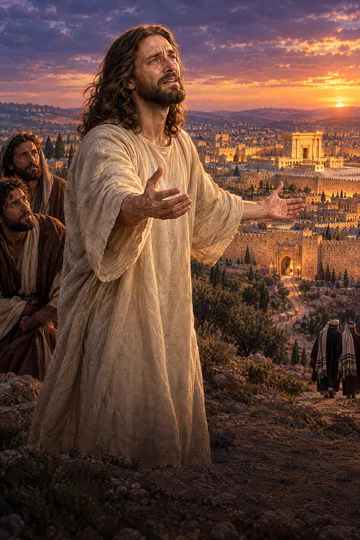
That multitude included people who had felt His healing power in their bodies, cripples who had been healed, blind whose eyes had been opened, lepers cleansed from impurity, and those raised from the dead.Ms 7a, 1886, par. 1–2 They spread their garments in the way and cried Hosanna to the Lord.Ms 7a, 1886, par. 1–2 He spoke halted on the crest of Olivet, on the summit overlooking the city, at sunset overlooking Jerusalem in all its glory amid general acclamation of triumph for the mighty works He had wrought.4RED 122.2–123.2Ms 7a, 1886, par. 5Ms 7a, 1886, par. 3 He spoke knowing the end from the beginning, seeing the tread of the coming mighty host, and seeing Calvary and Kidron at the foot of Olivet where He Himself would be stretched on the cross.Ms 7a, 1886, par. 5
While the multitude rejoiced, He wept in agony of tears that bedewed the palm branches strewn in the way, tears showing mercy and love toward a devoted city that rejected that mercy and love.Ms 54, 1886, par. 4–7Ms 7a, 1886, par. 3Ms 62, 1886, par. 19–23 In the midst of triumphal joy His sorrow broke like wailing into lament, unlike His God-like grief at the grave of Lazarus.4RED 122.2–123.2 The shouting multitude fell hushed while angels beheld their Commander in an agony of tears, His body rocking and anguish bursting from His quivering lips, with tears and groans of insuppressible agony.4RED 122.2–123.2
His triumphal entrance, cleansing of the temple, and judgment on the barren fig tree pointed to Jerusalem's doom, and His tears as He looked over Jerusalem were a final plea of rejected love and compassion.3SP 20.1 The judgment on the barren fig tree acted out the same warning, that Jerusalem and its temple would be destroyed because the nation rejected Christ and had become barren in piety and good works.Ms 32, 1898, par. 4–8
Siege Encirclement Described
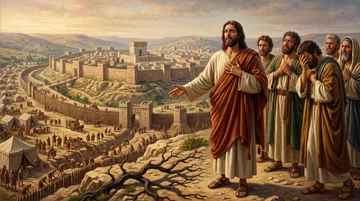
The days foretold would bring enemies casting a trench, ramp, siegeworks or army about the city, compassing it round and keeping it in on every side.2SP 392.1–393.1GC 17.14RED 124.1–125.14SP 17.1–2Ms 13, 1892, par. 26–28 That encirclement meant surrounding Jerusalem, shutting it in, cutting it off, trapping its people and preventing escape.4RED 124.1–125.1Ms 134, 1902, par. 2–3DA 577.1–32SP 393.2–395.1ST Feb 27, 1896 The city would be hemmed in and restricted on every side by hostile forces closing around it.2SP 392.1–393.14SP 17.1–2Ms 134, 1902, par. 2–3Ms 13, 1892, par. 26–28DA 645.1
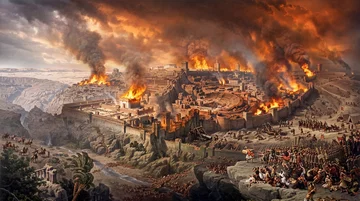
That shutting in would bring retribution in starvation, terrible suffering and death.2SP 392.1–393.1DA 577.1–3ST Feb 15, 18992SP 393.2–395.1DA 645.1 Enemy armies would lay the city and its inhabitants waste, laying her even with the ground with her children within her.2SP 392.1–393.1GC 17.1DA 577.1–3ST Feb 15, 18992SP 393.2–395.1 Not one stone would be left upon another, and the temple itself would be torn down.2SP 392.1–393.1GC 17.1DA 577.1–3ST Feb 15, 18992SP 393.2–395.1
He spoke this with the beautiful, seemingly secure city in view set against the approaching calamity He foresaw.4SP 17.1–2ST Feb 27, 1896DA 645.1 His knowledge of the coming siege and disaster moved Him to deep anguish and tears because He longed to save the people.4SP 17.1–2ST Feb 27, 1896DA 645.1
Rejection Caused Judgment
The encircling trench was judgment for rejecting the Redeemer, refusing His salvation, saving help, mercy and love, scorning conviction by His mighty miracles, and crowning that refusal by taking His life on the cross.2SP 392.1–393.14RED 124.1–125.1DA 577.1–3DA 575.3–576.1COS 95.3–6 The siege that shut the city in on every side and laid it and its people waste was retribution for failing to recognize the time of visitation, spoken by Christ with weeping over the doomed people.2SP 392.1–393.14RED 124.1–125.1ST Feb 27, 1896Ms 102, 1897, par. 18–20DA 577.1–3 Because the people rejected Christ, enemies would surround Jerusalem and bring it to desolation, though it might have stood forever and become a source of peace to the nations had they accepted Him and heeded His teaching.4RED 124.1–125.1Ms 102, 1897, par. 18–20DA 577.1–3DA 575.3–576.1COS 95.3–6
The city did not know in its day the things belonging to its peace, nor the time of its visitation, and therefore the days would come when enemies would cast a trench about her, compass her round, keep her in on every side, lay her even with the ground with her children within her, and leave not one stone upon another.2SP 392.1–393.1GC 17.14RED 124.1–125.1Ms 13, 1892, par. 26–28ST Feb 27, 1896 That failure was spiritual blindness, ignorance of God and Christ, impenitence, guilt, obstinacy, and disregard of repeated warnings and of the opportunity for peace.2SP 392.1–393.1GC 17.1Ms 13, 1892, par. 26–28ST Feb 27, 1896Ms 102, 1897, par. 18–20
The ruin need not have come, for had Jerusalem accepted Him who alone could heal her wound, no Roman encirclement and destruction would have fallen upon her.2SP 392.1–393.1COS 95.3–6ST Feb 15, 1899Ms 119, 1898, par. 6–7DA 241.4 Had the people searched the Scriptures honestly, recognized Jesus as Messiah, accepted the Redeemer, heeded His teaching and obeyed God, no Roman army would have besieged the city or placed it under Rome's yoke.2SP 392.1–393.1COS 95.3–6ST Feb 15, 1899Ms 119, 1898, par. 6–7DA 241.4 In that loyalty she could have stood forever and become a source of peace to the nations, with the armies of heaven shielding her from adversaries and the invisible host fighting for her, instead of God refusing to be her helper while enemies compassed her round and the proud temple burned till only smoldering ashes remained.2SP 392.1–393.1COS 95.3–6ST Feb 15, 1899RH Nov 13, 1900Ms 119, 1898, par. 6–7
The judgment came after centuries of resisted grace, with privileges abused, opportunities slighted, prophetic warnings, reproofs and counsels rejected, God's servants mistreated and abused, prophets put to death, and His vineyard trodden under foot.2SP 392.1–393.1Lt 20, 1892, par. 31–3219MR 97.2–99.2Ms 134, 1902, par. 7Lt 48, 1893, par. 38–40 For a thousand years the cloud of vengeance had been loading with ingratitude, formalism, hypocritical insincerity, Pharisaic pride and national apostasy before Him, yet though they were His property and their course offended Him, He bore long with them and did nothing to cut them off, having done all that could be done for His vineyard.Lt 20, 1892, par. 31–3219MR 97.2–99.2Ms 134, 1902, par. 7Lt 48, 1893, par. 38–40 Jesus saw the approaching calamity and wept in agony over Jerusalem as persistent refusal of grace and mercy brought the nation to the brink of ruin.Lt 20, 1892, par. 31–3219MR 97.2–99.2Ms 134, 1902, par. 7Lt 48, 1893, par. 38–40
Her day of mercy and privilege was ending and her probation was to pass when she crucified the Son of God, her day closing as the sun gilding her towers set and the whole nation given up to destruction.Lt 72, 1890, par. 21–22ST Mar 9, 1876Ms 7a, 1886, par. 5Lt 58, 1880, par. 4 Punishment was measured just according to the light from heaven that had shone upon her and been turned away, for she had refused untiring mercy, knew not the time of her visitation, and was blinded by sin so that she did not know her day was ending.Lt 72, 1890, par. 21–22ST Mar 9, 1876Ms 7a, 1886, par. 5 His tears over her impenitence added to her guilt, for they were not for His own coming agony, suffering, humiliation and shame at Calvary and Kidron at the foot of Olivet where He Himself would be stretched on the cross, but for giving up the people for whom God had done so much.ST Mar 9, 1876Ms 7a, 1886, par. 5Lt 58, 1880, par. 4
Fulfilled in Roman Ruin
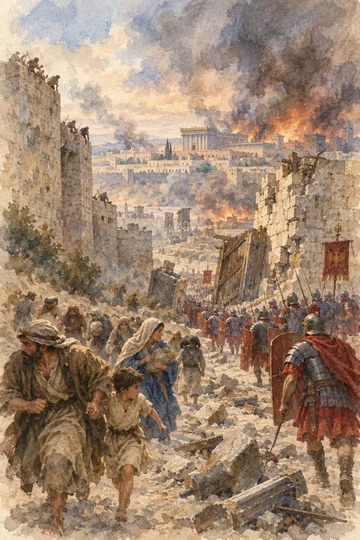
The warning was fulfilled when Roman legions and enemy armies surrounded Jerusalem, shut its inhabitants in, cut off escape and brought the city to ruin.2SP 393.2–395.14RED 125.2–127.1DA 533.1–534.2 What was foreseen as encirclement became siege and destruction, with terrible suffering visited as retribution for rejecting Jesus and His salvation.2SP 393.2–395.14RED 125.2–127.1 Inside the shut-in city the people suffered starvation and death.2SP 393.2–395.14RED 125.2–127.1
That same stubborn rejection of Christ's salvation led the people to reject submission to the invading armies, which was their last chance of safety.2SP 393.2–395.14RED 125.2–127.1 Though they would muster their forces for the defense of Jerusalem, God would not be their helper.RH Nov 13, 1900 The invisible host of heaven would not fight in their behalf while enemies compassed them round on every side.RH Nov 13, 1900
Many who were then mourning Lazarus would die in that siege with no hope in death.DA 533.1–534.2 That coming destruction followed the scene of Christ's humiliation and crucifixion.DA 533.1–534.2 The city's doom was sealed that night when its people rejected Jesus and were about to crucify their King, and about forty years later the Roman army utterly destroyed it and burned it with fire.COS 96.1
The retribution came for rebellion against God and hatred of the Roman power they were compelled to obey.RH Nov 13, 1900 The beautiful temple in which they prided themselves was seen consumed by fire till only a heap of smoldering ashes remained.RH Nov 13, 1900 The nation was scattered, its rich men despoiled of wealth gained by fraud and disobedience, the people dispersed through foreign countries as acknowledged citizens of none without any sure abiding place, and their children's children hunted from place to place and always refused protection or relief amid wails of anguish.RH Nov 13, 1900
Foreshadowing Final Destruction
The encirclement foretold for Jerusalem was a temporal judgment upon the covenant people for impenitence and rejection of salvation, and at the same time a first foretaste of the final judgment.Ms 134, 1902, par. 2–3GC88 21.3 It foreshadowed the destruction of the world at the second advent, pointing to the final destruction of the impenitent world.Ms 134, 1902, par. 2–3Ms 134, 1902, par. 10Ms 78, 1897, par. 30 In this the fate of the city serves as a symbol of a world hardened in unbelief and rebellion and facing retributive judgments, with Jerusalem representing the world and its besieging and ruin connected with the more terrible destruction of the world.GC88 21.3Ms 78, 1897, par. 30 The world before the first advent stands as a picture of the world before the second advent, showing the sure result of transgressing the law and refusing heaven-sent messages.6T 145.3Ms 134, 1902, par. 10 The weeping over the city and the foretold surrounding by enemies therefore look beyond Jerusalem itself to an impenitent world doomed to destruction.Ms 85, 1893, par. 3
The agonizing tears were shed not for Jerusalem only but in thought of the terrible retribution to fall upon an unrepentant world.Ms 57, 1901, par. 9Lt 125, 1886, par. 3 In the fate of Jerusalem was beheld the destruction of the world, for the Jewish nation was a symbol of people of all ages who scorn the pleadings of infinite love.Ms 56, 1902, par. 10–13 Those tears were for the sins of all time, not only the apostasy of the Jewish nation but the apostasy of the present time when the Protestant world departs from the principles of true Protestantism and churches whose spiritual declension is foretold look down the ages.Ms 56, 1902, par. 10–13 They are for all who abuse present privileges, who profess His name yet fail to become what was designed, who continue in sin and weakness from which they could be saved if they would come.Lt 125, 1886, par. 3 Vengeance will surely be visited upon those who have had so great light yet remain cold and unimpressible, with grace resisted, privileges abused, opportunities slighted, insincerity and hollow formalism and pride where earnest vital piety was expected, and ingratitude and abuse of blood-bought privileges registered against many entrusted with great and solemn truths.Lt 125, 1886, par. 3
As Sun and Light to that people He was about to be withdrawn because of stubborn refusal of offered mercy knocking at their hearts, in contrast to His soon coming in power and great glory.3MR 78.3–79.1 He knew the result of rejecting light and looked forward to strong armies encompassing the once-favored city and destroying its inhabitants, with the whole nation let go and cast off for iniquity because it did not know the things belonging to its peace.3MR 78.3–79.1 This shows there is a boundary to mercy where neglected blessings are recorded and persistent refusal leaves men given over to the power of Satan.3MR 78.3–79.1 The same will happen to all who now refuse the light for this time.3MR 78.3–79.1
The same pattern holds at the end, when warning is given because truth has been rejected and messages sent by God have been despised, yet the warning goes unheeded.Ms 161, 1897, par. 8–12Lt 21, 1897, par. 4–7 God sends by His ambassadors messages declaring that the end of all things is at hand, and some will listen but the vast majority will disregard them.Ms 161, 1897, par. 8–12 Farmers, merchants, lawyers and tradesmen left wholly engrossed in business will then be overtaken unprepared when He comes, as Lot's family was overtaken at Sodom.Ms 161, 1897, par. 8–12Lt 21, 1897, par. 4–7 The destruction of Jerusalem stands with the flood upon the antediluvian world and the destruction of Egypt's armies among God's judgments upon transgression, showing retribution that must come because of power man has taken to himself, including oppressive man-made unions bringing confusion and violence and strife and ruling men and acquiring means through underhand deception.4MR 90.5–91.3 Bible history is to be repeated, with most awful and unexpected calamities following one after another, and cities full of extreme transgression destroyed by earthquake, by fire, by flood, with devastation and death by unseen agencies to warn all the world that there is a God who will display His authority, so that notwithstanding scientific safeguarding one touch of the rightful Ruler brings idolatrous possessions and accumulated riches and magnificent display to nothingness.4MR 90.5–91.3 He cannot pass such injustice by with silence, for though He has borne long He has not been deceived but keeps strict account of every lie framed and every secret devising and will reward every transgressor according to works, yet if warnings are heeded and churches repent and return to allegiance other cities may be spared for a time, while if deceived men continue disregarding the law and presenting falsehoods He allows calamity that their senses may be awakened.4MR 90.5–91.3
The warning about judgment applies to similar scenes in the last great day, and the judgments coming upon the land make this a call to wakefulness and to come to Jesus.Ms 122, 1909, par. 24–26 It points also to the impending destruction of wicked cities and of cities devoted to idolatry, over which there is grief as there was over the doomed city that failed to recognize the time of its visitation.Ms 150, 1902, par. 18–19Ms 57, 1898, par. 15 Those who know the truth are therefore called to feel compassion and work to warn them rather than neglect them.Ms 150, 1902, par. 18–19
Christ's Sorrowing Love
Christ wept over the doomed people and the city He loved, with tears, groans of insuppressible agony and quivering lips expressing grief, tenderness, longing and pity over their guilt, hard-heartedness, crookedness and impenitence.Ms 102, 1897, par. 18–20ST Jul 22, 18864SP 18.1ST Jul 22, 1886Lt 34, 1898, par. 16–18 His weeping was the final pleading of rejected love and compassion, for He was their only hope and had come to bless and save them, yet they would not receive Him.Ms 102, 1897, par. 18–20Ms 123, 1909, par. 21–224SP 18.1RH Oct 8, 1901 The joyful crowd that surrounded Him did not understand His anguish as He contemplated the coming fate of the city trapped by its enemies in retribution for failing to recognize its time of visitation.Ms 102, 1897, par. 18–20ST Jul 22, 1886ST Jul 22, 1886
His tears were not in anticipation of physical suffering at His coming crucifixion, and no fear of pain, suffering, humiliation or shame moved His self-sacrificing soul.4RED 122.2–123.2Ms 7a, 1886, par. 5 Gethsemane and its darkness lay just before Him, and He saw Calvary and Kidron at the foot of Olivet where He Himself would be stretched on the cross, with the sheep gate of sacrifice pointing to His own sacrifice for the sins of the world.4RED 122.2–123.2Ms 7a, 1886, par. 5 He spoke halted on the crest of Olivet overlooking Jerusalem while the shouting multitude fell hushed, His body rocking and anguish bursting from His quivering lips as angels beheld their Commander in an agony of tears.4RED 122.2–123.2Ms 7a, 1886, par. 5
His sorrow was wholly unselfish, pierced by the sight of Jerusalem that had rejected the Son of God, scorned His love, refused conviction by His mighty miracles, and was about to take His life.4RED 122.2–123.2Ms 7a, 1886, par. 3 He was pierced by seeing her guilt in rejecting her Redeemer and what she might have been had she accepted Him who alone could heal her wound.4RED 122.2–123.2Ms 7a, 1886, par. 3 He was unwilling to give up the child of His care whom He had come to save, seeing a nation blessed with every advantage rejecting the only One who could give them peace and hope and rest, break the yoke from off their necks, and give them triumph and victory.4RED 122.2–123.2Ms 7a, 1886, par. 3
That same mercy and love that wept over a devoted city rejecting mercy moved Him to die for sinful man so that man would not perish in his sins.Ms 54, 1886, par. 4–7Ms 62, 1886, par. 19–23RH Aug 5, 1902 He bore day and night the weight of rebellious Jerusalem, grieving over its rebellion as a mother grieves over a son rebellious to God.Lt 34, 1898, par. 16–18Lt 124, 1893, par. 2–3 His tears expressed grief over willful rejection of the redemption He offered, since the people would not come to Him that they might have life, choosing instead thoughtless gaiety, social excitement and undisciplined inclination.1T 504.2–505.2Lt 34, 1898, par. 16–18 Souls are very precious in God's sight, and that same love led God to give His only begotten Son to be crucified to save sinners.Ms 54, 1886, par. 4–7RH Aug 5, 1902 The Redeemer is still grieved and longs after wandering individuals now, calling them to give their hearts to Jesus and find cheerful trust and a humble, happy walk with Him.1T 504.2–505.2Lt 34, 1898, par. 16–18
Warning for Later Generations
The solemn words belong not to the Jews only, for in weeping over Jerusalem Jesus looked down through the centuries even to the close of time.ST Aug 15, 1878ST Mar 9, 1876ST Jan 10, 1878 They are addressed to all in every age who repay His love and admonitions with selfishness and neglect, who scorn His counsels and love and despise and hate His servants for speaking the truth.ST Aug 15, 1878ST Mar 9, 1876 Many today in like manner draw upon themselves the wrath of God because opportunities are unheeded, mercy and privileges and warnings are refused, and persistent unbelief and disobedience leave them bound in doubt and despair.ST Aug 15, 1878ST Mar 9, 1876DA 587.1–3 Judgment is proportionate to the light received, for God gives light, warnings, and opportunities to repent, and when resistance is persisted in until there is no response left, mercy's final appeal has come and rejecting reproof brings condemnation with no means of deliverance.ST Jan 10, 1878DA 587.1–3
Those who receive great light and opportunity but respond with neglect and unfaithfulness bring judgment upon themselves, as Jerusalem brought destruction upon itself by rejecting Christ's mercy and failing to recognize the time of its visitation.4T 191.3–192.18T 68.1 Jerusalem's rejection stands as a warning to churches, for those who turn from the light they have received repeat her sin and face the consequences of that course.8T 68.1STGC 38.2–39.1 Persistent departure from just and righteous principles can leave them unable to discern light, truth, justice, or mercy.8T 68.1 The same sorrowful, displeased gaze that rested upon impenitent, ignorant Jerusalem rests upon spiritual backsliding and danger at Battle Creek.Ms 61, 1890, par. 4–6Ms 40, 1890, par. 2–6
The words spoken upon Olivet reach to the present time, and the tears shed there were shed for present impenitence.3SP 12.1 The same great light given to the Jews is now sent, with reproofs, entreaties, warnings, and the Saviour's yearning love to warn sinners of danger and rouse them to repentance.3SP 12.1 As the temple courts were desecrated by unholy traffic, so the temple of the heart where Christ should dwell is now defiled by selfishness, love of the world, malice, envy, and unholy passions.ST Aug 15, 18783SP 12.1 The messages are too often received as idle tales, and many who profess godliness remain as unsanctified as the Pharisees, with thousands rejecting the light of truth because it involves a cross and does not harmonize with their practices and natural inclinations.3SP 12.1
The condemnation falls on those who claim to represent Christ while their lives deny Him through selfishness, love of wealth, and desire for worldly honor.3SP 9.2Lt 125, 1886, par. 3 It falls on those entrusted with great and solemn truths where earnest, vital piety should be expected but insincerity, hollow formalism, and pride are seen instead, where grace is resisted, privileges abused, opportunities slighted, and blood-bought mercies met with ingratitude registered in heaven.3SP 9.2Lt 125, 1886, par. 3 It warns all today who have seen great evidence of His power, goodness, and mercy but have not fulfilled God's purpose for them, that a time comes when the results of a wrong course must be faced.Ms 106, 1902, par. 27Lt 125, 1886, par. 3 Vengeance will surely be visited upon those who have had so great light yet remain so cold and unimpressible that no light shines from them to the world.Lt 125, 1886, par. 3
Paris likewise had its chance to hear the gospel, but most rejected it.GC 222.2–223.1 After failing to recognize the things belonging to its peace, its churches were closed and persecution returned.GC 222.2–223.1 Jerusalem's ruin likewise warns against concentrating too many responsibilities and interests in Battle Creek lest similar evils come.7MR 351.1 In that weeping over Jerusalem was shown the very same corrupting influences that would corrupt God's cause at the heart of the work, namely selfish dealings carried on by business maxims based on false principles, with which men vitalized by the Spirit of Christ will never comply in even a single transaction.Ms 26, 1899, par. 11–12
A time of opportunity and visitation will not last, for privileges can be abused or rejected and then lost.Lt 16, 1875, par. 25 This is the day of healing and the day of opportunity, in which God's people are to exemplify before a world sunken in sin and selfishness the sinlessness of the Redeemer's character.Ms 57, 1901, par. 9 Real laborers share His care-worn, oppressed spirit when they see crookedness, impenitence, and refusal to listen, and with the last message of mercy going to the world and the coming of the Lord near, ministers must carry that burden with zeal, living interest, and intense effort for precious souls, while power attends the last warning only a little while.Lt 16, 1875, par. 25Ms 57, 1901, par. 96MR 73.1–2
His grief is the model for grieving over those who stray from the truth, seeking to restore them with love rather than condemn them.Lt 66, 1884, par. 11–13 The world where He suffered in agony is still filled with people perishing in sin.Ms 122, 1898, par. 12
Sources
Pioneers and periodicals
85 sources
The days coming upon Jerusalem meant its enemies would throw up a trench and siege embankment around it, encircle it on every side, shut it in and cut off escape and supply until it was brought to distress and ruin.RH May 13, 1909ST Jun 3, 1897ST Sep 17, 1894 It was spoken weeping over the city at His triumphal entry from the Mount of Olives because it did not know the things belonging to its peace nor recognize the time of its visitation in Him as Messiah.RH Feb 21, 1907ST Sep 27, 1910ST Oct 5, 1904 That guilt was their own choosing, for they rejected His mercy, delivered Him to the Romans and crucified Him, breaking the covenant by their wickedness and traditions, and had they repented and received Him no Roman army would have besieged them, but He withdrew His protection and gave the city up.ST Feb 15, 1899ST Oct 25, 1899ST Nov 8, 1883ST Nov 8, 1883 The word was literally fulfilled less than forty years later when the Romans under Titus built a wall about the whole city, hemmed it in without supplies, destroyed city and temple to the ground, slew more than a million and led the rest captive into all nations.ST Feb 15, 1899RH May 13, 1909ST May 31, 1910ST Jun 17, 1913ST So Jerusalem's doom stands as a type of the final destruction of a doomed world, warning that probation does not last forever and the last generation will perish like the Jews if it neglects the evidence, fails to discern the signs of the times and does not know when Christ is near.RH Apr 29, 1909RH Jul 25, 1854RH May 14, 1901ST Oct 21, 1880ST Jun 22, 1882
Wording and Historical Setting
The verse foretells that Jerusalem's enemies would cast a trench, embankment and siegeworks about the city, compass it round, shut it in and keep it in on every side, cutting off escape and supplies, trapping its inhabitants and bringing distress and ruin.RH May 13, 1909ST Jun 3, 1897ST Sep 17, 1894ST Feb 11, 1913ST Sep 27, 1899 The surrounding would be complete, leaving the city without supplies and helping bring about its capture, and the threat follows the city's refusal to accept God's message of healing and peace.RH May 13, 1909ST Feb 11, 1913ST May 31, 1910 The prediction was literally fulfilled, and later attempts to frustrate it failed.ST May 31, 1910
The word days means full periods of twenty-four hours embracing both night and day, as in other New Testament texts where periods of days or a succession of days are specified.RH Dec 12, 1871 The verse was spoken by Jesus as he approached Jerusalem at the triumphal entry, when the city came in full view from the descent of the Mount of Olives, weeping over it.ST Jul 22, 1886ST Sep 27, 1910STST Sep 27, 1899 It belongs to the scene of Christ's triumphal entry and weeping over Jerusalem, and to his lament, tears and anguish as he contemplated the city's coming fate which the joyful crowd did not understand.ST Jul 22, 1886ST Sep 27, 1910STST Apr 23, 1902 Luke 19 gives the fullest account of that scene, with parallel accounts in Matthew 21, Mark 11 and John 12.ST The prediction was made as Jesus approached Jerusalem in A.D. 31, five days before his death, coming after the foretelling of death, the healing of the blind man, the call of Zacchaeus and the parable of the pounds, and before the parable of the husbandman, the questions of the Pharisees and Sadducees, and the discourse on the destruction of Jerusalem and the second coming, and the following verse says the city would be destroyed because its people had not recognized the time of their visitation.ST Sep 27, 1899
The setting shows the disciples expected God's kingdom to appear immediately, so Jesus spoke the parable of the nobleman to correct that expectation, yet their triumphant welcome shows they still did not understand he was going to Jerusalem to be condemned and crucified.ST Sep 16, 1889 Luke 19 preaches of his coming kingdom on earth when oppression will end and peace and happiness will come to God's people. The days coming upon Jerusalem mean its grand temple worship was about to pass away, after religion had become mere form and earthly pomp and glory mattered more than true worship.RH Sep 17, 1903
The mountain from which Jesus sorrowed over sinners is where his tears were shed, from which he ascended triumphant over sin and all earth's attractions and powers, demonstrating his everlasting victory over sin.ST Sep 10, 1902 His feet will first rest there when he comes again as King of kings and Lord of lords to reign in his eternal kingdom.ST Sep 10, 1902
Cause of Jerusalem's Doom
The trench to be cast about Jerusalem was to come because the city did not know the things belonging to its peace and did not recognize the time of its visitation in Jesus as Messiah.ST Oct 5, 1904RH May 10, 1915ST Jan 2, 1879RH Apr 29, 1909 That ignorance was inexcusable, for the people had strong evidence, prophetic guidance, repeated warnings, calls to repentance, and every essential evidence of His anointing.RH Feb 21, 1907ST Jan 2, 1879 Had they known and heeded the prophets they could have recognized and accepted Christ instead of condemning Him, but they rejected the One who could save them.ST Oct 5, 1904ST Jan 2, 1879 The warning therefore shows that opportunities may be given repeatedly, yet a final chance comes when what is left undone decides the outcome.RH Feb 21, 1907
The people were responsible and guilty for not knowing. Many refused to come to Him for life or to confess Him because they valued human approval above God's honor. They hid from themselves the things of righteousness that belonged to their peace, and in rejecting Christ they rejected the principles that could have brought them life and peace.ST Oct 25, 1899 In rejecting Him they rejected His mercy, help and redemption, rejected Him as Savior and King, delivered Him to the Romans, crucified Him and chose Barabbas instead, reaping the fruit of their own choosing.ST Nov 8, 1883ST Nov 8, 1883ST Nov 8, 1883RH Nov 13, 1856
That blindness came by wickedness, sin and disobedience.ST Nov 13, 1884ST Apr 19, 1883 They broke the covenant by violating God's law, set aside His commandments through their traditions, rejected God's prophetic guidance and prophetic light, turned away from what would have brought them to Christ, corrupted temple worship, turned from the Lord to Caesar, rejected the distinctive gospel message sent through John the Baptist to prepare them, and stoned and killed His prophets.STST Nov 13, 1884RH Apr 21, 1868ST Nov 28, 1895ST Nov 7, 1895 Their foolish heart was darkened so that when Messiah came unto His own they received Him not and knew neither Him nor the Father, and the central issue in their opposition included the conflict between Jesus' principles of true Sabbath-keeping and the leaders' views.ST Nov 13, 1884 The same condemnation stands over any nation or Christendom that covers God's law with human traditions, especially by transgressing His Sabbaths and even compelling people by law to obey the traditions of men.ST Nov 13, 1884
The destruction was not God's desired outcome.ST Apr 19, 1883 Had they known, repented, prepared and received Him with all the heart, the city that might have stood forever could have been saved.ST Feb 15, 1899ST Mar 9, 1876ST Apr 19, 1883 No Roman army would have besieged the city or placed it under Rome's yoke, and had they been loyal to God the armies of heaven would have shielded them from their adversaries.ST Feb 15, 1899RH Nov 13, 1900 He had labored untiringly to save them from the fate they seemed determined to bring upon themselves, but they refused His mercy.ST Mar 9, 1876 In rejecting Christ as King He withdrew promised protection and gave the city up to destruction, leaving a house of prayer open to all nations unclaimed.ST Nov 8, 1883ST Nov 8, 1883ST Apr 19, 1883
That judgment marked the end of Israel's special standing as Messiah's people, with the kingdom taken from them and given to a people producing its fruits.RH Nov 13, 1856 Literal descent from Jacob did not exempt them from judgment or guarantee salvation.ST Aug 13, 1912 Having sown to the wind they reaped national extirpation and worldwide dispersion, led away captive into all nations, wandering over the earth and dispersed through foreign countries without any sure abiding place.RH Nov 13, 1900ST Dec 11, 1928ST Aug 13, 1912 Jerusalem was laid even with the ground and trodden down by Gentile nations until their probationary time should also end, and the city ceased to be the nation's center of worship and seat of authority and ceased to be the capital of a Jewish nation.ST Jun 17, 1913ST Dec 11, 1928RH May 1, 1913 If they had received Him when He came, their history would have been different.ST Dec 11, 1928
Siege and Fulfillment by Rome
The prediction was literally fulfilled when Roman forces surrounded Jerusalem, threw up siegeworks against it, encircled it with a trench, hemmed it in and shut it in on every side so that none could escape.RH May 13, 1909ST May 31, 1910ST Jun 17, 1913ST Dec 3, 1894 The blockade cut off the city completely and brought it to capture, ruin and desolation because its people had not recognized the time of their visitation.RH May 13, 1909ST Jun 17, 1913 Its splendor was reduced to ashes, the city with its sanctuary and temple was taken and destroyed, laid even with the ground with not one stone left upon another, and the Jews were led captive into all nations.ST Jun 17, 1913ST Dec 3, 1894RH Jun 11, 1857ST Sep 27, 1899 The destruction of Jerusalem and its sanctuary in A.D. 70 fulfilled the warning given amid the Jews' revolt, and the city ceased to be the nation's center of worship and seat of authority.ST Jun 17, 1913ST Dec 3, 1894RH Jun 11, 1857
Titus ordered a wall built around the whole city to stop the Jews from coming out, nearly six miles long and completed in three days, leaving the city without supplies.RH May 13, 1909 The siege under Titus brought famine, starvation, terrible suffering and ruin, with the temple torn down and consumed by fire.ST Feb 15, 1899RH May 13, 1909RH Feb 21, 1871 More than a million people were killed in the siege and slaughter, which was both judgment and the harvest of the people's own choices, including choosing Barabbas instead of Christ, while many were captured and sold into slavery.ST Aug 18, 1909RH Feb 21, 1871 Roman forces surrounded the city, besieged it, shut it in on every side, brought down its walls and temple, set Roman banners flying over its walls, and left its streets running with blood.STSTRH Feb 21, 1871
The warning was spoken as Jesus approached Jerusalem in A.D. 31, and it was fulfilled nearly forty years later, less than forty years after Christ's death.ST Sep 27, 1899ST Feb 11, 1913 A generation later the people rebelled against Rome, the Roman army encamped on the very ground where the words had been spoken and reduced the city's splendor to ashes.ST Sep 27, 1899ST Feb 11, 1913 Jerusalem fell in A.D. 70 after enemies surrounded it with siegeworks, closed it in on every side and brought it under siege with terrible suffering.ST Sep 27, 1899ST Feb 11, 1913 The disciples who heeded the teaching, recognized the signs of the coming overthrow and understood the calamity that would follow rejection of Christ, escaped when the Roman army approached, fleeing to the mountains when the army under Cestius withdrew.RH Apr 16, 1872RH Dec 3, 1867
The prediction was literally fulfilled, and Julian the Apostate later tried to frustrate it and failed.ST May 31, 1910 Jerusalem's later condition and the events that prevented the rebuilding of the temple stand as fulfilled evidence that the words were true and could not be overturned by human plans or power.ST May 31, 1910ST Jun 17, 1913
Warning for the Present Time
The Jews stood guilty for failing to understand fulfilled prophecy, and that failure brought destruction upon them when their enemies surrounded the city, built an embankment against it, and shut it in on every side.ST Aug 27, 1885ST Mar 27, 1884ST Oct 23, 1884 The threatened consequence of not recognizing the time of visitation was ruin, with the city surrounded and confined and its inhabitants trapped without escape.ST Mar 27, 1884ST May 8, 1884ST May 29, 1884 Failing now to understand the times plainly pointed out in Daniel's prophecy for the time of the end brings the same guilt and a similar fate of calamity and ruin.ST Aug 27, 1885ST Jun 26, 1884ST Oct 23, 1884
God gives notice of events beforehand, and people are accountable for neglecting evidence, discerning the signs of the times, and heeding timely warning.RH Jul 25, 1854ST Oct 21, 1880RH Jun 3, 1873 Jerusalem's overthrow followed its failure to discern the signs and recognize the day of its visitation, and Israel was destroyed because it failed to heed God's word.ST Oct 21, 1880RH Jun 3, 1873ST Nov 28, 1895 Those who fail to know when Christ is near, even at the doors, will like the Jews be unaware of their visitation and will perish, and the last generation will likewise suffer if it does not heed God's word.RH Jul 25, 1854RH May 14, 1901ST Nov 28, 1895 The Jews rejected prophetic light about their own time and the destruction coming upon them, and through lack of submission brought swift destruction upon themselves as a nation, standing as a national example of what happens when people refuse counsel and fail to prepare, proving how important it is to have knowledge of the time and of events about to transpire so obedience may test the heart.ST Oct 21, 1880RH Apr 21, 1868RH Jun 3, 1873
The warning belongs to a day of visitation and probation that does not last forever.ST Jun 22, 1882ST Feb 14, 1878RH Feb 21, 1907 Jerusalem's day of mercy was nearly over, though repentance and salvation remained possible while that day lasted, and its doom followed rejection of warnings and of Christ.RH Feb 21, 1907ST Jun 22, 1882ST Feb 14, 1878 Its accepted time had passed while the city still appeared peaceful, and letting the time of probation pass without heed is the danger.ST Feb 14, 1878RH May 18, 1905RH Feb 21, 1907 Opportunities may be given repeatedly, but a final chance comes when a thought, act, or word may decide eternal destiny, and what is left undone can determine the outcome.RH Feb 21, 1907ST Jun 22, 1882ST Feb 14, 1878 Israel failed to recognize its own day, and the present signs of upheaval and declining faith show the time for action is nearly past.RH May 18, 1905RH Feb 21, 1907RH Jul 7, 1910
The destruction of God's holy city under just retribution for its sins is also a type of the final destruction to come upon the great city.RH Apr 29, 1909RH Aug 15, 1865ST Feb 4, 1913 The judgment that followed the nation's rejection of Jesus, when enemies surrounded the city with siege works, closed it in on every side and prevented escape, serves as a pattern for grieving over a doomed world and a fallen church facing calamity.RH Apr 29, 1909RH Jun 30, 1874RH Aug 15, 1865 Britain likened to Jerusalem shows the city's national doom was fixed after it rejected the things that could bring it peace, even while individuals may still accept the Saviour and escape.RH Apr 29, 1909RH Jun 30, 1874ST Feb 4, 1913 The sight of a large, populous, proud and corrupted city recalls Christ weeping from the descent of Mount Olivet, with the lesson that few in such a city are prepared for the coming time of trouble, though God knows those who are His and will open for them a way of escape, while individuals could still receive saving mercy by remaining faithful.RH Apr 29, 1909RH Jun 30, 1874RH Jul 28, 1868
The warning is a present test of loyalty to the work and message, shown in giving, which is life or death to each person.RH Feb 21, 1907ST Feb 27, 1912RH Feb 21, 1907 Careless indifference at this moment becomes the point of turning by degrees and finally wholly from the ranks in the final death-grip struggle of the ages, while truth itself will still be proclaimed even if the very stones must cry out.RH Feb 21, 1907RH Feb 21, 1907 Before Christ's second coming, professed followers ignorant of prophecy and the things belonging to their peace face ruin, having failed to recognize the things that would bring them peace and the time of their visitation.RH Feb 21, 1907ST Feb 27, 1912ST Dec 25, 1901 Many thousands who rejected Christ died a cruel death in the siege, refusing Him their hearts and refusing to have Him reign, reaping the fruit of their own choosing.ST Feb 27, 1912ST Dec 25, 1901 So it will be with all who reject Him: if He is not let to reign in the heart and if His law is not the law of the life, when He comes to reign forever over a renewed and glorified earth they will not know Him but will have chosen a king to everlasting destruction.RH Feb 21, 1907ST Dec 25, 1901
Christ's Sorrow and Example
The verse belongs to the lament and bitter wailing with which Jesus wept over Jerusalem as the joyful crowd around Him did not understand what was coming.ST Jul 22, 1886ST Sep 27, 1910RH Mar 3, 1904 He foresaw down the future years the city's awful destiny in siege, encirclement, shutting in on every side, starvation and ruin, and He grieved because the city He loved faced destruction it did not understand after refusing to receive Him when He came to be made an offering for transgressions despite every essential evidence of His anointing.ST May 17, 1905RH Mar 3, 1904ST Dec 3, 1912 Instead of the peace and joy they might have had, fearful calamities would come upon that people and their doomed city because they knew not the things belonging to their peace nor the time of their visitation, and the calamities they feared came because they did not obey God's Word.ST May 17, 1905RH Mar 3, 1904ST Feb 2, 1882 His tears and anguish showed yearning love, pity and a breaking heart over guilt, ingratitude and righteous doom, longing to pardon and release a chosen and favored people who had stoned and killed the prophets, denied His servants, and sought to take His life and crucify Him, until their cup of wrath was almost filled and could not be turned away.ST Jul 22, 1886ST Mar 9, 1876ST Dec 3, 1912 That sorrow over righteous doom was too great to hold inside and was greater than the prospect of suffering on the cross.ST Jul 22, 1886RH Mar 3, 1904 The same voice rings down the years pleading for His people to come away from worldly pleasures, worldly strife and things the world holds dear, for the fields are white for harvest and the Judge will soon appear, no one can love the world and love and follow Him whom the world gave scoffs and sneers and death on Calvary, it is evening-time with earth's sun almost set, and the coming day brings glad hearts or vain regret.ST Dec 3, 1912
His grief over Jerusalem's estrangement reaches beyond that city, for the tears and words spoken from Olivet apply to each person and to all in every age who repay His love and admonitions with selfishness and neglect.ST Aug 15, 1878ST Mar 9, 1876ST Jan 10, 1878 Judgment is proportionate to light received, for God gives light, warnings, privileges and opportunities to repent, and those who refuse offered mercy draw retribution upon themselves even while their day of privilege is ending and they are so blinded by sin that they know it not.ST Aug 15, 1878ST Mar 9, 1876ST Jan 10, 1878 Persistent unbelief and disobedience leave people bound in doubt and despair, as sin desecrates the human heart as unholy traffic desecrated the temple, and Jerusalem's judgment reached its climax in His crucifixion after He had labored untiringly to save a people determined to bring fate upon themselves.ST Aug 15, 1878ST Mar 9, 1876 His grief is a parallel to His grief and pleading for sinners in the last moments of time before judgment brings destruction upon transgressors of God's law.RH Oct 8, 1901 In the same way He weeps over a self-deceived and willingly ignorant world today that wants a form of godliness without the power that regenerates the life, as He wept over perverse and self-deceived Jerusalem.ST Nov 9, 1915
His response shows strong, tender love that longed for sinful and weak people to choose righteousness and life, drawing all by love, but would not compel them.ST Dec 4, 1893ST Jan 23, 1879 Warning of judgment belongs with words of love that sweetly warn and awfully persuade, joining the fiery law with affection.ST Jan 23, 1879 His example calls workers to carry a deep burden for those who need salvation and to share His broken heart and mingle their tears with His.RH Dec 3, 1903RH Nov 30, 1911 Every true follower who has caught His spirit and realizes the importance of the hour must weep over large cities in their present sinful condition as their probation hastens to its close and destruction comes, and must do more than weep by entering them, cleansing, preaching the gospel, healing the sick, warning of coming doom and of a soon-coming Saviour, and perhaps laying down life in the effort, even as He entered Jerusalem, cleansed its temple, preached, healed and laid down His life yet failed to save the city.RH Jul 7, 1910RH Dec 3, 1903 That consecration is to be unreserved and expressed in individual, constant, united effort in little things, correcting others with compassion and care, mourning for sin, weeping with those who weep, and imparting truth with urgency while power attends the last warning.RH Dec 3, 1903ST Dec 4, 1893RH Oct 20, 1874
Sources