Luke 23:40
But the other answering rebuked him, saying, Dost not thou fear God, seeing thou art in the same condemnation?
Translations
But the other answering rebuked him, saying, Do not you fear God, seeing you are in the same condemnation?
King James Version, KJV Cambridge Paragraph Bible
But the other answering rebuked him, saying, Dost not thou fear God, seeing thou art in the same condemnation?
But the other answering, rebuked him, saying, Dost not thou fear God, seeing thou art in the same condemnation?
Revised Version, American Standard Version
But the other answered, and rebuking him said, Dost thou not even fear God, seeing thou art in the same condemnation?
And the other answering, was rebuking him, saying, 'Dost thou not even fear God, that thou art in the same judgment?
But the other answering rebuked him, saying, Dost thou too not fear God, thou that art under the same judgment?
But the other, answering, rebuked him, and said—Neither fearest, thou, God, in that thou art, in the same judgment?
Berean Standard Bible, Majority Standard Bible
But the other one rebuked him, saying, “ Do you not even fear God, since you are under the same judgment?
But the other answered, and rebuking him said, “Don’ t you even fear God, seeing you are under the same condemnation?
But the other, protesting, said, Have you no fear of God? for you have a part in the same punishment,
But the other answered, and rebuked him, saying, Fearest thou not God, seeing thou art in the same condemnation?
Douay-Rheims (Challoner revision)
But the other answering, rebuked him, saying: Neither dost thou fear God, seeing thou art condemned under the same condemnation?
Pictures
Cross-references
- Luke 23:34
Then said Jesus, Father, forgive them; for they know not what they do. And they parted his raiment, and cast lots.
Jesus prayed for his executioners while suffering on the cross.
- Matthew 27:44
The thieves also, which were crucified with him, cast the same in his teeth.
Both thieves initially mocked Jesus while crucified beside him.
- Mark 15:32
Let Christ the King of Israel descend now from the cross, that we may see and believe. And they that were crucified with him reviled him.
The other crucified man rebukes his companion while both are crucified with Jesus.
- Luke 23:33
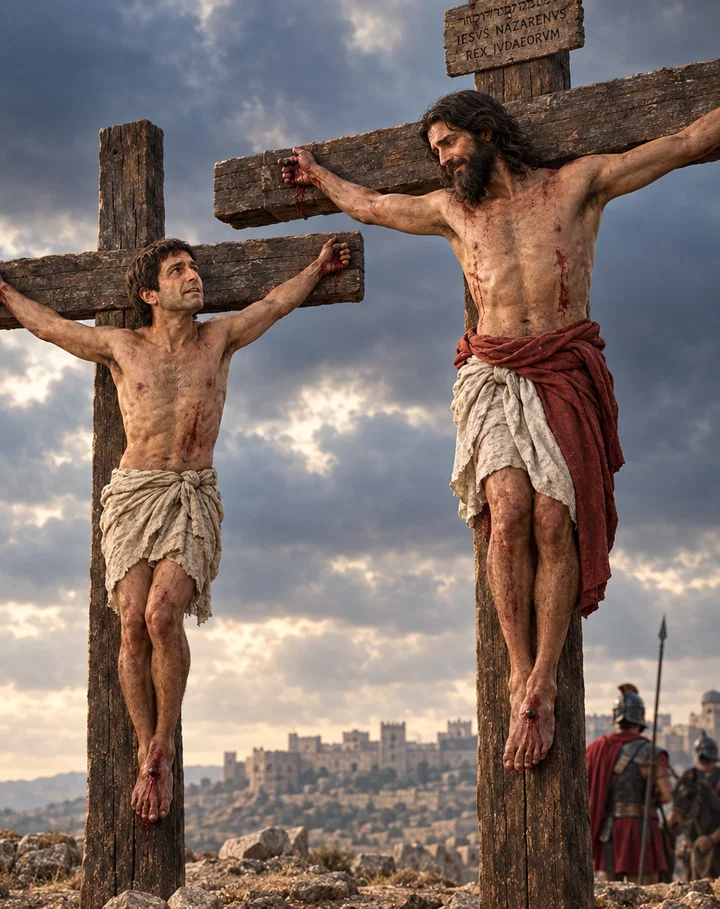
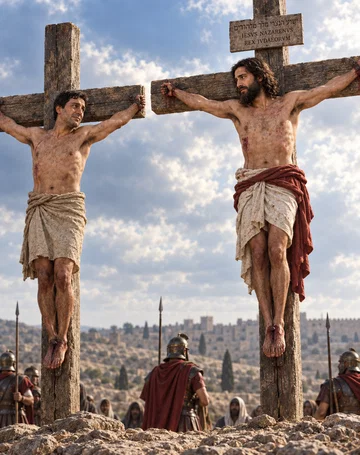
And when they were come to the place, which is called Calvary, there they crucified him, and the malefactors, one on the right hand, and the other on the left.
Jesus was crucified between two malefactors.
- John 19:32
Then came the soldiers, and brake the legs of the first, and of the other which was crucified with him.
The thieves were alive on the crosses before the soldiers broke their legs.
- Isaiah 53:12
Therefore will I divide him a portion with the great, and he shall divide the spoil with the strong; because he hath poured out his soul unto death: and he was numbered with the transgressors; and he bare the sin of many, and made intercession for the transgressors.
Jesus was numbered with transgressors when crucified between criminals.
- Mark 15:27
And with him they crucify two thieves; the one on his right hand, and the other on his left.
Two thieves were crucified with Jesus.
- John 19:16-30
Then delivered he him therefore unto them to be crucified. And they took Jesus, and led him away.
parallel account of same journey and crucifixion
- 2 Corinthians 5:10
For we must all appear before the judgment seat of Christ; that every one may receive the things done in his body, according to that he hath done, whether it be good or bad.
Both recognize they must answer before God’s judgment.
- Ecclesiastes 12:13
Let us hear the conclusion of the whole matter: Fear God, and keep his commandments: for this is the whole duty of man.
Both texts connect fearing God with human duty.
- Matthew 27:40-42
And saying, Thou that destroyest the temple, and buildest it in three days, save thyself. If thou be the Son of God, come down from the cross.
Passersby and leaders taunt Jesus on the cross.
- Romans 4:6
Even as David also describeth the blessedness of the man, unto whom God imputeth righteousness without works,
God imputes righteousness without works, including to the repentant thief.
- Luke 23:18
And they cried out all at once, saying, Away with this man, and release unto us Barabbas:
Barabbas chosen instead of Jesus
Commentary
Each commentary is drawn from primary sources: the writings of Ellen G. White and Adventist pioneers and periodicals. Each commentary is separate. Its own words are not a quotation; follow the references to read the source passages.
Ellen G. White
30 sources
On the cross one condemned criminal rebuked the other for mocking Jesus, asking whether he had no fear of God when under the same sentence of death, and openly confessed that they suffered justly for their deeds while Jesus had done nothing wrong.RH Aug 26, 1909Ms 140, 1908, par. 45–47Ms 130, 1909, par. 39–40Lt 102, 1905, par. 12–17 His mind was enlightened to see in the humiliated Jesus dying beside him the world's Redeemer and Lord, the sin-pardoning Saviour even in apparent defeat.RH Aug 26, 1909Lt 102, 1905, par. 12–175RED 77.3–78.2 He asked Jesus to remember him when entering His kingdom, and Jesus answered with forgiveness and the promise of paradise, showing that even in dying agony He kept power to forgive sin and save to the uttermost.RH Aug 26, 1909DA 751.3–4Ms 45, 1897, par. 20–22 His experience proves that even the vilest sinner may find pardon at the eleventh hour, and the two thieves stand for the two classes of people, those who look to Jesus lifted on the cross and live and those who refuse Him and die without hope.5RED 77.3–78.23SP 158.1–2ST Jul 25, 1878 Yet his last-moment turning must not be used to delay repentance, for he turned as soon as light came, while those who neglect present light grow darker until deception takes possession.5RED 77.3–78.2ST Jul 25, 18783SP 159.1
Rebuke at the Crucifixion
The rebuke was spoken after Jesus had been condemned and was led from the judgment hall to Calvary for crucifixion, when news of His condemnation had spread through Jerusalem and people of all classes and ranks flocked toward the place of execution, with disciples and believers from the city and surrounding region joining the throng that followed Him.DA 741.3 There three crosses stood with Jesus placed between two thieves so that He appeared to be the greatest criminal, with three figures hanging as the crowd gathered below.DA 751.3–4DA 684 He hung there lifted up as a malefactor, descended into the depths of humiliation and delivered into the hands of wicked men, after His own nation clamored for His blood and Barabbas the murderer was chosen in His place, after He was crowned with thorns by Herod and his soldiers, clad in the purple robe and mocked with bowing and struck with the reed placed in His hand, and scourged as the worst of criminals, a sight that made the hope and courage of the disciples fail.ST Jul 7, 1898
The other thief answered his fellow criminal and rebuked him for railing at and mocking and reviling Jesus, asking whether he did not fear God seeing they were under the same condemnation.Ms 140, 1908, par. 45–47Lt 102, 1905, par. 12–17Ms 81, 1910, par. 24ST Jul 25, 18785RED 77.1–2 Both men faced the same condemnation and the same suffering beside Jesus, yet the penitent one recognized that they deserved their punishment while Jesus did not, and his rebuke reflected fear of God and recognition of Christ's innocence.Ms 140, 1908, par. 45–47Ms 130, 1909, par. 39–40Lt 102, 1905, par. 12–17 That fear of God was shown to be inconsistent with joining in contempt for Christ even while suffering the same judgment, so that shared condemnation became a call to reverence and humility rather than scorn.Ms 81, 1910, par. 24 Conviction poured upon his soul that there is a God to fear and a future judgment to tremble at, with both thieves to stand before the judgment seat of Christ and answer to God in the great day for every insult and mockery done to Him when everyone shall receive according to his works.Ms 52, 1897, par. 17–20ST Dec 14, 1904
The rebuke belonged with open confession that he and his companion suffered justly and received the due reward of their deeds, while Christ had done nothing amiss and nothing wrong and suffered innocently.RH Aug 26, 1909Ms 140, 1908, par. 45–47ST Jul 25, 18785RED 77.1–2ST Dec 14, 1904 That admission of deserved punishment and of Jesus' innocence led into trust in the Saviour and into humble appeal to Jesus as Lord for mercy.RH Aug 26, 1909ST Jul 25, 1878ST Dec 14, 1904 Even Christ in His own agony could thus impress a sinner facing death, showing that God loves the sinner and that the dying thief recognized Jesus as a sin-pardoning Saviour.Ms 130, 1909, par. 39–40Lt 102, 1905, par. 12–17
The man who rebuked was a Jew who had believed Messiah was soon to come, who had once favored Christ and heard Him and been convicted by His teachings, but who had turned away through the influence of priests and rulers and through his own desires until he sank farther into wickedness through base association and pleasure, until arrested for open crime and condemned to die with conviction of his crime leaving him hopeless.Ms 52, 1897, par. 17–205RED 76.2–3 He was not a hardened criminal whose morals were hardened beyond feeling, but one whose morals had been corrupted, whose crimes were not so great as those of many who stood beneath the cross reviling Jesus, and who though guilty was far less guilty than the priests, scribes, rulers and revilers who took active part in demanding the death of the Son of God.5RED 76.2–3Ms 84a, 1897, par. 8 While one thief was hardened and made desperate and defiant by pain and joined the priests in mocking Jesus to save himself and them if He were Christ, the other refused to join him in railing like the priests, rulers and scribes.Ms 52, 1897, par. 17–205RED 76.2–3
On that day of trial he had been with Jesus in the judgment hall and on the way to Calvary, had heard Pilate declare Him a just man, and had marked His Godlike deportment and His pitying forgiveness of His tormentors with unresisting suffering without one word of reproach.Ms 52, 1897, par. 17–205RED 76.2–3 He heard passersby defend Christ and repeat His sayings and tell of His works, and those words dropped as seed into his heart and raised the question what manner of man this is.Ms 52, 1897, par. 17–20 Then conviction returned that this is the Christ, the Son of God acknowledged in his heart, so that he and his fellow had no more fear of man because men could make them suffer no more.Ms 52, 1897, par. 17–205RED 76.2–3 He grieved that he had not known this before while he might have lived a different life before closing his sin-polluted history, and trembled at having to answer for every insult to Christ.Ms 52, 1897, par. 17–20
Faith That Found Pardon
Though under the same condemnation and the same physical torture as Jesus, the penitent thief's mind was illuminated by the Spirit of God until link after link the chain of evidence that Jesus was the Messiah was joined together.5RED 77.3–78.23SP 158.1–2ST Jul 25, 18785RED 76.2–3ST Jul 25, 1878 That faith discerned in Jesus crucified like a malefactor the world's Redeemer, the Messiah, the Son of God, his Lord and Friend and sin-pardoning Saviour even in humiliation and apparent defeat.RH Aug 26, 1909Lt 102, 1905, par. 12–175RED 77.3–78.23SP 158.1–2ST Jul 25, 1878 While priests and rulers in self-righteous scorn failed to see His divine character and even the disciples doubted His divinity, the guilty dying soul on the brink of eternity called Jesus Lord, the only one to call Him Lord as He hung dying upon the cross.5RED 77.3–78.23SP 158.1–2
He prayed to Jesus as Lord to remember him when coming into His kingdom, openly confessing his own just punishment while declaring that Jesus had done nothing wrong.RH Aug 26, 1909Lt 102, 1905, par. 12–17ST Jul 25, 1878Ms 45, 1897, par. 20–22 Christ met the ensnared suffering thief with pity and forgiveness, giving him peace and comfort of acceptance with God and the promise to be with Him in Paradise.RH Aug 26, 1909DA 751.3–4Ms 45, 1897, par. 20–22Lt 71, 1901, par. 4Ms 93, 1899, par. 20–21 That pardon in dying agony proved Christ retained His right and power to forgive sin and to save to the uttermost all who receive Him, forgiving and encouraging a sinner even in His own agony while giving His life for the sins of the world.RH Aug 26, 1909DA 751.3–4Lt 71, 1901, par. 4 He could forgive as the propitiation for the sins of the whole world, His divinity at work while His humanity suffered the hatred of enemies, for He alone was free to undertake suretyship for the guilty.11MR 345.1
As those who looked on the uplifted brazen serpent in the wilderness lived, so all who now look in faith to the uplifted Saviour are pardoned through the merits of His blood, without shedding of which no one can be saved.Ms 45, 1897, par. 20–22 The gospel was thus preached even on the cross, showing it is to be preached to people in prison and that the Lord accepts all who receive and believe in Christ.Ms 45, 1897, par. 20–22Lt 146, 1903, par. 21 This reveals the tender consideration the Lord has for all who trust in His power to save them and give them the victory.Ms 45, 1897, par. 20–22
His experience shows that even the vilest sinner may find pardon and salvation through the merits of Christ's blood at the eleventh hour at the close of probation.5RED 77.3–78.23SP 158.1–2ST Jul 25, 1878ST Jul 25, 1878 The two thieves represent the two classes of people, those who look to and believe in Jesus lifted on the cross and will live forever and those who refuse Him and will die without hope.3SP 159.3 As Jesus saved the thief on the cross, so Judas too could have been saved if he had yielded and confessed his betrayal.Ms 149, 1904, par. 13–15
His was a genuine conversion under peculiar circumstances for a special purpose, testifying to all beholders that Jesus was no impostor but sustained His character and carried out His mission to the closing scene.5RED 77.3–78.23SP 158.1–2ST Jul 25, 18783SP 159.1 His petition gave Christ a gleam of comfort in bitter loneliness amid blasphemy and taunts, and no words in His whole ministry were more grateful to Him.5RED 77.3–78.2Ms 45, 1897, par. 20–22 With the Roman guard who commanded at the cross and the man who bore His cross he stands as fresh evidence of fulfilled prophecy and new witness to Christ's divinity declared on the very day of Christ's death, proving the Redeemer saw of the travail of His soul even upon the cross.Ms 45, 1897, par. 20–22DA 770.1–2
Warning Against Delayed Repentance
The rebuke on the cross must never be turned into an excuse for neglecting present opportunity and delaying repentance in presumption upon the thief as a warrant for trusting to a deathbed change.5RED 77.3–78.2ST Jul 25, 18783SP 159.1 Every ray of light neglected leaves the sinner in greater darkness until deception takes possession and the case becomes hopeless.5RED 77.3–78.2ST Jul 25, 18783SP 159.1 The dying thief's faith, which discerned the world's Redeemer in Jesus crucified as a malefactor and rebuked his fellow criminal, was a genuine conversion under peculiar circumstances for a special purpose, testifying to all beholders that Jesus was no impostor but sustained His character and carried out His mission to the closing scene.5RED 77.3–78.2ST Jul 25, 18783SP 159.1
Where enlightenment comes at the last moment and is accepted with intelligent faith, such penitents find favor with Christ.5RED 77.3–78.2ST Jul 25, 18783SP 159.1 The thief turned only at the last moment because until then he had no light, his mind then illuminated by the Spirit of God until link after link the chain of evidence was joined and the suffering victim stood forth before him as the Son of God.5RED 77.3–78.2Ms 16, 1895, par. 23 Those who have been shown their duty in God's Word should not delay serving God.Ms 16, 1895, par. 23
Jesus saved the thief on the cross, and Judas too could have been saved if he had yielded and confessed his betrayal.Ms 149, 1904, par. 13–15
Sources
Pioneers and periodicals
92 sources
On the cross one condemned criminal rebukes the other for mocking Jesus and demanding rescue, asking why he does not fear God when lying under the same sentence of death.RH Oct 30, 1855ST Nov 26, 1894ST Mar 20, 1901 His rebuke confesses that they suffer justly for their own deeds while Jesus suffers beside them innocent and having done nothing wrong.RH Aug 26, 1909RH Oct 30, 1855ST Mar 20, 1901 It turns at once into humble trust in Jesus as Lord and coming King who can pardon sin and give eternal life, drawing the promise of being with Him in paradise.RH Aug 26, 1909ST Jul 25, 1878ST Dec 14, 1904RH Oct 30, 1855ST Nov 30, 1915 Sharing the same condemnation should make even the guilty fear God and own accountability and judgment before Him rather than join the jeering crowd.ST Nov 26, 1894ST Mar 20, 1901ST May 28, 1896ST May 13, 1903ST Mar 7, 1878 Such last-hour conversion is truly possible and proves Christ can save even the vilest sinner by faith apart from works, yet it was given at first hearing of the gospel and gives no warrant for putting off repentance after light has been heard.ST Dec 23, 1897ST Apr 7, 1914RH Aug 14, 1860ST Nov 2, 1915
Crucifixion Setting and Speakers
On the cross the second crucified criminal rebuked the first criminal for mocking and railing at Jesus and demanding rescue, while all three hung on crosses with Jesus between them.RH Aug 26, 1909RH Oct 30, 1855ST Nov 26, 1894ST Mar 20, 1901ST May 28, 1896 The rebuke called the fellow sufferer to fear God seeing they were in the same condemnation, and it stood with confession that they suffered justly receiving the due reward of their deeds while Jesus had done nothing amiss, and with the request to be remembered when coming into His kingdom answered by the promise of paradise.RH Aug 26, 1909RH Oct 30, 1855ST Mar 20, 1901ST Nov 13, 1884 The repentant criminal thus rebuked his companion while they hung on the crosses, connecting awareness of divine judgment with humility before God.ST Nov 26, 1894ST May 28, 1896ST Nov 13, 1884
At first both thieves united with the priests, scribes, elders, rulers, soldiers and people in mocking the Son of God, but just before Christ expired one of them changed and rebuked the other for railing.ST Aug 27, 1894ST Nov 1, 1910 Matthew and Mark speak generally of both men railing, while Luke gives the specific account of the change by which one turned from railing to repentance.ST Aug 27, 1894ST Nov 1, 1910 Jesus' patient suffering touched that man's heart and led him to repent and remind the other that they were in the same condemnation.ST Aug 27, 1894ST Nov 1, 1910
The setting is Jesus condemned and executed as an innocent man at Golgotha shedding His blood, hanging between two malefactors with the superscription THIS IS THE KING OF THE JEWS over Him.RH Jul 4, 1865RH Jul 16, 1861 Around Him the people beheld, the rulers derided, the soldiers mocked and offered vinegar, His raiment was parted by lot, darkness covered the earth from the sixth to the ninth hour, the sun was darkened, the veil of the temple was rent, He commended His spirit to the Father and gave up the ghost, the centurion glorified God, the people smote their breasts, and acquaintance and women from Galilee stood afar off.RH Jul 4, 1865 Such derision was customary before and during executions in that period, and afterward Joseph of Arimathea obtained permission to bury Him, the tomb was found empty a few days afterward, and His disciples published that He had risen as He had foretold.RH Feb 11, 1862RH Jul 16, 1861
The disciples saw Him in whom their hopes of eternal life were centered in the hands of wicked men, heard His own nation clamoring for His blood, saw the crown of thorns for His brow, the purple robe with persecutors bowing and striking Him with the reed, and saw Him whom they thought would take His place on David's throne scourged as the worst of criminals with the murderous Barabbas chosen instead.ST Jul 7, 1898 Lifted up dying as a malefactor after descending into humiliation, He tried their faith and made hope and courage fail into mourning and fasting.ST Jul 7, 1898 The crucifixion occurred in A.D. 31 at the close of a public ministry lasting about three years and six months, the same year as His resurrection and ascension.ST Sep 22, 1909
The thieves were still alive when their legs were broken before the bodies were taken down at the beginning of the Sabbath, and Jesus had not yet ascended to the Father on the third day.ST Nov 30, 1915 The request to be remembered when coming into the kingdom concerned a future event, and the promise assured that the thief would yet be with Christ in Paradise, not that it happened that crucifixion day.ST Nov 30, 1915 The closing verses of Luke 23 place Friday afternoon when Christ was taken from the cross and laid in Joseph's tomb, then the Sabbath kept according to the commandment, then the first day of the week when the women came to the sepulcher. The Sabbath according to the commandment, that the seventh day is the Sabbath of the Lord thy God, is thus wedged between Friday the crucifixion day and Sunday the resurrection day, with true succession continued from the cross in immediate connection around death and resurrection, making clear which day is the Sabbath and showing no transference to the first day.ST Feb 1, 1905
Christ crucified between the two, not at the side, shows Him as God's great Middleman for the saving of the lost, with Calvary made a church, the heavy cross a mountain pulpit for preaching His sacrifice, and the rabble a waiting congregation.ST Dec 5, 1916 Remaining on the cross without descending wins honest hearts even when habits are criticized and the message rejected, and the repentant thief taking his stand for Christ is one of three converted on that dark day together with Simon who bore the cross and the Roman centurion.ST Dec 5, 1916 As the last earthly work of the Saviour they present to the Father a glorious wave sheaf of three rescued amid the throes of Calvary, with the thief from the posterity of Shem, Simon a descendant of Ham, and the centurion of Japheth, so each tribe of men is gathered.ST Dec 5, 1916 When Jesus died only one person honored Him, the penitent thief who rebuked the other thief and paid Him homage as the Christ, yet in less than sixty days three thousand had acknowledged His claims as the Christ.ST Dec 17, 1896ST Jul 25, 1911
Call to Fear God
The rebuke asks whether the other sufferer does not fear God when lying under the same condemnation, teaching that sharing the same sentence and punishment should itself produce fear of God.ST Nov 26, 1894ST Mar 20, 1901RH Jun 8, 1911ST May 28, 1896 Awareness of standing under divine judgment belongs with humility before God, for both men crucified beside Jesus were under that same condemnation while they mocked Him.ST May 28, 1896ST Mar 20, 1901ST May 28, 1896 His words explain themselves in what follows, that the criminals receive the due reward of their deeds while Jesus has done nothing wrong.ST Mar 20, 1901ST May 28, 1896ST Mar 20, 1901 Their shared punishment did not erase responsibility before God, and facing judgment should lead even the condemned to fear Him.ST May 13, 1903ST Mar 7, 1878ST Jun 27, 1878 That fear in the face of death could still turn to mercy, for pardon remained available to a penitent sinner even at the eleventh hour, and the same hope of pardon applies to a penitent drunkard.ST Mar 7, 1878ST Jun 27, 1878
The rebuke was brotherly love seeking to save a neighbor by confronting him with shared guilt and judgment even while suffering on the cross amid the jeering crowd.RH Sep 25, 1856ST Nov 19, 1896ST Sep 5, 1911 He rose above the crowd's judgment, accepted his punishment as just, and turned to Jesus for pardon and hope in His kingdom.ST Nov 19, 1896ST Sep 5, 1911 Though his life after conversion was short, this love with his faith, prayer and humility belongs to the full character of a believer and leaves abundant evidence that he was a child of God in deed and in truth and not in name only, in whom the Holy Spirit had completed His work.RH Sep 25, 1856 His appeal to the other man to repent before a hostile crowd was itself a work showing his faith and repentance, done while both were being punished for evil deeds.ST Aug 27, 1896 He did all he could to show his faith, though he had no time or opportunity to perform every work God requires.ST Aug 27, 1896
Though suffering justly for his crimes, the penitent thief was more open to God than the sneering Pharisee who prided himself on his righteous life, and less hard-hearted than the scoffing Pharisee at the cross.ST Jul 20, 1904ST Feb 6, 1896 A heart and life open to God receive His truth as light and beauty.ST Jul 20, 1904 Determined resistance to truth hardens the heart more than criminal guilt does.ST Feb 6, 1896 In the same condemnation and in the sudden arms of death the dying thief feared God and turned in prayer to find an instant Saviour.RH Jul 30, 1857 That instant finding means access to God is open in every place and at every moment to whatsoever a person is, with no need for sainthood, proficiency in piety, eloquent language, earthly rank, special holy ground, sharp ordeal, costly passport, painful expiation, price or personal merit, since the costliest provision of the blood of the atonement, the Saviour's merit and the name of Jesus is freely put at the sinner's disposal to be used instantly and constantly to reach the mercy-seat.RH Jul 30, 1857
Guilt Confessed, Christ Vindicated
The rebuke belongs together with open confession that both criminals suffer justly receiving the due reward of their deeds, while Jesus has done nothing amiss and suffers beside them as innocent.RH Aug 26, 1909ST Jul 25, 1878RH Oct 30, 1855ST Mar 20, 1901ST Mar 20, 1901 The call to fear God while under the same condemnation introduces that contrast between their guilt and His innocence and leads into the prayer to be remembered when He comes into His kingdom.RH Aug 26, 1909ST Jul 25, 1878RH Oct 30, 1855ST Mar 20, 1901ST Nov 26, 1894 By his own confession he admitted his conviction for crime was just and that he was suffering justly.ST Dec 23, 1897 His act was both crime against human authority and sin against God, as violation of the law of God whose penalty is eternal death.ST Dec 23, 1897
He did not become a votary of sin and vice in a moment, but sank little by little by slow gradations under sin's blighting touch.ST Sep 5, 1911 From once being a sweet and prattling babe with a fond Hebrew mother bending tenderly over him he became a jeering, mocking robber and murderer who while hanging in deepest shame spent his time mocking and deriding the sinless Sufferer.ST Sep 5, 1911 This shows what a dreadful thing sin is and how pride, covetousness, and love of the world live in hearts without fear of banishment or condemnation when left unremoved.ST Sep 5, 1911 His repentance and confession openly acknowledged sin, guilt, and the fear of God before God, Christ, and the world, under the same just condemnation.ST Sep 21, 1904 That repentance and confession is a dying to sin by which he is spiritually crucified with Christ, joined with recognition of Jesus as the sinless One who did nothing amiss and as Saviour of the world, and in this he stands as representative of all penitent and converted sinners.ST Sep 21, 1904
Together with Pilate's testimony to the innocence of Jesus, the strange cry of Jesus, the convulsion of nature, the rent veil of the temple, and the three hours of darkness, the confession moved the large multitude gathered at Jerusalem from all parts of Palestine deeply.RH Jun 25, 1867 It awakened remorse in them as sharers in the death of the Holy One, so that the dense throng returning from Calvary smote their breasts in penitence.RH Jun 25, 1867
Faith, Conversion and Promise
The rebuke passes at once into humble appeal to Jesus as Lord to remember him when He comes into His kingdom, grasping in the One who hangs in humiliation and apparent defeat the sin-pardoning Saviour, the Son of God, the Messiah, the world's Redeemer, his own Friend and Saviour, with conviction of sin and recognition of innocence leading to trust.RH Aug 26, 1909ST Jul 25, 1878ST Dec 14, 1904ST Jul 25, 1878ST Jul 25, 1878 Though his life had been led into crime he had heard Jesus, and seeing the evidence that He was Messiah and Christ he resisted the popular view that Jesus was forsaken by God and connected the evidence despite the insults of the religious leaders.ST Jul 25, 1878ST Jul 25, 1878ST Aug 8, 1900 He openly confessed what others only thought, that Jesus is Lord, that He is innocent and has done nothing amiss, that He will have a kingdom, and that He is able to give eternal life and glory.RH Sep 25, 1856 He made this confession when the whole nation had denied Christ shouting crucify Him and owning no king but Caesar, when chief priests and Pharisees had condemned Him and found Him guilty of death, when His own disciples had forsaken Him and fled, and when Jesus hung faint, bleeding and dying on the cross, numbered with transgressors and counted accursed.RH Sep 25, 1856 He saw Him only in agony and weakness, in suffering and pain, undergoing dishonorable punishment, deserted, mocked, despised, blasphemed and rejected by all the great and wise and noble of His people, with no sceptre, no royal crown, no outward dominion, no glory, no majesty, no power and no signs of might, and yet he believed and prayed and looked forward to Christ's kingdom.RH Sep 25, 1856 His faith pierced the gloom-cloud of the cross and saw the eternal triumph and glory beyond, even while Christ's own people, especially the learned and reputedly wise, had rejected Him as false prophet and blasphemer, His disciples had fled, and He suffered untold ignominy with His mission a seeming failure.ST Feb 20, 1901
His confession stood alone at the cross, going beyond the best the heathen Roman captain with limited understanding could say that Jesus was the Son of God, and given while the yet faithless disciples were silent.ST Jun 1, 1904 His genuine conversion under unusual circumstances and for a special purpose testified to watchers that Jesus was no impostor but true to character and mission to the end.ST Jul 25, 1878 He received enlightenment at the last moment and accepted it with intelligent faith, and was saved at the close of his probation at the eleventh hour.ST Jul 25, 1878ST Jul 25, 1878 The change in him was brought about by beholding the life and suffering of the Son of God during the hours of darkness in which they suffered together on the cross.ST Aug 27, 1894 Thus redeemed by the blood of Christ, the life there manifest slew the enmity in his heart and made him at one with Christ, for atonement means at-one-ment that destroys enmity and makes union of feeling and purpose.ST Aug 27, 1894 Pouring out his sin-sick soul for righteousness and a place with his Lord in His kingdom, by that asking in entire surrender he obtained forgiveness and promise of a home in Paradise, proving victory and life under even the most forbidding conditions with none debarred are secured only by asking, never by payment of gold or works of penance.ST Sep 21, 1904ST Apr 7, 1914
His request to be remembered when Jesus comes into His kingdom concerned a future event, and drew the promise, Verily I say unto thee, To-day shalt thou be with me in paradise.RH Oct 30, 1855ST Nov 30, 1915 That promise proved Christ retained in dying agony His right and power to forgive sin and to save to the uttermost all who receive Him.RH Aug 26, 1909 The promise indicates that paradise is a place rather than a condition, but it does not identify its location.RH Aug 13, 1914 It assured him that he would yet be with Christ in Paradise, not that this happened that crucifixion day, for the thieves were still alive when their legs were broken before bodies were taken down at the beginning of the Sabbath, and Jesus had not yet ascended to the Father on the third day.ST Nov 30, 1915 Even while hanging on the cross as a reproach of men and despised of the people, whose only offense was going about doing good and who opened not His mouth in self-defense or reproach against persecutors, Christ showed His power to save others by saving the thief, while Himself He could not save.ST Mar 20, 1901ST Jul 22, 1897 His power to save others was bound up with giving Himself, for He could not save Himself by remaining safe apart from humanity, because that would have meant leaving others to perish.ST Mar 20, 1901
Jesus loved both thieves, and He promised one that he would be with Him in Paradise because that man trusted Him as the world's Redeemer despite His humiliation.ST Aug 17, 1915 He continued His missionary work even on the cross in ministering to the robber, and His final command was the missionary commission.ST Jun 14, 1905 So kind was He in dying for sinners that hearing the account awakens love for Jesus and willingness to do anything for Him.ST Jan 1, 1894
Doctrines and Scripture Connections
The account of the two criminals and the promise of paradise does not prove that the dead are conscious or that the soul is immortal, because Christ did not go to paradise on the day of the crucifixion.RH Oct 1, 1872 It belongs to the usual argument cited concerning man's mortality, bearing on whether human beings are mortal or immortal.RH Mar 24, 1904
The thief confessed faith in the Lord Jesus Christ as his individual Saviour with expiring breath and was accepted and assured of a place in His kingdom.ST Sep 11, 1907RH Mar 26, 1914 He would have been baptized if opportunity had allowed, but the Lord accepted him without the outward act, since circumstances afforded no opportunity to take part in the baptismal service.ST Sep 11, 1907RH Mar 26, 1914 His case proves that baptism is essential to salvation only under conditions that make it possible and reasonable.RH Mar 26, 1914 It does not make a deathbed exception a reason to treat God's commands as nonessential, for those who know God's will should obey while opportunity remains, since regret may come too late for pardon.RH Sep 30, 1858
The difficulty over baptism as essential is resolved by those who held that the thief was baptized with blood from the Saviour's wounded side, or else had been baptized before his conviction. Others held that Christ was baptized for him, so that Christ's baptism was his baptism, since he could not be baptized for himself.ST Apr 29, 1908ST Feb 11, 1903 In that teaching Christ's baptism and obedience supply what is essential for those saved but unable to carry out an ordinance, which does not excuse anyone who knowingly cherishes rebellion against the Lord's commands.ST Feb 11, 1903 The question is asked how God's seal could be his, since he had not observed the seventh-day Sabbath and had not been baptized.ST He exemplifies ignorant but willing believers in past centuries who did not understand baptism or the seal of God yet desired to do God's will, for whom Christ was baptized and sealed so that Christ's baptism and sealing were theirs.ST Apr 29, 1908
His salvation shows that a sinner is saved by receiving Christ through faith by Christ's grace even when death leaves no time to produce good works, not by works.ST Nov 2, 1915 As he hung beside Jesus dying on Calvary he beheld the Son of God nailed to wood, accepted Him by faith as Saviour, poured out his sin-sick soul for righteousness and a place with his Lord in His kingdom, and by that asking obtained forgiveness and promise of a home in Paradise.ST Apr 7, 1914 Victory and life under even the most forbidding conditions, with none debarred, are secured only by asking in entire surrender of self, never by payment of gold or works of penance.ST Apr 7, 1914
Jesus on the cross in His own anguish heard the voice of the dying thief, forgot His anguish, turned to him and blessed and raised him.ST Sep 11, 1884ST Aug 28, 1884 That attention was forbearance, magnanimity, benevolence, self-renunciation, living only for the good of others and the glory of His Father, doing good, blessing the wretched and raising him to virtue and happiness.ST Sep 11, 1884ST Aug 28, 1884 It did not go a hair's breadth beyond the requirements of God's moral law but stayed inside the circle the law had drawn, complying with its demands, exhibiting neither more nor less than law perfectly observed.ST Sep 11, 1884ST Aug 28, 1884 It magnifies the law and makes it honorable as a perfect model of loveliness of character in Jesus of Nazareth, law drawn out in living characters, and his response displayed the perfect obedience that shaped his character.ST Sep 11, 1884ST Aug 28, 1884RH Sep 18, 1860
The dying thief in the same condemnation, in the sudden arms of death fearing God and turning in prayer to find an instant Saviour, shows that access to God is open in every place and at every moment to whatever a person is.RH Jul 30, 1857 There is no need for sainthood, proficiency in piety, eloquent language, earthly rank, special holy ground, sharp ordeal, costly passport, painful expiation, price or personal merit.RH Jul 30, 1857 The costliest provision, the blood of the atonement, the Saviour's merit and the name of Jesus, is freely put at the sinner's disposal to be used instantly and constantly to reach the mercy-seat.RH Jul 30, 1857
The thief recognized that he and the other criminal were under the same condemnation and rebuked him for not fearing God, and he became a member of Christ's true church despite having no visible connection to a church society.ST Sep 25, 1907 A person who lives up to the truth and light available to him and trusts in Christ is a Christian.ST Sep 25, 1907 The cross divides the penitent and believing thief who confesses sin and looks to Jesus for salvation from the impenitent and unbelieving one who complains and curses.ST Aug 19, 1880RH May 26, 1904 Being crucified at the same time as Christ is not the same as being crucified with Christ through faith.RH May 26, 1904
Like the publican in the temple, he was driven to throw himself upon the Lord's mercy.ST Mar 5, 1912 He rejoiced to see the fountain filled with blood opened for sin and uncleanness in his day and washed all his vile sins away there, showing that one though vile as he can be cleansed in the same fountain.ST Sep 2, 1886 He perfected Christian character in a very short time by the life-power of God as an emergency case, like the turning of water into wine at Cana, not the normal lifetime of growth and development required to do as much.RH Jan 28, 1902 Yet the steady growth of an even Christian experience holds just as much divine power as his conversion and as the conversion of Paul.RH Jan 28, 1902
Their poverty did not make either thief rich in faith; only one became rich in faith by seizing the opportunity for true riches at the last moment of his life.ST Mar 25, 1903 The cross of Calvary, set with the Garden of Gethsemane, the crown of thorns, and the triumphant resurrection, shows Jesus refusing to be turned aside from His holy mission by the devil's persuasions to compromise with the world, worldly principles, and worldly methods such as politics.ST Jul 25, 1911 By that resistance He enables His followers to resist the same persuasions in all time to come.ST Jul 25, 1911 Every compromise with the world makes the Christian and the church the loser, and suffering with Christ and rising with Him is better than blending politics with eternal truth and righteousness.ST Jul 25, 1911
Warnings and Encouragement Today
The rebuke belongs to the story of the thief who turned to Christ at his first opportunity to hear the gospel, instantly and without reserve, and his is one of the very few cases of a person saved when near death.RH Aug 14, 1860RH Sep 26, 1854 He had not previously heard it but heard and embraced it at once, not after repeatedly hearing it through life.RH Aug 14, 1860RH Sep 26, 1854 His case therefore does not make deathbed conversion a safe plan for those who have knowingly rejected Christ and truth through life, nor does it support relying on the repentance of those who have often heard the gospel.RH Sep 26, 1854 The right and safe course is to give oneself to faith and righteous action while strong and able, since a late profession may be only fear rather than sincere repentance.ST Aug 29, 1911
Confession of Christ with assurance of forgiveness is possible even at the very end of life, and conversion at the twelfth hour may be pressed, offered, received and enjoyed.ST Aug 29, 1911RH Aug 27, 1861 Pardon is available to a penitent sinner even at the eleventh hour, and the same hope extends even to a penitent drunkard.ST Aug 29, 1911ST Jun 27, 1878 Forgiveness is given whenever there is genuine repentance and faith, yet fear of death may produce only false repentance without true sense of sin or willingness to turn from it.ST Aug 29, 1911 The grace that culminates in glory begins now and the character perfected in heaven begins now, most men die as they live, and putting off the concerns of the soul to that hour hardens the heart.RH Aug 27, 1861 God is willing to forgive, but a person may become unable or unwilling to respond truly, so the safe time to repent is now.ST Aug 29, 1911
The dying thief's last-minute appeal cannot excuse a living person who refuses baptism, church membership, or service in support of the cause, for the decisive difference is that he was dying while such a person is still living.ST Nov 6, 1893RH Sep 30, 1858 His appeal to the fear of God under shared sentence of death shows that one who cannot be baptized at the end of life may still receive pardon, but it does not make a deathbed exception a reason to treat God's commands as nonessential.RH Sep 30, 1858 Those who know God's will should obey it while opportunity remains, since regret may come too late for pardon.RH Sep 30, 1858 To use a final confession from a deathbed scene with no profession of Christianity in life as a way to send such a life to heaven makes a self-sacrificing Christian life go for nothing.ST May 15, 1884
His genuine conversion under unusual circumstances for a special purpose testified to watchers that Jesus was no impostor but true to character and mission to the end, and receiving enlightenment at the last moment with intelligent faith he found favor, forgiveness, rest, and the offer of eternal life.ST Jul 25, 1878ST Aug 8, 1900 That forgiveness is available even at the hour of death, and a person can turn to Christ even at the point of death.ST Aug 8, 1900ST Dec 22, 1881 Yet his conversion does not justify delaying repentance or relying on a deathbed change, for neglected light deepens darkness and may leave the case hopeless.ST Jul 25, 1878 The offer must therefore be accepted today without delay, trusting in Jesus now, since delay may mean losing it forever.ST Aug 8, 1900ST Dec 22, 1881
Christ is merciful even at the last moment and may receive one who turns to him in prayer near death.ST Apr 7, 1881ST Apr 6, 1888 The thief's salvation shows it is not too late for Jesus to save even a great sinner, and even a dying sinner in the last hour of life can find acceptance with God through Christ, not without him.ST Apr 22, 1875ST Apr 6, 1888 By his own confession he admitted his conviction for crime was just and that he suffered justly, for his act was both crime against human authority and sin against God as violation of God's law whose penalty is eternal death.ST Dec 23, 1897 His conversion came only when hung on the cross, when he knew profession of faith would bring only derision from most hearers.ST Dec 23, 1897 Yet great as his sin and late as his faith, it was accepted by the Lord with assurance of a place in the eternal kingdom, proving the love and saving power of God through Jesus Christ to save even the vilest sinner by faith.ST Jul 25, 1878ST Dec 23, 1897
The scene teaches that even the vilest sinner can receive pardon and salvation through the merits of Christ's blood, recognizing the crucified Jesus as the world's Redeemer and personal Friend and Saviour, finding peace and comfort in acceptance with God.ST Jul 25, 1878 His example gives hope to people who fear they are too far gone to change, showing a sinner can still turn to Christ and be saved.ST Jun 7, 1905 A criminal may sincerely repent and be saved, but murder is not made a sure path to heaven, and a claim of faith at death alone does not prove repentance genuine.ST Apr 12, 1883 Jesus did not reject the penitent thief even while dying on the cross. No poor trembling sinner coming to Christ on earth is turned away, for Christ's desire to receive exceeds the sinner's desire to come, and because he is the same yesterday, today and forever with the same power to uphold and the same pity, love and willingness to accept and bless, even the most abandoned soul who comes will not perish.RH Jul 16, 1857
In one instance the salvation of the thief was offered as reassurance that Christ could save a dying man, yet the reassurance did not bring him peace and he remained troubled by his sins. The story as generally taught shows a sinner can turn to God and be received even at the end of life, resting salvation on believing the sacrifice has been made and accepted rather than on a lifetime of religious knowledge or service. It stands as an example to consider when confessing and forsaking sin.RH Sep 17, 1872 The Saviour finding a seeking sinner near him on the cross shows his followers can find opportunities everywhere to call sinners to repentance and offer personal help to those with no hope in Christ.RH Dec 26, 1907
Remaining on the cross without descending, even when habits of life are criticized and the saving message rejected, wins honest hearts to the Master, for Christ crucified between the two, not at the side, shows him as God's great Middleman with Calvary made a church and the heavy cross a mountain pulpit before a waiting congregation.ST Dec 5, 1916 The thief is one of three converted on that dark day with Simon who bore the cross and the Roman centurion, as the Saviour's very last earthly work presenting to the Father a wave sheaf of three rescued amid Calvary's throes, gathering Shem in the thief, Ham in Simon, and Japheth in the centurion.ST Dec 5, 1916 Even in one condemned for wrongdoing Christ saw and loved what was good in the human soul, and his love for the dying criminal despite faults shows love looks for good rather than fixing on and magnifying weaknesses.RH Jun 2, 1904RH Jul 22, 1902 Though suffering was so severe one might think he could not attend to a plea, Jesus in his own anguish heard the dying thief's voice and turned to him, an act of forbearance, magnanimity, benevolence and self-renunciation, living only for others' good and the Father's glory, staying inside the circle of God's moral law and magnifying it as a perfect model of loveliness.ST Sep 5, 1911ST Sep 11, 1884
Sources