Luke 23:39
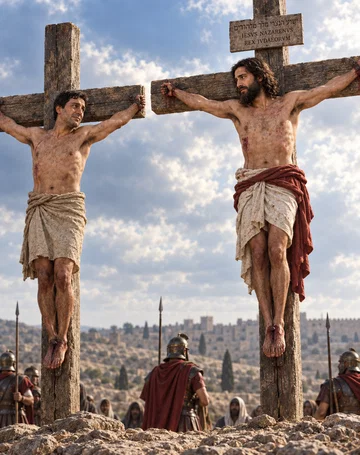
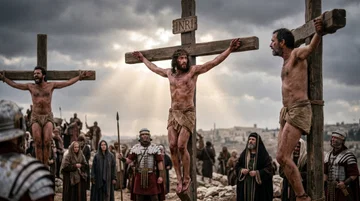
And one of the malefactors which were hanged railed on him, saying, If thou be Christ, save thyself and us.
Translations
And one of the malefactors which were hanged railed on him, saying, If you be Christ, save yourself and us.
King James Version, KJV Cambridge Paragraph Bible
And one of the malefactors which were hanged railed on him, saying, If thou be Christ, save thyself and us.
And one of the malefactors, who were hanged, railed on him, saying, If thou art Christ, save thyself and us.
And one of the malefactors which were hanged railed on him, saying, Art not thou the Christ? save thyself and us.
And one of the malefactors that were hanged railed on him, saying, Art not thou the Christ? save thyself and us.
And one of the evil-doers who were hanged, was speaking evil of him, saying, 'If thou be the Christ, save thyself and us.'
Now one of the malefactors who had been hanged spoke insultingly to him, saying, Art not thou the Christ? save thyself and us.
And, one of the suspended evil-doers, began to defame him—Art not, thou, the Christ? Save thyself and us!
One of the criminals who hung there heaped abuse on Him. “ Are You not the Christ?” he said. “ Save Yourself and us!”
One of the criminals who hung there heaped abuse on Him. “ If You are the Christ,” he said, “ save Yourself and us!”
One of the criminals who was hanged insulted him, saying, “ If you are the Christ, save yourself and us!”
And one of the evil-doers on the cross, with bitter feeling, said to him, Are you not the Christ? Get yourself and us out of this.
And one of the euill doers, which were hanged, railed on him, saying, If thou be that Christ, saue thy selfe and vs.
Douay-Rheims (Challoner revision)
And one of those robbers who were hanged, blasphemed him, saying: If thou be Christ, save thyself and us.
Pictures

Cross-references 20 of 27
- Luke 23:43
And Jesus said unto him, Verily I say unto thee, To day shalt thou be with me in paradise.
Jesus promises the repentant, believing thief life with him in Paradise.
- Matthew 27:42
He saved others; himself he cannot save. If he be the King of Israel, let him now come down from the cross, and we will believe him.
The mockers taunt Jesus that he saved others but cannot save himself.
- Luke 23:34
Then said Jesus, Father, forgive them; for they know not what they do. And they parted his raiment, and cast lots.
Jesus prayed for his enemies while enduring the cross.
- Mark 15:32
Let Christ the King of Israel descend now from the cross, that we may see and believe. And they that were crucified with him reviled him.
Both criminals revile Jesus and challenge him to save himself.
- Luke 23:35
And the people stood beholding. And the rulers also with them derided him, saying, He saved others; let him save himself, if he be Christ, the chosen of God.
Both taunt Jesus to save himself if he is the Christ.
- Matthew 27:44
The thieves also, which were crucified with him, cast the same in his teeth.
Both criminals initially mocked Jesus.
- John 19:16-18
Then delivered he him therefore unto them to be crucified. And they took Jesus, and led him away.
Both describe Jesus crucified between two criminals, including one who taunts him.
- Isaiah 53:12
Therefore will I divide him a portion with the great, and he shall divide the spoil with the strong; because he hath poured out his soul unto death: and he was numbered with the transgressors; and he bare the sin of many, and made intercession for the transgressors.
Jesus was numbered with transgressors while suffering contempt as the sin-bearer.
- Numbers 21:8-9
And the LORD said unto Moses, Make thee a fiery serpent, and set it upon a pole: and it shall come to pass, that every one that is bitten, when he looketh upon it, shall live.
The lifted serpent brought life, foreshadowing Christ lifted on the cross.
- Isaiah 53:7
He was oppressed, and he was afflicted, yet he opened not his mouth: he is brought as a lamb to the slaughter, and as a sheep before her shearers is dumb, so he openeth not his mouth.
Jesus remains silent and does not defend himself under suffering and insult.
- Isaiah 53:5
But he was wounded for our transgressions, he was bruised for our iniquities: the chastisement of our peace was upon him; and with his stripes we are healed.
Christ saves through his suffering and sacrifice for transgressions.
- Luke 23:47
Now when the centurion saw what was done, he glorified God, saying, Certainly this was a righteous man.
The centurion recognizes Jesus as righteous and glorifies God.
- Matthew 27:39-40
And they that passed by reviled him, wagging their heads,
Passersby mock Jesus and challenge him to come down from the cross.
- Luke 23:32-33
And there were also two other, malefactors, led with him to be put to death.
Identifies the malefactors hanged with Christ.
- Matthew 4:3
And when the tempter came to him, he said, If thou be the Son of God, command that these stones be made bread.
Both taunts challenge Jesus’ identity as the Son of God.
- John 19:32
Then came the soldiers, and brake the legs of the first, and of the other which was crucified with him.
The soldiers broke the legs of the two crucified with Jesus.
- Galatians 3:13
Christ hath redeemed us from the curse of the law, being made a curse for us: for it is written, Cursed is every one that hangeth on a tree:
Christ bore the law’s curse as humanity’s substitute.
- Matthew 4:6
And saith unto him, If thou be the Son of God, cast thyself down: for it is written, He shall give his angels charge concerning thee: and in their hands they shall bear thee up, lest at any time thou dash thy foot against a stone.
Both taunts challenge Jesus’ identity and call him to prove it.
- Luke 23:44-45
And it was about the sixth hour, and there was a darkness over all the earth until the ninth hour.
shares sun darkened over Calvary
- Luke 24:7
Saying, The Son of man must be delivered into the hands of sinful men, and be crucified, and the third day rise again.
Jesus predicted his crucifixion and resurrection, despite the mocker’s challenge to save himself.
Commentary
Each commentary is drawn from primary sources: the writings of Ellen G. White and Adventist pioneers and periodicals. Each commentary is separate. Its own words are not a quotation; follow the references to read the source passages.
Ellen G. White
31 sources
One of the two criminals crucified with Jesus at Calvary joined the priests, rulers and passersby in mocking Him, demanding that if He were the Christ He prove it by saving Himself and them.RH Aug 26, 1909Lt 102, 1905, par. 12–17Ms 52, 1897, par. 17–20 Though suffering the same torture as Jesus, he was hardened and made defiant by pain, taking up the scorn of the crowd and tempting Christ to escape the cross instead of looking to Him in faith.ST Jul 25, 18785RED 76.2–3DA 749.3–750.1 In contrast the other criminal rebuked him, confessed they were suffering justly for their crimes while Jesus was innocent and had done nothing wrong.RH Aug 26, 1909Ms 130, 1909, par. 39–40Lt 102, 1905, par. 12–17 The penitent thief recognized by Spirit-given faith that the dying Jesus was the Messiah and Lord, and Jesus honored that faith with forgiveness and the promise of being with Him in Paradise.RH Aug 26, 1909Ms 81, 1910, par. 245RED 77.3–78.23SP 158.1–2ST Jul 25, 1878 The scene shows even the vilest sinner may receive pardon at the very close of life, yet it gives no warrant to delay repentance, while the mocker who rejected Christ represents those who die without hope.RH Aug 26, 1909Ms 130, 1909, par. 39–405RED 77.3–78.23SP 158.1–23SP 159.1
Setting and Mocking Taunt
The taunt belongs to the crucifixion at Calvary outside Jerusalem's gate where criminals were executed, where Christ hung as the substitute bearing the curse of the law for transgression.DA 741.1–2 The two men crucified with Him were companions of Barabbas who were to suffer death at the same time with Jesus, and crosses were laid upon those two men as well.DA 741.4–742.1 The cross laid upon Jesus as He passed the gate of Pilate's court was the cross that had been prepared for Barabbas.DA 741.4–742.1
He was set between the two thieves by arrangement of the priests and rulers to mark Him as the greatest criminal.DA 751.3–4 This fulfilled that He would be numbered with transgressors, though they did not grasp its full meaning.DA 751.3–4 His cross stood at the center, and His pardon of the penitent thief brought a light that would reach the whole earth.DA 751.3–4
One of the criminals railed on Him, demanding that if He is the Christ He save Himself and them.Lt 102, 1905, par. 12–17Ms 87, 1903, par. 8–10DA 741 He joined the general reviling while Jesus hung with murderers, as passersby, chief priests, scribes and elders taunted Him to prove Himself the Son of God and Christ by coming down and saving Himself.RH Aug 26, 1909 His mother and disciples painfully hoped He would display His power and silence His revilers.RH Aug 26, 1909 His mockery echoed the scorn of the passersby and religious leaders and added contempt to the suffering of the sinless bearer of the world's sin.Ms 52, 1897, par. 17–20 The derision and insults heaped on Him in that hour show the cost of His sacrifice.Lt 1a, 1861, par. 2–5
He treated Christ's saving power as a reason to escape the cross.DA 741 In this he joined in tempting Him.Ms 93, 1899, par. 20–21 Though both men at first railed upon Him, this man under the same physical torture as Jesus was hardened and made desperate and defiant by pain and suffering.5RED 76.2–3DA 749.3–750.13SP 156.2–157.1 He took up the scornful upbraiding of the priests, religionists and passersby and threw it at Jesus.5RED 76.2–3DA 749.3–750.1 He was hardened and made defiant rather than softened, challenging Jesus to prove He was the Christ by saving Himself and them.ST Jul 25, 1878 He had been ensnared by Satan and would not look to and believe in the crucified Christ.Ms 93, 1899, par. 20–21
Seeing Jesus lifted up and dying as a malefactor tried the disciples, who had centered their hopes of eternal life in Him and thought He was to take His place on David's throne.ST Jul 7, 1898 Seeing Him in the hands of wicked men and dying like a criminal gave them cause to mourn and fast.ST Jul 7, 1898 That sight tried their faith and caused their hope and courage to fail.ST Jul 7, 1898
Contrasting Faith of Thieves
In contrast to the railing demand, the other criminal rebuked the mocker and confessed that they were suffering justly and deserved their punishment while Jesus was innocent and had suffered unjustly.RH Aug 26, 1909Ms 130, 1909, par. 39–40Lt 102, 1905, par. 12–17Ms 81, 1910, par. 24Ms 180, 1907, par. 10 The mocker did not recognize Jesus as an innocent, sin-pardoning Saviour, while the penitent thief was not a hardened criminal.RH Aug 26, 1909Lt 102, 1905, par. 12–175RED 77.3–78.2 His petition gave Christ a gleam of comfort in bitter loneliness on the cross.DA 749.3–750.1Ms 45, 1897, par. 20–22
The penitent thief grasped by Spirit-illuminated, intelligent faith that the dying condemned Jesus was the Messiah, Lord, Redeemer and sin-pardoning Saviour.5RED 77.3–78.23SP 158.1–2ST Jul 25, 1878ST Jul 25, 1878 Christ's suffering had impressed him, and he asked Jesus to remember him when He came into His kingdom.Ms 130, 1909, par. 39–40Ms 81, 1910, par. 24Ms 180, 1907, par. 10 His faith testified amid the mob's taunts that Jesus was no impostor and remained true to His character and saving mission to the end.5RED 77.3–78.2ST Jul 25, 18783SP 159.1
Jesus honored that faith and answered with forgiveness, peace, assurance and the promise of being with Him in Paradise.RH Aug 26, 1909Ms 81, 1910, par. 24Ms 45, 1897, par. 20–22Ms 180, 1907, par. 10 As those who looked on the lifted brazen serpent in the wilderness lived, so those who look in faith to the Saviour are pardoned, since without shedding of blood no one can be saved.Ms 45, 1897, par. 20–22 His answer proves that even in the agonies of death, humiliation and apparent defeat He held the right and power to forgive sin.RH Aug 26, 1909
Christ alone could answer the suffering thief as the propitiation for the sins of the whole world who gave His life for the sins of the world.11MR 345.1Lt 71, 1901, par. 4 While His humanity suffered the hatred and revenge of a God-hating people because He had acknowledged Himself the Son of God, His divinity was at work to work out redemption.11MR 345.1Ms 84a, 1897, par. 8 He alone was free to take the guilty soul's guilt as surety though the soul could not save himself.Ms 84a, 1897, par. 8Lt 71, 1901, par. 4 The thief was suffering justly for his crimes, yet Christ saw him as far less guilty than those who sentenced and executed Him, far less guilty than the priests, scribes and rulers who demanded the death of the Son of God.Ms 45, 1897, par. 20–22Ms 84a, 1897, par. 8 Together with the Roman centurion who commanded the guard and the man who bore Jesus' cross, the man who declared faith on the very day of Christ's death gave fresh evidence of fulfilled prophecy and new witness to Christ's divinity, three widely different men showing the Redeemer would see of the travail of His soul.DA 770.1–2
Salvation Offer and Warning
The cross shows Jesus as the divine Redeemer, the sinner's Friend and Saviour, whose death was for every person to save to the uttermost all who receive him.RH Aug 26, 1909Ms 130, 1909, par. 39–40ST Jul 25, 1878 The gospel was preached even to the dying thief, and even the vilest guilty sinner may receive pardon, salvation and peace with God through Christ's merits when he accepts the light given.5RED 77.3–78.23SP 158.1–2ST Jul 25, 1878ST Jul 25, 1878Lt 146, 1903, par. 21 As those who looked on the lifted brazen serpent in the wilderness lived, so those who now look in faith to the Saviour are pardoned, since without shedding of blood no one can be saved.Ms 45, 1897, par. 20–22 The loving compassion shown to that sinful soul reveals God's love for sinners and the tender consideration, loving compassion and pity the Lord has for all who look to him in faith, trusting his power to save them and give them victory.Ms 130, 1909, par. 39–40Ms 45, 1897, par. 20–22 As Christ saved the thief, so Judas could likewise have been saved if he had yielded and confessed his betrayal.RH Aug 26, 19093SP 158.1–2ST Jul 25, 1878
The thief's conversion was genuine, and a person may receive spiritual understanding and find favor with Christ at the close of life, for until then he had no light.3SP 158.1–23SP 159.1Ms 16, 1895, par. 23 His last-moment acceptance of the light given is no reason to delay repentance, neglect present opportunities, or presume on a deathbed conversion.5RED 77.3–78.2ST Jul 25, 18783SP 159.1 Those who have been shown their duty in God's Word should serve God at once with all heart and ability.Ms 16, 1895, par. 23 Neglecting opportunities for light deepens darkness and may lead to hopeless deception.3SP 159.1
The mocking thief failed to see Jesus' divine character amid condemnation and death.5RED 77.3–78.2 He refused to look to and believe in the crucified Christ.3SP 159.3 He thus represents those who reject Jesus and therefore die without hope.5RED 77.3–78.23SP 159.3
The promise to the repentant thief, who confessed just condemnation, declared Jesus innocent and unjustly suffering, and asked to be remembered when he came into his kingdom, did not mean he would be with Jesus in Paradise that day.Ms 180, 1907, par. 10 Jesus died and lay in the tomb.Ms 180, 1907, par. 10
Sources
Pioneers and periodicals
100 sources
One of the two criminals crucified with Jesus at Calvary railed at him, demanding that if he were the Christ he prove it by saving himself and them, joining rulers, soldiers, priests, scribes, elders and passersby who mocked him to come down from the cross.RH Aug 26, 1909ST Nov 1, 1910ST May 28, 1896ST Mar 20, 1901RH Jul 4, 1865
At first both thieves joined in that cursing and jeering at his dying suffering, but Luke focuses on the one who persisted while the other turned to rebuke him, confess his own guilt and Jesus' innocence, and ask to be remembered in his kingdom.ST Nov 1, 1910ST Mar 20, 1901ST Aug 27, 1894ST Sep 5, 1911ST May 13, 1903
The railing came from hardened unbelief and a mistaken hope for a warrior Messiah who would deliver from earthly trouble, seeing only a dying man with no more power than themselves, yet it demanded what could not be granted in that way, for Jesus could save sinners only by not saving himself.RH May 26, 1904ST Nov 26, 1894ST Nov 26, 1894ST Mar 20, 1901
In contrast the penitent's faith pierced through apparent defeat and ignominy to grasp the dying man as the sin-pardoning Saviour who would come again in his kingdom, and Jesus' answer proved that even in agony and humiliation he held right and power to forgive sin and save to the uttermost.RH Aug 26, 1909ST Jul 25, 1878ST Nov 19, 1896ST Jan 1, 1894
His promise does not mean the thief entered Paradise that day, for the saying made that day looks to the future coming and resurrection, and the thief, received without baptism when baptism was impossible, was justified by saving faith seen in all he could do in repentance, confession, rebuke of his fellow, and prayer.ST Nov 30, 1915ST Aug 27, 1896ST May 13, 1903ST Sep 11, 1907
His last-hour conversion shows even the vilest may be accepted at the end, yet it is one of very few such cases and gives no warrant to delay, since planning to repent at death is presumptuous and perilous and most die as they live.ST Dec 23, 1897RH Sep 26, 1854RH Jul 16, 1857RH Aug 27, 1861
Words and Crucifixion Setting
Luke 23:39 belongs to the crucifixion at Calvary where two criminals were hanged beside Jesus, and it identifies one of them as railing at him with the challenge that if he is the Christ he should save himself and them.ST Nov 1, 1910ST May 28, 1896ST Mar 20, 1901ST Jun 11, 1896RH Oct 1, 1872 The words are derision and a demand for rescue, distinct from what the other man did when he asked to be remembered when Jesus came into his kingdom, and Luke concentrates on the one who persisted in mocking while the other turned to repentance.ST Nov 1, 1910ST Mar 20, 1901ST Jun 11, 1896RH Oct 1, 1872ST Nov 13, 1884 The surrounding account places the taunt among rulers and soldiers mocking Jesus and challenging him to save himself, with no further explanation added beyond that setting.ST May 28, 1896
The criminal's taunt joined a wider mockery in which rulers, soldiers, chief priests, scribes, elders, passersby, murderers and others reviled Jesus as he hung on the cross.RH Aug 26, 1909ST May 28, 1896RH Jul 4, 1865ST Jul 28, 1914 They taunted him to prove himself Christ, the Chosen of God, King of the Jews and Son of God by saving himself and coming down from the cross, and the criminal's demand for miraculous self-rescue and rescue of the condemned men was the same challenge.RH Aug 26, 1909RH Jul 4, 1865ST Apr 8, 1903 Derision before and during the execution of criminals was customary at that time, and the thieves' taunts were part of that widespread derision surrounding the suffering of one presented as pure and noble.ST Apr 8, 1903RH Feb 11, 1862ST Jul 28, 1914
At first both thieves crucified with him had joined the priests, scribes, elders, people and Pharisees in mocking him in his dying suffering, with cursing and swearing and jeering and mocking of a fellow sufferer.ST Nov 1, 1910ST Aug 27, 1894ST Sep 5, 1911ST Sep 5, 1911 This verse marks the moment when one still mocked Christ just before Christ expired, challenging him to prove he is Christ by saving himself and them, while the other turned to rebuke him.ST Nov 1, 1910ST Aug 27, 1894 The one who persisted was a hardened, reckless and abandoned wretch, nailed to the cross in the last measure of woe this life could give with only hours to live, not appalled by death and untouched by the sufferings of Jesus beside him.ST Sep 5, 1911ST Sep 5, 1911
The crucifixion happened on preparation day, Friday, when Jesus was crucified and laid in the tomb, before the Sabbath on which the women rested and before the first day of the week when they came early expecting to anoint the body and found the stone rolled away and Jesus risen. It took place in A.D. 31, the same year as the resurrection and ascension, after a public ministry of about three years and six months.ST Sep 22, 1909
The thieves did not die that day, since crucifixion deaths usually took longer and the soldiers broke their legs before taking the bodies down, showing they were still alive.ST Nov 30, 1915 Jesus' unusually early death was confirmed by the centurion.ST Nov 30, 1915
Jesus endured this taunt along with the others without speaking in retaliation, lifting no hand in self-defense and uttering no word of reproach against his persecutors.ST Sep 5, 1911ST Jul 22, 1897RH Mar 9, 1905 In this he fulfilled the silence of the lamb brought to the slaughter, suffering and dying on the cross without a murmur even while hanging as a malefactor between criminals with one railing at him.ST Jul 22, 1897RH Mar 9, 1905
He hung in bloody agony with blood trickling over his face and dripping from his pierced hands and feet, faint, bleeding and dying, with countenance settled in suffering and soul full of trouble and woe.RH Sep 25, 1856ST Sep 5, 1911 He was numbered with transgressors and counted accursed, yielding his breath as a spotless victim and priceless sacrifice on the height of Mount Calvary in the midst of cruel foes and bearing the world's woe for human souls.RH Sep 25, 1856ST Jul 25, 1878RH Jan 16, 1908 Earth was ready to shudder and the skies draped in mourning, so that he appeared unable to pay attention to any cry from beside him.ST Sep 5, 1911
The setting was one of apparent defeat, humiliation and forsakenness, with no sceptre, no royal crown, no outward dominion, no glory, no majesty, no power and no signs of might.RH Aug 26, 1909RH Sep 25, 1856ST Feb 20, 1901 He was deserted, mocked, despised, blasphemed and rejected by all the great and wise and noble of his own people, condemned by chief priests and Pharisees as guilty of death, disowned in his kingship by the whole nation denying him and shouting for his crucifixion, and forsaken by his own disciples who fled.RH Sep 25, 1856ST Feb 20, 1901ST Apr 16, 1896 From Gethsemane to the cross he trod the winepress alone with none of the people with him, the disciples silent while only a fellow prisoner made full confession of him as the stricken Saviour and the heathen captain with limited understanding could only say he was the Son of God.ST Jun 1, 1904ST Apr 16, 1896 His mother and disciples painfully hoped he would display his power and silence his revilers, but lifted up dying as a malefactor he gave them cause to mourn and fast, for their hopes of eternal life centered in him and of his taking David's throne failed and their hope and courage were tried.RH Aug 26, 1909ST Jul 7, 1898
Meaning of the Criminal's Taunt
One of the criminals had no confidence in the claims made for Jesus, and though condemned under the same sentence and crucified at the same time he refused the salvation offered, neither trusting nor repenting but railing and demanding rescue for himself.RH May 26, 1904ST Nov 26, 1894ST Nov 26, 1894 Hardened and made defiant by his own suffering, he was overcome by the spirit of the time and by ruling passion rather than sympathy, so that his railing added to the suffering of Christ beside him.ST Jul 25, 1878ST Apr 25, 1900 He was a hardened, reckless and abandoned wretch, suffering the last measure of woe this life could give with only a few more hours to live before his dead body would be cast out, yet not appalled by death and untouched by the sufferings of Jesus beside him.ST Sep 5, 1911
Like the people around him he shared the mistaken expectation that the Messiah would be a mighty warrior delivering from earthly troubles, and therefore he did not understand the character or saving work of Jesus.ST Nov 26, 1894ST Nov 26, 1894 He saw in Jesus only a dying man with no more power and no greater prospect than himself, and put the claim to be Christ and Son of God to what looked like a reasonable test. Since Christ had proclaimed his mission to save life and never had greater opportunity to prove it, the demand for a display of saving power for self and for them was logical from the standpoint of the carnal mind and the wisdom of this world. That demand was impossible to grant in that way, for Jesus could save sinners only by sacrificing himself.ST Nov 26, 1894ST Nov 26, 1894ST Mar 20, 1901
His railing added pain to the dying agony, for wicked men under Satan's control were adding pain to Christ, and the demand to save himself was the devil's attempt to turn Christ aside from his holy mission by compromise toward worldly policy and expediency.ST Apr 25, 1900ST Apr 3, 1893ST Jul 25, 1911 Christ resisted that persuasion, choosing instead Gethsemane, the crown of thorns, the cross and the triumphant resurrection, for saving himself would have meant abandoning humanity to perish.ST Jul 25, 1911ST Mar 20, 1901 The taunt was done in ignorance, as shown by the prayer Father forgive them for they know not what they do, and therefore it becomes a call to repent and be converted that sins may be blotted out.ST Apr 3, 1893
Cursing, swearing, jeering and mocking another sufferer while gazing into their own graves with eternity staring them in the face displays the lowest depth to which humanity can sink.ST Sep 5, 1911 It reveals the wreck and ruin sin has wrought, turning men created to show forth the glory and goodness of God into mockers.ST Sep 5, 1911 He had not always been a jeering robber and murderer, but began as a sweet innocent babe tenderly loved by a Hebrew mother, until sin with its blighting, blasting, withering touch took hold little by little by slow gradations until he sank into the mire.ST Sep 5, 1911 His course exposes the progressive, blighting power of sin and warns against letting pride, covetousness and love of the world live in the heart without fear of banishment or condemnation.ST Sep 5, 1911
Contrast of the Two Criminals
The other criminal rebuked the railer, acknowledged his own just condemnation and guilt and the innocence and righteousness of Jesus, and asked to be remembered when Jesus came into his kingdom, turning toward Jesus in sorrow while Jesus was mocked by the crowd.RH Aug 26, 1909ST Mar 20, 1901ST May 13, 1903ST Aug 27, 1894ST Aug 26, 1913 His plea threw him upon the Lord's mercy like the publican's, in contrast with the demand for rescue made by his companion.ST Mar 20, 1901ST Mar 5, 1912ST Aug 26, 1913
The cross thus divides those who believe from those who do not, with the impenitent criminal's unbelief set against the other's repentance and belief.ST Aug 19, 1880 When Jesus died only one thief honored him while the other railed, and less than sixty days later three thousand acknowledged his claims as the Christ.ST Dec 17, 1896ST Jul 25, 1911 At that time only the one penitent thief turned to him in faith.ST Jul 25, 1911
The penitent thief's faith was marvelous because it pierced through seeming failure, ignominy, insult and gloom to see eternal triumph and glory beyond.RH Aug 26, 1909ST Aug 8, 1900ST Feb 20, 1901 Amid the mob's taunts and the impression that God had forsaken him, with his own people and the learned rejecting him as false prophet and blasphemer and his own disciples forsaking him and fleeing, one condemned man recognized evidence that he was the Christ.ST Jul 25, 1878ST Aug 8, 1900ST Feb 20, 1901 His faith grasped Jesus as a sin-pardoning Saviour and comprehended by faith the vicarious death and resurrection, believing the helpless dying man would come again to establish a kingdom.RH Aug 26, 1909 Despite the crowd's condemnation and the agony of death he looked beyond death to the resurrection and second coming in his kingdom and asked to be remembered, reaching toward eternal life in the dying Christ, and his conversion testified to watchers that Jesus was no impostor but true to his character and mission to the end.ST Jul 25, 1878ST Nov 19, 1896
His confession was produced by beholding the life and suffering of Christ during the hours of darkness as they suffered together on the cross.ST Aug 27, 1894 By that beholding he was redeemed by the blood of Christ, meaning not material blood but the life manifested there, which destroyed the enmity in his heart and made him at one with Christ in feeling and purpose, which is what atonement means.ST Aug 27, 1894 His brotherly love toward his railing companion, together with faith, prayer and humility in his short life after conversion, is evidence that his repentance was real in deed and in truth and a finished work showing every part of a believer's character.RH Sep 25, 1856 His full confession of Jesus as the stricken Saviour stood alone while the disciples were silent and the heathen captain with limited understanding could only say he was the Son of God, showing that from Gethsemane to the cross Jesus trod the winepress alone with none of the people with him.ST Jun 1, 1904
What Christ Revealed on Cross
Even in the agonies of death, humiliation and apparent defeat, the answer to the believing thief shows the right and power to forgive sin and to save to the uttermost all who receive him, and that the death on Calvary was for every person.RH Aug 26, 1909 That death was a kind dying for each sinner personally, and seeing that kindness awakens love and readiness to do anything for him.RH Aug 26, 1909ST Jan 1, 1894 The scene reveals the divine Redeemer as the sinner's Friend and Saviour, in whom even the vilest sinner may receive pardon and salvation through his merits.ST Jul 25, 1878 Though hanging on the cross as a malefactor between criminals with the only offense of going about doing good, lifting no hand in self-defense and uttering no word of reproach against persecutors in fulfillment of the silence of the lamb brought to the slaughter, and hanging as a reproach despised by men with one malefactor railing, power to save others was shown in saving the penitent thief, yet self he could not save.ST Jul 25, 1878ST Jul 22, 1897
That inability to save self was not merely a choice to endure suffering, for saving self would have meant abandoning humanity to perish.ST Mar 20, 1901 Because there could be no selfish remaining safe apart from people in their trouble, self was given for them, and this self-giving is the source of the power to save.ST Mar 20, 1901 Both thieves were loved, and what was good was seen even in the expiring criminals.ST Aug 17, 1915RH Jul 22, 1902RH Jun 2, 1904 The one was promised Paradise because he had faith as Redeemer even amid humiliation, though powerlessness to save anyone was all that appeared.ST Aug 17, 1915
In his own anguish the voice of the dying thief was heard and turned to, with own suffering forgotten in listening and answering.ST Aug 28, 1884ST Sep 11, 1884RH Sep 18, 1860 That forgetting of self was forbearance, magnanimity, benevolence and self-renunciation, living only for the good of those around and for the Father's glory.ST Aug 28, 1884ST Sep 11, 1884 It was not goodness going beyond duty but exact obedience staying within the circle the law had drawn, magnifying the law and making it honorable and presenting the law drawn out in living characters as a perfect model of loveliness of character.ST Aug 28, 1884ST Sep 11, 1884RH Sep 18, 1860 While dying on the cross time was taken to save the penitent thief, so that even at the supreme moment the work was not made incomplete by hurry.ST May 20, 1897 The robber's appeal and the response make the scene an example of missionary work, ministering even while hanging on the cross.ST Jun 14, 1905ST May 20, 1897
Crucified between two thieves and not at the side, he is God's great Middleman for the saving of the lost.ST Dec 5, 1916 Calvary became a church, the heavy cross a mountain pulpit and the rabble a waiting congregation, and on that dark day three were converted — Simon who bore the cross of the line of Ham, the thief of the line of Shem, and the Roman centurion of the line of Japheth — presented to the Father as a glorious wave sheaf of three rescued from every tribe of men amid the throes of Calvary.ST Dec 5, 1916 Every wound of head, back, side, hands and feet was for iniquities, for wisdom, love, burdens, duty and blessed service, calling for consecration of all self.ST Dec 5, 1916 The penitent thief's intelligent faith, received even amid the mob's taunts and as death came, testified to watchers that there was no imposture but faithfulness to character and mission to the end.ST Jul 25, 1878 That confession, together with Pilate's testimony to innocence, the cry on the cross, the three hours of darkness, the convulsion of nature and the rent veil of the temple, was beheld by a large multitude gathered at Jerusalem from all parts of Palestine and moved them deeply with remorse as sharers in the death of the Holy One, so that they returned from Calvary smiting their breasts in penitence.ST Jul 25, 1878RH Jun 25, 1867
Doctrines of Paradise and Acceptance
Christ's promise to the penitent criminal does not mean he entered Paradise that day, but concerns the future when the kingdom is given to the blessed and the faithful are remembered when Christ comes in his kingdom, in accord with the dead awaiting the resurrection rather than receiving final reward immediately.ST Nov 30, 1915ST May 13, 1903 The comma belongs after today so that today qualifies the saying that day, making the word mark when Jesus gave the promise concerning a later time.ST May 13, 1903 The promise was made on a day when Jesus appeared defeated and was about to die, yet it assured the man that His promised kingdom would come.ST May 13, 1903 The thieves did not die that crucifixion day, since crucifixion deaths usually took longer and the soldiers broke their legs before taking the bodies down, showing they were still alive, while Jesus' unusually early death was confirmed by the centurion.ST Nov 30, 1915 The criminal's survival until later is therefore not ruled out, and Jesus had not yet ascended to the Father on the resurrection morning nor on the third day, confirming the promise was for the future though given on the day Jesus appeared powerless to save anyone.ST May 13, 1903 The promise indicates Paradise is a place, not merely a condition, but does not identify its location.RH Aug 13, 1914
The thief confessed faith in Jesus as Saviour while dying with no opportunity to be baptized, and Christ accepted him without the outward act and assured him of a place in His kingdom.ST Sep 11, 1907RH Mar 26, 1914ST Feb 11, 1903 His case illustrates that baptism may be impossible under exceptional circumstances, distinct from cherishing rebellion against it, and that if able after believing, baptism would have been part of Christ's righteousness essential for salvation.RH Mar 26, 1914ST Feb 11, 1903 Christ was baptized for him and everything Christ did He did for such persons; as Christ kept the Sabbath for Sabbath-breakers and was sealed for those who never heard of the seal, His baptism and His sealing become theirs.ST Apr 29, 1908 Appeals that the thief was baptized with blood from Christ's wounded side or had been baptized before conviction bend the verse to keep unbroken the doctrine that baptism is essential, instead of letting it stand in its simple natural sense.
The repentant thief was saved by receiving Christ as a propitiatory sacrifice, with righteousness imputed without works because he did not live long enough to produce good works.ST Nov 2, 1915 He was justified and saved not by faith disconnected from works but by saving faith seen in works, for he did all he could in his time: he repented, labored before an immense throng of bitter opposers to persuade the other malefactor to repent, and offered prayer for final salvation under trying circumstances at cost greater than in ordinary circumstances.ST Aug 27, 1896 For the rest God accepted his will and good desires, yet had his life been prolonged God would have held him to actually performing them, and persistent refusal would have lost pardon by blotting out faith and repentance.ST Aug 27, 1896 By asking, pouring out his sin-sick soul for righteousness and a place with his Lord, he gained victory, life, forgiveness and promise of Paradise in the only way secured, never by gold or penance, though all is required to buy the field and the all is entire surrender of self.ST Apr 7, 1914
The thief became a member of the true church though not visibly connected with a church society, illustrating that people are saved by faithfulness to light received, not by belonging to a visible organization.ST Sep 25, 1907 His example, as one not a church member and not baptized because dying, does not excuse a living person from joining a church, being baptized, or giving and helping the cause.ST Nov 6, 1893 The thief is invoked alongside the question how a Christian could be sealed without observing the seventh-day Sabbath, placed beside the claim that everyone except Christ has broken God's commandments.ST The thief perfected Christian character in a very short time as an emergency case, like water turned to wine at Cana, while character is otherwise a product of growth requiring a lifetime, not a few moments' feeling, though the same divine life and power is in both.RH Jan 28, 1902 One thief rejected Christ while the other became rich in faith at his last opportunity, showing poverty alone does not make anyone rich in faith and that true spiritual riches may be found even at life's end.ST Mar 25, 1903
Warning and Comfort for Sinners
The dying thief heard the gospel for the first time on the cross and embraced it instantly and unreservedly with a petition for the benefits and joys of paradise, showing that conversion at the twelfth hour is possible and may be pressed, offered, received and enjoyed, and that a person may put trust in Jesus even when death is near.RH Sep 26, 1854ST Dec 22, 1881RH Aug 27, 1861 His case is one of the very few genuine death-bed conversions, and in the account of the two criminals only one turns to Jesus and is saved as he dies.RH Sep 26, 1854RH Aug 14, 1860 It does not support expecting conversion at death from people who have often heard the gospel and postponed repentance.RH Sep 26, 1854RH Aug 14, 1860
The whole account does not prove that a person who never made profession of Christianity goes to heaven on the strength of a death-bed scene where he makes a sign and says the Saviour died for him, for that use makes a self-sacrificing Christian life go for nothing.ST May 15, 1884 Planning through life to deny the Creator and Saviour his rights and indulge evil passions with a mental reservation to repent at the last is the quintessence of selfishness, presumption, cowardly baseness and meanness, and it is exceedingly perilous because caught in the death-trap there is little chance to show whether the alleged repentance is sincere and worth anything or mere make-shift fear. Putting off the concerns of the soul to that last hour hardens the heart, most men die as they live, and grace that culminates in glory must begin now and character that is perfected in heaven must begin now.RH Aug 27, 1861
The penitent's last-moment repentance shows that a penitent person who accepts the light given may find favor with Christ, but it is no reason to neglect present opportunities or presume on deathbed repentance.ST Jul 25, 1878 Forgiveness and life are offered today, and delaying to seek them risks losing the offer, since life may end before another chance comes.ST Aug 8, 1900ST Dec 22, 1881 A deathbed appeal for salvation does not make delayed repentance a safe excuse for neglecting known commands, for one who knows God's will and disobeys may feel sorrow and regret later yet find it too late for pardon, as the judgment will reveal which deathbed repentances were effective.RH Sep 30, 1858 The only right, honorable, just, manly and safe way is to give oneself in the prime of strength and the full capacities of the soul to righteous actions and to faith in him who alone can save.
The thief was a convicted criminal suffering justly by his own confession, whose crime was also sin against God as violation of the law of God whose penalty is eternal death, and he was not converted until hung upon the cross when his profession of faith in Christ would bring only derision from most who heard it.ST Dec 23, 1897 Though his sin was great and the hour of his profession late, his faith was accepted by the Lord with assurance of a place in the eternal kingdom, proving the love and saving power of God through Jesus Christ to justify even the vilest sinner by faith at the last hour.ST Dec 23, 1897 Even a sinner who seems deeply sinful and far gone may come to Christ when turning to him and receive help and acceptance and not be refused.RH Jul 16, 1857 Genuine repentance and faith can receive forgiveness even at death, with the penitent confessing Christ and receiving assurance at the very end of life.ST Aug 29, 1911
The fountain for sin was open in his day so that even one as vile as he could have his sins washed away.ST Sep 2, 1886 An open heart and life toward God receive His truth as light and beauty, while those who will not see are most blind, those who stop ears against instruction most deaf, and those who determinedly resist truth most hard-hearted, so that the sneering Pharisee at the foot of the cross priding himself on his righteous life was harder of heart than the penitent thief suffering justly for his crimes.ST Jul 20, 1904ST Feb 6, 1896 A person near death, even someone who never respected or thought about God, can receive hope through this story by believing the sacrifice has been made and accepted and asking God for mercy as a sinner, and be received by God. The dying man needs only ask forgiveness for his sins and Jesus will accept him, leaving assurance that he is safe in Jesus as he passes away.RH Jun 30, 1903 Despite the crowd's condemnation and the agony of death the penitent looked beyond death to Christ's resurrection and second coming in his kingdom and asked to be remembered, his faith reaching toward eternal life in the dying Christ, and Jesus' assurance calmed him so he died trusting his Saviour.ST Nov 19, 1896
This proves the saving power of the name of Jesus even in the last hour of life, so sinners ruined by drink and despair who are not yet that far gone need not despair but can still break away from sin and come to him for salvation.ST Jun 7, 1905 The thief on the cross received hope of salvation and assures even the worst sinner, as the dying soldier who knew his story but feared his own sin too great was assured that Jesus can save.ST Apr 22, 1875 Even the guilty and helpless can cast themselves on Christ's mercy and be saved, and Christ who could save the thief is able to save a sinner, an assurance offered to comfort the dying though it did not quiet one troubled mind.ST Mar 7, 1878 The dying thief who petitioned Jesus and received hope is appealed to in poetry as assurance of pardon for a guilty sinner.RH Jun 22, 1869
A condemned criminal may sincerely repent and ultimately enter heaven, but a murderer's claim at execution that he is at rest with Jesus does not prove genuine repentance or warrant certainty about salvation.ST Apr 12, 1883 Reports of murderers converted just before execution compared as a parody of the doctrines of grace show the need for discernment.ST Feb 8, 1883 Even a dying thief can turn to the Saviour and receive access to God, showing prayer through Jesus' atonement and merit freely available is open to anyone regardless of status or personal merit.RH Jul 30, 1857 Those who have stolen are urged in the call to confess and forsake sin and seek mercy to stop stealing.RH Sep 17, 1872
Those who truly repent value pardon more than the censure of people and may be approved by God even when condemned by human judgment.ST Nov 19, 1896 Followers of Jesus may find sinners close at hand wherever they go and have opportunities to call them to repentance, for people in need of help may be found wherever one goes.RH Dec 26, 1907 The taunt was done in ignorance, and therefore becomes a call to repent and be converted that sins may be blotted out, and a pattern for aggressive missionary work that goes to meet the lost where they are and suffers for the rebellious rather than waiting for them to ask.ST Apr 3, 1893 The story of Jesus' rejection and suffering on the cross as redeeming love for people everywhere, presented even in India, quelled an angry mob.ST Dec 18, 1901 A child's dying prayer to Jesus is compared with the thief's appeal as showing Jesus merciful to receive one turning at the last moment.ST Apr 7, 1881
The two thieves on the cross are made a byword of contempt to stigmatize virtue and respectability.RH Nov 18, 1873 Jesus did not reject the penitent thief on the cross but received Christ's mercy. A sinner may truly repent even in the last hour of life and find acceptance with God through Christ, not without Christ, and pardon remains possible even at the final hour.ST Apr 6, 1888ST Jun 27, 1878
Sources