John 19:16
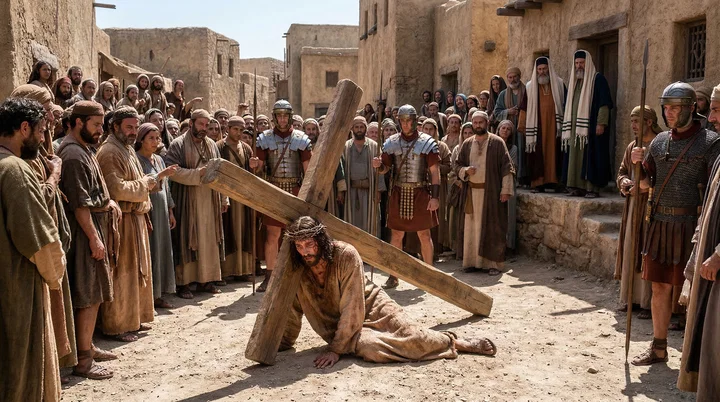
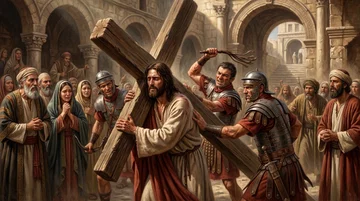
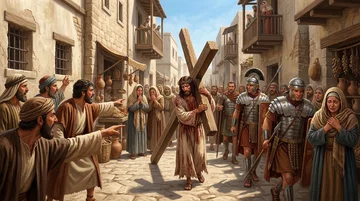
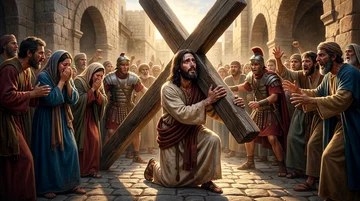
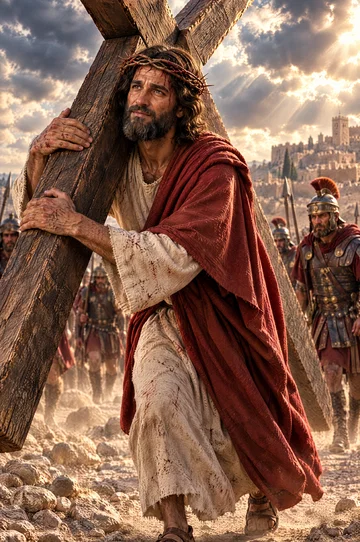
Then delivered he him therefore unto them to be crucified. And they took Jesus, and led him away.
Translations
Then delivered he him therefore to them to be crucified. And they took Jesus, and led him away.
King James Version, KJV Cambridge Paragraph Bible
Then delivered he him therefore unto them to be crucified. And they took Jesus, and led him away.
Then therefore he delivered him to them to be crucified. And they took Jesus, and led him away.
Revised Version, American Standard Version
Then therefore he delivered him unto them to be crucified.
Then, therefore, he delivered him up to them, that he may be crucified, and they took Jesus and led [him] away,
Then therefore he delivered him up to them, that he might be crucified; and they took Jesus and led him away.
Then, therefore, he delivered him up unto them, that he might be crucified. They took possession, therefore, of Jesus.
Then Pilate handed Jesus over to be crucified, and the soldiers took Him away.
Then Pilate handed Jesus over to be crucified, and the soldiers took Him and led Him away.
So then he delivered him to them to be crucified. So they took Jesus and led him away.
So then he gave him up to them to be put to death on the cross. And they took Jesus away;
Then deliuered he him vnto them, to be crucified. And they tooke Iesus, and led him away.
Douay-Rheims (Challoner revision)
Then therefore he delivered him to them to be crucified. And they took Jesus, and led him forth.
Pictures
Cross-references 20 of 53
- Matthew 27:22-26
Pilate saith unto them, What shall I do then with Jesus which is called Christ? They all say unto him, Let him be crucified.
The crowd demands Jesus’ crucifixion, and Pilate yields.
- Mark 15:15
And so Pilate, willing to content the people, released Barabbas unto them, and delivered Jesus, when he had scourged him, to be crucified.
Pilate yields to the crowd and delivers Jesus to be crucified.
- Matthew 27:31-32
And after that they had mocked him, they took the robe off from him, and put his own raiment on him, and led him away to crucify him.
Jesus is led away to be crucified after being mocked.
- Luke 23:24-25
And Pilate gave sentence that it should be as they required.
Pilate grants the demand for Jesus’ death and hands him over.
- Mark 15:20-21
And when they had mocked him, they took off the purple from him, and put his own clothes on him, and led him out to crucify him.
Jesus is led out to be crucified, and Simon is compelled to carry his cross.
- Luke 23:26
And as they led him away, they laid hold upon one Simon, a Cyrenian, coming out of the country, and on him they laid the cross, that he might bear it after Jesus.
Simon is made to carry the cross after Jesus.
- John 18:28-40
Then led they Jesus from Caiaphas unto the hall of judgment: and it was early; and they themselves went not into the judgment hall, lest they should be defiled; but that they might eat the passover.
Jesus stands before Pilate, who finds no fault in him before he is delivered for crucifixion.
- Exodus 12:6
And ye shall keep it up until the fourteenth day of the same month: and the whole assembly of the congregation of Israel shall kill it in the evening.
The Passover lamb’s slaughter prefigured Jesus’ death.
- 1 Corinthians 5:7
Purge out therefore the old leaven, that ye may be a new lump, as ye are unleavened. For even Christ our passover is sacrificed for us:
Christ is identified as the Passover sacrifice for believers.
- Matthew 27:26
Then released he Barabbas unto them: and when he had scourged Jesus, he delivered him to be crucified.
Pilate hands Jesus over to be crucified.
- John 19:4
Pilate therefore went forth again, and saith unto them, Behold, I bring him forth to you, that ye may know that I find no fault in him.
Pilate declares that he finds no fault in Jesus before yielding to the crowd.
- John 18:38
Pilate saith unto him, What is truth? And when he had said this, he went out again unto the Jews, and saith unto them, I find in him no fault at all.
Pilate declares Jesus faultless during his questioning about truth.
- Luke 23:33
And when they were come to the place, which is called Calvary, there they crucified him, and the malefactors, one on the right hand, and the other on the left.
Describes Jesus’ crucifixion at Calvary.
- Matthew 27:2
And when they had bound him, they led him away, and delivered him to Pontius Pilate the governor.
Both describe Jesus being delivered to Pilate for crucifixion.
- Matthew 27:32-35
And as they came out, they found a man of Cyrene, Simon by name: him they compelled to bear his cross.
Recounts Jesus being led away and crucified, with Simon compelled to carry his cross.
- Luke 23:14-16
Said unto them, Ye have brought this man unto me, as one that perverteth the people: and, behold, I, having examined him before you, have found no fault in this man touching those things whereof ye accuse him:
Pilate finds Jesus innocent but yields to the demand for his death.
- John 19:12
And from thenceforth Pilate sought to release him: but the Jews cried out, saying, If thou let this man go, thou art not Cæsar’s friend: whosoever maketh himself a king speaketh against Cæsar.
Fear for his standing with Caesar pressures Pilate to hand Jesus over.
- Luke 23:52-56
This man went unto Pilate, and begged the body of Jesus.
Jesus is crucified, then buried before the Sabbath on the preparation day.
- John 19:6
When the chief priests therefore and officers saw him, they cried out, saying, Crucify him, crucify him. Pilate saith unto them, Take ye him, and crucify him: for I find no fault in him.
Pilate declares Jesus innocent as the crowd demands his crucifixion.
- Acts 3:13-15
The God of Abraham, and of Isaac, and of Jacob, the God of our fathers, hath glorified his Son Jesus; whom ye delivered up, and denied him in the presence of Pilate, when he was determined to let him go.
Peter accuses the people of rejecting Jesus and handing him over to be killed.
Commentary
Each commentary is drawn from primary sources: the writings of Ellen G. White and Adventist pioneers and periodicals. Each commentary is separate. Its own words are not a quotation; follow the references to read the source passages.
Ellen G. White
33 sources
Pilate handed Jesus over to be crucified, and He was taken and led away from the judgment hall toward Calvary outside Jerusalem where criminals were executed.Ms 51, 1897, par. 33–34DA 741.4–742.1DA 722.5DA 741.1–2 The Jewish leaders had condemned Him and forced Pilate's consent by charging treason against Rome and claiming loyalty to Caesar alone.Ms 51, 1897, par. 33–34DA 723.1–724.1RH Nov 11, 1915 Weakened by scourging and loss of blood He sank beneath the heavy cross laid on Him, falling once and again until another was compelled to bear it the rest of the way.DA 741.4–742.1EW 143.3ST Jul 18, 1878SG1 57.2 As humanity's substitute He was made a curse outside the gate to bear the penalty of the broken law, and by enduring without retaliation He upheld God's law, revealed God's self-sacrificing love, and exposed Satan's malice as false.DA 741.1–2ST Jul 12, 1899Lt 12, 1911, par. 8–11ST Jul 11, 1878 Pilate knew Him innocent yet sacrificed Him to protect his position, and stands guilty despite shifting blame, warning that yielding conscience to pressure leads to ruin, while His disciples' hour of gloom in seeing the Bridegroom taken calls His followers to self-denying surrender measured by His great sacrifice.EW 152.3SG1 56.1Ms 74, 1911, par. 173SP 147.14RED 102.2–103.1
Delivered to Be Crucified
Pilate handed Him over to be crucified, and He was taken and led away from Pilate's court and judgment hall and house toward Calvary, the place of execution.Ms 51, 1897, par. 33–34DA 741.4–742.1DA 722.5DA 741.3DA 684 The Jewish council had already condemned Him and sought Pilate's approval to carry out the sentence, and the priests and rulers forced the governor to do their will by declaring they had no king but Caesar and charging that to release Him would oppose Caesar.Ms 51, 1897, par. 33–34DA 723.1–724.1RH Nov 11, 1915 The officials would not enter the judgment hall, to preserve ceremonial purity for the Passover, while their hearts were defiled by murderous hatred, though He was the true Passover lamb and by rejecting Him they lost the feast's significance.DA 723.1–724.1 The alleged crime was treason against the Roman government, for which those executed were taken down by common soldiers and buried in a burial ground reserved for criminals under sentence of death.5RED 92.2
He suffered outside the boundaries of Jerusalem and outside the gate, where felons and murderers were executed.DA 741.1–2 News of His condemnation spread through Jerusalem, and people of all classes and ranks flocked toward the crucifixion, so a vast multitude followed Him on the crowded road to Calvary.DA 722.5DA 741.3 Because the priests and rulers had promised not to molest His followers if He Himself were delivered to them, disciples and believers from the city and the surrounding region joined the throng that followed Him.DA 741.3 Later that same day the march was interrupted when the crowd saw the body of Judas, and the sight brought less mockery and pale faces among them.DA 722.5
As He passed out, the cross prepared for Barabbas was laid on His bruised and bleeding shoulders, and He was hurried toward Calvary amid shouts and jeers, while two thieves were also given crosses to be taken to die with Him.DA 741.4–742.1ST Jul 18, 1878COS 155.1 Weakened by the night's trials and by scourging and suffering and by weariness and pain and loss of blood, He could not carry its heavy burden and after carrying it only a short distance fell fainting beneath it.DA 741.4–742.1EW 143.3ST Jul 18, 1878COS 155.1 After it was laid on Him again He fell once more, and weakened by scourging and blows He fainted beneath the heavy cross three times.DA 741.4–742.1SG1 57.2 Then one of His followers, who believed in Him but had not openly professed faith, was made to carry it to the place of execution, while the disciples followed in grief and despair, recalling His joyful entry into Jerusalem and their hope that He would reign as a temporal king.EW 143.3SG1 57.2
Meaning of His Suffering
John 19:16 marks the moment Jesus was led out and delivered to the people to be crucified amid a vast, jeering crowd.3SP 148.1ST Jul 11, 18785RED 68.1 The chief priests and elders ridiculed His claim to be the Son of God while the multitude mocked and jeered Him.3SP 148.15RED 68.1 He endured that cruelty without a murmur and remained faithful to His Father's will.ST Jul 11, 1878 A religious frenzy had spread from the leaders to the mob, bringing them into shared hostility toward Him.ST Jul 11, 18785RED 68.1 Satan had stirred the priests and people to demand His crucifixion, and His rejection and death through Satan's influence exposed Satan's malice to the universe.3SP 148.1GC88 501.1–2
He was handed over after living a wholly pure, sinless, truthful and godly life.STB 40.1PK 710.2 That purity and godliness reproached proud, sensual and selfish people and reproved their refusal to honor God's rightful claims, and for that He was hated.STB 40.1PK 710.2 The crowd that had hailed Him as king turned against Him to revile Him.4RED 102.2–103.1 The people's rejection of Him, the Holy One of Israel, reached its climax in His crucifixion at Calvary, for which they became responsible.STB 40.14RED 102.2–103.1PK 710.2
As humanity's substitute He suffered outside the gate, where felons and murderers were executed, and was made a curse to redeem people from the curse of God's law.DA 741.1–2 He bore the penalty for the human race.ST Jul 12, 1899
His sacrifice reveals the character of God's government, upholds the honor of God's law, and makes salvation possible for those who return to allegiance to God.ST Jul 12, 1899 Wicked men carried out the sentence while Satan led the mob's abuse, yet Jesus submitted calmly to humiliation and death instead of retaliating or using His power to escape.Lt 12, 1911, par. 8–11 His sinless endurance and death exposed Satan's charges against God as false and showed God's willingness to make the greatest sacrifice for humanity.Lt 12, 1911, par. 8–11
Warning and Call to Follow
Pilate declared he found no fault in Jesus, knew Him innocent, and had no just cause to condemn Him, yet ordered Him scourged and handed Him over to suffer crucifixion and be nailed through hands and feet and hung on the cross.SG1 56.1Ms 74, 1911, par. 17ST Jul 12, 1899Lt 12, 1911, par. 8–11 He did so to protect his worldly honor and office, because he feared losing his position, power, authority, honor and life more than he feared doing wrong.EW 152.3SG1 56.1Ms 74, 1911, par. 173SP 147.1 Though knowing his own conviction, he sacrificed an innocent life rather than stand firmly by conviction, handing an innocent man over to die for selfish interests.SG1 56.13SP 147.1
Pilate was responsible for the condemnation, though his authority was given from above, and the one who delivered Jesus to him bore the greater sin.Ms 51, 1897, par. 33–34 His attempt to place responsibility on the accusers did not leave him innocent, for by handing Jesus over he was guilty of Jesus' blood.Ms 51, 1897, par. 33–34SG1 56.1 His wavering let the crowd and the leaders' claim to have no king but Caesar overrule him and led to his ruin, for the accusation that releasing Jesus would oppose Caesar pressured him to condemn Him.Ms 51, 1897, par. 33–343SP 147.1 Had he stood by conviction and refused the demand he could have defended Jesus, avoided the guilt of condemning an innocent man, and spared his name infamy.Ms 72, 1898, par. 11
Choosing self-interest over conscience and duty draws a person into guilt, and Pilate's yielding to public pressure over justice became an example followed by judges who let pressure overrule justice.3SP 147.1Ms 72, 1898, par. 11
His being taken away is the taking of the Bridegroom from the disciples and the coming of the time for Christ to approach the cross and go down into the depths of humiliation.ST Jul 7, 1898 Then they see Him in whom their hopes of eternal life are centered in the hands of wicked men, hear His own nation clamoring for His blood, see the crown of thorns plaited for His sacred brow, see Him clad in the purple robe with persecutors bowing in mock homage before Him and striking Him with the reed placed in His hand, see Him who they thought would take His place on David's throne scourged as the worst of criminals with the murderous Barabbas chosen in place of their beloved Teacher, and see Him lifted up on the cross and dying as a malefactor.ST Jul 7, 1898 It is a terrible hour of gloom and days of trial and temptation when the Comforter's presence is not clearly discerned, when faith is tried and hope and courage fail, and when there is cause to mourn and fast.ST Jul 7, 1898Ms 126, 1907, par. 9–10 The disciples failed the test and lost faith, and Peter denied his Lord before His enemies, because overcome with sleep they failed to watch and pray, heard little of what passed between Christ and the heavenly messenger, and did not receive the light of Christ's sufferings and following glory or the blessing of sharing His self-sacrifice; had they remained watching, rays of hope would have lighted the darkness and sustained faith.Ms 126, 1907, par. 9–10
His humiliation and death after the crowd that had hailed Him as king turned to revile Him were a severe trial for disciples, but He had prepared His faithful followers so they would not be overwhelmed or base faith on fickle opinions.4RED 102.2–103.1 His being delivered into His enemies' hands begins the way to the cross through mockery, thorns and nails willingly suffered, which shows what He gave up for humanity and makes the self-denial asked of followers small by comparison.Lt 1a, 1861, par. 2–5 His going to the cross as a bleeding victim provides grace and power and is evidence that He is at their side to help.Ms 8, 1886, par. 8 His death at Calvary as the price of the only begotten Son's blood by which people are bought calls them to surrender to Christ and conform life to His will.Lt 122, 1901, par. 15 His crucifixion as the great sacrifice is the measure of the church's work, which remains far behind what it should be.Ms 56, 1901, par. 8
Sources
Pioneers and periodicals
64 sources
Pilate handed Jesus over to be crucified, and they took him and led him away out of the city bearing his cross to Golgotha, where he was crucified between two thieves.ST Mar 20, 1901ST May 13, 1897RH Jun 23, 1910ST Jan 1, 1894 He was delivered after being declared innocent and subjected to scourging, mockery and abuse, and he went forth bruised and bleeding under the cross until he fell fainting from loss of blood, weariness and pain.ST Jul 18, 1878RH Apr 8, 1902ST Mar 13, 1901 Pilate yielded to the leaders' charge that his kingship challenged Caesar and to the mob's clamor for crucifixion, choosing office, Caesar's favor and self-interest over conscience and justice though he had repeatedly declared him innocent.ST Mar 15, 1877ST Mar 28, 1911ST Jul 11, 1878RH Jun 15, 1911 The Jews who demanded his death bore the greater responsibility while Rome under Pilate carried out the sentence, and Israel's failure to recognize him when he came brought the overthrow of their place and nation.ST Mar 28, 1911RH Feb 13, 1900ST Mar 19, 1894ST Feb 27, 1896 His being led away to the cross was the climax of a life of love in which the Son of God, the Passover Lamb slain from the foundation of the world, bore the penalty for sin to make salvation possible and supremely revealed God's holiness and love.ST Jul 12, 1899ST Nov 14, 1906RH Nov 10, 1863RH Jan 16, 1908RH Dec 5, 1907
Handover and Setting
Pilate yielded to the demand that Jesus be crucified and handed him over to his accusers, and they took Jesus and led him away to be crucified.ST May 13, 1897RH Jun 23, 1910ST Jan 1, 1894 The scene belongs to his suffering in the judgment hall and his journey to Calvary, where he meekly bore suffering, sustained by love for humanity, and died as a sacrifice for others.ST May 13, 1897RH Jun 23, 1910 His death for individuals is an act of kindness that calls for love in response.ST Jan 1, 1894
The delivery followed his scourging and abuse by the soldiers and the crowd's demand for crucifixion, and it reveals weakness and cowardice in yielding self-interest over declared innocence.ST Mar 13, 1901 He had been declared innocent yet was subjected to unmerited torture, mockery, and scourging, and his life was sacrificed so that human lives might be saved.ST Mar 13, 1901 As he left Pilate's house the cross prepared for Barabbas was laid on his bruised and bleeding shoulders, and after carrying it only a short distance he fell fainting from blood loss, weariness, and pain.ST Jul 18, 1878
He was led out of the city bearing his cross to Golgotha, where he was crucified between two thieves.ST Nov 14, 1906 His mother, other women, Joseph, and the Roman executioners witnessed his death, and his enemies also regarded it as certain, showing that he truly died. From his being taken away through his burial John's account parallels Matthew 27:31-66, Mark 15:21-47, and Luke 23:35-53, showing that Christ died for sins according to the Scriptures.ST Mar 20, 1901 His death was the climax of a life of love, for the Lamb slain from the foundation of the world gave his life so that sinful, mortal people might have life.ST Nov 14, 1906
The handing over took place in Jerusalem, where the popular religious community cried out for his death, and he offered his life as a ransom for lost humanity.RH Feb 10, 1863 It belongs to the account showing that he was crucified on the preparation day before the Sabbath, commonly called Friday.ST Apr 21, 1914 He was tried and condemned by the highest Jewish authority on the night of the Passover feast and delivered to be crucified the following day, an exception to usual reluctance to try and execute prisoners during that solemn season.ST Mar 6, 1884 The Jews clamored for him to be condemned and crucified on Passover day, disregarding their own tradition and the law against executions in Passover week.ST Apr 30, 1902 Jewish records expressly place his crucifixion at three o'clock in the afternoon on Passover.RH Sep 5, 1865
Pontius Pilate, Governor of Lower Galilee, sitting on the presidential chair of the praetorium in holy Jerusalem on March 25 in the seventeenth year of Tiberius Caesar when Anna and Caiaphas were priests, delivered Jesus of Nazareth to be crucified.RH Sep 3, 1857 The sentence condemned him to die on the cross between two thieves as a seducer, seditious enemy of the law falsely calling himself Son of God and King of Israel who entered the Temple followed by a multitude with palms.RH Sep 3, 1857 Pilate ordered the first centurion Quillus Cornelius to lead him out of Jerusalem by the gate of Struenus to execution, and forbade any person poor or rich to oppose it, with Daniel Robini a Pharisee, Joannes Rorobable, Raphdel Robani, and Capet a citizen as signing witnesses.RH Sep 3, 1857
The one delivered was the Word who was in the beginning, who was God with God, by whom all things were made.RH Apr 14, 1874 The same single person was made flesh and dwelt among men, came from the Father and returned to him, taught and worked miracles, was falsely accused, was put to death on the cross with shed blood, was buried, and rose again.RH Apr 14, 1874 His crucifixion was the obedient self-humbling of that one divine person unto death, even the death of the cross.RH Apr 14, 1874 His journey from the Roman praetorium to the cross after unjust condemnation was a step in his sacrifice for fallen humanity, culminating in his crucifixion and death.
Pilate's Unjust Sentence
Pilate handed Jesus over to be crucified after yielding to the leaders' accusation that his kingship challenged Caesar, so the condemnation rested on treason against Rome and not on blasphemy under Jewish law.ST Mar 15, 1877 He did this although he had found Jesus innocent and had repeatedly declared him innocent.ST Mar 15, 1877ST Mar 28, 1911RH Jun 15, 1911 The act exposed weakness and cowardice, for he would not let innocence stand in the way of self-interest. Fear that his office might be endangered moved him to sentence Jesus to die.ST Mar 28, 1911RH Dec 3, 1857
He chose earthly honor and Caesar's favor over conscience and God's approval, approving and signing the death warrant of the innocent Son of God.ST Jul 11, 1878RH Dec 3, 1857 He was convinced of Jesus' superiority and tried again and again to save him, yet when the Jews threatened his standing as Caesar's friend he yielded to the mob and to popular clamor.ST Oct 7, 1886 His loyalty was already suspect with the government, a report of unfaithfulness would cost him his office, and he knew his enemies would show him no mercy.ST Oct 7, 1886 The mob's demand prevailed through misrepresentation and threats, and the government ratified the demand of the masses.ST Feb 12, 1894RH Jun 4, 1908RH Jun 15, 1911
He surrendered Jesus for political advantage rather than according to reason and justice, showing how yielding to public pressure endangers liberty and leads to injustice.ST Mar 24, 1914 He insisted on the law while his victim could have explained the case.ST Sep 12, 1895 He chose his office over justice, yet the very loss he feared still came upon him, for afterward he was stripped of his honors and cast down from high office.ST Oct 7, 1886 Stung by remorse and wounded pride, he committed suicide not long after the crucifixion.ST Oct 7, 1886
His exercise of authority over Jesus' death illustrates that temporary earthly authority does not make its holder wiser or better, even though all power in heaven and earth belonged to Jesus.ST Jul 13, 1904 In delivering Jesus to be crucified despite recognizing his innocence and feeling the pressure of conscience, Pilate let the mob's demand prevail and condemned Jesus, the Incarnate Truth, to death. That choice sets before every person the decision whether to accept him as leader.
Accusers and Responsibility
Pilate found him innocent yet handed him over to be crucified and sentenced him to die, because fear that his office might be endangered moved him to condemn him.ST Mar 28, 1911 The Jews demanded his crucifixion and bore the greater responsibility for it, while the Roman authorities carried out the sentence.ST Mar 28, 1911 Those who crucified him were descendants of Abraham, so descent from Abraham did not ensure righteousness.ST Feb 27, 1896
Israel had been entrusted with God's truth for the nations, yet failed to recognize Jesus when he came and crucified him.RH Feb 13, 1900 That crucifixion followed the hostility of the religious leaders against him.ST Mar 19, 1894 It was the wicked act that brought about the everlasting overthrow of their place and nation.ST Mar 19, 1894
The charges brought against him by the Jews were for claiming to be the Son of God and for not observing the Sabbath according to their customs.ST May 19, 1914 After those charges he was sentenced to death by Pilate and executed at Calvary.ST May 19, 1914 In this he was a victim of religious legislation.ST May 19, 1914
More than twenty years before Paul's arrest, the Jerusalem mob demanded his death with the cry Away with him resounding through the streets.ST Apr 22, 1903 The same crowd that demanded his death followed him as he bore his cross toward Calvary.ST Apr 22, 1903 Satan stirred up that mob and instigated its cries.ST Apr 22, 1903 He was taken and led away because his ministry was finished, so the powers of darkness were then allowed to touch him.ST Apr 22, 1903
The chief priests and Pharisees brought the scourge, the thorny crown, and the Roman cross as their last argument against his teachings because they could not maintain their position.RH Oct 11, 1870 Abuse is the last resort of those who cannot maintain a position yet are determined to hold it right or wrong.RH Oct 11, 1870 Anger or abusiveness in religious controversy marks the wrong side, while one who contends for what he regards as truth with love of truth in his heart never needs to become angry or act unworthy of a gentleman.RH Oct 11, 1870
He was handed over to be crucified under the authority of the Roman government, which had authority to impose the death penalty.ST Feb 10, 1898 Rome in its pagan phase crucified Jesus, the Prince of the host.ST Feb 10, 1898 Rome acting through Pilate put the Son of God to death.RH Sep 2, 1909 He was raised from the dead and ascended to his Father.RH Sep 2, 1909
Sacrifice and Atonement
His being handed over to be crucified and led away was the climax of a life of love, for as the Lamb slain from the foundation of the world He gave His life so that sinful, mortal people might have life.ST Nov 14, 1906 In that leading away He bore the world's woe and was burdened for souls while the Father beheld Him in an agony of love.RH Jan 16, 1908 It shows the terrible consequence of sin, that it nailed the Son of the infinite God to a wooden cross.RH Dec 5, 1907
The crucifixion was the consequence of sin and the path by which Christ, who came from heaven, gave Himself as a sin-atoning sacrifice.RH Nov 10, 1863 The one led to the cross who died was the Son of God, not merely a human being.RH Nov 10, 1863 He bore the penalty for the human race to make salvation possible for those who return to allegiance to God.ST Jul 12, 1899
His death supremely reveals God's suffering for human sin.RH Aug 20, 1908 At the cross Christianity's standard shone with holiest light, revealing the infinite holiness of God's law and the infinite love of God, revealing the character of God's government and upholding the honor of God's law.ST Jul 12, 1899ST Feb 12, 1894 The cross and its suffering are past, never to be repeated, as He comes again in glory to reign.ST Dec 7, 1904
He meekly bore suffering in the judgment hall and on the journey to Calvary, sustained by love for humanity, dying as a sacrifice for others.RH Jun 23, 1910 His death came amid gloomy and foreboding circumstances on an ignominious cross, yet God's kingdom was founded through it. By His cross and suffering He was made perfect for others.ST Feb 13, 1907 The mountain of His crucifixion, where He was led away to be crucified, is where His sorrow for lost sinners and His sacrificial love reached their climax.ST Sep 10, 1902
He endured unjust condemnation with patience, as He had endured betrayal, abuse, mockery, and suffering throughout His trial.RH May 26, 1868 When led forth and delivered for crucifixion, the crowd's hostility had been stirred from the chief priests and elders down to the mob, while He endured cruelty without a murmur and remained faithful to His Father's will.ST Jul 11, 1878
His crucifixion was the saddest tragedy in human history, handed over and led away by a bloodthirsty, hardened mob. He went forth with thorn-crowned head, blood marking every step, laden with His cross, with pierced hands and feet, enduring three hours of fierce noontide heat, by which He became wholly His people's.RH Apr 8, 1902 As the man of sorrows He suffered bitter depths of human woe below, sharing every burden in pitying love after days of toil and nights of prayer, including the heavy cross, piercing crown, nails, spear, blood, joined to the anguish of Gethsemane.
Being led away to be crucified connects to His death through which He fulfilled the law.ST Jan 13, 1881 His journey from Gethsemane and Pilate's judgment hall to Calvary illustrates complete consecration: merely suffering then being released would be only partial dedication, while going with Him to death is full surrender.ST Sep 12, 1900 The shed blood signifies the giving of life and the flesh consumed on the altar signifies a life wholly given to God.ST Sep 12, 1900
Prophecy Types and Parallels
He is the Passover sacrifice and Lamb of God put to death on the fourteenth day of the first month, fulfilling at its appointed time the type of the lamb slain on that day.RH Oct 30, 1855ST Aug 13, 1874RH Dec 15, 1868 His death is the antitype of the Passover lamb, the slain lamb's sacrifice fulfilled in the death of the Lamb of God on that day.RH Oct 30, 1855ST Aug 13, 1874RH Dec 15, 1868
His being delivered to be crucified is the cutting off of Messiah in the middle of the seventieth week, which took place in the spring at the Passover in A.D. 31. Going back three years and six months from that spring crucifixion brings the commencement of his ministry as the Anointed One to the autumn of A.D. 27, and going forward three years and six months brings the end of the seventy weeks to the autumn of A.D. 34. Since the first 490 years of the 2300 days thus ended in the autumn of A.D. 34, the remaining 1810 years ended in the autumn of A.D. 1844.
His being taken away is the taking away of the Bridegroom, meaning the time has come for him to approach the cross and go down into the depths of humiliation.ST Jul 7, 1898 The disciples see him in whom their hopes of eternal life are centered in the hands of wicked men, hear his own nation clamoring for his blood, and see the crown of thorns plaited for his brow, the purple robe, his persecutors bowing before him and striking him with the reed placed in his hand.ST Jul 7, 1898 They see him who they thought would take his place on David's throne scourged as the worst of criminals, with the murderous Barabbas chosen in the place of their beloved Teacher, and see him lifted up on the cross and dying as a malefactor.ST Jul 7, 1898 These are days of trial and temptation when the presence of the Comforter is not clearly discerned, when there is cause to mourn and fast, when faith is tried and hope and courage fail.ST Jul 7, 1898
His being handed over to be crucified and led away shows the hatred of his spiritual kingdom culminating in crucifixion, where in Jerusalem the popular religious community cried out for his death.RH Feb 10, 1863ST Feb 27, 1896 The account teaches that he died for individuals as an act of kindness that calls for love in response, offering his life as a ransom for lost humanity.ST Jan 1, 1894RH Feb 10, 1863 Calvary, where he was taken and led away, with Gethsemane shows best what his compassion and affection are.RH Dec 23, 1873 The same sleepless vigilance with which his eyes watched over his people's welfare and the same unseen leading of his hand belong to the compassion seen at Calvary.RH Dec 23, 1873 They will be beheld and grasped when he comes again in glorious majesty and beauty, his eyes gazing with unutterable compassion and affection, making his sudden coming transcendently joyous to the few who are watching for the long-absent Beloved.RH Dec 23, 1873
Following Christ and Warning
His being handed over to be crucified and led away subdues pride and removes discontent, and remembering it steadies the fretful or gloomy believer.ST Apr 17, 1879 He went as the man of sorrows who suffered the bitter depths of human woe below, sharing every burden and care in pitying love after days of toil and nights of prayer, bearing the heavy cross, wearing the piercing crown of thorns, enduring the nails, the spear, and the blood, joined to the anguish of Gethsemane. Remembering this leaves no place to murmur or complain in grief and pain, to ask for a life of ease, or to live to please self. Since he suffered, pain is made sweet, bringing believers lower at his feet in closer sympathy with him, making grief and anguish fragrant, and calling the heart low at the cross to sing triumph and glory only in suffering.
Christian perfection is distinct from angelic perfection, which is uninterrupted transports of praise and ceaseless raptures of joy.RH Aug 14, 1860 It does not consist in ecstasies and extraordinary revelations, nor in building a tabernacle upon Mount Tabor to enjoy rare sights there, but in resolutely taking up the cross and following him to Caiaphas, to Pilate in his judgment hall, and to the top of an ignominious Calvary where he was delivered by an unjust Pilate to be crucified and led away.RH Aug 14, 1860 The only way by which he reached the throne for a redeemed world was by being led away to be crucified, with hands and feet pierced and brow scarred with a crown of thorns.RH Feb 4, 1904 The glory of the ascending Lord and a seat with him on his throne cannot be rightly understood apart from the wilderness of temptation, days of patient toil and nights of prayer, and the awful experiences of Gethsemane and Calvary, for the only way to the throne of God is by the way of Calvary.RH Feb 4, 1904 Whoever sees the throne with no crucified Lord between himself and the throne can never expect to have the throne above, but must deny himself and take up his cross daily and follow him.RH Feb 4, 1904
His handing over to be crucified came after the religious authorities joined with Caesar's power, condemning him because he did not submit to their traditions made civil law, showing how a church united with the state can use its power even against God. The Roman governor handed him over after pressure to execute him, for by condemning him for what they treated as sin and compelling the governor to act, they made civil power serve a religious judgment and usurp God's authority.ST Dec 18, 1893 Civil government has no right to enter the domain of conscience to define sin or to punish sin, and when it does so it usurps the place of God and becomes rebel to his authority, bringing disaster on itself and persecution on conscientious citizens.ST Oct 9, 1907 This is how religious persecution is carried out, when professed worshipers of God appeal to civil power to enforce their demands and obtain its cooperation for his death.ST Oct 2, 1893 The Jewish priests and rulers forced the Roman governor to do their will and by threats compelled him to hand Jesus over, trying in the same way to make civil authority enforce their religious judgment.RH Nov 11, 1915ST Oct 16, 1893 Their use of misrepresentation and threats to pressure Pilate parallels later religious efforts to influence government through exaggerated petitions and threats against lawmakers, showing how religious bigotry can use political coercion to advance its aims.ST Feb 12, 1894
Pilate surrendered him to be crucified after popular clamor swayed him, acting for political advantage rather than according to reason and justice, showing how yielding to public pressure can endanger liberty and lead to injustice.ST Mar 24, 1914 Public sentiment led to his being handed over, warning that popular opinion can support unjust action.ST May 10, 1910 A politician sacrifices Christ to protect his own position when, like Pilate pressed by religious leaders to save himself, he delivers Jesus to be crucified, and that same act is repeated when politicians grant demands for rigid enforcement of Sunday laws, so that Christ is again crucified in the persons of his saints who are persecuted under those laws.ST Aug 6, 1894 The soldiers who took him away to be crucified were not innocent merely because they acted under a Roman governor's orders, for civil authority cannot make a morally wrong act right.ST Mar 16, 1915 The soldiers seen in processions representing those who crucified him recall his handing over to be crucified.
Sources