Isaiah 53:12
Therefore will I divide him a portion with the great, and he shall divide the spoil with the strong; because he hath poured out his soul unto death: and he was numbered with the transgressors; and he bare the sin of many, and made intercession for the transgressors.
Translations
Therefore will I divide him a portion with the great, and he shall divide the spoil with the strong; because he has poured out his soul to death: and he was numbered with the transgressors; and he bore the sin of many, and made intercession for the transgressors.
Therefore will I divide him a portion with the great, and he shall divide the spoil with the strong; because he hath poured out his soul unto death: and he was numbered with the transgressors; and he bare the sin of many, and made intercession for the transgressors.
Therefore will I divide him a portion with the great,
And he shall divide the spoil with the strong;
Because he hath poured out his soul unto death:
And he was numbered with the transgressors;
And he bare the sin of many,
And made intercession for the transgressors.Therefore I will divide to him a portion with the great, and he shall divide the spoil with the strong; because he hath poured out his soul to death: and he was numbered with the transgressors; and he bore the sin of many, and made intercession for the transgressors.
Revised Version, American Standard Version
Therefore will I divide him a portion with the great, and he shall divide the spoil with the strong; because he poured out his soul unto death, and was numbered with the transgressors: yet he bare the sin of many, and made intercession for the transgressors.
Therefore I give a portion to him among the many, And with the mighty he apportioneth spoil, Because that he exposed to death his soul, And with transgressors he was numbered, And he the sin of many hath borne, And for transgressors he intercedeth.
Therefore will I assign him a portion with the great, and he shall divide the spoil with the strong: because he hath poured out his soul unto death, and was reckoned with the transgressors; and he bore the sin of many, and made intercession for the transgressors.
Therefore, will I give him a portion in the great, And the strong, shall he apportion as spoil, Because he poured out, to death his own soul, And with transgressors, let himself be numbered,—Yea, he, the sin of Many, bare, And for transgressors, interposeth.
Berean Standard Bible, Majority Standard Bible
Therefore I will allot Him a portion with the great,
and He will divide the spoils with the strong,
because He has poured out His life unto death,
and He was numbered with the transgressors.
Yet He bore the sin of many
and made intercession for the transgressors.Therefore I will give him a portion with the great.
He will divide the plunder with the strong,
because he poured out his soul to death
and was counted with the transgressors;
yet he bore the sins of many
and made intercession for the transgressors.For this cause he will have a heritage with the great, and he will have a part in the goods of war with the strong, because he gave up his life, and was numbered with the evil-doers; taking on himself the sins of the people, and making prayer for the wrongdoers.
Therefore will I giue him a portion with the great, and he shall deuide the spoyle with the strong, because hee hath powred out his soule vnto death: and he was counted with the transgressers, and he bare the sinne of many, and prayed for the trespassers.
Douay-Rheims (Challoner revision)
Therefore will I distribute to him very many, and he shall divide the spoils of the strong, because he hath delivered his soul unto death, and was reputed with the wicked: and he hath borne the sins of many, and hath prayed for the transgressors.
Pictures
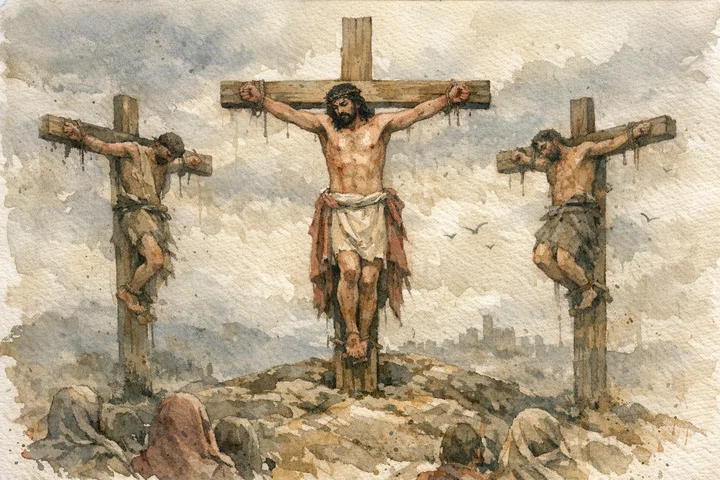
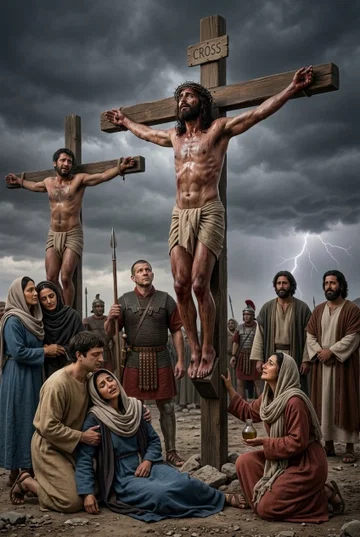
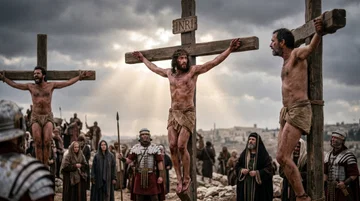
Cross-references 20 of 164
- 2 Corinthians 5:21
For he hath made him to be sin for us, who knew no sin; that we might be made the righteousness of God in him.
Christ bears sin as the sinless substitute so others may receive God's righteousness.
- Isaiah 53:6
All we like sheep have gone astray; we have turned every one to his own way; and the LORD hath laid on him the iniquity of us all.
The LORD lays the iniquity of all on the one who bears it.
- 1 Peter 2:24
Who his own self bare our sins in his own body on the tree, that we, being dead to sins, should live unto righteousness: by whose stripes ye were healed.
Christ bears sins in his body on the tree, suffering in the place of sinners.
- Luke 22:37
For I say unto you, that this that is written must yet be accomplished in me, And he was reckoned among the transgressors: for the things concerning me have an end.
Jesus says Isaiah’s prophecy of being numbered with transgressors must be fulfilled in him.
- Matthew 20:28
Even as the Son of man came not to be ministered unto, but to minister, and to give his life a ransom for many.
Christ gives his life as a ransom for many.
- Philippians 2:8
And being found in fashion as a man, he humbled himself, and became obedient unto death, even the death of the cross.
Christ humbles himself and obeys unto death on the cross.
- Galatians 3:13
Christ hath redeemed us from the curse of the law, being made a curse for us: for it is written, Cursed is every one that hangeth on a tree:
Christ bears the law’s curse in his death to redeem others.
- Hebrews 7:25
Wherefore he is able also to save them to the uttermost that come unto God by him, seeing he ever liveth to make intercession for them.
Christ’s death is joined to his continuing intercession and power to save sinners.
- Matthew 26:38
Then saith he unto them, My soul is exceeding sorrowful, even unto death: tarry ye here, and watch with me.
Jesus says His soul is sorrowful unto death.
- Revelation 1:18
I am he that liveth, and was dead; and, behold, I am alive for evermore, Amen; and have the keys of hell and of death.
Christ was dead and is alive forevermore, holding authority over death.
- Mark 15:27-28
And with him they crucify two thieves; the one on his right hand, and the other on his left.
Jesus is crucified with criminals, fulfilling the prophecy that he would be numbered with transgressors.
- John 1:29
The next day John seeth Jesus coming unto him, and saith, Behold the Lamb of God, which taketh away the sin of the world.
Jesus is the Lamb who takes away sin, paralleling his bearing the sins of many.
- Isaiah 53:5
But he was wounded for our transgressions, he was bruised for our iniquities: the chastisement of our peace was upon him; and with his stripes we are healed.
Christ is wounded for others’ transgressions, and his stripes bring healing.
- Psalms 22:16-18
For dogs have compassed me: the assembly of the wicked have inclosed me: they pierced my hands and my feet.
Both foretell Christ’s suffering and crucifixion, including pierced hands and feet and divided garments.
- John 3:16
For God so loved the world, that he gave his only begotten Son, that whosoever believeth in him should not perish, but have everlasting life.
God gave His Son to die for sinners and give believers everlasting life.
- 1 Peter 3:18
For Christ also hath once suffered for sins, the just for the unjust, that he might bring us to God, being put to death in the flesh, but quickened by the Spirit:
Christ, the just, died for the sins of the unjust.
- Acts 2:31
He seeing this before spake of the resurrection of Christ, that his soul was not left in hell, neither his flesh did see corruption.
Christ’s soul was not left in the grave but was raised.
- Daniel 9:26
And after threescore and two weeks shall Messiah be cut off, but not for himself: and the people of the prince that shall come shall destroy the city and the sanctuary; and the end thereof shall be with a flood, and unto the end of the war desolations are determined.
both foretell Messiah cut off without justice
- Hebrews 2:14
Forasmuch then as the children are partakers of flesh and blood, he also himself likewise took part of the same; that through death he might destroy him that had the power of death, that is, the devil;
Christ shares human flesh and defeats the devil through death.
- Hebrews 9:28
So Christ was once offered to bear the sins of many; and unto them that look for him shall he appear the second time without sin unto salvation.
Christ is offered once to bear the sins of many.
Commentary part 1 of 2
Each commentary is drawn from primary sources: the writings of Ellen G. White and Adventist pioneers and periodicals. Each commentary is separate. Its own words are not a quotation; follow the references to read the source passages.
Ellen G. White
90 sources
Isaiah foretells that Christ would fully give His life in death as an offering for sin, be counted among criminals and die as a condemned criminal in sinners' place, carry the sins and guilt of many who had no claim on Him, and pray for sinners pleading for His destroyers to be forgiven.PK 692.1–2Ms 29, 1900, par. 7Ms 112, 1897, par. 20–21Ms 141, 1901, par. 16DA 751.3–4 Though just, perfect and knowing no sin, He took the sinners' place as substitute and surety, with the iniquity of all humanity laid upon Him and the guilt of every descendant of Adam pressing upon His heart.SC 45.2DA 752.2–753.1ST Jan 27, 19143SP 161.2–163.1ST Sep 5, 1911 Because He poured out His life, was counted with criminals, carried the sins of many and prayed for transgressors, God declares He will exalt Him with a portion with the great and a share of spoil with the strong in victory and honor.PK 692.1–2Ms 112, 1897, par. 20–21Ms 45, 1893, par. 2–5 This was fulfilled in Jesus of Nazareth as the world's Redeemer when He was crucified between two thieves and treated as the greatest criminal, which is direct and conclusive proof that cannot be refuted.GC 357.2–358.1GC88 357.1–2DA 751.3–4Ms 111, 1897, par. 35–36 Believing and repenting sinners who receive His sin-bearing work may stand justified before God in His righteousness, saved and pardoned through His sacrifice and made sons and daughters of God to share His divine nature.Lt 180, 1902, par. 33–35Ms 67, 1900, par. 4–6ST Jan 6, 1881SCEV 47.14MR 162.2–163.1
Words and Immediate Context
To pour out his soul unto death means He fully gave His life in death as an offering for sin, following bitter suffering and a cruel death that is sad yet rich in promise.PK 692.1–2AA 227.3Ms 112, 1897, par. 20–21 Since He gave His life to death, was counted with criminals, carried the sins of many, and prayed for transgressors, God declares He will exalt Him with a place with the great and a share of spoil with the strong in victory and honor.PK 692.1–2Ms 112, 1897, par. 20–21Ms 45, 1893, par. 2–5 These details describe His atoning sacrifice, which fulfills the prophecies joined to the sacrificial service and pays the price of redemption out of love for sinners, a love stronger than death.PK 692.1–2AA 227.3ST Aug 23, 1910 The strong with whom He shares the spoil are identified as the overcomers.Ms 112, 1897, par. 20–21 Beholding His death on the cross reveals both hatred of sin and love for sinners.ST Aug 23, 1910
To be numbered with transgressors means He was counted among criminals and died as a condemned criminal in the sinners' place, taking the place of guilty rebels and rebellious sinners under sentence of death.Ms 141, 1901, par. 16RH Sep 4, 190017MR 339.3–340.2 He died as a malefactor enduring the shame and cruelty of crucifixion rather than an honored death, accepting insult, shame, and abuse and bearing their sins upon His divine soul.Ms 141, 1901, par. 16RH Sep 4, 190017MR 339.3–340.2 His shameful death was part of His work as humanity's substitute to meet the demands of God's broken law, to lift people from moral degradation and bring salvation.Ms 141, 1901, par. 16RH Sep 4, 190017MR 339.3–340.2 Through His obedient death, people could escape the penalty of the law.ST May 30, 1911
To bear the sin of many means He as the great Sin-bearer carried the sins and guilt of many, He who is just and perfect bearing them with perfect meekness under the shame of the cross as the Lamb of God.Ms 29, 1900, par. 7DA 78.3–5MH 90.2 He alone could bear sins as the sinless bearer who came to take away the sins of the world to save both Jews and Gentiles, with no people specially favored.Ms 18, 1895, par. 8–10Ms 81, 1893, par. 31–32 His sin-bearing work must be received before anyone can enter heaven.Ms 18, 1895, par. 8–10 Souls that turn to Him for refuge are lifted above accusing and the strife of tongues, united to His divine-human nature so that no man or evil angel can impeach them, and they stand beside Him in light proceeding from the throne of God.MH 90.2
To make intercession for transgressors means He prayed for sinners, pleading with the Father to forgive His destroyers and forgiving the penitent thief.DA 751.3–43SP 159.23RED 59.1 It was fulfilled when He was crucified between two thieves and treated as the greatest criminal, His place among them showing His numbering with transgressors while the pardon He spoke revealed His love and saving work even in death.DA 751.3–43SP 159.2 While pouring out His life in the most excruciating agony of mind and body yet thinking only of others, with a love stronger than death, He acted as prophet in addressing the daughters of Jerusalem, as priest and Advocate in pleading for His destroyers, and as loving Saviour in forgiving the iniquity of the penitent thief who called upon Him and encouraging the penitent soul to believe.3SP 159.2 His earnest prayers were not for Himself, but that sinners lost without redeeming grace might turn from guilt to salvation, and those scenes at Calvary afterward established many witnesses in faith.3SP 159.23RED 59.1
The verse belongs to Isaiah's portrayal of Christ's lowly, rejected, suffering work to save humanity, setting forth His rejection and sufferings in the world which the humble Jesus fulfilled.DA 458.2–4Ms 126, 1909, par. 9–12Ms 64, 1895, par. 8 He came to earth in humanity, little esteemed and stricken for the transgression of His people, in a lowly, self-denying life as part of God's wonderful work.Ms 126, 1909, par. 9–12Ms 64, 1895, par. 8 The whole course of His experience was shown in advance and history fulfilled that vision, His life revealed through His humanity.Ms 64, 1895, par. 8
Sinless Substitute's Suffering
Though just, perfect, innocent and knowing no sin, He took the sinners' place as their substitute, surety, representative and head, counted among transgressors and among the unholy on the sinner's account to bear the sins of many and intercede for them.SC 45.2ST Sep 5, 1911Lt 16, 1892, par. 16–19ST Oct 25, 18772SP 58.2–59.1 By imputation the transgressions and sins of the world and of the guilty were laid upon Him, so that He became the sinner in their stead before the Father and all the heavenly angels, with the curse due to sin coming upon Him.ST Sep 5, 19114MR 162.2–163.1Lt 16, 1892, par. 16–19 Though He had no sins of His own, He identified Himself with His people as their representative and head, taking their sins and submitting to the steps required of sinners, fulfilling all righteousness and the law's requirements, not to repent for Himself but on their behalf.ST Jul 7, 1887ST Oct 25, 18772SP 58.2–59.1 His obedience fulfilled God's law, and His suffering and patient endurance after baptism set the example of perfect obedience in human nature, teaching that men may be obedient and showing converted sinners what to patiently bear because of their sins.ST Sep 5, 1911ST Jul 7, 1887
The iniquity of all humanity was laid upon Him, with the guilt of every descendant of Adam of every age pressing upon His heart, that He as substitute and surety, counted a transgressor, might redeem sinners from the law's condemnation and curse.DA 752.2–753.1ST Jan 27, 19143SP 161.2–163.15RED 82.2–83.1ST Nov 25, 1889 He bore that guilt and died beneath the sins of the world, enduring judicial punishment for iniquity.3SP 161.2–163.15RED 82.2–83.1ST Nov 25, 1889 He became sin itself for man, was treated as sinners deserve to be treated in His life of humiliation and agonizing death, and bore sin's curse though innocent, willingly enduring in silence for the life of the world so that repentant sinners could be clothed with His righteousness and justified.3SP 161.2–163.1ST Sep 5, 19114MR 162.2–163.1Lt 16, 1892, par. 16–19 He endured God's displeasure and wrath against sin and transgression, with the guilt of Adam's descendants pressing upon Him.DA 752.2–753.1ST Jan 27, 1914DA 685.2 Though He knew no sin and had always lived in the Father's presence, He faced the weight of sin, the malignity of sin deeply rooted in the human heart, and the withdrawal of the divine countenance, light and comfort in supreme anguish, an anguish greater than bodily pain and death that made Him fear being shut out forever from His Father's love in eternal separation.DA 685.23SP 161.2–163.1ST Nov 25, 1889ST Aug 14, 1879 What broke His heart was not dread of death or bodily anguish, but the sense of sin bringing the Father's wrath upon Him.3SP 161.2–163.1
He gave His life in death as a willing ransom and sin offering, pouring out His life to take the sentence of death upon Himself, bear the sins of humanity, and secure salvation.SCEV 47.1ST Apr 1, 1889Ms 80, 1903, par. 9–10Lt 16, 1892, par. 16–19 His life alone could pay humanity's debt and be accepted by the Father as its ransom, whereas an angel's life could not.SG1 24.1 This self-sacrifice to pay the price of redemption was driven by love for sinners, a love stronger than death revealed in beholding His death on the cross together with God's hatred of sin.PK 692.1–2ST Aug 23, 19103SP 159.2 It came from infinite pity for the afflicted and suffering of earth, yearning to relieve them all, with the woes of fallen humanity pressing on His soul, and from unwillingness to see them exposed to eternal ruin, hopeless misery and retributive judgment without acting to save them.3T 198.1GC88 22.1COL 156.1–157.1 Even on Calvary, suffering the most excruciating agony of mind and body, He thought only of others, a love that amazed the angels.3SP 159.2
He left His glory, majesty, kingly throne and royal robes and became poor, denying Himself every luxury as the great Medical Missionary using His power for suffering humanity, so that human beings might be made rich through His poverty.3T 198.1Lt 38, 1901, par. 13–15 He gave Himself completely to death to save the human race from hopeless misery, enduring death on the cross despising the shame and refusing to save Himself, descending to the lowest depths of shameful humiliation so that those He saves might sit in heavenly places.3T 198.1TBC1872 52.1Lt 38, 1901, par. 13–15
Exaltation After Sacrifice
God's promise about the Promised One follows His bitter suffering and cruel death as an offering for sin, and though sad, that death is rich in promise.PK 692.1–2 Because He poured out His life unto death, was counted with criminals, carried the sins of many, and prayed for transgressors, God declares He will exalt Him with a portion with the great and a share of spoil with the strong in victory and honor.PK 692.1–2Ms 112, 1897, par. 20–21Ms 45, 1893, par. 2–5 That self-sacrifice to pay the price of redemption was driven by love for sinners.PK 692.1–2 The strong with whom He shares the spoil are the overcomers.Ms 112, 1897, par. 20–21
His reward is to see the results of His suffering: a people whose days will continue and the Lord's purpose prospering through His work as priest who offered Himself to make intercession for human transgression.STE 181.1–2 By consenting to have the crimes of humanity laid upon Him He spoils the domain of death and opens the gates of Paradise and immortal life.3SP 161.2–163.15RED 82.2–83.1 His sacrifice paid the redemption price for the fallen world and opened a grave for the sins of all who accept Him as personal Saviour.Ms 111, 1897, par. 35–36 Through His death He opened a new and living way and entered His enduring priestly office as High Priest for the whole world, having represented humanity before God by taking human form and bearing sin.12MR 399.2–400.1 Though humiliated and apparently defeated as one counted among transgressors, His suffering cannot take away His royal power and divinity to forgive sins and save completely all who come to God through Him as Sin-bearer and Conqueror.DA 751.1
Prophecy and Fulfillment
The prophecy points to the first coming in humiliation, to a Messiah who would suffer, be rejected, condemned and die for human sin, not to a temporal prince who would overthrow Rome and reign on an earthly throne on David's throne.GC 357.2–358.1Lt 65, 1894, par. 4–67MR 200.1–202.1Ms 138, 1897, par. 15–16 That expectation of an earthly kingdom came from trusting human teachers, and it kept many from receiving Him when He came as foretold.7MR 200.1–202.1Ms 138, 1897, par. 15–16 His refusal and rejection, humiliation and death were ordained in the councils between Father and Son and foretold by prophets and men inspired by the Holy Ghost, proving His kingdom is spiritual and not of this world.Ms 138, 1897, par. 15–16
The prophecy was fulfilled in Jesus of Nazareth, whose character, work, reception, treatment, life, ministry and death answered the prophetic description and showed Him to be the world's Redeemer.GC 357.2–358.1GC88 357.1–2SLP 103.2–104.1 Its details describe His atoning sacrifice — pouring out His life to death, counted among transgressors, bearing the sin of many, interceding for transgressors — fulfilling the prophecies joined to the sacrificial service.AA 227.3 That He would die as a malefactor was exactly fulfilled, and the fulfillment is direct and conclusive proof that cannot be refuted.SLP 277.2 The rabbis themselves applied this prophecy to Christ, so its fulfillment requires accepting Jesus as Christ, and reading Isaiah 53 convinced Wolff that Jesus was the Son of God.GC88 357.1–2SLP 277.2
From what He saw and heard on His first visit to the temple at twelve years old, Jesus knew He was to be that great sacrifice for sin and to fulfill the prophecy.Ms 183, 1903, par. 1–2 The whole course of His experience, His lowly self-denying life lived through His humanity, was shown in advance by Isaiah, and history fulfilled that vision.Ms 64, 1895, par. 8 He afterward opened these Scriptures to His disciples step by step, showing that all He had told them beforehand had come to pass and been verified, that every specification concerning Him was fulfilled, and that He rose on the third day.Ms 138, 1897, par. 15–16 The chapter gives a remarkably vivid representation of what the disciples witnessed and what Christ suffered in His own person, by which salvation was secured, and its Old Testament truths are to be sacredly cherished.Ms 138, 1897, par. 15–16
It was fulfilled at His baptism, where though sinless with no sins of His own to confess and nothing of His own to repent of, He numbered Himself with transgressors and bore the sins of others.ST Jul 7, 1887ST Oct 25, 1877RH Jan 21, 1873 Guilt was imputed to Him as the sinner's substitute, and coming in behalf of the sinner He identified Himself with His people as their representative, head, substitute, taking their sins upon Himself.ST Jul 7, 1887ST Oct 25, 18772SP 58.2–59.1RH Jan 21, 1873 By submitting to and honoring the ordinance of baptism, which symbolized repentance and cleansing from guilt, He took the steps the sinner is required to take and did the work the sinner must do, not to repent for His own sin but to fulfill righteousness on their behalf.ST Oct 25, 18772SP 58.2–59.1RH Jan 21, 1873 His obedience fulfilled God's law and every requirement to show perfect obedience, and His life of suffering and patient endurance after baptism stands as the example to converted sinners of what to endure and patiently suffer for their transgressions.ST Jul 7, 1887RH Jan 21, 1873
His humble entry into Jerusalem before that sacrifice drew attention to Him as Redeemer, while its royal honors faintly prefigured His future coming as Zion's King.ST Apr 1, 1889 He willingly gave His life as sacrifice and ransom for guilty humanity, bearing the burden of humanity and dying for the sins of the world.ST Apr 1, 1889 His suffering in Gethsemane, pouring out His soul in agony to His Father, was part of the anguish that preceded His death.DA 713.2–3 It was fulfilled when He was crucified between two thieves and treated as the greatest criminal among flagrant criminals, despite His compassion and efforts to save those who condemned Him.DA 751.3–4Lt 14, 1897, par. 9 The spotless Son of God was slain and descended into the grave as Sin-bearer, paying the redemption price for the fallen world and opening a grave for the sins of all who accept Him as personal Saviour, while the pardon He spoke to the penitent thief revealed His love and saving work even in death.DA 751.3–4Ms 111, 1897, par. 35–36
The verse belongs to the testimony that foretold what people would do to Christ in His first appearing, though they failed to recognize Him or the time of His visitation.Ms 41a, 1896, par. 33 Yet determined opposers still reject Jesus as a deceiver.SLP 277.2 His death was made widely known because He was crucified at a yearly Jewish gathering attended by people from many nations.SPBC 188.4 On Calvary He poured out His life in death while suffering the most excruciating agony of mind and body yet thinking only of others, exercising a love for man stronger than death that amazed the angels.3SP 159.2 Numbered with transgressors in His humiliation, He acted as prophet in addressing the daughters of Jerusalem, as priest and Advocate in pleading with the Father to forgive His destroyers, thus making intercession for transgressors, and as loving Saviour in forgiving the iniquity of the penitent thief who called upon Him and encouraging the penitent soul to believe, and those scenes afterward established many who witnessed them in faith in Christ.3SP 159.2
Covenant Law and Priesthood
Isaiah 53:12 reaches back to the councils of heaven held before creation and before man was created, where God and Christ covenanted that if man should sin Christ would give Himself, His life, as a ransom for the fallen race, taking human transgression upon Himself and bearing its penalty.Ms 80, 1903, par. 9–10Ms 78, 1901, par. 24–26 The Innocent would bear the sins of the guilty and stand before God to make intercession in behalf of the transgressor.Ms 80, 1903, par. 9–10 This arrangement, ordained in the councils between the Father and the Son and foretold by prophets and men inspired by the Holy Ghost, proves His kingdom is not a temporal kingdom on David's throne in this world but a spiritual kingdom.Ms 138, 1897, par. 15–16
When Adam fell Christ fulfilled that pledge to redeem the lost race, laying the redeemed under everlasting obligation to serve God with the whole heart.Ms 80, 1903, par. 9–10 He poured out His soul unto death through a sinless life of sore trial and temptation in all points like men, with strong crying and tears over backslidden, proud, selfish Israel, then took the place of the sinner in death and bore his iniquity and guilt.Ms 78, 1901, par. 24–26 He now makes intercession for transgressors by presenting the repentant sinner to the Father, saying lay his guilt on Me, showing His nail-pierced hands and pleading that the sinner be counted guiltless.Ms 78, 1901, par. 24–26 That intercession bridges the gulf of sin, joins justice and mercy at the cross, satisfies God, and opens the way for all to come boldly to God for help.Ms 78, 1901, par. 24–26
He offered Himself to make intercession for human transgression and thereby served as priest, and in His humiliation on Calvary He also acted as prophet in addressing the daughters of Jerusalem, as priest and Advocate in pleading with the Father to forgive His destroyers, and as loving Saviour in forgiving the iniquity of the penitent thief who called upon Him.3SP 159.2STE 181.1–2 His bearing sin vindicates God's holy, unchanging law rather than abolishing or altering it, and opens the way for God's love, grace, and power to reach those who come to Christ in repentance.ST May 21, 1912 His equality with the Father enabled Him to become fully sufficient as a sin offering for transgressors, to magnify the law and make it honorable.Ms 48, 1893, par. 6
He alone bears sin as the Sin-bearer, giving Himself to death and counted among transgressors.Ms 81, 1893, par. 31–32Ms 112, 1897, par. 47 The scapegoat in the type represents Him, who alone could bear sins because death had no power over Him.Ms 112, 1897, par. 47 As Sin-bearer, Substitute and Surety He stands at the head of the offending order and takes the sins of man to His own account, bearing the stroke of God's justice.Ms 93, 1899, par. 19 This was taught to God's chosen church in the wilderness as lessons essential to know in order to win a crown of life, binding all to obey the law of God, for no one can feel the justice and mercy of God in the destruction of the sinner until beholding Christ in this office, though all who will may find pardon through Him.Ms 93, 1899, par. 19 His suffering under divine justice as substitute and surety for sinful people reveals what justice means and what it is for sinners to stand before God without an intercessor.PK 691.1
Because God's law was broken and through Adam's transgression the human family was numbered with the subjects of Satan, Christ the sinless One was numbered with transgressors on the cross of Calvary as their only deliverance.Lt 100, 1900, par. 4–5 There He bought them with a price from Satan's claim, releasing captives who were sinful, lost, and ready at any time to die through Satan's power, so that it is within man's power to become free from Satan's wiles and destructive influence and to choose by his own course of action whether to be a subject of Satan's kingdom or a subject of God's kingdom.Lt 100, 1900, par. 4–5 As Israel's invisible leader He bore the people's iniquities and suffered more deeply than Moses because the people had sinned against Him, not Moses.10MR 151.3
Salvation and Daily Life
Believing and repenting sinners may stand justified before God in His righteousness when Christ's sin-bearing work is received, for He was counted among transgressors and made His soul an offering for sin, suffering and dying for sinners.ST Jan 6, 1881 Though innocent, He bore sin's curse and was treated as guilty because the sins of the world were laid upon Him, so that repentant sinners could be clothed with His righteousness and justified, His death willingly endured in silence for the life of the world.4MR 162.2–163.1 He came as the sinless bearer of humanity's sins to take away the sins of the world and to save both Jews and Gentiles with no people specially favored, and His sin-bearing work must be received before anyone can enter heaven.Ms 18, 1895, par. 8–10
His sacrifice makes pardon and escape from death possible, for He gave His life to bear the sins of humanity and take the sentence of death upon Himself.SCEV 47.1 Sinners who look to Him as their Sin-bearer are saved, for He gave His life in an agonizing death to save sinners, bearing their sins and interceding for them.Lt 77, 1895, par. 10–11 He saves those who come to Him, clothing repentant sinners with His righteousness and not casting them off when they make mistakes, His indwelling Spirit making them more than conquerors through His love and self-sacrifice.Lt 75, 1903, par. 5
His bearing sin opened the way for sinners to keep God's law and regain access to the tree of life lost through humanity's first transgression.SCEV 47.1 He willingly died in the sinner's place, though pure and innocent counted among criminals and enduring a shameful death on the cross, bearing sin so that people could escape the law's penalty through a life of obedience.ST Jan 5, 1915 His infinite sacrifice makes it possible for people to share in His divine nature and to reveal His character, for He took human nature and came to receive the penalty for sin on humanity's behalf.Ms 67, 1900, par. 4–6 Christ gave Himself and became humanity's Mediator, the life-giving Saviour as humanity's only hope of life equal to God's life, making it possible for people to become sons and daughters of God.Lt 180, 1902, par. 33–35 He did not save Himself from the cross but poured out His life in death and bore the guilt of sin so that those who believe in Him may be saved and receive life that measures with the life of God, thereby making it possible for believers to become children of God.Lt 71, 1901, par. 7
Souls that turn to Him for refuge as the great Sin-bearer who bore the sin of many are lifted above accusing and the strife of tongues, united to His divine-human nature so that no man or evil angel can impeach them, and they stand beside Him in the light proceeding from the throne of God.MH 90.2 He takes away the sin of the repentant, believing transgressor as Sin-bearer and Substitute for the offender, and cannot be accused as a sinner.Ms 124, 1901, par. 18–19 Through Christ those who repent of their sins and believe in Him can receive a vital connection with God.8MR 290.1 Because of His giving Himself to death to obtain victories for people and make it possible for them to obtain those victories, those in a life of self-denial and self-sacrifice must not become discouraged when trials press heavily and opposition from satanic agencies is strong, even when buffeted by Satan and by human agents who tempt, ensnare, and destroy by misrepresenting truth or by open falsehood, for angels of God work to let light shine on their souls so that through grace coming by the ministry of the Holy Spirit they shall be more than conquerors.Ms 29, 1900, par. 1
Because He poured out His soul unto death in behalf of human beings, unable to see them exposed to eternal ruin without acting to save them, He looks with pity and compassion on every soul who realizes he cannot save himself, and He raises up every trembling suppliant who comes to Him.COL 156.1–157.1 His bearing the sin of many and making intercession for transgressors express the boundless love of God, who gave His Son as the propitiation for human sin when Christ was numbered with transgressors as He gave His life in death for humanity.ST Jan 2, 1901 He bore each person's iniquities Himself and gives Himself as a personal Saviour whose worth is beyond all comparison, speaking to each one and inviting them to look to Him to be saved and to be made whole, because healing comes through the stripes laid upon Him.Ms 46, 1899, par. 2–3
Though sinless He took the place of sinners on the race's behalf, counted among transgressors, bearing the sins of many and interceding for them, showing why sinners must come to God in penitence and humility to receive assurance of acceptance.SC 45.2 His death as substitute, pouring out His life in death and bearing the sinner's guilt, vindicates the holy, unchanging law rather than abolishing it, and opens a way for God's love, grace, and power to reach those who come to Christ in repentance. His bearing sin made a way for God's love, grace, and power to reach those who come to Him in repentance, while demonstrating that God's holy, unchanging law need not be abolished or altered to save sinners.ST May 21, 1912
Those He purchased with His blood are therefore not their own, and He claims their time and strength for His service.4T 215.3–216.1 As the great Medical Missionary using His power for suffering humanity while denying Himself every luxury, He suffered to secure salvation, gave His life fully to death to save sinners, endured death on the cross despising the shame, and would not save Himself, descending to the lowest depths of humiliation so that those He saves might sit in heavenly places, a love that puts extravagant outlay for worldly show to shame and leaves an uncomputable debt owed to the Lord.Lt 38, 1901, par. 13–15 His giving His life to death to save the human race from hopeless misery, the final sacrifice after leaving His glory, majesty, kingly throne and royal robes and becoming poor so that human beings might be made rich through His poverty, proves His great interest in members of God's great family and stands as the example of disinterested benevolence to copy in glowing love and self-sacrificing care for youth whether one's own or others.3T 198.1 His self-sacrifice in giving Himself completely to death to save humanity from hopeless misery is the example of unselfish love for others.TBC1872 52.1
At His baptism He identified Himself with His people as their representative and head, taking their sins and submitting to the steps required of sinners, though He had no sins of His own, and His obedience fulfilled God's law.ST Jul 7, 1887 Though sinless with no sins of His own to confess and nothing of His own to repent of, guilt was imputed to Him as the sinner's substitute when He was counted among lawbreakers at His baptism, and by submitting to and honoring the ordinance of baptism He took their sins upon Himself, took the steps the sinner is required to take and did the work the sinner must do, and fulfilled every requirement of God's law to show perfect obedience and fulfill all righteousness.RH Jan 21, 1873 His life of suffering and patient endurance after His baptism then stands as the example to converted sinners of what to endure and patiently suffer for their transgressions and sins.ST Jul 7, 1887RH Jan 21, 1873
As Sin-bearer He holds out the remedy that cleanses the soul from sin, and it is shameful to commit sin, but those who now confess their sins and put them away are forgiven and cleansed and become vessels unto honor, so that at last they will meet the Sin-bearer with joy and not with grief.Ms 140, 1903, par. 61 As the great Sin-bearer and Saviour of a sinful race He uplifts the bloodstained banner of the cross before the armies of heaven and the armies of Satan, and calls ministers to engage heart and soul and voice and every entrusted capability to work with Him.Ms 29, 1900, par. 27 The prophecy about Christ's work to which He belongs is a help and blessing to His people.Lt 21, 1905, par. 10–11 He was willing to give His soul to death to bring salvation within reach of a fallen race, yet His bitter cry over Jerusalem came from the woes of fallen humanity pressing on His soul, the record of sin traced in misery and tears and blood, infinite pity for the afflicted and suffering of earth, and yearning to relieve them all, while Jerusalem stands as a symbol of the world hardened in unbelief and rebellion and hastening to meet the retributive judgments of God, and even His hand could not turn back the tide of human woe because few would seek their only source of help and few would come to Him that they might have life.GC88 22.1GC 22.1–2
Through His sacrifice the promised Son of God comes as Saviour and King, for the promise of salvation through the Messiah's atoning sacrifice brings redemption.PK 682.2 The words about being numbered with transgressors are applied to a person whose daily life is counted among them through robbing God, so the language serves as a warning about wrongdoing.Lt 72, 1890, par. 5 Being numbered with transgressors means being counted among the disloyal, and those who stubbornly resist God after receiving sufficient evidence and light bring this fate upon themselves and their final ruin.Ms 112, 1901, par. 20 Though He took fallen human nature and was capable of yielding, He remained pure and loyal to God and was not reckoned with transgressors, His humiliation lying in facing Satan's temptations as a human being without sinning.16MR 182.2–183.1 He took human nature and was capable of yielding to temptation, and His purity and holiness were assailed by Satan, yet Christ remained loyal to God, and in this moral sense He was not counted among transgressors.Ms 57, 1890, par. 12
Sources